Abstract—Small-scale vegetable farmers are generally experiencing some problems in improving the safety and quality of vegetables they supply to top-end consumers in modern retailers. They also have information and knowledge limitation to access capital financing. The farmers group and/or cooperative (FGC) should be able to assist its members by providing sufficient comprehension about accessing capital in order to enhance sustainable development and improvement. Previous research had explained several problems regarding to CSR program such as human resource development and vegetables’ deteriorated time, but neither had explained about the CSR program related to farmers’ ability in accessing capital. This study proposes an Agri-food supply chain (ASC) model which involves the CSR activities to cultivate the capabilities of farmers to access capital. ASC model is formulated as Multi-Integer Linear Programming (MILP) and is solved using the IBM®ILOG®CPLEX software. The result shows that the proposed model can be used to cultivate the capabilities of farmers in accessing capital.
Index Terms— agri-food supply chain, corporate social responsibility, small-scale vegetables farmers, multi integer linear goal programming
I. INTRODUCTION
OP-END consumers in modern retailers are really demanding a safe and high quality vegetables [1], [2], yet, they are also willing to pay the commodities at higher price, provided it satisfies the appropriate requirements. Unfortunately, the small-scale vegetable farmers in Indonesia have to still deal with insufficient knowledge and expertise in improving the safety and quality of vegetables supplied to top-end consumers [4], [6], and [7]. If the small-scale vegetable farmers could overcome such issues and fulfill the requirements of the top-end consumers, they could
Rillo S. Wahyudin is an Adjunct Researcher of Research Group of Industrial Engineering and Techno-economic, Department of Industrial Engineering, Faculty of Engineering, Sebelas Maret University, Surakarta, Indonesia ([email protected])
Wahyudi Sutopo is with the Laboratory of Logistics and Business System, Department of Industrial Engineering, Faculty of Engineering, Sebelas Maret University, Surakarta, Indonesia (corresponding author, e-mail: [email protected]).
Muhammad Hisjam and Yuniaristanto is with the Laboratory of Logistics and Business System, Department of Industrial Engineering, Faculty of Engineering, Sebelas Maret University, Surakarta, Indonesia.
Bobby Kurniawan is with the Department of Industrial Engineering University of Sultan Ageng Tirtayasa, Banten, Indonesia.
sell their vegetables directly to modern retailers and increase the revenues on agribusiness [3]-[5]. The farmers group and/or cooperative (FGC) should be able to assist its members by providing them sufficient comprehension about accessing capital in order to enhance sustainable development and improvement of the product and to attain sophisticated and latest system and technology. The modern retailers have several provisions for all suppliers on product specifications, delivery terms, and internal business requirements [2], [8], [9].
The case described in the previous paragraph can be seen as the integration of key business processes from the integrated system in ASC that consists of three main entities i.e. are farmers, the FGCs and the modern retailers (MR), and also the customers as end users. The ASC is created by the organizations responsible for producing, processing, distribution, process, and marketing the commodities to the final consumers [4]. The ASC system begins from farmers who establish vegetable cultivation; FGC, who then distributes the vegetables to modern retailers; and modern retailers who sell the vegetables to end consumer in order to deliver products and services to the market with the purpose of satisfying customers' demands [4], [9], and [10]. According to [11]-[13], modern retailers are imposed with environmental and social responsibility practices. As a consequence, modern retailer poses a compulsory responsibility to help maintain the sustainability of its supplier development. Thus, implementing the Corporate Social Responsibility (CSR) programs in the ASC integrated system could be very useful to empower the FGCs in managing the small-scale vegetable farmers.
Several researchers have attempted to improve the coordination of buyer-supplier. At the beginning of the development, market enhancement was defined and incorporated to figure out the model [18]. It then improved by accommodating the solution by means of cultivating the human resources in business skill improvement [15]. Deteriorated time have also already been incorporated to explain how the lifetime of the product could affect the quantity of selling vegetable [17]. A software/ application is even developed to help the decision maker, and latest research has attempted to measure the financial risk of CSR implementation [17]. All of them have succeeded to develop a model which can evaluate and enhance the relationship between the supplier and buyer/modern retailer.
An Agri-food Supply Chain Model for
Cultivating the Capabilities of Farmers in
Accessing Capital Using Corporate Social
Responsibility Program
Rillo S. Wahyudin, Wahyudi Sutopo, Muh. Hisjam, Yuniaristanto, and Bobby Kurniawan
However, there is still no model which can evaluate on how the farmers could access capital. This study proposes an ASC model which involves CSR activities to cultivate farmer’s knowledge sufficiency in accessing capital thus it could help them in providing appropriate funding for product improvement and development.
Fig. 1. Development of Supplier-Buyer Relationship in ASC [15] [16] [17] [19] [29] [31].
This paper is organized as follows. In Section I, we describe the background of our research and describe the real problem. In Section II, we describe the methods. In Section III, we provide the mathematical model formulation. In section IV we provide discussion and In Section V, we deliver the conclusion and future research.
II. METHODOLOGY
ASC network is considered as the relevant system of the problem. In Figure 2 we can see the illustration of the ASC network. The FGC consists of some farmers who live nearby. Every member of farmers plants several types of vegetables, which will be collected to FGC afterwards. The FGC then sells the corresponding vegetable to modern retailers. However, due to highly restrictive quality specification imposed by modern retailers, the FGC must strictly select and sort only the best quality of vegetable before it eventually be sold to modern retailers. The remaining vegetables, which unable to pass the correspond restriction are then sold to mid or low-end consumers who
offer prices lower than the modern retailers provide. As a result, farmers suffer an opportunity loss by which their revenue becomes lower than it's supposed to be.
Farmers need a stimulus/ funds penetration for them can improve and develop their vegetables. Sufficient funding is salient because the level of improvement is shown upon farmers’ ability to buy the latest technology, to apply latest agriculture system and to provide other supporting utilities. However, not all farmers could access enough capital for funding. The fund provider coexists to help farmers in providing cash to fund the activities related to a development and improvement of vegetables. Modern retailers then should help farmers by providing guidance and training for farmers to access sufficient or greater capital.
The greater the capital, the better the quality of vegetables they provide. Every level of the capital they have, shows the potential percentage number of vegetables which can be sold to modern retailer. Farmers can sell up to 100% of their vegetables to modern retailers if they have reached level 3 where they have a very strong fund (>IDR 1billion). We propose CSR activities conducted by division of human resource development (HRD) of the modern retailer for empowering farmers. The CSR activities are designed to enhance farmers’ skills to access capital. The objectives of the model are not only to maximize the profit of farmers, but also to maximize CSR benefits for the modern retailer. The decisions of the model are levels of farmers training skills, quality improvement target, and the CSR total cost.
The ASC model can be formulated using the mixed integer linear programming (MILP). The notations for this model are given in Table 1. While table 2 lists the decision variable of the model.
Market
Human Development
Deteriorated Time
Application/Software
Financial Risk
Financial Assessment
Supplier-Buyer Relationship
Modern Retailer HRD
Div. Procurement
Funds Provider
Buyer-Supplier Relationship Farmers
FGC
Farmers FGC
Customer
Improve Quality of Vegetables
+ Increase Capital Fig. 2. The Agri Supply Chain (ASC) Network
TABLEI NOTATION AND PARAMETERS
Symbol Represent
t∊T period set
i∊I farmer set
j∊J cooperative group set
k∊K modern retailer set
m∊M consumer market set
v∊V vegetable set
qtv(ij) the quantity of vegetables produced by farmer i in
co-operative group j at period t ptvmk price from retailer to market
ptvm(ij) price of vegetables from retailer to its consumer market
ptvk(ij) price of vegetables from farmer to modern retailer
ctv(ij) cost of farmer production
dtv(ij) cost of farmer distribution
δtk CSR cost
gtij vegetables’ worth
htij training cost
ωij initial skill level ɸ maximum skill level
CSR CSR budget
α precentage of quality improvement
Level 3 >IDR 1billion up to 100% Level 2 IDR 250mil–1billion up to 80%
[image:2.595.309.546.577.795.2] [image:2.595.46.282.630.780.2]III. MODEL FORMULATION
The CSR activities are organized by Human Resource Development (HRD) of the modern retailers in collaboration with the FGC. In order to improve farmers’ welfare, the modern retailers should cooperate with the FGC to implement CSR programs. The CSR is provided through CSR budgeting which will be used for farmers-related improvement activities regarding to accessing capital. However, in order to fit to its business objective, the allocated budget must be economically feasible for modern retailers. The proposed model has two stakeholders, namely the FGC and the HRD Division of Modern Retailer, both of them have their own different criteria.
A. The Supply Chain
The FGC is comprised of several farmers who inhabit around the farmer’s group and/or cooperative (FGC) nearby. Every farmer can only be part or a member of one FGC. The FGC sells the vegetables to a modern retailer (MR) with higher price than it is to traditional market (TM). However, they must strictly select the vegetables based on the quality requirements of the modern retailers. Therefore, not all vegetables produced by farmers can be sold to modern retailer. The relationship between the quantity of the vegetables that produced by farmers and that can be sold to modern retailer can be expressed by Eq. (1). Modern retailer sells the vegetables acquired from FGCs to the consumer. Eq. (2) shows the sum of all vegetables sold in customer market are less than or equal to the sum of all vegetables bought from all cooperative groups.
v
j
t
q
q
I
i k K
ij vk t ij
v
t
,
,
,
) ( )
(
(1)
v
j
t
q
Q
M
m k K
ij vk t vmk
t
,
,
,
)
(
(2)
B. Modern Retailer CSR Activities and Benefits
The budget consists only for training and improvement in farmers’ business skills regarding to accessing capital and/or any activities that are related to accessing capital, such as fund provider-farmers relationship enhancement. Consider CSR budget for enhancing business skills of the farmers by organizing management training that is focused on accessing capital.
First, current condition of every farmer in according to their ability to access capital is identified and classified. Then, modern retailers can decide what kind of training level is suitable for each farmer. The maximum skill is determined by modern retailers, maximum skill level 2 is taken for this scheme. For an example, ability for accessing market of farmer 2 and 3 are at level 2 and 1 respectively. Thus, farmer 2 requires level 1 training and farmer 3 requires level 2 training. By employing CSR activities, farmers can
increase the quantity of vegetable sold to the modern retailers. Both modern retailers and farmers will receive a mutual benefit. Additional vegetable supply is delivered to customer and additional revenue is gained by farmers.
Due to budget limitation, the number of the workers participated in training and the training level acquired should be determined. The associated CSR cost is expressed by Eq. (3). The members of FGC whom awarded grant to improve the vegetable quality and the skill enhancement can increase the sales volume of vegetables to modern retailer. We can modify Eq. (1) as the function of CSR activities as shown in Eq. (4). As a result, both modern retailer and members of FGC will receive additional vegetables supply and additional revenue respectively.
T
t j J i I
ij t ij t
h
F
( ) ( ) (3)v j t q F g q
I
i k K
ij vk t ij t ij t ij
v
t ( ) , , ,
) ( )
(
(4)C. Farmers’ Objectives
Profit is obtained from the total revenue deduct by total cost. The total revenue gains from the sale of vegetables, both to modern retailer and to traditional market. While the total cost consists of the production cost and the transportation cost. Farmer’s objectives can be formulated as to maximize Eq. (5). The first and second term of Eq. (5) expressed the revenues which represent revenues from MR and TM respectively. The last term presented the total relevant cost that consists of production and transportation cost, serves as the second objective of farmers.
) ( ) ( vkij
t T
t vVk Kj J i I ij vk
t
q
p
) ( ) ( )
( vkij
t ij v t T
t vVk Kj J i I ij vm
t
q
q
p
( ) ( )
)
( vij
t ij v t T
t vVk Kj J i I ij v
t
c
d
q
(5)
D. Modern retailers’ Objectives
The modern retailer objective is to maximize profit. The profit is gained from the total sale of vegetables to customer deduct by total relevant cost. The total relevant cost of the modern retailer consists of purchasing cost and operational cost. However, due to CSR allocation, additional CSR cost is added to the relevant cost. The CSR cost is allocated to fund CSR activities as described in the previous section. Hence the modern retailer objective is to maximize Eq. (6).
km t T
t vVk Km M vmk
t
Q
p
T t
k t ij
vk t T
t vVk Kj J i I ij vk
t
q
p
( ) ( )
(6)The first term of Eq. (6) is the first objective of modern retailers, which is to maximize total revenue. The second term presents the second objective of modern retailer, which is to minimize total purchasing cost. While the last term defines the third objective which is to minimize the CSR cost. The multi objectives of Eq. (7) is to maximize both
TABLEII DECISION VARIABLES
Symbol Represent
qtvk(ij) quantity of vegetables sold to retailer k from farmer i to in
cooperative group j at period t
Qtmk quantity of vegetables transacted between retailer k and
profit of farmers and modern retailer. It comprises of two terms, first represents total revenue and relevant costs of farmers, and the second represents MR’s total revenue, purchasing costs, and CSR cost
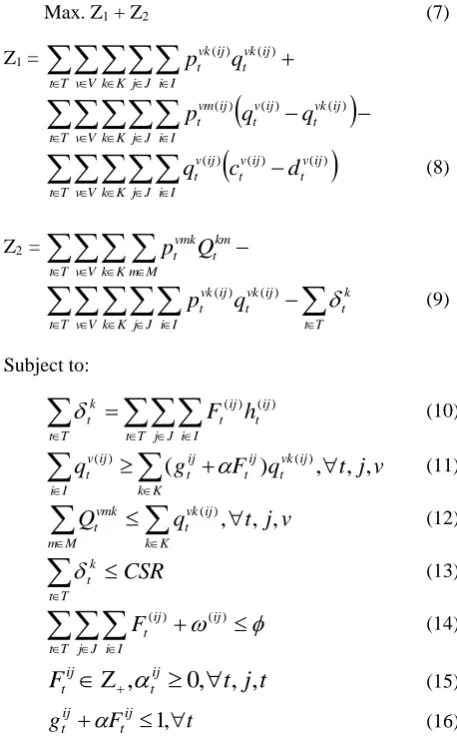
Max. Z1 + Z2 (7)
Z1 =
) ( ) ( vkij
t T
t vVk Kj J i I ij vk t
q
p
) ( ) ( )( vkij
t ij v t T
t vVk Kj J i I ij vm
t
q
q
p
( ) ( )
)
( vij
t ij v t T
t vVk Kj J i I ij v
t
c
d
q
(8)
Z2 =
km t T
t vVk Km M vmk t
Q
p
T t k t ij vk t Tt vVk Kj J i I ij vk
t
q
p
( ) ( )
(9)Subject to:
T
t t T j J i I
ij t ij t k
t
F
h
) ( ) (
(10)
q
g
F
q
t
j
v
I
i k K
ij vk t ij t ij t ij v
t
(
)
,
,
,
) ( ) (
(11)
Q
q
t
j
v
M
m k K
ij vk t vmk
t
,
,
,
) (
(12)
T t k tCSR
(13)
T t j J
ij
I i
ij t
F
( )
( )
(14)
F
tij
,
tij
0
,
t
,
j
,
t
(15)t
F
g
tij
tij
1
,
(16) The CSR cost that the modern retailer has to deal with is expressed in Eq. (10), states that the total CSR cost is equal to the sum of farmers’ skill enhancement cost. The vegetables flows transacted by the modern retailer from farmers is defined in Eq. (11).The vegetables flows transacted by the consumer market from MR are expressed in Eq. (12). It stated that the sum of the vegetables bought by all consumer markets must not exceed the quantity bought by modern retailer. Modern retailer spends the budget for CSR activities. The amount of the budget is limited to the amount of the CSR budget authorized by MR’s owner (Eq. 13). Equation (14) states that the training level taken by farmer added to the current level must not exceed the max skill level determined by the modern retailer. Finally, the last equation is utilized to force non-negativity for all decision variables (Eq. 15).
IV. DISCUSSION
For computational study, IBM® ILOG® CPLEX Academic version is used as a tool for solving the model. ILOG® CPLEX is likely similar to some other common programming softwares, however ILOG® CPLEX is particularly designed to be capable of solving, mostly, about optimizationandvariousequationsormodeling.Hereis the
flowchart of using ILOG® CPLEX as solver of this model:
ILOG® CPLEX is indisputably one of the most helpful tools for helping researchers find the solution of a problem or vary object of interest in mathematical modeling, especially for Multi Integer Linear Programming problem. ILOG® considered as a comprehensive software which enables us to simplify mathematical modeling such as optimization of a given objective function. Here are some procedures to use ILOG® as a solver of MILP problem.
First, we must define all variable which represents the problem. We have to make up which variable is considered as the determinant variable or the decisive one. This also includes the definition of parameter and the index (array). After that we must set every deterministic variable, parameter and index value. We then define any expression that could simplify the calculation, especially when the case is in a long equation and/or includes abundant operation. The objective function is set in along with constraint definition respectively. After all these steps are done, we can finally run the model. The model would keep running until it eventually finds the optimal solution.
In this study, there are a total of three cooperative in group j, with j = 1, 2, 3; 1 modern retailer k, with k = 1; 1 vegetable v, with v = 1; 1 consumer market m, with m = 1; and 2 periods t, with t = 1, 2. The numbers of farmers associated with the cooperative groups are 3 (FGC 1), 2 (FGC 2), and 4 (FGC 3) respectively, labeled by roman capital letter. The training cost per level and maximum CSR budget is IDR 5,000,000 and IDR 120,000,000 respectively. All cost units are in Rupiah. The vegetables’ sell price in period 1 and period 2 experienced by a consumer from a modern retailer is set at IDR 8,000.
Start
Set and Input indexing, variables and parameters value
(i=I; k=K ; CSR ; ptvit etc) Define variables, parameters, indexing
(i ; k ; d ; p ; g ; etc)
Set expression and/or array
Set Objective function
Set constraint
Run mathematical model
All constraints feasible?
Optimum solution obtained
End
No
Yes Start
Set and Input indexing, variables and parameters value
(i=I ; k=K ; CSR ; ptvit etc) Define variables, parameters, indexing
(i ; k ; d ; p ; g ; etc)
Set expression and/or array
Set Objective function
Set constraint
Run mathematical model
All constraints feasible?
Optimum solution obtained
End
No
Yes Start
Set and Input indexing, variables and parameters value
(i=I ; k=K ; CSR ; ptvit etc) Define variables, parameters, indexing
(i ; k ; d ; p ; g ; etc)
Set expression and/or array
Set Objective function
Set constraint
Run mathematical model
All constraints feasible?
Optimum solution obtained
End
No
Yes Start
Set and Input indexing, variables and parameters value
(i=I ; k=K ; CSR ; ptvit etc) Define variables, parameters, indexing
(i ; k ; d ; p ; g ; etc)
Set expression and/or array
Set Objective function
Set constraint
Run mathematical model
All constraints feasible?
Optimum solution obtained
End
No
Yes Start
Set and Input indexing, variables and parameters value
(i=I, k=K, CSR, ptvit, etc.) Define variables, parameters, indexing
(i, k,d,p, g, etc.)
Set expression and/or array
Set Objective function
Set constraint
Run mathematical model
All constraints feasible?
Optimum solution obtained
End
No
[image:4.595.55.284.108.477.2]Yes
TABLEIII DATA FOR PERIOD 1
Qty Worth
(kg) (%) (IDR) (IDR) (IDR) (IDR)
A 1 288 69 2.437 1.818 6.819 6.578 B 1 337 66 2.447 1.254 6.595 6.541 C 1 259 65 2.251 1.453 6.659 6.573 D 2 128 66 2.081 1.580 6.963 6.526 E 2 292 68 2.470 1.627 6.946 6.560 F 3 434 70 2.208 1.846 6.549 6.588 G 3 356 69 2.326 1.588 6.940 6.520 H 3 328 70 2.157 1.385 6.896 6.551 I 3 477 70 2.018 1.358 6.967 6.500
Prod. Cost
Transp. Cost
Price to M R
Price to TM Vegetable
FGC
F
arm
er
TABLEIV DATA FOR PERIOD 2
Qty Worth
(kg) (%) (IDR) (IDR) (IDR) (IDR)
A 1 398 68 2.680 2.090 6.580 6.518 B 1 449 68 2.691 1.442 6.972 6.581 C 1 488 67 2.476 1.670 6.570 6.575 D 2 384 70 2.289 1.817 6.771 6.551 E 2 327 65 2.717 1.871 7.000 6.530 F 3 335 67 2.428 2.122 6.735 6.503 G 3 487 65 2.558 1.826 6.850 6.511 H 3 274 69 2.372 1.592 6.928 6.548 I 3 298 67 2.219 1.561 6.885 6.536
FGC
Prod. Cost
Transp. Cost
Price to M R
Price to TM Vegetable
F
arm
er
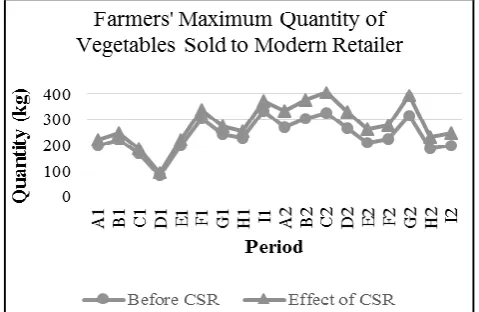
Fig. 5 below depicts the CSR effect on the total amount of vegetable which is qualified to enter modern retailer market. Normally, number of kg of vegetable that farmers try to sell to modern retailer are respectably lower than the one after CSR implementation. The substantial amount of vegetables increase in along with the CSR/capital accessing assistance through training. The greater amount of vegetables the farmers can provide to modern retailer, the less money should modern retailer spends due to farmers’ lower price.
Number of levels that farmers should go into depends on their initial assessment of capital/ financial circumstances they were under. Basically not all farmers partake in the same number of training.
It is found that CSR program can increase farmers’ total revenue. Based on the result, the average amount of
vegetable sold to modern retailer can increase, nearly up to 90% of the total production. Farmers could expect up to IDR 42,590,000 in total revenue, generating around 2% of profit enhancement. In comparison to CSR budget allocation, the benefit of farmers is 35.5% of the total CSR cost provided.
V. CONCLUSION
In this paper, we propose ASC model considering the CSR program which empowers farmers to have access in providing sufficient capital or financial funding. Multi-objective optimization programming was employed to determine quality improvement together with the level of farmers’ skills and CSR total cost. The result shows that CSR program is not only beneficial to its beneficiaries/ farmers, but also to the provider/modern retailer itself. This ASC model is probably even broaden the scope of the relationship, not only limited to supplier-buyer but also to fund provider such as financial service or Bank as well. Integration of the network is probably wider than it could be, which is involving to more entity. This means that the mutual benefits can be achieved to even more stakeholder as well.
There are some extensions of this study that could be derived to elaborate the formulation of this proposed mathematical model, such as supply-demand and price disruption effect that could eventually might alter the validity of prior results. Additionally, further assessment essentially regarding to CSR provider risk should be done in order to measure how extent the risk would affect.
ACKNOWLEDGMENT
Thanks to Research Group of Industrial Engineering and Techno-economics (RITE) of Sebelas Maret University for the financial support in this research.
REFERENCES
[1] S. K. Chowdhury, A. Gulati, & E. Gumbira-Sa’id (2005). The Rise of Supermarkets and Vertical Relationships in the Indonesian Food Value Chain: Causes and Consequences. Asian Journal of Agriculture and Development 2(1), 39-48.
[2] J.J Cadilhon, P. Moustier, N. D. Poole, P. T. G. Tam, and A. P. Fearne, “Traditional vs. modern food systems? Insights from vegetable supply chains to Ho Chi Minh city (Vietnam)”, Development Policy Review, vol 24, no. 1, pp. 31-49, January 2006. [3] A. Stamm, ”Agribusiness and poverty reduction: what can be learned
from the value chain approach?,” In: Agri-Food Commodity Chains and Globalizing Networks, C. Stringer and R. Le Heron, Eds. Hampshire, UK: Ashgate Publishing Limited, 2010, pp. 23-34. [4] W. Morgan, S. Iwantoro, and I. A. S. Lestari, “Improving Indonesian
vegetable supply chains,” in Agri Product Supply-Chain Management in Developing Countries, G.I. Johnson and P.J. Hofman, Eds. Canberra: Australian Centre for International Agricultural Research, 2004, pp. 139-141.
[5] N. Arumugam, M. A. Fatimah, E. F. C. Chew, and M. Zainalabidin, “Supply chain analysis of fresh fruits and vegetables,” Agric. Econ. Czech, vol. 56, no. 9, pp. 435–442, September 2010.
[6] E. Y. Hastuti, The Influence of Agribusiness System Applied to Vegetables Farmers Income Improvement in Boyolali Regency, the Master Thesis in Master of Agribusiness Postgraduate Program at Diponegoro University, Indonesia, 2007.
[7] W. Sutopo, W. and S. Nur Bahagia (2008) “An inventory model for deteriorating commodity under stock dependent selling rate,” in Proc. The 9th Asia Pacific Industrial Engineering and Management Systems Conf., Bali, Indonesia, 2008, pp. 1152-1159.
[image:5.595.50.290.526.682.2][8] J. E. Austin, “Supporting buyer-supplier relationships,” Agency for International Development, 2007.
[9] G. Beers, “Developing systems to maintain quality through the supply chain: getting the product right for the customer”, in Agri-product Supply-Chain Management in Developing Countries, G.I. Johnson and P.J. Hofman, Eds. Canberra: Australian Centre for International Agricultural Research, 2004, pp. 76-87.
[10] O. J. Ahumada and J. R. Villalobos, “Application of planning models in the agri-food supply chain: a review,” European Journal of Operational Research, vol. 195, no. 1, pp. 1–20, May 2009. [11] Law Number 40 of 2007 the Republic of Indonesia concerning on
Limited Liability Companies, http://www.djpp.depkumham.go.id, (Accessed on 03 Augustus 2010).
[12] H. Park-Poaps and K. Rees, “Stakeholder forces of socially responsible supply chain management orientation”, Journal of Business Ethics, vol. 92, no. 2, pp. 305-322, 2010.
[13] M. A. Salam, “Corporate social responsibility in purchasing and supply chain”, Journal of Business Ethics, vol. 85, no. 2, pp. 355– 370, 2009.
[14] M. Esmaeili and P. Zeephongsekul, “Seller–buyer models of SCM with an asymmetric information structure,” International Journal of Production Economics, vol. 123, no. 1, pp. 146-154, January 2010. [15] W. Sutopo et al, “An Agri-food Supply Chain Model for Cultivating
the Capabilities of Farmers Accessing Market Using Corporate Social Responsibility Program”, World Academy of Science, Engineering, and Technology, 2011.
[16] W. Sutopo et al, “A Goal Programming Approach for Assessing the Financial Risk of Corporate Social Responsibility Programs in Agri-food Supply Chain Network”, Proceedings of the World Congress on Engineering 2013 Vol I, WCE 2013, July 3 - 5, 2013, London, U.K. [17] W. Sutopo et al, “An Agri-food Supply Chain Model to Empower
Farmers for Supplying Deteriorated Product to Modern Retailer”, IAENG Transactions on Engineering Technologies, 2013.
[18] W. Sutopo et al, “An Agri-Food Supply Chain Model to Enhance the Business Skills of Small-Scale Farmers Using Corporate Social Responsibility”, MAKARA, TEKNOLOGI, VOL. 16, NO. 1, APRIL 2012: 43-50.
[19] W. Sutopo et al, “Developing an Agri-food Supply Chain Application for Determining the Priority of CSR Program to Empower Farmers as a Qualified Supplier of Modern Retailer”, Proceedings of the World Congress on Engineering and Computer Science 2013 Vol II, WCECS 2013, 23-25 October, 2013, San Francisco, USA
[20] Amaeshi, K., O. Osuji, & P. Nodim (2008). CSR in Supply Chains of Global Brands: A Boundary less Responsibility? Journal of Business Ethics 81(1), 223-234.
[21] Castka, P. & M. Balzarova (2008). ISO 26000 and Supply Chains - On the Diffusion of the Social Responsibility Standard. International Journal of Production Economics 111(2), 274-286.
[22] Correia, V. D. P. & M. F. Rola-Rubzen (2012). What Attributes Do Consumers Seek When Buying Vegetables: The Case of East Timorese Consumers? World Journal of Social Sciences 2(5), 79–89. [23] Cruz, J. M. (2008). Dynamics of Supply Chain Networks with
Corporate Social Responsibility through Integrated Environmental Decision-Making. European Journal of Operational Research 184(1), 1005–1031.
[24] Cruz, J. M. & T. Wakolbinger (2008). Multi period Effects of CSR on Supply Chain Networks, Transaction Costs, Emissions, and Risk. International Journal Production Economics 116(1), 61–74. [25] Maloni, M. J. & M. E. Brown (2006). Corporate Social
Responsibility in the Supply Chain: An Application in the Food Industry. Journal of Business Ethics 68(1), 35–52.
[26] Mark-Herbert, C. & C. von Schantz (2007). Communicating CSR– Brand Management. Electronic Journal of Business Ethics and Organization Studies 12(2), 4-11.
[27] Mueller, M., V. G. dos Santos, & S. Seuring (2009). The Contribution of Environmental and Social Standards towards Ensuring Legitimacy in Supply Chain Governance. Journal of Business Ethics 89(4), 509-52.
[28] Sutopo, W., M. Hisjam, & Yuniaristanto (2011). An Agri-Food Supply Chain Model for Cultivating the Capabilities of Farmers Accessing Market Using Corporate Social Responsibility Program. Proceedings of World Academic of Science, Engineering, and Technology (WASET) 2011, Venice, Italy, 2440-2444.
[29] Sutopo, W., M. Hisjam, & Yuniaristanto (2012a). An Agri-Food Supply Chain Model to Empower Farmers as Supplier for Modern Retailer Using Corporate Social Responsibility Activities on Deteriorated Product. Lecture Notes in Engineering and Computer Science, 2012, 1423-1427.
[30] Sutopo, W., M. Hisjam & Yuniaristanto (2013a). An Agri-Food Supply Chain Model to Empower Farmers for Supplying Deteriorated
Product to Modern Retailer. In S. I. Ao, G. C. Yang, X. Huang, & O. Castillo (eds), Lecture Notes in Electrical Engineering 186 LNEE 1st ed.: 189-202. Heidelberg: Springer.
[31] Chapter 19. Risk evaluation of the business performance of corporate social responsibility programs in Agri-food Supply Chain network, W. Sutopo, M. Hisjam, Yuniaristanto and B. Kurniawan, IAENG Transactions on Engineering Sciences, Edited by Sio-Iong Ao Alan Hoi-Shou Chan Hideki Katagiri Li Xu, CRC Press 2014, Pages 175– 181, Print ISBN: 978-1-138-00136-7, eBook ISBN: 978-1-315-76181-7, DOI: 10.1201/b16763-20 (Indexed by SCOPUS).
Start
Set and Input indexing, variables and parameters value
(i=I ; k=K ; CSR ; ptvit etc) Define variables, parameters, indexing
(i ; k ; d ; p ; g ; etc)
Set expression and/or array
Set Objective function
Set constraint
Run mathematical model
All constraints feasible?
![Fig. 1. Development of Supplier-Buyer Relationship in ASC [15] [16] [17] [19] [29] [31]](https://thumb-us.123doks.com/thumbv2/123dok_us/451566.543121/2.595.309.546.577.795/fig-development-supplier-buyer-relationship-asc.webp)