Abstract—Using of recycled materials in furnishing built environment is the basic principle of sustainability in architecture. Reuse properties of structural members during building components design are being subjected in this study. Reuse offers greater environmental advantage than recycling. Reuse means using the demounted products again with or without any refurbishment.Reuse is not yet that common, but a certain degree of standardization is necessary. To have no waste is a topic for future research in architecture and engineering. The proposal of light gauge steel framing (LGS) system design as an industrialized building system in order to be used in the field of low rise residential through reuse of structural members is being presented in this study in the context of “open building” concept. The main choice reasons of LGS system are; being light structure concludes in using less amount of structural materials, having higher industrialization level, 100% recycling potential and being used in low rise residentials. The system design proposal is being presented on a designed catalog. Design parameters presented on the catalog are within the limits of LGS system specifications used in North America. The system catalog consist of installation principles, dimensional datum, grid properties, modular coordination rules at horizontal and vertical plain, location of wall studs and floor joists on the grid, structural member properties and order / production form. Manufacturers and designers can independently contribute to designed system by using this system catalog. Reuse of steel structural members and production efficiency in construction market is aimed by definition of limited number of members and modular coordination rules.
Index Terms—system design, industrialized building, re-use of building materials, light gauge steel framing system
I. INTRODUCTION
ECYCLABLE materials are used in different levels in building industry either in support level and tissue level and evaluated in assessment programs for building’s environmental performance. The usage of recyclable building materials are highly promoted in the world in the context of sustainability. In addition to recyclability, the issue of reusable building materials have advantage in green building rating systems such as Leed and Breeam.
In many countries, sustainability focus is on recyclability. Sustainable construction can in many cases be achieved by “knowing before doing”. By life time thinking, efficient use
Manuscript received Jul. 16, 2013; revised Aug. 06, 2013. The author is received his Ph.D from the Istanbul Technical University, Faculty of Architecture, Taskisla Campus, Istanbul, TURKEY (phone: 0090 212 2452753; fax: 0090 212 2514895; e-mail: [email protected]).
of durable and recyclable materials and by careful construction using the best suitable components as intended sustainability improvements can be reached. Steel construction enables efficiency, durability and recyclability. For example the material efficiency, the relatively low weight, and high recyclability of steel structures are directly linked to e.g. less use of resources, less use of energy, less waste, less emission and less transport [1].
Reuse offers an even greater environmental advantage than recycling. Reuse means using the demounted product again with or without any refurbishment. Reuse is not yet that common, but a certain degree of standardization is necessary. Recycling is a notion related with production phase, whereas reuse is a notion related with design phase. In this context, a system design is proposed in industrialized building for reuse of structural members in this study.
Light gauge steel framing (LGS) system is selected as structural system. The main choice reasons of LGS system are; being light structure concludes in using less amount of structural materials, having higher industrialization level, 100% recycling potential and being used in low rise residential. Since the system technology is limited with three storey, LGS system widespread in the field of low rise residential in the world. Low rise residential has significant rate in existing building stock so, the proposed system is predicted to serve a large housing market. For instance; 85% of existing building stock is consisting of low rise (1-3 storey) buildings in Turkey [2]. Due to study is conducted in Turkey, the proposed system shall be tested initially in Turkey as a national system.
High industrialization level of steel structures is dealed within the scope of sustainability and aimed to increase the reuse properties of constructional steel members. Common conventions are required to be determined while designing a building system of which designer and manufacturer can use independently. Designing with limited number of members on a defined grid is the basic rule of industrialization in building [3].
Brief explanation of the notions of industrialization in building, open building concept and the technology of LGS system and then presentation of catalog datum of the designed system are the scope of the study.
Presented study is produced from the author’s PhD thesis completed in Istanbul Technical University in 2010 [13].
II. SYSTEM ANDBUILDINGSYSTEM DESIGN
The word of “system is; a set of interacting or interdependent components forming an integrated whole or;
Reuse Properties of Structural Members During
Building Components Design
Semih Goksel Yildirim
a set of elements and relationships which are different from relationships of the set or its elements to other elements or sets. Systems have structure defined by components/elements and their composition [4].
Transferring of experiences of furniture and toy industries to building industry takes an important role in industrialization of building. Re-usable components are used in Meccano and Lego toys and installation with defined components is done by customer in Ikea furniture concept. User manuals help to installation of these systems.
Re-distribution of design control is the field of industrial systematization. Design, production and installation processes are distinguished in industrialized building. The building systems are separated as support (base building) and infill (fit-out) level in open building concept. [5]. Nen codes in Netherland, ACC and Solfege codes in France and Bes codes in Finland are the samples of industrialized building systems [3].
An industrialized building system has to have below mentioned properties in general [6];
•Limited number and type of components in designed system shall be rapidly maintained. All required datum shall be classified on a system catalog.
•Compatible components shall be connected by using common conventions such as defined modular grid. •There is independence between designing and production
phase of system components.
•All system components shall be prefabricated in a factory and presented to users on a system catalog.
•The system components designed for a structural system of a building supply to designer variety architectural design alternatives during design phase.
The role of designer in proposed system is; to develop variety architectural solutions by using datum of structural system designed and ready to be used. The designer shall form the structural system by using common conventions on a system catalog shows the installation principles, dimensional and modular coordination rules, limited number of members [3].
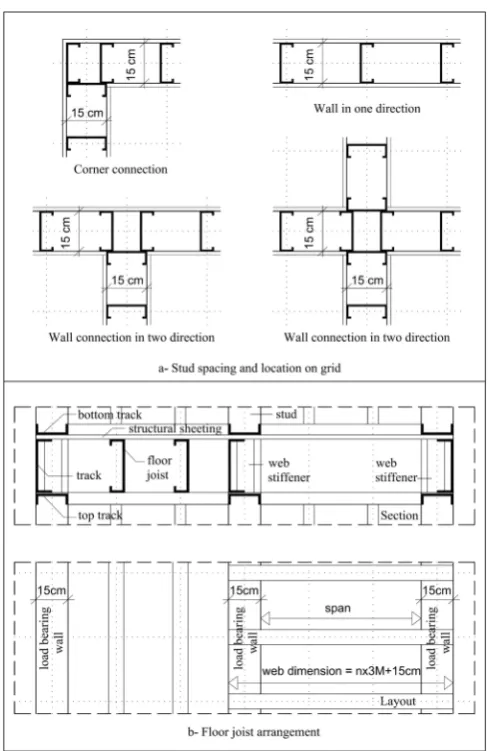
Rules for dimensions, positions and interfaces of building parts are prerequisite for “open building”. Based on Habraken’ s book “support, an alternative to mass housing” [7], later the SAR (foundation for architectural research) published SAR 65, the basic module of 4 feet (10, 16 cm) a tartan grid was developed [8]. Hence, the basic module is symbolized as “M” and “M” is equal to 4 inch (10,16 cm) in this study. Positioning of wall studs and floor joists shall be done according to this modular coordination rules. Otherwise, different location of the structural members on the grid will be accepted as the solutions apart from the system.
III. CATALOG DATUM OF PROPOSED INDUSTRIALIZED BUILDING SYSTEM
Steel structures are constituted by two ways. The skeleton of a building as columns and beams erected by hot rolled steel profiles as I, U and box sectional profiles in the first alternative. The second way is walls and floors are
installed by using many light steel profiles as galvanized cold formed steel profiles. Latter is called as light gauge steel framing system (see Fig. 1) [9].
I and U hot rolled profiles are not always available in the construction market or it is more costly to obtain these profiles on time to construction area. Due to procurement problems of required sections of these hot rolled steel profiles, designers are used to choice thicker sections of these profiles than required and caused to increase the cost of the total structural system. Using thicker sections forces to use 15-20 % of more structural members than required [10].
Installation principle, placement of wall studs and floor joists, connection properties, load distribution of LGS system is similar with timber frame system. The main difference of this system is; usage of hollow core galvanized steel profiles having high conductive value instead of usage of solid timber section having high insulation value [11].
LGS system is a rapid construction technique in any climate conditions and have better sectional and connection properties than timber frame system.
Wall and floor are formed in LGS system with many types of structural members in an order as being in timber frame system. In addition to horizontal or diagonal bracing, walls and floors are supported by structural sheeting particularly used OSB (oriented strand board).
[image:2.595.306.549.392.771.2]
Steel structural members are being cold formed U, C, Z and ∑ section galvanized steel profiles and up to thee storeys building can be erected by this system. Construction of a building with light frame members is called as “stick construction”. “Stick construction” is distinguished as “balloon frame system” and “platform frame system” due to connection type of load bearing members at the wall and floor [12].
LGS system is first introduced in Turkey after 1999 Izmit earthquake, since being a light structural system which can resist to earthquake forces. Technology of this system is directly transferred to Turkey from North American’ s specifications and these specifications are widely used in Turkish construction industry. Hence, North America’s specifications are the basis of this study.
[image:3.595.303.549.59.428.2]Dimensional coordination for design phase of low rise residential is classified by interviews with the firms serve in Turkish construction industry in addition to specifications (see Table 1) [13]. Different dimensional alternatives can be proposed apart from this study within the technological limits of the LGS system, but catalog datum shows a specific system design proposal, so as to enable reuse of structural members for later variety design alternatives. Building proportion shall be designed within the limits defined in the catalog. The basic principle is designing with limited number of components on a modular grid.
[image:3.595.44.293.396.778.2]TABLE 1. Dimensional data of the system required for system design.
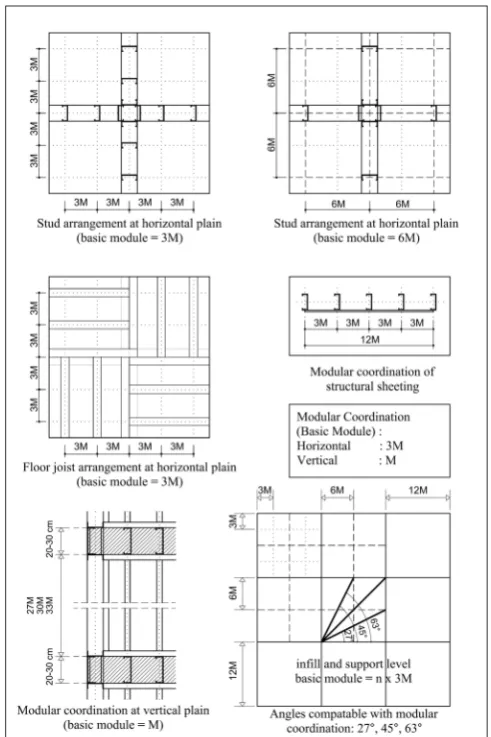
Fig. 2. Modular coordination rules.
Spacing between wall studs and floor joists is specified and limited in specifications as 12 inch (30,48 cm), 16 inch (40,64 cm), 20 inch (50,8 cm) and 24 inch (60,96 cm) in horizontal plain. These are the general modular coordination rules for the LGS system and the designer can accept any one during design phase. On the other hand, dimensions of structural sheeting also effect the spacing of structural members. Should the basic module is accepted as 20 inch (50,8 cm), waste occurs at the usage of structural sheeting such as OSB (oriented strand board) panels. Due to the fact that 20 inch spacing is not widely preferred in the construction market. In order to effective usage of building components as dimensional, 12 inch (30,48 cm) basic module is accepted in this study for the design of LGS system. So, 3M represents 12 inch (30,48 cm) basic module in the system (see Fig. 2).
Fig. 3. Location of wall studs and floor joists on the grid.
Rectangular forms of the layouts that load bearing walls are located to each other in right angle are more compatible with LGS system installation principles. Right angle arrangement of floor layout have simple solutions of connection with load bearing walls. Moreover, acute angle and obtuse angle design could be designed within the defined limits on this catalog. On the other hand, it is also possible to arrange curvilinear forms, but specific member types are required in this circumstances.
Building configuration is limited according to specifications classified as building offset by North American Steel Framing Alliance. Where plan offset is greater than 12M (4 feet - 121,92 cm), building shall be analyzed as separate structures [14]. In addition to this, similar classification for layout arrangements has been done in Turkish earthquake regulation too. It is subjected in the mentioned regulation in the title of “building disorder” [15].
Thickness of cold formed galvanized steel profiles depends on the span of floor joist and structural analyzes. Due to span tables in the specifications thickness alternatives are classified between 0,84 mm and 2,5 mm in North America’ s specifications and DIN standards.
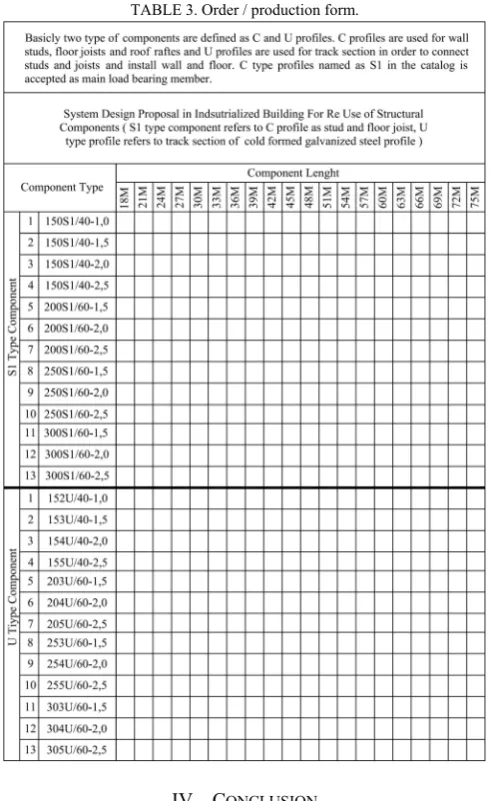
Basically two type of components are defined as C and U profiles. C profiles are used for wall studs, floor joists and roof rafters and U profiles are used for track section in order to connect studs and joists and install wall and floor. [16]
[14] [17] [18] [19]. In order to increase load bearing capacity, bending number is increased during cold forming process, and so C+, ∑ (named as sigma or epsilon), ∑+ and Z sectional profile types are shaped. These type of components are not preferred in Turkish construction industry due to the fact that, increasing number of component type, limited number of manufacturer, little competition in construction market. Therefore C type profiles named as S1 in the catalog is widely used in Turkey as stud, floor joist and roof rafter.
Sheeting used in LGS system for the envelope of a building or floor covering are also serve as structural sheeting in addition to blocking and flat strap usage. OSB (oriented strand board) panels over the envelope of the building and floor is a material accepted worldwide as structural sheeting as defined in specifications. Minimum thickness of OSB panel over wall shall be 9 mm, and 18 mm on floor joists. Should the panel is being used in dry conditions it shall be type 2 OSB and, used in wet conditions it should be type 3 OSB.
The catalog information of the member types and dimensions are being presented in Table 2 and Table 3. Maximum stud height and floor joist span and used member’s lengths are also shown in Table 2. Designer and manufacturer can independently use this table to contribute to the designed system.
[image:4.595.304.550.400.774.2]TABLE 3. Order / production form.
IV. CONCLUSION
Reuse of constructional steel profiles offers greater environmental advantage than recycling. Reuse is not yet that common, but a certain degree of standardization is required. In order to enable this, industrialization in building and open building concepts are used in this study. Re-usable components are used in Meccano and Lego toys and installation with defined components is done by customer in Ikea furniture concept by user manuals. Similar approach is used for designing of constructional system proposed by consisting of system catalog. Common conventions and modular coordination are prerequisite for system design as being “support system” in open building concept.
Since having high industrialization level of constructional steelwork, reuse properties of structural members are studied on LGS systems in this study.
Design and production of LGS system is run in Turkey by customer order. Technology of the system is confidential for the firms, but they are using similar specifications as North American’s specifications. Hence, there is potential of consisting of component market in Turkey by using common conventions on a system catalog. Designers and manufacturers can separately contribute to proposed system in the context of industrialization in building. So, reuse of structural members in terms of sustainability will be achieved in the course of time. The usage of this catalog in
the construction industry will help both increasing of constructional steelworks and reuse of structural members.
REFERENCES
[1] Sustainability of steel-framed buildings, Task 1206-Sustainability_DRAFT B.doc, retrieved from <http://www.sbi.nu/ uploaded/dokument/files/SBI-Sustainabilityofsteelframedbuildings. pdf> dated January 05, 2013
[2] DİE, 2000. 2000 yılı bina sayım sonuçları, Devlet İstatistik Enstitüsü, Ankara
[3] Şener, H., 1990. Endüstrileşmiş binada açık sistemler, İTÜ Mimarlık Fakültesi Baskısı, İstanbul
[4] Url, retrieved from <http://en.m.wikipedia.org/wiki/System> dated January 10, 2012
[5] Habraken, N. J., 2005. Open building as a condition for industrial construction, retrieved from < http:// habraken.org.> dated March 21, 2005
[6] Atasoy, A., Şener, H., Şener, S. M., Pulat, G., Erem, Ö., 1995. Türkiye’ de toplu konut üretiminde kullanılabilecek ulusal nitelikli bir endüstrileşmiş sistem tasarımı araştırma projesi 1. aşama : envanter,
İ.T.Ü. Araştırma Fonu, İstanbul
[7] Habraken, N. J., 1961. Supports, an alternative to mass housing, London 1972, Amsterdam 1961 (Dutch version)
[8] Cuperus, Y., 2005.An introduction to open building, OBOM open building strategic studies, Delft University of Technology, Netherland, retrieved from <http://obom.org.> dated March 22, 2005 [9] Ang, T. C., Chiew, S. P., Lam, D., 2004. Structural steelwork; design
to limit state theory, Elsevier Butterworth-Heinemann, Oxford [10] Badem, M., Kurtay, C., 2004. Avrupa ülkeleri ve Türkiye’ deki çelik
yapı uygulama olanak ve kısıtlarının incelenmesi, Gazi Üniv. Müh.
Mim. Fak. Dergisi, Cilt 19, No 4, s. 351-363
[11] Işık, B., 2001a. Hafif çelik yapıların geleneksel ahşap yapılar ile benzerlikleri, Türk Yapısal Çelik Derneği, retrieved from
<http://tucsa.org> dated July 15, 2001
[12] Smith, R. J., 1996. Innovations in steel, residential construction around the world, International Iron and Steel Institute, Belgium [13] Yıldırım, S.G., 2010. The proposal of cold formed steel framing
system for low rise residential in Turkey in the context of open building concept, PhD Thesis, Istanbul Technical University, Faculty of Architecture, Istanbul
[14] NASFA, 2000. Prescriptive method for residential cold formed steel framing, North American Steel Framing Alliance (NASFA), retrieved from <http://steelframingalliance.com> dated April 12, 2002 [15] DBYBHY, 2007. Specifications for Structures to be Built in
Earthquake Areas, The Ministry of Public Works and Settlement, Ankara
[16] AISI, 2001. Standard for cold-formed steel framing – general provisions, AISI/COFS/GP, American Iron and Steel Institute, Washington
[17] Larson, J, W., 2007. AISI standards for cold-formed steel framing, Construction Standards Development, American Iron and Steel Institute, Washington
[18] CSSBI, 2005. The lightweight steel frame house construction handbook, Canadian Sheet Steel Building Institute, Canada
![Figure 1. Installation of the system [14].](https://thumb-us.123doks.com/thumbv2/123dok_us/472870.545515/2.595.306.549.392.771/figure-installation-of-the-system.webp)