Transcripts of maize RbcS genes accumulate differentially in C
3and C
4tissues
Rob M. Ewing
1;3, Gareth I. Jenkins
2& Jane A. Langdale
1;1
Department of Plant Sciences, University of Oxford, South Parks Road, Oxford, UK (
author for
correspondence);2Plant Molecular Science Group, Division of Biochemistry and Molecular Biology, Institute of Biomedical and Life Sciences, Bower Building, University of Glasgow, Glasgow, G12 8QQ, UK;3Current address: Information Genetique & Structurale (CNRS-EP. 91), 31, Chemin Joseph Aiguier, 13402 Marseille Cedex 20, France
Received 23 May 1997; accepted in revised form 16 October 1997
Key words: C4photosynthesis, gene family, maize, RbcS
Abstract
RbcS genes exist as multigene families in most plant species examined. In this paper, we report an investigation
into the expression patterns of two maize RbcS genes, designated in this report as RbcS1and RbcS2. We present the sequence of RbcS2 and show that the structure of the gene has several features in common with other monocot
RbcS genes. To determine whether RbcS1 and RbcS2 fulfil different functional roles with respect to the C3 and
C4 carbon fixation pathways, we have investigated the expression patterns of the two genes in different maize
tissue types. Transcripts of both genes are found at high levels specifically in bundle-sheath cells of maize seedling leaves, indicating that both genes are expressed in the C4-type pattern. However, we show that RbcS1 transcripts
are relatively more abundant than RbcS2 transcripts in C3tissues such as husk leaves. These results are discussed
with respect to the evolution of C4carbon fixation and the mechanisms required for the cell-specific expression of
RbcS genes.
Introduction
C4 photosynthesis is an elaboration of the more
commonly found C3 mode of carbon assimilation,
and is proposed to have evolved from C3
photosyn-thesis on several independent occasions during the divergence of the flowering plants [15, 26]. In C3
plants, CO2is fixed directly by ribulose bisphosphate
carboxylase/oxygenase (Rubisco) in the Calvin cycle. This carboxylation reaction is inhibited when oxygen binds the active site of Rubisco [43]. To avoid the energy-wasting process of photorespiration that res-ults from this action, C4 plants operate an additional
carbon fixation cycle which serves to concentrate CO2
at the site of Rubisco. CO2 is first fixed in mesophyll
cells to generate a C4acid which is then transferred to
The nucleotide sequence data reported will appear in the EMBL, GenBank and DDBJ Nucleotide Sequence Databases under the accession number Y09214.
bundle-sheath cells. Subsequent decarboxylation in the bundle-sheath releases CO2for refixation in the Calvin
cycle [12]. The biochemical division of labour between bundle-sheath and mesophyll cells requires that photo-synthetic enzymes accumulate in the appropriate cell type. Thus, in C4 plants, the primary
carboxylat-ing enzyme, phosphoenolpyruvate carboxylase (PEP-Case), is abundant in mesophyll cells whereas Rubisco accumulates only in bundle-sheath cells.
The expression of genes encoding photosynthetic enzymes has been studied in a variety of C4 plants.
In maize, it has been shown that the expression of C4
genes and the development of the C4 photosynthetic
meso-phyll cells are found at a distance from a vein, tran-scripts encoding C4components such as PEPCase do
not accumulate, whilst rbcL and RbcS transcripts accu-mulate in a non-cell-specific manner. It has been sug-gested, therefore, that dark-grown leaves and non-C4
organs, such as husk leaves, adopt a default pattern of
RbcS and rbcL expression, analogous to that found in
leaves of C3plants [19].
Considerable progress has been made in elucidat-ing the molecular mechanisms which regulate the cell-specific expression of photosynthetic enzymes in C4
plants [3, 4, 18, 24, 25, 31, 40]. In maize, as in other higher plants, PEPCase is encoded by a multigene fam-ily [16]. A single member of the maize PEPCase gene family is expressed in a light-regulated, mesophyll cell-specific manner, whilst the other genes exhibit expression patterns consistent with non-photosynthetic function [16, 30, 39]. Promoter analysis of the maize C4-PEPCase gene in protoplasts and in transgenic rice
suggested that the primary step in the recruitment of PEPCase genes to C4 function was the acquisition of
novel cis elements in the promoter of the gene [24, 30].
RbcS genes also exist as small multigene families
in higher-plant genomes [10]. Numerous studies have investigated the expression of RbcS genes in response to light or in different tissue types and shown that transcripts from individual genes accumulate differ-entially [10]. The molecular mechanisms governing cell-specific expression of RbcS genes in maize have been investigated in several recent reports [4, 28, 29, 40]. These investigations point to both transcriptional and post-transcriptional control of RbcS gene expres-sion in C4cell types. It is not known, however, whether
the products of individual RbcS genes are functionally divergent with respect to C3 and C4 carbon fixation
pathways. In order to address this question, we invest-igated the RbcS gene family in maize and analysed the expression of individual genes in C3and C4maize
tissues. Our results suggest that RbcS2 is utilised to a greater extent in C4 tissue than in C3 tissue. We
dis-cuss the implications of these results on theories of C4
evolution.
Materials and methods
Plant material
The maize inbred line B73 (a gift from Pioneer HiBred International) was used for all experiments. Etiol-ated seedlings for red-light induction experiments were
grown in vermiculite in a dark-room at 28 C. Seed-lings were harvested when the 3rd leaf had just emerged (about 8 days after sowing). Light-grown seedlings were grown in a heated glasshouse (24
C day and
20
C night) with supplementary light from sodium lamps (16 h photoperiod, average 500mol m
,2
s,1
). Irradiation of etiolated seedlings with monochromatic red light (
max
660nm; 15mol m,2
s,1
) was carried out as described in a previous report [5]. Husk leaves were harvested from glasshouse-grown maize plants and were taken from 20 cm long ears.
Genomic libraries and DNA probes
RbcS1 clones were isolated from a Dash II library
(Sau3A partial fragments from maize inbred line B73) (gift of Pamela Close, Pioneer HiBred International) using existing maize RbcS1 genomic fragments (gift of Tim Nelson, Yale University), as probes. RbcS2 clones were isolated from a second library (Sau3A partial fragments of B73 inEmbl 3A) (Clontech, Palo Alto,
CA) using a gene-specific probe, SS6 (gift of Jen
Sheen, Massachusetts General Hospital). The gene-specific fragments pGS1 and pGS2 were subcloned from genomic clones of RbcS1 and RbcS2 respect-ively. The cDNA clones pJL10 (RbcS total) and pTN1 (Ppc1) have been described previously [17]. The ubi-quitin cDNA clone pSKUB1 was a gift from Peter Quail (USDA-PGEC, Albany) and has been described previously [9].
RNA preparation and hybridisation
RNA was extracted from maize tissue according to a previously published protocol [27], and electro-phoresed, blotted and hybridised as reported previ-ously [17]. All probes were prepared according to the random prime technique [13].
Results
Isolation and characterisation of maize RbcS genomic clones
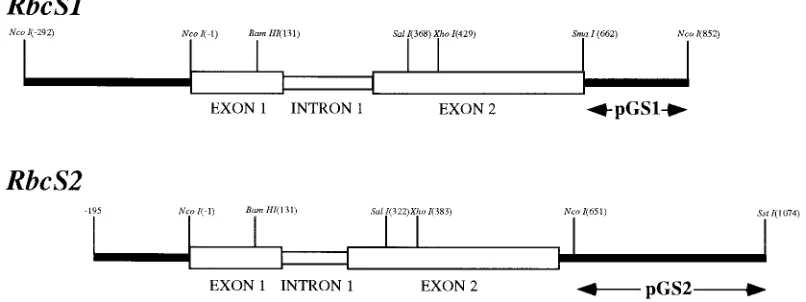
Figure 1. Schematic diagrams showing the structure of RbcS1 and RbcS2 genes. Exon and intron sequences are represented as shown. Subcloned fragments used as probes are shown beneath the gene structures by arrowed lines.
RbcS1 or RbcS2 (data not shown). The structures of RbcS1 and RbcS2, and the fragments used as
hybridisa-tion probes are shown schematically in Figure 1. The gene-specific probes pGS1 and pGS2, (derived from the 30
UTR regions of RbcS1 and RbcS2 respectively) were used in combination with recombinant inbred (RI) lines to map RbcS1 and Rbcs2 to two chromo-somal locations (4L1.61 and 2L095.8, respectively) [8]. No further loci were identified when RI lines were analysed with a full length cDNA clone and as such, any additional genes must map to either the RbcS1 or RbcS2 locus. Southern blot analyses to determine the exact number of RbcS genes present in the maize inbred line B73 were inconclusive. However, all of the restriction fragments analysed hybridised to either pGS1 or pGS2 and 90% of the restriction digests gen-erated a single RbcS1 or RbcS2 hybridising fragment. This suggests that if additional genes are present, they are almost identical in sequence to either RbcS1 or
RbcS2.
The sequence of RbcS1 genomic and cDNA clones was previously reported [20, 23]. Restriction maps of
RbcS2 genomic clones have been previously published
although the sequence of the coding region, intron 1 and 30
UTR have not been determined [29]. The com-plete sequence of RbcS2 is presented in Figure 2. The structure of maize RbcS2, with a single intron inser-ted between the 2nd and 3rd codons of the mature polypeptide, is characteristic of the structure found in other grass RbcS genes [7, 36, 42]. In common with
RbcS gene families of other species [10], there is a
high degree of conservation between members of the maize RbcS gene family. The RbcS1 and RbcS2 coding
regions differ by 21 bp over the 513 bp of exons 1 and 2. These mismatches represent 9 amino acid changes in the predicted sequences of the translation products of RbcS1 and RbcS2.
RbcS1 and RbcS2 are induced differentially by light
Light inducibility of RbcS gene expression is a well documented phenomenon [38]. To investigate the responsiveness of individual RbcS genes to light, we exposed dark-grown maize seedlings to pulses of red light and analysed the accumulation of RbcS1 and
RbcS2 transcripts at intervals thereafter. Preliminary
experiments showed that etiolated seedlings exposed to a 3 min pulse of red light accumulated RbcS transcripts within 6 h after return to darkness (results not shown). We therefore exposed 7-day old dark-grown seedlings to a 3 min pulse of red light (15mol m
,2
s,1
Figure 2. Sequence of RbcS2. The sequence is numbered with the translation start codon at position 1. The intron sequence is shown in lowercase letters and the predicted amino-acid sequence is shown below the corresponding nucleotide sequence. Amino-acids marked with an asterisk are not conserved between RbcS1 and RbcS2. The stop codon is marked with a+symbol.
[image:4.595.71.289.511.592.2]Figure 3. Time course of red light-induced expression of RbcS1 and RbcS2. Numbers above the top panel are the time in hours at which tissue was sampled after light exposure. Dark-grown seedlings were exposed to a 3 min red pulse and then returned to darkness. RNA was hybridised with either pGS1 (RbcS1) or pGS2 (RbcS2) or probes. Ubiquitin hybridisations served as a loading control (bottom panel). Transcript sizes are indicated to the left of each panel.
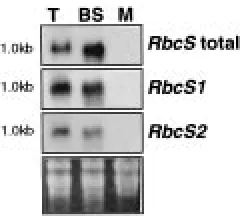
Figure 4. Bundle-sheath cell-specific expression of RbcS1 and RbcS2. RNA from whole leaf (T), or separated bundle-sheath (BS) and mesophyll (M) cells hybridised with either RbcS cDNA probe (RbcS total), pGS1 (RbcS1) or pGS2 (RbcS2). Transcript sizes are indicated to the left of each panel. Equal amounts of RNA were present in each lane as judged by ethidium bromide staining of the gel (bottom panel). The BS RNA was slightly degraded after puri-fication as indicated by the smeared hybridisation signals.
RbcS1 and RbcS2 are both expressed in
bundle-sheath cells of maize leaves
In order to determine whether RbcS1 and RbcS2 are both expressed in bundle-sheath cells, RNA isolated from separated bundle-sheath and mesophyll cells of light-grown leaves was used in northern hybridisation experiments (Figure 4). The gene-specific fragments, pGS1 and pGS2 and a fragment from the RbcS coding region, pJL10, were used as probes. The results show that RbcS1 and RbcS2 transcripts accumulate specific-ally in bundle-sheath cells of light-grown maize leaves. These results are in accord with previous studies which have demonstrated the cell-specific accumulation of transcripts encoding photosynthetic components [6, 21, 32, 33].
RbcS1 and RbcS2 transcripts accumulate
differentially in non-C4tissues of maize
We sought to investigate whether individual RbcS genes were expressed differentially in maize organs operating C3 versus C4 carbon fixation. RNA
extrac-ted from leaf blade (C4), purified leaf blade mesophyll
cells and husk leaves (C3), was hybridised with RbcS,
C4phosphoenolpyruvate carboxylase gene (Ppc1) and
ubiquitin probes (Figure 5). In agreement with pre-vious studies [17, 30], Ppc1 transcripts were present in C4 mesophyll cells and in foliar leaves operating
the C4carbon fixation pathway, but not in C3 tissues
such as husk leaves. In contrast, RbcS transcripts were present both in RNA from foliar leaf tissue (C4) and in
respect-Figure 5. Expression of RbcS1 and RbcS2 in C3and C4maize tissue
types. RNA prepared from foliar leaf blade 2 (F), isolated mesophyll cells (M), husk leaf 1 (H1) or husk leaf 2 (H2) was hybridised with the C4phosphoenolpyruvate carboxylase gene (Ppc1), RbcS
cDNA (RbcS total), RbcS1 (pGS1) or RbcS2 (pGS2). Ubiquitin hybridisations served as a loading control (bottom panel). Transcript sizes are indicated to the left of each panel.
ive levels in foliar leaves, RbcS1 transcripts accumu-lated to higher levels in husk leaves than RbcS2 tran-scripts. Furthermore, in other C3 maize organs, such
as adventitious roots and prophyll, RbcS1 transcripts were also relatively more abundant than RbcS2 tran-scripts (data not shown). This suggests that trantran-scripts in husk leaves are derived primarily from RbcS1 and that RbcS2 is preferentially expressed in C4tissue.
Discussion
We have investigated the structure and expression pat-terns of the two RbcS genes in the C4plant maize. RNA
blot analysis of RbcS1 and RbcS2 transcript accumula-tion patterns in etiolated seedlings given a pulse of red light, showed that both genes are light-inducible. When analysed in detail, however, the profiles of accumula-tion of RbcS1 and RbcS2 transcripts are not identical;
RbcS2 transcript abundance shows a much greater-fold
induction than RbcS1. Previous studies in other sys-tems have demonstrated that both RbcS1 and RbcS2 promoter fragments fused to the reporter gene GUS direct light-regulated expression [38]. Furthermore, the RbcS1 promoter has been shown to be less light-inducible than the RbcS2 promoter due to the presence of a short sequence of repeated elements [29]. We propose, therefore, that the difference in steady-state levels observed in light-shifted seedlings is due to the fact the RbcS1 promoter is not subject to the same degree of light-regulation as the RbcS2 promoter.
Expression of RbcS gene family members in dif-ferent plant organs, such as leaves, roots and fruits,
has been investigated in several species [11, 22, 34, 35, 41]. However, no studies have documented the expression of individual RbcS genes in tissues oper-ating C3 or C4 modes of carbon fixation. Our study
demonstrates that two RbcS genes, both expressed abundantly in bundle-sheath cells of foliar leaves (C4),
show markedly different levels of transcript accumu-lation in husk leaves (C3). Overall, RbcS transcripts
are less abundant in husk leaf tissue than in foliar leaves. In relation to their respective levels in foliar leaves, however, RbcS1 transcripts are more abund-ant in husk tissue than RbcS2 transcripts. The differ-ential accumulation of RbcS1 and RbcS2 in C3 husk
tissue might simply be a consequence of the incid-ent light quality perceived. The arrangemincid-ent of husk leaves as successive encircling layers around the ear means that incident light on inner husks is selectively depleted in red and blue wavelengths, but enriched in far-red. It has been estimated for example that second husk leaves are exposed to only 20% blue, 35% red and 70% far-red of incident light [37]. Our RNA gel blot analysis indicates that RbcS2 is more responsive to red light than RbcS1 expression. Selective deple-tion of the red and blue wavelengths incident on husk leaves might therefore selectively reduce expression of
RbcS2. Any such effects would most likely be
medi-ated at the post-transcriptional level since preliminary experiments suggest that RbcS1 and RbcS2 promoter activity in husk leaves is similar (unpublished obser-vations).
It was previously shown that C4 differentiation is
dependent in part upon the internal structure of the organ [19]. Thus, in husk leaves in which adjacent vascular bundles are separated by 10 or more meso-phyll cells, Rubisco accumulates in both mesomeso-phyll and bundle-sheath cells [1, 2, 19]. Our results sug-gest that individual genes comprising the maize RbcS gene family are not specifically utilised in C3 or C4
tissue. Thus, both RbcS1 and RbcS2 are expressed in bundle-sheath cells of foliar leaves and transcripts of both are present in husk leaf tissue. However, differen-tial expression is observed with RbcS2 being preferen-tially expressed in C4 tissue and the non-cell-specific
accumulation of RbcS transcripts in husk leaves being attributed primarily to RbcS1. These results contrast with other studies of maize C4 gene families such as
those encoding PEPCase or PPdK [14, 16, 30, 31]. In both the PEPCase and PPdK gene families, indi-vidual genes are specifically expressed in the C4
[image:5.595.106.255.65.185.2]novel 5 cis elements, which direct the cell-specific,
light-regulated components of their expression [24, 25]. Since transcripts of both RbcS1 and RbcS2 accu-mulate specifically in bundle-sheath cells, we suggest that both genes respond to signal(s) inducing expres-sion in bundle-sheath cells and represexpres-sion in mesophyll cells. Our results predict therefore that the molecular mechanisms that have evolved in C4plants to achieve
bundle-sheath cell-specific expression of RbcS genes, do not differentiate between RbcS1 and RbcS2.
Acknowledgements
This work was made possible with the financial assist-ance of the Barbinder Trust, the BBSRC and The Royal Society. We would also like to thank Gulsen Akgun for help with growth of plants and John Baker for photo-graphy.
References
1. Antonielli M, Lupatelli M, Venanzi G: Some characteristics of the chlorophyllous parenchyma of maize outside the leaf lamina. Plant Sci Lett 21: 107–119 (1981).
2. Antonielli M, Venanzi G: Structural properties of the rachis and hypsophyll of the maize ear. Plant Sci Lett 15: 301–304 (1979).
3. Bansal KC, Bogorad L: Cell type-preferred expression of maize cab-m1: repression in bundle sheath-cells and enhance-ment in mesophyll-cells. Proc Natl Acad Sci USA 90: 4057– 4061 (1993).
4. Bansal KC, Viret JF, Haley J, Khan BM, Schantz R, Bogorad L: Transient expression from cab-m1 and rbcS-m3 promoter sequences is different in mesophyll and bundle sheath-cells in maize leaves. Proc Natl Acad Sci USA 89: 3654–3658 (1992). 5. Bennett J, Jenkins GI, Hartley MR: Differential regulation of the accumulation of the light-harvesting chlorophyll a/b complex and ribulose bisphosphate carboxylase oxygenase in greening pea leaves. J Cell Biochem 25: 1–13 (1985). 6. Broglie R, Coruzzi G, Keith B, Chua N-H: Molecular biology
of C4photosynthesis in Zea mays: differential localisation of
proteins and mRNAs in the two leaf cell types. Plant Mol Biol 3: 431–444 (1984).
7. Broglie R, Coruzzi G, Lamppa G, Keith B, Chua N-H: Struc-tural analysis of nuclear genes coding for the precursor to the small subunit of wheat ribulose-1,5-bisphosphate carboxylase. Bio/technology 1: 55–61 (1983).
8. Burr B, Burr F: Recombinant inbreds for molecular mapping in maize. Trends Genet 7: 55–60 (1991).
9. Christensen, AH, Shartock, RA, Quail, PH: Maize polyubi-quitin genes: structure, thermal perturbation of expression and transcript splicing and promoter activity following transfer to protoplasts by electroporation. Plant Mol Biol 18: 675–689 (1992).
10. Dean C, Pichersky E, Dunsmuir P: Structure, evolution, and regulation of RbcS genes in higher-plants. Annu Rev Plant Physiol Plant Mol Biol 40: 415–439 (1989).
11. Dean C, Vandenelzen P, Tamaki S, Dunsmuir P, Bedbrook J: Differential expression of the 8 genes of the petunia ribu-lose bisphosphate carboxylase small subunit multi-gene family. EMBO J 4: 3055–3061 (1985).
12. Edwards G, Walker D: C3, C4: Mechanisms, and Cellular
and Environmental Regulation, of Photosynthesis. Blackwell Scientific Publications, Oxford (1983).
13. Feinberg AP, Vogelstein B: A technique for radiolabelling DNA restriction endonuclease fragments to high specific activ-ity. Anal Biochem 132: 6–13 (1983).
14. Glackin CA, Grula JW: Organ-specific transcripts of different size and abundance derive from the same pyruvate, orthophos-phate dikinase gene in maize. Proc Natl Acad Sci USA 87: 3004–3008 (1990).
15. Hattersley PW, Watson L: Diversification of photosynthesis. In: Chapman GP (ed) Grass Evolution and Domestication, pp. 38–116. Cambridge University Press, Cambridge, UK (1992). 16. Hudspeth RL, Glackin CA, Bonner J, Grula JW: Genomic and complementary DNA clones for maize phosphoenolpyruvate carboxylase and pyruvate, orthophosphate dikinase: expres-sion of different gene-family members in leaves and roots. Proc Natl Acad Sci USA 83: 2884–2888 (1986).
17. Langdale JA, Rothermel BA, Nelson T: Cellular-pattern of photosynthetic gene-expression in developing maize leaves. Genes Devel 2: 106–115 (1988).
18. Langdale JA, Taylor WC, Nelson T: Cell-specific accumulation of maize phosphoenolpyruvate carboxylase is correlated with demethylation at a specific site greater-than 3 kb upstream of the gene. Mol Gen Genet 225: 49–55 (1991).
19. Langdale JA, Zelitch I, Miller E, Nelson T: Cell position and light influence C4versus C3patterns of photosynthetic
gene-expression in maize. EMBO J 7: 3643–3651 (1988). 20. Lebrun M, Waksman G, Freyssinet G: Nucleotide
sequence of a gene encoding corn ribulose-1,5-bisphosphate carboxylase/oxygenase small subunit (RbcS). Nucl Acids Res 15: 4360 (1987).
21. Link G, Coen D, Bogorad L: Differential expression of the gene for the large subunit of Ribulose bisphosphate carboxylase in maize leaf cell types. Cell 15: 725–731 (1978).
22. Manzara T, Gruissem W: Organisation and expression of the genes encoding ribulose-1,5-bisphosphate carboxylase in higher-plants. Photosynth Res 16: 117–139 (1988).
23. Matsuoka M, Kano-Murakami Y, Tanaka Y, Ozeki Y, Yamamoto N: Nucleotide sequence of cDNA encoding the small subunit of ribulose-1,5-bisphosphate carboxylase from maize. J Biochem 102: 673–676 (1987).
24. Matsuoka M, Kyozuka J, Shimamoto K, Kano-Murakami Y: The promoters of two carboxylases in a C4plant (maize) direct
cell-specific, light-regulated expression in a C3plant (rice).
Plant J 6: 311–319 (1994).
25. Matsuoka M, Yuichi T, Fujimura T, Kano-Murakami Y: Tissue-specific light-regulated expression directed by the promoter of a C4gene, maize pyruvate, orthophosphate dikinase, in a C3
plant, rice. Proc Natl Acad Sci USA 90: 9586–9590 (1993). 26. Moore PD: Evolution of photosynthetic pathways in flowering
plants. Nature 295: 647–648 (1982).
27. Prescott A, Martin C: A rapid method for the assessment of levels of specific mRNAs in plants. Plant Mol Biol Rep 4: 219–224 (1987).
bundle-sheath and mesophyll cells, respectively. Proc Natl Acad Sci USA 92: 11504–11508 (1995).
29. Schaffner AR, Sheen J: Maize RbcS promoter activity depends on sequence elements not found in dicot RbcS promoters. Plant Cell 3: 997–1012 (1991).
30. Schaffner AR, Sheen J: Maize C4 photosynthesis involves
differential regulation of phosphoenolpyruvate carboxylase genes. Plant J 2: 221–232 (1992).
31. Sheen J: Molecular mechanisms underlying the differential expression of maize pyruvate, orthophosphate dikinase genes. Plant Cell 3: 225–245 (1991).
32. Sheen JY, Bogorad L: Expression of the ribulose-1,5-bisphosphate carboxylase large subunit gene and three small subunit genes in two cell types of maize leaves. EMBO J 5: 3417–3422 (1986).
33. Sheen J-Y, Bogorad L: Differential expression of the ribulose bisphosphate carboxylase large subunit gene in bundle sheath and mesophyll-cells of developing maize leaves is influenced by light. Plant Physiol 79: 1072–1076 (1985).
34. Sugita M, Gruissem W: Developmental, organ-specific, and light-dependent expression of the tomato ribulose-1,5-bisphosphate carboxylase small subunit gene family. Proc Natl Acad Sci USA 84: 7104–7108 (1987).
35. Sugita M, Manzara T, Pichersky E, Cashmore A, Gruissem W: Genomic organisation, sequence-analysis and expression
of all 5 genes encoding the small subunit of ribulose-1,5-bisphosphate carboxylase: oxygenase from tomato. Mol Gen Genet 19: 247–256 (1987).
36. Tang W, Sun SSM: Sequence of a sugarcane ribulose-1,5-bisphosphate carboxylase/oxygenase small subunit gene. Plant Mol Biol 21: 949–951 (1993).
37. Taylor L: The transmittance of sunlight through husk tissue under field conditions. Maize Genet Newsl 62: 106 (1988). 38. Terzaghi WB, Cashmore AR: Light-regulated transcription.
Annu Rev Plant Physiol Plant Mol Biol 46: 445–474 (1995). 39. Ting IP, Osmond CB: Multiple forms of plant
phosphoenolpyr-uvate carboxylase associated with different metabolic path-ways. Plant Physiol 51: 448–453 (1973).
40. Viret JF, Mabrouk Y, Bogorad L: Transcriptional photoregu-lation of cell-type preferred expression of maize rbcSm3: 30 and 50
sequences are involved. Proc Natl Acad Sci USA 91: 8577–81 (1994).
41. Wanner LA, Gruissem W: Expression dynamics of the tomato RbcS gene family during development. Plant Cell 3: 1289– 1303 (1991).
42. Xie Y, Wu R: Nucleotide sequence of a ribulose-1,5-bisphosphate carboxylase/oxygenase gene (RbcS) in rice. Nucl Acids Res 16: 7749 (1988).