Bayesian decision feedback equaliser for overcoming
co-channel interference
S. Chen SMcLaughlin B.MuIgrew RM.Grant
In&.xing terms: Co-channel interference, Bayesian decision feedback equuliser
Abstract: The authors derive a Bayesian decision feedback equaliser which incorporates co-channcl interference compensation. By exploiting the structure of co-channel interfering signals, the proposed Bayesian decision feedback equaliser is able to distinguish an interfering signal from white noise and utilises this information to improve performance. Adaptive implementation of this Bayesian decision feedback equaliser includes identifying the channel model using the least mean square algorithm and estimating the co-channel states by means of an unsupervised clustering scheme. Simulation involving a binary signal constellation is used to compare both the theoretical and adaptive performance of this Bayesian decision feedback equaliser with those of the maximum likelihood sequence estimator. The results obtained indicate that, in the presence of severe co-channel interference, the Bayesian decision feedback equaliser employing the proposed simple scheme to compensate co- channel interference can outperform the maximum likelihood sequence estimator that only treats co-channel interference as an additional coloured noise.
1 Introduction
Adaptive equalisers for combating channel intersymbol interference (ISI) and noise can be classified into two categories, namely sequence estimation and symbol decision equalisers. The optimal solution for the class of sequence estimation equalisers is the maximum like- lihood sequence estimator (MLSE) [I]. The MLSE pro- vides the lowest error rate att,ainable for any equaliser when the channel is known but is computationally very expensive. A widely used symbol decision equaliser is the conventional decision feedback equaliser (DFE) [2]
0 IEE, 1996
IEE Proceedings online no. 19960612
Paper first received 7th July 1995 and in revised form 25th March 1996 S. Chen is with the Department of Elecl.rical and Electronic Engineering, University of Portsmouth, Anglesea Building, Portsmouth PO1 3DJ, UK S. McLaughlin, B. Mulgrew and P.M. Grant are with the Department of Electrical Engineering, University of Edinburgh, King’s Buildings, Edinburgh EH9 3JL, UK
which has a very low computational complexity. The conventional DFE, however, does not achieve the full performance potential o f the symbol decision DFE structure, and the optimal symbol decision DFE is known to be the Bayesian DFE [3].
In the previous study [3-51, we have compared the Bayesian DFE with the conventional DFE and the MLSE extensively. In terms of computational require- ments, the adaptive Bayesian DFE is more complex than the conventional DFE but is less complex than the adaptive MLSE. The adaptive MLSE requires sophisticated processing capability while the implemen- tation o f the Bayesian DFE is relatively straightfor- ward. For stationary channels, the performance of the adaptive Bayesian DFE is much better than the con- ventional adaptive DFE but is inferior to that of the adaptive MLSE. The adaptive Bayesian DFE however has significant advantages over the adaptive ML!SE for rapidly time-varying channels. Extensive simulation results have demonstrated that the adaptive Bayesian DFE actually outperforms the adaptive MLSE in terms of error rate for severely fading channels. It has been suggested that the adaptive MLSE accumulates track- ing errors, which causes serious performance degrada- tion [5].
Many communication systems, such as mobile cellu- lar radio and dual polarised microwave radio channels, are impaired not only by channel IS1 but also by co- channel interference (CCI). It is well-known that an adaptive equaliser can usually do better against CCI than it can against the same level of noise [6]. However, in doing so, most of the equalisers can only treat CCI as an additional noise source and do not fully exploit the differences between the interfering signals and the noise. For example, a linear equaliser only exploits the spectral characteristics of the interference through its autocorrelations [6, 71. This is also the case for the con- ventional DFE studied in [8].
If both the channel and co-channels are known, it is possible to design the MLSE which takes into account both the IS1 and CCI. Such a full MLSE, although computationally very complex, will achieve the lowest possible error rate. The difficulty is that there is no practical way of obtaining accurate co-channel models needed. Unlike the case of channel identification., there is generally no training signals available for supervised co-channel identification. Even if a means of identify- ing the co-channels can be developed, the estimate errors are expected to be large. The MLSE, being a sequence estimation method, is more likely to accumu-
219
late the co-channel estimation errors, causing serious performance degradation. In the blind equalisation set- ting, in theory it is possible to design a joint data detec- tion and channelico-channels estimation based on the MLSE approach. Such an approach will certainly be computationally too expensive to implement. In prac- tice, interfering signals are often treated as an addi- tional coloured noise in the standard MLSE.
[image:2.614.330.543.206.331.2]The probability density function (PDF) of an inter- fering signal is quite different from that of the noise. An ideal equaliser should be capable of distinguishing the interfering signal from the noise. In a previous study [7], a Bayesian transversal equaliser was derived which can effectively exploit the differences between the CCI and the noise and uses this information to improve performance. The adaptive version of this Bayesian equaliser can be implemented easily. The present study extends this result to the D F E structure and incorporates CCI compensation into the Bayesian D F E derived previously for combatting IS1 and noise. It is shown that, in the presence of severe CCI, this Bayesian D F E has superior performance over the MLSE which only treats CCI as coloured noise. Adap- tive implementation of this Bayesian D F E is then investigated. To effectively compensate for the CCI, the set of co-channel states are required. A simple unsuper- vised clustering algorithm is used to estimate these co- channel states.
Fig. 1 Discrete-time model of communication system
The system model considered in this study is depicted in Fig. 1. This model [9] is widely used to represent communication systems in the presence of ISI, CCI and noise. The channel Ao(z) and the p interfering co- channels A,(z), l
s
is
p , are modelled by finite impulse response filtersn2 -1
A , ( z ) = U , , ~ Z - ~ , 0
5
i5 p
(1)3=0
where n, and ai,, are the length and the tap weights of the ith impulse response, respectively. The transmitted data so(k) and the interfering data s,(k), 1 2 i 5 p , are independently identically distributed (iid) and they are mutually independent. The three components of the channel observation,
~ ( k ) = ? ( k )
+
u ( k )+
e ( k ) (2) will be referred to as the desired signal, the interfering signal and the noise, respectively. The noise e(k) is assumed to be a Gaussian white noise with varianceE[e2(k)] = 0.:
220
The Bayesian D F E [3-51 was derived for complex valued multilevel signals. In the extension to include CCI, for notational simplicity and to highlight the basic concepts, s,(k), 0 5 i 5 p , are assumed to be binary and to take values from the symbol set
{dl)
= +1,d2)
= -1 }. The tap weights ulJ are therefore real valued. Application to complex valued A,(z) and multilevel symbol constellations are straightforward (as in the case of the Bayesian D F E for combating IS1 and noise) but the computational complexity will increase signifi- cantly. Let E[i2(k)] = 0," and E[u2(k)] = 0,". We define the signal to noise ratio (SNR) of the system as SNR= o!/oi, the signal to interference ratio (SIR) of the sys- tem as SIR =$/o;,
and the signal to interference and noise ratio (SINR) of the system as SINR =o,'(o,'
+
o,"),
respectively.decision
f iitering device
@...l+J
1
2-1-
j
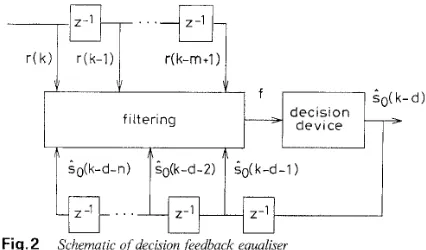
Fig. 2 Schematic of decision feedback equaliser
The structure of' the D F E considered in this study is depicted in Fig. 2. The equalisation process defined in Fig. 2 uses the information present in the observed channel output vector,
and the past detected symbol vector,
to produce an estimate &(k -
d)
of so(k -d).
The inte- gers d, rn and n are known as the decision delay, the feedforward order and the feedback order, respectively. Without the loss of generality, d = no - 1 is chosen to cover the entire channel dispersion Ao(z), m is related to d by m = d+
1 = no, and n is given by n = no+
m -r ( k ) = [ ~ ( k ) . . . ~ ( ~ ~ - r n + i - ) ] * ( 3 )
(4) ; b ( k ) = [So(k - d - 1) .
' .
So(k - d-
n)]*
d - 2 = ~ 1 0 - 1 [3].
2
In the presence of the IS1 and noise, the optimal solu- tion for the symbol decision structure of Fig. 2 is the Bayesian D F E [3-51. This Bayesian D F E is first sum- marised. This will naturally lead to the Bayesian solu- tion in the presence of CCI. A new version of this Bayesian D F E is then presented which has certain practical advantages. Given the channel model Ao(z),
the value of the noiseless channel output vector,
is specified by the symbol sequence s(k) = [s,@) sZ(k)lT,
where
Bayesian DFE in the absence of CCI
f(k)
= [ ? ( k ) .. .
? ( k - m+
1)]* (5)]
(6)S f ( k ) = [ s o @ ) .
. .
so(k - d ) ] T~ b ( k ) = [sO(k - d - 1) . . . sO(k - d -
n)lT
Under the assumption that the given feedback vector i s correct, that is, Ob(k) = sb(k), the state of i(k) is deter- mined by sf(k). Since s f ( k ) has N, = 2d+1 = 2" combina- tions, i ( k ) has N, states. Let N, sequences of sAk) be
[image:2.614.99.299.327.464.2]S f , 3
The corresponding states of i(k), denoted as rJ, are given by:
r,
=[F” F’][sfT,,,(k)
G:(k)IT,
15
j
5
N ,
(8)= b S , 3 ( k ) . ’ . S f , j ( k -
w,
1F
jL
Ns ( 7 )where the m x (d
+
1) matrix IT” has the form:-
and the m x n matrix F’ has the form
0 1
. . .
r
o
0The states of i(k) can be grouped into two subsets according to the value of so(k --
9:
~( 2 )=
{t(k)
= ry)Iso(k - I-I) == s ( t ) } ,1
5
i
5
2 (11)Each R(j) contains iV,(j) = N,/2 = 2d states.
The PDF of r(k) conditioned on so(k ~
d)
= isN ; t J
pr(r(k)lso(k-d) =
s ( ~ ) )
=1
a!i)pe(r(k)-rj), 1I
iI
2(12)
j=1
where ri E R(j), aii) are a priori probabilities of ri, and p , ( . ) is the PDF of the noise vector e(k) = [e(k)
...
e(k -m
+
l)]‘. Since all the channel states can be assumed to be equiprobable and the noise P D F is Gaussian, eqn. 12 leads to the Bayesian decision variables:N p
vi(k,ao)
= 1 e x p ( - l / r ( k ) -r,jl12/2cz), 1I
iI
2 (13)Here a. = [ao,oao,l
...
ao,no.,]r i:; included in the expres- sion to emphasise that the channel states are computed based on the given channel ;ao. The minimum error probability decision is defined byj = 1
which provides the optimal solution for the equalisa- tion structure o f Fig. 2 in the absence of CCI.
For the above version of the Bayesian DFE origi- nally derived in [ 3 ] , a different set of the channel states is required at each sample k even when the channel a. is constant because the feedback vector $,(k) is different at different k . That is, different Bayesian equalisers are used for different decision feedbacks. Analysis and implementation of the Bayesian DFE becomes easier if the following space translation is made. Define:
The elements of r’(k) can be computed recursively: r’(k) =
r(k)
-F’Gb(k)
r’(k - 2 ) = z - l r ’ ( k - 2
+
1) - ao,,,_1S(k - d - 1)r ’ ( k ) = r ( k )
(15)
i
i = m - 1,.
. .
, 2 , 1(16) In the new translated space, the channel states are given by
IEE Pioc -Commun , Vol 143 N o 4 August 1996
ri = F ’ ’ S ~ , ~ ( k ) , 1
5
J5 N ,
(17)The Bayesian DFE consists of computing the decision variables:
q2(k,ao) =
1
exp(-llr’(k) - r;112/2a,2), 15
i
5 2
(18)and making the decision according to eqn. 14.
This version of the Bayesian DFE realises the same optimal solution as the original one for the equalisation process defined in Fig. 2. It, however, has certain advantages over the original version. It removes the requirement of different Bayesian equalisers for differ- ent decision feedbacks, and has clear advantages in hardware implementation. Using the proposed transla- tion, analysis of the Bayesian
DFE
can be redwed to one of studying an equivalent Bayesian equaliser ‘with- out decision feedback’. Schematic diagram of this alter- native Bayesian DFE is depicted in Fig. 3.N p
3=1
r ’ ( k ) r ’ ( k-I) r ’( k-2) r ‘ ( k-m +I )
Bayesian equaliser
1
3
The Bayesian DFE can now readily be extended to cover CCI. The key to this extension is the fact that similar to the desired signal i ( k ) the interfering signal
u(k) can only take some finite number of values. With-
out loss of generality, we will assume that only one CCI (p = 1) is present. The interfering signal u(k) then has Nu,$ = 2nl scalar states {ui, 1 5 j 5 Nu,s}. Therefore, the interfering signal vector,
has Nu = 2n*+n1-1 states. The set of these co-channel vec- tor states is denoted as U = {uj, 1 5 j 5 N u } .
In the presence of this CCI, the PDF o f
r(k)
condi- tioned on so(k ~d)
= s(l) isN ; j J N,,
p,(r(k)lso(k - d) = s ( 1 ) ) = x a ! ! p e ( r ( k ) - r j - ul)
(20)
Bayesian DFE in the presence of CCI
u ( k ) = [ u ( k ) .
.
. u ( k - m+
l)IT (19),,=1 1=1
l 5 i 5 2
where ri E R(j), ul E U and
ay/
are a priori probabilitiesof rj
+
U/. Because all the rj+
U1 are equiprobable andthe noise PDF is Gaussian, the minimum error proba- bility decision is achieved by computing the Bayesian decision variables:
N.iZ1 N,,
(21)
vt(k,ao) = x e x p ( - I I r ’ ( k )
-ri
- u l 1 1 ~ / 2 d j=1 1x11 5 2 5 2
and making the decision according to eqn. 14.
The computational complexity of the Bayesian DFE without CCI compensation is an order of N, [3, 51. The complexity of the Bayesian DFE with full CCI com- pensation is thus an order of N , x Nu. To reduce the complexity, an approximation of this full Bayesian DFE can be adopted which only approximates co- channel states. The approximation can easily be achieved due to the symmetric structure of co-channel states, and this will be illustrated using an example. Another reason for adopting the approximation is due to practical considerations. The scalar co-channel states
U[ can only be estimated based on unsupervised learn-
ing. The resolution of unsupervised learning is limited, and it is not always possible to resolve all the co-chan- ne1 states. In such a situation, it is natural to consider an approximation. Carrying out the approximation to an extreme and approximating the CCI as an addi- tional noise, we obtain the Bayesian DFE with the decision variables:
Vz(k,a,) = exp(-llr'(k) - r;1l2/2a2), 1
5
i
I
2 ( 2 2 )where
rs2
= 0:+
0.; This has the same form as theBayesian DFE in the absence of CCI. N p
j=1
Table 1: Scalar co-channel states for A,(z) h(0.50 +
0 . 8 1 ~ '
+
0 . 3 1 ~ ~ )NO. SI ( k ) SI ( k - 1 ) S, ( k - 2 ) U,
1 1 1 1 1.62 ( h )
2 1 1 -1 1
.oo
(1)3 1 -1 1 0.00 (1)
5 -1 1 1 0.62 (1)
6 -1 1 -1 0.00 ( h )
7 -1 -1 1 -1
.oo
( h )8 -1 -1 -1 -1.62 (h) 4 1 -1 -1 -0.62 ( h )
We now use an example to illustrate the above dis- cussion and to compare the theoretical performance of the Bayesian DFE with that of the MLSE which only treats the CCI as noise. The channel and the interfering co-channel are given by
}
(23)Ao(z)
= 0.34+
0.88x-l+
0 . 3 4 ~ - ~Al(z)
= X(0.50+
0 . 8 1 ~ - ~+
0 . 3 1 ~ ~ ~ ) where the value of the parameter h dictates the SIR requirement. For example, h = 0.32 gives rise to a SIR = 1OdB. The set of the scalar co-channel states are listed in Table 1. The symmetric structure of the co- channel states is apparent in Table l. In general, this symmetric structure is expressed by the relationship:UN,,,--l+l = 1
5
15
N u , s / 2(24)
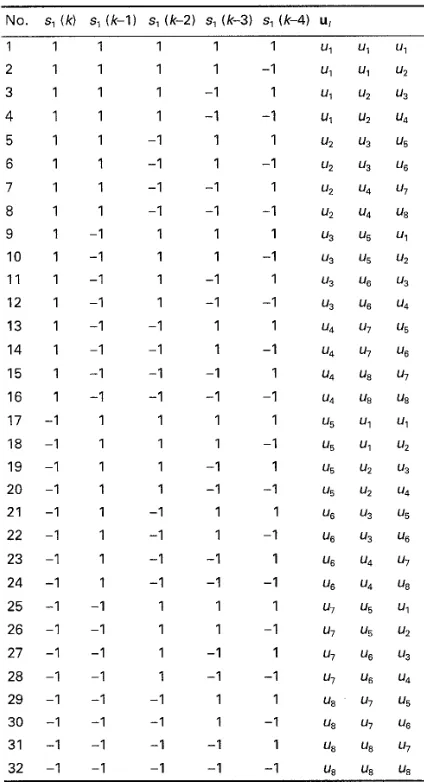
The set of the vector co-channel states U is obtained by expanding the scalar states. In this example, U contains 32 vector states as listed in Table 2. The rule to expand the set of the scalar co-channel states into the set of the vector co-channel states can be seen from Table 2. In general, in the table of the vector co-channel states, the last column (corresponding to u(k - m
+
1)) is repeat- edly filled withZ 0 Z 0 20
QQ--Q
the column corresponding to u(k - m
+
2) is repeatedly filled with21 21 21
A A
-
UlUl U 2 U 2 ' . ' U N , , , u N , > ,
..., and the first column (corresponding to u(k)) is filled with
2 T T - l 2 m - l 2 m - l
--
-
[image:4.614.330.542.178.569.2]U 1 ' ' ' U 1 U 2 ' ' ' U 2 ' ' UN,>, ' ' * UN,,,
Table 2: Vector co-channel states for A,(z) h(0.50
+
0 . 8 1 ~ '
+
0 . 3 1 ~ ~ )No.
1
2
3
4 5 6
7
8
9
10
11
12
1 3
14
15
16
17
18
19
20
21
22
23
24
25
26
27
28
29
30
31
32
- SI ( k ) ST (k-1) ~1 (k-2) SI (k-3) S, (k-4) U,
1 1 1 1 1 U1 U1 U1
1 1 1 1 -1 U1 U1 Y
1 U1 U2 U3
1 1
1 1 1 -1 -1 U1 U, U,
-1 1 1 U? U3 U5
1 1
1 1 -1 1 -1 U* U, U6
1 1 -1 -1 1 U, U4 U1
1 1 -1 -1 -1 U, U, U,
1 -1 1 1 1 U3 U5 U1
1 -1 1 1 -1 U, U, U,
1 -1 1 -1 -1
1 -1 -1 1 1 U4 U7 U5
1 -1 -1 1 -1 U, U, U,
1 U, U8 U7
1 -1 -1 -1 -1 U, U, U*
-1 1 1 1 1 U5 U1 U1
-1 1 1 1 -1 U, U , U,
1 -1 1 U5 Y U3
-1 1
-1 1 1 -1 -1 U5 Y U4
-1 1 -1 1 -1 U6 U3 U,
-1 1
-1 1 -1 -1 -1 U, U, U,
-1 -1 1 1 1 U7 U5 U1
-1 -1 1 1 -1 U7 U5 U, -1 -1 1 -1 -1 U, U6 U,
-1 -1 -1 1 1 U8 U7 U5
1 -1
1 -1 1 -1 u3
u3
-1 -1 1 -1
-1 1 -1 1 u6
-1 -1 u4
-1 -1 1 -1 u6
-1 -1 -1 1 -1 u7
1 ' 8 ' 8 ' 7
-1 -1
-1 -1
-1 -1 -1 -1 -1 U, U, us
In this expansion, to obtain correctly the set of the vector co-channel states as shown in Table 2, we need to know the correct order of the scalar co-channel states as indicated in Table 1. The clustering algorithm described in the next Section can only identify the val- ues of the scalar co-channel states and does not provide the information regarding their order. The order of the scalar co-channel states can be sorted out with the help of the state transition diagram. For the case of the eight scalar states, Fig. 4 depicts the state transition diagram. After the set of the eight scalar states has been obtained, by observing a sequence of states through time, their order can easily be arranged
IEE Proc.-Commun., Vol. 143, No. 4, August 1996
[image:4.614.92.309.320.433.2]according to the state transition diagram. The symmet- ric structure of the state transition diagram and the relationship of eqn. 24 helps to speed up this ordering process.
-1
- 2 -
m.
0
2 - 3 -
01
v
Fig. 4 State transition diagram for case of eight scalar co-channel states
-
-!
- .
Rearrange the eight scalar co-channel states of Table 1 into
(1.62X,1.00X,0.62X,0.00~,-0.00X,-0.62X,-1.00X,-1.62X)
( 2 5 ) We may approximate (1.621, 1.001) by its mean 1.311 and (0.621, 0.OOh) by 0.311,. This results in four approximated scalar co-channel states:
The number of resulting approximated vector co-chan- ne1 states is 16. This approximation may also be viewed from a different angle. The order of the co-channel is n1 = 3. Suppose that we only have an approximated co- channel order n^, = 2. This will give us four scalar co- channel states, and each of these approximated states is the mean of a pair of the true states. These four approximated scalar co-channel states are listed in Table 3 in the correct ordering, and the state transition diagram for the case of the four states is shown in Fig. 5. The Bayesian DFE with decision variables described by eqn. 22 may be viewed as the result of choosing 6, = 0.
[image:5.614.301.518.57.565.2](1.31X,0.31X, -0.31A, -1.31X) (26
1
Table 3: Approximated scalar co-channel states assum- ing
nl
=
2 for Al(z) h(0.50+
0 . 0 1 , ~ ~+
0 . 3 1 ~ - ~ )1 1 1 1.31 ( h )
2 1 -1 -0.31 (1)
3 -1 1 0.31 (h)
4 -1 -1 -1.31 (h)
Fig.5
IEE Proc.-Commun.. Vol. 143, Nu. 4, Au,qust 1996
State transition diagram for case of four scalar co-channel states
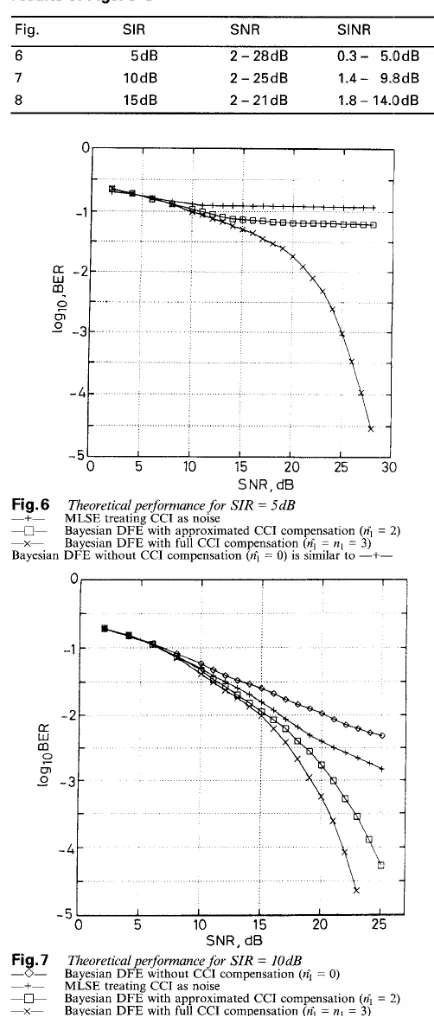
Table 4: SIR, SNR and SlNR values used to obtain the
results of Figs. 6-8
Fig. SIR SNR SlNR
6 5dB 2 - 28dB 0.3
-
5.0dB7 10dB 2 - 25dB 1.4- 9.8dB
8 15dB 2 - 2 1 d B 1.8- 14.0dB
-51 4 I I I I
i
0 5 10 15 2 0 25 30
S N R , dB Theoretical performance for SIR = 5dB
MLSE treating CCI as noise
Bayesian D F E with approximated CCI compensation (SI = 2 )
Bayesian D F E with full CCI compensation (SI 7 n l = 3)
Fig.6
-+-
-0-
-x-
Bayesian D F E without CCI compensation (rfl = 0) is similar to -+-
-1
, I
-1
-
-2
-
[r
w
m
-0
-0 01 - 3 -
Fig.7
-0-
-0-
-+-
-x-
I I 1 I
0 5 10 15 20 25
SNR, d 6 -5 1
Theoretical performance for SIR = 1OdB
Bayesian D F E without CCI compensation (rf, = 0) MLSE treating CCI as noise
Bayesian D F E with approximated CCI compensation (ril = 2) Bayesian D F E with full CCI compensation (rfl = nl = 3)
Figs. 6 to 8 plot the performance curves of the Baye- sian DFE without CCI compensation (n^, = 0), the MLSE which treats CCI as noise, the Bayesian DFE with an approximated CCI compensation (Al = 2) and the Bayesian DFE with the full CCI compensation (GI -
nl
= 3 ) for three different SIR conditions respec- tively. Table 4 summarises the SIR, SNR and SINR values used to obtain the results shown in Figs. 6 to 8. The performance of the Bayesian DFEs were obtained with detected symbols being fed back. When the ( X I is negligible, the MLSE has superior performance over the Bayesian DFE, as can be seen from the results of Fig. 8. However, in the presence of severe CCI, the - [image:5.614.73.278.91.206.2] [image:5.614.67.284.478.692.2]Bayesian D F E with an effective compensation of the CCI can outperform the MLSE that only treats the CCI as noise, as clearly shown in Figs. 6 and 7.
no-1 \
E(k) = r ( k ) -
E
ti()&
- l ) s o ( k -j)
P ( k ) = s;(k - j )& , j ( k ) = 60,Jk - 1)
+
- € ( k ) S o ( k -j)
J=Ono-1
j = O
Sa P ( k )
0
5
j5
120 - 11
0 I I I I
1
>
( 2 7 )-61 I I I I
0 5 10 15 20 Theoreticalperfbrmance for SIR = 15dB
Bayesian DFE without CCI compensation (f, = 0)
MLSE treating CCI as noise
Bayesian DFE with full CCI compensation (n", = nl = 3)
SNR,dB
Fig.8
-+-
where g , is an adaptive gain. Given the channel esti- mate go, it is straightforward to calculate the set of the channel states r? from eqn. 17.
The equaliser does not have access to the interfering data {s,(k)} or its estimate, and supervised learning such as the NLMS algorithm is not applicable for iden- tifying the co-channel states. In the previous study [7],
the unsupervised K-means clustering algorithm [ 101 is used to estimate the co-channel states. The ti-means clustering algorithm is known to be sensitive to the ini- tial positions of the cluster centres. Recently, an enhanced K-means clustering algorithm has been pro- posed [ I 11, which overcomes , this drawback. This
enhanced ti-means clustering algorithm is optimal in the sense that the variances of every cluster are equal after convergence. This property is particularly relevant for the application to estimate co-channel states since all the cluster variances in this case should be equal. Using this enhanced K-means clustering algorithm, we propose the following procedure to estimate the co- channel states:
(i) Compute the channel residual n o - 1
E(k) = r ( k ) -
E
& o , j S o ( k - j ) ( 2 8 )j = O
where go = [bo,o...80,no-r]r is the current channel esti- mate.
(ii) Compute the cluster variance weighted squared dis- tances between the residual ~ ( k ) and the scalar co-chan- ne1 states ui(k 11, 1 5 I S
G,5
G(k)
= U l ( k -l)C/(k)
= ~ l ( k - l ) ( ~ ( k ) - ~ l ( k - 1))2, 1
5
15
fiu,s(29)
where I$,s = 2'l, 6, is an estimate of the co-channel order, vl(k - 1) is the current variance of the Ith cluster and <,@) is the squared distance between ~ ( k ) and ul(k
- I). Find the minimum weighted distance:
i;-
( k ) = min{cl(w' 15
1I
fiu,s} (30)(iii) Update the l*th and
(G,,
states:1*
+
1)th co-channelwhere gu is an adaptive gain. The cluster variances are then updated according to the rule:
ul ( k ) = Q.UL ( I C - 1)
, 1 <
1<
fiu,, and I#
1 *,
fiu+
-I"
+
1I
U ,q u,,qpl*+l(k) = 211" ( k ) = Q('uL* ( k - 1)
+
(1.0 - a)C1* ( k ) (32) wherea
is a positive- constant slightly less than 1 .O. The initial vXO), 1 C 15&,,
can be set to a same small value. Setting ~;~,.+,*+,(k) = v,*(k) together with the rule ~ i ? j ~ , ~ - ~ * + , = -u,*(k) exploits the symmetric structure of the co-channel states, and this accelerates convergence.The scalar co-channel states are then arranged in the correct order and expanded to obtain the set of the vec- tor co-channel states, U. Alternatively, the vector co- channel states can be estimated directly using the same ti-means clustering algorithm. This however requires longer learning, since the number of the vector co- channel states is much larger. An advantage of the lat- ter is that there is no need to order the vector states. The resolution of the above unsupervised clustering
IEE Proc.-Commun., Vol. 143, No. 4, August 1996
algorithm obviously depends on the noise and the co- channel itself. A common-sense rule based on the amplitude of the channel residual can be adopted to choose the number of scalar co-channel states needed. For example, if the channel residual lieSAin the range (-
0.1, O.l), it is unnecessary to choose- &,s > 8. In this
case, it may be sufficient to choose = 4, regardless of the true number of the scalar co-channel states.
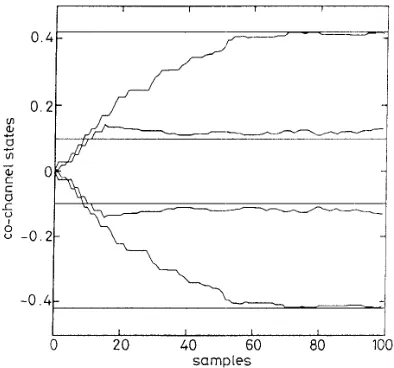
For the system defined in eqn. 23 with SIR = lOdB and SNR = 15dB, the combincd NLMS and clustering learning was used to estimate the channel model and the scalar co-channel states. The channel order was assumed to be known and only an estimated co-chan- ne1 order vil = 2 was assumed to be available. This gave rise to the four scalar co-channel states. The gain of the NLMS algorithm was chosen to be g , = 0.08. The parameters of the clustering procedure were set to:
a
= 0.999, gu = 0.05 and ~ ~ ( 0 ) = 0.000001 for all 1. Fig. 9 depicts a typical set of the scalar co-channel state tra- jectories obtained, where the lines indicate the expected values.0 . 2
-i
I
1
0 20 40 60 80 100
samples
Trajectories of scalar co-channel states obtained using clustering -1
Fig. 9
algorithm
Lines indicate expected values
-1
I
c
t
\
t
i
1
-5 -
A
0 5 10 15 20 25 30
SNR, dB
Adaptiveperjormance for SIR := lOdB
Fig. 10
-0- Bayesian DFE without CCI compensation (6, = 0) MLSE treating CCI as noise
Bayesian DFE with approximated CCI compensation (t, = 2)
For the same system (eqn. 2 3 ) with SIR = lOdB, Fig. 10 compares the adaptive performance of the Bayesian DFE without CCI compensation (Z1 = 0), the MLSE which only treats CCI as noise and the Bayesian DFE with an approximate CCI compensation (uil = 2). In the first two cases, the NLMS algorithm used 100 training pairs (channel observations and transmitted symbols) to identify the channel model. For the last case, in addition, the clustering algorithm used 100 channel observation samples to estimate the four scalar co- channel states. The adaptive performance of the Baye- sian DFE with an approximate CCI compensation ir very close to its theoretical performance, and is significantly better than that of the MLSE without CCI compensation.
5 Conclusions
Adaptive equalisation in the presence of ISI, additive Gaussian white noise and CCI has been investigated. It has been shown that, by exploiting the nature of inter- fering signals, the Bayesian DFE is capable of clistin- guishing an interfering signal from the noise. Simulation results have demonstrated that, in the pres- ence of severe CCI, the Bayesian DFE which incorpo- rates CCI compensation can outperform the MLSE without CCI compensation. In theory, if an accurate knowledge of the channel and co-channels is known, the MLSE can be designed to take into account both the IS1 and CCI and hence outperforms the Bayesian DFE. In practice, however, adaptive implementation of such a MLSE is very difficult. Adaptive implemienta- tion of the Bayesian DFE has been studied, and a. sim- ple unsupervised clustering algorithm has been suggested to learn the co-channel states. This adaptive Bayesian DFE is particularly effective in compensating one or a few dominant interferences. A drawback of this adaptive scheme is that its computational complex- ity increases quickly as the size of the symbol constalle- tion increases.
6 References
1
2
3
4
FORNEY, G.D.: ‘Maximum-likelihood sequence estimation of digital sequences in the presence of intersymbol interference’, IEEE Trans., 1972, IT-18, (3), pp. 363-378
QURESHI, S.U.H.: ‘Adaptive equalization’, Proc. IEEE, 1985,
CHEN, S., MULGREW, B., and MCLAUGHLIN, S.: ‘Adaptive Bayesian equaliser with decision feedback’, IEEE Trans., 1993,
SP-41, (9), pp. 2918-2927
CHEN, S., MCLAUGHLIN, S., and MULGREW, B.: ‘Com- dex-valued radial basis function network. Part 11: aoolication to 73, (9), pp. 1349-1387
higital communications channel equalisation’, E U R k I P Signal Proc. J., 1994, 36, pp. 175-188
5 CHEN. S., MCLAUGHLIN. S., MULGREW. B., and GRANT, P.M.: ‘Adaptive Bayesian decision feedback equaliser for dispersive mobile radio channels’, IEEE Trans., 1995, COM-
6 PETERSEN, B.R., and FALCONER, D.D.: ‘Exploiting cyclosta- tionary subscriber-loop interference by equalization’. Proceedings of GLOBECOM’90, San Diego, 1990, pp. 1156-1160
CHEN, S., and MULGREW, B.: ‘Overcoming co-channel inter- ference using an adaptive radial basis function equaliser’, EUR- A S I P Signal Proc. J . , 1992, 28, (l), pp. 91-107
8 FO, N.W.K., FALCONER, D.D., and SHEIKH, A.U.H.: Adaptive equalization for co-channel interference in a multipath fading environment’, IEEE Trans., 1995, COM-43, pp. 1441- 1453
9 CAMPBELL, J.C., GIBBS, A.J., and SMITH, B.M.: ‘The cyclostationary nature of crosstalk interference from digital sig- nals in multipair cable. Part I: fundamentals; Part 11: applications and further results’, IEEE Trans., 1983, COM-31, (S), pp. 629-
649
43, (5), pp. 1937-1946
7
10 DUDA, R.O., and HART, P.E.: ‘Pattern classification and scene analysis’ (John Wiley, New York, !973)
11 CHINRUNGRUENG, C., and SEQUIN, C.H.: ‘Optimal adap- tive r-means algorithm with dynamic adjustment of learning rate’, IEEE Trans., 1995, “4, (l), pp. 157-169
[image:7.614.75.272.261.445.2] [image:7.614.73.264.484.687.2]