Abstract— The present paper considers the problem of
managing investment projects as multistage processes in the conditions of a high uncertainty of their implementation environment. It emphasizes topicality of the approach to evaluation and management of investment projects in terms of the theory of real options, which do not consider uncertainty only as a source of risks but also as a potential opportunity of gaining additional value, in case of a relative preparation at the planning and implementation stages. It is shown in the paper that the main unsolved problem of the real option valuation is a correct evaluation of the probability of possible project development paths in the conditions of an objective absence of a priori statistical information. The paper offers a method, which allows to obtain such valuations based on the binary options theory and T. Saaty’s analytic hierarchy process (AHP). The paper also describes a procedure of expert project examination by means of the AHP to obtain quantitative evaluations of relative project development probabilities in accordance with the “optimistic” and “pessimistic” scenarios is each node of the binominal decision tree. It contains a realistic example of a practical application of the authors’ method.
Index Terms—Investment project, high uncertainty,
quantitative evaluations, management
I. INTRODUCTION
HE rationale of the research is preconditioned by the fact that in investment project management there are critical problems predetermined by the essence of the investment project as a multistage process implemented in the conditions of a high uncertainty and dynamism of the environment. In this regard, in case of a favorable situation development, project managers may have latent potential opportunities, which are able to significantly increase the project efficiency. In this connection, it is expedient already at the preliminary project development stage to provide them with capabilities necessary to unlock the positive potential of the probable environmental fluctuations in the course of project implementation. Otherwise, the achieved effect of such potentially efficient
Manuscript received February 20, 2017; revised March 04, 2017. The work was supported by Act 211 Government of the Russian Federation, contract № 02.A03.21.
L. A. Baev is with the Higher School of Economics and Management, South Ural State University, 76 Prospekt Lenina, Chelyabinsk, 454080, Russian Federation (e-mail: [email protected]).
O. V. Egorova is with the Higher School of Economics and Management, South Ural State University, 76 Prospekt Lenina, Chelyabinsk, 454080, Russian Federation (e-mail: [email protected]).
S. V. Aliukov is with the Innovative Management in Business Department, Higher School of Economics and Management, South Ural State University, 76 Prospekt Lenina, Chelyabinsk, 454080, Russian Federation (corresponding author, home phone: +7-351-267-97-81; sell phone: 8-922-6350-198; e-mail: [email protected]).
project will be underestimated.
The capabilities, which are inherent in the investment project or which must be specially embedded therein, are “real options”, and the technique of quantitative valuation of these capabilities is the real option valuation (ROV) method, which ideology lies in a fair affirmation that an uncertainty is not only risks but also capabilities [2,6].
Such approach allows to evaluate the potential of several processes in another way, while the conventional evaluation and management methods do not consider the cost of the capabilities opening in the future [5,7].
Besides, application of the real options theory in investment project evaluation and management allows to make management decisions at each project development stage, i.e. considers the project as a multistage process. In this regard, it is important that applicability of positive aspects of uncertainty must be laid in the project already at the planning stage. Depending on the environmental conditions, in the future the potential opportunities inherent in the project or specially embedded therein allow to:
in case of a favorable concourse of circumstances, strengthen the project’s effect due to an appropriate use of the previously gained capabilities;
in case of adverse conditions, mitigate the risks of losses by refusal from continuation of the project, deferral of the implementation beginning or reduction of the project with minimum losses for the participants.
A real option as a capability inherent in the project has its value and, consequently, cost [8]. The quantitative valuation of the available project option capabilities must be included in the management decision implementation cost [3,9].
However, practical application of the real options theory concepts is complicated by the absence of an adequate method of a quantitative real option valuation due to the principal absence of a priori statistical information on real investment projects.
II. REAL OPTION VALUATION METHODS Due to the difficulty in obtaining classic probabilistic characteristics of scheduled investment projects there arises a need for transit or, at least, supplementation of probabilistic evaluations with the expert ones, and development of methods of an appropriate and practically realizable real option valuation.
The authors call the ROV method, where probabilistic project characteristics are formed as expert evaluations specially organized and processed by the analytic hierarchy process within the framework of the binominal option theory, a modified ROV-method (MROV-method).
Management of Option Investment Projects:
Theory and Practice
L. Baev, O. Egorova and S. Aliukov
Based on the performed analysis of conventional ROV-methods it has been found that essentially there is no principal difference between the binominal and more complex models of option cost valuation, including much more alternatives. In this connection, the question of the real option valuation is not so much reduced to how much money we will earn thereon as to whether it is worth using it from the perspective of a real possibility to obtain an additional positive balance of the present cash flows in essence. To answer this question it is fair enough to consider correctly the two alternatives – optimistic and pessimistic. I.e., the problem of managerial real option valuation within the framework of the decision tree model is reduced to evaluation of the comparative probability of the binominal option outcomes. Therefore, the binominal real option valuation model has formed the basis of the MROV-method.
The binominal real option valuation model is based on building of the decision tree, in each node of which two variants of events are possible: project development in accordance with the “optimistic” or the “pessimistic” forecast of the option investment project.
Project development in accordance with any scenario depends on several characteristics of the project environment. Thus, the problem of the real option valuation becomes a multi-criterion problem.
One of the most justified and practically adequate methods of solving such problems is the analytic hierarchy process (AHP).
The analytic hierarchy process assume to divide the global problem into several sub-problems admitting homogeneous alternatives and further processing the sequence of the decision-makers’ judgements by pairwise comparisons [4]. Such approach transfers the indistinct problem of the overall evaluation of the multi-criterion problem into the plane of a pairwise comparison of certain alternatives. Thus, the basis of the MROV-method is formed by two base methods: the decision tree method and the analytic hierarchy process.
The essence of the authors’ approach lies in the following:
1. Not the absolute but the comparative probability of implementation of an optimistic and a pessimistic project development scenario is evaluated;
2. The analytic hierarchy process is used for multi-criterion evaluation of the comparative probability as a function of significant project variables;
3. The comparative probability of scenarios is evaluated on the basis of T. Saaty’s modified scales in terms of the evaluation, to what extent one of them is more probable than the other one.
The model of the MROV-method is schematically shown in Fig. 1.
The real option value is calculated by the formula (1):
оwei pwei
,
opt opt
PV
PV
PV
P
(1)where
PV
оwei – weighted by probability current cash flow value of an optimistic scenario;wei p
PV
– weighted by probability current cash flow value of a pessimistic scenario;opt
P
– striking price (total cost of acquisition and sale of the option).Fig.1. Model of the MROV-method
The weighted values of the optimistic and the pessimistic forecast are calculated by formulas (2) and (3) accordingly:
( )
wei
о о о
PV
PV
р К
, (2)( )
wei
p p p
PV
PV
р К
, (3)where
PV
о – current cash flow value of an optimistic scenario;p
PV
– current cash flow value of a pessimistic scenario;(
)
ор К
– probability of project development in accordance with an optimistic scenario;( )
p
р К
– probability of project development in accordance with a pessimistic scenario.Weighs in formulas (2) and (3) are ratings of probabilities of optimistic and pessimistic scenario development
р К
о( )
,р К
p( )
determined during project expertise by means of the AHP and calculated by formulas (4) and (5), accordingly:1 1 2 2
( )
(
)
(
)
...
(
)
...
о о о
o
i i
р К
а р К
а
р К
a
p K
(4)2
1 1 2
( )
(
)
(
)
...
(
)
...
p p p
p
i i
р К
а р К
а
р К
a
p
K
(5)where
i
1
,
2
,...
– factor number;,....
,
21
а
а
– factor significance evaluations (evaluations of the priorities of the relevant factors’ influence on the outcome of the evaluated project stage implementation);(
),
(
),....
о i p i
р К
р К
– evaluations of probabilities of implementation of the optimistic or pessimistic value of thei-th factor, accordingly.
Based on the presented model we outlined the main stages of the MROV-method:
1. Building of the decision tree and development of an optimistic and a pessimistic forecast with specification of significant factors and their values corresponding to the optimistic and the pessimistic forecast.
2. Building of a hierarchical structure of factors able to influence project development in accordance with alternative scenarios;
3. Evaluation of the significance of the outlined factors by their pair wise comparison in the course of the AHP expertise and calculation of weight coefficients
,...
,
21
а
а
;4. Evaluation of the comparative probabilities of implementation of the optimistic and the pessimistic values for each factor (
р К
о(
i),
р К
p(
i)
), by means of the AHP expertise with application of a relevant scale of significance of the alternatives;5. Calculation of the relative probabilities of alternative scenarios in view of the weight coefficients obtained by the AHP.
6. Summing up the values of
PV
о,
PV
p weighted by the probability we determine the real option value, which must be positive after deduction of the cost of its acquisition and sale, in this case the option is acceptable.For de facto comparison of the alternatives we use the AHP modified ratio scale – a scale of the relative probability of implementation of the alternatives in view of the fixed factor values presented in Table I.
In this scale the degree of influence of individual factors on the project development in accordance with an optimistic or a pessimistic scenario, i.e. implementation of the optimistic or the pessimistic factor value, is considered as evaluation. Tendencies of changes of individual factors over the accounting period are considered as actions influencing the objective.
After data processing we calculate the alternative priority vector with regard to each factor of the model. Based on the obtained results we make comparative evaluations of the probabilities of project development in accordance with an optimistic or a pessimistic forecast.
In view of the obtained evaluations, we calculate the real option value to justify expediency of inclusions thereof into the project. Such expertise is carried out for each option embedded in the project.
At the final stage we make a decision on expediency of implementation of the option investment project based on calculation of the net present value.
Practical applicability of the MROV-method is confirmed by the results of analyzing a project implemented by one of the industrial enterprises of the Ural Federal District having a multiyear history of successful work on the Russian market of electric drive control and automation in metallurgy, oil-and-gas complex and machine-building.
The essence of the project lies in construction of an automated line meant for production of a series of electric motors for drilling rigs, oilfield equipment and 325 – 1250 kW railway locomotives, with the production capacity of 300 units/year. The main competitive advantage of the project is that the motors to be designed and manufactured
surpass the existing analogs by their technical characteristics. In the general case, the strategic sales markets are industrial markets of equipment for the national oil-and-gas complex and railways.
TABLEI
SCALE OF THE RELATIVE PROBABILITY OF IMPLEMENTATION OF THE ALTERNATIVES BY INDIVIDUAL FACTORS
Intensity of relative probability
Definition Explanations
1 Equal probability
Equal probability of implementation of the pessimistic and optimistic values of this factor
3 Moderate superiority
Slight superiority of probability of implementation of one alternative over the other one
5 Significant superiority
Strong superiority of probability of implementation of one alternative over the other one
7
Very strong or evident superiority
So strong superiority is attached to implementation of one alternative that the probability of implementation of the second alternative becomes insignificant
9 Absolute superiority
Evidence of superiority of the probability of implementation of one alternative over the other one is confirmed to the maximum extent
2,4,6,8 Intermediate
decisions Applied in case of a compromise
Inverse values
In case one of the said figures (for example, 3) is obtained at comparison of one scenario with another one, we will obtain an inverse value (i.e., 1/3) at comparison of the second scenario with the first one
A preliminary analysis of the production and market situation has shown that it is expedient to consider this project. In this case, two development scenarios were considered: the optimistic scenario assumes a modernly high demand for the electric motors for drilling rigs and oilfield equipment; the pessimistic scenario assumes a moderately low demand.
Presence of an uncertainty in the variants of the project outcome has already pointed at the option project characteristics. The main sources of uncertainty are: demand on the oil market; cost of materials and components.
Methods to mitigate the risks connected with such uncertainty include continuous monitoring of marketing information, advertising campaigns, participation in exhibitions, search of direct product users, as well as increase of the number of raw materials suppliers, application of developed schemes and improvement of the logistics.
III. INCREASE OF THE COMMERCIAL PROJECT ATTRACTIVENESS
To increase commercial attractiveness of the project the following real options were embedded therein:
2. Real option for business change-over. In case of a pessimistic forecast of the demand for electric motors for drilling rigs and oilfield equipment the company can change over to production of other electric motors for railway rolling equipment.
Three project variants were considered for comparison. 1. Variant. Option-free investment project. The performed market analysis has shown that the expected capacity of the market of electric motors for drilling rigs and oilfield equipment currently comprises 200 units a year. In this regard, the optimistic demand variant comprises 260 units/year, the pessimistic variant – 140 units/year. Therefore, at the initial stage it is enough for the company to construct an electric motor production line with the minimum possible production capacity of 300 units/year.
The total project value comprises 585 mln. rub., including investments in equity 537 mln. rub., in floating assets and organization of current activities – 48 mln. rub.
The discounting rate for the project is calculated as the average weighted cost of the capital attracted from different sources under the WACC model and comprises 12% per annum. The planning horizon is 8 years.
The company enters the electric motor market with new products, which have no long-term market history yet. Therefore, in view of the competitors’ price analysis the minimum price of the electric motor comprising 2,700,000 rub. per product unit was taken as the base price of the electric motor sale forecast.
[image:4.595.313.540.114.252.2]The scheme of the option-free investment project of organization of electric motor production for the oil field is shown in Fig. 2.
Fig. 2. Scheme of the option-free investment project
If we proceed from the assumption of the company’s managers that both development scenarios have an equal probability, the average weighted net present project value compromises:
538 0.5 627 0.5 338
54.5 mln. rub.
NPV
Accordingly, this project must be rejected.
2. Variant. A more profound project analysis has shown that it has option properties. Additional market researches have shown that there are serious grounds to reckon to a significant increase of the drilling equipment production for the oil and gas fiend not only this year but also in a rather long-term prospective, which can result in a growing demand for electric motors for such equipment. Therefore, within the framework of the project it is expedient to provide for construction of an electric motor production line with the excess capacity of 450 units/year.
For this purpose, additional investments to the amount of 78 mln. rub. are needed.
[image:4.595.48.273.442.558.2]The scheme of the relevant option investment project in shown in Fig. 3.
Fig. 3 Scheme of the option investment project
(option-asset for expansion – construction of the automated production line with an excess capacity)
The average weighted net present value of such project comprises:
537
78
0,5 (0,5 1326
0,5 627)
0,5 338
42, 25 mln. rub.
NPV
3. Variant. This project can be also supplemented with an option-ability to change over to production of electric motors for equipment of modern railway rolling stock. For that purpose, at construction of the electric motor production line for drilling rigs it is necessary to provide for reconfigurability of the equipment for production of another type of motors. It requires additional capital investments at the construction stage but enables business change-over to another market in case of a recession in demand on the oil equipment market.
The performed analysis of the railway industrial market development prospects, as well as the innovative processes of the Russian railway development give a ground for supplementation of the project with a real option for business change-over (Fig. 4).
Fig. 4 Scheme of the option investment project
(option-asset for expansion of the production capacity, option-possibility of business change-over and delivery of electric motors to Russian
[image:4.595.310.541.546.737.2]Fig, 4 contains a scheme of a full two-option project, for implementation of which a contract was concluded with Russian Railways OJSC at the project planning stage (in the form of a real option-possibility) for delivery of 380 electric motors for electric locomotives, the price of such contract comprises 5% of the proceeds value.
The average weighted net present value of the third project variant with two embedded options is positive and comprises:
537
78 50
0,5 (0,5 1327
0,5 627)
0,5 (0,5 916
0,5 338) 137mln. rub.
NPV
which is considerably higher that the net present value of the second project variant with one option.
Thus, two real options were embedded in the project, wherein building of the decision tree of this option investment project shows that these options inside the project do not interact and influence each other’s value.
The example graphically shows that a more professional project consideration taking into account these option possibilities can transfer the project from the category of economically loss-making to the category of economically profitable.
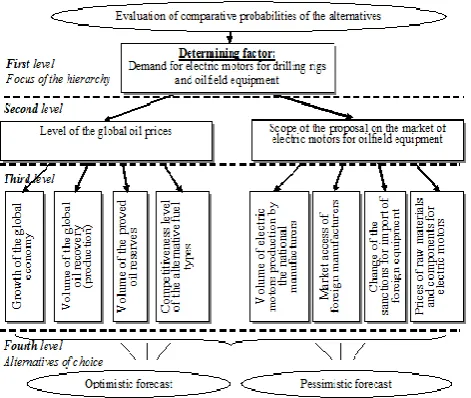
However, the assumption of an equal probability of the alternative project development scenarios is conventional. Therefore, at the next stages of the MROV-method we carry out an adequate expert evaluation of the comparative probabilities of the optimistic and the pessimistic project development scenarios maximally close to the reality by means of the AHP technology. For this purpose, we build a hierarchical structure of factors able to influence the project implementation by its alternative development scenarios for each option.
For the first option the determining factor (first level) is demand for electric motors for drilling rigs and oilfield equipment [1], which, in its turn, depends on several marco- and microeconomic factors of the second and the third levels. The hierarchical structure of factors “Demand for electric motors for the oil field” is shown in Fig. 5.
[image:5.595.49.285.528.727.2]
Fig. 5. Hierarchical structure of the factors for the option for expansion
To determine a comparative significance of influence of the analyzed factors on the outcome of implementation
of any project stage, we examined the project by means of the AHP, in the course of which five experts provided judgements concerning the factors included in the hierarchy, the comparison results are included in matrixes of pairwise comparisons in the form of natural numbers from 1 to 9.
In accordance with the AHP technology, the obtained data are processed, and the vector of the priorities of the third-level factors is determined for each factor complex of the second level. Then, the obtained results are aggregated by calculation of the average arithmetic value of the expert evaluations, whereas five experts took park in the expertise.
At the next stage the experts made a pairwise comparison of the alternatives of the outcome of a certain project stage by each factor from the perspective of what is “more probable” and what is “less probable”, in view of the certain factor values of the set “optimistic” and “pessimistic” forecast. Processing of the data obtained from the experts and averaging thereof result in the vectors of the alternative priorities for each factor of the hierarchy for factor complex “Level of global oil prices” (Table II) and “Scope of the proposal on the market of electric motors” (Table III).
TABLEII
MATRIX OF ALTERNATIVE PRIORITIES WITH REGARD TO THE FACTORS OF COMPLEX “LEVEL OF GLOBAL OIL PRICES”
Factor Forecast
Level of the global oil recovery (production) Volume of the proved reserves Competitiv eness level of the alternative fuel types Optimistic
forecast 0,598 0,434 0,618 0,429 Pessimistic
forecast
Growth of the global economy
0,566 0,382 0,571
457 , 0 543 , 0 092 , 0 100 , 0 252 , 0 556 , 0 571 , 0 382 , 0 566 , 0 402 , 0 429 , 0 618 , 0 402 , 0 589 , 0
- vector of the priorities of the 2 level. TABLEIII
MATRIX OF ALTERNATIVE PRIORITIES WITH REGARD TO THE FACTORS OF COMPLEX “SCOPE OF THE PROPOSAL ON THE MARKET OF ELECTRIC
MOTORS” Factor Forecast Volume of electric motors production by the national manufacturers
Market access of foreign manufacturers
Tightening of import sanctions
Prices of raw materials and components
for electric motors Optimistic
forecast 0,722 0,649 0,762 0,163 Pessimistic
forecast 0,278 0,351 0,238 0,837
357
,
0
643
,
0
119
,
0
102
,
0
227
,
0
552
,
0
837
,
0
238
,
0
351
,
0
278
,
0
163
,
0
762
,
0
649
,
0
722
,
0
-
Then, by means of a linear comparison of the obtained vectors of the priorities of the second level, we determine the general vector of the alternative priorities in view of the weighted coefficients of the second-level factors.
379 , 0
621 , 0 756 , 0
244 , 0 357 , 0 457 , 0
643 , 0 543 , 0
- general vector of the first level,
The comparative probabilities of the optimistic and the pessimistic forecast have the following values:
( )
о
р К
= 0,621;р К
p( )
= 0,379.For the third node of the decision tree (option for business change-over) the determining factor is development of the Russian railways and growing demand for electric motors for the railway transport, which depends on several factors of the second level, alternatives of choice are at the third level.
Processing of the expert AHP evaluations for the third node of the decision tree gave the following evaluations of comparative probabilities of the project implementation by the optimistic and the pessimistic forecast:
р К
о( )
= 0,721;р К
p( )
= 0,279.In view of the obtained evaluations, we calculated the improved net present project value:
1. Option-free investment project:
537 0,621 627 0,379 338 19,531 mln.rub.
NPV
2. Option investment project (option-asset for expansion):
537 78 0,621 (0,621 1326
0,379 627)
0,379 338 172,032 mln.rub.
NPV
3. Option investment project with two options:
537 78 50 0,621 (0,621 1327
0,379 627)
0,379 (0,721 916
0, 279 338)
280, 361 mln.rub.
NPV
Thus, the MROV-method helped to obtain a correct evaluation of comparative probabilities of the project implementation by the alternative development scenarios
having a higher reliability of real options embedded in the project.
IV. CONCLUSION
The problem of a correct evaluation and management of real investments in the conditions of uncertainty is currently becoming more and more urgent. Alongside with that, there is an increasing importance of investment project management based on accounting of the positive uncertainty component and formation of the necessary flexibility in management decision-making.
For adaptive investment project management there is a method for evaluation of the positive uncertainty potential based on application of the conceptual frameworks of the real options theory and the analytic hierarchy process ensuring practical applicability of this theory.
The offered approach allows to realize the methodological concepts of the option approach to development and analysis of investment projects and to evaluate the efficiency of such option investment projects with a high accuracy.
REFERENCES
[1] Bobylev, Yu.N. Factors of Oil Pricing / Yu.N. Bobylev – М.: Institute of the Economy in Transition, 2006. – 113p.
[2] Copeland, Т. Valuation: The Value of Companies: Measuring & Managing / Т. Copeland, Т. Koller. – McKinsey &Company Inc., 2015 – 848p.
[3] Limitovsky, М.А. Investment Projects and Real Options on Developing Markets: manual – practical guide / М.А. Limitovsky. – 5-th processed and enlarged edition – М.: Urait Publishing house, 2014. – 486с
[4] Saaty, Т. Decision-Making. Analytic Hierarchy Process / Т. Saaty; translated from English by Vachnadze R.G. – М.: Radio and Communication, 1993. – 278p.
[5] Bowman, E.H. Real Options Analysis and Strategic Decision Making / E.H. Bowman, G.T. Moskowitz // Organization Science. – 2001. – 12 (6). – P. 730-743.
[6] Copeland Т., Keenan Ph. How much is flexibility worth? // The McKinsey Quarterly, 1998. V.2 – p.p. 38-49.
[7] Copeland, T. The hidden potential investments / T. Copeland, T. Ostrowski // Vestnik McKinsey 2002. – №2. – p.p.113-132. [8] Merton, R. C. Applications of Option-Pricing Theory: Twenty-Five
Years Later / R.C. Merton // The American Economic Review. – 1998. – 88 (3). – P. 323-349.