doi: 10.17221/79/2016-CJFS
Effect of Indigenous
S. cerevisiae
Strains on Higher
Alcohols, Volatile Acids, and Esters in Wine
Katarína FurdíKová1, Katarína MaKyšová2 and Ivan špánIK2*
1Institute of Biotechnology and Food Science, and 2Institute of analytical Chemistry,
Faculty of Chemical and Food Technology, Slovak university of Technology in Bratislava, Bratislava, Slovak republic
*Corresponding author: [email protected]
Abstract
Furdíková K., Makyšová K., Špánik I. (2017): Effect of indigenous S. cerevisiae strains on higher alcohols, volatile acids, and esters in wine. Czech J. Food Sci., 35: 131–142.
Higher alcohols, volatile fatty acids, and esters are the most important volatiles and their formation is closely related to yeast strains employed during fermentation. In the present work, the effect of indigenous yeast strains on selected wine volatiles was examined using a highly sophisticated analytical method – comprehensive two-dimensional gas chromatography. Results of the statistical analysis revealed that each strain could be characterised and differenti-ated according to its volatile composition: strain Y2 was characterised by 2-phenylethanol and 1-hexanol, strain Y1 was in close relationship with high amounts of 4-methyl-1-pentanol, iso-amyl alcohol, ethyl 3-hydroxypentanoate and 3-methylpentanoic acid and strain Y3 was associated with 1-heptanol, cis-3-hexen-1-ol, β-phenylethyl butyrate, octanoic, and decanoic acids. The selection of an appropriate yeast strain thus represents a critical variable affecting the analysed volatile compounds (wine flavour) not only in a qualitative but also in a quantitative way.
Keywords: volatile organic compounds; secondary aroma of wine; yeast; comprehensive gas chromatography
Supported by Slovak Research and Development Agency, Project No. APVV-15-0333 and by the Scientific Grant Agency of the Slovak Ministry of Education of the Slovak Republic and the Slovak Academy of Sciences – VEGA, Grants No. 1/0573/14 and No. 1/0560/14.
One of the most common procedures in a win-emaking process is controlled fermentation in order to provide desired qualitative parameters (mainly flavour) of wine. This is ensured by the employment
of commercially available Saccharomyces cerevisiae
yeast strains. Nevertheless, the competitive char-acter of the wine market leads to the tendency of wine producers to look for innovations in fermenta-tion technologies (Fleet 2008). In recent years, the study of indigenous (autochthonous) yeast strains has seemed to be in the scope of scientists. Wines obtained using such microorganisms are closely related to a particular geographical region, known
as ‘terroir’, and thus are characterised by uniqueness and originality (Cadot et al. 2012).
Wine flavour (including its odour and taste) is very complex and consists of a high number of differ-ent volatile organic compounds (VOCs) of various chemical and physical properties and concentrations. Among all of them, volatiles synthesised during fer-mentation (so called ‘fermentative’ flavour) are meant
to be the most numerous group (Styger et al. 2011)
therefore, each strain produces a different profile of VOCs even when fermenting the same grape must (Molina et al. 2009).
According to Stribny et al. (2015), higher
alco-hols and esters are significant aroma contributors in alcoholic beverages. In the vast majority, con-ventional gas chromatography (1D-GC), and in the last years mainly comprehensive two-dimensional gas chromatography (GC×GC) has been applied to examine the composition of wine aroma (i.e. the profile of volatile organic compounds). The latter method is preferred because it disposes of several advantages: (I) enhanced peak capacity, (II) higher power signal/noise ratio, and thus resolution, and (III) obtaining of ‘structured’ chromatograms (Mur-ray 2012). GCxGC was successfully employed for studying VOCs in different wines (Weldegergis
et al. 2011a).
To the best knowledge of the Authors, there are no published works about the effect of indigenous yeast strains on the volatile profile of wines analysed by LLE-GCxGC-TOF-MS. The aim of the present study was to obtain a detailed profile of higher alcohols, volatile acids, and esters in wines to describe the effect of three indigenous Saccharomyces cerevisiae strains.
MAtErIAl And MEtHodS
Origin of grapes. In the present work, grapes of the wine variety Gewurztraminer (clone N20 with Kober 5BB rootstock) of 2011 vintage were used. Grapes originated from the production of the Slovak company from the Middle Slovak vineyard region, Modrý Kameň locality. The natural starting concen-tration of reducing sugars in pressed grape juice was 250 g/l, and no additional sugar was added. The pH value of original grape juice was 3.5.
Yeast strains. For the fermentation of Gewur-ztraminer juice, three indigenous yeast strains of
Saccharomyces cerevisiae var. cerevisiae signed as Y1, Y2, Y3 were used. All strains were isolated from grapes in 2010 and originated from the same locality as the grape used in the experiment. Yeast strains were previously identified using diagnostic keys (Kurtz-man & Fell 2000) and taxonomical classification was verified by PCR. Before the experiment, axenic
S. cerevisiae cultures were characterised also in terms of their oenological properties and became part of the collection of microorganisms of the Faculty of Chemical and Food Technology (Slovak University
of Technology, Slovakia). Axenic cultures of S. cere- visiae var. cerevisiae Y1, Y2, Y3 used in this experi-ment are characterised by low production of volatile acids, acetaldehyde, succinic acid, and foam; their osmotolerance is above 45% glucose in the medium and ethanol tolerance 12.5% (v/v) of ethanol, they have good sedimentation characteristics and are able to produce wines with residual sugars.
Yeast starters for grape juice inoculation were prepared from a yeast strain culture grown aerobi-cally for 24 h in a 100 ml of liquid medium (20 g/l glucose, 10 g/l yeast extract; pH 6.5) in a 500 ml culture flask on an orbital shaker (2 Hz) at 28°C. After cultivation, the concentration of yeast biomass was determined by counting in a Bürker chamber. The calculated volume of biomass was withdrawn and centrifuged (10 min, 1370 g). Separated biomass was washed with distilled water, centrifuged again, and finally added to grape juice.
Winemaking procedure. Destemmed and crushed Gewurztraminer grapes were macerated for 4 hours and subsequently pressed. Clarification of pressed grape juice was performed statically using bentonite and must gelatine (the product Mostgelatine, Erbslöh, Germany) (dose 100 g/l). After 12 h, the clarified juice was treated with gaseous SO2 (10 mg/l), filled into 50 l glass flasks and inoculated by an axenic yeast strain in the form of liquid yeast starter; the starting concentration of biomass in grape juice was
106 cells/ml. The main alcoholic fermentation had
proceeded at the temperature of 17°C for 2 weeks. Then, the young wine was separated from rough yeast sediments, treated with SO2 (80 mg/l), and left for another month. After the month, wines were racked again and underwent chemical and sensory analysis.
Basic analysis. Basic oenological parameters as well as detailed volatile profile of all wines were determined. Concentrations of reducing sugars were analysed by the Schoorl method (Schoorl & Regenbogen 1917), concentration of alcohol and extract pycnometrically (OIV-MA-AS312-01A, OIV-MA-AS2-03B). Total volatile acids (expressed as acetic acid) were separated from the sample by steam distillation and then total acids (expressed as tartaric acid) were determined by acid-base titration with 0.1 mol/l KOH (OIV-MA-AS313-01, OIV-MA-AS313-02).
benzo-doi: 10.17221/79/2016-CJFS
phenone (internal standard, 1.66 × 10⁻² g/l) and 2.5 g
of NaCl (p.a., dried at 250°C before use) was placed in a glass separatory funnel with stopcock. The mixture was extracted four times with 25 ml aliquots of hexane (overall 100 ml of hexane) at laboratory temperature. Collected hexane fractions were mixed, dried over anhydrous sodium sulphate, and concentrated using the Kuderna-Danish evaporator. Obtained extracts were placed in 2 ml volumetric flasks and filled with hexane to an exact volume of 2 ml.
Gas chromatography. For GC analysis, a Pegasus IV system consisting of an Agilent 6890N gas chro-matograph (Agilent Technologies, USA), an MPS II multipurpose sampler (Gerstel GmbH, Germany), a TOF-MS detector (LECO, USA), and a four-jet cryo-genic modulator was used. For GC×GC analysis, the following column set was used: a polar 30 m × 0.25 mm
i.d. × 0.25 µm df DB-FFAP primary column coupled
to a medium-polar 1.39 m × 0.10 mm i.d. × 0.10 µm
df BPX-50 secondary column. Temperature programs
used for separation were: (I) 1st column: initial
tem-perature 40°C kept for 10 min, ramped at 2°C/min to 220°C kept for 5 min, (II) 2nd column: initial
tem-perature 50°C kept for 10 min, ramped at 2°C/min to 230°C, and held for 5 minutes. Helium (99.996% purity, Merck) was used as a carrier gas at a constant flow of 1 ml/minute. Ions in the mass range of m/z
29–400 were acquired at a rate of 100 spectra/second. 1 µl of the concentrated hexane extract of each wine sample was injected into the GC system.
Data processing. Acquisition control and data processing were performed automatically using the
LECO ChromaTOFTM software (Version 4.21).
Au-tomated peak finding and spectra deconvolution with a baseline offset of 0.8 and signal-to-noise ratio set to the value 50 were used for data treatment. Individual peaks were identified by a comparison of retention times and mass spectra with standards (when available), and data found in the library of the National Institute of Standards and Technology (NIST11 Mass Spectra library). Tentative identifi-cation of volatile organic compounds (VOCs) was performed only based on the mass spectra com-parison with NIST11 library (with a minimal match factor 850). For determination of the experimental
1st dimension linear temperature programmed
reten-tion index (LTPRI) of each compound, the series of
n-alkanes was analysed under the same conditions.
Experimental LTPRIs (LTPRIexp) were compared with
LTPRIs of standards (LTPRIst) and/or with reference
LTPRI values (LTPRIlitr) obtained from the NIST
WebBook Chemistry database. A compound was considered as identified if the difference between LTPRIexp and LTPRIst was less than 20 units. In case of missing standards, compounds were considered only tentatively identified based on a comparison of LTPRIexp with LTPRIlitr. Relative peak areas of VOCs identified in samples (arel) were calculated based on Equation arel = ax / aIS, where: ax– peak area of identified volatile organic compound; aIS – peak area of internal standard (benzophenone).
Standards. Standard compounds and n-alkanes used in the experiment were purchased from Sigma-Aldrich/ Fluka (Germany) in purity of ≥ 95%. Stock solutions of each standard compound were prepared by dilution in a solution of methanol (12%, v/v) and tartaric acid (6 g/l) in MilliQ deionised water and extracted, concentrated, and analysed in the same way as wine samples.
Statistical analysis. Each analysis was performed in triplicate. The experimental values of arel of all Gewurztraminer wines fermented with 3
autoch-thonous strains of S. cerevisiae were evaluated by
the statistical dispersion method Analysis of Vari-ance between Groups – ANOVA (STATGRAPHICS plus for Windows 3.0) and by Principal Component Analysis ‒ PCA (Statistica® software, StatSoft, USA).
Sensory evaluation of wines. Quality of the aroma of Gewurztraminer wines fermented with 3 different strains of S. cerevisiae was evaluated by eight certified wine tasters in blind sensory evaluation (50 ml wine poured into ISO XL5 wine taster glasses). Tasters evaluated positive fruity and flower-like smells as well as green tones, and possible off-flavours by a ten-point scale test (zero representing non-existent and ten representing the extreme value of smell perception). Intensities of the following attributes were evaluated: rose, honey, lychee, white flowers, citruses, yellow fruits, elder flowers, mushrooms, herbal, and green tones. Aromagrams of individual wines were constructed based on average values of means obtained by the evaluation.
rESultS And dIScuSSIon
Gewurztraminer juice and wines fermented with three different strains of S. cerevisiae var. cerevisiae
The results of the basic analysis of wines are shown in Table 1. The statistical analysis ANOVA performed for the basic analysis of Gewurztraminer wine sam-ples showed significant differences (p < 0.05) in all descriptors except the means of volatile acid con-centrations which were evaluated as not significantly different (p > 0.05). All wines contained a higher concentration of residual sugars and a lower con-centration of total acids, which is typical of wines of the Gewurztraminer variety.
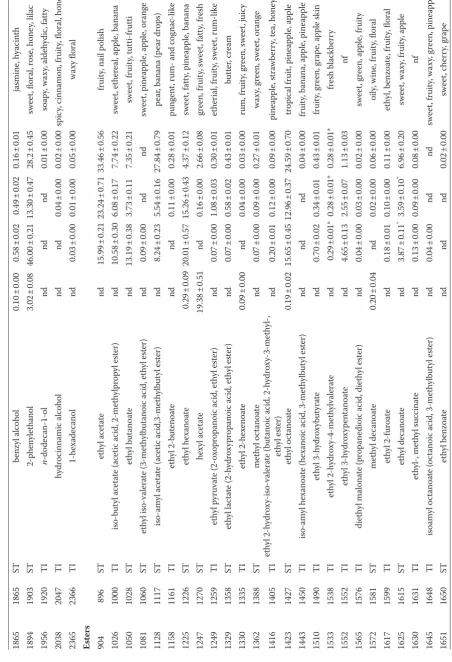
Using the above-mentioned gas chromatograph-ic method, more than 900 VOCs were detected in analysed Gewurztraminer samples. In wines, 175 VOCs in total were identified (tentatively or based on comparisons with standards). Out of this number, 41 volatiles belonged to esters, 34 to higher alcohols, and 8 to volatile acids. On the contrary, in grape juice
only 56 VOCs in total were identified and out of them only 17 higher alcohols, 6 esters, and 3 volatile acids. The remaining VOCs (30 in grape juice and 92 in wines) belonged to groups of terpenoids, furans, pyrans, carbonyls, volatile phenols, and sulphur compounds. For the illustration of the wine VOC profile complexity, higher alcohols, esters, and volatile acid profiles in wines and juice before fermentation
are presented in Table 2. A comparison of arel of
compounds identified in juice and in wines showed which VOCs are products of yeast metabolism and which originate naturally from the grape juice (and are produced by the vine plant).
Higher alcohols. Among all identified higher al-cohols, C6 and C8 alcohols were the most abundant in grape juice; the highest arel in juice was shown by 2-hexen-1-ol and 1-hexanol. Alcohols with minor abundance: 1-heptanol, 1-octanol, trans-3-hexen-1-ol,
cis-3-hexen-1-ol, 1-octen-3-ol, 2-octanol, 3-octanol, 2-heptanol, 2-nonanol, and 2-undecanol bring pre-dominantly green aroma tones, while higher saturated alcohols like 1-nonanol, 1-decanol, 1-undecanol, and 2-ethylhexanol are responsible for citrus-like smells. During fermentation, concentrations of all these fusel alcohols decreased and the most significant decrease was observed in 2-hexenol. The highest variance, according to the yeast strain used for fermentation, was observed in 1-hexanol. The relative peak area of this alcohol (responsible for ethereal and fruity
aroma) decreased using S. cerevisiae Y2 from 21.40
[image:4.595.63.530.123.240.2]to 18.18 compared with 0.40 (Y1) and 1.08 (Y3). The presence of most fusel alcohols in wine is bound to the metabolism of yeasts participating in alcoholic fermentation. Their occurrence and concen-tration depend on the varietal amino acid profile of grapes, metabolic activity of fermenting microflora, and technological conditions (Hernandez-Orte
Table 1. Basic oenological characteristics of Gewürztraminer wines fermented with autochthonous strains of S. cerevisiae
Strain S. cerevisiae Y1 Y2 Y3
Reducing sugars (g/l) 14.1 ± 0.10 14.7 ± 0.06 31.1 ± 0.12
Ethanol (% v/v) 14.2 ± 0.10 13.9 ± 0.10 11.9 ± 0.06
Total extract (g/l) 33.6 ± 0.20 35.4 ± 0.21 56.4 ± 0.23
Volatile acids (g/l) 0.31 ± 0.01* 0.31 ± 0.01* 0.29 ± 0.01*
Total acids (g/l) 4.9 ± 0.06 5.5 ± 0.06 5.5 ± 0.12
SO2 free (mg/l) 34 34 34
SO2 total (mg/l) 152 157 153
Data were mean values of triplicate samples (maximum SD ± 5%); p < 0.05; *the same characters in the same row correspond to a not statistically significant difference (p > 0.05)
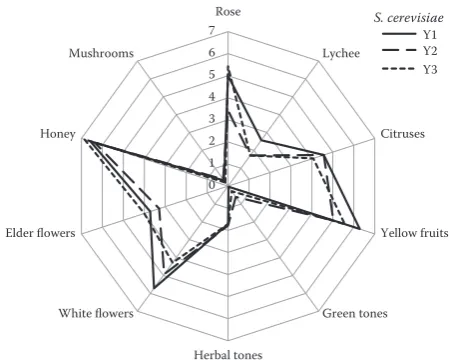
Figure 1. Aromagrams of Gewurztraminer wines fer-mented with 3 autochthonous strains of S. cerevisiae
Data were calculated as the arithmetic average of evaluations done by eight wine tasters; maximum SD ± 15%; p < 0.05
0 1 2 3 4 5 6 7
Rose
Lychee
Citruses
Yellow fruits
Green tones
Herbal tones White flowers
Elder flowers Honey
Mushrooms
[image:4.595.63.288.522.702.2]doi: 10.17221/79/2016-CJFS
Ta
ble 2. E
st
ers
, hig
her alc
ohol
s, and vol
atile ac
id
s iden
tifie
d in G
ew ur ztraminer w ine s f er men te d w ith t hr ee a ut oc ht honou
s strains of
S. cere vi si ae LTPR Iexp LTPR Ilit ID VO C iden tifie d arel O dour de sc ript or gra pe juic e Y1 Y2 Y3 Hig her a lcohol s 1065 1064 ST 1-pr op anol nd 10.93 ± 0.13 9.26 ± 0.44 12.86 ± 0.32 m usty , ye asty , s we et 1100 1100 ST iso-but anol (2-me th yl-1-pr op anol) 0.91 ± 0.10 29.72 ± 1.05 13. 20 ± 0.47 6.68 ± 0.24 et her eal, w ine y 1114 1100 ST 3-pen tanol nd 1.31 ± 0.05 0.92 ± 0.03 1.12 ± 0.04 swe et , herb al, oily , n ut ty 1125 1113 ST 2-pen tanol nd 4.47 ± 0.16* 3.23 ± 0.11 4.31 ± 0.15* mild, g re en, oily , f er men te d 1144 1151 ST 1-but anol nd 0.36 ± 0.01 0.31 ± 0.01 0.16 ± 0.01 fu se
l, oil, s
we et , b al sam, whi sk ey 1183 1201 ST ac tive am yl alc ohol (2-me th yl-1-but anol) nd 0.02 ± 0.00 0.40 ± 0.01 0.66 ± 0.02 fer men te d, ye asty 1205 1213 ST iso-am yl alc ohol (3-me th yl-1-but anol) nd 42.42 ± 1.50 15.79 ± 0.56* 14.21 ± 0.50* pungen t, f ruity , b anana 1230 1248 ST 2-me th yl-1-pen ten-3-ol nd 0.04 ± 0.00* 0.04 ± 0.00* 0.01 ± 0.00 nf 1231 1248 ST 3-me th yl-3-but en-1-ol nd nd 0.10 ± 0.00* 0.10 ± 0.00* swe et , f ruity 1233 1251 ST 1-pen tanol 0.49 ± 0.11 nd 0.94 ± 0.03 0.88 ± 0.03 fer men te d, ye asty , w ine y 1312 1317 ST 2-he pt anol 0.42 ± 0.08 nd 0.36 ± 0.01 0.28 ± 0.01 lemon g ra ss , s we et , g re en 1317 1341 ST 3-me th yl-1-pen tanol nd 0.34 ± 0.01 2.17 ± 0.08 1.41 ± 0.05 fu se l, c og nac , w ine, f ruity 1317 1324 ST iso-he xanol (4-me th yl-1-pen tanol) nd 6.17 ± 0.22 0.07 ± 0.00 nd nut ty 1336 1351 ST 1-he xanol 21.40 ± 0.25 0.40 ± 0.01* 18.18 ± 0.64 1.08 ± 0.04* et her eal, f ruity , alc oholic 1344 1334 ST tra ns -3-he xen-1-ol 0.60 ± 0.04 2.00 ± 0.07 nd nd gr een, le af y 1358 1355 ST ci s -3-he xen-1-ol 0.31 ± 0.03 nd nd 0.05 ± 0.00 gr een, g ra ss y, me lon r ind 1365 1390 ST 3-o ct anol 0.62 ± 0.10 nd 0.02 ± 0.00* 0.02 ± 0.00* ear th y, m us hr oom, herb al, spic y 1410 1412 TI 2-he xen-1-ol, i somer 24.51 ± 0.91 0.03 ± 0.00 0.15 ± 0.01 0.11 ± 0.00 fre sh, ve ge ta tive, s lig ht ly f at ty 1413 1416 ST 2-o ct anol 0.10 ± 0.00 nd 0.08 ± 0.00 0.06 ± 0.00 fre sh, spic y, g re en, wo ody 1438 1451 ST 1-o ct en-3-ol 3.50 ± 0.12 0.33 ± 0.01 0.26 ± 0.01 0.24 ± 0.01 ear th y, g re en, oily , f ung al 1442 1453 ST 1-he pt anol 2.04 ± 0.09 0.28 ± 0.01 0.24 ± 0.01 0.65 ± 0.02 m usty , le af y, ve ge ta tive 1448 1451 ST sulc at ol nd 0.24 ± 0.01 0.15 ± 0.01 0.13 ± 0.00 swe et , oily , g re en, c or iander 1467 1485 ST 2-e th yl-1-he xanol 1.10 ± 0.07 0.09 ± 0.00 0.08 ± 0.00 0.05 ± 0.00 citr us , f re
sh, floral, oily
, s we et 1480 1509 TI 3-e th yl-4-me th ylp en tanol, ( s )-nd 0.03 ± 0.00* 0.03 ± 0.001 0.03 ± 0.00* nf 1512 1515 ST 2-nonanol 0.30 ± 0.01 0.02 ± 0.00 0.06 ± 0.00 0.03 ± 0.00 w axy , g re en, c re am y, orange 1531 1538 ST 2,3-but ane diol nd 2.52 ± 0.09* 0.17 ± 0.01 2.42 ± 0.09* fr uity , c re am y, but ter y 1544 1536 ST 1-o ct anol 3.72 ± 0.04 0.27 ± 0.01 0.41 ± 0.01 0.23 ± 0.01 w axy , g re en, c itr us , floral 1645 1654 ST 1-nonanol 3.30 ± 0.05 0.06 ± 0.00* 0.06 ± 0.00* 0.18 ± 0.01 fre sh, f at ty
, floral, r
os e, orange 1750 1759 ST 1-de canol nd nd 0.01 ± 0.00* 0.01 ± 0.00* fa tty , s we et
1865 1865 ST benz yl alc ohol 0.10 ± 0.00 0.58 ± 0.02 0.49 ± 0.02 0.16 ± 0.01 ja smine, h yac in th 1894 1903 ST 2-phen yle thanol 3.02 ± 0.08 46.00 ± 0.21 13.30 ± 0.47 28.2 ± 0.45 swe et
, floral, r
os e, hone y, lil ac 1956 1920 TI n -do de can-1-ol nd nd nd 0.01 ± 0.00 so apy , w axy , alde hydic , f at ty 2038 2047 TI hydr oc innamic alc ohol nd nd 0.04 ± 0.00 0.02 ± 0.00 spic y, c innamon, f ruity
, floral, hone
y 2365 2366 TI 1-he xade canol nd 0.03 ± 0.00 0.01 ± 0.00 0.05 ± 0.00 w axy floral Ester s 904 896 ST et hyl ac et at e nd 15.99 ± 0.21 23.24 ± 0.71 33.46 ± 0.56 fr uity
, nail p
oli sh 1026 1000 TI iso-butyl ac et at e (ac etic ac id, 2-me th ylpr opyl e st er) nd 10.58 ± 0.30 6.08 ± 0.17 7.74 ± 0.22 swe et , e ther eal, a pple, b anana 1050 1028 ST et hyl but ano at e nd 13.19 ± 0.38 3.73 ± 0.11 7.35 ± 0.21 swe et , f ruity , t ut ti-f rut ti 1081 1060 ST et hyl i so-valera te (3-me th ylbut anoic ac id, e th yl e st er) nd 0.09 ± 0.00 nd nd swe et , pine apple, a pple, orange 1128 1117 ST iso-am yl ac et at e (ac etic ac id,3-me th ylbutyl e st er) nd 8.24 ± 0.23 5.54 ± 0.16 27.84 ± 0.79 pe ar , b anana (p ear dr op s) 1158 1161 TI et hyl 2-but eno at e nd nd 0.11 ± 0.00 0.28 ± 0.01 pungen t, r
um- and c
og nac -lik e 1225 1226 ST et hyl he xano at e 0.29 ± 0.09 20.01 ± 0.57 15.26 ± 0.43 4.37 ± 0.12 swe et , f at ty , pine apple, b anana 1247 1270 ST he xyl ac et at e 19.38 ± 0.51 nd 0.16 ± 0.00 2.66 ± 0.08 gr een, f ruity , s we et , f at ty , f re sh 1249 1259 TI et hyl py ruv at e (2-o xopr op anoic ac id, e th yl e st er) nd 0.07 ± 0.00 1.08 ± 0.03 0.30 ± 0.01 et her ial, f ruity , s we et , r um-lik e 1329 1358 ST et hyl l ac ta te (2-h ydr oxy pr op anoic ac id, e th yl e st er) nd 0.07 ± 0.00 0.58 ± 0.02 0.43 ± 0.01 but ter , c re am 1330 1335 TI et hyl 2-he xeno at e 0.09 ± 0.00 nd 0.04 ± 0.00 0.03 ± 0.00 rum, f ruity , g re en, s we et , juic y 1362 1388 ST me th yl o ct ano at e nd 0.07 ± 0.00 0.09 ± 0.00 0.27 ± 0.01 w axy , g re en, s we et , orange 1416 1405 TI et hyl 2-h ydr oxy -is o-valera te ( but anoic ac id, 2-h ydr oxy -3-me th yl-, et hyl e st er) nd 0.20 ± 0.01 0.12 ± 0.00 0.09 ± 0.00 pine apple, stra w ber ry , t ea , hone y 1423 1427 ST et hyl o ct ano at e 0.19 ± 0.02 15.65 ± 0.45 12.96 ± 0.37 24.59 ± 0.70 tr opic al f ruit , pine apple, a pple 1443 1450 TI iso-am yl he xano at e (he xanoic ac id, 3-me th ylbutyl e st er) nd nd nd 0.04 ± 0.00 fr uity , b anana , a pple, pine apple 1510 1490 TI et hyl 3-h ydr oxy buty ra te nd 0.70 ± 0.02 0.34 ± 0.01 0.43 ± 0.01 fr uity , g re en, g ra pe, a pple s kin 1533 1538 TI et hyl 2-h ydr oxy -4-me th ylv alera te nd 0.29 ± 0.01* 0.28 ± 0.01* 0.28 ± 0.01* fre sh bl ac kb er ry 1552 1552 TI et hyl 3-h ydr oxy pen tano at e nd 4.65 ± 0.13 2.55 ± 0.07 1.13 ± 0.03 nf 1565 1576 TI die th yl malona te (pr op ane dioic ac id, die th yl e st er) nd 0.04 ± 0.00 0.03 ± 0.00 0.02 ± 0.00 swe et , g re en, a pple, f ruity 1572 1581 ST me th yl de cano at e 0.20 ± 0.04 nd 0.02 ± 0.00 0.06 ± 0.00 oily , w ine, f ruity , floral 1617 1599 TI et hyl 2-f ur oa te nd 0.18 ± 0.01 0.10 ± 0.00 0.11 ± 0.00 et hyl, b enzo at e, f ruity , floral 1625 1615 ST et hyl de cano at e nd 3.87 ± 0.11
* 3.59
±
0.10
* 6.96
[image:6.595.73.526.115.778.2]± 0.20 swe et , w axy , f ruity , a pple 1630 1631 TI et hyl-, me th yl suc cina te nd 0.13 ± 0.00 0.09 ± 0.00 0.08 ± 0.00 nf 1645 1648 TI iso am yl o ct ano at e ( oc tanoic ac id, 3-me th ylbutyl e st er) nd 0.04 ± 0.00 nd nd swe et , f ruity , w axy , g re en, pine apple 1651 1650 ST et hyl b enzo at e nd nd nd 0.02 ± 0.00 swe et , c her ry , g ra pe Ta
ble 2 t
doi: 10.17221/79/2016-CJFS 1661 1672 ST et hyl 3-h ydr oxyhe xano at e nd 0.01 ± 0.00 0.01 ± 0.00 0.01 ± 0.00 fr uity , g ra pe, g re en, s we et , ha y lik e 1663 1670 ST die th yl suc cina te ( but ane dioic ac id, die th yl e st er) nd 0.59 ± 0.02 6.01 ± 0.17 2.82 ± 0.08 mild, f ruity , c ook ed a pple 1665 1671 ST n -de cyl ac et at e 0.22 ± 0.05 4.70 ± 0.13 nd nd w axy , c le an, f re sh, c itr us , s oa py 1671 1675 TI et hyl 9-de ceno at e nd 0.09 ± 0.00 0.07 ± 0.00 0.45 ± 0.01 fr uity , f at ty 1769 1773 TI et hyl phen yl ac et at e nd 0.41 ± 0.01 0.39 ± 0.01 0.19 ± 0.01 swe et
, floral, hone
y, r os e, c oc oa 1810 1810 TI 2-phen yle th yl ac et at e nd 3.63 ± 0.10 4.94 ± 0.14 4.42 ± 0.13 swe et , hone
y, floral, r
os y 1833 1820 ST et hyl do de cano at e nd 0.15 ± 0.00 0.19 ± 0.01 0.61 ± 0.02 swe et , w axy , s oa py , r umm y 1869 1846 TI et hyl h ydr oc innama te ( benzene pr op anoic ac id, e th yl e st er) nd nd 0.01 ± 0.00 0.01 ± 0.00 hy ac in th, r os e, hone y, f ruity , r umm y 1942 1938 TI ( z )-3-he xen yl nonano at e nd 0.05 ± 0.00 0.04 ± 0.00 0.03 ± 0.00 1952 1958 TI 2 -phen yle th yl but ano at e nd nd 0.09 ± 0.00 0.01 ± 0.00 m usty , s we et
, floral, ye
asty , n uanc e 2038 2053 TI die th yl dl -mal at e ( but ane dioic ac id, h ydr oxy -, die th yl e st er) nd 0.02 ± 0.00 *0.05 ± 0.00 0.02 ± 0.00* w ine, f ruity , a pple s kin 2040 2042 TI et hyl m yr ist at e (t etrade canoic ac id, e th yl e st er) nd nd 0.02 ± 0.00 nd swe et , w axy 2248 2250 TI et hyl p almit at e (he xade canoic ac id, e th yl e st er) nd 0.17 ± 0.00
* 0.16
± 0.00* 0.24 ± 0.01 mild, w axy , f ruity , c re am y, milk y 2450 2467 TI et hyl st eara te ( oc tade canoic ac id, e th yl e st er) nd nd 0.03 ± 0.00 nd mild, w axy 2599 2598 TI me th yl v anill at e ( benzoic ac id, 4-h ydr oxy -3-me tho xy -, me th yl est er) nd 0.14 ± 0.00
* 0.15
± 0.00* 0.14 ± 0.00 * spic y, v anill a, phenolic 2626 2612 TI et hyl v anill at e ( benzoic ac id, 4-h ydr oxy -3-me tho xy -, e th yl e st er) nd 0.15 ± 0.00 0.17 ± 0.00 0.18 ± 0.01 phenolic , bur nt , smok y, p owder y Vol atile ac id s 1432 1434 TI 4-me th yl-2-o xov aler ic ac id nd 0.08 ± 0.00* 0.07 ± 0.00* 0.02 ± 0.00 fr uity 1558 1563 TI iso-but anoic ac id (2-me th ylpr op anoic ac id) nd nd 0.04 ± 0.00 0.07 ± 0.00 ac idic , c he es e, d air y, but ter y 1627 1619 ST but anoic ac id nd nd nd 0.08 ± 0.00 shar p, c he es y, but ter y 1659 1684 TI 3-me th ylv aler ic ac id (3-me th ylp en tanoic ac id) nd 0.50 ± 0.03* 0.37 ± 0.02 0.48 ± 0.03* animalic , s har p, ac idic , g re en 1840 1837 ST he xanoic ac id nd 0.74 ± 0.04 2.41 ± 0.14* 2.21 ± 0.13* sour , f at ty , s we at , c he es e 1944 1969 ST 2-e th yl-he xanoic ac id 0.17 ± 0.00 0.22 ± 0.01 0.17 ± 0.01 0.26 ± 0.01 herb ac eou s, e ar th y 2051 2059 ST oc tanoic ac id 0.59 ± 0.03 1.57 ± 0.09* 2.18 ± 0.13* 9.39 ± 0.54 fa tty , w axy , ve ge ta ble, c he es y 2268 2274 ST n -de canoic ac id 0.17 ± 0.01 5.74 ± 0.33 2.08 ± 0.00 1.11 ± 0.06 un ple asan t, s our , f at ty , c itr us The d at a wer e me an v alue
s of tr
iplic at e sam ple s ( p
< 0.05); L
TPR Iexp – e xp er imen tal v
alue of line
ar t em pera tur e pr og ramme d r et en tion inde x (L TPR I); L TPR Ilib – r ef er enc e L TPR I value obt aine d f rom t he N IS T W ebB ook C hemi str y d at ab as e; I
D – iden
tific
ation; VO
C – vol
atile or
ganic c
om
pound; S
T – VO
C c
onfir
me
d by a
ut
hen
tic st
and
ar
d; TI – t
en ta tive ly iden tifie d VO C ; arel – r el ative p eak ar
ea of VO
C
; nf – not f
ound; *v
alue
s in t
he same r
ow c
or
re
sp
ond t
o a not st
[image:7.595.78.457.94.777.2]ati stic ally sig nific an t diff er enc e ( p > 0.05) Ta
ble 2 t
et al. 2002). The most abundant higher alcohols in the studied Gewurztraminer wines were 2-pheny-lethanol, 3-methylbutanol, 2-methyl-1-propanol, 1-propanol, and 2,3-butandiol. 2-Phenylethanol was identified in all samples at significantly higher arel
than the other identified VOCs. It can be considered as the major yeast produced higher alcohol in tested wines in spite of the fact that the grape juice also contained it before fermentation (3.02). S. cerevisiae
produces this rose-scent alcohol by bioconversion of l-phenylalanine via the Ehrlich pathway and its production strictly depends on the yeast strain (Stark
et al. 2003). The highest arel of 2-phenylethanol was confirmed in wine fermented with the autochthonous strain of S. cerevisiae Y1 (46.0). 2-Phenylethanol is important since it can support the typical rose-like aroma of Gewurztraminers.
The second abundant alcohol identified in wine samples was 3-methylbutanol (iso-amyl alcohol). At an optimal concentration it brings the typical banana
and pear-like aroma (Swiegers et al. 2005;
Samap-pito & Butkhup 2010), excessive concentrations cause the nail polish odour of wines. Precursors of 3-methylbutanol are the amino acids leucine and valine, but it can be formed also by the metabolism of pyruvate (Swiegers et al. 2005). The highest arel
of 3-methylbutanol reported wine fermented with
S. cerevisiae Y1 (42.4), the lowest with S. cerevisiae
Y3 (14.2). From a sensory point of view, grassy and green aromas are very important for the final flavour of each wine. Except of primary aroma alcohols (dis-cussed previously) this type of smell is represented by higher alcohols produced by the yeast and detected
in wine samples: 2-pentanol, 3-pentanol, and dl-6-methyl-5-hepten-2-ol (sulcatol).
Higher alcohols identified in wines fermented with three different yeast strains underwent statistical treatment using PCA (Figure 3). The correlation matrix was calculated in order to discriminate the variables. Finally, 20 higher alcohols were consid-ered as products of the metabolism of tested yeast strains (the values of arel after fermentation were higher than before fermentation). The PC analysis explained 98.9% of total variance (60.9% for the PC1 and 38% for PC2).
The score plot of PCA displays three clearly dif-ferentiated groups occupying different quadrants of the plot. The profile of higher alcohols related to the strain Y1 was separated from strains Y2 and Y3 by a positive correlation with PC1. Y1 was charac-terised by the production of 4-methyl-1-pentanol (nutty aroma), 3-methylbutanol (banana descriptor), 6-methyl-5-hepten-2-ol (spiciness), 2-methylpropan-1-ol (winey), and 2-phenyl ethanol (roses). The strains Y2 and Y3 differ from Y1 by higher production of 3-methyl-3-buten-1-ol and 1-decanol (both sweet fruity smell). The PC2 allowed the differentiation
of strains Y2 and Y3. 1-Propanol, n-dodecanol, and
2-methyl-1-butanol (active amyl alcohol) were posi-tively correlated with S. cerevisiae Y3 and negatively with Y2. S. cerevisiae Y2 was characterised by higher production of 3-methyl-1-pentanol.
[image:8.595.64.376.106.327.2]Esters. Most esters in wine are formed during fermentation enzymatically by the metabolism of yeasts or during wine maturation as a consequence of the slow non-enzymatic esterification of different
Figure 2. Colour plot of Gewurztramin-er wine fGewurztramin-ermented with S. cerevisiae Y2 obtained by GC×GC-TOF-MS with the employment of DB-FFAP (polar) × BPX-50 (mid-polar) column configuration
The x-axis represents 1st dimension
re-tention time expressed in min; the y-axis represents 2nd dimension retention time
doi: 10.17221/79/2016-CJFS
organic acids with higher alcohols present in wine
(Campo et al. 2007; Weldegergis et al. 2011b).
Branched-chain aliphatic esters are the result of the enzymatic esterification of acids with alcohols pro-duced by yeasts from the corresponding amino acids (Ehrlich pathway) or amino acid derivatives, such as
α-ketoacids (Antalick et al. 2010). The production
of esters depends on many factors including aeration, concentration of fatty acids, higher alcohols, and their precursors. The species and strain of yeasts plays an important role in the production of esters (Plata et
al. 2003). In Gewurztraminer wines fermented with
three autochthonous S. cerevisiae strains 41 esters were identified by the LLE-GC×GC-TOF/MS tech-nique (Table 1). According to literature (Jackson 2008) the most frequent were ethyl esters (28), methyl
(5), and isoamyl esters (3) and esters derived from acetic (7), hexanoic (3), octanoic (3), and decanoic acid (3). Based on arel of identified VOCs the most abundant were ethyl hexanoate, ethyl acetate, ethyl octanoate, ethyl butanoate, 2-methylpropyl acetate, and 3-methylbutyl acetate.
[image:9.595.63.531.90.282.2]Esters have been studied very well in terms of the yeast and bacteria metabolism as well as winemak-ing technology. However, the profile of naturally oc-curring esters in grapes or grape juice has not been published so frequently. Jackson (2008) showed that the major esters in grapes are phenolic esters, methyl antranilate, and partially isoamyl acetate in Pinotage; ethyl 2-methylpropanoate, ethyl 2-butenoate, 3-meth-ylbutyl butanoate, ethyl hexanoate, ethyl octanoate, hexyl acetate, 2-metylbutyl acetate were identified
Figure 3. Score plot (A) and loading plot (B) of the first and second principal components after the PC analysis of higher alcohol profiles of Gewurztraminer wines fermented with three autochthonous strains of S. cerevisiae (Y1, Y2, and Y3)
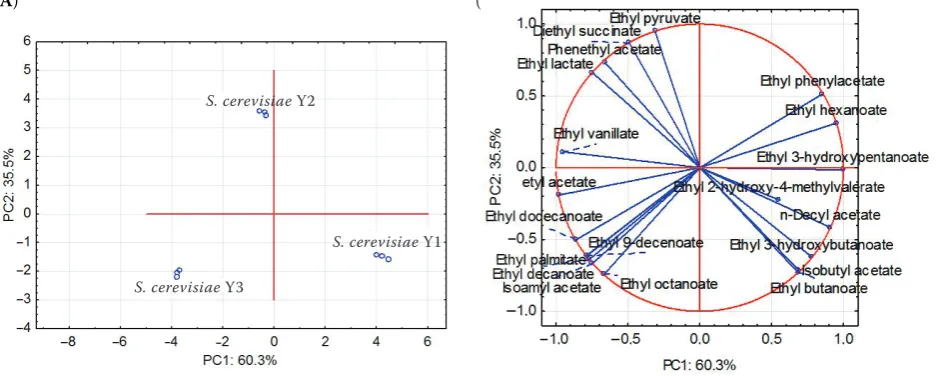
Figure 4. Score plot (A) and loading plot (B) of the first and second principal components after the PC analysis of ester profiles of Gewurztraminer wines fermented with three autochthonous strains of S. cerevisiae (Y1, Y2, and Y3)
(A) (B)
(A) (B)
S. cerevisiae Y3
S. cerevisiae Y2 S. cerevisiae Y1
S. cerevisiae Y3
S. cerevisiae Y2
[image:9.595.67.536.544.732.2]in Chardonnay juice and a significant concentration of isoamyl butanoate and ethyl hexanoate in Riesling (Swiegers et al. 2005). In the analysed Gewurztramin-er grape juice 6 estGewurztramin-ers wGewurztramin-ere identified: hexyl acetate, ethyl hexanoate, n-decyl acetate, methyl decanoate, ethyl octanoate, and ethyl 2-hexenoate. In terms of
arel ethyl hexanoate (19.38) was the major ester. The relative peak area of other esters in juice was signifi-cantly lower (0.09–0.29). During fermentation, the concentration of most juice esters rapidly decreased;
only ethyl octanoate, ethyl hexanoate, and n-decyl
acetate (in case of S. cerevisiae Y1) increased. The influence of the yeast strain on the profile of esters in wine was analysed using PCA (Figure 4) and the correlation matrix was calculated based on arel values of 20 esters with the highest average increase of the value in wine compared with grape juice. PCA explained 95.8% of total variance (60.3% for the PC1 and 35.8% for PC2). Similarly to higher alcohols, each yeast strain was located in an indi-vidual quadrant of the score plot. The ester profile
related to S. cerevisiae Y1 was separated from the
other two strains by a positive correlation with PC1 and S. cerevisiae Y2 and Y3 were separated by PC2. Strain Y1 was characterised by higher production of ethyl butanoate, 2-methylpropyl acetate, and ethyl hexanoate (typical fruity scent esters) and low pro-duction of ethyl acetate. Therefore, this strain can be useful in the production of wines characterised by sweet and fruity (apple, banana, pineapple) smell descriptors. This finding correlates also with the sensory evaluation of tested wine (Figure 1). Strains
Y2 and Y3 could be distinguished from each other according to PC2. S. cerevisiae Y2 was characterised by higher production of ethyl pyruvate (sweet, rum-like), diethyl succinate (cooked apple), 2-phenylethyl acetate (honey, rose-like), and ethyl lactate (cream-like) and by the lowest production of fruity esters typical of the strain Y1. S. cerevisiae Y3 produced the highest concentration of isoamyl acetate (pear/nail polish) and of long-chain fatty acid esters (fatty and waxy aroma). Based on these facts, S. cerevisiae Y3 was considered too risky and not suitable for practi-cal winemaking.
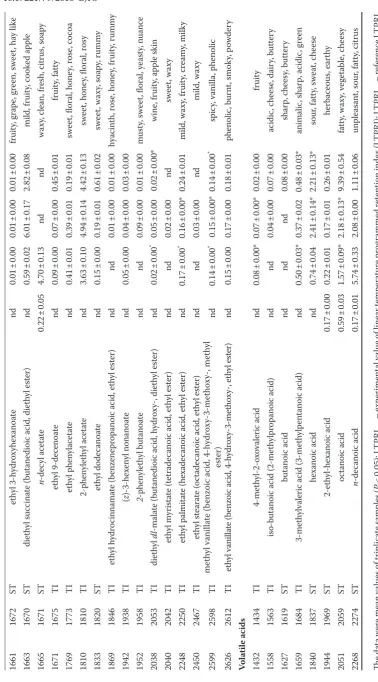
Volatile acids. The most abundantvolatile acids in wines include short-chain acids (acetic, propa-noic, and butanoic) and medium-chain saturated acids (hexanoic, octanoic, decanoic, and dodeca-noic). Short-chain acids are formed as metabolic by-products of alcoholic fermentation, while medium-chain acids are considered as intermediates of the long-chain fatty acid biosynthesis (Lambrechts & Pretorius 2000). Beside acetic acid (Table 1), 8 volatile acids were identified in the analysed wine samples (Table 2), while 3 of them were also present in grape juice (octanoic acid, decanoic acid, and 2-ethylhexanoic acid). Generally, arel of all identified volatile acids increased during fermentation depend-ing on the applied yeast strain. Accorddepend-ing to literature (Jascon 2008) the largest increase was recorded in octanoic and decanoic acid (both responsible for fatty and waxy odours).
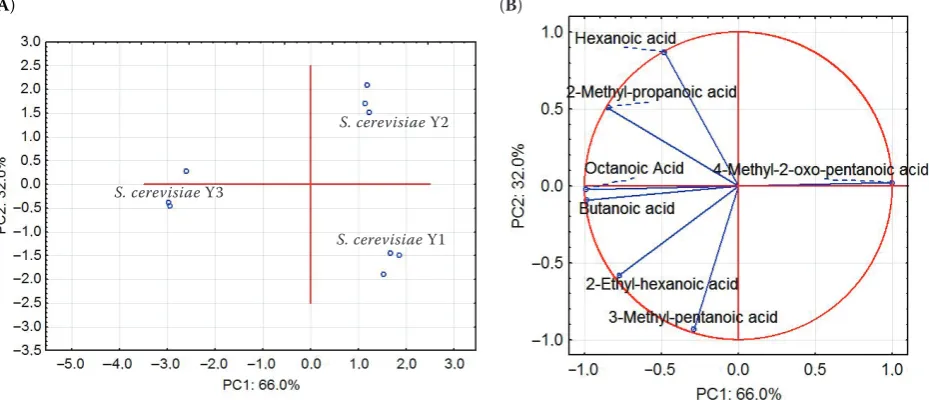
[image:10.595.65.530.539.739.2]To judge the influence of particular yeast strains on the profile of volatile organic acids in wine, the PC
Figure 5. Score plot (A) and loading plot (B) of the first and second principal components after the PC analysis of volatile acid profiles of Gewurztraminer wines fermented with three autochthonous strains of S. cerevisiae (Y1, Y2, and Y3)
(A) (B)
S. cerevisiae Y3
S. cerevisiae Y2
doi: 10.17221/79/2016-CJFS
analysis was performed; the correlation matrix was calculated based on arel values of all 8 volatile acids identified in wine samples. PCA explained 98% of total variance (66% for PC1 and 32% for PC2). The profile of volatile acids related to S. cerevisiae Y3 was separated from the other two strains by a negative correlation with PC1; strains Y1 and Y2 were more similar and separated by PC2. Strain Y1 (compared with the other strains) was characterised by the lowest production of octanoic acid and by the highest production of decanoic acid; yeast strain Y2 was characterised by higher production of hexanoic acid. S. cerevisiae Y3 produced all 8 volatile acids. Compared to the other strains, the strain Y3 was characterised by higher pro-duction of octanoic, butanoic, 2-methylpropanoic, and 2-ethylhexanoic acid. Among all tested yeast strains
S. cerevisiae Y3 produced the lowest concentration of n-decanoic acid but a high amount of decanoates. Because of the significantly different odour threshold, the production of volatile acids does not affect the aroma of wine as considerably as the production of their corresponding esters (Jiang & Zhang 2010):
odour threshold of n-decanoic acid 15 mg/l versus
ethyl decanoate 0.2 mg/l; odour threshold of octanoic acid 0.5 mg/l versus ethyl octanoate 2 µg/l. Neverthe-less, the evaluation of the aroma profile by sensory analysis did not confirm any waxy, fatty, or soapy aroma in tested wines.
concluSIon
Gewurztraminer wines fermented with three dif-ferent strains of S. cerevisiae var. cerevisiae as well
as grapejuice before fermentation were analysed by
methods of basic chemical analysis, gas chromatogra-phy (LLE-GCxGC-TOF/MS), and sensory analysis to evaluate the influence of the yeast strain on the profile of higher alcohols, esters, and volatile acids in wine.
In the analysed wine samples, 175 volatile organic compounds (VOCs) were identified while in the initial grape juice only 56 VOCs belonging to higher alcohols (17), esters (6), and volatile acids (3) were present. From those VOCs found in wines; 41 belong to esters, 34 are higher alcohols, and 8 belong to volatile acids.
A comparison of arel values of VOCs identified in
juice with those in wines provided information on VOCs originating naturally from grapes and those produced by the yeast metabolism.
C6 and C8 alcohols identified in juice decreased dur-ing fermentation, probably as a result of strippdur-ing with
CO2 or esterification. The influence of the yeast strain was mostly obvious in case of 1-hexanol. The profile of higher alcohols associated with yeast metabolism was strictly yeast strain dependent and the most abun-dant alcohols were 2-phenylethanol, 3-methylbutanol, 2-methylpropanol, 1-propanol, and 2,3-butandiol. Based on arel the most abundant esters in analysed wines were ethyl hexanoate, ethyl acetate, ethyl oc-tanoate, ethyl buoc-tanoate, 2-methylpropyl acetate, and 3-methylbutyl acetate; 6 esters were identified already in grape juice (hexyl acetate, ethyl hexanoate, n-decyl acetate, methyl decanoate, ethyl octanoate, and ethyl 2-hexenoate). During fermentation the arel of most ‘juice esters’ rapidly decreased; only ethyl octanoate and ethyl hexanoate increased. Eight volatile acids were identified in the analysed wine samples, while 3 of them were already present in grape juice (octanoic acid, decanoic acid, and 2-ethylhexanoic acid). The concentration of all identified volatile acids increased during fermentation and the increase depended on the yeast strain used for fermentation.
To consider the influence of particular yeast strains on the profile of higher alcohols, esters, and vola-tile acids in wine, the means of arel acquired by GC analysis were used as input values for the principal component analysis. Using PCA it was found that
S. cerevisiae Y1 was characterised by higher pro-duction of 4-methyl-1-pentanol, 3-methylbutanol, 6-methyl-5-hepten-2-ol, 2-methylpropanol, and 2-phenyl ethanol. Among the esters, higher produc-tion of ethyl butanoate, 2-methylpropyl acetate, and ethyl hexanoate and low production of ethyl acetate was observed. This strain also produced the low-est concentration of octanoic acid and the highlow-est concentration of decanoic acid. The profile of wine
fermented with S. cerevisiae Y2 was characterised
by higher concentration of 3-methyl-3-buten-1-ol and 1-decanol, 3-methyl-1-pentanol, ethyl pyruvate, diethyl succinate, 2-phenyletyl acetate, and ethyl lac-tate and by the lowest concentration of fruity esters typical of the strain Y1. Also, Y2 was characterised by higher production of hexanoic acid. S. cerevisiae Y3 was characterised by high production of
3-methyl-3-buten-1-ol, 1-decanol, 1-propanol, n-dodecanol,
and 2-methylbutanol. It also differentiated by the highest production of ethyl acetate, 3-methylbutyl acetate, and of long-chain fatty acid esters.
clean aroma and sweet, fruity (apple, banana, pine-apple) smell descriptors. S. cerevisiae Y2 provided rather a neutral aroma profile with intense green tones and Y3 (in spite of the most intense rose-like aroma) was not considered suitable for practical winemaking because of the excessive production of ethyl and isoamyl acetate and waxy scents.
references
Antalick G., Perello M.-C., De Revel G. (2010): Develop-ment, validation and application of a specific method for the quantitative determination of wine esters by head-space-solid-phase microextraction-gas chromatography– mass spectrometry. Food Chemistry, 121: 1236–1245. Cadot Y., Caillé S., Thiollet-Scholtus M., Samson A.,
Bar-beau G., Cheynier V. (2012): Characterisation of typicality for wines related to terroir by conceptual and by percep-tual representations. An application to red wines from the Loire Valley. Food Quality and Preference, 24: 48–58. Campo E., Cacho J., Ferreira V. (2007): Solid phase extrac-tion, multidimensional gas chromatography mass spec-trometry determination of four novel aroma powerful ethyl esters Assessment of their occurrence and impor-tance in wine and other alcoholic beverages. Journal of Chromatography A, 1140: 180–188.
Fleet G.H. (2008): Wine yeasts for the future. FEMS Yeast Research, 8: 979–995.
Hernandez-Orte P., Cacho J.F., Ferreira V. (2002): Relation-ship between varietal amino acid profile of grapes and wine aromatic composition. Experiments with model solutions and chemometric study. Journal of Agricultural and Food Chemistry, 50: 2891–2899.
Jackson R.S. (2008): Wine Science: Principles and Applica-tions. 3rd Ed. Amsterdam, Elsevier.
Jiang B., Zhang Z. (2010): Volatile compounds of young wines from Cabernet Sauvignon, Cabernet Gernischet and Chardonnay varieties grown in the Loess Plateau region of China. Molecules, 15: 9184–9196.
Kurtzmann C.P., Fell J.W. (2000): The Yeasts, a Taxonomic Study. 4th Ed. Amsterdam, Elsevier.
Lambrechts M.G., Pretorius I.S. (2000): Yeast and its im-portance to wine aroma – a review. South African Journal of Enology and Viticulture, 21: 97–129.
Molina A.M., Guadalupe V., Varela C., Swiegers J.H., Pre-torius I.S., Agosin E. (2009): Differential synthesis of fer-mentative aroma compounds of two related commercial wine yeast strains. Food Chemistry, 117: 189–195.
Murray J.A. (2012): Qualitative and quantitative approaches in comprehensive two-dimensional gas chromatography. Journal of Chromatography A, 1261: 58–68.
OIV (2015): Compendium of international methods of wine and must analysis. Edition 2015, International Organiza-tion of Vine and Wine, Paris, France.
Plata C., Millán C., Mauricio J.C., Ortega J.M. (2003). For-mation of ethylacetate and isoamyl acetate by various species of wine yeasts. Food Microbiology, 20: 217–224. Samappito S., Butkhup L. (2010). Effect of skin contact
treatments on the aroma profile and chemical compo-nents of mulberry (Morus alba Linn.) wines. African Journal of Food Science, 4: 52–61.
Schoorl N., Regenbogen A. (1917): Maßanalytische Zuck-erbestimmung, Zeitschrift für analytische Chemie, 56: 191–202.
Stark D., Zala D., Münch T., Sonnleitner B., Marison I.W., von Stockar U. (2003): Inhibition aspects of the biocon-version of l-phenylalanine to 2-phenylethanol by Saccha-romyces cerevisiae. Enzyme and Microbial Technology, 32: 212–223.
Stribny J., Gamero A., Pérez-Torrado R., Querol A. (2015): Saccharomyces kudriavzevii and Saccharomyces uvarum differ from Saccharomyces cerevisiae during the produc-tion of aroma-active higher alcohols and acetate esters using their amino acidic precursors. International Journal of Food Microbiology, 205: 41–46.
Styger G., Prior B., Bauer F.F. (2011): Wine flavor and aroma. Journal of Industrial Microbiology and Biotechnology, 38: 1145–1159.
Swiegers J.H., Bartowsky E.J., Henschke P.A., Pretorius I.S. (2005): Yeast and bacterial modulation of wine aroma and flavour. Australian Journal of Grape and Wine Research, 11: 139–173.
Weldegergis B.T., de Villiers A., Crouch A.M. (2011b): Ch-emometric investigation of the volatile content of young South African wines. Food Chemistry, 128: 1100–1109. Weldegergis B.T., de Villiers A., McNeish C., Seethapathy
S., Mostafa A., Gorecki T., Crouch A.M. (2011a): Char-acterisation of volatile components of Pinotage wines using comprehensive two-dimensional gas chromatogra-phy coupled to time-of-flight mass spectrometry (GC × GC–TOFMS). Food Chemistry, 129: 188–199.