Model Order Reduction of Continuous LTI Large
Descriptor System Using LRCF-ADI and Square
Root Balanced Truncation
Mehrab Hossain Likhon, Shamsil Arifeen, and Mohammad Sahadet Hossain
Abstract− In this paper, we analyze a linear time invariant (LTI) descriptor system of large dimension. Since these systems are difficult to simulate, compute and store, we attempt to reduce this large system using Low Rank Cholesky Factorized Alternating Directions Implicit (LRCF-ADI) iteration followed by Square Root Balanced Truncation. LRCF-ADI solves the dual Lyapunov equations of the large system and gives low-rank Cholesky factors of the gramians as the solution. Using these cholesky factors, we compute the Hankel singular values via singular value decomposition. Later, implementing square root balanced truncation, the reduced system is obtained. The bode plots of original and lower order systems are used to show that the magnitude and phase responses are same for both the systems.
Keywords−LTI descriptor system, suboptimal shift parameter, Lyapunov equation, low rank Cholesky factor alternating direction implicit (LRCF-ADI), square root balanced truncation.
I. INTRODUCTION
1With the advancement of technology, our lives are
getting simpler but systems around us are getting compact and complex. Often, these complex systems, such as multi body dynamics with constrains, electrical circuit simulation, fluid flow dynamics, VLSI chip design are modeled as Descriptor systems or generalized state space systems of very large dimension. Even though, the computational speed and performance of the contemporary computers are enhanced, simulation and optimization of such large-scale systems still remain difficult due to storage limitations and expensive computations [1]. In order to eliminate this problem, reduction of such large systems is mandatory. Large systems are generally comprised of sparse matrices [2]. The system was reduced after implementing several numerical methods namely Arnoldi iteration for calculating the Ritz values, ADI min-max problem to get the shift parameters heuristically, then low-rank Cholesky factor alternating directions implicit iteration for low rank
Mehrab Hossain Likhon is with the Electrical and Computer Engineering Department, North South University, Basundhara R/A, Dhaka 1229, Bangladesh (e-mail: [email protected])
Shamsil Arifeen is with the Electrical and Computer Engineering Department, North South University, Basundhara R/A, Dhaka 1229, Bangladesh (e-mail: [email protected])
Mohammed Sahadet Hossain is with the Mathematics and Physics Department, North South University, Basundhara R/A, Dhaka 1229, Bangladesh (e-mail: [email protected])
approximations of the cholesky factors of the controllability and observability Gramians of the system. Finally, by using the Hankel Singular Values, calculated from singular value decomposition of the product of the approximated cholesky factors, were able to discard the states of the system that are both difficult to observe and control. Only the Hankel Singular Values of large magnitude determine the dimension of the reduced system, since these values describe the dominant dynamics of the large system. Thus using projection matrices, the original system matrices are transformed into reduced dimension, same as the quantity of the Hankel Singular Values retained. However, the major difficulty while conducting this research was in calculating the optimal shift parameters.
II. MATHEMATICAL MODEL
Our system of concern is a continuous Linear Time Invariant (LTI) system of Descriptor form and can be represented as follows:
𝐸𝑥̇(𝑡) = 𝐴𝑥(𝑡) + 𝐵𝑢(𝑡),
𝑦(𝑡) = 𝐶𝑥(𝑡) + 𝐷𝑢(𝑡). (1)
Where, 𝐸 ∈ ℝ𝑛×𝑛, 𝐴 ∈ ℂ𝑛×𝑛, 𝐵 ∈ ℝ𝑛×𝑚, 𝐶 ∈ ℝ𝑝×𝑛, 𝐷 ∈ ∅. Here, 𝐸 is sparse, non-singular (i.e. invertible) and is a symmetric positive definite matrix, like most other large systems, indicating that all the variables are state variables and cannot be neglected [3]. If E = I, then the LTI continuous system is a standard state space system, else, it is a descriptor or generalized state space system. 𝐴 is a complex, sparse Hurwitz matrix (i.e. all the real parts of the eigenvalues of 𝐴 are negative). Both 𝐴 and 𝐸 are tridiagonal for this system. 𝐵 is the m-dimensional input vector, 𝐶 is the p-dimensional output vector, As this is not a closed loop system, so 𝐷 is null, 𝑥(𝑡) is the n-dimensional descriptor/state vector of the system and 𝑢(𝑡) and 𝑦(𝑡) are the system input and output respectively. This is a single-input-single-output (SISO) system so, 𝑚 = 𝑝 =1. As,
𝐸, 𝐴, 𝐵, 𝐶 are constant matrices and independent of time, hence this system is linear and time invariant. As rank [𝛼𝐸 − 𝛽𝐴, 𝐵] =rank [𝛼𝐸𝑇− 𝛽𝐴𝑇, 𝐶𝑇] = 𝑛, for ∀(𝛼, 𝛽) ∈
system. This pencil must be regular, i.e. det(𝜆𝐸 − 𝐴) ≠ 0 and all the eigenvalues must lie on the left half plane to ensure that the LRCF-ADI iteration converges.
After undergoing the model order reduction process, this descriptor system will be approximated by a reduced-order system as:
𝐸𝑟𝑥̇𝑟(𝑡) = 𝐴𝑟𝑥𝑟(𝑡) + 𝐵𝑟𝑢(𝑡),
𝑦(𝑡) = 𝐶𝑟𝑥(𝑡).
(2)
Here, 𝐸𝑟∈ ℝ𝑙×𝑙, 𝐴𝑟∈ ℂ𝑙×𝑙, 𝐵𝑟∈ ℝ𝑙×𝑚, 𝐶𝑟∈ ℝ𝑝×𝑙 and
𝑙 ≪ 𝑛. These are the system matrices of the reduced system where 𝑙 is the dimension of the reduced system.
III. PRELIMINARIES
A. Block Arnoldi Iteration
As mentioned in [5], Arnoldi method creates an orthogonal basis of a Krylov subspace represented by the orthonormal matrix, 𝑉 = (𝑣1, 𝑣2, 𝑣3… … … … , 𝑣𝑘) ∈ ℂ𝑛×𝑘 such that 𝑉∗𝑉 = 𝐼, where 𝑉∗ is the conjugate transpose of 𝑉. Here 𝑠𝑝𝑎𝑛(𝑣1, 𝑣2, 𝑣3… , 𝑣𝑘) ≅ 𝛫𝜅(𝐹, 𝑏) means
𝑠𝑝𝑎𝑛(𝑣1, 𝑣2, 𝑣3… , 𝑣𝑘) ≅ 𝑠𝑝𝑎𝑛(𝑏, 𝐹𝑏, 𝐹2𝑏, … , 𝐹𝑘−1𝑏) Where, 𝐹 = 𝐸−1𝐴, and 𝑏 is a random initial vector, required to start the Arnoldi iteration. The generalized eigenvalues can be approximated from the eigenvalues of the Hessenberg matrix 𝐻 (i.e. Ritz values) provided that the same eigenvector is present in the subspace, where 𝐻 = 𝑉∗𝐹𝑉 and 𝐻 ∈ ℂ𝑘×𝑘 and is generated as a by-product of the Arnoldi iteration. The algorithm of the Arnoldi Iteration up to k-th step is depicted in [6]. Solving the equations (3) and (4) at each step, is the main job till the k-th step is reached.
𝐹𝑉 = 𝑉𝐻 + 𝑓𝑒𝑘,
𝐻 = 𝑉𝑇𝐹𝑉, 𝑉𝑇𝑉 = 𝐼
𝑘, 𝑉𝑇𝑓 = 0.
(3) (4) 𝐻 is the Hessenberg matrix and 𝑉 is the orthonormal vector matrix and 𝑓 is the residual at each iteration and 𝑒𝑘 is the last column of 𝐼𝑘. Arnoldi algorithm generates a factorization of the form 𝐹𝑉𝑘= 𝑉𝑘+1𝐻𝑘 [7]. Initially, 𝑉1 is set as the unit vector of the initial vector, 𝑏. Then it computes 𝐻1= 𝑉1∗𝐹𝑉1 followed by the residual 𝑓1= 𝐹𝑉1−
𝑉1𝐻1 which in turn is orthogonal to 𝑉1. Thus 𝑉2=
[𝑉1
𝑓1
||𝑓1||]. Then again 𝐻2= 𝑉2
∗𝐹𝑉
2 and 𝑅2= 𝐹𝑉2− 𝑉2𝐻2, resulting in 𝑅2=[0 𝑓2] = 𝑓2𝑒2. Sequentially, 𝑉3, 𝐻3, 𝑅3 are calculated and so are the respective matrices until the last Arnoldi iteration step is reached to give 𝑉𝑘and 𝐻𝑘.
We will execute the Arnoldi iteration one more time, using 𝐹−1 instead of 𝐹, this process is referred to as the inverse Arnoldi iteration. From each of the Hessenberg matrices, which are always upper triangular matrices, obtained from the iterations, would help us in better approximation of the large as well as the small generalized eigenvalues of the system. In other words, smaller and the largest eigenvalues of the pencil are approximated from the eigenvalues of each of the Hessenberg matrices. The process of how the eigenvalues of the system is approximated is mentioned elaborately in [5]. At the end, we get the Ritz values that are pretty good approximation of the significant eigenvalues (i.e. smallest and largest ones).
B. Low-Rank Cholesky Factor ADI
The system is a model of continuous generalized Lyapunov equation that helps to determine the asymptotic stability of the system [8]. The generalized Lyapunov equation is shown in (4).
𝐴𝑋𝐸𝑇+ 𝐸𝑋𝐴𝑇= −𝐺𝐺𝑇. (4) We consider the solutions of the dual Lyapunov equations in (5)
𝐴𝑃𝐸𝑇+ 𝐸𝑃𝐴𝑇 = −𝐵𝐵𝑇,
𝐴𝑇𝑄𝐸 + 𝐸𝑇𝑄𝐴 = −𝐶𝑇𝐶. (5) The solutions of the equations in (5) are matrices 𝑃, the controllability Gramian, and 𝑄, the observability Gramian [9]. There are several methods for solving Lyapunov equations, namely Bartel-Stewart method, alternating direction implicit (ADI) method, Smith method, Krylov subspace method [10]. But, LRCF-ADI gives the low-rank approximations 𝑃̂, 𝑄̂ instead of the full rank solutions from the methods mentioned earlier, especially when the right hand side of the equation has low rank. This is a major improvement suggested in [11] and is a great advantage for storage space and computational speed.
LRCF-ADI gives low rank approximated Cholesky factors 𝑍̂𝐶 and 𝑍̂𝑂 of the controllability and observability gramians respectively, such that
𝑃̂ = 𝑍̂𝐶𝑍̂𝐶𝑇, 𝑄̂ = 𝑍̂𝑂𝑍̂𝑂𝑇. (7) Initial task is to compute optimal shift parameters,
{𝑝1, 𝑝2, 𝑝3,, … . . 𝑝𝑗}. LRCF-ADI only converges if the shift parameters are negative, retrieved if the eigenvalues of the pencil (𝜆𝐸 − 𝐴) are negative. These shift parameters are the solution of rational discrete min-max problem as depicted in [2].
𝑚𝑖𝑛
𝑝1, 𝑝2, 𝑝3,𝑝4, … . . 𝑝𝑗
𝑚𝑎𝑥 𝑥𝜖ℝ∏
(𝑝𝑗− 𝑥)
(𝑝𝑗+ 𝑥) 𝑗
𝑛=1
(8)
In (8), 𝑥 represents the set of ritz values obtained from the Arnoldi iteration. Though, they should be a set of real values, in this case these are complex. The process (8) decides whether the parameters selected are optimal, suboptimal or near-optimal. If the eigenvalues of the pencil
(𝜆𝐸 − 𝐴) are strictly real and is bounded, then it is possible to retrieve optimal parameters. As the Ritz values are complex, so the parameters are sub-optimal.
Once the parameter selection is complete, then the ADI iteration is carried out, that will give 𝑍̂𝐶 and 𝑍̂𝑂. ADI solves the following iterations using (5), (6)
(𝐴 + 𝑝𝑗𝐸)𝑋𝑗 − 1 2
= −𝐺𝐺𝑇− 𝑋
𝑗−1(𝐴𝑇− 𝑝𝑗𝐸),
(𝐴 + 𝑝𝑗𝐸)𝑋𝑗= −𝐺𝐺𝑇− 𝑋
𝑗 − 12
𝑇 (𝐴𝑇− 𝑝
𝑗𝐸).
(9)
iteration of 𝑋𝑗 − 1 2
in the second one for 𝑋𝑗, we get one-step iteration
𝑋𝑗= −2𝑝𝑗(𝐴 + 𝑝𝑗𝐸)−1𝐺𝐺𝑇 (𝐴 + 𝑝𝑗𝐸)−𝑇+(𝐴 + 𝑝𝑗𝐸)−1
(𝐴 − 𝑝𝑗𝐸)𝑋𝑗−1 (𝐴 − 𝑝𝑗𝐸) 𝑇
(𝐴 + 𝑝𝑗𝐸) −𝑇
.
(10)
Now, writing 𝑋𝑗 as the product of Cholesky factors, it turns out to be 𝑋𝑗= 𝑍𝑗𝑍𝑗𝑇, now relating this factorization to the one-step iteration above
𝑍𝑗=[√−2𝑝1 ((𝐴 + 𝑝1𝐸)−1𝐺), (𝐴 + 𝑝𝑗𝐸) −1
(𝐴 − 𝑝𝑗𝐸)𝑍𝑗−1],
Where the result of very first iteration
𝑍1= √−2𝑝1((𝐴 + 𝑝1𝐸) −1𝐺).
At every iteration step, a new column is added to the Cholesky factors in the following process i.e.
𝑍𝐽= [𝑧𝐽, 𝑃𝐽−1𝑧𝐽, 𝑃𝐽−2(𝑃𝐽−1𝑧𝐽), … … , 𝑃1(𝑃2…𝑃𝐽−1𝑧𝐽)] , Where 𝑃𝑖=
√−2𝑅𝑒(𝑝𝑖)
√−2𝑅𝑒(𝑝𝑖+1) (𝐴 + 𝑝𝑖𝐸)
−1(𝐴 − 𝑝
𝑖−1𝐸).
𝑃𝑖is the iteration step operator and the product 𝑍𝑗𝑍𝑗𝑇 is calculated to get 𝑋𝑗, which after substitution in the equation (4), the residual norm is checked after each iteration step.
||𝐴𝑋𝑗𝐸𝑇+ 𝐸𝑋𝑗𝐴𝑇+ 𝐺𝐺𝑇|| < 𝜀.
Until, a desired residual tolerance, 𝜀, is overcome, the steps 3 to 5 of the algorithm in [12] are repeated.
𝑃̂ = 𝑍̂𝐶𝑍̂𝐶𝑇,
𝑄̂ = 𝑍̂𝑂𝑍̂𝑂𝑇.
(11) (12)
LRCF-ADI solves (5) and (6) to give 𝑃̂, 𝑄̂ in (11) and (12). Which are the low-rank approximation to the Controllability and Observability Gramians. Column compression computes a compressed form of the Cholesky factor using rank revealing QR decomposition [12]. Column compression process is required in case of failure to compute the optimal shift parameters resulting in slow convergence with many iteration steps. This will gradually increase the dimension of the subspace spanned by the columns of the low-rank Cholesky factors. As a new column is added in every iteration step to the Cholesky factor 𝑍𝑗. These new columns occupy the memory and increases the computational cost of the iteration. It is therefore required to keep the factors as small in rank as possible.
C. Balanced Truncation
Balanced Truncation is an important projection method which delivers high quality reduced models by choosing the projection subspaces based on the Controllability and Observability of a control system [13], by truncating low energy states of the system corresponding to the small Hankel singular values. [14]
Among couple of methods, Square Root Balanced Truncation (SRBT) is used here for truncating the system. SRBT algorithms often provide more accurate reduced-order models in the presence of rounding errors [15]. This
method needs the Hankel singular values, and low-rank Cholesky factors in (11) and (12), obtained from LRCF-ADI iteration. These are considered as a measure of energy for each state in the system. They are the basis of balanced model reduction,in which low energy states are identified from the high energy states and are truncated.
Hankel singular values are calculated as the square roots of the eigenvalues for the product of the low-rank controllability and the observability Gramians. These Hankel singular values 𝜎𝑖, are the diagonal entries of the Hankel matrix Σ.
𝜎𝑖(𝛴) = √𝜆𝑖(𝑃̂𝑄̂) ,
The Hankel singular values calculated from singular value decomposition of the product of the low-rank Cholesky factors and the matrix 𝐸 shown in (13), truncates the states of the large system that are both difficult to observe and control. This factorization is known as full singular value decomposition [14].
𝑈𝛴𝑉𝑇= 𝑠𝑣𝑑(𝑍̂
𝑂𝑇𝐸𝑍̂𝐶) . (13) Where 𝑈 𝜖 ℝ𝑚 𝑥 𝑚 is a unitary matrix, and UUT = VVT = I and 𝛴 𝜖 ℝ𝑚 𝑥 𝑛 is a diagonal matrix with positive real numbers, and 𝑉 𝜖 ℝ𝑛 𝑥 𝑛 is another unitary matrix.
𝑉𝑇denotes the conjugate transpose of 𝑉. This factorization is called a singular value decomposition and the diagonal entries of Σ are known as the singular values.
A tolerance level is necessary so that the Hankel singular values less than that in magnitude will be truncated. Now, for instance if the number of Hankel singular values above the tolerance level is 𝑞, then the first 𝑞 columns from
U and V will be retained and can be denoted as 𝑈𝐶 and 𝑉𝐶 respectively (𝑈𝐶 𝜖 ℝ𝑚 × 𝑞 and 𝑉𝐶 𝜖 ℝ𝑛 × 𝑞). After truncating the lower Hankel values and retaining the first 𝑞 values from the diagonal singular matrix, 𝛴 denoting the reduced matrix as 𝛴𝐶, where, 𝛴𝐶 = 𝑑𝑖𝑎𝑔(𝜎1… … … … 𝜎𝑞) 𝜖 ℝ𝑞 𝑥 𝑞 then we can write this SVD as thin SVD or economic SVD [14], [16].
The square root balanced truncation is successful if the error between the transfer function of both the systems is less than twice the sum of the truncated Hankel values
𝜎𝑞+1, … … … 𝜎𝑛 and 𝑞 < 𝑛 [14].
‖𝐻(𝑠) − 𝐻̂(𝑠)‖ℋ
∞ ≤ 2(𝜎𝑞+1+ ⋯ + ⋯ + 𝜎𝑛). These reduced Hankel singular values are used to get the non-singular transformation/projection matrices 𝑇𝐿 and 𝑇𝑅 such that
𝑇𝐿= 𝑍𝑂𝑈𝐶𝛴𝐶 −1/2
and 𝑇𝑅= 𝑍𝐶𝑉𝐶𝛴𝐶 −1/2
.
𝐸𝑟= 𝑇𝐿𝑇 𝐸 𝑇𝑅,
𝐴𝑟= 𝑇𝐿𝑇 𝐴 𝑇𝑅,
𝐵𝑟= 𝑇𝐿𝑇 𝐵,
𝐶𝑟= 𝐶 𝑇𝑅.
(14)
After undergoing the model order reduction process, this descriptor system will be approximated by a reduced-order system as
𝐸𝑟𝑥̇𝑟(𝑡) = 𝐴𝑟𝑥𝑟(𝑡) + 𝐵𝑟𝑢(𝑡),
𝑦(𝑡) = 𝐶𝑟𝑥(𝑡).
(15)
IV. NUMERICAL RESULT
To compute these Hessenberg matrices H, we used the Block Arnoldi method and inverse Arnoldi method. Here the Arnoldi process returns larger eigenvalues and Inverse Arnoldi process returns the smaller eigenvalues of the Hessenberg matrices, H, for the respective cases via QR algorithm.
Numbers of steps for Arnoldi process and inverse Arnoldi processes are determined as 𝑘𝑝=35 and 𝑘𝑚=35 respectively. Desired number of shift parameters for LRCF-ADI are selected to be, 𝑙𝑜=25. The values selected are relatively high due to the complexity and large dimensionality of the system [11].
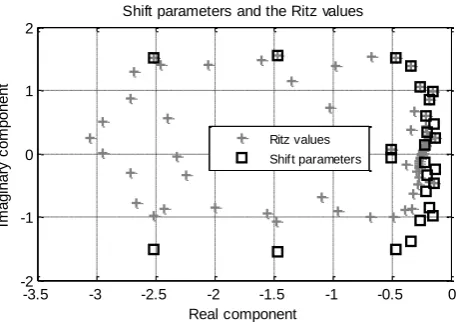
[image:4.595.311.543.299.478.2]Using the Heuristic Algorithm, ADI min max rational problem computes the shift parameters heuristically from the Ritz values. These were sub-optimal due to the Ritz values being complex quantities. These parameters were not close to the largest Ritz values as shown in Fig. 1.
Fig. 1: Suboptimal shift parameters and Ritz values
We made a model of our system with Lyapunov equations (5) and (6) and solved these to get the low-rank Cholesky factors of controllability gramian and of observability gramian, 𝑍̂𝐶 and 𝑍̂𝑂 respectively where 𝑍̂𝐶 𝜖 ℂ645 𝑥 22 and 𝑍̂𝑂 𝜖 ℂ645 𝑥 21. The columns of the Cholesky factors of the controllability and observability gramians are 22 and 21 respectively; this is because the LRCF-ADI iteration converged to a residual norm of 10-5 by
21 iteration steps. In addition, column compression frequency of 20 was used along with the column compression tolerance of 10-5.
Later, using these cholesky factors, we computed Hankel singular values by singular value decomposition method.
𝑈𝛴𝑉𝑇= 𝑠𝑣𝑑(𝑍
𝑂𝑇𝐸𝑍𝐶). (17)
Here 𝑈 𝜖 ℝ21 𝑥 21, 𝛴 𝜖 ℝ21 𝑥 22, 𝑉 𝜖 ℝ22 𝑥 22 .
[image:4.595.53.283.471.632.2]As shown in Fig. 2, a truncation tolerance of 10−1 is used, considering that the Hankel values above 0.1 are dominating and represent the high energy states. Thus the most controllable and most observable Hankel singular values of the high energy states were eight among twenty five of them, which were retained such that 𝑈𝐶 𝜖 ℝ21 𝑥 8, 𝛴𝐶 𝜖 ℝ8 𝑥 8, 𝑉𝐶 𝜖 ℝ22 𝑥 8 .
Fig. 2: Original and reduced hankel singular values with a tolerance of 10-1 indicated by the green line
Then we computed the transformation matrices 𝑇𝐿 and 𝑇𝑅 using the dominating Hankel singular values. We got 𝑇𝐿 𝜖 ℂ645 𝑥 8 and 𝑇𝑅 𝜖 ℂ645 𝑥 8.
After that, we used these transformation matrices to get our reduced system (Er, Ar, Br, Cr) where 𝐸𝑟=
𝐼 , 𝐴𝑟 𝜖 ℂ8 𝑥 8, 𝐵𝑟 𝜖 ℝ8 𝑥 1, 𝐶𝑟 𝜖 ℝ1 𝑥 8 .
V. DISCUSSION
Even though, we faced some hurdles in obtaining the optimal parameters from the ADI min-max rational discrete problem, the LRCF-ADI iteration converged well, up to a residual of 10-5, we used a column compression frequency
of 20 and a column compression tolerance level of 10-5,
Taking higher column compression frequency would result in higher computational cost but would yield a very good approximation of the Cholesky factors of the system Gramians, while taking it larger, results in wrong approximation of the factors which in turn affects heavily on
-3.5 -3 -2.5 -2 -1.5 -1 -0.5 0
-2 -1 0 1 2
Real component
Im
a
g
in
a
ry
c
o
m
p
o
n
e
n
t
Shift parameters and the Ritz values
Ritz values Shift parameters
0 5 10 15 20 25 30
10-8 10-6 10-4 10-2 100 102
Number of entries in the diagonal
P
ro
p
e
r
H
a
n
k
e
l
S
in
g
u
la
r
V
a
lu
e
s
Hankel Singular Values
the reduced model approximation. Thus 20, was chosen as the column compression frequency as a trade-off between the two ends. Moreover, the column compression frequency should not exceed the number of columns of the Cholesky factors. In that case, column compression would not be performed at all. Thus it is absolutely necessary to consider the column compression to be lower than 21.
Fig. 3: Eigenvalues of pencils of original and reduced system
[image:5.595.64.265.173.285.2]Fig. 3 shows clearly that, the stability of the original system is preserved by the reduced one i.e. the eigenvalues of both the systems lie on the open left half plane.
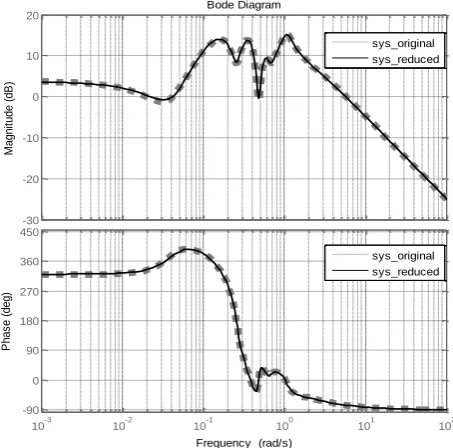
Fig. 4: Magnitude and phase responses for original and reduced system
Fig. 4 clearly illustrates that both the original and reduced system of dimension 8, have identical magnitude and phase responses for a wide range of frequencies.
When we rewrite the system descriptor model in terms of frequency domain via Laplace Transformation; we get:
𝑠𝐸𝑥(𝑠) = 𝐴𝑥(𝑠) + 𝐵𝑈(𝑠), 𝑌(𝑠) = 𝐶𝑥(𝑠) + 𝐷𝑈(𝑠).
Then by substitution, we get 𝐻(𝑠) =𝑌(𝑠)
𝑈(𝑠)=
𝐶(𝑠𝐸 − 𝐴)−1𝐵, where H(s) is the transfer function of the original system. Likewise, the transfer function derived from
the reduced model is 𝐻̃(𝑠) =𝑌(𝑠)
𝑈(𝑠)= 𝐶𝑟(𝑠𝐸𝑟− 𝐴𝑟)
−1𝐵
𝑟.
Fig. 5: Transfer functions for both original and reduced system
[image:5.595.53.280.406.630.2]Fig. 5 shows that the transfer functions of both the original and reduced systems are exactly the same for small as well as for the very large frequencies, indicating that our reduced model has very much accurately approximated the original counterpart.
Fig. 6: The error between the norm of transfer functions.
Fig. 6 shows the error between the norm of the transfer functions of the large and reduced order systems. It is evident from here that, an error is observed only initially. Later no error were observed. We can see that this error value, 0.03, is below the global error bound, 0.1341 i.e. twice the sum of the truncated Hankel values. So this truncation was valid and yielded good approximation as it satisfied the priori error bound.
VI. CONCLUSION
-6 -5 -4 -3 -2 -1 0
-6 -4 -2 0 2 4 6
Original system Reduced order system
-30 -20 -10 0 10 20
M
a
g
n
it
u
d
e
(
d
B
)
10-3 10-2 10-1 100 101 102
-90 0 90 180 270 360 450
P
h
a
s
e
(
d
e
g
)
Bode Diagram
Frequency (rad/s)
sys_original sys_reduced
sys_original sys_reduced
0 1 2 3 4 5 6 7 8 9 10
x 104 10-6
10-4 10-2 100 102
Transfer function plot of the original and reduced system
Frequency (rad/sec)
M
a
g
n
it
u
d
e
o
f
fr
e
q
u
e
n
c
y
r
e
s
p
o
n
s
e
o
f
th
e
s
y
s
te
m
s
Response of the original system Response of the reduced system
0 20 40 60 80 100
0 0.05 0.1 0.15 0.2
Frequency points
N
o
rm
a
liz
e
d
e
rr
o
r
b
e
tw
e
e
n
t
h
e
s
y
s
te
m
s
Priori error bound
[image:5.595.308.546.418.584.2]Large scale descriptor systems can often be reduced significantly. We presented in this paper that several model order reduction techniques can be employed to attain a very low order system with very accurate responses. All the numerical methods mentioned in this paper are implemented via MATALAB. In our case, we could successfully approximate a large system of a dimension of 645 to a reduced-dimensional system of dimension 8. We actually obtained several reduced approximations of the large system. The reduced system approximations of dimensions 3 and 5 yielded mismatch or deviation for the low frequency response. Only the 8-dimensional reduced system could perfectly produce a response most identical to the large system for all the frequency range. A key step in model reduction is the solution of two Lyapunov functions of a large system which is computationally intensive and difficult to store in memory. We presented low rank cholesky factorization ADI (LRCF-ADI) method which suppresses the computational load and memory storage requirement. However, this method required the selection of a set of suboptimal shift parameters, which are pretty hectic being the fact that these are chosen heuristically. The properties of the original system such as sparsity, symmetry, regularity, passivity, and stability are preserved in the reduced model as well.
REFERENCES
[1] V. Mehrmann and T. Stykel, "Balanced Truncation Model Reduction for Large-scale Systems in Descriptor Form," in Dimension Reduction of Large-Scale Systems, Springer Berlin Heidelberg, 2005, pp. 83-115.
[2] J.-R. Li, "Model Reduction of Large Linear Systems via Low Rank System Gramians," Massachutes Institute of Technology, Department of Mathematics, 2000.
[3] S. L. a. A. C. A. Roxana Ionutiu, "Comparison of Model Reduction Methods," in Scientific Computing in Electrical Engineering, Springer Science & Business Media, 2007, pp. 3-24
[4] J. Sabino, "Solution of large-scale lyapunov equations via the block modified smith method," Rice University, Houston, 2006 [5] E. Jarlebring, Convergence of the Arnoldi method for eigenvalue
problems, KTH Royal Institute of Technology, 2014
[6] A. C. Antoulas, Approximation of Large-Scale Dynamical System, Philadelphia: Society for Industrial and Applied Mathematics, 2005.
[7] C. C. K. Mikkelsen, "Numerical Methods for Large Lyapunov Equations," Purdue University, West Lafayette, 2009
[8] J. Lygeros and F. A. Ramponi, Lecture Notes on Linear System Theory, Brescia: Department of Information Engineering, University of Brescia, 2015.
[9] K. Ogata, Modern Control Engineering, New Jersey: Prentice Hall, 2010.
[10] M. M.-S. Hossain, "Numerical Methods for Model Reduction of Time-Varying Descriptor Systems," Faculty of Mathematics, Chemnitz University of Technology, Chemnitz, 2011.
[11] T. Penzl, LYAPACK, Chemnitz, 2000.
[12] J. Saak, "Efficient Numerical Solution of Large Scale Algebraic Matrix Equations in PDE Control and Model Order Reduction," Chemnitz University of Technology, Chemnitz, 2009. [13] A. Megretski, Model Reduction, Cambridge: Department of
Electrical Engineering and Computer Science, Massachusetts Institute of Technology, 2004.
[14] M. M. Uddin, "Model Reduction for Piezo-Mechanical Systems Using Balanced Truncation," Matematiska Institutionen, Stockholms Universitet, STOCKHOLM, 2011.
[15] J. M. Badía, P. Benner, R. Mayo and E. S. Quintana-Ortí, "Parallel Algorithms for Balanced Truncation Model Reduction of Sparse Systems," in Applied Parallel Computing. State of the Art in Scientific Computing, Lyngby, Springer Berlin Heidelberg, 2006, pp. 267-275.