Abstract— Authors have earlier formulated the basic models
on use of artificial neural networks (ANN) into prediction of performance of compact solar refrigeration system (CSRS) and implemented successfully a few classes of ANN for the same purpose. The main motivation for the above work was that research domain, on solar energy and its applications, continues to remain a potential area of research among the young researchers. This is clearly evident from growing number of research articles and publications in the recent times from this thrust area. The results of the above endeavor have shown that ANN show more potential and prominence for predicting the performance of CSRS. In this attempt, authors have compared two different classes of ANN namely radial basis function (RBF) and feedforward (FF) which are most widely used classes of neural networks for engineering applications. Keeping the conditions and training data sets the same, both classes of networks were implemented on the refrigeration problem. It has been observed that they both fare well and but results obtained from RBF class of network prove to be more accurate and consistent than that obtained from FF class of network. Advantages and limitations of each class of ANN are analysed at length and finally, potential future efforts in this direction are identified.
Index Terms—Solar Refrigeration, Performance Evaluation, Neural Networks, RBF class, Feedforward class
I. INTRODUCTION
lobally, there is a huge awareness and realization created on efficient energy production, distribution and usage, particularly in the areas of refrigeration and air-conditioning. The reason that cooling systems play a major role in share of energy demand is that the industries which operate on i) designing human comfort ii) processing foods and chemicals iii) manufacturing automobiles require a greater deal of energy need. Therefore, the role of energy engineers is much significant and crucial and they are forced to determine and establish best practices and methods of energy usage in order to optimize utilization irrespective of
Manuscript received June 20, 2015; revised July 29, 2015. This work titled Compact Solar Refrigeration System (CSRS) Performance – a comparative analysis using ANN based predictive models was supported in part by the Caledonian College of Engineering, Oman under Staff Development Programme.
R V Murali is with the Caledonian College of Engineering, Oman, PB 2322, PC 111, phone: 968-24536165, fax: 968-24535675; (e-mail: [email protected]).
M Achuthan is with the Caledonian College of Engineering, Oman, PB 2322, PC 111, phone: 968-24536165, fax: 968-24535675; (e-mail: [email protected]).
the form of energy used or applications that use energy or whatsoever [1],[2]. Solar refrigeration is a technique where in conventional cooling systems such as Vapour Compression Refrigeration (VCR) and Vapour Absorption Refrigeration (VAR) systems, utilize the solar energy for their operation. It is a common practice that wherever good electricity grid available, end users choose to employ vapour compression air-conditioning systems driven by electricity. As a consequence, electricity-driven vapour compression systems have played a significant role in the market. Research and development on solar thermal driven refrigeration systems was scant until the energy crisis in 1970s. Because of the fact, during this period, photovoltaic (PV) technology was not very popular and also was considered to be expensive and less efficient. The effect of energy crisis in 1970s forced people and manufacturers to resort to solar energy source [3],[4]. Quite recently, research endeavours in the field of solar energy have grown rapidly and particularly, in the research efforts on solar cooling are on the rise.
The latest development of absorption chillers with small cooling capacities of up to 10 kW now provides alternate solution to the conventional ones. Solar cooling systems using these chillers provide cooling comfort with reduction in power consumption and CO2 emissions. Despite their ecological advantages, solar cooling systems have to yield an economic advantage for the customer. In India, more than 20% of the population are living in remote and rural areas that do not have access to electric power are needed for refrigeration for long time storage and perishables like rare spices and honey. Solar energy is the promising energy source be readily converted and utilised for the purpose. Consequently, focus given is to design and develop an effective low capacity solar operated refrigeration system to improve considerably the quality of life of the rural community in remote areas. The advantages of resorting to use of solar energy in those cooling systems are reduced impact on the environment, much reduced cooling load during winter seasons and finally cost effectiveness. Artificial Neural Network (ANN) concept has been expanded in this work from the efforts laid down in the past by the same authors because ANN classes do not require a low level language written and user-specified problem solving algorithm. They exhibit significant prediction ability through learning from the training samples and they have excellent inherent generalization ability in their possession.
Compact Solar Refrigeration System (CSRS)
Performance – A Comparative Analysis using
ANN based Predictive Models
Murali R. V.,
Member, IAENG
and Achuthan M.
II. VAPOUR ABSORPTION REFRIGERATION SYSTEM
A. Background
The working principle of vapour absorption refrigeration system (VARS) is similar to that of the vapour compression refrigeration system (VCRS). VARS consists of an absorber, generator, condenser, evaporator and heat exchangers to enhance the performance of the system. Absorber and generator are responsible to carry out the compressor function of VCRS in VARS. Refrigerant vapour is evaporated by heating the weak solution in the generator. The evaporated refrigerant vapour is fed into the condenser for phase change; liquid refrigerant is fed into the evaporator where it is evaporated by absorbing heat from the cooling space via heat exchangers. Vapour refrigerant then fed into the absorber is absorbed by the strong solution and is circulated to the generator. Thereby the refrigeration effect is achieved at the cooling space. In this context, solar energy obtained from the solar collector is utilised in the generator to heat the weak solution by hot water circulated in the generator coils.
B. Problem Description
Performance evaluation and prediction of the CSRS is the objective of present attempt and this is carried out with a help newly introduced ANN class namely RBF. To achieve the expected task, a CSRS with capacity of 1.75 kW is designed, constructed and operational with Li-Br and H2O as working substances. The source of heat to this system is the solar energy which is recovered by the solar collectors and from this set up, hot water stream is circulated to feed heat to CSRS. This implies that the heat energy is supplied to the CSRS by hot water at the electrical generator. The ratio of the refrigeration effect to the heat supplied is the co-efficient of performance of the system (CoP) which is the measure of the performance of the CSRS. Since the load on the system is fixed, the performance of the system mainly depends on the heat supply which in turn is based on the solar insolation. The performance of the system is studied for over a period of one year in particular location where this system is installed. The CoP of the system is experimentally found to vary from 0.3 to 0.5 during the abovementioned time period. Subsequently, ANN class RBF is designed, structured and deployed to predict the performance of the system. The training data for this network constitute the experimental readings taken from the set up on day-wise atmospheric temperature, relative humidity, solar insolation and the CoP of the system.
The present study investigates the feasibility of implementing the system in residential sector in remote areas where the electric grids are not connected and have to rely only on low capacity solar and/or other non-conventional energy sources. This part is the performance analysis of the same system for a period of one year in particular geographical location with respect to the climate conditions like temperature, relative humidity and importantly with solar insolation of the location.
This CSRS is installed at Arunai Engineering College,
Tiruvannamalai, Tamilnadu, India. Geographically, Tiruvannamalai is located at the Latitude of 12.229 and the Longitude of 79.076 and the meteorological data along with one year experimental data are recorded. CSRS working with absorption refrigeration cycle has some interesting features such as simplicity, less number of moving parts and the ability to operate with relatively low temperature heat sources; a feature that could potentially counterbalance the relatively low coefficient of performance that could be expected [7]. Another interesting thing in the scope of the thesis is development of a prediction tool for analysing the performance of the system using artificial neural network (ANN) concept. The purpose of the development tool is to explore the feasibility of using CSRS for a particular geographical location using the meteorological data.
III. ARTIFICIAL NEURAL NETWORK MODELS AND THEIR APPLICABILITY
A. Introduction
ANN is originally developed to simulate the function of the human brain or neural system, resulting in systems that learn by experience. The use of ANNs has increased dramatically in recent years in the field of applied mechanics, logistics, manufacturing and etc. in order to model complex system behavior. The human brain consists of a large number (approximately 1011) of highly connected neurons those have many desirable characteristics not present in modern sequential computers [8]. Some of these characteristics are:
massive parallelism
distributed representation and computation learning ability
generalization ability fault-tolerance and low-energy consumption
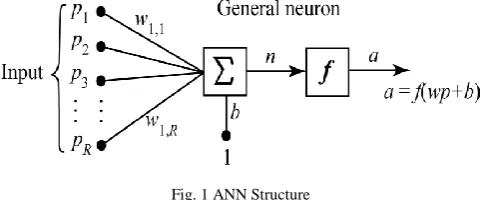
ANN involves processing elements or neurons and interconnection weights between neurons. These interconnection weights determine the nature and the strength of the connection between neurons. In ANN, information processing occurs at many neurons and signals are passed between neurons over interconnection links. Each interconnection link has its associated weight that multiplies the signal transmitted and each neuron applies an activation function to determine its output signal. A single neuron with R element input vector is shown in Fig.1.
[image:2.595.306.548.622.722.2]
Fig. 1 ANN Structure
B. Feedforward networks
suitability to adapt to the environment of the given problem. They do not require a user-specified problem solving algorithm but instead they acquire knowledge from environments. With this knowledge, they can match unknown patterns that are similar but not identical to the ones with which they have been trained [8].
Fig. 2 Feedforward Netual Network struture
The basic rule in feedforward network is that the neurons are added when training is slow or when the mean squared error is larger than a specified value, and that neurons are removed when a change in neuron’s value does not correspond to a change in the network’s response or when the weight values that are associated with this neuron remain constant for a large number of training epochs. Typical feedforward network architecture is given in Fig. 2. Various atmospheric temperatures like temperature of a day, month, year, daily average temperature as well as the daily average solar insolation are provided as input in the architecture and the performance coefficient of the CSRS is obtained in the output layer [9].
C. Radial Basis Function (RBF) Networks
RBF networks perform in a much similar manner with that of biologic neurons and owing to their simpler architectural structure and faster learning algorithms, they exhibit much better approximation abilities. This gives an edge to RBF structures and they are widely used in many science and engineering applications.
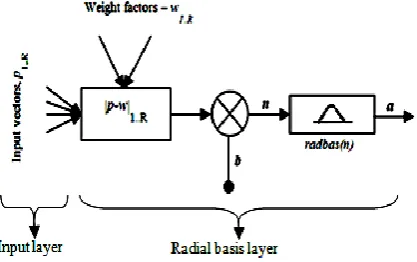
Fig. 3 RBF network structure
RBF, one of the most popular network classes of neural networks, consists of two layers whose output units form a linear combination of the basic functions computed by the hidden units and Gaussian spheroid function is used in this structure [10]. Fig. 3 presents the general structure of a RBF network with R inputs with corresponding weight vector w and the bias b. The transfer function for a radial basis neuron is given by the equation (1).
(1) It is also observed from the literature that though RBF networks need more neurons than other feed forward networks, the training time is very much reduced although processing time may be more. This is because the linear weights associated with the output layer are treated separately from the hidden layer neurons. The radial basis function has a maximum of 1 when its input is 0. As the distance between w and p decreases, the output increases. Thus, a RBF neuron acts as a detector, producing 1 whenever the input p is identical to its weight vector w. From the previous study undertaken by the authors, feedforward class of neural networks takes more training time to reach convergence process because of many training factors such as hidden neurons, training tolerance, initial weight distribution and function gradient. However, a RBF network’s learning is based on three parameters namely number of pattern units, width of a radial basis function and the initial weight distribution between the pattern and output layers. This has simplified the operation and the network is able to classify or predict clusters of data quickly and accurately [11].
D. ANN training
ANN class is constructed using suitable architectural parameters and test run with sample data input. The output is then compared with that of the available results. This is done through iteration process. While doing the iteration, the network would give accurate results at a specific trial run with suitable parameter setting. This is termed as ANN training. When ANN training is given to the network, actually the performance of the network is for minimum error - root mean square value (through varying the network design parameters) and the predicted values are obtained. The predicted values are compared with the original values evaluated from the experiment for the accuracy of the prediction.
[image:3.595.62.271.615.746.2]IV. PREDICTION OF COEFFICIENT OF PERFORMANCE
Coefficient of performance (COP) is all about how much amount of heat is getting transferred for the amount of power prescribed and it depends primarily on the temperatures of the evaporator and the condenser. More closer these two temperatures, the higher the COP. It also depends on the type of refrigerant used and the type of compressor used. CoP values are calculated for the readings taken from the experimental set up, using the fundamental equations from thermal engineering. Prediction of CoP values is done using a neural network class for an unknown inputs.
A new class of ANN is developed in this study to determine the performance of CSRS and then the results are compared with that of feedforward class and evaluated. The experiments are performed under the meteorological conditions of Tiruvannamalai. Performance parameters obtained from the experimentation are used as training data. Ambient temperature, solar insolation, declination angle, azimuth angle and tilt angle are used in the input layer and the coefficient of performance is the output. Estimated values are compared with measured values in terms of mean percentage error (MPE), mean bias error (MBE) and root mean square error (RMSE). Table 1 lists various architectural input parameters used for RBF network. Despite the fact that feed forward artificial neural networks prove to be a preferred area of research in the recent past, there are still perceived drawbacks in relation to the development of an ANN model and eventual uncertainty on its reliable performance. A number of different approaches have investigated all aspects of the ANN modeling procedure, from training data collection and pre/post-processing to elaborate training schemes and algorithms. Increased attention is especially directed to proposing a systematic way to establish an appropriate architecture in contrast to the current common practice that calls for a repetitive trial-and-error process, which is time-consuming and produces uncertain results. During back propagation learning process in ANN, network weights are automatically adjusted based on the known inputs and outputs. MSE is a network performance function which measures the network's performance according to the mean of squared errors. MSE is computed by taking the differences between the target vector values and the predicted neural network output vector values, squaring them and averaging over all classes of the validation samples [9].
MSE
( (2) Where EP is squared error function for each pattern ‘p’.
Mean Absolute Error (MAE)
(3) Root Mean Squared Error (RMSE)
(4)
[image:4.595.302.553.120.182.2]Where n is the number of data points and xd and xp are the desired and predicted values of the data being processed by the network.
TABLE 1 RBF INPUT SETTINGS Sum
squared error goal
value
Spread Constant
ANN function
used
Maximum number of neurons
Number of neurons to add
between displays 0.00001 1000 newrb 180 25
V. RESULTS &DISCUSSION
The trained ANN algorithm is tested for the performance prediction and is subjected to different iteration process and thereby different predicted values are obtained.
The average and minimum root mean square values of 20 iterations in feedforward type are 0.054 and 0.037 respectively while for RBF network, it is 0.000549276 minimum error value. Number of neurons used by RBF class is 175.
TABLE 2
ANN TRAINING – SAMPLE DATA FOR BOTH CLASSES OF ANN (FEED FORWARD AND RADIAL BASIS)
Reading No Insolation value
Temperature
o
C
RH %
COP value 1 4.43 24.15 81.13 0.26 2 4.45 23.66 74.87 0.29 3 4.46 24.86 65.19 0.28 4 4.46 31.44 54.73 0.36 5 4.47 29.01 63.55 0.31 6 4.5 26.78 76.47 0.30 7 4.52 25.13 87.91 0.29 8 4.52 27.94 83.42 0.33 9 4.55 23.2 73.65 0.28 10 4.6 33.97 48.33 0.35 11 4.62 26.9 89.48 0.29 12 4.62 27.7 87.3 0.29 13 4.66 26.48 85.17 0.31 14 4.66 32.16 54.94 0.34 15 4.67 24.24 74.74 0.24 16 4.69 25.64 70.76 0.29 17 4.69 26.92 82.9 0.29 18 4.7 24.22 73.91 0.26 19 4.71 24 83.57 0.26 20 4.71 26.37 70.35 0.31 21 4.71 33.76 49.78 0.35 22 4.72 28.1 84.41 0.35 23 4.77 33.5 45.22 0.36 24 4.78 26.39 81.16 0.28 25 4.8 23.39 72.95 0.25 26 4.8 28.05 79.15 0.30 27 4.8 30.3 62.89 0.30 28 4.81 27 88.65 0.26 29 4.81 32.84 51.64 0.36 30 4.82 26.78 86.59 0.29 31 4.82 27.44 83.43 0.33
[image:4.595.288.549.361.760.2]79.0700° E and the meteorological data along with one year experimental data are recorded.
Before using these datasets for training the network, the datasets (collected through the experimental set up) were scrutinized meticulously thoroughly for any erratic patterns or ranges and accordingly the deviations were eliminated. Based on the data collected from the experimental set up, CoP was calculated using analytical equations.
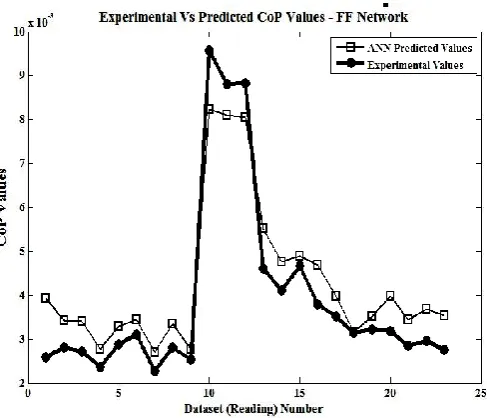
[image:5.595.306.550.49.258.2]CoP values are identified as target vectors for these datasets. Table 3 presents datasets for validating both the models and the prediction success rate for feedforward is exceeding 80% while for RBF class the matching is found to be above 90%, in some cases, it attained 100% matching. The results of feedforward and 180-epoch run RBF model are presented in fig. 4 and fig. 5.
TABLE 3
SAMPLE VALIDATION DATA – FOR BOTH CLASSES OF ANN (FEED FORWARD AND RADIAL BASIS)
Reading No
Insolation value
Temperature
o
C
RH %
COP value 1 5.47 27.38 85.86 0.26 2 5.47 27.73 78.65 0.28 3 5.47 29.6 69.61 0.27 4 5.5 26.15 64.66 0.24 5 5.51 29.73 64.3 0.29 6 5.51 30.43 63.86 0.31 7 5.52 23.73 76 0.28 8 4.78 26.39 81.16 0.28 9 4.8 23.39 72.95 0.25 10 1.28 24.08 87.64 0.96 11 1.36 24.63 85.4 0.88 12 1.42 26.08 78.6 0.88 13 3.12 29.45 54.91 0.46 14 3.13 22.85 85.86 0.41
Fig. 4 and Fig. 5 illustrate graphically the corresponding experimental and ANN predicted values, as a result of implementation of both classes of ANN on the problem at hand. The plot shows that the predicted values and the evaluated values are almost in agreement except at few points and yet the differences are very minimal.
The trained RBF network is tested for the performance prediction and is subject to different iteration process and thereby different predicted values are obtained.
The total number of epochs for training the RBF network is 180 and the sum squared error value obtained is 5.37x10⁻⁴. Several trials were conducted and each time when the network was operated, good results were obtained in terms of better classification success rate and the minimal time taken.
[image:5.595.42.296.301.457.2]The input data for the ANN are year, month, day of the recording, daily average insolation, daily average atmospheric temperature, average daily relative humidity and estimated coefficient of performance of the CSRS using related equations with appropriate experimental recordings. Randomly selected meteorological data with corresponding CoP taken from the experiment over a period of two years are used to train the network. Problem data selected to train the network covers wide range of the period to obtain the best results.
[image:5.595.306.547.318.526.2]
Fig. 4 Predicted Vs Experimental Results – Comparison for FF class of ANN
Fig. 5 Predicted Vs Experimental Results – Comparison for RBF class of ANN
Number of neurons to add between displays is fixed 25 which is a default value for RBF structure. Initially, the data sets collected through the experimental set up were scrutinized meticulously thoroughly for any erratic patterns or ranges and accordingly the deviations were eliminated. Based on the data collected from the experimental set up, CoP was calculated using analytical equations.
It is certain that with optimized architectural parameters setting for the RBF network, we would be able to achieve the best possible output consistently as the network would demonstrate its best performance with optimal setting of its architectural parameters.
The ANN-RBF model is designed, developed and tested with MATLAB© tool in Intel core i6 CPU, 3 MHz speed system. The success rate of prediction, error values, and the time taken for the simulation portray the acceptability of the model. The proposed ANN RBF model, with relevant testing information as input vectors, is able to predict the performance of CSRS under different climatic conditions and locational data.
VI. CONCLUSION
In summary, the concept of employing ANN classes into CSRS problem was earlier introduced by the same authors and the type of ANN class used then was feedforward network. The results obtained from the above effort showed the prominence of feedforward type for the problem at hand. Despite the fact that feedforward class of ANN proved to be of a potential tool for various problems for many years, it is reported that there still are certain issues regarding the development of an ANN model and its absolute performance for the problem under study. Therefore, in this attempt, application of another consistently reliable type of ANN class namely RBF is implemented on CSRS performance analysis problem. The results obtained from application of RBF were analysed and compared with that feedforward type.
It is reiterated that both these ANN classes, with relevant testing information as input vectors, were able to predict the performance of CSRS fairly well under different climatic conditions and locational data. Both classes of ANN use the same training, testing and validating datasets. Both models were designed, developed and tested with MATLAB© tool in Intel core i6 CPU, 3 MHz speed system. However, it is to be observed through the results of the later study that although the scope and prominence of ANN classes for the chosen problem is reaffirmed, RBF class outperforms feedforward class and is able to predict CoP values more accurately than the earlier type. This is due to a fact that feed forward classes of neural networks take more training time to reach convergence process because of many training factors such as hidden neurons, training tolerance, initial weight distribution and function gradient. However, a RBF network’s learning is based on three parameters namely number of pattern units, width of a radial basis function and the initial weight distribution between the pattern and output layers. This has simplified the operation and the network is able to classify or predict clusters of data quickly and accurately. The success rate of prediction, error values, and the time taken for the simulation portray the acceptability of both models. On the other hand, the above developed models can be further expanded by integrating them with a genetic algorithm (GA) in order to optimize its architectural parameters for obtaining the best classification performance of each model.
ACKNOWLEDGMENT
Authors would like to place on record their deep gratitude and appreciation to Executives of Caledonian College of Engineering, Oman for continual support for research and scholarly activities. Authors gratefully acknowledge the support and encouragement provided by the department of Mechanical and Industrial Engineering during the preparation of this paper.
REFERENCES
[1] Achuthan, M., & Rathnasamy, R. 2011. Performance Evaluation of locality based Compact Solar Refrigeration System. International
Journal of Energy Technology and Policy, 7(5/6), pp. 407 - 416.
[2] Achuthan, M., Venkataraman, A., & Rathnasamy, R. 2011. Experimental Analysis on the Performance Characteristics of Compact Solar Refrigeration System. Distributed Generation and
Alternate Energy Journal, 3(26). pp.68-80.
[3] Ahmed, H. P. 2008. Performance assessment of an integrated free cooling and solar powered single-effect lithium bromide-water absorption chiller. International Solar Energy Society (ISES), pp.1021–1030.
[4] Aziz, M., & Achuthan, M. Design of a Cooling System Using Waste Heat Recovery in a Refractory Industry. 3rd NCT Symposium, Nizwa College of Technology. Nizwa,Oman. 28 – 29 May 2012.
[5] Fuqiang, W. Y. 2010. Thermal stress analysis of eccentric tube receiver using concentrated solar radiation. Solar Energy, 84, pp.1809–1815.
[6] Huilong, L. R. (n.d.). The effects of operation parameter on the performance of a solar-powered adsorption chiller. Applied Energy., 87, pp. 3018–3022.
[7] Ameel T. A., Gee K. G. & Wood B. D,. 1995. Performance predictions of alternative, low cost absorbents for open cycle absorption solar cooling, Solar Energy, 54(2), pp.65–73.
[8] Haykin, 1999. Neural Networks: A Comprehensive Foundation, 2nd
ed. Prentice-Hall, Englewood Cliffs, NJ, USA.
[9] Achuthan, M., & Murali, R.V,. 2013. Performance Prediction of Compact Solar Refrigeration System, International Journal of
Emerging Technology and Advanced Engineering, 3(4), pp.43-49
[10] Murali, R.V et al. Comparison of Feed Forward and Radial Basis Function Neural Networks for Worker Assignment into Virtual Cells, 21st International Conference on Computer-Aided Production Engineering (CAPE 2010), University of Edinburgh, Scotland, UK, 13-14 April 2010.