1
Abstract—The purpose of this research is to develop a biped robot with antagonistic actuation. An antagonistic actuation mechanism based on the human musculoskeletal structure was applied to the hip joint of the developed walking robot. SAT(Stiffness Adjustable Tendon) was attached at the actuation mechanism of the developed biped robot. The antagonistic actuation was realized by using motor and wire with SAT. A control algorithm utilizing the antagonism for walking motion was proposed and applied to the walking experiment by using the developed robot. The results of the walking experiment conducted using the proposed control algorithm are presented and discussed.
Index Terms—Biped walking robot, Antagonistic actuation, Semi-passive walking, Walking experiment, Stiffness adjustable tendon
I. INTRODUCTION
OR the walking motion of biped robots, the two main technologies of actuation and feedback control are essential. For example, in the cases of ASIMO [1] and HRP-4 [2], a harmonic gear mechanism and ZMP (zero moment point)-based control have been employed. These robots had succeeded in continuous walking.
However, the energy efficiency associated with the walking motion of typical biped robots is known to be worse than that of humans [3]. Besides, their motion is not compliant owing to their actuation mechanism of high reduction ratio. Passive walking is considered as a potential approach to solving the energy efficiency problem [4, 5]. The legs of a passive walking robot follow a pendulum-like motion by using gravitational energy, thus allowing the robots to walk continuously. Therefore, passive walking robots can walk without any actuators and controls on shallow slopes with certain initial conditions. This implies that from the energy efficiency viewpoint, passive walking robots are superior to typical walking robots with ZMP-based control. However, passive walking robots cannot walk on horizontal surfaces because they have no actuators and controls. Semi-passive walking robots utilizing the pendulum theory with minimal number of actuators have been
Manuscript received December 9, 2015; revised December 20, 2015. This work was supported by JSPS KAKENHI Grant Number 26420201.
Every author is with Mechanical Engineering Course, Graduate School of Science and Engineering, Ehime University, 3 Bunkyo-cho, Matsuyama, Ehime, 790-8577, Japan.
Takashige Yano (e-mail: [email protected]). Jae Hoon Lee (e-mail: [email protected]). Shingo Okamoto (e-mail: [email protected]).
considered for walking on horizontal surfaces in previous research works [6, 7]. This walking strategy realizes human-like walking based on passive walking.
Recently, much attention has been paid to mimicking human structure, especially the musculoskeletal structure and its antagonistic actuation. Humans can adaptively adjust elasticity of the musculoskeletal structure by controlling the corresponding muscle tension. Thus, various types of human motion, such as walking, jumping, and running, could be performed. In addition, walking energy efficiency has been reported to improve by using musculoskeletal structure-like design [8]. Biped robots with musculoskeletal structure have been developed as well [9, 10]. Previously, we analyzed the model of a 1-DOF antagonistic actuation unit with a musculoskeletal structure [11, 12]. Simulation of motion and experiments by using the proposed control method and the calculation were also performed. Moreover, a semi-passive walking robot with antagonistic actuation was designed and developed in our previous research [13]. The control algorithm utilizing passive walking theory was proposed and embedded to the developed robot system. Those were tested through the walking experiments. Resultantly, it was shown in the experiment that the developed robot with antagonistic actuation can walk on the horizontal ground. Furthermore, its capability is similar to that of the previous research with no antagonistic actuation [6].
To control the stiffness of the robot, a particular spring with non-linear elasticity such as SAT (Stiffness Adjustable Tendon) is needed [14]. This paper deals with a method to utilize a SAT in the antagonistic actuator of the robot developed previous research. In addition, a control algorithm utilizing antagonism for walking motion is proposed.
Takashige Yano, Jae Hoon Lee,
Member, IAENG
and Shingo Okamoto
[image:1.595.334.510.606.769.2]F
II. CONFIGURATION OF THE BIPED WALKING ROBOT A. Model of biped walking robot
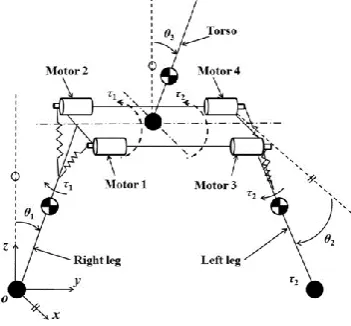
Figure 1 shows the model of the walking robot. The model was derived based on the previously published research [6, 7]. The model is a three-linked planar system comprising two legs and a torso. The control torques between the torso and each leg are generated by two antagonistic wires connected to the pulley of the DC motors on the torso link. The pulling force of each wire is generated by the torque for winding up the motor. It mimics the antagonistic actuation of the human musculoskeletal structure. The angles 𝜃1and 𝜃2 are the right
and left leg angles, respectively. The quantities 𝜏1 and 𝜏2 denote the control torques for both legs generated by the motors connected by the wires. The angle 𝜃3 is the pitch
angle of the torso with respect to the vertical direction. B. Mechanism of the biped walking robot
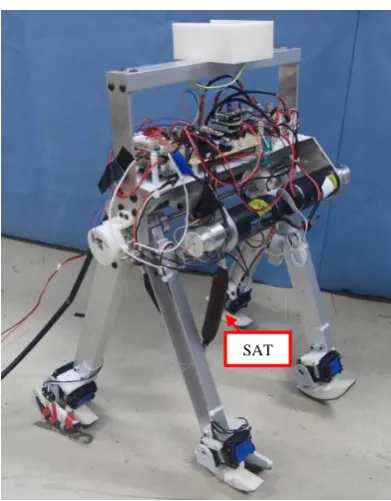
Figure 2 shows the developed robot in this research. The robot has two pairs of legs and one torso. To constrain the walking motion to the vertical planar space, each leg in Figure 1 was designed as a pair of two parallel links. The inner legs were connected to each other by additional frame. The outer legs were fixed on the hip shaft. Therefore, both legs of each pair moved together, while leg pairs moved independently. The control torques for each pair of legs were generated by using two wires connected to the pulleys of the DC motors on the torso links. Thus, the left two motors were used for controlling the outer legs. the motors and the legs were connected by using wires as muscles.
In the real robot in Figure 2, 𝜃1 denotes the angle of the
inner pair of legs, while 𝜃2 denotes the angle of the outer pair
of legs. The control torques, 𝜏1 and 𝜏2, correspond to the
angles. The inner legs are controlled by Motors 1 and 2, while the outer legs are controlled by Motors 3 and 4.
The foot of the robot makes contact with the ground during swing motion because the lengths of all the legs are the same. (a) During in landing state (b) During in swing state
[image:2.595.330.518.51.164.2]Fig. 3. The ankle part of the robot.
Fig. 7. System configuration of the walking robot Fig. 2. The experimental biped walking robot system
[image:2.595.322.533.191.343.2]developed in this research.
Fig. 5. SAT(Stiffness Adjustable Tendon) used in this research SAT
Fig. 6. Relationship between elongation and load in SAT
[image:2.595.52.288.324.752.2] [image:2.595.59.287.337.460.2]pointed downward, as shown in Figure 3(a). On the contrary, when the feet of the swinging legs came closer to the ground, they were made to point upward by using the servo motors, as shown in Figure 3(b), to prevent the feet from touching the ground. Touch sensors, developed in the present study, were used for determining whether the feet touched the ground. Figure 4 shows a sample touch sensor. It is comprised of a limit switch and a trigger made of a foamed styrol plate. When the foot touches the ground, the trigger presses the limit switch and the landing of each leg can be detected.
C. Non-Linear Spring SAT
Human walking shows high adaptability against disturbance such as external force or unevenness of terrain. It is realized by adjusting elasticity of leg joints using muscle antagonism which utilizes the peculiar characteristics of non-linearity. Non-linear spring is needed to adjust its elasticity. A non-linear spring of SAT shown in Figure 5 was employed in this research. Its characteristic of non-linear spring is shown in Figure 6 which shows relationship between elongation and load on SAT. It is observed that the more the SAT stretched, the higher stiffness is achieved.
D. Configuration of control system
The system configuration of the developed robot system is shown in Figure 7. This robot is controlled by two controllers. Two encoders were installed at the hip joints to measure the angles between both the leg pairs and torso. An attitude sensor (IMU: Inertial Measurement Unit) was installed on the robot’s torso to measure the angle of the torso. The control torques were calculated using the main controller cased on the information from the sensors. For generating the torque of inner legs, Motors 1 and 2 were controlled by the main controller. Motors 3 and 4 for outer legs were controlled by the sub-controller, based on the commands from the main controller. The servo motors for changing the feet angles were also controlled by the sub-controller. The internal status, including the angles of the legs and the torso, was wirelessly sent to a laptop computer by using a Bluetooth module. The servo motors and motor drivers were supplied with voltage of 11.1 (V). the controllers, encoders, IMU and Bluetooth module were supplied with the voltage regulator of 5.0 volts.
III. CONTROL METHOD A. Control for Walking Motion
The fundamental control scheme for walking motion of this research is based on semi-passive walking [6], an extension of passive walking [4, 5]. The robot’s walking motion is decided in four stages, according to the values of the touch sensors. The stages are as follows:
(a) The inner legs are in the stance stage and the outer legs are in the swing phase.
𝜏2= 𝑘2𝑝(𝜃12𝑑− 𝜃12) (2)
𝜃12= 𝜃1+ 𝜃2 (3)
𝜃12𝑑= 𝜋/2 (4)
Here, 𝜏1denotes the torque applied to the outer legs, 𝜏2
denotes the torque applied to the inner legs, 𝑘3𝑝 denotes the proportional gain, 𝜃3𝑑 denotes the desired angle of the torso,
𝜃12𝑑 denotes the desired angle of the outer legs, 𝑘2𝑝 denotes
the proportional gain. In addition, the robot turns the feet of the inner legs downward and the feet of the outer legs upward.
In the stage (b), the control torques 𝜏1 and 𝜏2 are computed by (1) and the following equation:
𝜏1= 𝑘1𝑝(𝜃12𝑑− 𝜃12) (5)
Here, 𝑘1𝑝 denotes the proportional gain. In addition, the robot
turns the toes of the inner and outer legs downward.
In the stage (c), the control torques 𝜏1 and 𝜏2 are computed by (1) and (5). In addition, the robot turns the toes of the inner legs upward and the feet of the outer legs downward.
In the stage (d), the control torques 𝜏1 and 𝜏2 are computed by (1) and (2). In addition, the robot turns the toes of the inner and outer legs downward.
B. Generating Torques with Antagonistic Actuation
Each leg pair of the robot is controlled by two DC motors and wires with SAT; thus, the torque of the joints are generated by the torque of the four motors. They are computed by the following equations:
𝜏1𝑚= {
𝜏1− 𝜏𝑝 (𝜏1< 0)
−𝜏𝑝 (𝜏1> 0) (9)
𝜏2𝑚= {
𝜏𝑝 (𝜏1< 0)
𝜏1+ 𝜏𝑝 (𝜏1> 0) (10)
𝜏3𝑚= {
𝜏2− 𝜏𝑝 (𝜏2< 0)
−𝜏𝑝 (𝜏2> 0) (11)
𝜏4𝑚= {
𝜏𝑝 (𝜏2< 0)
𝜏2+ 𝜏𝑝 (𝜏2> 0) (12)
[image:3.595.356.543.499.597.2]Here, 𝜏𝑝 is a preload torque for preventing wires from sagging and for changing the internal force in the antagonistic actuation.
[image:3.595.328.522.637.775.2]Fig. 10. Temporal dynamics of the joints’ angles for the robot walking with P control.
(a) t = 0.46 [s] (b) t=0.60[s] (c) t=0.66[s] (d) t=0.70[s]
(e) t =0.73 [s] (f) t=0.76[s] (g) t=0.83[s] (h) t=0.90[s]
used for safety of the robot system. This configuration did not affect the walking motion. However, when the robot fell down owing to a walking motion failure, the robot was hung on the bar with a belt; thus, the configuration prevented the robot from collapsing on the ground.
B. Experimental Result
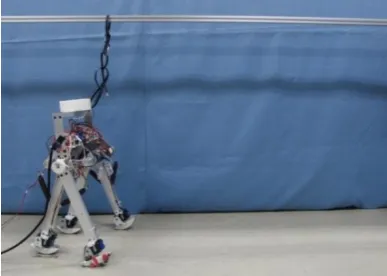
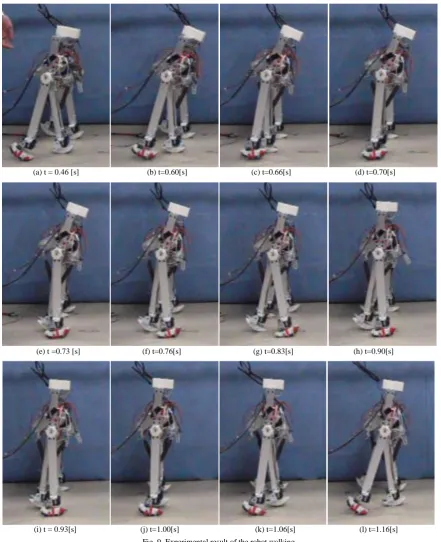
Figure 9 shows experimental result. The figures, from (a) to (l) in Figure 9, show the snapshot captured while the robot had been walking on the ground in the experiment. Figure 10 shows the time history responses of the angles of both legs and the torso. The robot landed 4 times in this experiment.
V. CONCLUSION
In this research, the semi-passive biped walking robot with antagonistic actuation using non-linear spring was developed. The walking experiment was carried out by using the control method proposed in this research. Resultantly, it was shown in the experiment where the developed robot with antagonistic actuation can walk on the horizontal ground. Furthermore, it was observed that its capability is similar to that of the previous research with no non-linear spring [13].
For more effective and stable walking motion, it is needed to utilize the control method that can adjust the elasticity of the joint as proposed previous research [11].
REFERENCES
[1] Y. Sakagami, R. Watanabe, C. Aoyama, S. Matsunaga, N. Higaki, and K. Fujimura, “The intelligent ASIMO: System Overview and Integration”, Proc. of the Int. Conf. on Intelligent Robots and Systems, 3, pp2478-2483, 2002.
[2] K. Kaneko, F. Kanehiro, M. Morisawa, K. Akashi, G. Miyamori, A. Hayashi and N. Kanehira, “Humanoid Robot HRP-4 - Humanoid Robotics Platform with Lightweight and Slim Body –,“ IROS, pp.4400-4407, 2011.
[3] K. Ono and R. Liu, “Optimal Biped Walking Locomotion Solved by Trajectory Planning Method”, J. of Dynamic Systems., 124, pp.554-565, 2002.
[4] T. McGeer, “Passive dynamic walking”, Int. J. Robot. Res., 9, 2, pp.62-82, 1990.
[5] K. Rushdi, D. Koop and C. Q. Wu, “Experimental studies on passive dynamic bipedal walking”, Robotics and Autonomous Systems, 62, pp.446-455, 2014.
[6] H. Koike, J.H. Lee and S. Okamoto, “Development and motion control of a biped walking robot based on passive walking theory”, Artificial Life and Robotics, 19, pp. 68-75, 2014.
[7] H. Yamada, J.H. Lee and S. Okamoto, “Semi-passive Biped Robot using Motion Control Combining Energy and PD Controls,” Proceeding of the IMCES, pp.297-300, 2014.
[8] B. Vanderborght, B. Verrelst, R. V. Ham, M. V. Damme, P. Beyl and D. Lefeber, “Development of a Compliance Controller to Reduce Energy Consumption for Bipedal Robots,” Autonomous Robots, 24, pp.419-434, 2008.
[9] K. Hosoda, T. Takuma, A. Nakamoto and S. Hayashi, “Biped robot design powered by antagonistic pneumatic actuators for multi-modal locomotion,” Robotics and Autonomoous Systems, 56, pp.46-53, 2007.
Mechatronics and Manufacturing, 2016.