To Design and Implement a Reliable Sugar
Evaporation Control System that will Work in an
Energy Saving Way
Tawanda Mushiri,
MEMBER, IAENG,
Charles Mbohwa
Abstract - The main objective of this research was to
deve1lop and implement a user friendly but advanced
control program that is easy to monitor, control, maintain and implementing changes or correcting errors. There was also need to develop a program that would work in an energy saving way. This project was a great achievement to the researchers. The researchers also has to focus on implementation of the system too and it was done. The engineering design process was put in place to do the design and a PLC was taken as a final solution.
Keywords - Sugar evaporation, energy saving, automation, PLC I: INTRODUCTION
Most of the energy consumed is in the evaporator section and the main contributor to this is the complexity in its control. Multiple effect evaporator control is a problem that has been widely reported in the sugar industries. Evaporators are the largest heat users and major contributors to losses in sugar cane factories. These factors make effective evaporator control crucial to overall factory efficiency
A Background
Evaporation as one of the most energy intensive processes used in the dairy, food and chemical industries, it is essential that evaporation be approached from the viewpoint of economical energy utilization as well as process effectiveness. This can be done only if the equipment manufacturer is able to offer a full selection of evaporation technology and systems developed to accommodate various product characteristics, the percent of concentration required, and regional energy costs. In the evaporation process, concentration of a product is accomplished by boiling out a solvent, generally water. The recovered end product should have an optimum solids content consistent with desired product quality and operating economics. It is a unit operation that is used extensively in
Submitted March 18, 2015; Revised April 19, 2015
Tawanda Mushiri is a D.Eng Candidate of University of Johannesburg, Faculty of Engineering and the Built Environment, Auckland Park Campus, Auckland Park 2006, P.O Box 524, Johannesburg, South Africa and a Lecturer of University of Zimbabwe, Department of Mechanical Engineering, P.O Box MP167, Mt Pleasant, Harare, Zimbabwe (email: [email protected], [email protected]) Charles Mbohwa is a Professor and Supervisor of Quality and Operations Management Department, University of Johannesburg, Auckland Park Bunting Road Campus, P. O. Box 524, Auckland Park 2006, Room C Green 5, Johannesburg, South Africa (email: [email protected])
processing foods, chemicals, pharmaceuticals, fruit juices, dairy products, paper and pulp, and both malt and grain beverages. Also it is a unit operation which, with the possible exception of distillation, is the most energy intensive. While the design criteria for evaporators are the same regardless of the industry involved, two questions always exist: is this equipment best suited for the duty, and is the equipment arranged for the most efficient and economical use? As a result, many types of evaporators and many variations in processing techniques have to be developed to take into account different product characteristics and operating parameters.
For complete separation of liquids, the process of heating, condensation, separation and storage need to be done automatically to achieve the objective. The work can be used in oil industries, chemical industries and paint industries. Increasing energy costs in almost all economics influence worldwide in last decades all separation processes. Thus, also the sugar industry was developed with new machines as well as with improved computer technology. One of challenges in sugar fabrication is without doubt the reduction of energy consumption [Smejkal et al., 2005].
control on relevant variables of the process is needed in order to achieve such objectives. In a previous work, the evaporation stage emerged as the key process of the global mass and energy balances (Colombo et al.,1999).
B Problem statement
The unreliability of the manual evaporation process control in sugar refining, needless and surplus energy consumed by the process is leading to loss of money (maintenance costs), business growth, and even the general differences in product quality.
C Aim
To design and implement a reliable sugar evaporation control system that will work in an energy saving way.
D Objectives
The main objectives of this paper are:
To implement and provide an evaporation process controller that will work automatically and more efficiently.
To design a user friendly control program that is easy to monitor and control.
To make the developed program give accurate and constant product quality but at the same time working in an energy saving way.
E Scope
This project is mainly based on the sugar refining evaporation process. The main focus will be on the method used to control the process and the amount of energy used to control the processes Although other aspects of Monitoring and Control (microcontrollers and stand-alone controllers) shall be analyzed in this research, much concentration shall be on Programmable Logic Controller (PLC) and how best can we interface it with other monitoring and controlling equipment to give the best accurate product qualities that are acceptable to the consumer and less cost to the manufacturer. Greatest concern will be on the evaporation control, but energy consumption also needs to be evaluated as it is a contributing factor for the evaporation process.
II: PLANT AUDIT
In all profit making organizations, one major aspect concentrated on is maximum utilization of all resources that is time, money and energy, so as to have the maximum possible profits. At one plant under study the evaporator station forms an important link between the juice production and crystallization parts of the sugar production plant. Basically, it has the following main tasks:
Evaporation of the water content to thicken the purified thin juice with approx. 15 % dry substance to a thick juice with 68 % to 71 % dry substance. Supply of heating steam to the individual plant parts
like juice production, purification, sugar house, etc. Supply of condensate 1 to the boiler house for feed
water
The primary purpose is to assist the plant in creating a sustainable energy consumption minimization in the production process through the application of more advanced control systems in the evaporator section.
The evaporator station consists of two parallel sets of quadruple effect evaporators, ‘A’ and ‘B’ lines. The
evaporator station has two types of evaporators namely; the long tube rising film evaporators (Kersners) and the vertical short tube evaporators (Roberts). Prior to evaporation the juice is heated in horizontal juice heaters using exhaust steam. There are two clear juice heaters per line. The purpose of clear juice heaters is to raise the temperature of juice leaving the clarifiers to (or just above) the boiling temperature of juice within the first effect. The climbing film evaporators will not function satisfactorily if they receive juice that is not close to its boiling point. The clear juice heaters heat the juice to 115C.
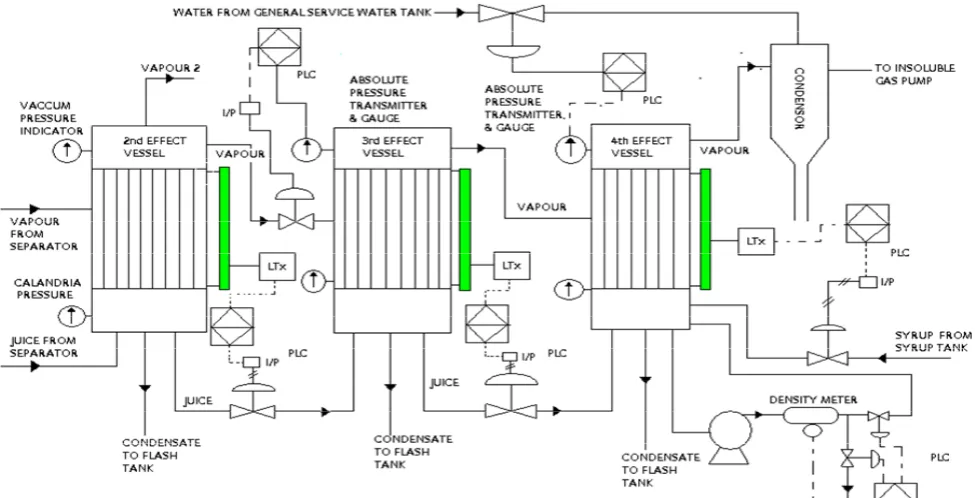
The evaporation station evaporators are termed quadruple-effect evaporators. . Multiple quadruple-effect evaporation means that vapour produced in one vessel is used to heat the contents of the subsequent vessel. The juice flow is summed up in the diagram below.
III: RESEARCH DESIGN
The information listed above and up until the end of this project was gathered using different ways and methods. The researcher opted for many methods which included researches, interview, just to mention but a few. This helped the researcher to produce this document. The researcher also follows a certain process which is described below.
A: The engineering design process
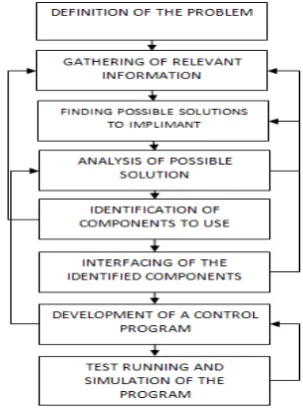
[image:2.595.321.473.479.684.2]Design activity occurs over a period of time and requires a step-by-step methodology. Nachmias (1982) defines a research design as the program that guides the investigator in the process of collecting, analyzing and interpreting observations. In regards to come up with an improved design and this finished project, the researcher undertook the following eight steps of engineering design process and in the same process revisiting some of the areas if a problem arises.
Fig 1: The engineering design process
B: Conceptual designs
were other alternative systems which could have been implemented to upgrade and control the air conditioning process. The solutions to be provided had to have the application of computerized, automated technologies that include interfacing with continuous monitoring and process measurement instrumentation. However the researcher has restricted the conceptual designs to at least three so as to reduce the size of the write up at the same time clearly explaining the chosen possible solutions. These sections will only summaries how the controllers are interfaced with sensors and actuators so as to execute the control objective.
[image:3.595.313.547.209.330.2]1 DESIGN 1: PLC based evaporation control system.
Fig 2:
PLC based evaporation control system.3.2.1.1: Operation
The evaporation station at the plant consists of a series of evaporators termed quadruple-effect evaporators. Multiple effect evaporation means that vapor produced in one vessel is used to heat the contents of the subsequent vessel.
Steam that is used to heat juice in the evaporator station comes from the boilers that are from the power plant station. Steam from the boilers will be at a pressure of 450psi. It goes through a pressure reduction station and then the evaporator station receives steam at a pressure of between 15 and 18psi. The steam heats up the tubes in the 2 kestners, steam from the
kestners is then transferred to the separator. The separator simply separates juice and steam. Evaporation starts in the 2nd effect vessel. The temperature of the steam will be at 107OC. This is wen water starts to evaporate. The vapour is transferred from the 2nd effect to the 3rd effect from the top and juice is transferred from the bottom. Evaporation continues and a thick juice is now starting to form. The last vessel is the 4th effect, in this vessel we now have a thick juice now termed syrup.
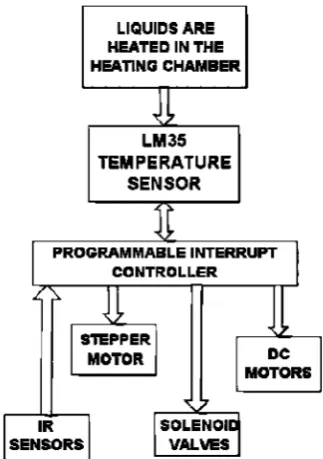
[image:3.595.48.292.224.342.2]2 DESIGN 2: Standalone controller based control system
Fig 3:
Standalone controller based control system.3 DESIGN 3: Microprocessor based evaporation control system
Fig 4:
Microprocessor based evaporation control systemIV: SELECTION OF THE BEST CONTROLLER
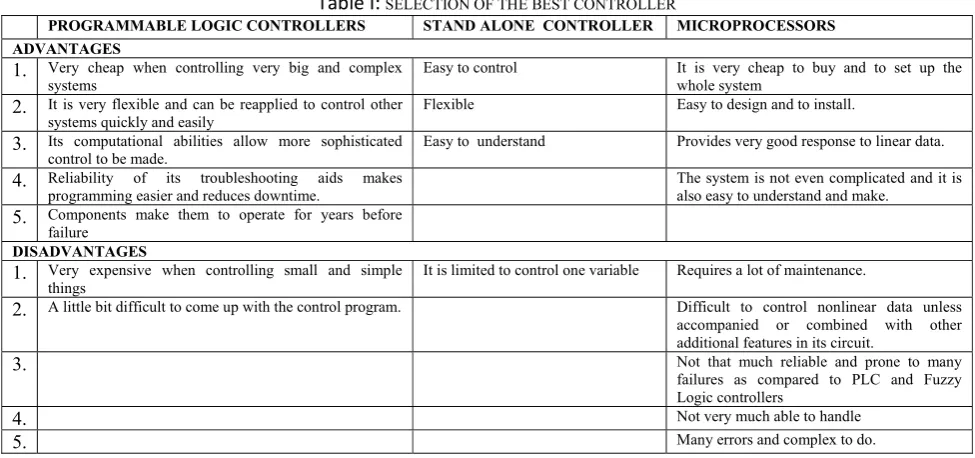
Table
I:
SELECTION OF THE BEST CONTROLLER
PROGRAMMABLE LOGIC CONTROLLERS STAND ALONE CONTROLLER MICROPROCESSORS
ADVANTAGES
1. Very cheap when controlling very big and complex
systems Easy to control It is very cheap to buy and to set up the whole system
2. It is very flexible and can be reapplied to control other systems quickly and easily
Flexible Easy to design and to install.
3. Its computational abilities allow more sophisticated
control to be made. Easy to understand Provides very good response to linear data.
4. Reliability of its troubleshooting aids makes
programming easier and reduces downtime. The system is not even complicated and it is also easy to understand and make.
5. Components make them to operate for years before
failure DISADVANTAGES
1. Very expensive when controlling small and simple
things It is limited to control one variable Requires a lot of maintenance.
2. A little bit difficult to come up with the control program. Difficult to control nonlinear data unless
accompanied or combined with other additional features in its circuit.
3. Not that much reliable and prone to many
failures as compared to PLC and Fuzzy Logic controllers
4. Not very much able to handle
[image:3.595.311.544.352.477.2] [image:3.595.49.537.524.753.2]A Analysis and evaluation of best design and controller On analysing the best controller to choose, much focus was on the controller to be impimanted. Looking at the advantages and disadvantages of each controller, the researcher decided to opt for the PLC controller in his design, because it is cheap, easy to design, energy saving and implement. Because of these advantages that the PLCs offer and from economic point of view, it came to the researcher’s attention to design a PLC user program that would replace the manual operation of the system.
B Development of a chosen solution
On developing the chosen solution, the researcher opted to include other things which the researcher thought will be able to make the control process better. Listed below are some of the components that the researcher thought of using in coming up with the best design that is going to make the process work in a better way. This also includes the process in which the control objective is going to be achieved.
V HOW THE NEW SYSTEM WILL OPERATE The PLC will control all the operations of the system. Whether its temperature monitoring or stepper motor control, tank emptying or conveyor control, each and every component is subservient to the PLC. The VFD will be used to drive the compressor that will push the liquid to the vessels. The LCD is also used for multiple messages and updates the user with the various ongoing activities. The juice from the mills is acidic and turbid. The clarification (or defecation) process is designed to remove both soluble and insoluble impurities (such as sand, soil, and ground rock) that have not been removed by preliminary screening. The process employs lime and heat as the clarifying agents. Milk of lime (about one pound per ton of cane) neutralizes the natural acidity of the juice, forming insoluble lime salts. Heating the lime juice to boiling coagulates the albumin and some of the fats, waxes, and gums, and the precipitate formed entraps suspended solids as well as the minute particles. The sugar cane solution, on the other hand, is purified by precipitating calcium carbonate, calcium sulfite, or both in it repeatedly. Impurities become entangled in the growing crystals of precipitate and are removed by continuous filtration. The muds separate from the clear juice through sedimentation. The non-sugar impurities are removed by continuous filtration. The final clarified juice contains about 85 percent water and has the same composition as the raw extracted juice except for the removed impurities. To concentrate this clarified juice, about two-thirds of the water is removed through vacuum evaporation. Generally, four vacuum-boiling cells or bodies are arranged in series so that each succeeding body has a higher vacuum (and therefore boils at a lower temperature). The vapors from one body can thus boil the juice in the next one—the steam introduced into the first cell does what is called multiple-effect evaporation. The vapor from the last cell goes to a condenser. The syrup leaves the last body
[image:4.595.309.471.199.429.2]continuously with about 65 percent solids and 35 percent water. The sugar cane sucrose solution, at this point, is also nearly colorless, and it likewise undergoes multiple-effect vacuum evaporation. The syrup is seeded, cooled, and put in a centrifuge machine. The finished sugar crystals are washed with water and dried. The control process can be described by the figure below.
Fig 5: The schematic representation of the final solution
VI OVERVIEW
To a greater extent the design managed to certify all design specifications and objectives and the main objective of continuously monitor and control the room conditions has been achieved. The design project when implemented will achieve the main goal of controlling the air condition in a more efficient and better way. It is also able to work in an energy serving way so that little energy is going to be used but producing excellent room conditions. The design has a number of merits such as:
1.Continuous monitoring and controlling of room air condition.
2.Data acquisition of all controlled parameters for future references
3.Reduced human intervention 4.Less frequency of maintenance
5.Ensured safety, reliable and excellent room condition control to the user.
Fig 6: General process flow and PLC in place saving energy.
[image:5.595.53.541.85.334.2]
Fig 7: Flow Chart
[image:5.595.50.539.400.661.2]
A Maintainability
The main concern was to ensure that the project would not going to become a liability for the hospitals or the people that are going to use it due to unnecessary breakdowns and easy wear and tear of instruments, on selecting each and every component in the system the researcher analyzed the strength of material used and whether it can survive in those operation conditions. The system does require some hint and skills on how to monitor the system and to operate it using a SCADA system and a computer respectively; therefore the researcher opted to give a short training to the people that are going to use the system so that they will not have unnecessary problems in running the machine. On the other hand this system is “automatic” so there is minimum human interference so its maintainability is easier than any automatic control system as no routine work is done on it.
B Cost benefits analysis
The cost of implementing the project is mainly centred on the cost of the control components, installation and commissioning. The summation of all costs of all individual components which make up the system is shown below. These are the costs associated with test runs and error debugging stage done, during commissioning of the system. The total costs have been budgeted at, after the calculations were done.
Cost of control equipment and other general costs was US3725.56.
VII CONCLUSION
In conclusion the main objective of this project was to develop and implement a user friendly but advanced control program that is easy to monitor, control, maintain and implementing changes or correcting errors. There was also need to develop a program that would work in an energy saving way. This project was a great achievement to the researchers. The researchers also has to focus on implementation of the system too and it was done.
A Recommendations
The researcher recommend that during installation of this system a Mechatronics Engineer or Automation Engineer has to be present and also no naked wires should be allowed as this can cause some energy loses or electric shocks thereby damaging precious equipment from short circuiting, also proper grounding of electrical equipment should be put in practice, and also proper calibration of the RTDs to ensure correct readings.
ACKNOWLEDGEMENT
My invaluable thanks go to my supervisor Professor Charles Tichakunda Mbohwa, who, out of his tightly packed and busy schedules managed to offer me his invaluable supervision. It is through his consistent guidance that this paper developed in the way it did. I would like to thank for the support from him and University of Johannesburg to fund me this paper.
REFERENCES
[1]. Sidney Mintz (1986). Sweetness and Power: The Place of Sugar in Modern History. Penguin. ISBN 978-0-14-009233-2.
[2]. "Forced Labour". The National Archives, Government of the
United Kingdom. 2010.
http://www.nationalarchives.gov.uk/pathways/blackhistory/ind ia/forced.htm.
[3]. "Sugar: World Markets and Trade". United States Department of Agriculture. November 2011. http://www.fas.usda.gov/htp/sugar/2011/Nov2011sugar.pdf. [4]. "World agriculture: towards 2015/2030". Food and Agriculture
Organization of the United Nations. ISBN 92-5-104761-8. http://www.fao.org/docrep/004/y3557e/y3557e00.htm#TopOf Page.
[5]. Moxham, Roy, The Great Hedge of India, Carroll & Graf, 2001 ISBN 0-7867-0976-6.
[6]. Kenneth F.Kiple & Kriemhild Conee Ornelas. "World history of Food – Sugar". Cambridge University Press. http://www.cambridge.org/us/books/kiple/sugar.htm.
Retrieved 9 January 2012.
[7]. Sharpe, Peter (1998). "Sugar Cane: Past and Present". Illinois:
Southern Illinois University.
http://web.archive.org/web/20110710203319/http://www.ethn oleaflets.com//leaflets/sugar.htm.
[8]. George Rolph (1873). Something about sugar: its history, growth, manufacture and distribution. http://www.archive.org/details/somethingaboutsu00rolprich. [9]. "Sugarcane: Saccharum Offcinarum". USAID, Govt of United
States. 2006. p. 7.1.
http://www.usaid.gov/locations/latin_america_caribbean/envir onment/docs/ag&environ/Sugarcane.pdf.
[10]. Adas, Michael (January 2001). Agricultural and Pastoral Societies in Ancient and Classical History. Temple University Press. ISBN 1-56639-832-0. Page 311.
[11]. Kieschnick, John (2003). The Impact of Buddhism on Chinese Material Culture Princeton University Press. ISBN 0-691-09676-7.
[12]. Sen, Tansen. (2003). Buddhism, Diplomacy, and Trade: The Realignment of Sino-Indian Relations, 600–1400. Manoa: Asian Interactions and Comparisons, a joint publication of the University of Hawaii Press and the Association for Asian Studies. ISBN 0-8248-2593-4. Pages 38–40.
[13]. Kieschnick, John (2003). The Impact of Buddhism on Chinese Material Culture Princeton University Press. 258. ISBN 0-691-09676-7.
[14]. Ponting, Clive (2000) [2000]. World history: a new perspective. London: Chatto & Windus. p. 481. ISBN 0-7011-6834-X.
[15]. Barber, Malcolm (2004). The two cities: medieval Europe, 1050–1320 (2nd ed.). Routledge. p. 14. ISBN 978-0-415-17415-2.
http://books.google.com/?id=7Kkm7cgT_xkC&pg=PA14. [16]. Abreu y Galindo, J. de; A. Cioranescu (ed) (1977). Historia de
la conquista de las siete islas de Canarias. Tenerife: Goya ediciones.
[17]. Walton Lai (1993). Indentured labor, Caribbean sugar: Chinese and Indian migrants to the British West Indies, 1838-1918. ISBN 978-0-8018-7746-9.
[18]. Steven Vertovik (Robin Cohen, ed.) (1995). The Cambridge survey of world migration. pp. 57–68. ISBN 978-0-521-44405-7.
[19]. K Laurence (1994). "A Question of Labour: Indentured Immigration Into Trinidad & British Guiana, 1875-1917". St Martin's Press. ISBN 978-0-312-12172-3.