Minimum Error Rate Training by Sampling the Translation Lattice
Samidh Chatterjee∗
Department of Computer Science Florida State University, USA
Nicola Cancedda
Xerox Research Centre Europe
6 Chemin de Maupertuis, 38240 Meylan, France
Abstract
Minimum Error Rate Training is the algo-rithm for log-linear model parameter train-ing most used in state-of-the-art Statistical Machine Translation systems. In its original formulation, the algorithm uses N-best lists output by the decoder to grow the Transla-tion Pool that shapes the surface on which the actual optimization is performed. Recent work has been done to extend the algorithm to use the entire translation lattice built by the decoder, instead of N-best lists. We pro-pose here a third, intermediate way, consist-ing in growconsist-ing the translation pool usconsist-ing sam-ples randomly drawn from the translation lat-tice. We empirically measure a systematic im-provement in the BLEU scores compared to training using N-best lists, without suffering the increase in computational complexity as-sociated with operating with the whole lattice.
1 Introduction
Most state-of-the-art Statistical Machine Translation (SMT) systems are based on a log-linear model of the conditional probability of generating a certain translation given a specific source sentence. More specifically, the conditional probability of a transla-tion e and a word alignment a given a source sen-tence f is modeled as:
∗The work behind this paper was done during an
intern-ship at the Xerox Research Centre Europe. The author was par-tially supported by NSF through Grant CCF-0643593 and the AFOSR Young Investigator Research Program.
P(e,a|f)∝exp
à K X
k=1
λkhk(e,a,f) !
(1)
where the hk(e,a,f) are feature functions provid-ing complementary sources of information on the quality of the produced translation (and alignment). Once such a model is known: the decoder (i.e. the actual translation program), which builds a tion by searching in the space of all possible transla-tions the one that maximizes the conditional proba-bility:
(e∗
,a∗
) = arg max
e,a
K X
k=1
λkhK(e,a,f) (2)
where we have taken into account that the exponen-tial is monotonic.
The parameters λk determine the relative impor-tance of the different feature functions in the global score. Best results are typically obtained by search-ing in the space of all possible parameter vectorsλ¯
for the one that minimizes the error on a held-out development dataset for which one or more refer-ence human translations are available, as measured by some automatic measure. This procedure is re-ferred to as Minimum Error Rate Training (MERT).
1.1 Minimum Error Rate Training on N-best Lists
The most widespread MERT algorithm is the one described in (Och, 2003). This algorithm starts by initializing the parameter vector ¯λ. For each source sentence in the development set, the decoder
is used to initialize a translation pool with a list of N-best scoring candidate translations according to the model. Using this pool and the corresponding refer-ence translations then, an optimization procedure is run to update the parameter vector to aλ¯′ with re-duced error. The decoder is then invoked again, the new output N-best list is merged into the translation pool, and the procedure is iterated. The algorithm stops either after a predefined number of iterations or upon convergence, which is reached when no new element is added to the translation pool of any sen-tence, or when the size of the update in the parameter vector is below a threshold.
The error measure minimized at each iteration is usually BLEU (Papineni et al., 2002). BLEU essen-tially measures the precision with which the trans-lation produced by a system recovers n-grams of different orders from the available reference trans-lation(s), used as a gold standard.
The optimization procedure that is run within each iteration on the growing translation pools is based on the key observation that BLEU only de-pends on the single translation receiving the highest score by the translation model (which would be the one shown to the receipient) in the translation pool. This in turn means that, for any given sentence, its contribution to BLEU changes only when the value of the parameters change in such a way that the sen-tence ranking first according to the model switches from one to another. This situation does not change when one considers all the sentences in a develop-ment set instead of just one: while varying the λ¯
vector, the BLEU score changes only when there is a change at the top of the ranking of the alternatives for at least one sentence in the set. In other words, BLEU is piece-wise constant inλ¯. MERT then pro-ceeds by performing an iterative line search by fix-ing each time the value of all components of¯λbut one1: for such a free parameter a global optimum can be identified by enumerating all the points that cause a change in BLEU. The value of the compo-nent is then fixed at the middle of an interval with maximum BLEU, and the procedure is iterated un-til convergence. Since the error function is highly irregular, and the iterative line search is not
guaran-1More generally, one can select each time a combination of
coordinates identifying a line in the parameter space, and is not restricted to a coordinate direction.
teed to converge to a global optimum, the procedure is repeated many times with different initializations, and the best convergence point is retained.
The MERT algorithm suffers from the following problem: it assumes at each iteration that the set of candidates with a chance to make it to the top (for some value of the parameter vector) is well represented in the translation pool. If the transla-tion pool is formed in the standard way by merg-ing N-best lists, this assumption is easily violated in practice. Indeed, the N-best list often contains only candidates displaying minor differences, and repre-sents only a very small sample of alternative possi-ble translations, strongly biased by the current pa-rameter setting.
Recognizing this shortcoming, Macherey et al. (2008) extended the MERT algorithm so as to use the whole set of candidate translations compactly represented in the search lattice produced by the de-coder, instead of only a N-best list of candidates extracted from it. This is achieved via an elegant but relatively heavy dynamic programming algo-rithm that propagates sufficient statistics (called
en-velopes) throughout the whole search graph. The
re-ported theoretical worst-case complexity of this al-gorithm isO(|V||E|log|E|), whereV andE are the vertex set and the edge set of the lattice respectively. We propose here an alternative method consist-ing in samplconsist-ing a list of candidate translations from the probability distribution induced by the transla-tion lattice. This simple method produces a list of candidates more representative of the complete dis-tribution than an N-best list, side-stepping the in-tricacies of propagating envelopes throughout the lattice. Computational complexity increases only marginally over the N-best list approach, while still yielding significant improvements in final transla-tion quality.
1.2 The translation lattice
source sentence. Each prefix is associated with a node in a graph, and receives a score according to the model. Whenever two prefixes having exactly the same possible extensions are detected, the lower-scoring one is merged into the other, thus creating a re-entrancy in the directed graph, which has then the characteristics of a lattice (Figure 1). Edges in the lattice are labelled with the phrase-pair that was used to perform the corresponding extension, the source word positions that were covered in doing the ex-tension, and the corresponding increment in model score.
0
F
I have a J’ai une (1,2,3) −12.24
bleue (4) ... blue
voiture (5) ... car J’ai une bleue
I have a blue
(1,2,3,4) ...
2 3
1
a blue car une voiture bleue (3,4,5) ... I have
[image:3.612.71.294.226.386.2]J’ai (1,2) ...
Figure 1: A lattice showing some possible translations of the English sentence: I have a blue car. The state with ID 0 is the start state and the one withFis the final state.
2 Related Work
Since its introduction, (Och, 2003) there has been various suggestions for optimizing the MERT cri-terion. Zens et al. (2007) use the MERT criterion to optimize the N-best lists using the Downhill Simplex Algorithm (Press, 2007). But the Down-hill Simplex Algorithm loses its robustness as the dimension goes up by more than 10 (Macherey et al., 2008). Deterministic Annealing was sug-gested by Smith and Eisner (2006) where the au-thors propose to minimize the expected loss or
risk. They define the expectation using a
proba-bility distribution over hypotheses that they gradu-ally anneal to focus on the 1-best hypothesis. Dif-ferent search strategies were investigated by Cer et al. (2008). Work has been done to investigate a perceptron-like online margin training for statisit-ical machine translation (Watanabe et al., 2007).
Building on this paper, the most recent work to our knowledge has been done by Chiang et al. (2008). They explore the use of the Margin Infused Relaxed Algorithm (MIRA) (Crammer and Singer, 2003; Crammer et al., 2006) algorithm instead of MERT. Macherey et al. (2008) propose a new varia-tion of MERT where the algorithm is tuned to work on the whole phrase lattice instead of N-best list only. The new algorithm constructs the error surface of all translations that are encoded in the phrase lat-tice. They report significant convergence improve-ments and BLEU score gains over N-best MERT when trained on NIST 2008 translation tasks. More recently, this algorithm was extended to work with hypergraphs encoding a huge number of translations produced by MT systems based on Synchronous Context Free Grammars (Kumar et al., 2009). All the methods cited here work on either N-best lists or from whole translation lattices built by the decoder. To our knowledge, none of them proposes sampling translations from the lattice.
3 Sampling candidate translations from
the lattice
In this section we first start by providing an intu-ition of why we believe it is a good idea to sample from the translation lattice, and then describe in de-tail how we do it.
3.1 An intuitive explanation
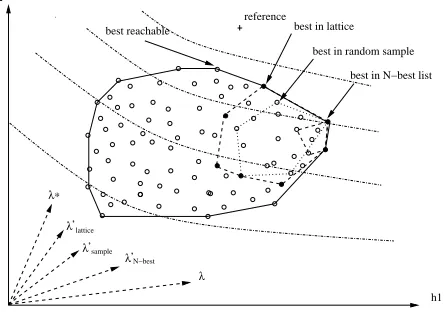
The limited scope of n-best lists rules out many al-ternative translations that would receive the highest score for some values of the parameter vector. The complete set of translations that can be produced us-ing a fixed phrase table (also called reachable trans-lations) for a given source sentence can be repre-sented as a set of vectors in the space spanned by the feature functions (Fig. 2). Not all such transla-tions stand a chance to receive the highest score for any value of the parameter vector, though. Indeed, if translations h, h’and h” are such thathk≤h′k≤h
polynomial time. The set of candidates represented by the decoder lattice is a subset (enclosed in the larger dashed polygon in the figure) of this set. This subset is biased to contain translations ranking high according to the values of the parameter vector (the direction labelled withλ) used to produce it, because of the pruning strategies that guide the construction of the translation lattice. Both the N-best list and our proposed random sample are further subsets of the set of translations encoded in the lattice. The N-best list is very biased towards translations that score high with the current choice of parameters: its con-vex envelope (the smaller dashed polygon) is very different from the one of the complete set of trans-lations, and also from that of the translations in the lattice. The convex envelope of a random sample from the translation lattice (the dotted polygon in the figure), will generally be somewhat closer to the en-velope of the whole lattice itself.
The curves in the figure indicate regions of con-stant loss (e.g. iso-BLEU score, much more irregu-larly shaped in reality than in the drawing). For this sentence, then, the optimal choice of the parameters would be around λ∗
. Performing an optimization step based on the random sample envelope would result in a more marked update (λ′
sample) in the di-rection of the best parameter vector than if an N-best list is used (λ′
N-best).
Notice that Figure 2 portraits a situation with only two features, for obvious reasons. In practice the number of features will be substantially larger, with values between five and twenty being common prac-tice. In real cases, then, a substantially larger frac-tion of reachable translafrac-tions will tend to lie on the convex envelope of the set, and not inside the convex hull.
3.2 The sampling procedure
We propose to modify the standard MERT algorithm and sample N candidates from the translation lattice according to the probability distribution over paths induced by the model, given the current setting of the ¯λ parameters, instead of using an N-best list. The sampling procedes from the root node of the lattice, corresponding to an empty translation can-didate covering no words of the source, by chosing step by step the next edge to follow. The probability
reference
λ’
λ’
λ’
h1 h2
λ λ∗
best in lattice best in random sample
best in N−best list best reachable
[image:4.612.315.537.59.215.2]N−best sample lattice
Figure 2: Envelope of the set of reachable translations where the model has two feature functionsh1 and h2. The envelope of the lattice is the outer dashed polygon, while the envelope of the N-best list is the inner one. Us-ing the whole lattice as translation pool will result in a more marked update towards the optimal parameters. The random sample from the lattice is enclosed by the dotted line. If we use it, we can intuitively expect updates to-wards the optimum of intermediate effectiveness between those of the N-best list method and those of the lattice method.
distribution for each possible follow-up is the poste-rior probability of following the edge given the path prefix derived from the lattice: it is obtained via a preliminary backward sweep.
Since feature functions are incremental over the edges by design, the non-normalized probability of a path is given by:
P(e1, . . . , em) =e
Pm
i=1σ(ei) (3)
where
σ(ei) = K X
k=1
λkhk(ei) (4)
S(nj|ni)≈e(σ(nj)+σ(ni,j)) (5)
The scores required to compute this sampling probabilities can be obtained by a simple backward pass in the lattice. LetPi be the set of successors ofni. So the total unnormalized log-probability of reaching a final state (i.e. with a complete transla-tion) fromni is given by the equation below.
σ(ni) = log( X
nj∈Pi
e(σ(nj)+σ(ni,j))) (6)
where we set σ(ni) = 0 if Pi = ∅, that is if ni is a final node. At the end of the backward sweep,
σ(n0) contains the unnormalized cumulative prob-ability of all paths, i.e. the partition function. No-tice that this normalising constant cancels out when computing local sampling probabilities for traversed nodes in the lattice.
Once we know the transition probability (Eq. 5) for each node, we sample by starting in the root node of the lattice and at each step randomly selecting among its successors, until we end in the final node. The whole sampling procedure is repeated as many times as the number of samples sought. After col-lecting samples for each sentence, the whole list is used to grow the translation pool.
Notice that when using this sampling method it is no longer possible to use the stability of the trans-lation pool as a stopping criterion. The MERT al-gorithm must thus be run either for a fixed number of iterations, or until the norm of the update to the parameter vector goes below a threshold.
3.3 Time Complexity Analysis
For each line search in the inner loop of the MERT algorithm, all methods considered here need to com-pute the projection of the convex envelope that can be scanned by leaving all components unchanged but one2. If we use either N-best lists or random samples to form the translation pool, andM is the size of the translation pool, then computing the en-velope can be done in timeO(MlogM)using the
SweepLine algorithm reproduced as Algorithm 1 in
(Macherey et al., 2008). As shown in the same ar-ticle, the lattice method for computing the envelope
2
In general, moving along a 1-dimensional subspace of the parameter space.
isO(|V||E|log|E|), whereV is the vertex set of the lattice, andE is its edge set. In standard decoders there is a maximum limitD to the allowed distor-tion, and lattice vertices are organized inJ priority queues3of size at mosta, whereJ is the length of the source sentence andais a parameter of the de-coder set by the user. Also, there is a limit K to the maximum number of source words spanned by a phrase, and only up to c alternative translations for a same source phrase are kept in the phrase ta-ble. Under these standard conditions, the number of outgoing edges E′ from each lattice vertex can be bounded by a constant. A way to see this is by considering that if an hypothesis is extended with a phrase, then the extended hypothesis must end up in a stack at mostK stacks to the right of the original one. There are onlyaKplaces in these stacks, so it must be|E′| ≤aK.
Since the number of edges leaving each node is bounded by a constant, it is|E| = Θ(|V|), and the lattice method isO(|V|2log(|V|)). The maximum number of vertices in the lattice is limited by the capacity of the stacks: |V| ≤ aJ. This eventually leads to a complexity ofO(J2logJ) for the inner loop of the lattice method.
It is interesting to observe that the complexity is driven by the length of the source sentence in the case of the lattice method, and by the size of the translation pool in the case of both the N-best list method and the random sampling method. The lat-ter two methods are asymptotically more effective as long as the size of the sample/N-best list grows sub-quadratically in the length of the sentence. In most of our experiments we keep the size of the sample constant, independent of the length of the sentence, but other choices can be considered. Since the num-ber of reachable translations grows with the length of the source sentence, length-independent samples explore a smaller fraction of the reachable space. Generating samples (or n-best lists) of size increas-ing with the length of the source sentence could thus lead to more homogeneous sampling, and possibly a better use of CPU time.
We have so far compared methods in term of the complexity of the innermost loop: the search for a global optimum along a line in the parameter space.
This is indeed the most important analysis, since the line search is repeated many times. In order to complete the analysis, we also compare the differ-ent methods in terms of the operations that need be performed as part of the outer iteration, that is upon redecoding the development set with a new parame-ter vector.
The N-best list method requires simply construct-ing an N-best list from the lattice. This can be done in time linear in the sizeJof the sentence and inN
with a backward sweep in the lattice.
The sampling method requires samplingN times the lattice according to the probability distribution induced by the weights on its edges. We use a dynamic programming approach for computing the posterior probabilities of traversing edges. In this phase we visit each edge of the lattice exactly once, hence this phase is linear in the number of edges in the lattice, hence under the standard assumptions above in the lengthJof the sentence. Once posterior probabilities are computed for the lattice, we need to sampleN paths from it, each of which is com-posed of at mostJ edges4. Under standard assump-tions, randomly selecting the next edge to follow at each lattice node can be done in constant time, so the whole sampling is alsoO(N J), like extracting the N-best list.
No operation at all is required by the lattice method in the outer loop, since the whole lattice is passed over for envelope propagation to the inner loop.
4 Experimental Results
Experiments were conducted on the Europarl corpus with the split used for the WMT-08 shared task (Eu-roparl training and test condition) for the language pairs English-French Fr), English-Spanish (En-Es) and English-German (En-De), each in both di-rections. Training corpora contain between 1.2 and 1.3 million sentence pairs each, development and test datasets are of size 2,000. Detailed token and type statistics can be found in Callison-Burch et al. (2008). The Moses decoder (Koehn et al., 2007) was used for generating lattices and n-best lists. The maximum number of decoding iterations was set to twelve. Since Moses was run with its lexicalised
dis-4We assume all phrase pairs cover at least one source word.
0.18 0.2 0.22 0.24 0.26 0.28 0.3 0.32
0 1 2 3 4 5 6 7 8 9 10 11 12
nb.200.en-fr s.200.en-fr m.200.en-fr s.100.en-fr nb.100.en-fr
0.3 0.32 0.18 0.2 0.22 0.24 0.26 0.28 0.3 0.32
0 1 2 3 4 5 6 7 8 9 10 11 12
nb.200.en-fr s.200.en-fr m.200.en-fr s.100.en-fr nb.100.en-fr
0.2 0.22 0.24 0.26 0.28 0.3 0.32
0 1 2 3 4 5 6 7 8 9 10 11
[image:6.612.332.537.73.350.2]nb.200.fr-en s.200.fr-en m.200.fr-en s.100.fr-en nb.100.fr-en
Figure 3: Learning curves (BLEU on the development set) for different tested conditions for English to French (top) and French to English (bottom).
tortion model, there were 14 features. Moses L1-normalises the parameter vector: parameter scaling only marginally affects n-best list construction (via threshold pruning during decoding), while it sub-stantially impacts sampling.
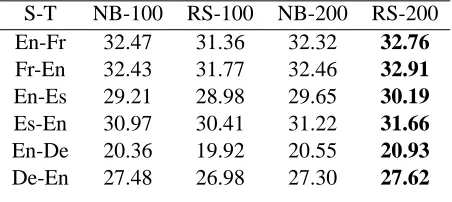
For each of the six configurations, we compared the BLEU score on the test data when optimizing feature weights with MERT using n-best and ran-dom samples of size 100 and 200. In all cases we used 20 random restarts for MERT. Results are pre-sented in Table 1. We also ran non systematic ex-periments on some of the configurations with larger samples and n-best lists, with results changing very little from the respective 200 cases: we do not report them here.
5 Analysis of results
All differences of the test scores between optimiz-ing the parameters usoptimiz-ing nbest-200 lists and from randomly sampled lists of size 200 were found to be statisitically significant at 0.05 level at least. We used Approximate Randomization Test (Riezler and Maxwell, 2005) for the purpose, random sampling being done 1000 times.
S-T NB-100 RS-100 NB-200 RS-200 En-Fr 32.47 31.36 32.32 32.76
Fr-En 32.43 31.77 32.46 32.91
En-Es 29.21 28.98 29.65 30.19
Es-En 30.97 30.41 31.22 31.66
En-De 20.36 19.92 20.55 20.93
[image:7.612.317.526.54.158.2]De-En 27.48 26.98 27.30 27.62
Table 1: Test set BLEU Scores for six different “Source-Target” Pairs
Somewhat surprisingly, while random sampling with sample size of 200 yields overall the best re-sults, random sampling with size 100 give system-atically worse results than n-best lists of the same size. We conjectured that n-best lists and random samples could have complementary advantages. In-deed, it seems intuitive that a good translation pool should be sufficiently varied, as argued in Section 3.1. However it should also stand high chances to contain the best reachable translation, or translations close to the best. It might thus be that 100-best lists are unable to provide diversity, and random samples of size 100 to guarantee sufficient quality.
In order to test this conjecture we repeated our experiments, but at each iteration we used the union of a 100 random sample and a 100 n-best list. Re-sults for this experiments are in Table 2. The cor-responding results with random samples of size 200 are also repeated to ease comparison. Depending on the language pair, improvements over random sam-pling range from 0.17 (En-Es) to 0.44 (Fr-En) BLEU points. Improvements over 200-best lists range from 0.68 (De-En) to 0.89 (Fr-En) BLEU points. These results indicate quite clearly that N-best lists and random samples contribute complementary infor-mation to the translation pool: indeed, in most cases there is very little or no overlap between the two.
Convergence curves show that RS-200, NB-100
Source-Target Mixed 100 + 100 RS-200
En-Fr 33.17 32.76
Fr-En 33.35 32.91
En-Es 30.37 30.19
Es-En 32.04 31.66
En-De 21.31 20.93
[image:7.612.70.296.182.283.2]De-En 27.98 27.62
Table 2: Test set BLEU Scores for the same ’‘Source-Target” pairs using a mixed strategy combining a 100 N-best list and a random sample of size 100 after each round of decoding.
given case, but from the convergence curves it would seem that the first prevails in the case of random samples, whereas the second wins in the case of n-best lists. In the case of random samples going from size 100 to 200 systematically leads to higher BLEU score on the devsets, as more high-BLEU candidates are drawn. In the case of n-best lists, conversely, this leads to lower BLEU scores, as lower-BLEU (in average) candidates are added to translation pools providing a sharper representation of the BLEU sur-face and growing MERT out of the “delusion” that a given high BLEU score is actually achieveable.
In the light of this discussion, it is interesting to observe that the value achieved by the objective function on the development set is only a weak pre-dictor of performance on the test set, e.g. M-200 never converges to values above those of NB-100, but is systematically superior on the test data.
In Macherey et al. (2008) the authors observe a dip in the value of the objective function at the first iteration when training using n-best lists. We did not observe this behaviour in our experiments. A possible explanation for this resides in the larger size of the n-best lists we use (100 or 200, compared to 50 in the cited work) and in the smaller number of dimensions (14 instead of 20-30).
We hinted in Section 3.3 that it would seem rea-sonable to use samples/nbest-list of size increasing with the length of the source sentence, so as to sam-ple reachable translations with a more uniform den-sity across development sentences. We tested this idea on the French to English condition, making samples size depend linearly on the length of the sentence, and in such a way that the average sam-ple size is either 100 or 200. For average samsam-ple size 100 we obtained a BLEU of 31.55 (compared to 31.77 with the constant-size 100 random sample) and for average size 200 31.84 (32.46 in the cor-responding constant-size condition). While partial, these results are not particularly encouraging w.r.t. using variable size samples.
Finally, in order to assess the stability of the pro-posed training procedure across variations in devel-opment datasets, we experimented with extracting five distinct devsets of size 2,000 each for the French to English RS-200 condition, keeping the test set fixed: the maximum difference we observed was of 0.33 BLEU points.
6 Conclusions
We introduced a novel variant to the well-known MERT method for performing parameter estimation in Statistical Machine Translation systems based on log-linear models. This method, of straightforward implementation, is based on sampling candidates from the posterior distribution as approximated by an existing translation lattice in order to progres-sively expand the translation pool that shapes the optimization surface. This method compares favor-ably against existing methods on different accounts. Compared to the standard method by which N-best lists are used to grow the translation pool, it yields empirically better results as shown in our experi-ments, without significant penalties in terms of com-putational complexity. These results are in agree-ment with the intuition that the sampling method introduces more variety in the translation pool, and thus allows to perform more effective parameter up-dates towards the optimum. A hybrid strategy, con-sisting in combining N-best lists and random sam-ples, brings about further significant improvements, indicating that both quality and variety are desire-able in the translation pool that defines the optimiza-tion surface. A possible direcoptimiza-tion to investigate in the future consists in generalizing this hybrid strat-egy and combining random samples where the prob-ability distribution induced on the lattice by the cur-rent parameters is scaled by a further temperature parameterβ:
P′
(e,a|f)∝P(e,a|f)β (7)
where forβ= 1the random samples used in this pa-per are obtained, forβ tending to infinite the distri-bution becomes peaked around the single best path, thus producing samples similar to N-best lists, and samples from other real values of the temperature can be combined.
Compared to the method using the whole lat-tice, the proposed approaches have a substantially lower computational complexity under very broad and common assumptions, and yet yield transla-tion quality improvements of comparable magnitude over the baseline N-best list method.
forests generated by hierarchical decoders (Chiang, 2007) seems straightforward. In that case, the back-ward sweep for propagating unnormalized posterior probabilities is replaced by a bottom-up sweep, and the sampling now concerns (binary) trees instead of paths, but the rest of the procedure is substantially unchanged. We conjecture however that the exten-sion to translation forests would be less competitive compared to working with the whole packed forest (as in (Kumar et al., 2009)) than lattice sampling is compared to working with the whole lattice. The reason we believe this is that hierarchical models lead to much more spurious ambiguity than phrase-based models, so that both the N-best method and the sampling method explore a smaller portion of the candidate space compared to the compact represen-tation of all the candidate translations in a beam.
Acknowledgements
We would like to thank Vassilina Nikoulina, Greg Hanneman, Marc Dymetman for useful discussions and the anonymous reviewers for their suggestions and constructive criticism.
References
Chris Callison-Burch, Cameron Fordyce, Philipp Koehn, Christof Monz, and Josh Schroeder. Further meta-evaluation of ma-chine translation. In Proceedings of the
ACL 2008 Workshop on Statistical Ma-chine Translation, Columbus, Ohio, 2008. http://www.statmt.org/wmt08/pdf/WMT09.pdf.
Daniel Cer, Daniel Jurafsky, and Christopher D. Manning. Regularization and search for mini-mum error rate training. In Proceedings of the
Third Workshop on Statistical Machine Transla-tion, pages 26–34, Columbus, Ohio, 2008. ISBN
978-1-932432-09-1.
David Chiang. Hierarchical phrase-based transla-tion. Computational Linguistics, 33(2):201–228, 2007.
David Chiang, Yuval Marton, and Philip Resnik. Online large-margin training of syntactic and structural translation features. In Proceedings of
the Conference on Empirical Methods in Natural Language Processing (EMNLP ’08), pages 224–
233, Honolulu, Hawaii, 2008.
Koby Crammer and Yoram Singer. Ultracon-servative online algorithms for multiclass prob-lems. Journal of Machine Learning Research (JMLR), 3:951–991, 2003. ISSN 1532-4435. doi:
http://dx.doi.org/10.1162/jmlr.2003.3.4-5.951.
Koby Crammer, Ofer Dekel, Joseph Keshet, Shai Shalev-Shwartz, and Yoram Singer. Online passive-aggressive algorithms. Journal of Ma-chine Learning Research (JMLR), 7:551–585,
2006. ISSN 1532-4435.
Kevin Knight. Decoding complexity in word-replacement translation modals. Computational Linguistics, Squibs and Discussion, 25(4),, 1999.
Philipp Koehn, Hieu Hoang, Alexandra Birch, Chris Callison-Burch, Marcello Federico, Nicola Bertoldi, Brooke Cowan, Wade Shen, Christine Moran, Richard Zens, Chris Dyer, Ondrej Bojar, Alexandra Constantin, and Evan Herbst. Moses: Open source toolkit for statistical machine trans-lation. In Proceedings of the Annual Meeting
of the Association for Computationl Linguistics (ACL ’07), pages 177–180, prague, Czech
repub-lic, 2007.
Shankar Kumar, Wolfgang Macherey, Chris Dyer, and Franz Och. Efficient minimum error rate training and minimum bayes-risk decoding for translation hypergraphs and lattices. In
Proceed-ings of the Joint 47th Annual Meeting of the ACL and the 4th International Joint Conference on Natural Language Processing of the AFNLP,
pages 163–171, Suntec, Singapore, August 2009.
Wolfgang Macherey, Franz Josef Och, Ignacio Thayer, and Jakob Uszkoreit. Lattice-based min-imum error rate training for statistical machine translation. In Proceedings of the Conference
on Empirical Methods in Natural Language Pro-cessing (EMNLP ’08), pages 725–734, Honolulu,
Hawaii, 2008.
Franz Josef Och. Minimum error rate training in statistical machine translation. In
Proceed-ings of the 41st Annual Meeting on Associa-tion for ComputaAssocia-tional Linguistics (ACL ’03),
pages 160–167, Sapporo, Japan, 2003. doi: http://dx.doi.org/10.3115/1075096.1075117.
evaluation of machine translation. In
Proceed-ings of the 40th Annual Meeting on Association for Computational Linguistics (ACL ’02), pages
311–318, Philadelphia, Pennsylvania, 2002. doi: http://dx.doi.org/10.3115/1073083.1073135.
William H. Press. Numerical recipes : the art of scientific computing. Cambridge University Press, third edition, September 2007. ISBN 0521880688.
Stefan Riezler and John T. Maxwell. On some pit-falls in automatic evaluation and significance test-ing for MT. In Proceedtest-ings of the ACL Workshop
on Intrinsic and Extrinsic Evaluation Measures for Machine Translation and/or Summarization,
pages 57–64, Ann Arbor, Michigan, June 2005.
David A. Smith and Jason Eisner. Minimum risk annealing for training log-linear models. In
Pro-ceedings of the Joint International Conference on Computational Linguistics and Annual meet-ing of the Association for Computational Lmeet-inguis- Linguis-tics (COLING/ACL ’06), pages 787–794, Sydney,
Australia, 2006.
Taro Watanabe, Jun Suzuki, Hajime Tsukada, and Hideki Isozaki. Online large-margin training for statistical machine translation. In Proceedings of
the 2007 Joint Conference on Empirical Meth-ods in Natural Language Processing and Com-putational Natural Language Learning (EMNLP-CoNLL), pages 764–773, Prague, Czech
Repub-lic, June 2007.
Richard Zens, Sasa Hasan, and Hermann Ney. A systematic comparison of training criteria for sta-tistical machine translation. In Proceedings of
the 2007 Joint Conference on Empirical Meth-ods in Natural Language Processing and Com-putational Natural Language Learning (EMNLP-CoNLL), pages 524–532, Prague, Czech