Uptraining for Accurate Deterministic Question Parsing
Slav Petrov, Pi-Chuan Chang, Michael Ringgaard, Hiyan Alshawi
Google Research
{slav,pichuan,ringgaard,hiyan}@google.com
Abstract
It is well known that parsing accuracies drop significantly on out-of-domain data. What is less known is that some parsers suffer more from domain shifts than others. We show that dependency parsers have more difficulty parsing questions than constituency parsers. In particular, deterministic shift-reduce depen-dency parsers, which are of highest interest for practical applications because of their lin-ear running time, drop to 60% labeled accu-racy on a question test set. We propose an uptraining procedure in which a deterministic parser is trained on the output of a more ac-curate, but slower, latent variable constituency parser (converted to dependencies). Uptrain-ing with 100K unlabeled questions achieves results comparable to having 2K labeled ques-tions for training. With 100K unlabeled and 2K labeled questions, uptraining is able to improve parsing accuracy to 84%, closing the gap between in-domain and out-of-domain performance.
1 Introduction
Parsing accuracies on the popular Section 23 of the Wall Street Journal (WSJ) portion of the Penn Tree-bank have been steadily improving over the past decade. At this point, we have many different pars-ing models that reach and even surpass 90% depen-dency or constituency accuracy on this test set (Mc-Donald et al., 2006; Nivre et al., 2007; Charniak and Johnson, 2005; Petrov et al., 2006; Carreras et al., 2008; Koo and Collins, 2010). Quite impressively, models based on deterministic shift-reduce parsing
algorithms are able to rival the other computation-ally more expensive models (see Nivre (2008) and references therein for more details). Their linear running time makes them ideal candidates for large scale text processing, and our model of choice for this paper.
Unfortunately, the parsing accuracies of all mod-els have been reported to drop significantly on out-of-domain test sets, due to shifts in vocabulary and grammar usage (Gildea, 2001; McClosky et al., 2006b; Foster, 2010). In this paper, we focus our attention on the task of parsing questions. Questions pose interesting challenges for WSJ-trained parsers because they are heavily underrepresented in the training data (there are only 334 questions among the 39,832 training sentences). At the same time, questions are of particular interest for user facing applications like question answering or web search, which necessitate parsers that can process questions in a fast and accurate manner.
We start our investigation in Section 3 by train-ing several state-of-the-art (dependency and con-stituency) parsers on the standard WSJ training set. When evaluated on a question corpus, we observe dramatic accuracy drops exceeding 20% for the de-terministic shift-reduce parsers. In general, depen-dency parsers (McDonald et al., 2006; Nivre et al., 2007), seem to suffer more from this domain change than constituency parsers (Charniak and Johnson, 2005; Petrov et al., 2006). Overall, the latent vari-able approach of Petrov et al. (2006) appears to gen-eralize best to this new domain, losing only about 5%. Unfortunately, the parsers that generalize better to this new domain have time complexities that are cubic in the sentence length (or even higher), render-ing them impractical for web-scale text processrender-ing.
SBARQ
WHNP
WP
What
SQ
VBZ
does
NP
DT
the
NNP
Peugeot
NN
company
VP
VB
manufacture
.
?
(a)
What does the Peugeot company manufacture ? ROOT
dobj aux det nn nsubj p root
[image:2.612.79.540.54.153.2](b)
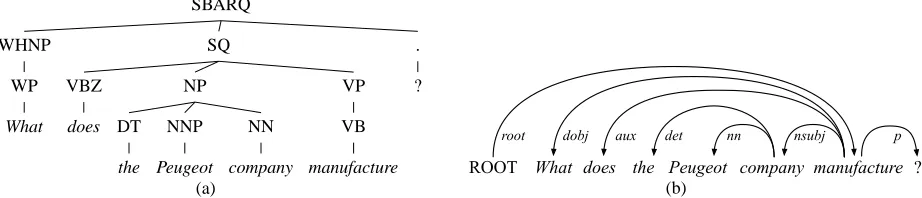
Figure 1: Example constituency tree from the QuestionBank (a) converted to labeled Stanford dependencies (b).
We therefore propose an uptraining method, in which a deterministic shift-reduce parser is trained on the output of a more accurate, but slower parser (Section 4). This type of domain adaptation is rem-iniscent of self-training (McClosky et al., 2006a; Huang and Harper, 2009) and co-training (Blum and Mitchell, 1998; Sagae and Lavie, 2006), except that the goal here is not to further improve the perfor-mance of the very best model. Instead, our aim is to train a computationally cheaper model (a linear time dependency parser) to match the performance of the best model (a cubic time constituency parser), resulting in a computationally efficient, yet highly accurate model.
In practice, we parse a large amount of unlabeled data from the target domain with the constituency parser of Petrov et al. (2006) and then train a deter-ministic dependency parser on this noisy, automat-ically parsed data. The accuracy of the linear time parser on a question test set goes up from 60.06% (LAS) to 76.94% after uptraining, which is compa-rable to adding 2,000 labeled questions to the train-ing data. Combintrain-ing uptraintrain-ing with 2,000 labeled questions further improves the accuracy to 84.14%, fully recovering the drop between in-domain and out-of-domain accuracy.
We also present a detailed error analysis in Sec-tion 5, showing that the errors of the WSJ-trained model are primarily caused by sharp changes in syn-tactic configurations and only secondarily due to lexical shifts. Uptraining leads to large improve-ments across all error metrics and especially on im-portant dependencies like subjects (nsubj).
2 Experimental Setup
We used the following experimental protocol throughout the paper.
2.1 Data
Our main training set consists of Sections 02-21 of the Wall Street Journal portion of the Penn Treebank (Marcus et al., 1993), with Section 22 serving as de-velopment set for source domain comparisons. For our target domain experiments, we evaluate on the QuestionBank (Judge et al., 2006), which includes a set of manually annotated questions from a TREC question answering task. The questions in the Ques-tionBank are very different from our training data in terms of grammatical constructions and vocabulary usage, making this a rather extreme case of domain-adaptation. We split the 4,000 questions contained in this corpus in three parts: the first 2,000 ques-tions are reserved as a small target-domain training set; the remaining 2,000 questions are split in two equal parts, the first serving as development set and the second as our final test set. We report accuracies on the developments sets throughout this paper, and test only at the very end on the final test set.
We convert the trees in both treebanks from con-stituencies to labeled dependencies (see Figure 1) using the Stanford converter, which produces 46 types of labeled dependencies1 (de Marneffe et al., 2006). We evaluate on both unlabeled (UAS) and labeled dependency accuracy (LAS).2
Additionally, we use a set of 2 million ques-tions collected from Internet search queries as unla-beled target domain data. All user information was anonymized and only the search query string was re-tained. The question sample is selected at random after passing two filters that select queries that are
1
We use the Stanford Lexicalized Parser v1.6.2.
2
Training on Evaluating on WSJ Section 22 Evaluating on QuestionBank
WSJ Sections 02-21 F1 UAS LAS POS F1 UAS LAS POS
Nivre et al. (2007) — 88.42 84.89 95.00 — 74.14 62.81 88.48
McDonald et al. (2006) — 89.47 86.43 95.00 — 80.01 67.00 88.48
Charniak (2000) 90.27 92.33 89.86 96.71 83.01 85.61 73.59 90.49
Charniak and Johnson (2005) 91.92 93.56 91.24 96.69 84.47 87.13 75.94 90.59
Petrov et al. (2006) 90.70 92.91 90.48 96.27 85.52 88.17 79.10 90.57
Petrov (2010) 92.10 93.85 91.60 96.44 86.62 88.77 79.92 91.08
Our shift-reduce parser — 88.24 84.69 95.00 — 72.23 60.06 88.48
Our shift-reduce parser (gold POS) — 90.51 88.53 100.00 — 78.30 68.92 100.00
Table 1: Parsing accuracies for parsers trained on newswire data and evaluated on newswire and question test sets.
similar in style to the questions in the QuestionBank: (i) the queries must start with an English function word that can be used to start a question (what, who when, how, why, can, does, etc.), and (ii) the queries have a maximum length of 160 characters.
2.2 Parsers
We use multiple publicly available parsers, as well as our own implementation of a deterministic shift-reduce parser in our experiments. The depen-dency parsers that we compare are the determinis-tic shift-reduce MaltParser (Nivre et al., 2007) and the second-order minimum spanning tree algorithm based MstParser (McDonald et al., 2006). Our shift-reduce parser is a re-implementation of the Malt-Parser, using a standard set of features and a lin-ear kernel SVM for classification. We also train and evaluate the generative lexicalized parser of Char-niak (2000) on its own, as well as in combination with the discriminative reranker of Charniak and Johnson (2005). Finally, we run the latent variable parser (a.k.a. BerkeleyParser) of Petrov et al. (2006), as well as the recent product of latent variable gram-mars version (Petrov, 2010). To facilitate compar-isons between constituency and dependency parsers, we convert the output of the constituency parsers to labeled dependencies using the same procedure that is applied to the treebanks. We also report their F1 scores for completeness.
While the constituency parsers used in our experi-ments view part-of-speech (POS) tagging as an inte-gral part of parsing, the dependency parsers require the input to be tagged with a separate POS tagger. We use the TnT tagger (Brants, 2000) in our
experi-ments, because of its efficiency and ease of use. Tag-ger and parser are always trained on the same data.
3 Parsing Questions
We consider two domain adaptation scenarios in this paper. In the first scenario (sometimes abbreviated as WSJ), we assume that we do not have any labeled training data from the target domain. In practice, this will always be the case when the target domain is unknown or very diverse. The second scenario (ab-breviated as WSJ+QB) assumes a small amount of labeled training data from the target domain. While this might be expensive to obtain, it is certainly fea-sible for narrow domains (e.g. questions), or when a high parsing accuracy is really important.
3.1 No Labeled Target Domain Data
We first trained all parsers on the WSJ training set and evaluated their performance on the two domain specific evaluation sets (newswire and questions). As can be seen in the left columns of Table 1, all parsers perform very well on the WSJ development set. While there are differences in the accuracies, all scores fall within a close range. The table also confirms the commonly known fact (Yamada and Matsumoto, 2003; McDonald et al., 2005) that con-stituency parsers are more accurate at producing de-pendencies than dependency parsers (at least when the dependencies were produced by a deterministic transformation of a constituency treebank, as is the case here).
Evaluating on Training on WSJ + QB Training on QuestionBank
QuestionBank F1 UAS LAS POS F1 UAS LAS POS
Nivre et al. (2007) — 83.54 78.85 91.32 — 79.72 73.44 88.80
McDonald et al. (2006) — 84.95 80.17 91.32 — 82.52 77.20 88.80
Charniak (2000) 89.40 90.30 85.01 94.17 79.70 76.69 69.69 87.84
Petrov et al. (2006) 90.96 90.98 86.90 94.01 86.62 84.09 78.92 87.56
Petrov (2010) 92.81 92.23 88.84 94.48 87.72 85.07 80.08 87.79
Our shift-reduce parser — 83.70 78.27 91.32 — 80.44 74.29 88.80
Our shift-reduce parser (gold POS) — 89.39 86.60 100.00 — 87.31 84.15 100.00
Table 2: Parsing accuracies for parsers trained on newswire and question data and evaluated on a question test set.
might have expected, the accuracies are significantly lower, however, the drop for some of the parsers is shocking. Most notably, the deterministic shift-reduce parsers lose almost 25% (absolute) on la-beled accuracies, while the latent variable parsers lose around 12%.3 Note also that even with gold POS tags, LAS is below 70% for our determinis-tic shift-reduce parser, suggesting that the drop in accuracy is primarily due to a syntactic shift rather than a lexical shift. These low accuracies are espe-cially disturbing when one considers that the aver-age question in the evaluation set is only nine words long and therefore potentially much less ambiguous than WSJ sentences. We will examine the main error types more carefully in Section 5.
Overall, the dependency parsers seem to suf-fer more from the domain change than the con-stituency parsers. One possible explanation is that they lack the global constraints that are enforced by the (context-free) grammars. Even though the Mst-Parser finds the globally best spanning tree, all con-straints are local. This means for example, that it is not possible to require the final parse to contain a verb (something that can be easily expressed by a top-level production of the form S→NP VP in a context free grammar). This is not a limitation of de-pendency parsers in general. For example, it would be easy to enforce such constraints in the Eisner (1996) algorithm or using Integer Linear Program-ming approaches (Riedel and Clarke, 2006; Martins et al., 2009). However, such richer modeling capac-ity comes with a much higher computational cost.
Looking at the constituency parsers, we observe
3
The difference between our shift-reduce parser and the MaltParser are due to small differences in the feature sets.
that the lexicalized (reranking) parser of Charniak and Johnson (2005) loses more than the latent vari-able approach of Petrov et al. (2006). This differ-ence doesn’t seem to be a differdiffer-ence of generative vs. discriminative estimation. We suspect that the latent variable approach is better able to utilize the little evidence in the training data. Intuitively speak-ing, some of the latent variables seem to get allo-cated for modeling the few questions present in the training data, while the lexicalization contexts are not able to distinguish between declarative sentences and questions.
To verify this hypothesis, we conducted two addi-tional experiments. In the first experiment, we col-lapsed the question specific phrasal categories SQ and SBARQ to their declarative sentence equivalents S and SBAR. When the training and test data are processed this way, the lexicalized parser loses 1.5% F1, while the latent variable parser loses only 0.7%. It is difficult to examine the grammars, but one can speculate that some of the latent variables were used to model the question specific constructions and the model was able to re-learn the distinctions that we purposefully collapsed. In the second experiment, we removed all questions from the WSJ training set and retrained both parsers. This did not make a significant difference when evaluating on the WSJ development set, but of course resulted in a large performance drop when evaluating on the Question-Bank. The lexicalized parser came out ahead in this experiment,4 confirming our hypothesis that the la-tent variable model is better able to pick up the small amount of relevant evidence that is present in the WSJ training data (rather than being systematically
4The F
better suited for modeling questions).
3.2 Some Labeled Target Domain Data
In the above experiments, we considered a situation where we have no labeled training data from the tar-get domain, as will typically be the case. We now consider a situation where a small amount of labeled data (2,000 manually parsed sentences) from the do-main of interest is available for training.
We experimented with two different ways of uti-lizing this additional training data. In a first experi-ment, we trained models on the concatenation of the WSJ and QuestionBank training sets (we did not at-tempt to weight the different corpora). As Table 2 shows (left columns), even a modest amount of la-beled data from the target domain can significantly boost parsing performance, giving double-digit im-provements in some cases. While not shown in the table, the parsing accuracies on the WSJ develop-ment set where largely unaffected by the additional training data.
Alternatively, one can also train models exclu-sively on the QuestionBank data, resulting in ques-tion specific models. The parsing accuracies of these domain-specific models are shown in the right columns of Table 2, and are significantly lower than those of models trained on the concatenated training sets. They are often times even lower than the results of parsers trained exclusively on the WSJ, indicating that 2,000 sentences are not sufficient to train accu-rate parsers, even for quite narrow domains.
4 Uptraining for Domain-Adaptation
The results in the previous section suggest that parsers without global constraints have difficul-ties dealing with the syntactic differences between declarative sentences and questions. A possible ex-planation is that similar word configurations can ap-pear in both types of sentences, but with very differ-ent syntactic interpretation. Local models without global constraints are therefore mislead into dead-end interpretations from which they cannot recover (McDonald and Nivre, 2007). Our approach will therefore be to use a large amount of unlabeled data to bias the model towards the appropriate distribu-tion for the target domain. Rather than looking for feature correspondences between the domains
70 75 80 85 90
1M 100K 10K 1K 100 10 0
UAS
WSJ+QB WSJ
60 65 70 75 80 85
1M 100K 10K 1K 100 10 0
LAS
Number of unlabeled questions WSJ+QB
[image:5.612.317.511.50.259.2]WSJ
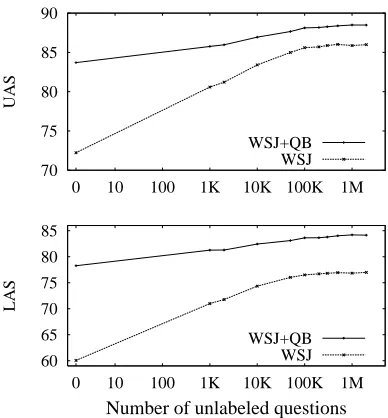
Figure 2: Uptraining with large amounts of unlabeled data gives significant improvements over two different supervised baselines.
(Blitzer et al., 2006), we propose to use automati-cally labeled target domain data to learn the target domain distribution directly.
4.1 Uptraining vs. Self-training
The idea of training parsers on their own output has been around for as long as there have been statis-tical parsers, but typically does not work well at all (Charniak, 1997). Steedman et al. (2003) and Clark et al. (2003) present co-training procedures for parsers and taggers respectively, which are ef-fective when only very little labeled data is avail-able. McClosky et al. (2006a) were the first to im-prove a state-of-the-art constituency parsing system by utilizing unlabeled data for self-training. In sub-sequent work, they show that the same idea can be used for domain adaptation if the unlabeled data is chosen accordingly (McClosky et al., 2006b). Sagae and Tsujii (2007) co-train two dependency parsers by adding automatically parsed sentences for which the parsers agree to the training data. Finally, Suzuki et al. (2009) present a very effective semi-supervised approach in which features from multiple generative models estimated on unlabeled data are combined in a discriminative system for structured prediction.
Uptraining with Using only WSJ data Using WSJ + QB data
different base parsers UAS LAS POS UAS LAS POS
Baseline 72.23 60.06 88.48 83.70 78.27 91.32
Self-training 73.62 61.63 89.60 84.26 79.15 92.09
Uptraining on Petrov et al. (2006) 86.02 76.94 90.75 88.38 84.02 93.63
[image:6.612.89.527.54.147.2]Uptraining on Petrov (2010) 85.21 76.19 90.74 88.63 84.14 93.53
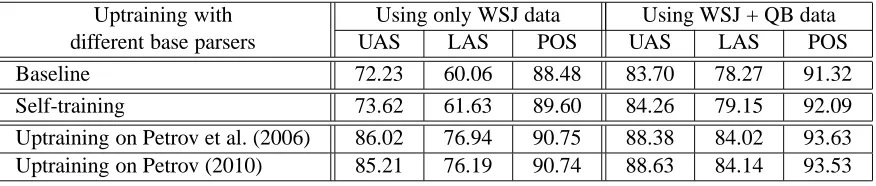
Table 3: Uptraining substantially improves parsing accuracies, while self-training gives only minor improvements.
performance of the best parser, we want to build a more efficient parser that comes close to the ac-curacy of the best parser. To do this, we parse the unlabeled data with our most accurate parser and generate noisy, but fairly accurate labels (parse trees) for the unlabeled data. We refer to the parser used for producing the automatic labels as the base parser (unless otherwise noted, we used the latent variable parser of Petrov et al. (2006) as our base parser). Because the most accurate base parsers are constituency parsers, we need to convert the parse trees to dependencies using the Stanford converter (see Section 2). The automatically parsed sentences are appended to the labeled training data, and the shift-reduce parser (and the part-of-speech tagger) are trained on this new training set. We did not increase the weight of the WSJ training data, but weighted the QuestionBank training data by a fac-tor of ten in the WSJ+QB experiments.
4.2 Varying amounts of unlabeled data
Figure 2 shows the efficacy of uptraining as a func-tion of the size of the unlabeled data. Both la-beled (LAS) and unlala-beled accuracies (UAS) im-prove sharply when automatically parsed sentences from the target domain are added to the training data, and level off after 100,000 sentences. Comparing the end-points of the dashed lines (models having access only to labeled data from the WSJ) and the starting points of the solid lines (models that have access to both WSJ and QuestionBank), one can see that roughly the same improvements (from 72% to 86% UAS and from 60% to 77% LAS) can be ob-tained by having access to 2,000 labeled sentences from the target domain or uptraining with a large amount of unlabeled data from the target domain. The benefits seem to be complementary and can be combined to give the best results. The final
accu-racy of 88.63 / 84.14 (UAS / LAS) on the question evaluation set is comparable to the in-domain per-formance on newswire data (88.24 / 84.69).
4.3 Varying the base parser
Table 3 then compares uptraining on the output of different base parsers to pure self-training. In these experiments, the same set of 500,000 questions was parsed by different base parsers. The automatic parses were then added to the labeled training data and the parser was retrained. As the results show, self-training provides only modest improvements of less than 2%, while uptraining gives double-digit improvements in some cases. Interestingly, there seems to be no substantial difference between up-training on the output of a single latent variable parser (Petrov et al., 2006) and a product of latent variable grammars (Petrov, 2010). It appears that the roughly 1% accuracy difference between the two base parsers is not important for uptraining.
4.4 POS-less parsing
Our uptraining procedure improves parse quality on out-of-domain data to the level of in-domain ac-curacy. However, looking closer at Table 3, one can see that the POS accuracy is still relatively low (93.53%), potentially limiting the final accuracy.
vary-UAS LAS POS Part-of-Speech Tags 88.35 84.05 93.53 Word Cluster Features 87.92 83.73 —
Table 4: Parsing accuracies of uptrained parsers with and without part-of-speech tags and word cluster features.
ing cluster granularities (6 and 10 bits in our experi-ments). Table 4 shows that roughly the same level of accuracy can be achieved with cluster based features instead of POS tag features. This change makes our parser completely deterministic and enables us to process sentences in a single left-to-right pass.
5 Error Analysis
To provide a better understanding of the challenges involved in parsing questions, we analyzed the er-rors made by our WSJ-trained shift-reduce parser and also compared them to the errors that are left after uptraining.
5.1 POS errors
Many parsing errors can be traced back to POS tag-ging errors, which are much more frequent on out-of-domain data than on in-domain data (88.8% on the question data compared to above 95.0% on WSJ data). Part of the reason for the lower POS tagging accuracy is the higher unknown word ratio (7.3% on the question evaluation set, compared to 3.4% on the WSJ evaluation set). Another reason is a change in the lexical distribution.
For example, wh-determiners (WDT) are quite rare in the WSJ training data (relative frequency 0.45%), but five times more common in the Ques-tionBank training data (2.49%). In addition to this frequency difference, 52.43% of the WDTs in the WSJ are the word “which” and 46.97% are“that”. In the QuestionBank on the other hand, “what” is by far the most common WDT word (81.40%), while “which” and “that” account only for 13.65% and 4.94% respectively. Not surprisingly the most com-mon POS error involves wh-determiners (typically the word “what”) being incorrectly labeled as Wh-pronouns (WP), resulting in head and label errors like the one shown in Figure 3(a).
To separate out POS tagging errors from parsing errors, we also ran experiments with correct (gold)
Dep. Label Frequency WSJ Uptrained
nsubj 934 41.02 88.64
amod 556 78.21 86.00
dobj 555 70.10 83.12
attr 471 8.64 93.49
aux 467 77.31 82.56
Table 5: F1 scores for the most frequent labels in the QuestionBank development set. Uptraining leads to huge improvements compared to training only on the WSJ.
POS tags. The parsing accuracies of our shift-reduce parser using gold POS tags are listed in the last rows of Tables 1 and 2. Even with gold POS tags, the de-terministic shift-reduce parser falls short of the ac-curacies of the constituency parsers (with automatic tags), presumably because the shift-reduce model is making only local decisions and is lacking the global constraints provided by the context-free grammar.
5.2 Dependency errors
To find the main error types, we looked at the most frequent labels in the QuestionBank development set, and analyzed the ones that benefited the most from uptraining. Table 5 has the frequency and F-scores of the dependency types that we are going to discuss in the following. We also provide examples which are illustrated in Figure 3.
nsubj: The WSJ-trained model is often producing
parses that are missing a subject (nsubj). Questions like “What is the oldest profession?” and “When was Ozzy Osbourne born?” should have “profes-sion” and “Osbourne” as nsubjs, but in both cases the WSJ-trained parser did not label any subj (see Figures 3(b) and 3(c)). Another common error is to mislabel nsubj. For example, the nsubj of “What are liver enzymes?” should be enzymes, but the WSJ-trained parser labels “What” as the nsubj, which makes sense in a statement but not in a question.
amod: The model is overpredicting “amod”,
What is the oldest profession ? ROOT
det amod p
root attr nsubj
WP VBZ DT JJS NN .
ROOT
det amod p
root dep attr
WP VBZ DT JJS NN .
What is the oldest profession ?
When was Ozzy Osbourne born ? ROOT WRB VBZ NNP NNP VBN .
root advmod aux nn nsubj p
When was Ozzy Osbourne born ? ROOT WRB VBZ NNP NNP NNP .
root compl nn nn nsubj p
What films featured the character ? ROOT WDT NNS VBD DT NN NNP NNP .
Popeye Doyle
nsubj dep det nn nn dobj
What films featured the character ? ROOT WP NNS VBD DT NN NNP NNP .
Popeye Doyle nsubj
compl det nn nn
root ccomp
(a)
(b)
(c)
(d)
How many people did Randy ? ROOT WRB JJ NNS VBD NNP NNP VB .
Craft kill
dobj dep aux nn nsubj p
?
. dep
How many people did Randy
ROOT WRB JJ NNS VBD NNP NNP VB
[image:8.612.85.518.48.297.2]Craft kill compl amod nsubj ccomp nn nsubj p root
Figure 3: Example questions from the QuestionBank development set and their correct parses (left), as well as the predictions of a model trained on the WSJ (right).
the WSJ model often makes this mistake and there-fore the precision is much lower when it doesn’t see more questions in the training data.
dobj: The WSJ model doesn’t predict object
ex-traction well. For example, in “How many people did Randy Craft kill?” (Figure 3(d)), the direct ob-ject of kill should be “How many people.” In the Stanford dependencies, the correct labels for this noun phrase are “dobj dep dep,” but the WSJ model predicts “compl amod nsubj.” This is a common error caused by the different word order in ques-tions. The uptrained model is much better at han-dling these type of constructions.
attr: An attr (attributive) is a wh-noun phrase
(WHNP) complement of a copular verb. In the WSJ training data, only 4,641 out of 950,028 dependen-cies are attr (0.5%); in the QuestionBank training data, 1,023 out of 17,069 (6.0%) are attr. As a con-sequence, the WSJ model cannot predict this label in questions very well.
aux: “What does the abbreviation AIDS stand
for?” should have “stand” as the main head of the sentence, and “does” as its aux. However, the WSJ model labeled “does” as the main head. Similar patterns occur in many questions, and therefore the WSJ has a very low recall rate.
In contrast, mostly local labels (that are not re-lated to question/statement structure differences) have a consistently high accuracy. For example: det has an accuracy of 98.86% with the WSJ-trained model, and 99.24% with the uptrained model.
6 Conclusions
Acknowledgements
We would like to thank Ryan McDonald for run-ning the MstParser experiments and for many fruit-ful discussions on this topic. We would also like to thank Joakim Nivre for help with the MatlParser and Marie-Catherine de Marneffe for help with the Stan-ford Dependency Converter.
References
J. Blitzer, R. McDonald, and F. Pereira. 2006. Domain adaptation with structural correspondence learning. In EMNLP ’06.
A. Blum and T. Mitchell. 1998. Combining labeled and unlabeled data with co-training. In COLT ’98. T. Brants. 2000. TnT – a statistical part-of-speech tagger.
In ANLP ’00.
P. Brown, V. Della Pietra, P. deSouza, J. Lai, and R. Mer-cer. 1992. Class-based n-gram models of natural lan-guage. Computational Linguistics.
X. Carreras, M. Collins, and T. Koo. 2008. TAG, dy-namic programming, and the perceptron for efficient, feature-rich parsing. In CoNLL ’08.
E. Charniak and M. Johnson. 2005. Coarse-to-Fine N-Best Parsing and MaxEnt Discriminative Reranking. In ACL’05.
E. Charniak. 1997. Statistical parsing with a context-free grammar and word statistics. In AI ’97.
E. Charniak. 2000. A maximum–entropy–inspired parser. In NAACL ’00.
S. Clark, J. Curran, and M. Osborne. 2003. Bootstrap-ping pos-taggers using unlabelled data. In CoNLL ’03. M.-C. de Marneffe, B. MacCartney, and C. Manning. 2006. Generating typed dependency parses from phrase structure parses. In LREC ’06.
J. Eisner. 1996. Three new probabilistic models for de-pendency parsing: An exploration. In COLING ’96. J. Foster. 2010. “cba to check the spelling”:
Investigat-ing parser performance on discussion forum posts. In NAACL ’10.
D. Gildea. 2001. Corpus variation and parser perfor-mance. In EMNLP ’01.
Z. Huang and M. Harper. 2009. Self-training PCFG grammars with latent annotations across languages. In EMNLP ’09.
J. Judge, A. Cahill, and J. v. Genabith. 2006. Question-bank: creating a corpus of parse-annotated questions. In ACL ’06.
T. Koo and M. Collins. 2010. Efficient third-order de-pendency parsers. In ACL ’10.
T. Koo, X. Carreras, and M. Collins. 2008. Simple semi-supervised dependency parsing. In ACL ’08.
M. Marcus, B. Santorini, and M. Marcinkiewicz. 1993. Building a large annotated corpus of English: The Penn Treebank. In Computational Linguistics. A.F.T. Martins, N.A. Smith, and E.P. Xing. 2009.
Con-cise integer linear programming formulations for de-pendency parsing. In ACL ’09.
D. McClosky, E. Charniak, and M. Johnson. 2006a. Ef-fective self-training for parsing. In NAACL ’06. D. McClosky, E. Charniak, and M. Johnson. 2006b.
Reranking and self-training for parser adaptation. In ACL ’06.
R. McDonald and J. Nivre. 2007. Characterizing the errors of data-driven dependency parsing models. In EMNLP ’07.
R. McDonald, K. Crammer, and F. Pereira. 2005. Online large-margin training of dependency parsers. In ACL ’05.
R. McDonald, K. Lerman, and F. Pereira. 2006. Multi-lingual dependency analysis with a two-stage discrim-inative parser. In CoNLL ’06.
J. Nivre, J. Hall, J. Nilsson, A. Chanev, G. Eryigit, S. Kbler, S. Marinov, and E. Marsi. 2007. Maltparser: A language-independent system for data-driven de-pendency parsing. Natural Language Engineering, 13(2).
J. Nivre. 2008. Algorithms for deterministic incremen-tal dependency parsing. Computational Linguistics, 34(4).
S. Petrov, L. Barrett, R. Thibaux, and D. Klein. 2006. Learning accurate, compact, and interpretable tree an-notation. In ACL ’06.
S. Petrov. 2010. Products of random latent variable grammars. In NAACL ’10.
S. Riedel and J. Clarke. 2006. Incremental integer linear programming for non-projective dependency parsing. In EMNLP ’06.
K. Sagae and A. Lavie. 2006. Parser combination by reparsing. In NAACL ’06.
K. Sagae and J. Tsujii. 2007. Dependency parsing and domain adaptation with lr models and parser ensem-bles. In CoNLL ’07.
M. Steedman, M. Osborne, A. Sarkar, S. Clark, R. Hwa, J. Hockenmaier, P. Ruhlen, S. Baker, and J. Crim. 2003. Bootstrapping statistical parsers from small datasets. In EACL ’03.
J. Suzuki, H. Isozaki, X. Carreras, and M. Collins. 2009. An empirical study of semi-supervised structured con-ditional models for dependency parsing. In EMNLP ’09.