Experiments with a Higher-Order Projective Dependency Parser
Xavier Carreras
Massachusetts Institute of Technology (MIT)
Computer Science and Artificial Intelligence Laboratory (CSAIL) 32 Vassar St., Cambridge, MA 02139
Abstract
We present experiments with a dependency parsing model defined on rich factors. Our model represents dependency trees with fac-tors that include three types of relations be-tween the tokens of a dependency and their children. We extend the projective pars-ing algorithm of Eisner (1996) for our case, and train models using the averaged percep-tron. Our experiments show that consider-ing higher-order information yields signifi-cant improvements in parsing accuracy, but comes at a high cost in terms of both time and memory consumption. In the multi-lingual exercise of the CoNLL-2007 shared task (Nivre et al., 2007), our system obtains the best accuracy for English, and the second best accuracies for Basque and Czech.
1 Introduction
Structured prediction problems usually involve models that work with factored representations of structures. The information included in the factors determines the type of features that the model can exploit. However, richer representations translate into higher complexity of the inference algorithms associated with the model.
In dependency parsing, the basic first-order model is defined by a decomposition of a tree into head-modifier dependencies. Previous work extended this basic model to include second-order relations—i.e. dependencies that are adjacent to the main depen-dency of the factor. Specifically, these approaches
considered sibling relations of the modifier token (Eisner, 1996; McDonald and Pereira, 2006). In this paper we extend the parsing model with other types of second-order relations. In particular, we incorpo-rate relations between the head and modifier tokens and the children of the modifier.
One paradigmatic case where the relations we consider are relevant is PP-attachment. For example, in “They sold 1,210 cars in the U.S.”, the ambigu-ity problem is to determine whether the preposition “in” (which governs “the U.S.”) is modifying “sold” or “cars”, the former being correct in this case. It is generally accepted that to solve the attachment deci-sion it is necessary to look at the head noun within the prepositional phrase (i.e., “U.S.” in the exam-ple), which has a grand-parental relation with the two candidate tokens that the phrase may attach— see e.g. (Ratnaparkhi et al., 1994). Other ambigu-ities in language may also require consideration of grand-parental relations in the dependency structure. We present experiments with higher-order models trained with averaged perceptron. The second-order relations that we incorporate in the model yield sig-nificant improvements in accuracy. However, the in-ference algorithms for our factorization are very ex-pensive in terms of time and memory consumption, and become impractical when dealing with many la-bels or long sentences.
2 Higher-Order Projective Models
A dependency parser receives a sentencexofn
to-kens, and outputs a labeled dependency tree y. In the tree, a labeled dependency is a triplehh, m, li, whereh ∈ [0. . . n]is the index of the head token,
l
[image:2.612.355.498.60.142.2]h ch cmi m cmo
Figure 1: A factor in the higher-order parsing model.
m∈[1. . . n]is the index of the modifier token, and
l ∈ [1. . . L] is the label of the dependency. The value h = 0 is used for dependencies where the head is a special root-symbol of the sentence. We denote by T(x) the set of all possible dependency
structures for a sentencex. In this paper, we restrict
to projective dependency trees. The dependency tree computed by the parser for a given sentence is:
y∗(x) = arg max
y∈T(x)
X
f∈y
score(w,x, f)
The parsing model represents a structureyas a set of factors,f ∈y, and scores each factor using param-etersw. In a first-order model a factor corresponds
to a single labeled dependency, i.e. f = hh, m, li. The features of the model are defined through a fea-ture functionφ1(x, h, m)which maps a sentence
to-gether with an unlabeled dependency to a feature vector in Rd1. The parameters of the model are a
collection of vectors wl
1 ∈ Rd1, one for each pos-sible label. The first-order model scores a factor as
score1(w,x,hh, m, li) =φ1(x, h, m)·wl
1.
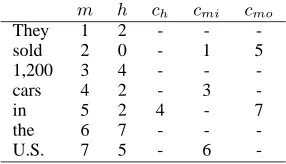
The higher-order model defined in this paper de-composes a dependency structure into factors that include children of the head and the modifier. In particular, a factor in our model is represented by the signaturef = hh, m, l, ch, cmi, cmoi where, as in the first-order model,h,mandlare respectively the head, modifier and label of the main dependency of the factor; ch is the child of h in [h . . . m]that is closest to m; cmi is child of m inside [h . . . m] that is furthest fromm; cmo is the child ofm out-side[h . . . m]that is furthest fromm. Figure 1 de-picts a factor of the higher-order model, and Table 1 lists the factors of an example sentence. Note that a factor involves a main labeled dependency and three adjacent unlabeled dependencies that attach to chil-dren ofhandm. Special values are used when either of these children are null.
The higher-order model defines additional
m h ch cmi cmo
They 1 2 - -
-sold 2 0 - 1 5
1,200 3 4 - -
-cars 4 2 - 3
-in 5 2 4 - 7
the 6 7 - -
-U.S. 7 5 - 6
-Table 1: Higher-order factors for an example sentence. For simplicity, labels of the factors have been omitted. A first-order model considers onlyhh, mi. The second-order model of Mc-Donald and Pereira (2006) considershh, m, chi. For the PP-attachment decision (factor in row 5), the higher-order model allows us to define features that relate the verb (“sold”) with the content word of the prepositional phrase (“U.S.”).
second-order features through a function
φ2(x, h, m, c) which maps a head, a modifier
and a child in a feature vector inRd2. The
param-eters of the model are a collection of four vectors for each dependency label: wl
1 ∈ Rd1 as in the first-order model; and wl
h,wlmi andwlmo, all three in Rd2 and each associated to one of the adjacent
dependencies in the factor. The score of a factor is:
score2(w,x,hh, m, l, ch, cmi, cmoi) = φ1(x, h, m)·wl
1+ φ2(x, h, m, ch)·wl
h+
φ2(x, h, m, cmi)·wl
mi+ φ2(x, h, m, cmo)·wl
mo
Note that the model uses a common feature func-tion for second-order relafunc-tions, but features could be defined specifically for each type of relation. Note also that while the higher-order factors include four dependencies, our modelling choice only ex-ploits relations between the main dependency and secondary dependencies. Considering relations be-tween secondary dependencies would greatly in-crease the cost of the associated algorithms.
2.1 Parsing Algorithm
In this section we sketch an extension of the pro-jective dynamic programming algorithm of Eis-ner (1996; 2000) for the higher-order model de-fined above. The time complexity of the algo-rithm isO(n4L), and the memory requirements are
[image:2.612.114.256.60.117.2]h m h m cmo e
l
mi
c r+1 r
h
c
[image:3.612.74.300.59.134.2]l
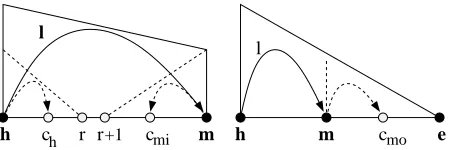
Figure 2:Dynamic programming structures used in the pars-ing algorithm. The variables in boldface constitute the index of the chart entry for a structure; the other variables constitute the back-pointer stored in the chart entry. Left: an open structure for the chart entry[h, m, l]O; the algorithm looks for ther,ch andcmithat yield the optimal score for this structure. Right: a closed structure for the chart entry[h, e, m]C; the algorithm looks for thelandcmothat yield the optimal score.
• Open structures: For each span fromstoeand each label l, the algorithm maintains a chart entry [s, e, l]O associated to the dependency
hs, e, li. For each entry, the algorithm looks for the optimal splitting pointr, siblingch and grand-childcmi using parameters wl
1, wl
h and
wl
mi. This can be done in O(n2) because our features do not consider interactions between
ch andcmi. Similar entries[e, s, l]Oare main-tained for dependencies headed ate.
• Closed structures: For each span from sto e
and each token m ∈ [s . . . e], the algorithm maintains an entry [s, e, m]C associated to a partial dependency tree rooted atsin whichm
is the last modifier ofs. The algorithm chooses the optimal dependency labelland grand-child
cmoinO(nL), using parameterswl
mo. Similar entries[e, s, m]Care maintained for dependen-cies headed ate.
We implemented two variants of the algorithm. The first forces the root token to participate in ex-actly one dependency. The second allows many de-pendencies involving the root token. For the single-root case, it is necessary to treat the single-root token dif-ferently than other tokens. In the experiments, we used the single-root variant if sentences in the train-ing set satisfy this property. Otherwise we used the multi-root variant.
2.2 Features
The first-order features φ1(x, h, m) are the exact
same implementation as in previous CoNLL sys-tem (Carreras et al., 2006). In turn, those features
were inspired by successful previous work in first-order dependency parsing (McDonald et al., 2005). The most basic feature patterns consider the sur-face form, part-of-speech, lemma and other morpho-syntactic attributes of the head or the modifier of a dependency. The representation also considers com-plex features that exploit a variety of conjunctions of the forms and part-of-speech tags of the follow-ing items: the head and modifier; the head, modifier, and any token in between them; the head, modifier, and the two tokens following or preceding them.
As for the second-order features, we again base our features with those of McDonald and Pereira (2006), who reported successful experiments with second-order models. We add some patterns to their features. Let dir be “right” if h < m, and “left” otherwise; let form(xi) and cpos(xi) return the surface form and coarse part-of-speech of token
xi, respectively. The definition ofφ2(x, h, m, c)is:
• dir·cpos(xh)·cpos(xm)·cpos(xc) • dir·cpos(xh)·cpos(xc)
• dir·cpos(xm)·cpos(xc) • dir·form(xh)·form(xc) • dir·form(xm)·form(xc) • dir·cpos(xh)·form(xc) • dir·cpos(xm)·form(xc) • dir·form(xh)·cpos(xc) • dir·form(xm)·cpos(xc)
3 Experiments and Results
We report experiments with higher-order models for the ten languages in the multilingual track of the CoNLL-2007 shared task (Nivre et al., 2007).1
In all experiments, we trained our models us-ing the averaged perceptron (Freund and Schapire, 1999), following the extension of Collins (2002) for structured prediction problems. To train models, we used “projectivized” versions of the training depen-dency trees.2
1
We are grateful to the providers of the treebanks that con-stituted the data for the shared task (Hajiˇc et al., 2004; Aduriz et al., 2003; Mart´ı et al., 2007; Chen et al., 2003; B ¨ohmov´a et al., 2003; Marcus et al., 1993; Johansson and Nugues, 2007; Prokopidis et al., 2005; Csendes et al., 2005; Montemagni et al., 2003; Oflazer et al., 2003).
2
Catalan Czech English First-Order, no averaging 82.07 68.98 83.75
First-Order 86.15 75.96 87.54
Higher-Order,ch 87.50 77.15 88.70
[image:4.612.323.531.58.198.2]Higher-Order,chcmo 87.68 77.62 89.28 Higher-Order,chcmicmo 88.04 78.09 89.59
Table 2: Labeled attachment scores on validation data (∼10,000 tokens per language), for different models that ex-ploit increasing orders of factorizations.
3.1 Impact of Higher-Order Factorization
Our first set of experiments looks at the performance of different factorizations. We selected three lan-guages with a large number of training sentences, namely Catalan, Czech and English. To evaluate models, we held out the training sentences that cover the first 10,000 tokens; the rest was used for training. We compared four models at increasing orders of factorizations. The first is a first-order model. The second model is similar to that of McDonald and Pereira (2006): a factor consists of a main labeled dependency and the head child closest to the mod-ifier (ch). The third model incorporates the modi-fier child outside the main dependency in the fac-torization (cmo). Finally, the last model incorpo-rates the modifier child inside the dependency span (cmi), thus corresponding to the complete higher-order model presented in the previous section.
Table 2 shows the accuracies of the models on validation data. Each model was trained for up to 10 epochs, and evaluated at the end of each epoch; we report the best accuracy of these evaluations. Clearly, the accuracy increases as the factors in-clude richer information in terms of second-order relations. The richest model obtains the best accu-racy in the three languages, being much better than that of the first-order model. The table also reports the accuracy of an unaveraged first-order model, il-lustrating the benefits of parameter averaging.
3.2 Results on the Multilingual Track
We trained a higher-order model for each language, using the averaged perceptron. In the experiments presented above we observed that the algorithm does not over-fit, and that after two or three train-ing epochs only small variations in accuracy occur. Based on this fact, we designed a criterion to train models: we ran the training algorithm for up to three
training test
sent./min. mem. UAS LAS
Arabic 1.21 1.8GB 81.48 70.20
Basque 33.15 1.2GB 81.08 75.73
Catalan 5.50 1.7GB 92.46 87.60
Chinese 1461.66 60MB 86.20 80.86
Czech 18.19 1.8GB 85.16 78.60
English 15.57 1.0GB 90.63 89.61
Greek 8.10 250MB 81.37 73.56
Hungarian 5.65 1.6GB 79.92 75.42
Italian 12.44 900MB 87.19 83.46
Turkish 116.55 600MB 82.41 75.85
[image:4.612.77.298.59.125.2]Average - - 84.79 79.09
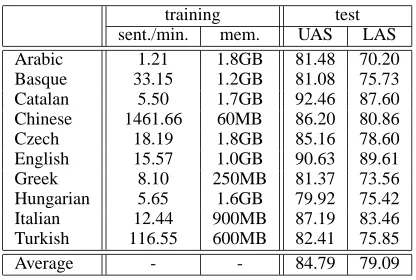
Table 3: Performance of the higher-order projective models on the multilingual track of the CoNLL-2007 task. The first two columns report the speed (in sentences per minute) and mem-ory requirements of the training algorithm—these evaluations were made on the first 1,000 training sentences with a Dual-Core AMD OpteronTM Processor 256 at 1.8GHz with 4GB of memory. The last two columns report unlabelled (UAS) and labelled (LAS) attachment scores on test data.
days of computation, or a maximum of 15 epochs. For Basque, Chinese and Turkish we could complete the 15 epochs. For Arabic and Catalan, we could only complete 2 epochs. Table 3 reports the perfor-mance of the higher-order projective models on the ten languages of the multilingual track.
4 Conclusion
We have presented dependency parsing models that exploit higher-order factorizations of trees. Such factorizations allow the definition of second-order features associated with sibling and grand-parental relations. For some languages, our models obtain state-of-the-art results.
One drawback of our approach is that the infer-ence algorithms for higher-order models are very ex-pensive. For languages with many dependency la-bels or long sentences, training and parsing becomes impractical for current machines. Thus, a promising line of research is the investigation of methods to efficiently incorporate higher-order relations in dis-criminative parsing.
Acknowledgments
References
A. Abeill´e, editor. 2003. Treebanks: Building and Using Parsed Corpora. Kluwer.
I. Aduriz, M. J. Aranzabe, J. M. Arriola, A. Atutxa, A. Diaz de Ilarraza, A. Garmendia, and M. Oronoz. 2003. Con-struction of a Basque dependency treebank. In Proc. of the
2nd Workshop on Treebanks and Linguistic Theories (TLT),
pages 201–204.
A. B¨ohmov´a, J. Hajiˇc, E. Hajiˇcov´a, and B. Hladk´a. 2003. The PDT: a 3-level annotation scenario. In Abeill´e (Abeill´e, 2003), chapter 7, pages 103–127.
X. Carreras, M. Surdeanu, and L. M`arquez. 2006. Projective dependency parsing with perceptron. In Proc. CoNLL-X.
K. Chen, C. Luo, M. Chang, F. Chen, C. Chen, C. Huang, and Z. Gao. 2003. Sinica treebank: Design criteria, representa-tional issues and implementation. In Abeill´e (Abeill´e, 2003), chapter 13, pages 231–248.
M. Collins. 2002. Discriminative training methods for hidden markov models: Theory and experiments with perceptron al-gorithms. In Proc. of EMNLP-2002.
D. Csendes, J. Csirik, T. Gyim ´othy, and A. Kocsor. 2005. The
Szeged Treebank. Springer.
J. Eisner. 1996. Three new probabilistic models for depen-dency parsing: An exploration. In Proc. COLING.
J. Eisner. 2000. Bilexical grammars and their cubic-time pars-ing algorithms. In H. C. Bunt and A. Nijholt, editors, New
Developments in Natural Language Parsing, pages 29–62.
Kluwer Academic Publishers.
Y. Freund and R. E. Schapire. 1999. Large margin classifi-cation using the perceptron algorithm. Machine Learning, 37(3):277–296.
J. Hajiˇc, O. Smrˇz, P. Zem´anek, J. ˇSnaidauf, and E. Beˇska. 2004. Prague Arabic dependency treebank: Development in data and tools. In Proc. of the NEMLAR Intern. Conf. on Arabic
Language Resources and Tools, pages 110–117.
R. Johansson and P. Nugues. 2007. Extended constituent-to-dependency conversion for English. In Proc. of the 16th
Nordic Conference on Computational Linguistics (NODAL-IDA).
M. Marcus, B. Santorini, and M. Marcinkiewicz. 1993. Build-ing a large annotated corpus of English: the Penn Treebank.
Computational Linguistics, 19(2):313–330.
M. A. Mart´ı, M. Taul´e, L. M`arquez, and M. Bertran. 2007. CESS-ECE: A multilingual and multilevel annotated corpus. Available for download from: http://www.lsi.upc.edu/∼mbertran/cess-ece/.
R. McDonald and F. Pereira. 2006. Online learning of approx-imate dependency parsing algorithms. In Proc. of
EACL-2006.
R. McDonald, K. Crammer, and F. Pereira. 2005. Online large-margin training of dependency parsers. In Proc. ACL.
S. Montemagni, F. Barsotti, M. Battista, N. Calzolari, O. Coraz-zari, A. Lenci, A. Zampolli, F. Fanciulli, M. Massetani, R. Raffaelli, R. Basili, M. T. Pazienza, D. Saracino, F. Zan-zotto, N. Nana, F. Pianesi, and R. Delmonte. 2003. Build-ing the Italian Syntactic-Semantic Treebank. In Abeill´e (Abeill´e, 2003), chapter 11, pages 189–210.
J. Nivre, J. Hall, S. K ¨ubler, R. McDonald, J. Nilsson, S. Riedel, and D. Yuret. 2007. The CoNLL 2007 shared task on de-pendency parsing. In Proc. of EMNLP-CoNLL.
K. Oflazer, B. Say, D. Zeynep Hakkani-T ¨ur, and G. T¨ur. 2003. Building a Turkish treebank. In Abeill´e (Abeill´e, 2003), chapter 15, pages 261–277.
P. Prokopidis, E. Desypri, M. Koutsombogera, H. Papageor-giou, and S. Piperidis. 2005. Theoretical and practical is-sues in the construction of a Greek dependency treebank. In
Proc. of the 4th Workshop on Treebanks and Linguistic The-ories (TLT), pages 149–160.
A. Ratnaparkhi, J. Reinar, and S. Roukos. 1994. A maximum entropy model for prepositional phrase attachment. In Proc.