Deciphering Related Languages
Nima Pourdamghani, Kevin Knight
Information Sciences Institute & Department of Computer Science University of Southern California
{damghani,knight}@isi.edu
Abstract
We present a method for translating texts between close language pairs. The method does not require parallel data, and it does not require the languages to be written in the same script. We show results for six language pairs: Afrikaans/Dutch, Bosnian/Serbian, Danish/Swedish, Mace-donian/Bulgarian, Malaysian/Indonesian, and Polish/Belorussian. We report BLEU scores showing our method to outperform others that do not use parallel data.
1 Introduction
Statistical Natural Language Processing (NLP) tools often need large amounts of training data in order to achieve good performance. This limits the use of current NLP tools to a few resource-rich languages. Assume an incident happens in an area with a low-resource language, known as the Incident Language (IL). For a quick response, we need to build NLP tools with available data, as finding or annotating new data is expensive and time consuming. For many languages this means that we only have a small amount of often out-of-domain parallel data (e.g. a Bible or Ubuntu man-ual), some monolingual data and almost no anno-tation such as part of speech tags.
Fortunately, many low-resource languages have one or more higher-resource, closely Related Lan-guages (RL). Examples of such IL/RL pairs are Afrikaans/Dutch and Bosnian/Serbian. A natural idea is to use RL resources to improve the task for IL. But this requires some kind of conversion between RL and IL. Assume the required NLP ca-pability is named entity tagging. If we can con-vert RL to IL, we can concon-vert all RL training data along with annotations into IL and train the tagger for IL. Or, if we can convert IL to RL we can use
the potentially existing RL named entity tagger on converted IL data and project back the tags.
Following this idea, Currey et al. (2016) use a rule-based translation system to convert Italian and Portuguese into Spanish, to improve Span-ish (here, IL) language modeling, Nakov and Ng (2009) convert RL/English parallel data to IL/English where both RL and IL have Latin or-thography to improve IL/English machine trans-lation. Hana et al. (2006) use cognates to adapt Spanish resources to Brazilian Portuguese to train a part-of-speech tagger. Mann and Yarowsky (2001) use Spanish/Portuguese cog-nates to convert an English/Spanish lexicon to En-glish/Portuguese. These works prove the useful-ness of RL data to improve NLP for IL, but they are designed for specific tasks and IL/RL pairs.
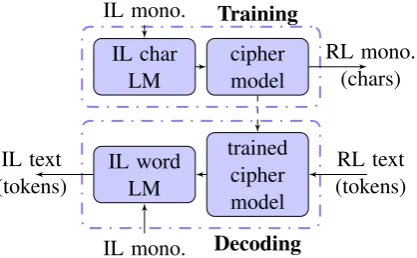
In this paper we propose a universal method for translating texts between closely related lan-guages. We assume that IL and RL are mostly cognates, having roughly the same word order. Our method is orthography-agnostic for alphabetic systems, and crucially, it does not need any paral-lel data. From now on, we talk about converting RL to IL, but the method does not distinguish be-tween RL and IL; as mentioned above, each direc-tion of transladirec-tion can have its own potential uses. To translate RL to IL, we train a character-based cipher model and connect it to a word-based lan-guage model. The cipher model is trained in a noisy channel model where a character language model produces IL characters and the model con-verts them to RL. Expectation Maximization is used to train the model parameters to maximize the likelihood of a set of RL monolingual data. At decoding time, the cipher model reads the RL text character by character in which words are separated by a special character, and produces a weighted lattice of characters representing all the possible translations for each of the input tokens.
IL mono. IL char
LM ciphermodel
RL mono. (chars)
IL word LM
trained cipher model IL mono.
RL text (tokens) IL text
(tokens)
Training
[image:2.595.79.288.65.194.2]Decoding
Figure 1: The process used for training the cipher model and decoding RL text to IL
The word-based language model takes this lat-tice and produces a sequence of output words that maximize the language model score times the ci-pher model score. Figure1depicts this process.
Our cipher models one-to-one, one-to-two and two-to-one character mappings. This allows us to handle cases like Cyrillic ‘q’ and Latin ‘ch’, and also subtle differences in pronunciation between RL and IL like Portuguese ‘justiça’ and Spanish ‘justicia’. Using a character-based cipher model provides the flexibility to generate unseen words. In other words, the vocabulary is limited by the decoding LM, not the cipher model. Separation of training and decoding language models enables us to train the decoding LM on as much data as is available without worrying about training speed or memory issues. We can also transliterate out of vocabulary words by spelling out the best path produced by cipher model in case no good match is found for a token in the decoding LM.
2 Related Work
Previous work on translation between related lan-guages can be categorized into three groups:
Systems for specific language pairs such as Czech-Slovak (Haji et al.,2000), Turkish-Crimean Tatar (Cicekli,2002), Irish-Scottish Gaelic ( Scan-nell, 2006), and Indonesian-Malaysian (Larasati and Kubo,2010). Another similar trend is trans-lation between dialects of the same language like Arabic dialects to standard Arabic (Hitham et al., 2008;Sawaf,2010;Salloum and Habash, 2010). Also, work has been done on translating back the Romanized version of languages like Greeklish to Greek (Chalamandaris et al.,2006) and Arabizi to Arabic (May et al., 2014). These methods can-not be applied to our problem because time and resources are limited to build a translation system for the specific language pair.
Machine learning systems that use parallel data: These methods cover a broader range of languages but require parallel text between related languages. They include character-level machine translation (Vilar et al.,2007;Tiedemann,2009) or combination of word-level and character-level ma-chine translation (Nakov and Tiedemann, 2012) between related languages.
Use of non-parallel data: Cognates can be extracted from monolingual data and used as a parallel lexicon (Hana et al., 2006; Mann and Yarowsky,2001;Kondrak et al.,2003). However, our task is whole-text transformation, not just cog-nate extraction.
Unsupervised deciphering methods, which re-quire no parallel data, have been used for bilin-gual lexicon extraction and machine translation. Word-based deciphering systems ignore sub-word similarities between related languages (Koehn and Knight, 2002; Ravi and Knight, 2011b; Nuhn et al.,2012;Dou and Knight,2012;Ravi,2013). Haghighi et al. (2008) and Naim and Gildea (2015) propose models that can use orthographic similarities. However, the model proposed by (Naim and Gildea, 2015) is only capable of pro-ducing a parallel lexicon and not translation. Fur-thermore, both systems require the languages to have the same orthography and their vocabulary is limited to what they see during training.
Character-based decipherment is the model we use for solving this problem. Character-based decipherment has been previously applied to problems like solving letter substitution ciphers (Knight et al., 2006; Ravi and Knight, 2011a) or transliterating Japanese katakana into English (Ravi and Knight, 2009), but not for translating full texts between related languages.
3 Translating RL to IL
We learn a character-based cipher model for trans-lating RL to IL. At decoding, this model is com-bined with a word based IL language model to pro-duce IL text from RL.
3.1 Cipher Model
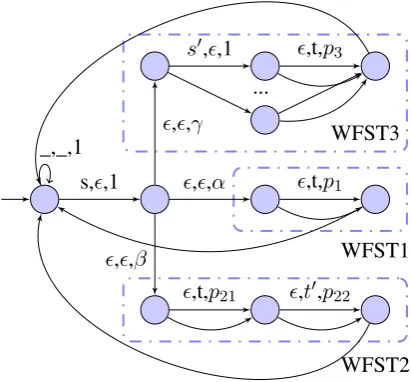
Our noisy-channel cipher model converts a se-quence of IL characterss1, ..., snto a sequence of
RL characterst1, ..., tm. It is a WFST composed
of three components (Figure2):
WFST3
WFST1
WFST2 s,ϵ,1
s′,ϵ,1
...
ϵ,t,p3
ϵ,ϵ,γ
ϵ,ϵ,α
ϵ,ϵ,β
ϵ,t,p1
ϵ,t,p21 ϵ,t′,p22
[image:3.595.80.286.70.261.2]_,_,1
Figure 2: Part of the cipher model correspond-ing to readcorrespond-ing IL character s from start state. The same pattern repeats for any IL character. After readings, the model goes to WFST1, WFST2, or WFST3 with respective probabilityα(s),β(s), or γ(s). In WFST1, the model produces each RL character t with probability p1(t|s). In WFST2,
the model produces each two RL characters t andt′ with probability p21(t|s) andp22(t′|s). In
WFST3, the model reads each IL character s′
and produces each RL charactertwith probability p3(t|ss′). From the last state of WFST1, WFST2,
and WFST3, the model returns to the start state without reading or writing.The model has a loop on start state that reads and writes space.
WFST2 is a one-to-two letter substitution model. For each IL character s, it writes two RL characters t andt′ with respective
probabili-tiesp21(t|s)andp22(t′|s).
We assume p22(t′|s) is independent of t.
As a result we can estimate p(tt′|s) =
p(t|s)p(t′|t, s) ≃ p
21(t|s)p22(t′|s) as modeled in
WFST2. This simplification is required to make the model practicable. Otherwise, the size of the cipher model would become cubic in the number of RL and IL characters, and combining it with a language model would make the system unfeasi-bly large for training.
WFST3 is a two-to-one letter substitution ci-pher. For each IL character s, it reads another IL characters′with probability1, and then writes
one RL charactertwith probabilityp3(t|ss′). As
we will discuss in Section3.2we trainp3directly
fromp21 andp22, hence the cubic number of
pa-rameters does not cause a problem.
The start state reads each IL character s and
goes to WFST1, WFST2, or WFST3 with respec-tive probabilityα(s),β(s), orγ(s). The last state of each component returns to start without reading or writing anything. The start state also reads and writes space with probability one.
3.2 Training the Model
The cipher model described in Section3.1is much more flexible than a one-to-one letter substitution cipher. A few thousand sentences of RL mono-lingual data is not enough to train the model as a whole, and more training data makes the pro-cess too slow to be practical. Hence, we break the full model into WFST1, WFST2, and WFST3 and train the parameters of each component, i.e. p1,
p21andp22, andp3 in separate steps. A final step
trains the probability of moving into each of the components, i.e.α,β, andγ.
Each step of the training uses EM algorithm to maximize the likelihood of 500 sentences of RL text in a noisy channel model where a fixed 5-gram character based IL language model (trained on 5000 IL sentences) produces an IL text charac-ter by characcharac-ter and the cipher model converts RL characters into RL (top section of Figure1).
Step one: We setα(s) = 1andβ(s) =γ(s) = 0 and train p1IL→RL(t|s) for each IL character
s and each RL character t. In parallel we re-verse RL and IL and trainp1RL→IL(s|t)for each
RL charactert and each IL character s. We use p1(t|s) = 12(p1IL→RL(t|s) + p1RL→IL(s|t)) to
set WFST1 parameters in the next steps.
Step two: We set α(s) = β(s) = 1 2 and
γ(s) = 0, fix p1 and train p21IL→RL(t|s) and
p22IL→RL(t′|s) for each IL character sand each
pair of RL characters t and t′. In parallel we
reverse RL and IL and train p21RL→IL(s|t) and
p22RL→IL(s′|t) for each RL charactertand each
pair of IL characterssands′.
afr dut bel pol bos srb dan swe mkd bul mal ind #sent. 0.9M 4M 1.9M 4M 0.8M 1.6M 4M 4M 0.9M 2.1M 0.4M 4M #tok. 19M 74M 26M 58M 17M 29M 71M 70M 16M 33M 8M 75M
Table 1: Size of monolingual data available for each language. IL and RL are presented in pairs, IL first.
character that follows “c” which is not desirable. One way to overcome this problem is to change the model to make the decision after reading two IL characters, but this will over-complicate the model. We use a simpler trick instead. We computep3IL→RL(t|ss′)fromp21RL→IL(s|t)and
p22RL→IL(s′|t)using Bayes rule:
p3(t|ss′) = p(ss ′|t)p(t)
p(ss′) ≃
p21(s|t)p22(s′|t)p(t)
p(ss′)
(1) The estimate is based on our assumption from the previous step that p22(s′|t) is independent of s.
For each RL charactertwe compute the empirical probabilityp(t)from monolingual data andp(ss′)
is the normalization factor.
We setp3parameters using equation (1), but
be-fore normalizing we manually prune the probabili-ties. If for IL characterssands′there exists no RL
charactertsuch thatp21(s|t)p22(s′|t)p(t) >0.01
we assume thatss′ does not map to any RL
char-acter. Otherwise, we only keep RL characters for which p21(s|t)p22(s′|t)p(t) > 0.01 and then
ap-ply the normalization.
Step four: In the final step we fixp1,p21,p22,
andp3 to the trained values and trainα(s), β(s),
andγ(s)for each IL characters.
3.3 Decoding
In the decoding step we compose the cipher WFST with an IL word based language model WFST and find the best path for the input sen-tence in the resulting WFST (bottom section of Figure 1). If the best path has a high enough score the model outputs the corresponding IL to-ken. Otherwise it outputs the highest scored char-acter sequence produced by the cipher model as and OOV. In our experiments we use 1-gram and 2-gram language models trained on all the existing IL monolingual data (Table1).
4 Data
We collect data for six pairs of related languages: Afrikaans(afr) / Dutch(dut), Bosnian(bos) / Ser-bian(srb), Danish(dan) / Swedish(swe), Macedo-nian(mkd) / Bulgarian(bul), Malaysian(mal) / In-donesian(ind), and Polish(pol) / Belorussian(bel).
For each language, we download the monolin-gual data from Leipzig corpora (Goldhahn et al., 2012). The domain of the data is news, web, and Wikipedia. We consider the language with more data as RL and the one with less data as IL. Table1 shows the size of available data for each language. We also extract the list of alphabets for each lan-guage from Wikipedia, and collect the Universal Declaration of Human Rights (UDHR) for each IL and RL. We manually sentence align these docu-ments and get 104 sentences and about 1.5K to-kens per language. We use these documents for testing the conversion accuracy.
We tokenize and lowercase all the monolin-gual, parallel and UDHR data with Moses scripts. We remove all non-alphabetic characters from each text according to the alphabet extracted from Wikipedia. This includes numbers, punctuations, and rare/old characters that are not considered as official characters of the language. We keep all the accented variations of characters.
5 Experiments
We translate the UDHR between the related lan-guages using the following methods:
Copy:Copying the text. This is not applicable for languages with different orthography.
LS: One-to-one Letter Substitution cipher. This is equivalent to using WFST1 without a decoding language model.
LS+1g LM:One-to-one letter substitution cipher with a 1-gram word language model at decoding.
PM+1g LM,PM+2g LM:The Proposed Method with respectively 1-gram and 2-gram word lan-guage model at decoding.
afr→dut bel→pol bos→srb dan→swe mkd→bul mal→ind Copy 1.9/29.1 - / - - / - 1.2/17.6 5.6/34.2 10.0/42.7 LS 1.9/29.1 0.0/7.9 33.2/59.4 1.3/20.7 9.1/39.1 10.0/42.7 LS+1g LM 2.9/33.3 0.7/15.1 32.8/59.2 4.5/31.3 9.1/39.1 10.3/43.1 PM+1g LM 4.1/36.3 0.0/21.8 39.9/64.6 6.4/36.5 11.8/43.3 10.4/42.8 PM+2g LM 4.3/36.2 1.9/24.2 39.2/64.4 6.9/38.8 11.9/43.0 10.4/42.8
Table 2: BLEU scores for IL-to-RL translation of UDHR text. Format is BLEU4/BLEU1. Polish / Belorussian and Serbian / Bosnian have different orthographies hence copying is not applicable.
dut→afr pol→bel srb→bos swe→dan bul→mkd ind→mal Copy 1.9/25.0 - /- - / - 1.2/18.7 5.6/33.5 10.0/41.6 LS 2.13/26.5 0.0/12.8 33.3/60.6 1.3/20.7 5.94/34.6 10.0/41.6 LS+1g LM 3.07/27.6 0.7/19.7 33.0/60.5 3.8/32.7 6.9/37.6 10.1/41.7 PM+1g LM 3.9/29.4 1.3/23.7 42.3/67.8 7.7/41.1 9.4/40.6 10.1/41.7 PM+2g LM 5.2/31.2 1.9/25.2 42.3/67.8 7.6/41.2 10.2/41.3 10.0/41.7
Table 3: BLEU scores for RL-to-IL translation of UDHR text. Format is BLEU4/BLEU1. Polish / Belorussian and Serbian / Bosnian have different orthographies hence copying is not applicable.
mal: semua manusia dilahirkan bebas dan samarata dari segi kemuliaan dan hakhak
ind: semua orang dilahirkan merdeka dan mempunyai martabat dan hakhak yang sama
Figure 3: First sentence of the first article of UDHR in Malaysian (mal) and Indonesian (ind). These languages have a different vocabulary, but their cognates (shown in bold) are exact matches.
afr: alle menslike wesens word vry met gelyke -- waardigheid en regte a2d: alle menslike wezens werd vrij met gelijke -- waardigheid en rechte dut: alle mensen --- worden vrij en gelijk in waardigheid en rechten afr2en: all human beings are free with equal -- dignity and rights a2d2en: all human beings were free with equal -- dignity and straight dut2en: all people --- are free and equal in dignity and rights
Figure 4: First sentence of the first article of UDHR in Afrikaans (afr), Dutch (dut) and its conversion from Afrikaans to Dutch using PM+2-gram LM (a2d), along with their translations to English.
The proposed method translates between Ser-bian (srb) and Bosnian (bos) almost perfectly. For other pairs, we translate between a quarter and half of the words correctly, but we get few of the higher n-grams. Figure4visualizes the conversion of the first sentence of the first article of UDHR from Afrikaans (afr) to Dutch (dut) using PM+2g LM (4.3 BLEU4, 36.2 BLEU1). Observe that 4 out of 10 tokens are translated correctly, close to the 36.2 BLEU1 score, and there is no 3 or 4-gram match. For other tokens except “menslike” the translation is either correct but non-existent in the dutch sentence (wezens = beings, met = with) or has a meaning similar enough that can be useful in the downstream applications (werd = were v.s. worden = are, gelijke = equal(noun) v.s. gelijk = equal(adjective), rechte = straight/right v.s. rechten = rights). The token “menslike” in a2d is an OOV. The model is not able to convert “menslike” (afr) to “mensen” (dut). The language
model does not accept other potential conversions and passes out “menslike” (a2d) as the best output of the cipher model.
6 Conclusion
In this paper we present a method for translat-ing texts between closely related languages with potentially different orthography, without needing any parallel data. The only requirement is a few thousand lines of monolingual data for each lan-guage and a word lanlan-guage model for the target. Our experiments on six language pairs show the proposed method outperforms others that do not use parallel data.
Acknowledgments
References
Aimilios Chalamandaris, Athanassios Protopapas, Pir-ros Tsiakoulis, and SpyPir-ros Raptis. 2006. All Greek to me! An automatic Greeklish to Greek translitera-tion system. InProc. LREC.
Ilyas Cicekli. 2002. A machine translation system be-tween a pair of closely related languages. InProc. ISCIS.
Anna Currey, Alina Karakanta, and Jonathan Poitz. 2016. Using related languages to enhance statisti-cal language models. InProc. NAACL.
Qing Dou and Kevin Knight. 2012. Large scale deci-pherment for out-of-domain machine translation. In
Proc. EMNLP.
Dirk Goldhahn, Thomas Eckart, and Uwe Quasthoff. 2012. Building large monolingual dictionaries at the Leipzig corpora collection: From 100 to 200 Lan-guages. InProc. LREC.
Aria Haghighi, Percy Liang, Taylor Berg-Kirkpatrick, and Klein Dan. 2008. Learning bilingual lexicons from monolingual corpora. InProc. ACL.
Jan Haji, Hric Jan, and Kubo Vladislav. 2000. Machine translation of very close languages. InProc. ANLP.
Jirka Hana, Anna Feldman, Chris Brew, and Luiz Ama-ral. 2006. Tagging Portuguese with a Spanish tagger using cognates. InProc. ACL workshop on Cross-Language Knowledge Induction.
Abo Bakr Hitham, Khaled Shaalan, and Ibrahim Ziedan. 2008. A hybrid approach for converting written Egyptian colloquial dialect into diacritized Arabic. InProc. INFOS.
Kevin Knight, Anish Nair, Nishit Rathod, and Kenji Yamada. 2006. Unsupervised analysis for decipher-ment problems. InProc. COLING.
Philipp Koehn and Kevin Knight. 2002. Learning a translation lexicon from monolingual corpora. In
Proc. ACL workshop on Unsupervised lexical acqui-sition.
Grzegorz Kondrak, Daniel Marcu, and Kevin Knight. 2003. Cognates can improve statistical translation models. InProc. NAACL.
Septina Dian Larasati and Vladislav Kubo. 2010. A study of Indonesian-to-Malaysian MT system. In
Proc. MALINDO workshop.
Gideon S Mann and David Yarowsky. 2001. Multipath translation lexicon induction via bridge languages. InProc. NAACL.
Jonathan May, Yassine Benjira, and Abdessamad Echi-habi. 2014. An Arabizi-English social media statis-tical machine translation system. InProc. AMTA.
Iftekhar Naim and Daniel Gildea. 2015. Feature-based decipherment for large vocabulary machine transla-tion. InarXiv.
Preslav Nakov and Hwee Tou Ng. 2009. Improved statistical machine translation for resource-poor lan-guages using related resource-rich lanlan-guages. In
Proc. EMNLP.
Preslav Nakov and Jörg Tiedemann. 2012. Combin-ing word-level and character-level models for ma-chine translation between closely-related languages. InProc. ACL.
Malte Nuhn, Arne Mauser, and Hermann Ney. 2012. Deciphering foreign language by combining lan-guage models and context vectors. InProc. ACL. Sujith Ravi. 2013. Scalable decipherment for machine
translation via hash sampling. InProc. ACL. Sujith Ravi and Kevin Knight. 2009. Learning
phoneme mappings for transliteration without par-allel data. InProc. ACL.
Sujith Ravi and Kevin Knight. 2011a. Bayesian infer-ence for Zodiac and other homophonic ciphers. In
Proc. ACL.
Sujith Ravi and Kevin Knight. 2011b. Deciphering for-eign language. InProc. ACL.
Wael Salloum and Nizar Habash. 2010. Dialectal to standard Arabic paraphrasing to improve Arabic-English statistical machine translation. InProc. ACL workshop on algorithms and resources for modeling of dialects and language varieties.
Hassan Sawaf. 2010. Arabic dialect handling in hybrid machine translation. InProc. AMTA.
Kevin P. Scannell. 2006. Machine translation for closely related language pairs. InProc. LREC Work-shop on Strategies for developing machine transla-tion for minority languages.
Jörg Tiedemann. 2009. Character-based PSMT for closely related languages. InProc. EAMT.