SCDV : Sparse Composite Document Vectors using soft clustering over
distributional representations
Dheeraj Mekala* IIT Kanpur
Vivek Gupta* Microsoft Research [email protected]
Bhargavi Paranjape Microsoft Research [email protected]
Harish Karnick IIT Kanpur [email protected]
Abstract
We present a feature vector forma-tion technique for documents - Sparse Composite Document Vector (SCDV) -which overcomes several shortcomings of the current distributional paragraph vec-tor representations that are widely used for text representation. In SCDV, word em-beddings are clustered to capture multiple semantic contexts in which words occur. They are then chained together to form document topic-vectors that can express complex, multi-topic documents. Through extensive experiments on multi-class and multi-label classification tasks, we outper-form the previous state-of-the-art method, NTSG (Liu et al.,2015a). We also show that SCDV embeddings perform well on heterogeneous tasks like Topic Coherence, context-sensitive Learning and Informa-tion Retrieval. Moreover, we achieve sig-nificant reduction in training and predic-tion times compared to other representa-tion methods. SCDV achieves best of both worlds - better performance with lower time and space complexity.
1 Introduction
Distributed word embeddings represent words as dense, low-dimensional and real-valued vectors that can capture their semantic and syntactic prop-erties. These embeddings are used abundantly by machine learning algorithms in tasks such as text classification and clustering. Traditional bag-of-word models that represent words as indices into a vocabulary don’t account for word ordering and long-distance semantic relations. Represen-tations based on neural network language models
*Represents equal contribution
(Mikolov et al.,2013b) can overcome these flaws and further reduce the dimensionality of the vec-tors. The success of the method is recently math-ematically explained using the random walk on discourses model (Arora et al.,2016a). However, there is a need to extend word embeddings to en-tire paragraphs and documents for tasks such as document and short-text classification.
Representing entire documents in a dense, low-dimensional space is a challenge. A simple weighted average of the word embeddings in a large chunk of text ignores word ordering, while a parse tree based combination of embeddings (Socher et al.,2013) can only extend to sentences. (Le and Mikolov, 2014) trains word and para-graph vectors to predict context but shares word-embeddings across paragraphs. However, words can have different semantic meanings in different contexts. Hence, vectors of two documents that contain the same word in two distinct senses need to account for this distinction for an accurate se-mantic representation of the documents. (Ling et al., 2015), (Liu et al., 2015a) map word em-beddings to a latent topic space to capture differ-ent senses in which words occur. However, they represent complex documents in the same space as words, reducing their expressive power. These methods are also computationally intensive.
In this work, we propose the Sparse Compos-ite Document Vector(SCDV) representation learn-ing technique to address these challenges and cre-ate efficient, accurcre-ate and robust semantic repre-sentations of large texts for document classifica-tion tasks. SCDV combines syntax and semantics learnt by word embedding models together with a latent topic model that can handle different senses of words, thus enhancing the expressive power of document vectors. The topic space is learnt effi-ciently using a soft clustering technique over em-beddings and the final document vectors are made
sparse for reduced time and space complexity in tasks that consume these vectors.
The remaining part of the paper is organized as follows. Section 2 discusses related work in docu-ment representations. Section 3 introduces and ex-plains SCDV in detail. This is followed by exten-sive and rigorous experiments together with anal-ysis in section 4 and 5 respectively.
2 Related Work
(Le and Mikolov, 2014) proposed two models for distributional representation of a document, namely, Distributed Memory Model Paragraph Vectors (PV-DM) and Distributed BoWs para-graph vectors (PV-DBoW). InPV-DM, the model is learned to predict the next context word us-ing word and paragraph vectors. In PV-DBoW, the paragraph vector is directly learned to predict randomly sampled context words. In both mod-els, word vectors are shared across paragraphs. While word vectors capture semantics across dif-ferent paragraphs of the text, documents vectors are learned over context words generated from the same paragraph and potentially capture only local semantics (Singh and Mukerjee,2015). Moreover, a paragraph vector is embedded in the same space as word vectors though it can contain multiple top-ics and words with multiple senses. As a result, doc2vec (Le and Mikolov,2014) doesn’t perform well on Information Retrieval as described in (Ai et al.,2016a) and (Roy et al.,2016). Consequently, we expect a paragraph vector to be embedded in a higher dimensional space.
A paragraph vector also assumes all words con-tribute equally, both quantitatively (weight) and qualitatively (meaning). They ignore the impor-tance and distinctiveness of a word across all doc-uments (Singh and Mukerjee, 2015). Mukerjee et al. (Singh and Mukerjee, 2015) proposed idf-weighted averaging of word vectors to form doc-ument vectors. This method tries to address the above problem. However, it assumes that all words within a document belong to the same se-mantic topic. Intuitively, a paragraph often has words originating from several semantically dif-ferent topics. In fact, Latent Dirichlet Allocation (Blei et al.,2003) models a document as a distri-bution of multiple topics.
These shortcomings are addressed in three novel composite document representations called Topical word embedding (TWE-1,TWE-2 and
TWE-3)by (Liu et al.,2015a).TWE-1learns word and topic embeddings by considering each topic as a pseudo word and builds the topical word embed-ding for each word-topic assignment. Here, the interaction between a word and the topic to which it is assigned is not considered. TWE-2 learns a topical word embedding for each word-topic as-signment directly, by considering each word- topic pair as a pseudo word. Here, the interaction be-tween a word and its assigned topic is considered but the vocabulary of pseudo-words blows up. For each word and each topic, TWE-3 builds distinct embeddings for the topic and word and concate-nates them for each word-topic assignment. Here, the word embeddings are influenced by the corre-sponding topic embeddings, making words in the same topic less discriminative.
(Liu et al., 2015a) proposed an architecture called Neural tensor skip-gram model (NTSG-1, NTSG-2, NTSG-3, NTSG-4), that learns multi-prototype word embeddings and uses a tensor layer to model the interaction of words and top-ics to capture different senses. NT SG outper-forms other embedding methods likeT W E−1on the 20 newsgroup data-set by modeling context-sensitive embeddings in addition to topical-word embeddings. LT SG(Law et al.,2017) builds on
NT SGby jointly learning the latent topic space and context-sensitive word embeddings. All three,
T W E, NT SG and LT SG use LDA and suf-fer from computational issues like large training time, prediction time and storage space. They also embed document vectors in the same space as terms. Other works that harness topic modeling likeW T M (Fu et al.,2016),w2v−LDA(Nguyen et al.,2015),T V +MeanW V (Li et al.,2016a),
LT SG (Law et al., 2017), Gaussian − LDA
(Das et al.,2015),T opic2V ec(Niu et al.,2015), (Moody,2016) andMvT M(Li et al.,2016b) also suffer from similar issues.
(Gupta et al.,2016) proposed a method to form a composite document vector using word embed-dings and tf-idf values, called the Bag of Words Vector (BoWV). InBoW V, each document is rep-resented by a vector of dimensionD=K∗d+K, where K is the number of clusters and d is the dimension of the word embeddings. The core idea behindBoW V is that semantically different words belong to different topics and their word vectors should not be averaged. Further,BoW V
clus-ter (icf) by averaging the idf values of its mem-ber terms to capture the importance of words in the corpus. However,BoW V does hard clustering using K-means algorithm, assigning each word to only one cluster or semantic topic but a word can belong to multiple topics. For example, the word applebelongs to topicfoodas a fruit, and belongs to topicInformation Technologyas an IT company. Moreover, BoW V is a non-sparse, high dimen-sional continuous vector and suffers from compu-tational problems like large training time, predic-tion time and storage requirements.
3 Sparse Composite Document Vectors In this section, we present the proposed Sparse Composite Document Vector (SCDV) representa-tion as a novel document vector learning algo-rithm. The feature formation algorithm can be di-vided into three steps.
3.1 Word Vector Clustering
We begin by learning d dimensional word vec-tor representations for every word in the vocab-ularyV using the skip-gram algorithm with neg-ative sampling (SGNS) (Mikolov et al., 2013a). We then cluster these word embeddings using the Gaussian Mixture Models(GMM) (Reynolds, 2015) soft clustering technique. The number of clusters, K, to be formed is a parameter of the SCDV model. By inducing soft clusters, we en-sure that each word belongs to every cluster with some probabilityP(ck|wi).
p(ck= 1) =πk
p(ck= 1|w) = ΣKπkN(w|µk,Σk) j=1πjN(w|µj,Σj)
3.2 Document Topic-vector Formation
For each word wi, we create K different
word-cluster vectors of d dimensions (wcv~ik) by
weight-ing the word’s embeddweight-ing with its probability dis-tribution in the kth cluster, P(c
k|wi). We then
concatenate all K word-cluster vectors (wcv~ik)
into a K×d dimensional embedding and weight it with inverse document frequency ofwi to form a
word-topics vector (wtv~ i). Finally, for all words
appearing in document Dn, we sum their
word-topic vectors wtv~ i to obtain the document vector ~
dvDn.
~
wcvik =wv~i×P(ck|wi)
Algorithm 1: Sparse Composite Document Vector
Data:DocumentsDn, n = 1. . .N
Result:Document vectorsSCDV~ Dn, n = 1 . . .N
1 Obtain word vector (wv~i), for each wordwi; 2 Calculate idf values,idf(wi), i= 1..|V|;
/* |V| is vocabulary size */ 3 Cluster word vectorswv~ using GMM
clustering into K clusters;
4 Obtain soft assignmentP(ck|wi)for wordwi and clusterck;
/* Loop 5-10 can be
pre-computed */
5 foreach wordwi in vocabularyV do 6 foreach clusterckdo
7 wcv~ik=wv~i×P(ck|wi);
8 end
9 wtv~ i=idf(wi)×LKk=1wcv~ik;
/* L is concatenation */ 10 end
11 for n∈(1..N)do
12 Initialize document vectordv~Dn =~0; 13 forwordwiinDndo
14 dv~Dn +=wtv~ i; 15 end
16 SCDV~ Dn= make-sparse(dv~Dn);
/* as mentioned in sec 3 */
17 end
~
wtvi =idf(wi)× K
M
k=1
~ wcvik
where,Lis concatenation
3.3 Sparse Document Vectors
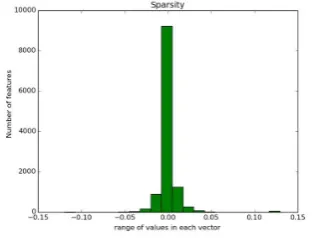
After normalizing the vector, we observed that most values indv~Dn are very close to zero.
Fig-ure3verifies this observation. We utilize this fact to make the document vectordv~Dnsparse by
zero-ing attribute values whose absolute value is close to a threshold (specified as a parameter), which re-sults in the Sparse Composite Document Vector
~ SCDVDn.
In particular, letpbe percentage sparsity thresh-old parameter, ai the value of theith attribute of
the non-Sparse Composite Document Vector and
Figure 1: Word-topics vector formation.
Figure 2: Sparse Composite Document Vector for-mation.
Figure 3: Distribution of attribute feature vector values.
ai=
(
ai if|ai| ≥ 100p ∗t
0 otherwise
t= |amin|+|amax| 2
amin =avgn(mini(ai))
amax =avgn(maxi(ai))
Flowcharts depicting the formation of word-topics vector and Sparse Composite Document Vectors are shown in figure1and figure2 respec-tively. Algorithm1describes SCDV in detail.
4 Experiments
We perform multiple experiments to show the ef-fectiveness of SCDV representations for multi-class and multi-label text multi-classification. For all ex-periments and baselines, we use Intel(R) Xeon(R) CPU E5-2670 [email protected], 40 working cores, 128GB RAM machine with Linux Ubuntu 14.4. However, we utilize multiple cores only during Word2Vec training and when we run the one-vs-rest classifier for Reuters.
4.1 Baselines
We consider the following baselines: Bag-of-Words (BoW) model (Harris,1954), Bag of Word Vector (BoWV) (Gupta et al.,2016) model, para-graph vector models (Le and Mikolov, 2014), Topical word embeddings (TWE-1) (Liu et al., 2015b), Neural Tensor Skip-Gram Model (NTSG-1 to NTSG-3) (Liu et al., 2015a), tf-idf weighted average word-vector model (Singh and Mukerjee, 2015) and weighted Bag of Concepts (weight-BoC) (Kim et al., 2017), where we build topic-document vectors by counting the member words in each topic.
We use the best parameter settings as reported in all our baselines to generate their results. We use 200 dimensions for tf-idf weighted word-vector model, 400 for paragraph vector model, 80 top-ics and400dimensional vectors for TWE, NTSG, LTSG and 60 topics and 200 dimensional word vectors for BOWV. We also compare our results with reported results of other topic modeling based document embedding methods like W T M (Fu et al.,2016),w2v−LDA(Nguyen et al.,2015),
LDA (Chen and Liu, 2014), T V + MeanW V
(Li et al., 2016a), LT SG (Law et al., 2017),
Gaussian−LDA(Das et al.,2015),T opic2V ec
(Niu et al.,2015), (Moody,2016) andMvT M(Li et al., 2016b). Implementation of SCDV and re-lated experiments is available here1.
4.2 Text Classification
We run multi-class experiments on 20NewsGroup dataset 2 and multi-label classification
experi-ments on Reuters-21578 dataset 3. We use
the script4 for preprocessing the Reuters-21578
dataset. We use LinearSVM for multi-class classi-1https://github.com/dheeraj7596/SCDV
2http://qwone.com/∼jason/20Newsgroups/ 3https://goo.gl/NrOfu
[image:4.595.119.242.579.700.2]fication and Logistic regression with OneVsRest setting for multi-label classification in baselines and SCDV.
For SCDV, we set the dimension of word-embeddings to 200 and the number of mixture components in GMM to 60. All mixture com-ponents share the same spherical co-variance ma-trix. We learn word vector embedding using Skip-Gram with window size of 10, Negative Sampling (SGNS) of 10 and minimum word frequency as 20. We use 5-fold cross-validation on F1 score to tune parameter C of SVM and the sparsity thresh-old for SCDV.
4.2.1 Multi-class classification
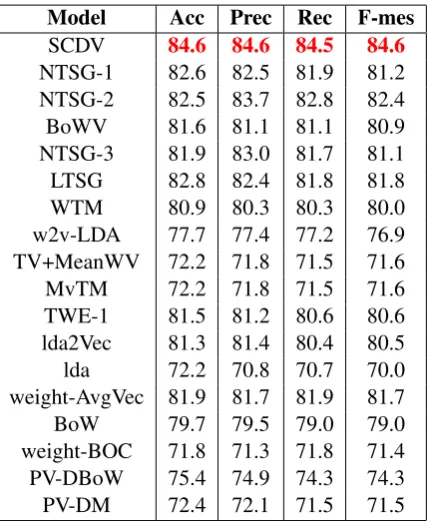
[image:5.595.306.530.114.337.2]We evaluate classifier performance using standard metrics like accuracy, macro-averaging precision, recall and F-measure. Table 1shows a compari-son with the current state-of-art (NTSG) document representations on the 20Newsgroup dataset. We observe that SCDV outperforms all other current models by fair margins. We also present the class-wise precision and recall for 20Newsgroup on an almost balanced dataset with SVM over Bag of Words model and the SCDV embeddings in Table 2 and observe that SCDV improves consistently over all classes.
Table 1: Performance on multi-class classification (Values in red show best performance, the SCDV algorithm of this paper)
Model Acc Prec Rec F-mes
SCDV 84.6 84.6 84.5 84.6
NTSG-1 82.6 82.5 81.9 81.2 NTSG-2 82.5 83.7 82.8 82.4 BoWV 81.6 81.1 81.1 80.9 NTSG-3 81.9 83.0 81.7 81.1 LTSG 82.8 82.4 81.8 81.8 WTM 80.9 80.3 80.3 80.0 w2v-LDA 77.7 77.4 77.2 76.9 TV+MeanWV 72.2 71.8 71.5 71.6 MvTM 72.2 71.8 71.5 71.6 TWE-1 81.5 81.2 80.6 80.6 lda2Vec 81.3 81.4 80.4 80.5 lda 72.2 70.8 70.7 70.0 weight-AvgVec 81.9 81.7 81.9 81.7 BoW 79.7 79.5 79.0 79.0 weight-BOC 71.8 71.3 71.8 71.4 PV-DBoW 75.4 74.9 74.3 74.3 PV-DM 72.4 72.1 71.5 71.5
Table 2: Class-level results on the balanced 20newsgroup dataset.
BoW SCDV
Class Name Pre. Rec. Pre. Rec.
alt.atheism 67.8 72.1 80.2 79.5 comp.graphics 67.1 73.5 75.3 77.4 comp.os.ms-windows.misc 77.1 66.5 78.6 77.2 comp.sys.ibm.pc.hardware 62.8 72.4 75.6 73.5 comp.sys.mac.hardware 77.4 78.2 83.4 85.5 comp.windows.x 83.2 73.2 87.6 78.6 misc.forsale 81.3 88.2 81.4 85.9 rec.autos 80.7 82.8 91.2 90.6 rec.motorcycles 92.3 87.9 95.4 95.7 rec.sport.baseball 89.8 89.2 93.2 94.7 rec.sport.hockey 93.3 93.7 96.3 99.2 sci.crypt 92.2 86.1 92.5 94.7 sci.electronics 70.9 73.3 74.6 74.9 sci.med 79.3 81.3 91.3 88.4 sci.space 90.2 88.3 88.5 93.8 soc.religion.christian 77.3 87.9 83.3 92.3 talk.politics.guns 71.7 85.7 72.7 90.6 talk.politics.mideast 91.7 76.9 96.2 95.4 talk.politics.misc 71.7 56.5 80.9 59.7 talk.religion.misc 63.2 55.4 73.5 57.2
4.2.2 Multi-label classification
We evaluate multi-label classification perfor-mance using Precision@K, nDCG@k (Bhatia et al., 2015), Coverage error, Label ranking av-erage precision score (LRAPS)5 and F1-score.
All measures are extensively used for the multi-label classification task. However, F1-score is an appropriate metric for multi-label classifica-tion as it considers label biases when train-test splits are random. Table3show evaluation results for multi-label text classification on the Reuters-21578 dataset.
4.2.3 Effect of Hyper-Parameters
SCDV has three parameters: the number of clus-ters, word vector dimension and sparsity threshold parameter. We vary one parameter by keeping the other two constant. Performance on varying all three parameters in shown in Figure 4. We ob-serve that performance improves as we increase the number of clusters and saturates at 60. The performance improves until a word vector dimen-sion of 300 after which it saturates. Similarly, we observe that the performance improves as we increase p till 4 after which it declines. At 4% thresholding, we reduce the storage space by 80% compared to the dense vectors. We observe that SCDV is robust to variations in training Word2Vec
[image:5.595.75.289.497.758.2]Table 3: Performance on various metrics for multi-label classification for Reuters(Values in red show best performance, the SCDV algorithm of this paper)
Model Prec@1
nDCG@1 Prec@5 nDCG@5 CoverageError LRAPS F1-Score
SCDV 94.20 36.98 49.55 6.48 93.30 81.75
BoWV 92.90 36.14 48.55 8.16 91.46 79.16
TWE-1 90.91 35.49 47.54 8.16 91.46 79.16
PV-DM 87.54 33.24 44.21 13.15 86.21 70.24 PV-DBoW 88.78 34.51 46.42 11.28 87.43 73.68 AvgVec 89.09 34.73 46.48 9.67 87.28 71.91 tfidf AvgVec 89.33 35.04 46.83 9.42 87.90 71.97
and GMM. The performance metrics reported in Tables1,3are the average values obtained across 5 separate runs ofSCDV, each run training a dif-ferent Word2Vec and GMM model with identical hyper-parameters.
4.3 Topic Coherence
We evaluate the topics generated by GMM cluster-ing on 20NewsGroup for quantitative and qualita-tive analysis. Instead of using perplexity (Chang et al.,2011), which doesn’t correlate with seman-tic coherence and human judgment of individ-ual topics, we used the popular topic coherence (Mimno et al.,2011), (Arora et al., 2013), (Chen and Liu,2014) measure. A higher topic coherence score indicates a more coherent topic.
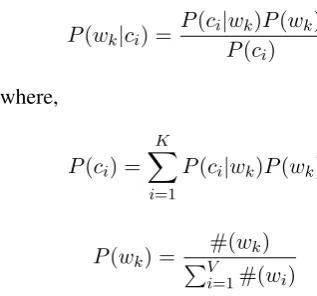
We used Bayes rule to compute the P(wk|ci)
for a given topic ci and given wordwj and
com-pute the score of the top 10 words for each topic.
P(wk|ci) = P(ci|Pw(kc)P(wk) i)
where,
P(ci) = K
X
i=1
P(ci|wk)P(wk)
P(wk) = PV#(wk) i=1#(wi)
Here,#(wk)denotes the number of times word wkappears in the corpus and V represents
vocab-ulary size.
We calculated the topic coherence score for all topics forSCDV,LDA andLT SG(Law et al., 2017). Averaging the score of all 80 topics, GMM clustering scores -85.23 compared to -108.72 of
LDA and -92.23 of LTSG. Thus, SCDV creates more coherent topics than both LDA and LTSG.
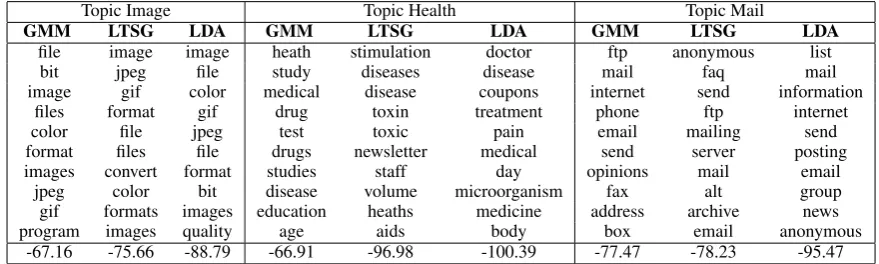
Table 4 shows top 10 words of 3 topics from
GMM clustering,LDAmodel andLT SGmodel on 20NewsGroup andSCDV shows higher topic coherence. Words are ranked based on their prob-ability distribution in each topic. Our results also support the qualitative results of (Randhawa et al., 2016), (Sridhar, 2015) paper, where k-means, GMM was used respectively over word vectors to find topics.
4.4 Context-Sensitive Learning
In order to demonstrate the effects of soft clus-tering (GMM) during SCDV formation, we se-lect some words (wj) with multiple senses from
20Newsgroup and their soft cluster assignments to find the dominant clusters. We also select top scoring words (wk) from each cluster (ci) to
rep-resent the meaning of that cluster. Table5shows polysemic words and their dominant clusters with assignment probabilities. This indicates that using soft clustering to learn word vectors helps com-bine multiple senses into a single embedding vec-tor. (Arora et al.,2016b) also reported similar re-sults for polysemous words.
4.5 Information Retrieval
(Ai et al., 2016b) used (Mikolov et al., 2013b)’s paragraph vectors to enhance the basic language model based retrieval model. The language model(LM) probabilities are estimated from the corpus and smoothed using a Dirichlet prior (Zhai and Lafferty, 2004). In (Ai et al., 2016b), this language model is then interpolated with the para-graph vector (PV) language model as follows.
Figure 4: Effect of varying number of clusters (left), varying word vector dimension (center) and varying sparsity parameter (right) on performance for 20NewsGroup with SCDV
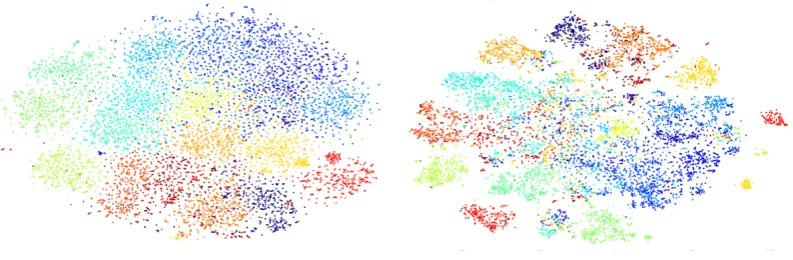
Figure 5: Visualization of paragraph vectors(left) and SCDV(right) using t-SNE
where,
PP V(w|d) = PVexp(~w.~d) i=1exp(w~i.~d)
and the score for document d and query string Q is given by
score(q, d) = X
w∈Q
P(w)P(w|d)
where P(w) is obtained from the unigram query model andscore(q, d)is used to rank documents. (Ai et al., 2016b) do not directly make use of paragraph vectors for the retrieval task, but im-prove the document language model. To di-rectly make use of paragraph vectors and make computations more tractable, we directly inter-polate the language model query-document score
score(q, d) with the similarity score between the normalized query and document vectors to gener-atescoreP V(q, d), which is then used to rank
doc-uments.
scoreP V(q, d) = (1−λ)score(q, d) +λ~q.~d
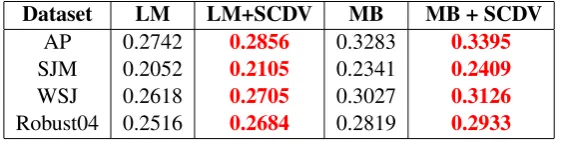
Directly evaluating the document similarity score with the query paragraph vector rather than col-lecting similarity scores for individual words in the query helps avoid confusion amongst distinct query topics and makes the interpolation operation faster. In Table 6, we report Mean Average Pre-cision(MAP) values for four datasets, Associated Press 88-89 (topics 51-200), Wall Street Journal (topics 51-200), San Jose Mercury (topics 51-150) and Disks 4 & 5 (topics 301-450) in the TREC collection. We learnλon a held out set of topics. We observe consistent improvement in MAP for all datasets. We marginally improve the MAP re-ported by (Ai et al.,2016b) on the Robust04 task. In addition, we also report the improvements in MAP score when Model based relevance feedback (Zhai and Lafferty,2001) is applied over the ini-tially retrieved results from both models. Again, we notice a consistent improvement in MAP.
5 Analysis and Discussion
[image:7.595.99.496.258.388.2]Table 4: Top words of some topics from GMM and LDA on 20NewsGroup for K = 80. Higher score represent better coherent topics.
Topic Image Topic Health Topic Mail
GMM LTSG LDA GMM LTSG LDA GMM LTSG LDA
file image image heath stimulation doctor ftp anonymous list
bit jpeg file study diseases disease mail faq mail
image gif color medical disease coupons internet send information
files format gif drug toxin treatment phone ftp internet
color file jpeg test toxic pain email mailing send
format files file drugs newsletter medical send server posting
images convert format studies staff day opinions mail email
jpeg color bit disease volume microorganism fax alt group
gif formats images education heaths medicine address archive news
program images quality age aids body box email anonymous
[image:8.595.71.303.303.408.2]-67.16 -75.66 -88.79 -66.91 -96.98 -100.39 -77.47 -78.23 -95.47
Table 5: Words with multiple senses assigned to multiple clusters with significant probabilities
Word Cluster Words P(ci|wj)
subject:1 physics, chemistry, math, science 0.27 subject:2 mail, letter, email, gmail 0.72 interest:1 information, enthusiasm, question 0.65 interest:2 bank, market, finance, investment 0.32 break:1 vacation, holiday, trip, spring 0.52 break:2 encryption, cipher, security, privacy 0.22 break:3 if, elseif, endif, loop, continue 0.23 unit:1 calculation, distance, mass, length 0.25 unit:2 electronics, KWH, digital, signal 0.69
1. Clustering word-embeddings to discover top-ics improves performance of classification as Figure 4 (left) indicates, while also gener-ating coherent clusters of words (Table 4). Figure 5 shows that clustering gives more discriminative representations of documents than paragraph vectors do since it uses K× d dimensions while paragraph vectors embed documents and words in the same space. This enables SCDV to represent complex docu-ments. Fuzzy clustering allows words to belong to multiple topics, thereby recogniz-ing polysemic words, as Table 5 indicates. Thus it mimics the word-context interaction in NTSG and LTSG.
2. Semantically different words are assigned to different topics. Moreover, a single docu-ment can contain words from multiple differ-ent topics. Instead of a weighted averaging of word embeddings to form document vec-tors, as in most previous work, concatenat-ing word embeddconcatenat-ings for each topic (cluster) avoids merging of semantically different top-ics.
3. It is well-known that in higher dimensions, structural regularizers such as sparsity help overcome the curse of dimensionality ( Wain-wright, 2014).Figure 3 demonstrates this, since majority of the features are close to zero. Sparsity also enables linear SVM to scale to large dimensions. On 20News-Groups, BoWV model takes up 1.1 GB while SCDV takes up only 236MB(80%decrease). Since GMM assigns a non-zero probability to every topic in the word embedding, noise can accumulate when document vectors are cre-ated and tip the scales in favor of an unrelcre-ated topic. Sparsity helps to reduce this by zeroing out very small values of probability.
4. SCDV uses Gaussian Mixture Model (GMM) while T W E, NT SGand LT SG use LDA for finding semantic topics respectively. GMM time complexity is O(V NT2) while that of LDA isO(V2NT). Here, V = Vo-cabulary size, N = number of documents and T = number of topics. Since num-ber of topics T< vocabulary size V, GMM is faster. Empirically, compared to T W E,
SCDV reduces document vector formation, training and prediction time significantly. Ta-ble7shows training and prediction times for BoWV, SCDV and TWE models.
6 Conclusion
in-Table 6: Mean average precision (MAP) for IR on four IR datasets
Dataset LM LM+SCDV MB MB + SCDV
AP 0.2742 0.2856 0.3283 0.3395
SJM 0.2052 0.2105 0.2341 0.2409
WSJ 0.2618 0.2705 0.3027 0.3126
Robust04 0.2516 0.2684 0.2819 0.2933
Table 7: Time Comparison (20NewsGroup) (Val-ues in red show least time, the SCDV algorithm of this paper)
Time (sec) BoWV TWE-1 SCDV
DocVec Formation 1250 700 160
Total Training 1320 740 200
Total Prediction 780 120 25
dicates that SCDV shows considerable improve-ments in feature formation, training and prediction times for the 20NewsGroups dataset. We show that fuzzy GMM clustering on word-vectors lead to more coherent topic than LDA and can also be used to detect Polysemic words. SCDV embed-dings also provide a robust estimation of the query and document language models, thus improving the MAP of language model based retrieval sys-tems. In conclusion, SCDV is simple, efficient and creates a more accurate semantic representation of documents.
Acknowledgments
The authors want to thank Nagarajan Natarajan (Post-Doc, Microsoft Research, India), Praneeth Netrapalli (Researcher, Microsoft Research, In-dia), Raghavendra Udupa (Researcher, Microsoft Research, India), Prateek Jain (Researcher, Mi-crosoft Research, India) for encouraging and valu-able feedback .
References
Qingyao Ai, Liu Yang, Jiafeng Guo, and W Bruce Croft. 2016a. Analysis of the paragraph vector model for information retrieval. In Proceedings of the 2016 ACM on International Conference on the Theory of Information Retrieval, pages 133–142. ACM.
Qingyao Ai, Liu Yang, Jiafeng Guo, and W Bruce Croft. 2016b. Improving language estimation with the paragraph vector model for ad-hoc retrieval. In
Proceedings of the 39th International ACM SIGIR conference on Research and Development in Infor-mation Retrieval, pages 869–872. ACM.
Sanjeev Arora, Rong Ge, Yonatan Halpern, David Mimno, Ankur Moitra, David Sontag, Yichen Wu, and Michael Zhu. 2013. A practical algorithm for topic modeling with provable guarantees. In Inter-national Conference on Machine Learning, pages 280–288.
Sanjeev Arora, Yuanzhi Li, Yingyu Liang, Tengyu Ma, and Andrej Risteski. 2016a. A latent variable model approach to pmi-based word embeddings. Transac-tions of the Association for Computational Linguis-tics, 4:385–399.
Sanjeev Arora, Yuanzhi Li, Yingyu Liang, Tengyu Ma, and Andrej Risteski. 2016b. Linear algebraic struc-ture of word senses, with applications to polysemy.
arXiv preprint arXiv:1601.03764.
Kush Bhatia, Himanshu Jain, Purushottam Kar, Manik Varma, and Prateek Jain. 2015. Sparse local embed-dings for extreme multi-label classification. In Ad-vances in Neural Information Processing Systems, pages 730–738.
David M. Blei, David M. Ng, Michael I. Jordan, and John Lafferty. 2003. Latent dirichlet allocation.
Journal of Machine Learning Research, 3:2003. Jonathan Chang, Jordan L Boyd-Graber, Sean Gerrish,
Chong Wang, and David M Blei. 2011. Reading tea leaves: How humans interpret topic models. pages 262–272.
Zhiyuan Chen and Bing Liu. 2014. Topic modeling us-ing topics from many domains, lifelong learnus-ing and big data. InInternational Conference on Machine Learning, pages 703–711.
Rajarshi Das, Manzil Zaheer, and Chris Dyer. 2015. Gaussian lda for topic models with word embed-dings. In Proceedings of The 53th Annual Meet-ing of the Association of Computational LMeet-inguis- Linguis-tic (ACL), pages 795–804. Association of Compu-tational Linguistic.
[image:9.595.159.440.88.159.2]Vivek Gupta, Harish Karnick, Ashendra Bansal, and Pradhuman Jhala. 2016. Product classification in e-commerce using distributional semantics. In Pro-ceedings of COLING 2016, the 26th International Conference on Computational Linguistics: Techni-cal Papers, pages 536–546.
Zellig Harris. 1954. Distributional structure. Word, 10:146–162.
Han Kyul Kim, Hyunjoong Kim, and Sungzoon Cho. 2017. Bag-of-concepts: Comprehending docu-ment representation through clustering words in dis-tributed representation. Neurocomputing.
Jarvan Law, Hankz Hankui Zhuo, Junhua He, and Erhu Rong. 2017. Ltsg: Latent topical skip-gram for mu-tually learning topic model and vector representa-tions. arXiv preprint arXiv:1702.07117.
Quoc V Le and Tomas Mikolov. 2014. Distributed rep-resentations of sentences and documents. InICML, volume 14, pages 1188–1196.
Shaohua Li, Tat-Seng Chua, Jun Zhu, and Chunyan Miao. 2016a. Generative topic embedding: a con-tinuous representation of documents. In Proceed-ings of The 54th Annual Meeting of the Association for Computational Linguistics (ACL). Association of Computational Linguistic.
Ximing Li, Jinjin Chi, Changchun Li, Jihong Ouyang, and Bo Fu. 2016b. Integrating topic modeling with word embeddings by mixtures of vmfs.Proceedings of COLING 2016, the 26th International Confer-ence on Computational Linguistics: Technical Pa-pers, pages 151–160.
Wand Ling, Chris Dyer, Alan Black, and Isabel Tran-coso. 2015. Two/too simple adaptations of word-vec for syntax problems. InProceedings of the 2015 Conference of the North American Chapter of the Association for Computational Linguistics: Human Language Technologies. North American Associa-tion for ComputaAssocia-tional Linguistics.
Pengfei Liu, Xipeng Qiu, and Xuanjing Huang. 2015a. Learning context-sensitive word embeddings with neural tensor skip-gram model. InProceedings of IJCAI 2014, the 24th International Joint Conference on Artificial Intelligence, pages 1284–1290.
Yang Liu, Zhiyuan Liu, Tat-Seng Chua, and Maosong Sun. 2015b. Topical word embeddings. In Proceed-ings of AAAI 2015, the 29th Twenty-Ninth Associa-tion for the Advancement of Artificial Intelligence, pages 2418–2424.
Tomas Mikolov, Ilya Sutskever, Kai Chen, Greg S Cor-rado, and Jeff Dean. 2013a. Distributed representa-tions of words and phrases and their compositional-ity. InAdvances in Neural Information Processing Systems, pages 3111–3119.
Tomas Mikolov, Wen-tau Yih, and Geoffrey Zweig. 2013b. Linguistic regularities in continuous space word representations. InHLT-NAACL, pages 746– 751.
David Mimno, Hanna M Wallach, Edmund Talley, Miriam Leenders, and Andrew McCallum. 2011. Optimizing semantic coherence in topic models. In
Proceedings of the Conference on Empirical Meth-ods in Natural Language Processing, pages 262– 272. Association for Computational Linguistics.
Christopher E Moody. 2016. Mixing dirichlet topic models and word embeddings to make lda2vec.
arXiv preprint arXiv:1605.02019.
Dat Quoc Nguyen, Richard Billingsley, Lan Du, and Mark Johnson. 2015. Improving topic models with latent feature word representations. Transactions of the Association for Computational Linguistics, 3:299–313.
Liqiang Niu, Xinyu Dai, Jianbing Zhang, and Jiajun Chen. 2015. Topic2vec: learning distributed repre-sentations of topics. In2015 International Confer-ence on Asian Language Processing (IALP), pages 193–196. IEEE.
Ramandeep S Randhawa, Parag Jain, and Gagan Madan. 2016. Topic modeling using dis-tributed word embeddings. arXiv preprint arXiv:1603.04747.
Douglas Reynolds. 2015. Gaussian mixture models.
Encyclopedia of biometrics, pages 827–832.
Dwaipayan Roy, Debasis Ganguly, Mandar Mitra, and Gareth JF Jones. 2016. Representing documents and queries as sets of word embedded vectors for infor-mation retrieval. arXiv preprint arXiv:1606.07869.
Pranjal Singh and Amitabha Mukerjee. 2015. Words are not equal: Graded weighting model for build-ing composite document vectors. In Proceedings of the twelfth International Conference on Natural Language Processing (ICON-2015).
Richard Socher, Alex Perelygin, Jean Y Wu, Jason Chuang, Christopher D Manning, Andrew Y Ng, Christopher Potts, et al. 2013. Recursive deep models for semantic compositionality over a senti-ment treebank. InProceedings of the conference on empirical methods in natural language processing (EMNLP), volume 1631, page 1642.
Vivek Kumar Rangarajan Sridhar. 2015. Unsupervised topic modeling for short texts using distributed rep-resentations of words. InVS@ HLT-NAACL, pages 192–200.
Chengxiang Zhai and John Lafferty. 2001. Model-based feedback in the language modeling approach to information retrieval. InProceedings of the tenth international conference on Information and knowl-edge management, pages 403–410. ACM.