Globally Normalized Reader
Jonathan Raiman and John Miller Baidu Silicon Valley Artificial Intelligence Lab
{jonathanraiman,millerjohn}@baidu.com
Abstract
Rapid progress has been made towards question answering (QA) systems that can extract answers from text. Existing neu-ral approaches make use of expensive bi-directional attention mechanisms or score all possible answer spans, limiting scala-bility. We propose instead to cast extrac-tive QA as an iteraextrac-tive search problem: select the answer’s sentence, start word, and end word. This representation re-duces the space of each search step and al-lows computation to be conditionally allo-cated to promising search paths. We show that globally normalizing the decision pro-cess and back-propagating through beam search makes this representation viable and learning efficient. We empirically demonstrate the benefits of this approach using our model, Globally Normalized Reader (GNR), which achieves the sec-ond highest single model performance on the Stanford Question Answering Dataset (68.4 EM, 76.21 F1 dev) and is 24.7x faster than bi-attention-flow. We also in-troduce a data-augmentation method to produce semantically valid examples by aligning named entities to a knowledge base and swapping them with new entities of the same type. This method improves the performance of all models considered in this work and is of independent interest for a variety of NLP tasks.
1 Introduction
Question answering (QA) and information extrac-tion systems have proven to be invaluable in wide variety of applications such as medical informa-tion collecinforma-tion on drugs and genes (Quirk and
Who was first to recognize that the Analytical Engine had applications beyond pure calculation?
Ada Lovelace was known for her work on Charles Babbage's Analytical Engine.
She was the first to recognize that the machine had applications beyond calculation.
Ada Lovelace was known for her work on Charles Babbage's Analytical Engine.
Lovelace was known for her work on Charles Babbage's Analytical Engine.
Charles Babbage's Analytical Engine.
Charles Babbage’s Analytical Engine Charles Babbage
Ada Lovelace
Span Stop Span Start Sentence
0.51 0.49
0.55 0.09 0.36
0.64 0.20 0.16
Decision Boundary
0.9 State probability
Prediction Decision
[image:1.595.308.523.224.475.2]Word pick Question
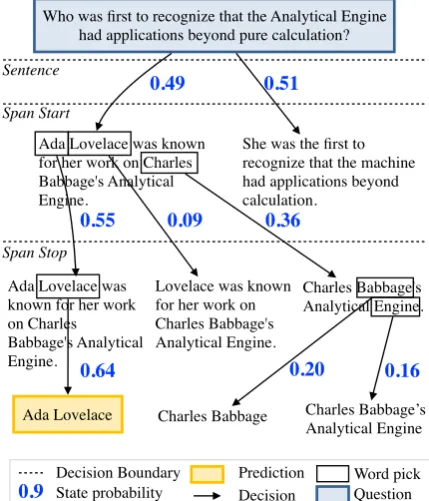
Figure 1: GNR answering a question. It first picks a sentence, then start word, then end word. Probabilities are global and normalized over the beam. Model initially picks the wrong sentence, but global normalization lets it recover. Final prediction’s probability (0.64) exceeds sentence pick (0.49), whereas with local normalization each probability is upper bounded by the previous step.
Poon,2016), large scale health impact studies (Al-thoff et al.,2016), or educational material develop-ment (Koedinger et al.,2015). Recent progress in neural-network based extractive question answer-ing models are quickly closanswer-ing the gap with human performance on several benchmark QA tasks such as SQuAD (Rajpurkar et al.,2016), MS MARCO (Nguyen et al.,2016), or NewsQA (Trischler et al., 2016a). However, current approaches to extractive question answering face several limitations:
1. Computation is allocated equally to the en-tire document, regardless of answer location, with no ability to ignore or focus computation on specific parts. This limits applicability to longer documents.
2. They rely extensively on expensive bi-directional attention mechanisms (Seo et al., 2016) or must rank all possible answer spans (Lee et al.,2016).
3. While data-augmentation for question an-swering have been proposed (Zhou et al., 2017), current approaches still do not pro-vide training data that can improvethe per-formance of existing systems.
In this paper we demonstrate a methodology for addressing these three limitations, and make the following claims:
1. Extractive Question Answering can be cast as a nested search process, where sentences provide a powerful document decomposition and an easy to learn search step. This fac-torization enables conditional computation to be allocated to sentences and spans likely to contain the right answer.
2. When cast as a search process, models with-out bi-directional attention mechanisms and without ranking all possible answer spans can achieve near state of the art results on extrac-tive question answering.
3. Preserving narrative structure and explicitly incorporating type and question information into synthetic data generation is key to gener-ating examples that actually improve the per-formance of question answering systems.
Our claims are supported by experiments on the SQuAD dataset where we show that the Globally Normalized Reader (GNR), a model that performs an iterative search process through a document (shown visually in Figure1), and has computation conditionally allocated based on the search pro-cess, achieves near state of the art Exact Match (EM) and F1 scores without resorting to more ex-pensive attention or ranking of all possible spans. Furthermore, we demonstrate that Type Swaps, a type-aware data augmentation strategy that aligns named entities with a knowledge base and swaps them out for new entities that share the same type,
improves the performance of all models on extrac-tive question answering.
We structure the paper as follows: in Section 2 we introduce the task and our model. Section 3 de-scribes our data-augmentation strategy. Section 4 introduces our experiments and results. In Section 5 we discuss our findings. In Section 6 we relate our work to existing approaches. Conclusions and directions for future work are given in Section 7.
2 Model
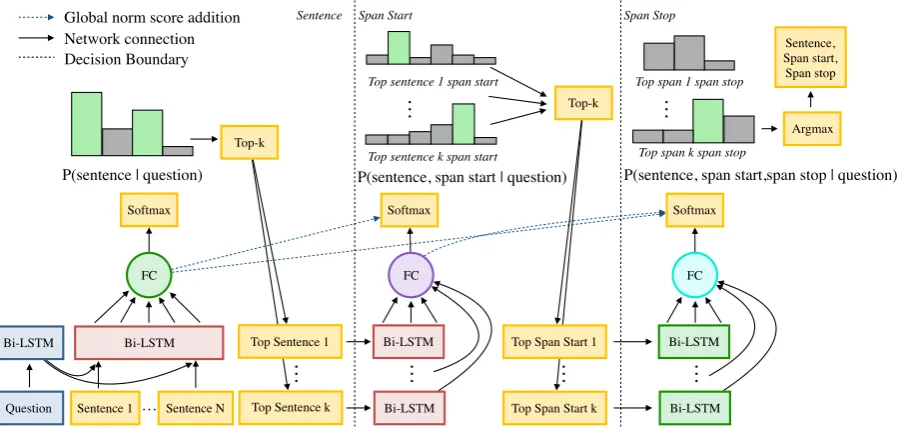
Given a documentdand a questionq, we pose ex-tractive question answering as a search problem. First, we select the sentence, the first word of the span, and finally the last word of the span. A ex-ample of the output of the model is shown in Fig-ure1, and the network architecture is depicted in Figure2.
More formally, let d1, . . . , dn denote each sen-tence in the document, and for each sensen-tence di, let di,1, . . . , di,mi denote the word vectors
corre-sponding to the words in the sentence. Similarly, letq1, . . . , q` denote the word vectors correspond-ing to words in the question. An answer is a tuple
a= (i∗, j∗, k∗)indicating the correct sentencei∗,
start word in the sentencej∗and end word in the
sentencek∗. LetA(d)denote the set of valid
an-swer tuples for documentd. We now describe each stage of the model in turn.
2.1 Question Encoding
Each question is encoded by running a stack of bidirectional LSTM (Bi-LSTM) over each word in the question, producing hidden states
(hfwd
1 , hbwd1 ), . . . ,(hfwd` , hbwd` ) (Graves and Schmidhuber, 2005). Following Lee et al. (2016), these hidden states are used to compute a
passage-independent question embedding, qindep. Formally,
sj =wq>MLP([hbwdj ;hfwdj ]) (1)
αj = P`exp(sj)
j0=1exp(sj0) (2)
qindep=X` j=1
αj[hbwdj ;hfwdj ], (3)
where wq is a trainable embedding vector, and MLP is a two-layer neural network with a Relu
for-ward and backfor-ward LSTMs and the passage-independent embedding,q= [hbwd
1 ;hfwd` ;qindep].
2.2 Question-Aware Document Encoding Conditioned on the question vector, we compute a representation of each document word that is sensitive to both the surrounding context and the question. Specifically, each word in the document is represented as the concatenation of its word vec-tor di,j, the question vector q, boolean features indicating if a word appears in the question or is repeated, and aquestion-aligned embedding from Lee et al. (2016). The question-aligned embed-dingqi,jalignis given by
si,j,k =MLP(di,j)>MLP(qk) (4)
αi,j,k = P`exp(si,j,k)
k0=1exp(si,j,k0) (5)
qi,jalign=X`
k=1
αi,j,kqk. (6)
The document is encoded by a separate stack of Bi-LSTMs, producing a sequence of hidden states
(hfwd
1,1, hbwd1,1 ), . . . ,(hfwdn,mn, hbwdn,mn). The search
procedure then operates on these hidden states.
2.3 Answer Selection
Sentence selection. The first phase of our search process picks the sentence that contains the answer span. Each sentencedi is represented by the hid-den state of the first and last word in the sentence for the backward and forward LSTM respectively,
[hbwd
i,1 ;hfwdi,mi], and is scored by passing this
repre-sentation through a fully connected layer that out-puts the unnormalized sentence score for sentence
di, denotedφsent(di).
Span start selection. After selecting a sentence
di, we pick the start of the answer span within the sentence. Each potential start worddi,j is rep-resented as its corresponding document encoding
[hfwd
i,j ;hbwdi,j ], and is scored by passing this encod-ing through a fully connected layer that outputs the unnormalized start word score for wordj in sen-tencei, denotedφsw(di,j).
Span end selection. Conditioned on sentence
di and starting word di,j, we select the end word from the remaining words in the sen-tence di,j, . . . , di,mi. To do this, we run a
Bi-LSTM over the remaining document hidden states
(hfwd
i,j , hbwdi,j ), . . . ,(hfwdi,mi, hbwdi,mi) to produce
repre-sentations (˜hfwd
i,j ,h˜bwdi,j ), . . . ,(˜hfwdi,mi,˜hbwdi,mi). Each
end word di,k is then scored by passing
[˜hfwd
i,k ; ˜hbwdi,k ] through a fully connected layer that outputs the unnormalized end word score for word k in sentencei, with start word j, denoted
φew(di,j:k).
2.4 Global Normalization
The scores for each stage of our model can be nor-malized at the local or global level. Previous work demonstrated that locally-normalized models have a weak ability to correct mistakes made in previ-ous decisions, while globally normalized models are strictly more expressive than locally normal-ized models (Andor et al.,2016;Zhou et al.,2015; Collins and Roark,2004).
In a locally normalized model each decision is made conditional on the previous decision. The probability of some answera= (i, j, k)is decom-posed as
P(a|d, q) =Psent(i|d, q)·Psw(j|i, d, q)· Pew(k|j, i, d, q). (7)
Each sub-decision is locally normalized by apply-ing a softmax to the relevant selection scores:
Psent(i|d, q) = Pnexp(φsent(di))
x=1exp(φsent(dx)), (8)
Psw(j|i, d, q) = Pmexp(i φsw(di,j))
x=1exp(φsw(di,x)), (9)
Pew(k|j, i, d, q) = Pmexp(i φew(di,j:k))
x=jexp(φew(di,j:x)). (10) To allow our model to recover from incorrect sentence or start word selections, we instead glob-ally normalize the scores from each stage of our procedure. In a globally normalized model, we define
score(a, d, q) =φsent(di)+φsw(di,j)+φew(di,j:k). (11) Then, we model
P(a|d, q) = exp(scoreZ(a, d, q)), (12)
whereZis the partition function
Z= X
a0∈A(d)
Bi-LSTM
P(sentence | question)
FC Top-k
Top Sentence 1
Top Sentence k Bi-LSTM
P(sentence, span start | question)
Top sentence 1 span start
Top sentence k span start
Top-k
Top Span Start 1
Top Span Start k
Bi-LSTM FC
Bi-LSTM
P(sentence, span start,span stop | question)
Top span 1 span stop
Top span k span stop
Argmax Sentence, Span start, Span stop
…
Sentence 1 Sentence N
Bi-LSTM FC
Question Bi-LSTM
Softmax Softmax Softmax
… …
…
…
…
Global norm score addition Network connection
Sentence Span Start Span Stop
…
[image:4.595.76.525.63.277.2]Decision Boundary
Figure 2: Globally Normalized Reader’s search process. Same color Bi-LSTMs share weights.
In contrast to locally-normalized models, the model is normalized over all possible search paths instead of normalizing each step of search proce-dure. At inference time, the problem is to find
arg max
a∈A(d)P(a|d, q), (14)
which can be approximately computed using beam search.
2.5 Objective and Training
We minimize the negative log-likelihood on the training set using stochastic gradient descent. For a single example (a, d, q), the negative log-likelihood
−score(a, d, q) + logZ (15)
requires an expensive summation to compute
logZ. Instead, to ensure learning is efficient, we use beam search during training and early updates (Andor et al.,2016;Zhou et al.,2015;Collins and Roark, 2004). Concretely, we approximateZ by summing only over candidates on the final beam B:
Z ≈ X
a0∈B
exp(score(a0, d, q)). (16)
At training time, if the gold sequence falls off the beam at step t during decoding, a stochastic gradient step is performed on the partial objective computed through steptand normalized over the beam at stept.
2.6 Implementation
Our best performing model uses a stack of 3 Bi-LSTMs for the question and document encodings, and a single Bi-LSTM for the end of span predic-tion. The hidden dimension of all recurrent layers is 200.
We use the 300 dimensional 8.4B token Com-mon Crawl GloVe vectors (Pennington et al., 2014). Words missing from the Common Crawl vocabulary are set to zero. In our experiments, all architectures considered have sufficient capac-ity to overfit the training set. We regularize the models by fixing the word embeddings throughout training, dropping out the inputs of the Bi-LSTMs with probability 0.3 and the inputs to the fully-connected layers with probability 0.4 (Srivastava et al.,2014), and adding gaussian noise to the re-current weights withσ = 10−6. Our models are
trained using Adam with a learning rate of 0.0005,
β1 = 0.9,β2 = 0.999,= 10−8and a batch size
of 32 (Kingma and Ba,2014).
All our experiments are implemented in Ten-sorflow (Abadi et al.,2016), and we tokenize us-ing Ciseau (Raiman, 2017). Despite perform-ing beam-search durperform-ing trainperform-ing, our model trains to convergence in under 4 hours through the use of efficient LSTM primitives in CuDNN (Chetlur et al., 2014) and batching our computation over examples and search beams. We release our code and augmented dataset.1
1https://github.com/baidu-research/
Our implementation of the GNR is 24.7 times faster at inference time than the official Bi-Directional Attention Flow implementation2. Specifically, on a machine running Ubuntu 14 with 40 Intel Xeon 2.6Ghz processors, 386GB of RAM, and a 12GB TitanX-Maxwell GPU, the GNR with beam size 32 and batch size 32 requires
51.58±0.266seconds (mean± std)3 to process the SQUAD validation set. By contrast, the Bi-Directional Attention Flow model with batch size 32 requires1260.23±17.26seconds. We attribute this speedup to avoiding expensive bi-directional attention mechanisms and making computation conditional on the search beams.
3 Type Swaps
Question: Who said in April 25, 2011
December 2012
that the fight would change from military to law enforce-ment?
Answer: Sheryl Sandberg
Jeh Johnson
Document (snippet): . . . Basic objectives of the Cabinet of Japan
Bush administration
“war on terror”, such as targeting al Qaeda and building international counterterrorism alliances, remain in place. In April 25, 2011
December 2012
, Sheryl Sandberg
Jeh Johnson
, the General Counsel of the ministry of education
Department of Defense
, stated
that the military fight will be replaced by a law enforcement operation when speaking at Ain Shams University
Oxford University
. . .
Figure 3: Type Swaps example. Replacements un-derlined with originals underneath.
In extractive question answering, the set of pos-sible answer spans can be pruned by only keeping answers whose nature (person, object, place, date, etc.) agrees with the question type (Who, What, Where, When, etc.). While this heuristic helps hu-man readers filter out irrelevant parts of a docu-ment when searching for information, no explicit supervision of this kind is present in the dataset. Despite this absence, the distribution question rep-resentations learned by our models appear to uti-lize this heuristic. The final hidden state of the
2https://github.com/allenai/
bi-att-flow
3All numbers are averaged over 5 runs.
question-encoding LSTMs naturally cluster based on question type (Table1).
In other words, the task induces a question en-coding that superficially respects type informa-tion. This property is a double-edged sword: it allows the model to easily weed out answers that are inapplicable, but also leads it astray by select-ing a text span that shares the answer’s type but has the wrong underlying entity. A similar obser-vation was made in the error analysis of (Weis-senborn et al.,2017). We propose Type Swaps, an augmentation strategy that leverages this emergent behavior in order to improve the model’s ability to prune wrong answers, and make it more robust to surface form variation. This strategy has three steps:
1. Locate named entities in document and ques-tion.
2. Collect surface variation for each entity type:
human→ {Ada Lovelace, Daniel Kah-nemann,...},
country→ {USA, France, ...}, ... 3. Generate new document-question-answer
ex-amples by swapping each named entity in an original triplet with a surface variant that shares the same type from the collection.
0 1000 2000 3000 4000 5000 6000 Types ordered by number of surface variants 100
101 102 103 104 105
Number of surface variants
human (18735)
date (3127) number (2868) organization (825) country (381)
monarchy (21)
commercial building (8) international conference (1)
[image:5.595.312.519.462.672.2]Variations per Type
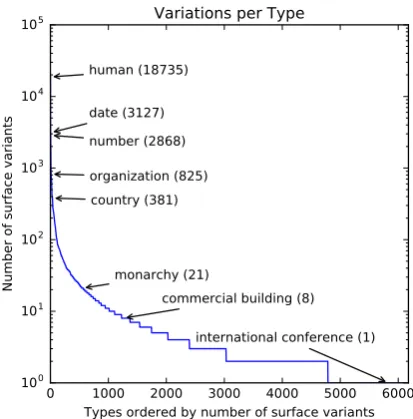
Figure 4: The majority of the surface variations occur for people, numbers, dates, and organiza-tions.
Table 1: Top bigrams in K-means (K = 7) clusters of question after Bi-LSTM. We observe emergent clustering according to question type: e.g. Where→ Cluster 7, Who→ Cluster 3. “What” granularity only observable with more clusters.
Cluster 1 2 3 4 5 6 7
Size 84789 42187 53061 130022 27549 16894 28377
Bigram Bigram Occurences
what is 3339 520 87 3736 20 8 138
what did 2463 3 3 112 1 0 1
how many 2 5095 1 1 0 0 0
how much 7 1102 0 12 0 0 0
who was 2 0 1934 0 0 0 1
who did 2 0 683 2 0 0 0
what was 2177 508 105 2034 71 31 92
when did 0 0 0 1 2772 0 0
when was 0 0 1 1 1876 0 0
what year 0 0 0 1 13 2690 0
in what 52 3 9 727 110 1827 518
where did 0 0 0 13 1 0 955
where is 0 1 0 11 0 0 665
with documents where we can safely assume that the majority of the entities will be contained in a large knowledge base (KB) such as Wikidata Vrandeˇci´c and Kr¨otzsch(2014) we find that sim-ple string matching techniques are sufficiently ac-curate. Specifically, we use a part of speech tagger (Honnibal,2017) to extract nominal groups in the training data and string-match them with entities in Wikidata. Using this technique, we are able to extract 47,598 entities in SQuAD that fall under 6,380 Wikidatainstance of4types. Addition-ally we assign “number types” (e.g. year, day of the week, distance, etc.) to nominal groups that contain dates, numbers, or quantities5. These ex-traction steps produce 84,632 unique surface vari-ants (on average 16.93 per type) with the majority of the variation found in humans, numbers or or-ganizations as visible in Figure4.
With this method, we can generate2.92·10369
unique documents (average of 3.36 ·10364 new
documents for each original document). To ensure there is sufficient variation in the generated docu-ments, we sample from this set and only keep vari-ations where the question or answer is mutated. At each training epoch, we train onT Type Swap
ex-4https://www.wikidata.org/wiki/
Property:P31
5In our experiments we found that not including
numeri-cal variation in the generated examples led to an imbalanced dataset and lower final performance.
amples and the full original training data. An ex-ample output of the method is shown in Figure3.
4 Results
We evaluate our model on the 100,000 example SQuAD dataset (Rajpurkar et al.,2016) and per-form several ablations to evaluate the relative im-portance of the proposed methods.
4.1 Learning to Search
In our first experiment, we aim to quantify the im-portance of global normalization on the learning and search process. We useT = 104 Type Swap
samples and vary beam widthBbetween 1 and 32 for a locally and globally normalized models and summarize the Exact-Match and F1 score of the model’s predicted answer and ground truth com-puted using the evaluation scripts from (Rajpurkar et al.,2016) (Table3). We additionally report an-other metric, theSentencescore, which is a mea-sure for how often the predicted answer came from the correct sentence. This metric provides a mea-sure for where mistakes are made during predic-tion.
4.2 Type Swaps
Table 2: Model comparison
Model EM F1
Human (Rajpurkar et al.,2016) 80.3 90.5
Single model
Sliding Window (Rajpurkar et al.,2016) 13.3 20.2 Match-LSTM (Wang and Jiang,2016) 64.1 73.9
DCN (Xiong et al.,2016) 65.4 75.6
Rasor (Lee et al.,2016) 66.4 74.9
Bi-Attention Flow (Seo et al.,2016) 67.7 77.3
R-Net(Wang et al.,2017) 72.3 80.6
[image:7.595.313.524.289.439.2]Globally Normalized Reader w/o Type Swaps (Ours) 66.6 75.0 Globally Normalized Reader (Ours) 68.4 76.21
Table 3: Impact of Beam WidthB
Model B EM F1 Sentence
Local,T = 104
1 65.7 74.8 89.0 2 66.6 75.0 88.3 10 66.7 75.0 88.6 32 66.3 74.6 88.0 64 66.6 75.0 88.8
Global,T = 104
1 58.8 68.4 84.5 2 64.3 73.0 86.8 10 66.6 75.2 88.1 32 68.4 76.21 88.4 64 67.0 75.6 88.4
the best beam sizes for each model (B = 10for lo-cal andB = 32for global) and vary the augmenta-tion fromT = 0(no augmentation) toT = 5·104.
The results of this experiment are summarized in (Table4).
We observe that both models improve in perfor-mance withT >0and performance degrades past
T = 104. Moreover, data augmentation and global
normalization are complementary. Combined, we obtain 1.6 EM and 2.0 F1 improvement over the locally normalized baseline.
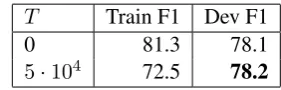
We also verify that the effects of Type Swaps are not limited to our specific model by observ-ing the impact of augmented data on the DCN+ (Xiong et al.,2016)6. We find that it strongly re-duces generalization error, and helps improve F1, with potential further improvements coming by
re-6 The DCN+ is the DCN with additional
hyperpa-rameter tuning by the same authors as submitted on the SQuAD leaderboard https://rajpurkar.github. io/SQuAD-explorer/.
Table 4: Impact of Augmentation Sample SizeT.
Model T EM F1 Sentence
Local 0 65.8 74.0 88.0
Local 103 66.3 74.6 88.9
Local 104 66.7 74.9 89.0
Local 5·104 66.7 75.0 89.0
Local 105 66.2 74.5 88.6
Global 0 66.6 75.0 88.2
Global 103 66.9 75.0 88.1
Global 104 68.4 76.21 88.4
Global 5·104 66.8 75.3 88.3
Global 105 66.1 74.3 86.9
Table 5: Impact of Type Swaps on the DCN+
T Train F1 Dev F1
0 81.3 78.1
5·104 72.5 78.2
ducing other forms of regularization (Table5).
5 Discussion
In this section we will discuss the results presented in Section 4, and explain how they relate to our main claims.
5.1 Extractive Question Answering as a Search Problem
[image:7.595.71.299.297.452.2] [image:7.595.343.484.486.531.2]above 88% correct (Table3)7. Thus, sentence se-lection is the easy part of the problem, and the model can allocate more computation (such as the end-word selection Bi-LSTM) to spans likely to contain the answer. This approach avoids wasteful work on unpromising spans and is important for further scaling these methods to long documents.
5.2 Global Normalization
The Globally Normalized Reader outperforms previous approaches and achieves the second highest EM behind (Wang et al., 2017), with-out using bi-directional attention and only scor-ing spans in its final beam. Increasscor-ing the beam width improves the results for both locally and globally normalized models (Table 3), suggest-ing search errors account for a significant por-tion of the performance difference between mod-els. Models such as Lee et al.(2016) and Wang and Jiang(2016) overcome this difficulty by rank-ing all possible spans and thus never skipprank-ing a possible answer. Even with large beam sizes, the locally normalized model underperforms these ap-proaches. However, by increasing model flexi-bility and performing search during training, the globally normalized model is able to recover from search errors and achieve much of the benefits of scoring all possible spans.
5.3 Type-Aware Data Augmentation
Type Swaps, our data augmentation strategy, of-fers a way to incorporate the nature of the ques-tion and the types of named entities in the answers into the learning process of our model and reduce sensitivity to surface variation. Existing neural-network approaches to extractive QA have so far ignored this information. Augmenting the dataset with additional type-sensitive synthetic examples improves performance by providing better cover-age of different answer types. Growing the num-ber of augmented samples used improves the per-formance of all models under study (Table 4-5). WithT ∈ [104,5·104], (EM, F1) improve from
(65.8 → 66.7,74.0 → 75.0)for locally normal-ized models, and (66.6 → 68.4,75.0 → 76.21) 7The objective function difference explains the lower
per-formance of globally versus locally normalized models on the Sentencescore: local models must always assign the high-est probability to the correct sentence, while global models only ensure the correct span has the highest probability. Thus global models do not need to enforce a high margin between the correct answer’s sentence score and others and are more likely to keep alternate sentences around.
for globally normalized models.
Past a certain amount of augmentation, we ob-serve performance degradation. This suggests that despite efforts to closely mimic the original train-ing set, there is a train-test mismatch or excess du-plication in the generated examples.
Our experiments are conducted on two vastly different architectures and thus these benefits are expected to carry over to different models (Weis-senborn et al.,2017;Seo et al.,2016;Wang et al., 2017), and perhaps more broadly in other natu-ral language tasks that contain named entities and have limited supervised data.
6 Related Work
Our work is closely related to existing approaches in learning to search, extractive question answer-ing, and data augmentation for NLP tasks.
Learning to Search. Several approaches to learning to search have been proposed for various NLP tasks and conditional computation. Most re-cently,Andor et al.(2016) andZhou et al.(2015) demonstrated the effectiveness of globally normal-ized networks and training with beam search for part of speech tagging and transition-based depen-dency parsing, while Wiseman and Rush (2016) showed that these techniques could also be applied to sequence-to-sequence models in several appli-cation areas including machine translation. These works focus on parsing and sequence prediction tasks and have a fixed computation regardless of the search path, while we show that the same tech-niques can also be straightforwardly applied to question answering and extended to allow for con-ditional computation based on the search path.
Learning to search has also been used in con-text of modular neural networks with conditional computation in the work ofAndreas et al. (2016) for image captioning. In their work reinforcement learning was used to learn how to turn on and off computation, while we find that conditional com-putation can be easily learnt with maximum like-lihood and the help of early updates (Andor et al., 2016;Zhou et al.,2015;Collins and Roark,2004) to guide the training process.
also explored this approach in the context of ques-tion answering.
Extractive Question Answering. Since the in-troduction of the SQuAD dataset, numerous sys-tems have achieved strong results. Seo et al. (2016);Wang et al.(2017) andXiong et al.(2016) make use of a bi-directional attention mecha-nisms, whereas the GNR is more lightweight and achieves similar results without this type of at-tention mechanism. The document representation used by the GNR is very similar to Lee et al. (2016). However, both Lee et al. (2016) and Wang and Jiang (2016) must score all O(N2)
possible answer spans, making training and infer-ence expensive. The GNR avoids this complex-ity by learning to search during training and out-performs both systems while scoring only O(B)
spans. Weissenborn et al.(2017) is a locally nor-malized model that first predicts start and then end words of each span. Our experiments lead us to believe that further factorizing the problem and using global normalization along with our data augmentation would yield corresponding im-provements.
Data augmentation. Several works use data augmentation to control the generalization error of deep learning models. Zhang and LeCun (2015) use a thesaurus to generate new training examples based on synonyms. Vijayaraghavan et al.(2016) employs a similar method, but uses Word2vec and cosine similarity to find similar words. Jia and Liang (2016) use a high-precision synchronous context-free grammar to generate new semantic parsing examples. Our data augmentation tech-nique, Type Swaps, is unique in that it leverages an external knowledge-base to provide new ex-amples that have more variation and finer-grained changes than methods that use only a thesaurus or Word2Vec, while also keeping the narrative and grammatical structure intact.
More recently Zhou et al. (2017) proposed a sequence-to-sequence model to generate diverse and realistic training question-answer pairs on SQuAD. Similar to their approach, our technique makes use of existing examples to produce new examples that are fluent, however we also are able to explicitly incorporate entity type information into the generation process and use the generated data to improve the performance of question an-swering models.
7 Conclusions and Future Work
In this work, we provide a methodology that over-comes several limitations of existing approaches to extractive question answering. In particular, our proposed model, the Globally Normalized Reader, reduces the computational complexity of previous models by casting the question answer-ing as search and allocatanswer-ing more computation to promising answer spans. Empirically, we find that this approach, combined with global normaliza-tion and beam search during training, leads to near state of the art results. Furthermore, we find that a type-aware data augmentation strategy improves the performance of all models under study on the SQuAD dataset. The method is general, only re-quiring that the training data contains named enti-ties from a large KB. We expect it to be applicable to other NLP tasks that would benefit from more training data.
As future work we plan to apply the GNR to other question answering datasets such as MS MARCO (Nguyen et al., 2016) or NewsQA (Trischler et al.,2016a), as well as investigate the applicability and benefits of Type Swaps to other tasks like named entity recognition, entity link-ing, machine translation, and summarization. Fi-nally, we believe there a broad range of structured prediction problems (code generation, generative models for images, audio, or videos) where the size of original search space makes current tech-niques intractable, but if cast as learning-to-search problems with conditional computation, might be within reach.
Acknowledgments
We would like to thank the anonymous review-ers for their valuable feedback. In addition, we thank Adam Coates, Carl Case, Andrew Gibian-sky, and Szymon Sidor for thoughtful comments and fruitful discussion. We also thank James Brad-bury and Bryan McCann for running Type Swap experiments on the DCN+.
References
Mart´ın Abadi, Ashish Agarwal, Paul Barham, Eugene Brevdo, Zhifeng Chen, Craig Citro, Greg S Corrado, Andy Davis, Jeffrey Dean, Matthieu Devin, et al. 2016. Tensorflow: Large-scale machine learning on
heterogeneous distributed systems. arXiv preprint
Tim Althoff, Ryen W White, and Eric Horvitz. 2016. Influence of pok´emon go on physical activity: Study
and implications. Journal of Medical Internet
Re-search, 18(12).
Daniel Andor, Chris Alberti, David Weiss, Aliaksei Severyn, Alessandro Presta, Kuzman Ganchev, Slav Petrov, and Michael Collins. 2016. Globally
nor-malized transition-based neural networks. arXiv
preprint arXiv:1603.06042.
Jacob Andreas, Marcus Rohrbach, Trevor Darrell, and Dan Klein. 2016. Learning to compose neural
networks for question answering. arXiv preprint
arXiv:1601.01705.
Sharan Chetlur, Cliff Woolley, Philippe Vandermersch, Jonathan Cohen, John Tran, Bryan Catanzaro, and Evan Shelhamer. 2014. cudnn: Efficient primitives for deep learning. arXiv preprint arXiv:1410.0759.
Michael Collins and Brian Roark. 2004. Incremental
parsing with the perceptron algorithm. In
Proceed-ings of the 42nd Annual Meeting on Association for Computational Linguistics, page 111. Association for Computational Linguistics.
Alex Graves and J¨urgen Schmidhuber. 2005. Frame-wise phoneme classification with bidirectional lstm and other neural network architectures. Neural Net-works, 18(5):602–610.
Matthew Honnibal. 2017. Spacy. https://
github.com/explosion/spaCy.
Robin Jia and Percy Liang. 2016. Data
recombina-tion for neural semantic parsing. arXiv preprint
arXiv:1606.03622.
Diederik Kingma and Jimmy Ba. 2014. Adam: A
method for stochastic optimization. arXiv preprint
arXiv:1412.6980.
Kenneth R Koedinger, Sidney D’Mello, Elizabeth A McLaughlin, Zachary A Pardos, and Carolyn P
Ros´e. 2015. Data mining and education.
Wi-ley Interdisciplinary Reviews: Cognitive Science, 6(4):333–353.
Kenton Lee, Tom Kwiatkowski, Ankur Parikh, and Di-panjan Das. 2016. Learning recurrent span repre-sentations for extractive question answering. arXiv preprint arXiv:1611.01436.
Tri Nguyen, Mir Rosenberg, Xia Song, Jianfeng Gao, Saurabh Tiwary, Rangan Majumder, and Li Deng. 2016. Ms marco: A human generated machine
reading comprehension dataset. arXiv preprint
arXiv:1611.09268.
Jeffrey Pennington, Richard Socher, and Christopher D Manning. 2014. Glove: Global vectors for word
representation. InEMNLP, volume 14, pages 1532–
1543.
Chris Quirk and Hoifung Poon. 2016. Distant super-vision for relation extraction beyond the sentence boundary. arXiv preprint arXiv:1609.04873.
Jonathan Raiman. 2017. Ciseau. https://
github.com/jonathanraiman/ciseau.
Pranav Rajpurkar, Jian Zhang, Konstantin Lopyrev, and Percy Liang. 2016. Squad: 100,000+ questions
for machine comprehension of text. arXiv preprint
arXiv:1606.05250.
Minjoon Seo, Aniruddha Kembhavi, Ali Farhadi, and Hannaneh Hajishirzi. 2016. Bidirectional attention
flow for machine comprehension. arXiv preprint
arXiv:1611.01603.
Nitish Srivastava, Geoffrey E Hinton, Alex Krizhevsky, Ilya Sutskever, and Ruslan Salakhutdinov. 2014. Dropout: a simple way to prevent neural networks
from overfitting. Journal of Machine Learning
Re-search, 15(1):1929–1958.
Adam Trischler, Tong Wang, Xingdi Yuan, Justin Har-ris, Alessandro Sordoni, Philip Bachman, and Ka-heer Suleman. 2016a. Newsqa: A machine compre-hension dataset. arXiv preprint arXiv:1611.09830. Adam Trischler, Zheng Ye, Xingdi Yuan, Jing He,
Phillip Bachman, and Kaheer Suleman. 2016b. A parallel-hierarchical model for machine
com-prehension on sparse data. arXiv preprint
arXiv:1603.08884.
Prashanth Vijayaraghavan, Ivan Sysoev, Soroush
Vosoughi, and Deb Roy. 2016. Deepstance at
semeval-2016 task 6: Detecting stance in tweets
us-ing character and word-level cnns. arXiv preprint
arXiv:1606.05694.
Denny Vrandeˇci´c and Markus Kr¨otzsch. 2014.
Wiki-data: a free collaborative knowledgebase.
Commu-nications of the ACM, 57(10):78–85.
Shuohang Wang and Jing Jiang. 2016. Machine com-prehension using match-lstm and answer pointer.
arXiv preprint arXiv:1608.07905.
Wenhui Wang, Nan Yang, Furu Wei, Baobao Chang, and Ming Zhou. 2017. Gated self-matching net-works for reading comprehension and question
an-swering. InProceedings of the 55th Annual Meeting
of the Association for Computational Linguistics. David Weiss and Benjamin Taskar. 2010. Structured
prediction cascades. In Proceedings of the
Thir-teenth International Conference on Artificial Intel-ligence and Statistics, pages 916–923.
Dirk Weissenborn, Georg Wiese, and Laura Seiffe. 2017. Fastqa: A simple and efficient neural
ar-chitecture for question answering. arXiv preprint
arXiv:1703.04816.
Caiming Xiong, Victor Zhong, and Richard Socher. 2016. Dynamic coattention networks for question
answering. arXiv preprint arXiv:1611.01604.
Xiang Zhang and Yann LeCun. 2015. Text understand-ing from scratch.arXiv preprint arXiv:1502.01710. Hao Zhou, Yue Zhang, Shujian Huang, and Jiajun
Chen. 2015. A neural probabilistic
structured-prediction model for transition-based dependency parsing. InACL (1), pages 1213–1222.
Qingyu Zhou, Nan Yang, Furu Wei, Chuanqi Tan, Hangbo Bao, and Ming Zhou. 2017. Neural ques-tion generaques-tion from text: A preliminary study.