Zipporah: a Fast and Scalable Data Cleaning System
for Noisy Web-Crawled Parallel Corpora
Hainan Xu Philipp Koehn Department of Compute Science, Center for Language and Speech Processing,
Johns Hopkins University, U.S.A., 21218
[email protected] [email protected]
Abstract
We introduce Zipporah, a fast and scal-able data cleaning system. We propose a novel type of bag-of-words translation fea-ture, and train logistic regression models to classify good data and synthetic noisy data in the proposed feature space. The trained model is used to score parallel sen-tences in the data pool for selection. As shown in experiments, Zipporah selects a high-quality parallel corpus from a large, mixed quality data pool. In particular, for one noisy dataset, Zipporah achieves a 2.1 BLEU score improvement with using 1/5 of the data over using the entire corpus. 1 Introduction
Statistical machine translation (SMT) systems re-quire the use of parallel corpora for training the internal model parameters. Data quality is vital for the performance of the SMT system (Simard,
2014). To acquire a massive parallel corpus, many researchers have been using the Internet as a re-source, but the quality of data acquired from the Internet usually has no guarantee, and data clean-ing/data selection is needed before the data is used in actual systems. Usually data cleaning refers to getting rid of a small amount of very noisy data from a large data pool, and data selection refers to selecting a small subset of clean (or in-domain) data from the data pool; both have the objective of improving translation performances. For practi-cal purposes, it is highly desirable to perform data selection in a very fast and scalable manner. In this paper we introduce Zipporah1, a fast and scal-able system which can select an arbitrary size of good data from a large noisy data pool to be used in SMT model training.
1https://github.com/hainan-xv/zipporah
2 Prior Work
Many researchers have studied the data clean-ing/selection problem. For data selection, there have been a lot of work on selecting a sub-set of data based on domain-matching. Duh et al. (2013) used a neural network based lan-guage model trained on a small in-domain cor-pus to select from a larger data pool. Moore and Lewis (2010) computed cross-entropy between in-domain and out-of-in-domain language models to se-lect data for training language models. XenC (Rousseau, 2013), an open-source tool, also se-lects data based on cross-entropy scores on lan-guage models. Axelrod et al. (2015) utilized part-of-speech tags and used a class-based n-gram lan-guage model for selecting in-domain data. There are a few works that utilize other metrics. L¨u et al. (2007) redistributed different weights for sen-tence pairs/predefined sub-models. Shah and Spe-cia (2014) described experiments on quality esti-mation which, given a source sentence, select the best translation among several options. The qe-clean system (Denkowski et al.,2012;Dyer et al.,
2010;Heafield, 2011) uses word alignments and language models to select sentence pairs that are likely to be good translations of one another.
For data cleaning, a lot of researchers worked on getting rid of noising data. Taghipour et al. (2011) proposed an outlier detection algorithm which leads to an improved translation quality when trimming a small portion of data. Cui et al. (2013) used a graph-based random walk algorithm to do bilingual data cleaning. BiTextor ( Espl´a-Gomis and Forcada,2009) utilizes sentence align-ment scores and source URL information to filter out bad URL pairs and selects good sentence pairs. In this paper we propose a novel way to eval-uate the quality of a sentence pair which runs efficiently. We do not make a clear distinction
between data selection and data cleaning in this work, because under different settings, our method can perform either based on the computed quality scores of sentence pairs.
3 Method
The method in this paper works as follows: we first map all sentence pairs into the proposed fea-ture space, and then train a simple logistic regres-sion model to separate known good data and (syn-thetic) bad data. Once the model is trained, it is used to score sentence pairs in the noisy data pool. Sentence pairs with better scores are added to the selected subset until the desired size constraint is met.
3.1 Features
Since good adequacy and fluency are the major two elements that constitute a good parallel sen-tence pair, we propose separate features to address both of them. For adequacy, we propose bag-of-words translation scores, and for fluency we use n-gram language model scores. For notational sim-plicity, in this section we assume the sentence pair is French-English in describing the features, and we will use subscriptsf andeto indicate the lan-guages. In designing the features, we prioritize efficiency as well as performance since we could be dealing with corpora of huge sizes.
3.1.1 Adequacy scores
We view each sentence as a bag of words, and de-sign a “distance” between the sentence pairs based on a bag-of-words translation model. To do this, we first generate dictionaries from an aligned cor-pus, and represent them as sets of triplets. For-mally,
Df2e={(wfi, wei, p(wei|wfi)), i= 1, ..., m}.
Given a sentence pair(sf, se)in the noisy data pool, we represent the two sentence as two sparse word-frequency vectors vf and ve. For exam-ple for any French word wf, we have vf[wf] =
c(wf,sf)
l(sf) , wherec(wf, sf)is the number of
occur-rences ofwf insf andl(sf)is the length ofsf. We do the same for ve. Notice that by construction, both vectors add up to 1 and represent a proper probability distribution on their respective vocab-ularies. Then we “translate”vf into v0e, based on
the probabilistic f2e dictionary, where
ve0[we] = X
wf
vf[wf]p(we|wf)
For a French wordw that does not appear in the dictionary, we keep it as it is in the translated vec-tor, i.e. assume there is an entry of(w, w,1.0)in the dictionary. Since the dictionary is probabilis-tic, the elements in v0
e also add up to 1, and v0e represents another probability distribution on the English vocabulary. We compute the (smoothed) cross-entropy betweenveandv0e,
xent(ve, v0e) = X
we
ve[we] logv0 1
e[we] +c (1)
wherecis a smoothing constant to prevent the de-nominator from being zero, and set c = 0.0001
for all experiments in this paper (more about this in Section4).
We perform similar procedures for English-to-French, and compute xent(vf, vf0). We define the adequacy score as the sum of the two:
adequacy(sf, se) =xent(ve, v0e) +xent(vf, vf0) 3.1.2 Fluency scores
We train two n-gram language models with a clean French and English corpus, and then for each sentence pair (sf, se), we score each sentence with the corresponding model, Fngram(sf) and
Fngram(se), each computed as the ratio between the sentence negative log-likelihood and the sentence length. We define the fluency score as the sum of the two:
fluency(sf, se) =Fngram(sf) +Fngram(se) 3.2 Synthetic noisy data generation
We generate synthetic noisy data from good data, and make sure the generated noisy data include sentence pairs with a) good fluency and bad ad-equacy, b) good adequacy and bad fluency and c) bad both.
words. We emphasize that, while the synthetic data might not represent “real” noisy data, it has the following advantages: 1) each type of noisy data is equally represented so the classifier has to do well on all of them; 2) the data generated this way would be among the hardest to classify, espe-cially type a and type b, so if a classifier separates such hard data with good performance, we expect it to also be able to do well in real world situations. 3.3 Logistic regression feature mapping
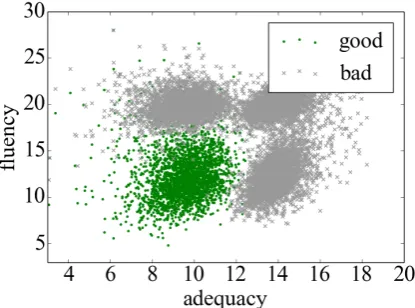
Figure 1: newstest09 fr-en data in the feature space We plot the newstest09 data (original and auto-generated noisy ones as described in Section
3.2) into the proposed feature space in Figure 1. We observe that the clusters are quite separable, though the decision function would not be linear. We map the features into higher order forms of
(xn, yn)in order for logistic regression to train a non-linear decision boundary.2 We use n = 8 in this work since it gives the best classification per-formance on the newstest09 fr-en corpus.
4 Hyper-parameter Tuning
We conduct experiments to determine the value of the constant c in the smoothed cross-entropy computation in equation1. We choose the new-stest09 German-English corpus, and shuffle the sentences in the English file and combine the orig-inal (clean) corpus with the shuffled (noisy) cor-pus into a larger corcor-pus, where half of them are good sentence pairs. We set different values ofc and use the adequacy scores to pick the better half,
2We avoid using multiple mappings of one feature be-cause we want the scoring function to be monotonic both w.r.t xandy, which could break if we allow multiple higher-order mappings of the same feature and they end up with weights with different signs.
and compute the retrieval accuracy. Table1shows that the best value forcis 0.0001, and we use that in all experiments.
c accuracy 0.001 0.975 0.0001 0.984 0.00001 0.983 0.000001 0.981
Table 1: Tuning cross-entropy constantc
5 Evaluation
We evaluate Zipporah on 3 language pairs, French-English, German-English and Spanish-English. The noisy web-crawled data comes from an early version of http://statmt.org/ paracrawl. The number of words are (in mil-lions) 340, 487 and 70 respectively.
To generate the dictionaries for computing the adequacy scores, we use fast align (Dyer et al.,
2013) to align the Europarl (Koehn, 2005) cor-pus and generate probabilistic dictionaries from the alignments. We set the n-gram order to be 5 and use SRILM (Stolcke et al.,2011) to train lan-guage models on the Europarl corpus and generate the n-gram scores.
For each language pair, we use scikit-learn ( Pe-dregosa et al.,2011) to train a logistic regression model to classify between the original and the syn-thetic noisy corpus of newstest09, and the trained model is used to score all sentence pairs in the data pool. We keep selecting the best ones until the de-sired number of words is reached.
To evaluate the quality, we train a Moses (Koehn et al.,2007) SMT system on selected data, and evaluate each trained SMT system on 3 test corpora: newstest2011 which contains 3003 sen-tence pairs, and a random subset of the TED-talks corpus and the movie-subtitle corpus from OPUS (Tiedemann, 2012), each of which contains 3000 sentence pairs.
Tables2,3and4show the BLEU performance of the selected subsets of the Zipporah system compared to the baseline, which selects sentence pairs at random; for comparison, we also give the BLEU performance of systems trained on Eu-roparl. The Zipporah system gives consistently better performance across multiple datasets and multiple languages than the baseline.3
[image:3.595.77.285.235.389.2]BLEU newstest11 ted-talk subtitle num-words rand zipp rand zipp rand zipp
10 million 21.5 24.4 24.0 27.4 12.3 14.9 20 million 22.8 25.1 25.0 27.9 12.8 15.5 50 million 24.3 26.0 27.4 28.8 14.5 15.8 100 million 25.2 26.6 28.3 30.3 15.0 17.3 200 million 26.1 26.7 29.9 30.0 16.4 17.3 340 mil (all) 26.2 30.0 16.7
[image:4.595.76.288.102.247.2]Europarl 24.4 27.0 14.2
Table 2: BLEU Performance, French-English
BLEU newstest11 ted-talk subtitle num-words rand zipp rand zipp rand zipp
10 million 13.6 17.6 17.0 22.5 11.4 15.8 20 million 14.8 18.4 18.9 23.7 12.7 16.9 50 million 16.3 19.2 20.8 24.8 13.9 17.8 100 million 16.9 19.5 21.3 25.0 14.0 18.3 200 million 18.0 19.2 22.9 24.2 15.3 17.9 487 mil (all) 18.7 23.5 16.2
[image:4.595.312.508.232.354.2]Europarl 17.5 21.5 14.5
Table 3: BLEU Performance, German-English
BLEU newstest11 ted-talk subtitle num-words rand zipp rand zipp rand zipp
10 million 24.2 25.5 25.9 28.3 17.9 19.8 20 million 25.3 26.2 28.2 29.7 19.3 21.2 50 million 26.6 26.5 29.9 30.4 21.3 21.4 70 mil (all) 27.1 30.3 21.8
Europarl 25.4 28.4 19.8 Table 4: BLEU Performance, Spanish-English
In particular, for the Germen-English corpus, when selecting less than 2% of the data (10 mil-lion words), on the TED-talk dataset, Zipporah achieves a 5.5 BLEU score improvement over the baseline; by selecting less than 4% of the data (20 million words) the system gives better perfor-mance than using all data. Peak perforperfor-mance is achieved when selecting 100 million words, where an improvement of 2.1 BLEU score over all data is achieved on the movie-subtitle dataset, despite only using less than 1/5 of the data.
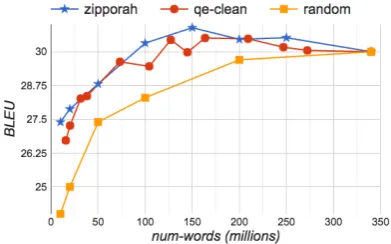
Figure 2: BLEU performance of Zipporah, qe-clean and random on TED-talks, French-English
Figure 3: BLEU performance of Zipporah, qe-clean and random on newstest11, German-English Figures2,3and4compare the result of Zippo-rah with that of qe-clean (Denkowski et al.,2012;
Dyer et al.,2010;Heafield,2011) and the random baseline. We use the same data when running qe-clean, with Europarl for training and newstest09 for dev. While they both perform comparably and better than the baseline, Zipporah achieves a bet-ter peak in all the datasets, and the peak is usu-ally achieved when selecting a smaller number of words compared to qe-clean, Another advantage of Zipporah is it allows the user to select an
[image:4.595.312.510.409.528.2]Figure 4: BLEU performance of Zipporah, qe-clean and random on TED-talks, Spanish-English
trary size from the pool.4 We also want to empha-size that unlike qe-clean, which requires running word-alignments for all sentence pairs in the noisy corpus, Zipporah’s feature computation is simple, fast and can easily be scaled for huge datasets. 6 Conclusion and Future Work
In this paper we introduced Zipporah, a fast data selection system for noisy parallel corpora. SMT results demonstrate that Zipporah can select a high-quality subset of the data and significantly improve SMT performance.
Zipporah currently selects sentences based on the “individual quality” only, and we plan in future work to also consider other factors, e.g. encourage selection of a subset that has a better n-gram cov-erage.
Acknowledgments
This project was funded by Google Faculty Re-search Award. The authors would like to thank Shuoyang Ding, Tongfei Chen, Matthew Wiesner, Winston Wu, Huda Khayrallah and Adi Renduch-intala for their help during this project. The au-thors would also like to thank Penny Peng for her moral support.
References
Amittai Axelrod, Yogarshi Vyas, Marianna Martindale, Ma-rine Carpuat, and Johns Hopkins. 2015. Class-based n-gram language difference models for data selection. InIWSLT (International Workshop on Spoken Language Translation).
Lei Cui, Dongdong Zhang, Shujie Liu, Mu Li, and Ming Zhou. 2013. Bilingual data cleaning for smt using graph-based random walk. InACL (2), pages 340–345. Michael Denkowski, Greg Hanneman, and Alon Lavie. 2012.
The cmu-avenue french-english translation system. In 4In the plots the data points of Zipporah and qe-clean are not aligned because we always select multiples of million words, but it is hard to do so with qe-clean.
Proceedings of the NAACL 2012 Workshop on Statistical Machine Translation.
Kevin Duh, Graham Neubig, Katsuhito Sudoh, and Hajime Tsukada. 2013. Adaptation data selection using neural language models: Experiments in machine translation. In
ACL (2), pages 678–683.
Chris Dyer, Victor Chahuneau, and Noah A Smith. 2013. A simple, fast, and effective reparameterization of ibm model 2. Association for Computational Linguistics. Chris Dyer, Adam Lopez, Juri Ganitkevitch, Johnathan
Weese, Ferhan Ture, Phil Blunsom, Hendra Setiawan, Vladimir Eidelman, and Philip Resnik. 2010. cdec: A de-coder, alignment, and learning framework for finite-state and context-free translation models. InProceedings of the Association for Computational Linguistics (ACL). Miquel Espl´a-Gomis and M Forcada. 2009. Bitextor, a
free/open-source software to harvest translation memories from multilingual websites. Proceedings of MT Summit XII, Ottawa, Canada. Association for Machine Transla-tion in the Americas.
Kenneth Heafield. 2011. KenLM: Faster and smaller lan-guage model queries. InProceedings of the Sixth Work-shop on Statistical Machine Translation.
Philipp Koehn. 2005. Europarl: A parallel corpus for statis-tical machine translation. InMT summit, volume 5, pages 79–86.
Philipp Koehn, Hieu Hoang, Alexandra Birch, Chris Callison-Burch, Marcello Federico, Nicola Bertoldi, Brooke Cowan, Wade Shen, Christine Moran, Richard Zens, et al. 2007. Moses: Open source toolkit for statisti-cal machine translation. InProceedings of the 45th annual meeting of the ACL on interactive poster and demonstra-tion sessions, pages 177–180. Association for Computa-tional Linguistics.
Yajuan L¨u, Jin Huang, and Qun Liu. 2007. Improving statis-tical machine translation performance by training data se-lection and optimization. InEMNLP-CoNLL, volume 34, pages 3–350.
Robert C Moore and William Lewis. 2010. Intelligent se-lection of language model training data. InProceedings of the ACL 2010 conference short papers, pages 220–224. Association for Computational Linguistics.
F. Pedregosa, G. Varoquaux, A. Gramfort, V. Michel, B. Thirion, O. Grisel, M. Blondel, P. Prettenhofer, R. Weiss, V. Dubourg, J. Vanderplas, A. Passos, D. Cour-napeau, M. Brucher, M. Perrot, and E. Duchesnay. 2011. Scikit-learn: Machine learning in Python. Journal of Ma-chine Learning Research, 12:2825–2830.
Anthony Rousseau. 2013. Xenc: An open-source tool for data selection in natural language processing.The Prague Bulletin of Mathematical Linguistics, 100:73–82. Kashif Shah and Lucia Specia. 2014. Quality estimation
for translation selection. InProceedings of the 17th An-nual Conference of the European Association for Machine Translation, Dubrovnik, Croatia.
Andreas Stolcke, Jing Zheng, Wen Wang, and Victor Abrash. 2011. Srilm at sixteen: Update and outlook. In Proceed-ings of IEEE Automatic Speech Recognition and Under-standing Workshop, volume 5.
Kaveh Taghipour, Shahram Khadivi, and Jia Xu. 2011. Par-allel corpus refinement as an outlier detection algorithm.
Proceedings of the 13th Machine Translation Summit (MT Summit XIII), pages 414–421.