Proceedings of the 2019 Conference on Empirical Methods in Natural Language Processing
1311
An Evaluation Dataset for Intent Classification
and Out-of-Scope Prediction
Stefan Larson Anish Mahendran Joseph J. Peper Christopher Clarke
Andrew Lee Parker Hill Jonathan K. Kummerfeld Kevin Leach
Michael A. Laurenzano Lingjia Tang Jason Mars
Clinc, Inc. Ann Arbor, MI, USA
Abstract
Task-oriented dialog systems need to know when a query falls outside their range of sup-ported intents, but current text classification corpora only define label sets that cover ev-ery example. We introduce a new dataset that includes queries that are out-of-scope— i.e., queries that do not fall into any of the system’s supported intents. This poses a new challenge because models cannot assume that every query at inference time belongs to a system-supported intent class. Our dataset also covers 150 intent classes over 10 domains, capturing the breadth that a production task-oriented agent must handle. We evaluate a range of benchmark classifiers on our dataset along with several different out-of-scope iden-tification schemes. We find that while the clas-sifiers perform well on in-scope intent classi-fication, they struggle to identify out-of-scope queries. Our dataset and evaluation fill an im-portant gap in the field, offering a way of more rigorously and realistically benchmarking text classification in task-driven dialog systems.
1 Introduction
Task-oriented dialog systems have become ubiq-uitous, providing a means for billions of people to interact with computers using natural language. Moreover, the recent influx of platforms and tools such as Google’s DialogFlow or Amazon’s Lex for building and deploying such systems makes them even more accessible to various industries and de-mographics across the globe.
Tools for developing such systems start by guid-ing developers to collect trainguid-ing data for intent classification: the task of identifying which of a fixed set of actions the user wishes to take based on their query. Relatively few public datasets exist for evaluating performance on this task, and those that do exist typically cover only a very small number of intents (e.g. Coucke et al.(2018), which has 7
What is my balance?
You have $1,847.51 across your 3 accounts.
How are my sports teams doing?
Who has the best record in the NBA?
1
2
3
✓
✗
Sorry, I can only answer
questions about banking.
✓
Your last payday was on [image:1.595.335.498.218.384.2]the 1st of November.
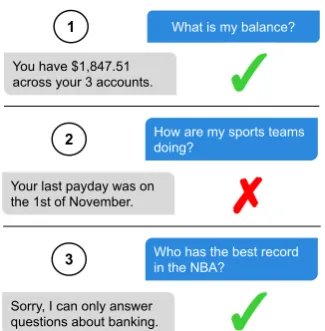
Figure 1: Example exchanges between a user (blue, right side) and a task-driven dialog system for personal finance (grey, left side). The system correctly identi-fies the user’s query in 1 , but in 2 the user’s query is mis-identified as in-scope, and the system gives an unrelated response. In 3 the user’s query is correctly identified as out-of-scope and the system gives a fall-back response.
intents). Furthermore, such resources do not facil-itate analysis ofout-of-scopequeries: queries that users may reasonably make, but fall outside of the scope of the system-supported intents.
Figure 1 shows example query-response ex-changes between a user and a task-driven dialog system for personal finance. In the first user-system exchange, the user-system correctly identifies the user’s intent as an in-scope BALANCE query. In the second and third exchanges, the user queries with out-of-scope inputs. In the second exchange, the system incorrectly identifies the query as in-scope and yields an unrelated response. In the third exchange, the system correctly classifies the user’s query as out-of-scope, and yields a fallback response.
Correctly identifying out-of-scope cases is thus crucial in deployed systems—both to avoid per-forming the wrong action and also to identify po-tential future directions for development. How-ever, this problem has seen little attention in anal-yses and evaluations of intent classification sys-tems.
This paper fills this gap by analyzing intent classification performance with a focus on out-of-scope handling. To do so, we constructed a new dataset with 23,700 queries that are short and un-structured, in the same style made by real users of task-oriented systems. The queries cover 150 intents, plus out-of-scope queries that do not fall within any of the 150 in-scope intents.
We evaluate a range of benchmark classifiers and out-of-scope handling methods on our dataset. BERT (Devlin et al.,2019) yields the best in-scope accuracy, scoring 96% or above even when we limit the training data or introduce class imbal-ance. However, all methods struggle with iden-tifying out-of-scope queries. Even when a large number of out-of-scope examples are provided for training, there is a major performance gap, with the best system scoring 66% out-of-scope recall. Our results show that while current models work on known classes, they have difficulty on out-of-scope queries, particularly when data is not plenti-ful. This dataset will enable future work to address this key gap in the research and development of di-alog systems. All data introduced in this paper can be found at https://github.com/clinc/ oos-eval.
2 Dataset
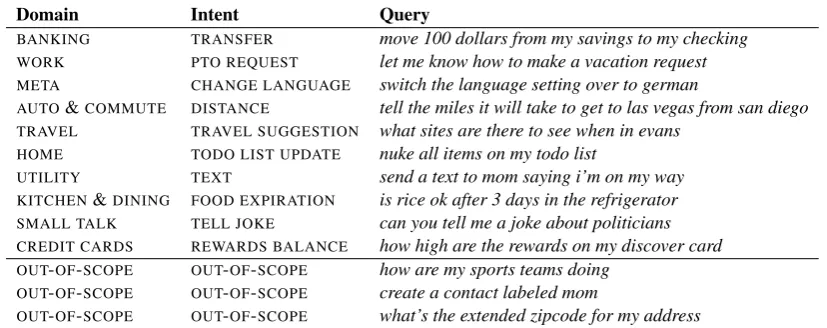
We introduce a new crowdsourced dataset of 23,700 queries, including 22,500 in-scope queries covering 150 intents, which can be grouped into 10 general domains. The dataset also includes 1,200 out-of-scope queries. Table1shows exam-ples of the data.1
2.1 In-Scope Data Collection
We defined the intents with guidance from queries collected using a scoping crowdsourcing task, which prompted crowd workers to provide ques-tions and commands related to topic domains in the manner they would interact with an artificially intelligent assistant. We manually grouped data
1See the supplementary material for a full list of domains
and intents, as well as additional examples.
generated by scoping tasks into intents. To col-lect additional data for each intent, we used the
rephrase and scenario crowdsourcing tasks pro-posed by Kang et al. (2018).2 For each intent, there are 100 training queries, which is represen-tative of what a team with a limited budget could gather while developing a task-driven dialog sys-tem. Along with the 100 training queries, there are 20 validation and 30 testing queries per intent.
2.2 Out-of-Scope Data Collection
Out-of-scope queries were collected in two ways. First, using worker mistakes: queries written for one of the 150 intents that did not actually match any of the intents. Second, using scoping and
scenariotasks with prompts based on topic areas found on Quora, Wikipedia, and elsewhere. To help ensure the richness of this additional out-of-scope data, each of these task prompts contributed to at most four queries. Since we use the same crowdsourcing method for collecting out-of-scope data, these queries are similar in style to their in-scope counterparts.
The out-of-scope data is difficult to collect, re-quiring expert knowledge of the in-scope intents to painstakingly ensure that no out-of-scope query sample is mistakenly labeled as in-scope (and vice versa). Indeed, roughly only 69% of queries col-lected with prompts targeting out-of-scope yielded out-of-scope queries. Of the 1,200 out-of-scope queries collected, 100 are used for validation and 100 are used for training, leaving 1,000 for testing.
2.3 Data Preprocessing and Partitioning
For all queries collected, all tokens were down-cased, and all end-of-sentence punctuation was re-moved. Additionally, all duplicate queries were removed and replaced.
In an effort to reduce bias in the in-scope data, we placed all queries from a given crowd worker in a single split (train, validation, or test). This avoids the potential issue of similar queries from a crowd worker ending up in both the train and test sets, for instance, which would make the train and test distributions unrealistically similar. We note that this is a recommendation from concurrent work by
Geva et al. (2019). We also used this procedure for the out-of-scope set, except that we split the data into train/validation/test based on task prompt instead of worker.
2 In all cases, crowd workers were paid $0.20 per task.
Domain Intent Query
BANKING TRANSFER move 100 dollars from my savings to my checking
WORK PTO REQUEST let me know how to make a vacation request
META CHANGE LANGUAGE switch the language setting over to german
AUTO&COMMUTE DISTANCE tell the miles it will take to get to las vegas from san diego
TRAVEL TRAVEL SUGGESTION what sites are there to see when in evans
HOME TODO LIST UPDATE nuke all items on my todo list
UTILITY TEXT send a text to mom saying i’m on my way
KITCHEN&DINING FOOD EXPIRATION is rice ok after 3 days in the refrigerator
SMALL TALK TELL JOKE can you tell me a joke about politicians
CREDIT CARDS REWARDS BALANCE how high are the rewards on my discover card OUT-OF-SCOPE OUT-OF-SCOPE how are my sports teams doing
OUT-OF-SCOPE OUT-OF-SCOPE create a contact labeled mom
[image:3.595.91.505.64.228.2]OUT-OF-SCOPE OUT-OF-SCOPE what’s the extended zipcode for my address
Table 1: Sample queries from our dataset. The out-of-scope queries are similar in style to the in-scope queries.
2.4 Dataset Variants
In addition to the full dataset, we consider three variations. First, Small, in which there are only 50 training queries per each in-scope intent, rather than 100. Second,Imbalanced, in which intents have either 25, 50, 75, or 100 training queries. Third,OOS+, in which there are 250 out-of-scope training examples, rather than 100. These are in-tended to represent production scenarios where data may be in limited or uneven supply.
3 Benchmark Evaluation
To quantify the challenges that our new dataset presents, we evaluated the performance of a range of classifier models3 and out-of-scope prediction schemes.
3.1 Classifier Models
SVM:A linear support vector machine with bag-of-words sentence representations.
MLP:A multi-layer perceptron with USE embed-dings (Cer et al.,2018) as input.
FastText:A shallow neural network that averages
embeddings ofn-grams (Joulin et al.,2017). CNN:A convolutional neural network with non-static word embeddings initialized with GloVe (Pennington et al.,2014).
BERT: A neural network that is trained to
pre-dict elided words in text and then fine-tuned on our data (Devlin et al.,2019).
Platforms: Several platforms exist for the
de-velopment of task-oriented agents. We con-sider Google’s DialogFlow4and Rasa NLU5with spacy-sklearn.
3
See the supplementary material for model details. 4
https://dialogflow.com
5https://github.com/RasaHQ/rasa
3.2 Out-of-Scope Prediction
We use three baseline approaches for the task of predicting whether a query is out-of-scope: (1) oos-train, where we train an additional (i.e.151st) intent on out-of-scope training data; (2) oos-threshold, where we use a threshold on the clas-sifier’s probability estimate; and (3)oos-binary, a two-stage process where we first classify a query as in- or out-of-scope, then classify it into one of the 150 intents if classified as in-scope.
To reduce the severity of the class imbalance be-tween in-scope versus out-of-scope query samples (i.e., 15,000 versus 250 queries for OOS+), we investigate two strategies when usingoos-binary: one where we undersample the in-scope data and train using 1,000 in-scope queries sampled evenly across all intents (versus 250 out-of-scope), and another where we augment the 250 OOS+ out-of-scope training queries with 14,750 sentences sam-pled from Wikipedia.
From a development point of view, the oos-train and oos-binary methods both require care-ful curation of an out-of-scope training set, and this set can be tailored to individual systems. The
oos-threshold method is a more general decision rule that can be applied to any model that pro-duces a probability. In our evaluation, the out-of-scope threshold was chosen to be the value which yielded the highest validation score across all in-tents, treating out-of-scope as its own intent.
3.3 Metrics
in-In-Scope Accuracy Out-Of-Scope Recall Classifier Full Small Imbal OOS+ Full Small Imbal OOS+
FastText 89.0 84.5 87.2 89.2 9.7 23.2 12.2 32.2 SVM 91.0 89.6 89.9 90.1 14.5 18.6 16.0 29.8 CNN 91.2 88.9 89.1 91.0 18.9 22.2 19.0 34.2 DialogFlow 91.7 89.4 90.7 91.7 14.0 14.1 15.3 28.5 Rasa 91.5 88.9 89.2 90.9 45.3 55.0 49.6 66.0
oos-train
MLP 93.5 91.5 92.5 94.1 47.4 52.2 35.6 53.9 BERT 96.9 96.4 96.3 96.7 40.3 40.9 43.8 59.2
SVM 88.2 85.6 86.0 — 18.0 13.0 0.0 —
FastText 88.6 84.8 86.6 — 28.3 6.0 33.2 — DialogFlow 90.8 89.2 89.2 — 26.7 20.5 38.1 —
Rasa 90.9 89.6 89.4 — 31.2 1.0 0.0 —
CNN 90.9 88.9 90.0 — 30.9 25.5 26.9 —
oos-threshold MLP 93.4 91.3 92.5 — 49.1 32.4 13.3 —
[image:4.595.124.471.63.264.2]BERT 96.2 96.2 95.9 — 52.3 58.9 52.8 —
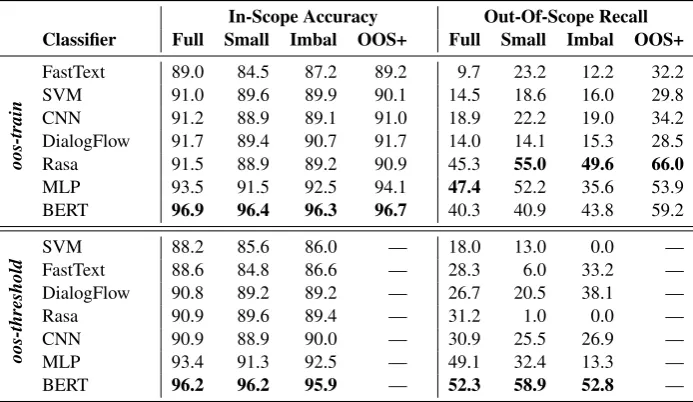
Table 2: Benchmark classifier results under each data condition using theoos-train(top half) andoos-threshold
(bottom half) prediction methods.
scope, as this would mean a system gives the user a response that is completely wrong. Precision er-rors are less problematic as the fallback response will prompt the user to try again, or inform the user of the system’s scope of supported domains.
4 Results
4.1 Results withoos-train
Table2 presents results for all models across the four variations of the dataset. First, BERT is consistently the best approach for in-scope, fol-lowed by MLP. Second, out-of-scope query per-formance is much lower than in-scope across all methods. Training on less data (Small and Imbal-anced) yields models that perform slightly worse on in-scope queries. The trend is mostly the op-posite when evaluating out-of-scope, where recall increases under the Small and Imbalanced training conditions. Under these two conditions, the size of the in-scope training set was decreased, while the number of out-of-scope training queries remained constant. This indicates that out-of-scope perfor-mance can be increased by increasing the relative number of out-of-scope training queries. We do just that in the OOS+ setting—where the models were trained on the full training set as well as 150 additional out-of-scope queries—and see that per-formance on out-of-scope increases substantially, yet still remains low relative to in-scope accuracy.
4.2 Results withoos-threshold
In-scope accuracy using the oos-threshold ap-proach is largely comparable to oos-train. Out-of-scope recall tends to be much higher on Full,
In-Scope Out-of-Scope Accuracy Recall Classifier under wiki aug under wiki aug
DialogFlow 84.7 — 37.3 —
Rasa 87.5 — 37.7 —
[image:4.595.311.523.300.419.2]FastText 88.1 87.0 22.7 31.4 SVM 88.4 89.3 32.2 37.7 CNN 89.8 90.1 25.6 39.7 MLP 90.1 92.9 52.8 32.4 BERT 94.4 96.0 46.5 40.4
Table 3: Results ofoos-binaryexperiments on OOS+, where we compare performance of undersampling (un-der) and augmentation using sentences from Wikipedia (wiki aug). The wiki aug approach was too large for the DialogFlow and Rasa classifiers.
but several models suffer greatly on the lim-ited datasets. BERT and MLP are the top oos-threshold performers, and for several models the threshold approach provided erratic results, partic-ularly FastText and Rasa.
4.3 Results withoos-binary
Table3compares classifier performance using the
oos-binaryscheme. In-scope accuracy suffers for all models using the undersampling scheme when compared to training on the full dataset using the
Num. Num. Chatbot Many Constrained Out-of-Scope Dataset Intents Utterances Style Intents Training Data Utterances
Our Dataset (This Work) 150 23,700 3 3 3 3
TREC-6, (Li and Roth,2002) 6 5,952 7 7 7 7
TREC-50, (Li and Roth,2002) 50 5,952 7 3 3 7
Web Apps, (Braun et al.,2017) 8 89 7 7 3 7
Ask Ubuntu, (Braun et al.,2017) 5 162 7 7 3 7
Chatbot Corpus, (Braun et al.,2017) 2 206 3 7 3 7
Snips, (Coucke et al.,2018) 7 14,484 3 7 7 7
[image:5.595.78.522.65.186.2]Liu et al.(2019) 54 25,716 3 3 7 7
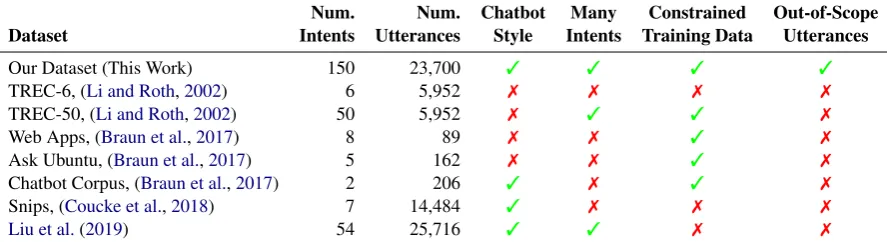
Table 4: Classification dataset properties. Ours has the broadest range of intents and specially collected out-of-scope queries. We consider “chatbot style” queries to be short, possibly unstructured questions and commands.
5 Prior Work
In most other analyses and datasets, the idea of out-of-scope data is not considered, and in-stead the output classes are intended to cover all possible queries (e.g., TREC (Li and Roth,
2002)). Recent work by Hendrycks and Gimpel
(2017) considers a similar problem they call out-of-distribution detection. They use other datasets or classes excluded during training to form the of-distribution samples. This means that the out-of-scope samples are from a small set of coher-ent classes that differ substantially from the in-distribution samples. Similar experiments were conducted for evaluating unknown intent discov-ery models inLin and Xu(2019). In contrast, our out-of-scope queries cover a broad range of phe-nomena and are similar in style and often similar in topic to in-scope queries, representing things a user might say given partial knowledge of the ca-pabilities of a system.
Table4 compares our dataset with other short-query intent classification datasets. The Snips (Coucke et al., 2018) dataset and the dataset pre-sented inLiu et al.(2019) are the most similar to the in-scope part of our work, with the same type of conversational agent requests. Like our work, both of these datasets were bootstrapped using crowdsourcing. However, the Snips dataset has only a small number of intents and an enormous number of examples of each. Snips does present a low-data variation, with 70 training queries per intent, in which performance drops slightly. The dataset presented in Liu et al.(2019) has a large number of intent classes, yet also contains a wide range of samples per intent class (ranging from 24 to 5,981 queries per intent, and so is not con-strained in all cases).
Braun et al. (2017) created datasets with con-strained training data, but with very few intents,
presenting a very different type of challenge. We also include the TREC query classification datasets (Li and Roth, 2002), which have a large set of labels, but they describe the desired response type (e.g., distance, city, abbreviation) rather than the action intents we consider. Moreover, TREC contains only questions and no commands. Cru-cially, none of the other datasets summarized in Table 4 offer a feasible way to evaluate out-of-scope performance.
The Dialog State Tracking Challenge (DSTC) datasets are another related resource. Specifically, DSTC 1 (Williams et al., 2013), DSTC 2 ( Hen-derson et al., 2014a), and DSTC 3 (Henderson et al.,2014b) contain “chatbot style” queries, but the datasets are focused on state tracking. More-over, most if not all queries in these datasets are in-scope. In contrast, the focus of our analysis is on both in- and out-of-scope queries that challenge a virtual assistant to determine whether it can pro-vide an acceptable response.
6 Conclusion
This paper analyzed intent classification and out-of-scope prediction methods with a new dataset consisting of carefully collected out-of-scope data. Our findings indicate that certain models like BERT perform better on in-scope classification, but all methods investigated struggle with identify-ing out-of-scope queries. Models that incorporate more out-of-scope training data tend to improve on out-of-scope performance, yet such data is ex-pensive and difficult to generate. We believe our analysis and dataset will lead to developing better, more robust dialog systems.
References
Daniel Braun, Adrian Hernandez-Mendez, Florian Matthes, and Manfred Langen. 2017. Evaluating natural language understanding services for conver-sational question answering systems. In Proceed-ings of the 18th Annual SIGdial Meeting on Dis-course and Dialogue (SIGDIAL).
Daniel Cer, Yinfei Yang, Sheng-yi Kong, Nan Hua, Nicole Limtiaco, Rhomni St. John, Noah Constant, Mario Guajardo-Cespedes, Steve Yuan, Chris Tar, Brian Strope, and Ray Kurzweil. 2018. Universal sentence encoder for English. In Proceedings of the 2018 Conference on Empirical Methods in Nat-ural Language Processing: System Demonstrations (EMNLP).
Alice Coucke, Alaa Saade, Adrien Ball, Th´eodore Bluche, Alexandre Caulier, David Leroy, Cl´ement Doumouro, Thibault Gisselbrecht, Francesco Calt-agirone, Thibaut Lavril, Ma¨el Primet, and Joseph Dureau. 2018. Snips voice platform: an embedded spoken language understanding system for private-by-design voice interfaces.CoRR, abs/1805.10190. Jacob Devlin, Ming-Wei Chang, Kenton Lee, and
Kristina Toutanova. 2019. BERT: Pre-training of deep bidirectional transformers for language under-standing. InProceedings of the 2019 Conference of the North American Chapter of the Association for Computational Linguistics: Human Language Tech-nologies (NAACL).
Mor Geva, Yoav Goldberg, and Jonathan Berant. 2019.
Are We Modeling the Task or the Annotator? An Investigation of Annotator Bias in Natural Lan-guage Understanding Datasets. arXiv e-prints, page arXiv:1908.07898.
Matthew Henderson, Blaise Thomson, and Jason D. Williams. 2014a. The second dialog state tracking challenge. InProceedings of the 15th Annual Meet-ing of the Special Interest Gorup on Discourse and Dialogue (SIGDIAL).
Matthew Henderson, Blaise Thomson, and Jason D. Williams. 2014b. The third dialog state tracking challenge. InSpoken Language Technology Work-shop (SLT).
Dan Hendrycks and Kevin Gimpel. 2017. A baseline for detecting misclassified and out-of-distribution examples in neural networks. In Proceedings of International Conference on Learning Representa-tions (ICLR).
Armand Joulin, Edouard Grave, Piotr Bojanowski, and Tomas Mikolov. 2017. Bag of tricks for efficient text classification. InProceedings of the 15th Con-ference of the European Chapter of the Association for Computational Linguistics (EACL).
Yiping Kang, Yunqi Zhang, Jonathan K. Kummerfeld, Parker Hill, Johann Hauswald, Michael A. Lauren-zano, Lingjia Tang, and Jason Mars. 2018. Data col-lection for dialogue system: A startup perspective.
InProceedings of the 2018 Conference of the North American Chapter of the Association for Computa-tional Linguistics: Human Language Technologies (NAACL).
Xin Li and Dan Roth. 2002. Learning question classi-fiers. InProceedings of the 19th International Con-ference on Computational Linguistics (COLING). Ting-En Lin and Hua Xu. 2019. Deep unknown intent
detection with margin loss. InProceedings of the 57th Annual Meeting of the Association for Compu-tational Linguistics (ACL).
Xingkun Liu, Arash Eshghi, Pawel Swietojanski, and Verena Rieser. 2019. Benchmarking natural lan-guage understanding services for building conversa-tional agents. InProceedings of the Tenth Interna-tional Workshop on Spoken Dialogue Systems Tech-nology (IWSDS).
Jeffrey Pennington, Richard Socher, and Christo-pher D. Manning. 2014. Glove: Global vectors for word representation. In Proceedings of the 2014 Conference on Empirical Methods in Natural Lan-guage Processing (EMNLP).