Proceedings of the 2019 Conference on Empirical Methods in Natural Language Processing
2840
Learning with Limited Data for Multilingual Reading Comprehension
Kyungjae Lee1∗ Sunghyun Park1∗ Hojae Han1 Jinyoung Yeo3 Seung-won Hwang1† Juho Lee2
1Yonsei University, 2 NAVER Corp, 3 SK T-Brain
Abstract
This paper studies the problem of supporting question answering in a new language with limited training resources. As an extreme sce-nario, when no such resource exists, one can (1) transfer labels from another language, and (2) generate labels from unlabeled data, us-ing translator and automatic labelus-ing function respectively. However, these approaches in-evitably introduce noises to the training data, due to translation or generation errors, which require a judicious use of data with vary-ing confidence. To address this challenge, we propose a weakly-supervised framework that quantifies such noises from automatically gen-erated labels, to deemphasize or fix noisy data in training. On reading comprehension task, we demonstrate the effectiveness of our model on low-resource languages with varying simi-larity to English, namely, Korean and French.
1 Introduction
Reading comprehension question answering (RCQA) is one of many well-known NLP tasks, to answer questions based on text understanding. For RCQA, a well-known resource is SQuAD ( Ra-jpurkar et al., 2016) with 100K QA data created by human, followed by NarrativeQA (Koˇcisk`y et al.,2018), SQuAD 2.0 (Rajpurkar et al.,2018), and CoQA (Reddy et al.,2018). However, as these datasets support only English, supporting other languages requires either annotation efforts in a comparable scale (Lim et al.,2018), or modeling efforts to overcome the limitation of training resources in terms of quantity or quality. Our work pursues the latter goal.
To illustrate, consider an extreme scenario of bootstrapping a RCQA model for a new language with no labelled resource. We can overcome the
∗
First two authors equally contributed to this work. †
correspond to [email protected]
limitation in quantity by generating alternative low-quality resources. First, neural machine trans-lation (NMT) can convert existing English anno-tations into a target language (Faruqui and Ku-mar, 2015; Ture and Boschee, 2016). For exam-ple, (passagep, questionq, answera) in SQuAD can be translated into (p0, q0, a0) in a target lan-guage (Asai et al.,2018;Lee et al.,2018). Second, automatic labeling function (Du and Cardie,2018;
Serban et al., 2016) can be adopted to generate synthetic labels in a target language. For example,
Du and Cardie(2018) leverages Question Gener-ator (QG) and Answer Extractor (AE) as labeling function for RCQA, to create training resources of a virtually infinite amount from unlabeled corpora. However, overcoming the quantity limitation using the above methods, leads to quality prob-lems. As a consequence, some of the following assumptions on quality may cease to hold, after errors introduced from generation. (1) Answer-ability: the semantic of the translated passage or generated question may shift, so that a question gets unanswerable after generation, or (2)Answer alignment: the answer span in a target language may become incorrect. Our goal is estimating the quality of resources and even improving the qual-ity, to overcome the limited quality of training re-sources.
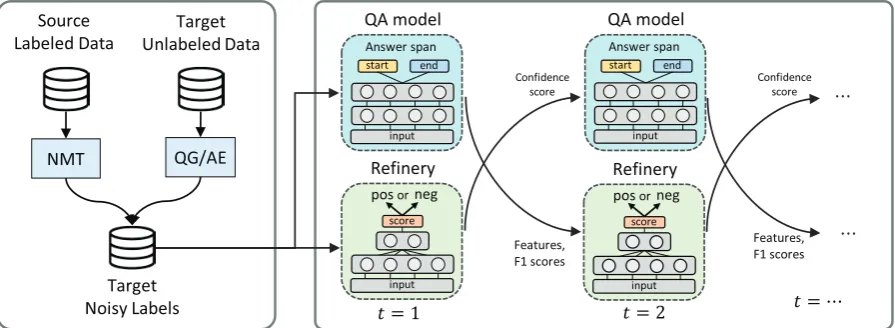
For the goal, we exploit noisy data from the above two sources, translator and labeling func-tion, considered asweak labels, and pursue robust learning overcoming noises: Our key contribution isRefinerynetwork that predict confidence – qual-ity of (p, q, a) instance into a score in the range of 0 to 1. While most existing weakly supervi-sion approach focuses on generating positive ex-amples, we leverage synthetic negative examples for trainingRefinery, optimized to distinguish pos-itive from negative one.
Source Labeled Data
Target Unlabeled Data
NMT QG/AE
Target
Noisy Labels ݐ= 1 ݐ= 2 ݐ=ڮ
Features, F1 scores
Confidence score
Confidence score
Features, F1 scores
ڮ ڮ
QA model
start end
input
Answer span
Refinery
input pos orneg
score
Refinery
input pos orneg
score QA model
start end
input
[image:2.595.76.524.66.230.2]Answer span
Figure 1: Overview of our approach
QA and Refinery is iterative: QA model is used for confidence estimation andRefineryis used to determine which noisy instances should be deem-phasized in training, or whether to modify wrong labels, towards the direction of improving QA model. As our framework does not re-train or ac-cess data generation models, our approach is ag-nostic to generation model, such that it can extend to generation models not discussed here.
For experiments on RCQA in a new lan-guage, our model is evaluated on three human-annotated sets. Our experiments show that our method withRefineryaugments training data and outperforms all state-of-the-arts. This observation can be generalized over similar and distant lan-guage pairs (English with French and Korean respectively), and with and without significant topic overlaps: To validate this claim, we ate over widely adopted human generated evalu-ation sets on Korean and French Wikipedia doc-uments. In addition, our reported gains are or-thogonal to a pre-trained model, such that we can easily leverage the strength of the latest BERT model (Devlin et al., 2018), and contribute addi-tional gains. Our implementation is available at:
https://github.com/lkj0509/multilingual MRC.
2 Preliminaries
RCQA problem is defined based on SQuAD dataset (Rajpurkar et al.,2016) in English, which consists of 23,215 passages and 100k+ question-answer pairs requiring the understanding of corre-sponding passages to answer correctly. Letpbe a passage withmwords,i.e.,p={w1p, wp2, ..., wmp}, and q be a question with n words, i.e., q = {wq1, w2q, ..., wnq}. Then, given a pair of passage
p and question q, the objective of RCQA is to estimate a consecutive answer span a, i.e., a = {wpi, wip+1, ..., wpj} where a ⊆ p. For task eval-uation, the estimated answer span ais compared with the ground truth answer spana∗ in terms of F1 score at word-level.
The majority of RCQA models (Seo et al.,
2016; Yu et al., 2018; Devlin et al., 2018) con-sist of (a) encoding the passage and question into a fixed-size vector, then (b) decoding to predict the probability of each position in the passage be-ing the start or end of an answer span. As a ba-sic QA model, we start from BiDAF model (Seo et al.,2016), which is a widely known open-source code.1 BiDAF model uses bi-directional LSTM networks with attention mechanism to align ques-tion with passage and vice-versa. More specifi-cally, the probabilities of the starting and ending position are modeled as:
P1 =sof tmax(h1·[M0;M1])
P2 =sof tmax(h2·[M0;M2])
(1)
whereh1,h2 are trainable weights, andM0,M1,
M2 are the hidden states at each LSTM layer to represent the passage words according to the given question. The probability ofs-to-espan of the pas-sage is defined as follows:
P(a={wps, ..., wep}|p, q) =P1s×P2e (2)
In test, the model selects the answer span with the highest probability (Eq. (2)) during post-processing.
3 Data Generation for New Language
This section introduces how we generate weak su-pervisions, from machine translation and synthetic label generation.
3.1 Method I: Neural Machine Translation
SQuAD is a set of(p, q, a)triple, where answera
to questionq can be found as a consecutive sub-string match in the passage p (i.e., a ⊆ p). Due to this property of SQuAD, translating the triple
(p, q, a)is non-trivial: whenpandaare translated into target language, pt and at, at ⊆ pt may no longer hold. Therefore, we need to find the answer spanatin the target language, by matching withas in the source language s. We overviewed a high-precision baseline (Lee et al.,2018) whereasand
ps are independently translated, and at is found only when the translation ofasis exactly and con-secutively found in that ofps. However, this suf-fers low-recall, considering we found only 53.6% spans among whole translated Q-A pairs by the high-precision method.
To complement, we propose a perfect-recall alignment to find 46.4% spans that cannot be ex-tracted by the above method. Our method is exten-sible to any language with an existing open-source NMT, leveraging only its attention scores ( Bah-danau et al.,2014).
(1) One-to-one alignment: A widely adopted simplifying assumption for machine translation is that each target word is aligned to one source lan-guage word (Brown et al., 1993). Based on at-tention score in NMT, each word in as can be aligned with word in the target language, by se-lecting highest score. After 1-to-1 matching, we select the longest sub-sequence as answer spanat.
(2) Span-to-span alignment: One-to-one as-sumption is simplifying, by treating values in the alignment matrix as binary and excluding a pos-sibility that a word can be aligned with multiple target words. Instead, we align span-to-span, to calculate a “soft” score between as and at, and change the span boundary dynamically. To illus-trate, assume at = {i, ..., j} is the answer span found from the one-to-one alignment. Before fi-nalizing this answer, we may ask whether chang-ing the boundary i and j improves the match2. Formally, when Sm,n denotes (m, n)-th element
2We notice that 16% spans from 1-to-1 alignment can be
changed to gain F1 score of 1% point on Korean test set.
in the alignment matrix, we can evaluate the match score of between as and at by averaging all pairwise combinations in the two spans:S = average(Sm,n)for∀m ∈ as,∀n∈ at. If chang-ing the target boundarya0t ={i0, ..., j0}improves this score, we will make a modification. Specifi-cally, we consider updating the end position toj0
in the range ofj±N, within a pre-defined win-dow sizeN, and enqueue a possible update j0 if the average score ofS forasanda0tis higher than that ofasandat. Similarly, we compare the scores of start position in the range ofi±Nto enqueue a possible update i0. After this, highest-scoring up-date pair(i0, j0)in the queue (Hwang and Chang,
2005) can be aligned.
3.2 Method II: Synthetic Label Generation
This section introduces an automatic labeler which can generate question-answer pairs from unla-beled text crawled for the target language. Train-ing data collected via NMT is inherently skewed to specific domains answerable for English-speaking area (e.g., United States), which causes the domain gap with test data on a new language. Automatic labeler can complement by collecting unlabeled text on the domains not covered, and generating synthetic labels.
For generating synthetic training data, we lever-age Question Generator (QG) and Answer Extrac-tor (AE) as labeler, following (Du and Cardie,
2018). Given a passage in a target language, our goal is to generate question-answer pairs, related to the given passage. In (Du and Cardie, 2018), BiLSTM-CRF model (Huang et al.,2015) is used for AE, classifying whether the word belongs to the answer span. For QG, sequence-to-sequence model (Bahdanau et al.,2014) is adopted, by set-ting a passage and answer candidates as input and question words as output. To train QG and AE, we use weak labels obtained from Method I. At infer-ence time of QG and AE, we insert human-written passages, crawled from web documents in a tar-get language (e.g., Wikipedia), and obtain pairs of question and answer as the output of QG and AE, respectively.
4 Weakly-supervised QA model
In this section, we illustrate how we score con-fidence for noisy training data obtained from the above two generation methods. We propose a new
confi-Embedding+LSTM Embedding+LSTM Bi-Attention
ݍଵ
Question
ݍ ଵ ଶ
Passage
ڮ ڮ
LSTM
Embedding Embedding BERT
ݍଵ
Question
ݍ ଵ ଶ
Passage
ڮ ڮ
Passage Repܯ
Passage Repܯ
L
S
T
M
P-Q Repܴ
Refinery QA – (2) BERT
QA – (1) BiDAF
Dense + sigmoid
P-Q Rep
Concatenate Confidence Score
P-Q Repܴ
ܴ
+ Answer Rep ܯ௦ ܯ
ܯ௦ ܯ
[image:4.595.76.521.63.224.2]ܯ௦ ܯ
Figure 2: Architecture of our QA model andRefinery. Our approach ofRefinery(Right) can be applicable to various RCQA models, illustrated with BiDAF (Left) and BERT (Center) here.
dence of noisy input from multiple generators but also improving labels and QA model. Existing work (Bach et al.,2011) estimates translation error that can be used as a confidence proxy. However, it requires large labels through human-correction, and cannot apply to other generators such as QG. Our goal is confidence estimation regardless of whether it is generated from NMT or QG methods (generator-agnostic).
4.1 Refinery Network
OurRefineryaims to score the quality of the gen-erated (p, q, a) labels, depending on whether the example is positive or negative. It is known that RCQA models trained solely on positive exam-ples fail on unanswerable cases, assuming that a correct answer is guaranteed to exist in the pas-sage (Rajpurkar et al.,2018). A simple remedy is to manually augment training resources with neg-ative examples, to teach how to distinguish them from positive examples. Our key contribution is automatic collection of both positive and negative training examples for trainingconfidence predic-tion, which we will discuss in details below.
Our research question now is then: how do we obtain positive and negative examples? For positive examples, we treat weak labels from the generation methods as “pseudo-positive”, since it would be positive, when the transla-tion/generation is perfect. For negative examples, we generate synthetic noises, similarly to transla-tion/generation errors, by adopting a naive but ef-fective method to change words or sentences in a positive example (Levy et al.,2017;Zhang et al.,
2019;Yang et al.,2019).
Specifically, we modify pseudo-positive labels to generate synthetic negative examples of unan-swerable or wrong answer. For unanunan-swerable cases, (1) we first replace a question with its se-mantic neighbor derived from other documents (e.g., “who first discovered america?” into “who first discovered canada?”). For this, we use the av-erage of word embedding and the cosine distance. Second, (2) we modify a passage by removing a sentence containing the answer span, so that the modified passage is the subset of original one, but unanswerable. Lastly, for wrong answers, (3) we perturb an answer span into a random span in the same passage, which is answerable but with an in-correct label. We generate negative examples from the above (1)-(3) methods (33.3% each). As we will show later in Section5, these negative exam-ples are empirically effective for trainingRefinery. The training objective is that CS of pseudo-positive example should be greater than that of negative one, with at least marginδ. To deal with pseudo-positive examples unequally, we set the margin δ dynamically, which is derived from F1 score of QA model. That is, we relatively assign a larger margin to a higher confidence instance, and smaller otherwise. The magnitude of margin depends on the F1 score of the predicted answer from QA model. Considering the marginδ, the fi-nal objective function is computed as follows:
δi=α·F1score(p+i , q + i , a
+ i )
Lcs =
X
i
max(0, δi− {CSi+−CS − i })
(3)
Now, to obtain the confidence score, we use BiDAF (Seo et al.,2016) as QA model, as shown in Figure 2 (Left). First, to model answerability of(p, q), we extract the feature of(p, q)from QA model. For this, we concatenate the two hidden statesM1 andM2 from BiDAF, as mentioned in Section 2.1. Then, the representations are aggre-gated by LSTM and attention layer, as follows:
G=σ(W1[M1 ;M2] +b1)
G=←−−−→LST M(G)
a=sof tmax(v1·σ(W2G+b2))
Rpq =
X
i
ai·Gi
(4)
where W1, W2, v1, b1, b2 are trainable weights, andσis tanh function. The vectorRpqcontaining the information of both passage and question will be used for confidence score.
Second, to model the confidence of answer la-bels, we represent answer spans in the labels. For this, we concatenate two hidden statesM1
s andMe2 ofs-th start ande-th end words in the answer. The final confidence score CS is obtained from Rpq and the answer feature, as follows:
Rspan= [Ms1;Me2]
CS=sigmoid(v2·[Rpq ;Rspan] +b3) (5)
wherev2 andb3are trainable weights, and[ ; ] in-dicates concatenation.
An extension to the above model is to replace BiDAF with BERT (Devlin et al., 2018), a pre-trained model on a masked language model task. Due to the commonality of BiDAF and BERT, tak-ing question and passage as input and generat-ing passage representations for answer span pre-diction, we can apply BERT to our approach, as shown in Figure 2(Center), by modifying Refin-erymodule of modeling confidence score. Mean-while, architectural differences of the two, such as BiDAF using bi-attention layers and BERT using self-attention layers, require some minor changes: In BERT, as the output of CLS token can rep-resent the input sequence of passage and ques-tion, we use the output vector of CLS as Rpq. For Rspan, we use the hidden states at the layer of BERT, instead of M in Eq. (5). We will show the effectiveness of our approach on both BiDAF and BERT model in Section 5.
4.2 Improving QA and Weak Labels
During an iterative procedure of QA and Refin-ery, our approach improves both QA model and weak labels. Using confidence, Refinery acts as two functions: (1)down-weightinginstances with low-quality, and (2) answer modification with low-quality for higher quality.
The objective of original QA model minimizes the sum of the negative log probabilities:
Lqa=− N
X
i
log(P1si) +log(P2ei)
=−
N
X
i
log(P(ai|pi, qi))
(6)
whereN is the number of examples in training set,
si andei are the start and end indices of thei-th example, respectively. For down-weighting noise, we combine this QA loss function with weighted confidence score, based on functionf(CS(p, q)):
Lqa0 =−
N
X
i
f(CSi)·log(P(ai|pi, qi)) (7)
However, in initial steps of training, the confi-dence score is not reliable, and may cause unsta-ble training. To avoid the prounsta-blem, we apply an annealing technique, adjusting the contribution of the confidence score. We set the initial function
f to be uniform constant, and then gradually in-crease the contribution of instance weighting as learning steps. That is, we design the function f
as follows:
f(CSi) =
c·e−λt+CSi
c·e−λt+ 1 (8)
wheret is the number of current iteration step,c
andλare hyper-parameters.
Besides down-weighting noisy instances, we could change some answers in weak labels to higher-quality one, while unanswerable passages-question pairs are difficult to modify. To improve such labels, we compare confidence scores be-tween the answera∗ predicted by QA model and
ain the weak label. If the confidence increase is greater than threshold γ, we change the answer
a to the model-generated answer a∗ when each epoch ends. Finally, we train the QA and Refin-erymodules jointly, as Eq. (3) and (7), which are updated in turns3, until convergence. Algorithm1
describes this procedure in detail.
3When updating
Algorithm 1Iterative QA and Refinery
N = 0, θqa(0)←Initial QA, θ (0)
re ←Initial Refinery
forepochinepochsdo foriinmax stepsdo
LetDbe(P, Q, A)triplets in mini-batch
D+i ←(Pi+, Q+i , A+i )from weak labels
D−i ←(Pi−, Q−i , A−i )from negative examples
A∗i ←Answer of(Pi+, Q+i )from QAθqa(N) Fi←F1 score of(A+i , A∗i)
CSi←Confidence(D+i )from Refineryθ (N) re
θqa(N+1)←Update QA model on(D+i , CSi) θre(N+1)←Update Refinery on(D+i , D
−
i , Fi) N ←N+ 1
end
D∗←(P+, Q+, A∗)predicted from QAθ(N) qa CS∗←Confidence(D∗)on predicted answers
CS+←Confidence(D+)on weak labels
ifCS∗−CS+ > γthen
D+←modified label(P+, Q+, A∗)
end end
5 Experiment
In this section, we address the following research questions:
• RQ1: Does our proposed work outperform existing approaches? Does it generalize for languages with diverse distance or topics?
• RQ2: Does our model generally work on more noisy environment?
• RQ3: Is ourRefineryeffective in distinguish-ing positive and negative set? How does QA/Refinerycontribute to each other?
5.1 Dataset
For evaluation, we conduct experiments on three datasets for French and Korean RCQA. First is the public datasets, built on French (327 pairs) (Asai et al., 2018) and Korean (2K pairs) (Lee et al., 2018) Wikipedia, denoted as Wiki Fr and Wiki Kr respectively. Supposing zero-annotation at training, we use their training set (2K) in Wiki Kras our dev set, and evaluate our model on the test set. Third dataset is a his-tory RC dataset (7K), which we collect on Korean-specific topics to show the robustness of our model with respect to domain gap: Specifically, dealing with Korean history documents, as denoted as His-tory Kr. For annotation, we follow the conven-tion of SQuAD (Rajpurkar et al., 2016). Lastly,
for generating synthetic labels, we crawled about 400 articles in each French and Korean, with gen-eral and (Korean) history topic from Wikipedia and Doopedia4, respectively. Through automatic labeler (QG/AE) as mentioned in Section 3.2, we generated totally 100K QA pairs from passages in Wikipedia and Doopedia.
5.2 Experimental Setting
Our implementation settings for QA model fol-low original BiDAF (Seo et al., 2016) and BERT (Multilingual-Base version) (Devlin et al.,2018). For machine translation, we use pre-trained and open-sourced NMT models for French5 and Ko-rean6. As hyper-parameters, α, c, λ and γ, are set to 1/10, 10, 1/4000, and 0.5 respectively, op-timized by dev set. For QG and AE implementa-tions, we follow the setting of NQG model (Zhou et al., 2017). In BiDAF model, we used Natu-ral Language Toolkit (NLTK) and KoNLPY7 for French/Korean tokenizer, and FastText (Mikolov et al.,2017) for word embedding.
5.3 Evaluation of Full QA Model
We compare our QA model with the following baselines:
Base1&2: Asai et al. (2018) translate (p, q, a)
in target language into English, then test on pre-trained English QA model. The answer from model is translated back to target language. We present their reported F1 scores for French with and without ELMo (Peters et al.,2018), and leave unreported results blank.
Base3: Lee et al. (2018) proposed semi-supervised method, to train the weak model on a small human-labeled set, and evaluate translated QA pairs by the output probabilities (in Eq. (2)) of the weak QA model. For training QA, the trans-lated data over threshold is used together with a human-labeled data. We present their reported F1 scores and leave unreported results blank.
Ours: Our proposed models are trained on BiDAF and BERT, and with/without Refinery (for ablation purposes described below).
4
https://www.doopedia.co.kr
5
https://github.com/pytorch/fairseq/blob/master/examples/translation
6
https://developers.naver.com/products/nmt/
Table 1: The results of QA models. Compared to version w/o Refinery, our models outperform with statistical significance (* indicatesp <0.05).
Method QA model F1 score
Wiki Fr Wiki Kr History Kr Base1 Test on source (Asai et al.,2018) BiDAF+ELMo 61.9 - -Base2 Test on source (Asai et al.,2018) BiDAF 57.6 - -Base3 Semi-supervision (Lee et al.,2018) BiDAF - 71.5
-Ours
No weighting (w/oRefinery) BiDAF 60.8 70.1 61.5
Full model withRefinery BiDAF 63.5* 73.4* 64.1*
No weighting (w/oRefinery) BERT 74.3 77.1 67.7
Full model withRefinery BERT 76.6* 79.7* 70.4*
Results on QA datasets Table 1 shows the comparison on En-Kr (distant) and En-Fr (close) language pairs. Similarly, we contrast in diverse topic-similarity scenarios: History (distant) and Wiki (close). When compared with Base1&2 (Test on source), our model outperforms the two mod-els, even when Base1 is boosted by ELMo (Peters et al., 2018). When compared with Base3, semi-supervision (Lee et al.,2018) using 2K human la-bels outperforms our BiDAF model (without Re-finery), on Wiki Kr set. However, ours with
Re-fineryoutperforms the Base3 model, which means
that large and noisy labels refined by our method have comparable quality to small but strong labels. To show that the effectiveness of our approach is orthogonal to QA model, we construct two QA models, BiDAF and BERT, as in Table 1. When compared with No weighting, our full model on BiDAF improved 2.7%, 3.3% and 2.6% of F1 scores, and that on BERT improved 2.3%, 2.6% and 2.7% of F1 score, on Wiki Fr, Wiki Kr and History Kr, respectively. BERT model with our
Refineryperforms the best among all models, by
adding the power of pre-trained representations.
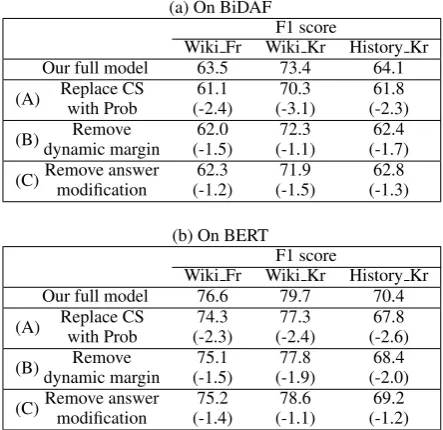
Ablation Study As shown in Table 2, we con-duct an ablation study on both BiDAF and BERT models, by examining the effects, from remov-ing each component. In (A), we replace our con-fidence score (CS) with the probabilities in Eq. (2), which is similar to the use of confidence in (Lee et al., 2018). We normalize the probabili-ties in mini-batch by softmax function, then apply
to down-weighting. On the QA model using the
[image:7.595.306.528.290.505.2]replaced confidence, the performance decreased significantly, suggesting the importance of CS. In (B), we remove a dynamic margin in Eq. (3), by setting the margin as a constant value instead (i.e.,
Table 2: The ablation study on three datasets. The num-ber inside the parenthesis indicates the decrease from our full model.
(a) On BiDAF F1 score
Wiki Fr Wiki Kr History Kr Our full model 63.5 73.4 64.1
(A) Replace CS with Prob
61.1 (-2.4)
70.3 (-3.1)
61.8 (-2.3)
(B) Remove dynamic margin
62.0 (-1.5)
72.3 (-1.1)
62.4 (-1.7)
(C)Remove answer modification
62.3 (-1.2)
71.9 (-1.5)
62.8 (-1.3)
(b) On BERT
F1 score
Wiki Fr Wiki Kr History Kr Our full model 76.6 79.7 70.4
(A) Replace CS with Prob
74.3 (-2.3)
77.3 (-2.4)
67.8 (-2.6)
(B) Remove dynamic margin
75.1 (-1.5)
77.8 (-1.9)
68.4 (-2.0)
(C)Remove answer modification
75.2 (-1.4)
78.6 (-1.1)
69.2 (-1.2)
δ = 1). Using static margin lowered the perfor-mance of both QA models, suggesting that QA feedback (dynamic margin) is effective for refin-ing noises. In (C), we removeanswer modification
in Section 4.2, while preserving down-weighting
module. Compared with our full model, adding
answer modificationimproved the performance on
both QA models. We can also observe the effect
ofdown-weighting, as the model without answer
modificationstill outperforms that withNo weight-ingin Table1.
0.2 0.3 0.4 0.5 0.6 0.7 0.8
0% 10% 20% 30% 40%
0.5 0.6 0.7 0.8 0.4 F 1 s c o r e 0.3 0.2
0% 10% 20% 30% 40%
Noise ratio Ͳܭ ܭ ܭ ܭ ܴ݂݁݅݊݁ݎݕ ܳܣ ݈݉݀݁ Bܽݏ݁ ܱݑݎݏ Ͳܭ
(a) QA performance as noise ratio
0.5 0.6 0.7 0.8 0.9 1 0 0.2 0.4 0.6 0.8 1
1Ͳܭ 20ܭ 5ܭ 15ܭ
Iterations 0.6 0.8 0.4 F 1 s c o r e 0.2 0 1.0 0.8 0.9 0.7 A U R O C 0.6 0.5 1.0 ܴ݂݁݅݊݁ݎݕ ܳܣ ݈݉݀݁ ܽݏ݁ ܱݑݎݏ Ͳܭ
(b) Iterative QA andRefinery
0 0.05 0.1 0.15 0.2 0.25 ܴܽ ݐ݅ 0.15 0.20 0.10 0.05 0 0.25 ܥ݂݊݅݀݁݊ܿ݁ ܵܿݎ݁ 0.5 1.0 0.25 0.75 ܰ݁݃ܽݐ݅ݒ݁ܲݏ݅ݐ݅ݒ݁ 0
[image:8.595.76.525.66.202.2](c) Distribution of confidence score
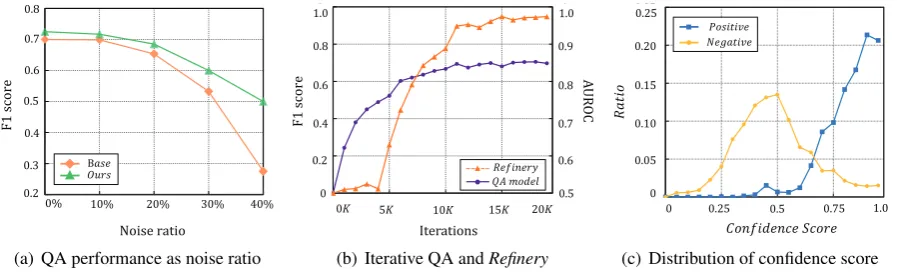
[image:8.595.73.288.292.367.2]Figure 3: Experimental results of our model on dev set. (a) Comparison of robustness between Base (w/oRefinery) and Ours in noisy environments. (b) The performances of QA (F1 score) andRefinery(AUROC) over iterations. (c) Distribution of confidence scores for positive and negative examples.
Table 3: The results of confidence score evaluation
TNR
(95% TPR) AUROC AUPR
(Wiki Kr / History Kr) (A) Base1 47.4 / 39.0 82.9 / 85.8 78.2 / 85.4 (B) Base2 44.9 / 69.5 71.2 / 83.5 63.3 / 75.7 Ours 88.4/90.9 97.7/98.5 98.2/98.8
noises increase, Base BiDAF model sharply drops its F1 score, while that of our full model degrades gracefully.
5.4 Evaluation of Confidence Score
This section addresses RQ3, aiming at directly ob-serving whether our confidence score effectively distinguishes the positive from negative. As base-lines, we conduct (A) and (B) in the above ablation study. (A) Base1 uses the probability in Eq. (2) as confidence score. (B) Base2 is Refinery with-out a dynamic margin (δ= 1). In this experiment, we use BiDAF model on Wiki Kr and History Kr, and generate negative examples from positive test set as 1:1 ratio.
As a quantitative evaluation, we measure three metrics of detecting negative examples, compar-ing confidence of positive and negative one.
• True Negative Rate (TNR) at 95% True Pos-itive Rate (TPR).
• Area under the Receiver Operating Charac-teristic Curve (AUROC).
• Area under the Precision – Recall Curve (AUPR).
As shown in Table 3, ourRefineryoutperforms other baselines with statistical significance ofp <
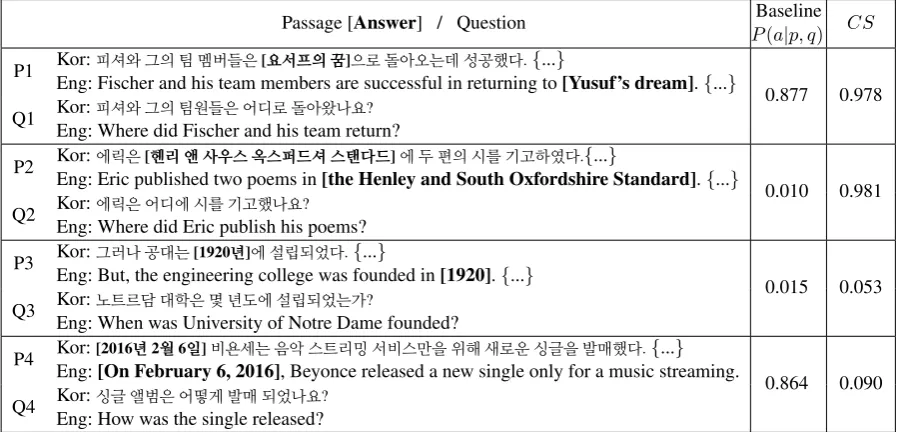
0.01and by a large margin on all measures, show-ingRefineryis effective in distinguishing positive-negative pairs. We also compare our work with and without a dynamic margin from QA feedback, to show that such strategy improves the performance. To show performance of QA/Refinery over it-erations, we check their performance as iterations continue on dev set, in Figure3(b). In early iter-ations,Refinerycannot contribute to QA, because F1 score of all instance is zero. After the training stabilizes, the performance of Refinery increases rapidly. Figure 3(c) contrasts the distribution of confidence from positive and negative samples: Unlike negative examples of varying confidence, positive examples are clearly skewed to high-ends. Table4compares the examples in Baseline and our model, where the first two are high-quality data and the third and forth are not. In the first ex-ample, both models show high score, while Base-line underestimates the quality andRefineryworks correctly for the second example. The third exam-ple is unanswerable on(p, q)pair, since the words about the subject disappeared during translation, which is assigned to lower scores by two models. The last example has also translation error where the given question was mistranslated from ‘when’ to ‘how’. In this case, our Refinerynetwork suc-cessfully assigned low confidence score, as the question is no longer answerable after a bad trans-lation, but Baseline gives a high confidence.
6 Related Work
ap-Table 4: Qualitative examples showing our proposed confidence estimation score CS for (p,q) pairs in Korean. Human translated English is given in the bracket only for readability. We omitted some irrelevant sentences in the passages for conciseness.
Passage [Answer] / Question Baseline
P(a|p, q) CS
P1 Kor:피셔와그의팀멤버들은[요서프의꿈]으로돌아오는데성공했다.{...}
Eng: Fischer and his team members are successful in returning to[Yusuf’s dream].{...}
0.877 0.978 Q1 Kor:피셔와그의팀원들은어디로돌아왔나요?
Eng: Where did Fischer and his team return?
P2 Kor:에릭은[헨리앤사우스옥스퍼드셔스탠다드]에두편의시를기고하였다.{...}
Eng: Eric published two poems in[the Henley and South Oxfordshire Standard].{...}
0.010 0.981 Q2 Kor:에릭은어디에시를기고했나요?
Eng: Where did Eric publish his poems?
P3 Kor:그러나공대는[1920년]에설립되었다.{...}
Eng: But, the engineering college was founded in[1920].{...}
0.015 0.053 Q3 Kor:노트르담대학은몇년도에설립되었는가?
Eng: When was University of Notre Dame founded?
P4 Kor:[2016년2월6일]비욘세는음악스트리밍서비스만을 위해새로운싱글을발매했다.{...} Eng:[On February 6, 2016], Beyonce released a new single only for a music streaming.
0.864 0.090 Q4 Kor:싱글앨범은어떻게발매되었나요?
Eng: How was the single released?
ply English-based models, then translate the an-swer back (Asai et al., 2018). Not only for ques-tion answering, such method has been success-ful in sentiment classication (Zhou et al., 2016), relation extraction (Faruqui and Kumar, 2015), and causal commonsense (Yeo et al.,2018). How-ever, these approaches are dependent on quality of translation.
RCQA for Resource-Poor LanguageTo over-come the lack of RCQA resources on other lan-guage, in (Lee et al.,2018), they proposed a semi-supervised strategy to remove the noise instances. They hand-annotated a small seed set of QA pairs to train a weak QA. Then, the weak QA indirectly judges the quality of machine-translated SQuAD pairs, by considering the output probability as con-fidence score. As concon-fidence score, they selec-tively remove translated pairs below a fixed thresh-old. Meanwhile, we eliminate the needs for hu-man annotation, by leveraging positive and neg-ative sets from translated and generated data.
Combining models of QG and QA: Several works (Wang et al.,2017;Tang et al.,2017;Tang et al.) propose a framework jointly optimizing QG and QA model as dual. These approaches share commonality with our approach for generating training data with another model, but with the fol-lowing crucial difference: Existing work can use a reliable training set annotated by human, which can be strong hint to decide the quality of gener-ated data. For example, in (Tang et al.), QG
gener-ates questions on the given answer sentence, then the generated question is compared with the origi-nal question in training set. Meanwhile, we do not require human annotation, and rather leverage au-tomatically generated from NMT and QG models, judiciously guided by our Refinery network.
7 Conclusion
This paper studies a zero-resource training data generation for supporting RCQA to a new target language. Inspired by limited resources, we gen-erate RCQA data, by using existing NMT and QG techniques. To explore the noisy generated data, we proposed an integrated QA model with Re-fineryto control the generated data as confidence score. Our results showed that our strategies using
Refinery and generated data enhance the
perfor-mance of existing QA model, andRefineryhas ef-fectiveness to distinguish positive-negative pairs.
Acknowledgements
We thank NAVER Corporation for sponsoring this project. Partial support received from IITP grant funded by the Korea government (MSIT) (No.2017-0-01779, XAI).
References
[image:9.595.74.525.109.325.2]reading comprehension by runtime machine transla-tion. arXiv preprint arXiv:1809.03275.
Nguyen Bach, Fei Huang, and Yaser Al-Onaizan. 2011. Goodness: A method for measuring machine transla-tion confidence. InProceedings of the 49th Annual Meeting of the Association for Computational Lin-guistics: Human Language Technologies-Volume 1, pages 211–219. Association for Computational Lin-guistics.
Dzmitry Bahdanau, Kyunghyun Cho, and Yoshua Ben-gio. 2014. Neural machine translation by jointly learning to align and translate. arXiv preprint arXiv:1409.0473.
Peter F Brown, Vincent J Della Pietra, Stephen A Della Pietra, and Robert L Mercer. 1993. The mathematics of statistical machine translation: Parameter estima-tion. Computational linguistics, 19(2):263–311.
Jacob Devlin, Ming-Wei Chang, Kenton Lee, and Kristina Toutanova. 2018. Bert: Pre-training of deep bidirectional transformers for language understand-ing. arXiv preprint arXiv:1810.04805.
Xinya Du and Claire Cardie. 2018. Harvest-ing paragraph-level question-answer pairs from wikipedia.arXiv preprint arXiv:1805.05942.
Manaal Faruqui and Shankar Kumar. 2015. Multi-lingual open relation extraction using cross-Multi-lingual projection. arXiv preprint arXiv:1503.06450.
Zhiheng Huang, Wei Xu, and Kai Yu. 2015. Bidirec-tional lstm-crf models for sequence tagging. arXiv preprint arXiv:1508.01991.
Seung-won Hwang and Kevin Chang. 2005. Optimiz-ing access cost for top-k queries over web sources: A unified cost-based approach. InICDE.
Tom´aˇs Koˇcisk`y, Jonathan Schwarz, Phil Blunsom, Chris Dyer, Karl Moritz Hermann, G´aabor Melis, and Edward Grefenstette. 2018. The narrativeqa reading comprehension challenge. Transactions of the Association of Computational Linguistics, 6:317–328.
Kyungjae Lee, Kyoungho Yoon, Sunghyun Park, and Seung-won Hwang. 2018. Semi-supervised training data generation for multilingual question answering.
LREC.
Omer Levy, Minjoon Seo, Eunsol Choi, and Luke Zettlemoyer. 2017. Zero-shot relation extrac-tion via reading comprehension. arXiv preprint arXiv:1706.04115.
Seungyoung Lim, Myungji Kim, and Jooyoul Lee. 2018. Korquad: Korean qa dataset for machine com-prehension. Communications of the Korean Institute of Information Scientists and Engineers, pages 539– 541.
Tomas Mikolov, Edouard Grave, Piotr Bojanowski, Christian Puhrsch, and Armand Joulin. 2017. Ad-vances in pre-training distributed word representa-tions.arXiv preprint arXiv:1712.09405.
Matthew E Peters, Mark Neumann, Mohit Iyyer, Matt Gardner, Christopher Clark, Kenton Lee, and Luke Zettlemoyer. 2018. Deep contextualized word rep-resentations. arXiv preprint arXiv:1802.05365.
Pranav Rajpurkar, Robin Jia, and Percy Liang. 2018. Know what you don’t know: Unanswerable ques-tions for squad.arXiv preprint arXiv:1806.03822.
Pranav Rajpurkar, Jian Zhang, Konstantin Lopyrev, and Percy Liang. 2016. Squad: 100,000+ questions for machine comprehension of text. arXiv preprint arXiv:1606.05250.
Siva Reddy, Danqi Chen, and Christopher D Manning. 2018. Coqa: A conversational question answering challenge. arXiv preprint arXiv:1808.07042.
Minjoon Seo, Aniruddha Kembhavi, Ali Farhadi, and Hannaneh Hajishirzi. 2016. Bidirectional attention flow for machine comprehension. arXiv preprint arXiv:1611.01603.
Iulian Vlad Serban, Alberto Garc´ıa-Dur´an, Caglar Gulcehre, Sungjin Ahn, Sarath Chandar, Aaron Courville, and Yoshua Bengio. 2016. Generating factoid questions with recurrent neural networks: The 30m factoid question-answer corpus. In Pro-ceedings of the 54th Annual Meeting of the Associa-tion for ComputaAssocia-tional Linguistics (Volume 1: Long Papers), volume 1, pages 588–598.
Duyu Tang, Nan Duan, Tao Qin, and Ming Zhou. 2017. Question answering and question generation as dual tasks.arXiv preprint arXiv:1706.02027.
Duyu Tang, Nan Duan, Zhao Yan, Zhirui Zhang, Yibo Sun, Shujie Liu, Yuanhua Lv, and Ming Zhou. Learning to collaborate for question answering and asking. InProceedings of the 2018 Conference of the North American Chapter of the Association for Computational Linguistics: Human Language Tech-nologies.
Ferhan Ture and Elizabeth Boschee. 2016. Learn-ing to translate for multilLearn-ingual question answerLearn-ing. In Proceedings of the 2016 Conference on Empiri-cal Methods in Natural Language Processing, pages 573–584.
Tong Wang, Xingdi Yuan, and Adam Trischler. 2017. A joint model for question answering and question generation.arXiv preprint arXiv:1706.01450.
Wei Yang, Yuqing Xie, Luchen Tan, Kun Xiong, Ming Li, and Jimmy Lin. 2019. Data augmentation for bert fine-tuning in open-domain question answering.
Jinyoung Yeo, Geungyu Wang, Hyunsouk Cho, Seung-taek Choi, and Seung-won Hwang. 2018. Machine-translated knowledge transfer for commonsense causal reasoning. InAAAI.
Adams Wei Yu, David Dohan, Minh-Thang Luong, Rui Zhao, Kai Chen, Mohammad Norouzi, and Quoc V Le. 2018. Qanet: Combining local convolution with global self-attention for reading comprehen-sion.arXiv preprint arXiv:1804.09541.
Yuan Zhang, Jason Baldridge, and Luheng He. 2019. Paws: Paraphrase adversaries from word scram-bling. arXiv preprint arXiv:1904.01130.
Qingyu Zhou, Nan Yang, Furu Wei, Chuanqi Tan, Hangbo Bao, and Ming Zhou. 2017. Neural ques-tion generaques-tion from text: A preliminary study. In
National CCF Conference on Natural Language Processing and Chinese Computing, pages 662–671. Springer.