Proceedings of the 2019 Conference on Empirical Methods in Natural Language Processing 1931
Modeling Personalization in Continuous Space for Response Generation
via Augmented Wasserstein Autoencoders
Zhangming Chan1,3,∗, Juntao Li1,3,∗, Xiaopeng Yang4, Xiuying Chen1,3, Wenpeng Hu2,3, Dongyan Zhao1,3 and Rui Yan1,3,†
1 Center for Data Science, AAIS, Peking University 2School of Mathematical Sciences, Peking University 3 Wangxuan Institute of Computer Technology, Peking University 4 David R. Cheriton School of Computer Science, Faculty of Mathematics,
University of Waterloo
{zhangming.chan,ljt,ruiyan}@pku.edu.cn
Abstract
Variational autoencoders (VAEs) and Wasser-stein autoencoders (WAEs) have achieved no-ticeable progress in open-domain response generation. Through introducing latent vari-ables in continuous space, these models are capable of capturing utterance-level seman-tics, e.g., topic, syntactic properties, and thus can generate informative and diversified
re-sponses. In this work, we improve the
WAE for response generation. In addition to the utterance-level information, we also model user-level information in latent con-tinue space. Specifically, we embed user-level and utterance-level information into two mul-timodal distributions, and combine these two multimodal distributions into a mixed distribu-tion. This mixed distribution will be used as the prior distribution of WAE in our proposed model, named as PersonaWAE. Experimental results on a large-scale real-world dataset con-firm the superiority of our model for gener-ating informative and personalized responses, where both automatic and human evaluations outperform state-of-the-art models.
1 Introduction
Over the past decade, a myriad of conversational systems have been proposed in the field of artifi-cial intelligence and achieved remarkable success in various industry scenarios, such as e-commerce assistant (Li et al., 2017) and chit-chat machine XiaoIce (Shum et al., 2018). Based on the do-mains involved in previous research, existing work can be categorized into two groups, i.e., vertical-domain (Glas et al.,2015) and open-domain (Zhao et al., 2017), where the former group pursues to complete a specific target with limited domain knowledge while the latter one involves massive topics in conversations. In this work, we focus on
∗
Equal contribution. Ordering is decided by a coin flip. †
Corresponding author.
the latter one and intend to generate a natural and meaningful response for a given conversation con-text. Most recent works build upon the sequence to sequence model (Bahdanau et al.,2014) and can generate a fluent response. But they suffer from the notorious “universal response” issue, i.e., gen-erating safe and uninformative responses (e.g., I don’t know) (Li et al.,2015).
To address the aforementioned shortcoming, advanced conversational systems propose to cap-ture and incorporate extra information from two different levels, i.e., utterance-level and user-level. As for utterance-level information modeling, pre-vious works mainly construct models upon varia-tional autoencoders (VAE) (Kingma and Welling,
2014). By doing so, responses with diverse and informative words can be generated by introduc-ing a latent variable for modelintroduc-ing utterance-level information such as topic, and syntactic struc-ture (Bowman et al., 2015). It is verified in var-ious open-domain response generation situations that conditional variational autoencoders (CVAE) (Serban et al.,2017;Zhao et al.,2017) are effec-tive for addressing the “universal response” issue. In user-level information modeling, existing mod-els either implicitly learn user information from training data such as learning user embedding (Li et al., 2015) or explicitly collect user profiles as the accurate personalization (Zhang et al., 2017;
Yang et al., 2018;Zhang et al.,2018). Although obtaining user profiles is more effective and ac-curate than user embeddings, it is time-consuming and economically costly, or even impossible under the condition of protecting user privacy.
per-sona modeling methods cannot discover the com-mon properties acom-mong users and train the embed-ding for different user independently, which cause (equal to learning) a very high-dimensional per-sona embedding and thus have a low data utiliza-tion efficiency or require a large amount of train-ing data for each user. 2) benefited by the se-mantic capturing ability of WAEs, plenitude per-sona information can be gathered into the con-tinuous space (Li et al., 2019). To this end, we build our model upon the state-of-the-art conver-sation model WAE (Gu et al., 2019) to model utterance-level and the user-level information. In the case, user embeddings are utilized as the con-dition of the prior distribution of the latent vari-able to formulate a WAE conditional prior. Mean-while, to further model and fuse the utterance and user-level information, we extend these sim-ple prior distributions to the Gaussian Mixture Distributions (GMDs, more details of the reasons in Section 2.2). After obtaining two GMDs, we combine them into a mixed distribution and re-gard this mixed distribution as the prior distribu-tion of PersonaWAE. To evaluate the effectiveness of our proposed personalized conversational sys-tem, we collect a large dataset with user identifi-cations. Experimental results on both automatic and human evaluation demonstrate that our pro-posed model can outperform several strong meth-ods, and generate personalized responses for dif-ferent users.
In a nutshell, our contributions can be summa-rized as follows:
• We proposed a novel personalized Wasser-stein autoencoder (PersonaWAE) for open-domain response generation, which incorporates both utterance-level and user-level information;
• We proposed to mix two different types of Gaussian mixture distribution as the prior distri-bution of our model for scaling up the capability of the latent variable;
• Experiments performed on a large dataset demonstrate the effectiveness of our proposed model and achieves the new state-of-the-art re-sults.
2 Preliminaries
2.1 VAE and WAE
Conditional VAE (CVAE) is a popular framework for dialogue generation (Zhao et al., 2017; Shen et al., 2017, 2018). CVAE, as an extension of
VAE, supervises the generation process under an extra condition c. To train a CVAE model, the log-likelihood objectivelogpθ(x|c)is maximized through pushing up its variational lower bound:
O(θ, φ, x, c) =−KL(qφ(z|x, c)||pθ(z|c))
+Eqφ(z|x,c)[logpθ(x|z, c)] (1)
where qθ(z|x, c) and pθ(z|c) represent the ap-proximated conditional posterior and the condi-tional prior respectively, logpθ(x|z, c) represents the probability of reconstructingxconditioned on both z and c. Herein KL(·) represents the KL-divergence term, which serves as the regulariza-tion for encouraging the approximated posterior qφ(z) to approach the prior pθ(z), i.e. a stan-dard Gaussian distribution. E[·]is the term of re-construction loss, reflecting how well the decoder performs. The KL-divergence can be replaced by Wasserstein distance which is implemented by Ar-jovsky et al.(2017) and is proved to be superior to KL-divergence by many experiments. The condi-tional VAE based on Wasserstein distance is called conditional WAE.
2.2 Gaussian Mixture Model
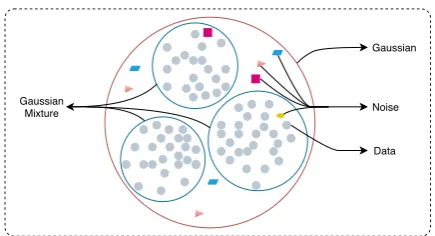
In VAE/WAE frameworks, a variable in latent space is introduced for modeling information in datasets. As demonstrated in Figure1, each gray point represents a data sample while colorized points refer to noise data. If the latent variable obeys a Gaussian distribution, noise samples (col-orized points) will result in inferior responses. Al-ternatively, a Gaussian mixture distribution can model the datasets more accurately. Conventional VAE and WAE models usually set the prior distri-bution of the latent variable to a multivariate Gaus-sian distribution, formulated as
z∼ N {µ, σ2I} (2)
whereµandσ2 represent the mean and variance ofN. In our model, we utilize a Gaussian mixture distribution as the prior distribution of the latent variablez, written by
z∼ N {πk, µk, σ2kI}Kk=1 (3)
Data Noise Gaussian
[image:3.595.72.290.59.177.2]Gaussian Mixture
Figure 1: Distributions on latent space. The pink cir-cle represents a Gaussian distribution while three small blue circles refer to a Gaussian mixture distribution, where gray points represent positive samples, and col-orized points represent noise data.
2.3 Problem Formulation
We follow the conventional personalized conver-sation generation research (Li et al.,2016) and for-mulate the response generation task with the fol-lowing necessary notations. A dataset with user dialogue history contentD = {(ci, ri, mi)}N
i=1is
firstly given, whereci, ri, mi represent dialogue context, response candidate, and user specific di-alogue utterance respectively. Note that we treat the user dialogue utterance for extracting person-alization information in multi-turn response gen-eration. Herein, the context is formulated by: ci = (s1, s2,· · · , sj,· · ·, sni)wheresjrepresents
an utterance in the j-th turn of dialogue context and there are ni utterances in the dialogue con-text. mi denotes the user specific dialogue utter-ance. ri = {ri,1, ri,2,· · · , ri,nr}, wherenr is the
length of a target responseri. Then, our task is defined as learning a mapping functionf(·) from the given dataset that can yield a personalized re-sponse according to the given dialogue context and the user dialogue history.
3 Proposed Model
As in Figure2, our proposed personalized Wasser-stein autoencoder (PersonaWAE) consists of user personalization modeling and WAE, where details are elaborated as follows.
3.1 User Personalization Modeling
Personalization Gaussian Mixture Distribution.
To model the user-level information in the con-tinue space, we build the Personalization Gaussian Mixture Distribution (Personalization GMD).
We train vector representations of users (Li et al., 2016) from user dialog history M =
{mi}Ni=1 as the user personalizations to facilitate
personalized response generation. We denote the trained user embeddings asU ={u1,u2, . . . ,ui}
whereui represents the vector representations of
i-th user (Useri).
Based on the user embeddings as U, we uti-lize learned user personalizations in the latent space. Specifically, the conditional prior tion of WAE part is a Gaussian mixture distribu-tion (GMD) condidistribu-tioned on the learned user em-beddings, namely personalization GMD. We for-mulate the conditional prior as:
p(zu|ui) =
K X
k=1
vkN(zu;µk, σk2I) (4)
where {πk, µk, σk2I}Kk=1 represent the GMD (the
distribution will deprecate to a Gaussian distribu-tion whenK=1) and the parameters ofk-th Gaus-sian distribution are{µk, σ2k}. vk is a component indicator with class probabilities π1, π2, . . . , πK,
where πk is the mixture coefficient of the k-th component of the GMD. We follow (Gu et al.,
2019) and compute these parameters as:
ak µk
logσ2k
=Wk(ui) +bk
πk = e
ak
PK i=1eak
(5)
To obtain vk, we use the Gumbel-Softmax reparametrization to replace the exact sampling:
gi =−log(−log(bi))
vk =
e(ak+gk)/τ
PK
i=1e(ai+gi)/τ
(6)
where bi is a sample from U(0,1), and τ is the softmax temperature to control the sampling pro-cess.
Fusion of Personalization in Decoder.We also
incorporate the user embeddings into the decoder. Concretely, user personalization is used as the put of each updating step to obtain user-specific in-formation for generating personalized responses. Meanwhile, ui is updated by back-propagating
··· ··· ···
···
···
···
···
Sentence Encoder
Decoder
··· ···
··· ···
D
Wasserstein distance
···
Context Encoder
··· ···
··· ···
Se
n
te
n
c
e
En
c
o
d
e
r
··· ···
Recognition
··· ···
Multinomial
Multinomial
Context Prior
[image:4.595.73.532.73.274.2]Personalization Prior
Figure 2: The detailed architecture of our proposed PersonaWAE model.
3.2 Personalized Wasserstein Autoencoder
Our proposed PersonaWAE consists of encoder, prior and recognition networks, and decoder.
Encoder. The encoder encodes a given
con-text by a bidirectional RNN with GRU cells fol-lowing (Chen et al.,2018). Through the encoder, the contextci = (u1, u2,· · ·, uj,· · ·, uni)is
rep-resented as concatenated forward and backward1 vectors Vc = (v1, v2,· · ·, vj,· · · , vni), where
vi = [−→vi,←−vi]. Similarly, the target response ri is represented by the concatenation of states from another bi-directional RNN with GRU cells, de-noted as vr,i. The vectors sequenceVcis further processed by an RNNs and yields a vector repre-sentationvc,i. Note thatvc,irefers tocin Equation
1whilevr,irepresentsx.
Recognition and Prior Networks. We use
a recognition network to learn the posterior qθ(z|x, c), we hypothesize that the approximated variational posterior follows an isotropic multi-variate Gaussian distributionN(µ, σ2I), whereI represents the diagonal covariance. Thus model-ingqθ(z|x, c) is converted to learnµ andlogσ2:
µ
logσ2
=Wo(
x c
) +b (7)
which is presented as the recognition network in Figure2.Woandbare trainable parameters.
To approach the prior distribution, we su-perpose two conditional GMD, where the first
1→and←refer to forward and backward, respectively.
one is personalization GMD as mentioned before while another conditional GMD that called con-text GMD is performed on concon-text c. Resemble to the personalization GMD, the parameters of the context GMD pφ(zc|c) are defined asa0k, µ
0 k and
logσk02, which is learned by:
a0k µ0k
logσ0k2
=Wrk(c) +b
0
k (8)
Fusion of two GMDs. In fusing
personaliza-tion and context GMD, we use the weighted addi-tion strategy to superpose these two distribuaddi-tions, where the resulted new distribution is the prior dis-tribution of PersonaWAE (which is also a GMD).
wc wu
=sof tmax(Wf(
c
ui
))
zp =wc·zc+wu·zu
(9)
whereWf is a trainable parameter.
Decoder. The decoder is a one-layer GRU
net-work to output the sentence in the generation, which is shown in the right hand of Figure2. Tak-ing the generation of responseri as an example, the initial state of the decoder is calculated as:
si,0 =Wd(
zp c
) +bd (10)
we incorporate a gate module (Tu et al., 2018) in our model:
g=f(Ust−1+Vdt+Wui)
ot=GRU(st−1,
dt g·ui
) (11)
wheref is the sigmoid funtion andotrefers to the decoder output in time step t. After processing ot with the softmax operation, the responseri is generated.
Training. To train our proposed model,
we launch the following objective to simultane-ously minimize the Wasserstein distance between pθ(z|c,ui) and qφ(z|x, c), and maximize the
re-constructing probability ofx:
L(θ, φ;c, x,ui) =−Eqφ(z|x,c,ui)logp(x|z, c,ui)
+W(qφ(z|x, c)||pθ(z|c,ui))
(12)
4 Experiments
4.1 Dataset
To evaluate the effectiveness of our proposed per-sonalized WAE model (PersonaWAE), we collect a dataset from an open online chatting forum, i.e., Weibo 2, which contains massive multi-turn con-versation sessions and user identification informa-tion. Overall, there are 31,128,520 utterances in the raw dataset with corresponded user identifica-tions. To construct the personalized conversation systems, we retrieve users with more than 14 utter-ances from the raw Weibo corpus. We also filtrate conversation sessions with less than 2 turns for training multi-turn conversation systems. We use a sliding window with a size of 3 to construct each dialogue session and there are 3 utterances in each dialogue session. By doing so, there are 336,342 conversation sessions in the cleaned corpus. We remove emojis in utterances and utilize NLTK for tokenization. Then, we randomly split the Weibo corpus into 335,342/5,000/5,000 sessions as train-ing/validation/testing sets. For each session, the last utterance is the target response for generation while other utterances are treated as context.
4.2 Baselines
In our experiments, we compare our proposed method with the following highly related and strong baselines.
2http://www.weibo.com/
Readability Is the response grammatically formed and smooth ?
Informativeness Does the response contains informative words ?
Personalization Does the response resembles with any user history?
Table 1: Criteria of human evaluation.
Seq2Seq, the vanilla schema of the sequence to sequence model with attention mechanism ( Bah-danau et al.,2014), which is widely used in vari-ous generation tasks.
Persona, a typical and recent neural person-alized conversation system, which incorporates user-level representations in the generation pro-cess (Li et al.,2016).
Adaptation, the domain adaptation solution for building personalized conversation systems (Zhang et al., 2017). We adapt the model in our scenario and we use the tf-idf to obtain the per-sonal words as the user information.
CVAE, which is the conventional CVAE model and trained by KL-divergence. We change our model to use KL-divergence as the training loss.
RL-Persona, the personalized conversational system (Yang et al.,2018), which takes the advan-tages of deep reinforcement learning. We apply the method into our scenario as same as Adapta-tion.
DiaWAE-GMD, where the former is the state-of-the-art model for open-domain conversation generation (Gu et al.,2019). DiaWAE-GMD em-ploys the Gaussian mixture prior to WAE.
4.3 Settings
The dimension of word embeddings is set to 200, which is initialized with pre-trained word2vec vectors3. The vocabulary is comprised of the most frequent 31,000 words. The sentence encoder and the context encoder in our PersonaWAE model are two bi-directional RNN with the GRU cells, re-spectively. The decoder consists of a one-layer RNN with GRUs. The hidden state sizes of both GRU encoder and decoder are set to 256. Each user is allocated a user-level vector representation with dimension size 512. We set the mini-batch size to 100. The SGD optimizer is used to train the autoencoder module with the initial learning rate 1.0, and the learning rate decay strategy is employed. We use RMSprop optimizer (Hinton et al.,2012) to update the parameters of the gener-ator and the discrimingener-ator, where the initial
Models Embedding Metrics BLEU Human Evaluation Extrema Greedy Average Recall Precision F1 Read. Info. P-score
Seq2Seq 0.1640 0.4098 0.4911 0.1646 0.1646 0.1646 2.30 2.16 0.49
Persona 0.1631 0.3982 0.4871 0.1646 0.1646 0.1646 2.31 2.15 0.50
Adaptation 0.1722 0.4038 0.5113 0.1689 0.1689 0.1689 2.29 1.93 0.47
CVAE 0.2643 0.2911 0.5759 0.1931 0.1636 0.1771 2.02 2.33 0.45
RL-Persona 0.1694 0.4536 0.4906 0.1723 0.1723 0.1723 2.21 2.22 0.63
DiaWAE-GMD 0.4387 0.4752 0.7573 0.3409 0.1710 0.2277 2.31 2.35 0.50
PersonaWAE 0.4542 0.5914 0.7585 0.3365 0.1806 0.2350 2.33 2.37 0.66
ground-truth 2.73 2.66 0.86
Table 2: The results of both automatic evaluations and human evaluation. Read., Info., P-score refer to readability, informativeness, personalization scores. The kappa value between human annotators is 0.41, which indicates a moderate inter-rater.
# Distributions in GMD Embedding Metrics BLEU-F1 Extrema Greedy Average
1 0.4114 0.3110 0.7026 0.1547
2 0.4228 0.4494 0.7135 0.1543
3 0.4542 0.5914 0.7585 0.2350
4 0.4013 0.5764 0.7256 0.2150
[image:6.595.74.291.292.367.2]5 0.4382 0.5680 0.7490 0.2480
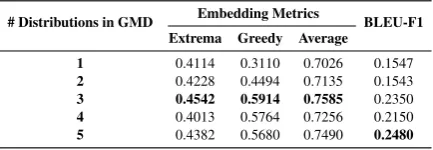
Table 3: The results of different settings ofk in per-sonalization GMD, wherekdenotes number of distri-butions. Whenk= 1, it is a Gaussian distribution.
ing rates are set to5e-5 and1e-5, respectively. The gradient penalty is used for training discriminator (Gulrajani et al.,2017). The value ofτ in Gumbel softmax is set to 0.1.
4.4 Evaluation Metrics
To evaluate the results of the generated responses, we adopt the following metrics widely used in ex-isting research.
Embedding Metrics. To capture the seman-tic matching degrees between generated responses and ground-truth, we perform evaluations on em-bedding space. In consistent with previous study (Gu et al., 2019), we compute the similarity be-tween the bag-of-words (BOW) embeddings rep-resentations of generated results and reference. In particular, we calculate three metrics:1) Greedy
(BOW-Greedy), i.e., greedily matching words in two utterances based on the cosine similarities, and the total scores is then averaged across all words (Rus and Lintean,2012); 2)Average (BOW-Average), cosine similarity between the averaged word embeddings in the two utterances (Mitchell and Lapata, 2008); 3) Extrema (BOW-Extrema),
Models Embedding Metrics BLEU-F1 Extrema Greedy Average
PersonaWAE 0.4542 0.5914 0.7585 0.2350
w/o prior 0.4360 0.4848 0.7479 0.2256 w/o fusion 0.4293 0.4813 0.7588 0.2244
Table 4: The results of Ablation Experiments. w/o de-notes without. Fusion represents fusion of personaliza-tion in decoder.
cosine similarity between the largest extreme val-ues among the word embeddings in the two utter-ances (Forgues et al., 2014). We report the max-imum BOW embedding scores of the 10 sampled responses for each testing context.
Overlap-based Metric. We utilize BLEU score (Papineni et al.,2002) to measure n-grams overlaps between ground-truth and generated re-sponse. Specifically, we follow the conventional setting in previous work (Gu et al.,2019) to com-pute BLEU scores using smoothing techniques (smoothing 7)4. For each testing context, we sam-ple 10 responses from the models and compute their BLEU scores, i.e., n-gram precision (BLEU-Precision), gram recall (BLEU-Recall), and n-gram F1 (BLEU-F1).
Human Evaluation. We also employ human evaluation to assess the responses generated by our model and the baselines. Three well-educated an-notators are hired to evaluate the quality of gener-ated responses, where the evaluation is conducted in a double-blind fashion. Totally, 200 randomly
4http://www.nltk.org/_modules/nltk/
-这孩子,太稚嫩了,真想踹一脚
(This child is so immature that I really want to kick him.) -wow,你大粗腿,能抬多高啊
(Wow, how high can you get with those big legs.)
ground truth 你(Try it ? Prove I can do it.)要不要试试?见证一下我能办得到!
RL-Persona 哈哈,(Haha, it’s all right.)那就好了
DiaWAE-GMD 啊,(Game over, I can’t talk it.)完了,我就不敢说
PersonaWAE 我(I’ll punch you with my fist.)我我拿拿拿小小小拳拳拳拳拳拳捶捶捶你你你
-你什么时候回香港?
(When are you going back to HongKong?) -签证好了就回去(when visa is ready.)
ground truth 要(About half a month.)半个月嗬
RL-Persona 我(I don’t know, I don’t know.)也不知道,我也不知道
DiaWAE-GMD 是(Because I’m not in your dormitory.)因为我没在你宿舍里
[image:7.595.305.525.65.503.2]PersonaWAE 哈(Ha, play togther when you are back.)哈哈哈哈哈,,,回回回来来来约约约,,,约约约个个个时时时间间间
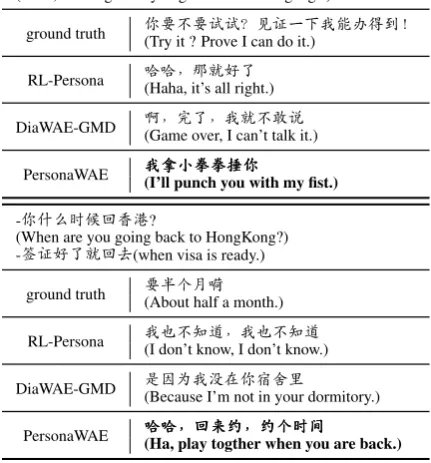
Table 5: Responses generated by baselines and our model.
sampled responses generated by each model are rated by each annotator with three different as-pects, i.e., readability, informativeness, and per-sonalization. Details of the criteria are illustrated in Table 1. Note that it is very difficult to judge whether a generated response resembles with the style of the corresponding user history utterances, and thus we rate the personalization with {0,1}, representing bad or normal. Other criteria are scored from 1 to 3, i.e., bad, normal, and good.
5 Results and Analysis
In this section, we perform automatic evaluations and human evaluation to measure the quality of the generated responses quantitatively. Meanwhile, we also conduct a qualitative study to intuitively analyze the generated results. Table2presents the results of automatic and human evaluation.
5.1 The Effect of WAE
WAE can effectively improve the quality of
re-sponses but fails to capture personalization. As
we mentioned before, we intend to improve the response quality by using WAE. Unsurprisingly, Seq2Seq gets the worst performance. Compar-ing DiaWAE-GMD with CVAE, we can observe that DiaWAE-GMD significantly improves BLEU scores and BOW scores upon CVAE, which is
-求种草水乳,性价比高点的。 (Please recommend cost-effective make-up water and lotion to me.)
-我水乳用的老慢啦哈哈,感觉两年用一套
(I use make-up water and lotion so slow that one can be used for 2 years.)
User1 [UNK]([UNK], thank you, my xiaoU (name)),谢谢,我的小U
User2 哈哈(Haha, thank you and I love you.),么么哒。
User3 小姐姐我买了(Ok, I buy it)
User4 是,哈哈(Yes, Haha)
-这孩子,太稚嫩了,真想踹一脚
(This child is so immature that I really want to kick him.)
-wow,你大粗腿,能抬多高啊
(Wow, how high can you get with those big legs.)
User1 我i’m almost blown away by the wind.)被风吹走了(I am so thin that
User2 我今天,小仙女(Today, I am a fairy !)
User3 哈哈,好(Haha, OK.)
User4 哈哈,我瘦了(Haha, I am thin !.)
-哈哈演不下去了
(Haha! I can’t play anymore.)
-早已看穿一切
(I have seen everything before.)
User1 我看(I watch it again, I think I am handsome.)了一遍,我觉得我很帅
User2 哈哈(Haha, get it, wait for me.),好哒好,等我
User3 哈哈,服(Haha, come on.)
User4 哈哈,太可怕(Haha, it’s terrible.)
Table 6: Responses generated by our model for four users. We fix the context and test the effects of different user personalizations.
shown in Table 2. Such results indicate that the Wasserstein distance and the adversarial train-ing can enhance model learntrain-ing and address KL-vanishing issue in VAEs, as a result of which achieves better results of generated responses, which is also confirmed in the previous research (Gu et al., 2019). Besides, human evaluation re-sults in Table 4 further illustrate that DiaWAE-GMD fails to model personalization of different users insomuch as DiaWAE-GMD lacks user-level information learning.
The number of distributions in conditional Gaussian mixture distribution significantly alter
model performance.Table3presents the ablation
[image:7.595.73.289.100.332.2]personaliza-tion Gaussian mixture distribupersonaliza-tion. It is observed that whenk ≤ 3 , model performance improves with the increasing ofk, which suggests that more distributions in GMD are helpful for modeling user personalization. However, fork > 3, model performance slightly drops with the increasing of k, The potential reason is GMD with three dis-tributions is effective enough for modeling per-sonalization, and sophisticated GMD might suffer scarce datasets for training.
5.2 The Influence of Personalization Modeling
User embeddings substantially improve the qual-ity of generated response and introduce
person-alizations for different users. Through
conduct-ing the comparison between PersonaWAE and DiaWAE-GMD. We can learn that incorporating user personalization in decoding step substantially enhance the personalization score of human eval-uations, which means user embeddings and the combination in decoder has a positive influence on response quality.
Incorporating personalization in the condi-tional GMD prior is more effective than combing
personalization in decoder. As shown in Table2,
Persona model only achieves comparable results with Seq2Seq in terms of BLEU scores and BOW scores. For PersonaWAE and DiaWAE-GMD, in-corporating personalizations in both decoder and the latent space yields a performance improve-ment. For the BLEU-Recall, which PersonaWAE does not outperform than DiaWAE-GMD, a possi-ble explanation for this might be that PersonaWAE model the personalization information and gener-ation may be more limited.
5.3 Discussion
Overall, PersonaWAE outperforms all other base-lines on both automatic and human evaluations. Especially for personalization modeling, Person-aWAE achieves a noticeable achievement over the strong baselines DiaWAE-GMD and RL-Persona. These results support that our proposed Person-aWAE is effective in generating personalized re-sponse. We also observe that fusing personalized GMD and context GMD as the conditional prior is also useful, which is proven by the results shown in Table 4.
5.4 Case Study
Table 5 illustrates the generated response of dif-ferent models for a given context. We can observe that our proposed model can generate responses with readability and personalization information. Table6shows a few example responses generated by altering the user personalization information. With different user representations, the generated responses change, which supports that person-alization representation introduced in our model helps learn user-level information. Although it is difficult to evaluate the personalization of gen-erated response and there exists a gap between generated responses and human-comprised ones, quality improvement of responses is achieved. Moreover, we observe that our proposed model might generate a too long and repeated sentence in extreme cases. The potential reason might be the relative short dialog history for each user. Besides, explicitly extracting knowledge and user person-alization from conversation history is also promis-ing. These results point out the direction of future work.
6 Related Work
Constructing an automatic conversation system is an attractive and prevalent task within the com-munity of artificial intelligence. Previous stud-ies mainly focus on vertical domains by applying rule- and template-based models (Pieraccini et al.,
2009). Later on, with the explosive growth of data, the application of open-domain conversation model is promising. Conventional methods in ver-tical domains have obstacles to scale to open do-main. Given this, various data-driven approaches have been proposed for modeling open-domain conversation, including retrieval-based methods (Yan et al.,2016;Tao et al.,2019), statistical ma-chine translation model (Ritter et al., 2011), and neural networks (Serban et al., 2015; Hu et al.,
2019).
Recently, building a personalized conversation system has been attached more attention, e.g., im-plicitly learning user personalizations from dia-log history (Li et al., 2015), explicitly collecting and modeling user profiles as personalizations for generating personalized responses (Zhang et al.,
2017,2018). To improve wording diversity, CVAE models (Serban et al., 2017; Zhao et al., 2017;
CVAE, Wasserstein autoencoder (Gu et al.,2019) is also used for open-domain response generation to solve the issues of posterior collapse and van-ishing latent variables. We build our model upon both the advantages of WAE and personalization modeling for personalized response generation.
7 Conclusion
Open domain response generation is a challeng-ing task, which involves automatically comprischalleng-ing a response with informative words and personal-ization. Although prompting progress has been made in wording informativeness, there still ex-ists a noticeable gap between generated response and those created by humans, especially in person-alization modeling. To fill this gap, we propose a personalized Wasserstein autoencoder (Person-aWAE) for response generation, where the WAE module improves informativeness by using a con-tinuous latent variable with GMD and user vector representations learned from dialog history is used for introducing personalization information. Ex-perimental results on a large dataset indicate that our proposed model can generate better responses, and outperforms existing models under both auto-matic and human evaluations.
Acknowledgments
We would like to thank the reviewers for their con-structive comments. This work was supported by the National Key Research and Development Pro-gram of China (No. 2017YFC0804001), the Na-tional Science Foundation of China (NSFC No. 61876196 and NSFC No. 61672058). Rui Yan was sponsored by Alibaba Innovative Research (AIR) Grant. Rui Yan is the corresponding author.
References
Martin Arjovsky, Soumith Chintala, and L´eon
Bot-tou. 2017. Wasserstein gan. arXiv preprint
arXiv:1701.07875.
Dzmitry Bahdanau, Kyunghyun Cho, and Yoshua Ben-gio. 2014. Neural machine translation by jointly learning to align and translate. Computer Science.
Samuel R Bowman, Luke Vilnis, Oriol Vinyals, An-drew M Dai, Rafal Jozefowicz, and Samy Ben-gio. 2015. Generating sentences from a continuous space. arXiv preprint arXiv:1511.06349.
Xiuying Chen, Shen Gao, Chongyang Tao, Yan Song, Dongyan Zhao, and Rui Yan. 2018. Iterative
docu-ment representation learning towards summarization with polishing.EMNLP.
Gabriel Forgues, Joelle Pineau, Jean-Marie
Larchevˆeque, and R´eal Tremblay. 2014. Boot-strapping dialog systems with word embeddings. In Nips, workshop, volume 2.
Nadine Glas, Ken Prepin, and Catherine Pelachaud. 2015. Engagement driven topic selection for an information-giving agent. InSemDial.
Xiaodong Gu, Kyunghyun Cho, Jung-Woo Ha, and
Sunghun Kim. 2019. DialogWAE: Multimodal
response generation with conditional wasserstein auto-encoder. In International Conference on Learning Representations.
Ishaan Gulrajani, Faruk Ahmed, Martin Arjovsky, Vin-cent Dumoulin, and Aaron C Courville. 2017. Im-proved training of wasserstein gans. InNIPS, pages 5767–5777.
Geoffrey Hinton, Nitish Srivastava, and Kevin Swer-sky. 2012. Rmsprop: Divide the gradient by a run-ning average of its recent magnitude. Neural net-works for machine learning, Coursera lecture 6e.
Wenpeng Hu, Zhangming Chan, Bing Liu, Dongyan
Zhao, Jinwen Ma, and Rui Yan. 2019. Gsn: A
graph-structured network for multi-party dialogues. arXiv preprint arXiv:1905.13637.
Diederik P Kingma and Max Welling. 2014. Auto-Encoding Variational Bayes.stat, 1050:10.
Feng-Lin Li, Minghui Qiu, Haiqing Chen, Xiong-wei Wang, Xing Gao, Jun Huang, JuXiong-wei Ren, Zhongzhou Zhao, Weipeng Zhao, Lei Wang, et al. 2017. Alime assist: an intelligent assistant for creat-ing an innovative e-commerce experience. InCIKM, pages 2495–2498.
Jiwei Li, Michel Galley, Chris Brockett, Jianfeng Gao, and Bill Dolan. 2015. A diversity-promoting objec-tive function for neural conversation models. arXiv preprint arXiv:1510.03055.
Jiwei Li, Michel Galley, Chris Brockett, Georgios Sp-ithourakis, Jianfeng Gao, and Bill Dolan. 2016. A persona-based neural conversation model. InACL.
Juntao Li, Lisong Qiu, Bo Tang, Dongmin Chen, Dongyan Zhao, and Rui Yan. 2019. Insufficient data can also rock!learning to converse using smaller data with augmentation.
Jeff Mitchell and Mirella Lapata. 2008. Vector-based
models of semantic composition. NAACL-HLT,
pages 236–244.
Roberto Pieraccini, David Suendermann, Krishna Dayanidhi, and Jackson Liscombe. 2009. Are we there yet? research in commercial spoken dia-log systems. In International Conference on Text, Speech and Dialogue, pages 3–13.
Alan Ritter, Colin Cherry, and William B. Dolan. 2011. Data-driven response generation in social media. In Conference on Empirical Methods in Natural Lan-guage Processing, pages 583–593.
Vasile Rus and Mihai Lintean. 2012. A comparison of greedy and optimal assessment of natural language student input using word-to-word similarity metrics. InProceedings of the Seventh Workshop on Building Educational Applications Using NLP, pages 157– 162. ACL.
Iulian V. Serban, Alessandro Sordoni, Yoshua Bengio, Aaron Courville, and Joelle Pineau. 2015. Building end-to-end dialogue systems using generative hier-archical neural network models. (4):3776–3783.
Iulian Vlad Serban, Alessandro Sordoni, Ryan Lowe, Laurent Charlin, Joelle Pineau, Aaron C Courville, and Yoshua Bengio. 2017. A hierarchical latent variable encoder-decoder model for generating di-alogues. InAAAI, pages 3295–3301.
Xiaoyu Shen, Hui Su, Yanran Li, Wenjie Li, Shuzi Niu, Yang Zhao, Akiko Aizawa, and Guoping Long. 2017. A conditional variational framework for dia-log generation.arXiv preprint arXiv:1705.00316.
Xiaoyu Shen, Hui Su, Shuzi Niu, and Vera
Dem-berg. 2018. Improving variational
encoder-decoders in dialogue generation. arXiv preprint arXiv:1802.02032.
Heung-Yeung Shum, Xiao-dong He, and Di Li. 2018. From eliza to xiaoice: challenges and opportunities with social chatbots. Frontiers of Information Tech-nology & Electronic Engineering, 19(1):10– 26.
Chongyang Tao, Wei Wu, Can Xu, Wenpeng Hu, Dongyan Zhao, and Rui Yan. 2019. One time of interaction may not be enough: Go deep with an interaction-over-interaction network for response se-lection in dialogues. In Proceedings of the 57th Conference of the Association for Computational Linguistics, pages 1–11.
Zhaopeng Tu, Yang Liu, Shuming Shi, and Tong Zhang. 2018. Learning to remember translation his-tory with a continuous cache. Transactions of the Association of Computational Linguistics, 6:407– 420.
Rui Yan, Song Yiping, and Wu Hua. 2016. Learning to respond with deep neural networks for retrieval-based human-computer conversation system. In SI-GIR, pages 55–64.
Min Yang, Qiang Qu, Kai Lei, Jia Zhu, Zhou Zhao, Xiaojun Chen, and Joshua Z Huang. 2018. Inves-tigating deep reinforcement learning techniques in personalized dialogue generation. In SIAM, pages 630–638.
Saizheng Zhang, Emily Dinan, Jack Urbanek, Arthur Szlam, Douwe Kiela, and Jason Weston. 2018. Per-sonalizing dialogue agents: I have a dog, do you have pets too? InACL, pages 2204–2213.
Wei-Nan Zhang, Qingfu Zhu, Yifa Wang, Yanyan Zhao, and Ting Liu. 2017. Neural personalized re-sponse generation as domain adaptation. WWW, pages 1–20.