Proceedings of the 2019 Conference on Empirical Methods in Natural Language Processing and the 9th International Joint Conference on Natural Language Processing, pages 5316–5326,
5316
A Split-and-Recombine Approach for Follow-up Query Analysis
Qian Liu†∗, Bei Chen§, Haoyan Liu♦∗, Jian-Guang Lou§, Lei Fang§,
Bin Zhou†, Dongmei Zhang§
†State Key Laboratory of Virtual Reality Technology and Systems,
School of Computer Science and Engineering, Beihang University, China
♦State Key Lab of Software Development Environment, Beihang University, China
§Microsoft Research, Beijing, China †♦{qian.liu, haoyan.liu, zhoubin}@buaa.edu.cn;
§{beichen, jlou, leifa, dongmeiz}@microsoft.com
Abstract
Context-dependent semantic parsing has
proven to be an important yet challenging
task. To leverage the advances in
context-independent semantic parsing, we propose to perform follow-up query analysis, aiming to restate context-dependent natural language
queries with contextual information. To
accomplish the task, we propose STAR,
a novel approach with a well-designed two-phase process. It is parser-independent and able to handle multifarious follow-up scenarios in different domains. Experiments
on the FollowUp dataset show that STAR
outperforms the state-of-the-art baseline by a large margin of nearly 8%. The superiority on parsing results verifies the feasibility of follow-up query analysis. We also explore the extensibility of STAR on the SQA dataset, which is very promising.
1 Introduction
Recently, Natural Language Interfaces to Data-bases (NLIDB) has received considerable atten-tion, as they allow users to query databases by directly using natural language. Current stud-ies mainly focus on context-independent seman-tic parsing, which translates a single natural lan-guage sentence into its corresponding executable form (e.g. Structured Query Language) and re-trieves the answer from databases regardless of its context. However, context does matter in real world applications. Users tend to issue queries in a coherent way when communicating with NLIDB. For example, after the query “How much money has Smith earned?” (Precedent Query), users may pose another query by simply asking “How about Bill Collins?” (Follow-up Query) in-stead of the complete “How much money has Bill
∗
Work done during an internship at Microsoft Research.
Collins earned?” (Restated Query). Therefore, contextual information is essential for more accu-rate and robust semantic parsing, namely context-dependent semantic parsing.
Compared with context-independent semantic parsing, context-dependent semantic parsing has received less attention. Several attempts include a statistical model with parser trees (Miller et al., 1996), a linear model with context-dependent log-ical forms (Zettlemoyer and Collins,2009) and a sequence-to-sequence model (Suhr et al., 2018). However, all these methods cannot apply to differ-ent domains, since the ATIS dataset (Dahl et al., 1994) they rely on is domain-specific. A search-based neural method DynSP∗arises along with the SequentialQA (SQA) dataset (Iyyer et al.,2017), which takes the first step towards cross-domain context-dependent semantic parsing. Neverthe-less, DynSP∗ focuses on dealing with relatively simple scenarios. All the aforementioned methods design context-dependent semantic parser from scratch. Instead, inspired by Liu et al. (2019), we propose to directly leverage the technical ad-vances in context-independent semantic parsing. We define follow-up query analysis as restating the follow-up queries using contextual informa-tion in natural language, then the restated queries can be translated to the corresponding executable forms by existing context-independent parsers. In this way, we boost the performance of context-dependent semantic parsing.
re-wards to jointly train the two phases by applying reinforcement learning (RL) (Sutton and Barto, 1998). Our major contributions are as follows:
• We propose a novel approach, named SpliT-And-Recombine (STAR)1, to restate follow-up queries via two phases. It is parser-independent and can be seamlessly integrated with existing context-independent semantic parsers.
• We conduct experiments on the FollowUp dataset (Liu et al.,2019), which covers multifar-ious cross-domain follow-up scenarios. The re-sults demonstrate that our approach significantly outperforms the state-of-the-art baseline. • We redesign the recombination process and
ex-tend STAR to the SQA dataset, where the anno-tations are answers. Experiments show promis-ing results, that demonstrates the extensibility of our approach.
2 Methodology
In this section, we first give an overview of our proposed method with the idea of two-phase pro-cess, then introduce the two phases in turn.
2.1 Overview of Split-And-Recombine
Letx= (x1, . . . , xn),y = (y1, . . . , ym)andz = (z1, . . . , zl) denote the precedent query, follow-up query and restated query respectively, each of which is a natural language sentence. Our goal is to interpret the follow-up queryywith its prece-dent query x as context, and generate the corre-sponding restated queryz. The restated query has the same meaning with the follow-up query, but it is complete and unambiguous to facilitate bet-ter downstream parsing. Formally, given the pair (x,y), we aim to learn a model Pmodel(z|x,y) and maximize the objective:
L=E(x,y,z)∼D[logPmodel(z|x,y)], (1)
where D represents the set of training data. As toPmodel(z|x,y), sincezalways overlaps a great withxandy, it is intuitively more straightforward to find a way to mergexandy. To this end, we design a two-phase process and present a novel ap-proach STAR to perform follow-up query analysis with reinforcement learning.
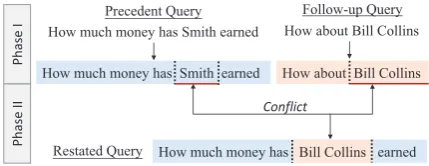
A concrete example of the two-phase process is shown in Figure1. Phase I is toSplitinput queries
1Code is available at http://github.com/
microsoft/EMNLP2019-Split-And-Recombine.
Precedent Query Follow-up Query How much money has Smith earned How about Bill Collins
How much money has Smith earned How about Bill Collins
Restated Query
Phase I
Phas
e I
I
[image:2.595.308.523.62.145.2]How much money has Smith earnedBill Collins Conflict
Figure 1: The two-phase process of an example from the FollowUp dataset (More real cases of diverse follow-up scenarios can be found in Table3).
into several spans. For example, the precedent query is split into 3 spans: “How much money has”, “Smith” and “earned”. Letqdenote a kind of way to split(x,y), then Phase I can be formulated as Psplit(q|x,y). Phase II is to Recombine the spans by finding out the most probable conflict-ing way, and generating the final output by restate-ment, denoted asPrec(z|q). Two spans being con-flicting means they are semantically similar. For example, “Smith” conflicts with “Bill Collins”. A conflicting way contains all conflicts between the precedent and follow-up spans. Backed by the two-phase idea of splitting and recombination, the overall likelihood of generatingzgivenx,yis:
Pmodel(z|x,y) = X
q∈Q
Psplit(q|x,y)Prec(z|q), (2)
whereQrepresents the set of all possible ways to split (x,y). Due to the lack of annotations for splitting and recombination, it is hard to directly perform supervised learning. Inspired by Liang et al. (2017), we employ RL to optimizePmodel. Denoting the predicted restated query by ˜z, sim-plifyingE(x,y,z)∼DasE, the goal of the RL train-ing is to maximize followtrain-ing objective:
Lrl=E[ X
˜ z∈Z
X
q∈Q
Psplit(q|x,y)Prec(˜z|q)r(z,˜z)], (3)
Sec-ࢉଶ
LS
TM
ݔଵ ݔଶ ݔ ݕଵ ݕିଵ
So
ft
m
ax
ܝଵ ܝ
ܐଵ
ܐ
Softmax
Recombine
ܐଵ ܐଶ ܐ୬ ܝଵ ܝ୫ିଵ
Split/Retain
Reward
Split
Phase I Phase II
ࢉଵ ࢉ்
How much earned How Bill
ݕ ܝ୫
Collins
… …
ࢉ்ିଵ
[image:3.595.100.502.66.203.2]Retain Retain Split Retain
Figure 2: The overview of STAR with two phases.
tion3.2.2. Thus the problem turns to design a re-ward functionR(q,z)to evaluateqand guide the learning. To achieve it, we reformulate Equation3 as:
Lrl=E[ X
q∈Q
Psplit(q|x,y) X
˜ z∈Z
Prec(˜z|q)r(z,˜z)], (4)
and set theR(q,z)as:
X
˜ z∈Z
Prec(˜z|q)r(z,˜z). (5)
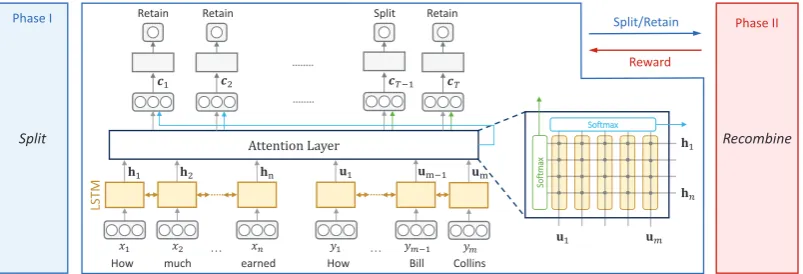
The overview of STAR is summarized in Figure2. Givenx,y, during training of Phase I (in blue), we fixPrecto provide the rewardR(q,z), thenPsplit can be learnt by the REINFORCE algorithm. Dur-ing trainDur-ing of Phase II (in red), we fixPsplit and utilize it to generateq,Precis trained to maximize Equation 5. In this way, Psplit and Prec can be jointly trained. The details are introduced below.
2.2 Phase I: Split
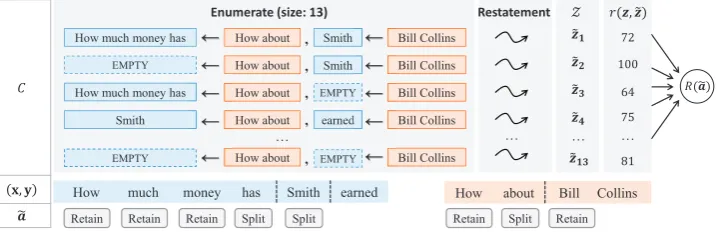
As mentioned above, fixedPrec, Phase I updates Psplit, the Split Neural Network (SplitNet). Tak-ing the precedent query and follow-up query as in-put, as shown in Figure2, splitting spans can be viewed as a sequence labeling problem over in-put. For each word, SplitNet outputs a labelSplit orRetain, indicating whether a split operation will be performed after the corresponding word. A la-bel sequence uniquely identifies a way of splitting (x,y), mentioned as q in Section 2.1. Figure 3 gives an example on the bottom. In the prece-dent query, two split operations are performed af-ter “has” and “Smith” , since their labels areSplit.
2.2.1 Split Neural Network
Intuitively, only after obtaining information from both the precedent query and follow-up query can
SplitNet get to know the reasonable way to split spans. Inspired by BiDAF (Seo et al.,2017), we apply a bidirectional attention mechanism to cap-ture the interrelations between the two queries.
Embedding Layer We consider embedding in three levels: character, word and sentence, re-spectively denoted as φc, φw and φs. Character-level embedding maps each word to a vector in a high-dimensional space using Convolutional Neu-ral Networks (Kim, 2014). Word-level embed-ding is initialized using GloVe (Pennington et al., 2014), and then it is updated along with other pa-rameters. Sentence-level embedding is a one-hot vector designed to distinguish between precedent and follow-up queries. Then, the overall embed-ding function isφ= [φc;φw;φs].
Context Layer On top of the embedding layer, Bidirectional Long Short-Term Memory Network (BiLSTM) (Hochreiter and Schmidhuber, 1997; Schuster and Paliwal,1997) is applied to capture contextual information within one query. For word xi(i= 1, . . . , n)in the precedent queryx, the hid-den statehi = [
− →
hi;
←−
hi]is computed, where the forward hidden state is:
− →
hi =
−−−−→
LSTM φ(xi);
− →
hi−1
. (6)
Similarly, a hidden stateuj is computed for word yj(j= 1, . . . , m). The BiLSTMs forxandyshare the same parameters.
Attention Layer The interrelations between the precedent and follow-up queries are captured via attention layer. LetH= [h1,h2, . . . ,hn]andU= [u1,u2, . . . ,um]denote the hidden states of two queries respectively, the similarity matrix is:
How much money has Smith earned How about Bill Collins
←
( , )
Enumerate (size: 13)
Retain Split Split
,
EMPTY
Retain How much money has How about , Smith ← Bill Collins
← How about , Smith ← Bill Collins How about , Bill Collins How much money has ← EMPTYY ←
How about , EMPTYY ← Bill Collins ←
EMPTY
Smith ← How about , earnedd ← Bill Collins
… …
72
100
64
75
81
Retain Retain Retain Split
( )
Restatement
[image:4.595.121.480.64.180.2]… …
Figure 3: Illustration of reward computation in Phase II.
whereA∈Rn×mand the entryA
i,jrepresents the similarity between wordsxiandyj. Then the soft-max function is used to obtain the precedent-to-follow(P2F)attention and the follow-to-precedent (F2P)attention. P2F attention representsyj using the similarities between yj and every word inx. Specifically, letfj = softmax(A:,j), wherefj ∈ Rn denotes the attention weights onx according toyj. Thenyj can be represented by a precedent-aware vector˜uj =Pnk=1fj[k]·hk. Similarly, F2P attention computes the attention weights ony ac-cording toxi, and representsxias˜hi.
Output Layer Combining the outputs of the context layer and the attention layer, we design the final hidden state as follows:
cxi = [h
i; hi◦h˜i; hi+1◦h˜i+1], (8)
cyj = [u
j; uj◦u˜j; uj+1◦u˜j+1], (9)
wherei∈{1,. . . ,n−1},j∈{1,. . . ,m−1}and◦denotes element-wise multiplication (Lee et al.,2017). Let
c= (ct)Tt=1 = (cx1, ...,cxn−1,cy1, ...,cym−1) de-note the final hidden state sequence. At each po-sitiont, the probability ofSplitisσ(W∗ct+b), whereσdenotes thesigmoidfunction and{W, b}
denotes the parameters.
2.2.2 Training
It is difficult to train RL model from scratch. Therefore, we propose to initialize SplitNet via pre-training, and then use reward to optimize it.
Pre-training We obtain the pre-training anno-tation a by finding the common substrings be-tween (x,y) and z. One a is a label sequence, each of which is Split orRetain. Given the pre-training data setDprewhose training instance is as (x,y,a), the objective function of pre-training is:
Lpre(θ) =E(x,y,a)∼Dpre[logpθ(a|x,y)], (10)
whereθis the parameter of SplitNet.
Policy Gradient After pre-training, we treat the label sequence as a variable˜a. The rewardR(˜a,z) (details in Section2.3) is used to optimize the pa-rameter θ with policy gradient methods (Sutton et al.,1999). SplitNet is trained to maximize the following objective function:
Lrl(θ) =E(x,y,z)∼D[E˜a∼pθ(˜a|x,y)R(˜a,z)]. (11)
In practice, REINFORCE algorithm (Williams, 1992) is applied to approximate Equation11 via sampling ˜a frompθ(˜a|x,y) for M times, where M is a hyper-parameter representing the sample size. Furthermore, subtracting a baseline (Weaver and Tao, 2001) on R(˜a,z) is also applied to re-duce variance. The final objective function is as follows:
Lrl(θ)=E(x,y,z)∼D
hXM
i=1
pθ(˜ai|x,y)R(˜ai,z)−R¯ i
,
whereR¯= 1
M M X
i=1
R(˜ai,z). (12)
2.3 Phase II: Recombine
Here we present Phase II with two questions: (1) Receiving the sampled label sequencea˜, how to compute its rewardR(˜a,z); (2) How to do training and inference forPrec.
2.3.1 Reward Computation
Receiving the label sequence˜a, we first enumer-ate all conflicting way candidenumer-ates. Following the example in Figure3, once we get a deterministic ˜
a, the split of(x,y)is uniquely determined. Here
span either has no conflict (denoted asEMPTY) or has only one conflict with a span in another query. LetC denote the set of all conflicting way candi-dates, the size of which is13in Figure3.
For each conflicting way, we deterministically generate a restated query via the process named Restatement. In general, we simply replace spans in the precedent query with their conflicting spans to generate the restated query. For example, in Figure 3, the first one in C is restated as “How about Bill Collins earned”. For spans in the follow-up query, if they contain column names or cell values and do not have any conflict, they are appended to the tail of the precedent query. It is designed to remedy the sub-query situation where there is no conflict (e.g. “Which opponent re-ceived over 537 attendance” and “And which got the result won 5-4”). Specially, if a span in the follow-up query contains a pronoun, we will in re-verse replace it with its conflicting span to obtain the restated query.
Finally, the reward can be computed. Here we use BLEU and SymAcc2to build the reward func-tion, expandingr(z,z˜)in Equation5as:
r(z,˜z) =α·BLEU(z,˜z)+β·SymAcc(z,˜z), (13)
whereα, β >0andα+β = 1. The reward fora˜ can be obtained using Equation5.
2.3.2 Training and Inference
Besides the reward computation, the recombina-tion model Prec needs to be trained to maximize Equation5. To achieve this, we define a conflict-ing probability matrix F ∈ RNx×Ny, whereN
x andNydenote the number of spans inxandy re-spectively. The entry Fu,v, the conflicting prob-ability between the u-th span in x and the v-th span in y, is obtained by normalizing the cosine similarity between their representations. Here the span representation is the subtraction representa-tion (Wang and Chang, 2016; Cross and Huang, 2016), which means that span(xi, . . . , xk)is rep-resented by[−h→k−
− →
hi;
←−
hi−
←−
hk]from the same BiL-STM in the context layer in Section2.2.1. Given a conflicting way denoted as˜c ∈ C, the probability of generating its corresponding˜zcan be written as the multiplication overg(u, v):
Prec(˜z|a˜) =P(˜c|F) = Nx
Y
u=1 Ny
Y
v=1
g(u, v), (14)
2Their definitions along with the motivations of using
them will be explained in Section3.2.
whereg(u, v) = Fu,v if theu-th span in x con-flicts with thev-th span iny; otherwise,g(u, v) =
1 −Fu,v. With the above formulation, we can
maximize Equation 5 through automatic differ-entiation. To reduce the computation, we only maximizePrec(˜z∗|a˜), the near-optimal solution to Equation5, where ˜z∗= arg max˜z∈Z(r(z,˜z)) de-notes the best predicted restated query so far.
Guided by the golden restated queryz, in train-ing, we find out ˜z∗ by computing the reward of each candidate. However in inference, where there is no golden restate query, we can only obtain˜z∗
fromF. Specially, for thev-th span in the follow-up query, we find u∗ = arg maxuFu,v. That means, compared to other spans in the precedent query, the u∗-th span has the highest probabil-ity to conflict with thev-th span in the follow-up query. Moreover, similar to Lee et al.(2017), if
Fu∗,v < λ, then the v-th span in the follow-up
query has no conflict. The hyper-parameterλ >0 denotes the threshold.
2.4 Extension
So far, we have introduced the whole process of STAR. Next we explore its extensibility. As ob-served, when the annotations are restated queries, STAR is parser-independent and can be incor-porated into any context-independent semantic parser. But what if the annotations are answers to follow-up queries? Assuming we have an ideal se-mantic parser, a predicted restated query˜zcan be converted into its corresponding answerw˜. For ex-ample, given˜zas “where are the players from”,w˜ could be “Las Vegas”. Therefore, revisiting Equa-tion 3, in theory STAR is able to be extended by redesigningrasr(w,w˜), wherewdenotes the an-swer annotation. We conduct an extension experi-ment to verify it, as discussed in Section3.3.
3 Experiments
In this section, we demonstrate the effectiveness of STAR on the FollowUp dataset3 with restated query annotations, and its promising extensibility on the SQA dataset4with answer annotations.
3.1 Implementation details
We utilize PyTorch (Paszke et al., 2017) and Al-lenNLP (Gardner et al., 2018) for implementa-tion, and adopt Adam (Kingma and Ba,2015) as
3
http://github.com/SivilTaram/FollowUp
Model Dev Test
SymAcc (%) BLEU (%) SymAcc (%) BLEU (%) AnsAcc (%)
SEQ2SEQ†(Bahdanau et al.,2015) 0.63±0.00 21.34±1.14 0.50±0.22 20.72±1.31 –
COPYNET†(Gu et al.,2016) 17.50±0.87 43.36±0.54 19.30±0.93 43.34±0.45 –
COPY+BERT (Devlin et al.,2019) 18.63±0.61 45.14±0.68 22.00±0.45 44.87±0.52 –
CONCAT† – – 22.00± – 52.02± – 25.24
E2ECR†(Lee et al.,2017) – – 27.00± – 52.47± – 27.18
FANDA†(Liu et al.,2019) 49.00±1.28 60.14±0.98 47.80±1.14 59.02±0.54 60.19
[image:6.595.89.511.63.187.2]STAR 55.38±1.21 67.62±0.65 54.00±1.09 67.05±1.05 65.05
Table 1: SymAcc, BLEU and AnsAcc on the FollowUp dataset. Results marked†are fromLiu et al.(2019).
the optimizer. The dimensions of word embed-ding and hidden state are both 100. Variational dropout (Blum et al.,2015) is employed at embed-ding layer for better generalization ability (with probability 0.5). The learning rate is set to be 0.001for pre-training,0.0001for RL training on FollowUp, and0.0002for SQA. In the implemen-tation of the REINFORCE algorithm, we set M to be 20. Finally, for hyper-parameters, we set α= 0.5,β = 0.5andλ= 0.6. All the results are averaged over5runs with random initialization.
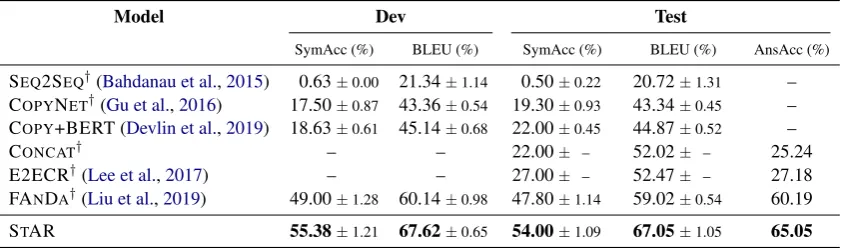
3.2 Results on FollowUp dataset
The FollowUp dataset contains 1000natural lan-guage query triples(x,y,z). Each triple belongs to a single database table, and there are 120 ta-bles in several different domains. Following the previous work, we split them into the sets of size 640/160/200 for train/dev/test. We evaluate the methods using both answer level and query level metrics. AnsAccis to check the answer accuracy of predicted queries manually. Concretely, 103 golden restated queries can be successfully parsed by COARSE2FINE (Dong and Lapata,2018). We parse their corresponding predicted queries into SQL using COARSE2FINE and manually check the answers. Although AnsAcc is most convinc-ing, it cannot cover the entire test set. Therefore, we apply two query level metrics:SymAccdetects whether all the SQL-related words are correctly involved in the predicted queries, for example col-umn names, cell values and so on. It reflects the approximate upper bound of AnsAcc, as the cor-rectness of SQL-related words is a prerequisite of correct execution in most cases; BLEU, referring to the cumulative 4-gram BLEU score, evaluates how similar the predicted queries are to the golden ones (Papineni et al.,2002). SymAcc focuses on limited keywords, so we introduce BLEU to
eval-uate quality of the entire predicted query.
3.2.1 Model Comparison
Our baselines fall into two categories. Gener-ation-based methods conform to the architec-ture of sequence-to-sequence (Sutskever et al., 2014) and generate restated queries by decoding each word from scratch. SEQ2SEQ (Bahdanau et al., 2015) is the sequence-to-sequence model with attention, and COPYNETfurther incorporates a copy mechanism. COPY+BERT incorporates the latest pre-trained BERT model (Devlin et al., 2019) as the encoder of COPYNET. Rewriting-based methodsobtain restated queries by rewrit-ing precedent and follow-up queries. CONCAT di-rectly concatenates the two queries. E2ECR (Lee et al., 2017) obtain restated queries by perform-ing coreference resolution in follow-up queries. FANDA (Liu et al., 2019) utilizes a structure-aware model to merge the two queries. Our method STAR also belongs to this category.
Answer Level Table1shows AnsAcc results of competitive baselines on the test set. Compared with them, STAR achieves the highest, 65.05%, which demonstrates its superiority. Meanwhile, it verifies the feasibility of follow-up query analysis in cooperating with context-independent semantic parsing. Compared with CONCAT, our approach boosts over39.81%on COARSE2FINEfor the ca-pability of context-dependent semantic parsing.
Variant SymAcc (%) BLEU (%)
STAR 55.38 67.62
– Phase I 40.63 61.82
– Phase II 23.12 48.65
– RL 41.25 60.19
+ Basic Reward 43.13 58.48
+ Oracle Reward 45.20 63.04
[image:7.595.89.275.63.174.2]+ Uniform Reward 53.40 66.93
Table 2: Variant results on FollowUp dev set.
0 20 40 60 Epoch 50
60 70 80
BLEU (%)
[image:7.595.88.275.63.176.2]STAR Basic Reward Oracle Reward Uniform Reward
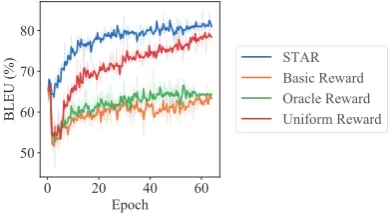
Figure 4: Learning curve on FollowUp train set.
ones. It suggests that the idea of rewriting is more reasonable for the task, where precedent and follow-up queries are of full utilization.
3.2.2 Variant Analysis
Besides baselines, we also conduct experiments with several variants of STAR to further validate the design of our model. As shown in Table 2, there are three variants with ablation: “– Phase I” takes out SplitNet and performs Phase II on word level; “– Phase II” performs random guess in the recombination process for testing; and “– RL” only contains pre-training. The SymAcc drops from about55% to40%by ablating Phase I, and to 23% by ablating Phase II. Their poor perfor-mances indicate both of the two phases are in-dispensable. “– RL” also performs worse, which again demonstrates the rationality of applying RL. Three more variants are presented with differ-ent designs ofR(q,z)to prove the efficiency and effectiveness of Equation5as a reward. “+ Basic Reward” represents the most straightforward RE-INFORCE algorithm, which samples bothq ∈ Q
and˜z∈Z, then takesr(z,˜z)asR(q,z). “+ Oracle Reward” assumes the conflicts are always correct and rewritesR(q,z)asmax˜z∈Z(r(z,˜z)). “+
Uni-form Reward” assigns the same probability to all ˜
zand obtainsR(q,z)asmean(P ˜
z∈Zr(z,˜z)). As
shown in Table2and Figure4, STAR learns better
After the week 6 , whichopponentswon the result of the match ? Precedent Query
how about before week 10 ?
Follow-up Query
Figure 5: An example of similarity matrix in SplitNet.
and faster than the variants due to the reasonable reward design. In fact, as mentioned in Section 2.1, the vast action space of the most straightfor-ward REINFORCE algorithm leads to poor learn-ing. STAR shrinks the space from|Q|·|Z|down to
|Q|by enumerating˜z. Meanwhile, statistics show that STAR obtains a15×speedup over “+ Basic Reward” on the convergence time.
3.2.3 Case Study
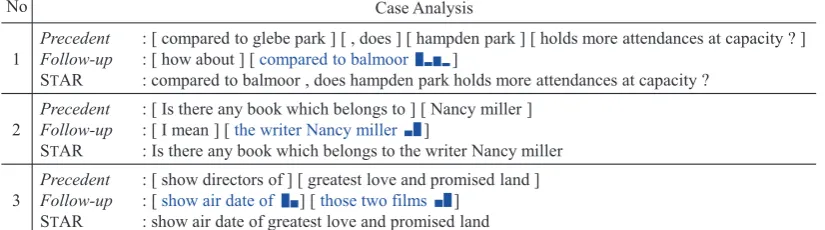
Figure5shows a concrete example of the similar-ity matrixA on attention layer of SplitNet. The span “before week 10” is evidently more similar to “After the week 6” than to others, which meets our expectations. Moreover, the results of three real cases are shown in Table3. The spans in blue are those have conflicts, and the histograms rep-resent the conflict probabilities to all the spans in precedent queries. In Case 1, “glebe park”, “ham-pden park” and “balmoor” are all cell values in the database table with similar meanings. STAR cor-rectly finds out the conflict between “compared to glebe park” and “compared to balmoor” with the highest probability. Case 2 shows STAR can dis-cover the interrelation of words, where “the writer Nancy miller” is learnt as a whole span to re-place “Nancy miller” in the precedent query. As for Case 3, STAR successfully performs corefer-ence resolution and interprets “those two films” as “greatest love and promised land”. Benefiting from two phases, STAR is able to deal with di-verse follow-up scenarios in different domains.
3.2.4 Error Analysis
[image:7.595.320.512.67.176.2] [image:7.595.83.279.215.324.2]Case Analysis
1
Precedent Follow-up
STAR
: [ compared to glebe park ] [ , does ] [ hampden park ] [ holds more attendances at capacity ? ] : [ how about ] [ compared to balmoor ]
: compared to balmoor , does hampden park holds more attendances at capacity ?
2
Precedent Follow-up
STAR
: [ Is there any book which belongs to ] [ Nancy miller ] : [ I mean ] [ the writer Nancy miller ]
: Is there any book which belongs to the writer Nancy miller
3
Precedent Follow-up
STAR
: [ show directors of ] [ greatest love and promised land ] : [ show air date of ] [ those two films ]
[image:8.595.94.507.68.183.2]: show air date of greatest love and promised land No
Table 3: Case analysis of STAR on FollowUp dataset. Square brackets denote different spans.
Model Precedent Follow-up
DynSP (Iyyer et al.,2017) 70.9 35.8
NP (Neelakantan et al.,2016) 58.9 35.9
NP + STAR 58.9 38.1
DynSP + STAR 70.9 39.5
DynSP∗(Iyyer et al.,2017) 70.4 41.1
Table 4: Answer accuracy on SQA test set.
than perform split operations inside them. The SplitNet fails probably because the conflicting spans, “the biggest”↔“the smallest” and “zone”
↔“one”, are adjacent, which makes it difficult to identify span boundaries well.
3.3 Extension on SQA dataset
Finally, we demonstrate STAR’s extensibility in working with different annotations. As mentioned in Section 2.4, by designingr(w,w˜), STAR can cooperate with the answer annotations. We duct experiments on the SQA dataset, which con-sists of 6066 query sequences (5042/1024 for train/test). Each sequence contains multiple nat-ural language queries and their answers, where we are only interested in the first query and the imme-diate follow-up one. As discussed in (Iyyer et al., 2017), every answer can be represented as a set of cells in the tables, each of which is a multi-word value, and the intentions of the follow-up queries mainly fall into three categories. Column selec-tion means the follow-up answer is an entire col-umn;Subset selectionmeans the follow-up answer is a subset of the precedent answer; andRow se-lectionmeans the follow-up answer has the same rows with the precedent answer.
We employ two context-independent parsers, DynSP (Iyyer et al., 2017) and NP (Neelakan-tan et al., 2016), which are trained on the SQA dataset to provide relatively reliable answers for
reward computing. Unfortunately, they both per-form poorly for the restated queries, as the re-stated queries are quite different from the origi-nal queries in SQA. To address the problem, we redesign the recombination process. Instead of generating the restated query, we recombine the predicted precedent answerw˜x and the predicted follow-up answer w˜y to produce the restated an-swerw˜. Therefore, the objective of Phase II is to assign an appropriate intention to each follow-up span via an additional classifier. The goal of Phase I turns to split out spans having obvious intentions such as “of those”. The way of recombining an-swer is determined by the voting from intentions on all spans. If the intention column selection wins, thenw˜ = ˜wy; for subset selection, we ob-tain the subsetw˜by taking the rows of w˜y as the constraint and applying it tow˜x; and for row se-lection, we take the rows ofw˜xand the columns of
˜
wyas the constraints, then apply them to the whole database table to obtain the answerw˜retrieved by the predicted SQL. The reward r(w,w˜) is com-puted based on Jaccard similarity between the gold answerwandw˜as in (Iyyer et al.,2017), and the overall training process remains unchanged.
performance for follow-up queries, which demon-strates the effectiveness of STAR in collaborating with different semantic parsers. The comparable results of DynSP+STAR to DynSP∗ further veri-fies the promising extensibility of STAR.
4 Related Work
Our work is closely related to two lines of work: context-dependent sentence analysis and reinforcement learning. From the perspective of context-dependent sentence analysis, our work is related to researches like reading comprehension in dialogue (Reddy et al.,2019;Choi et al.,2018), dialogue state tracking (Williams et al., 2013), conversational question answering in knowledge base (Saha et al., 2018; Guo et al., 2018), context-dependent logic forms (Long et al.,2016), and non-sentential utterance resolution in open-domain question answering (Raghu et al., 2015; Kumar and Joshi,2017). The main difference is that we focus on the context-dependent queries in NLIDB which contain complex scenarios. As for the most related context-dependent semantic parsing,Zettlemoyer and Collins(2009) proposes a context-independent CCG parser and then con-duct context-dependent substitution, Iyyer et al. (2017) presents a search-based method for sequen-tial questions, and Suhr et al. (2018) presents a sequence-to-sequence model to solve the problem. Compared to their methods, our work achieves context-dependent semantic parsing via learnable restated queries and existing context-independent semantic parsers.
Moreover, the technique of reinforcement learn-ing has also been successfully applied to natu-ral language tasks in dialogue, such as hyper-parameters tuning for coreference resolution (Clark and Manning, 2016), sequential question answering (Iyyer et al., 2017) and coherent dia-logue responses generation (Li et al., 2016). In this paper, we employ reinforcement learning to capture the structures of queries, which is similar toZhang et al.(2018) for text classification.
5 Conclusion and Future Work
We present a novel method, named Split-And-Recombine (STAR), to perform follow-up query analysis. A two-phase process has been designed: one for splitting precedent and follow-up queries into spans, and the other for recombining them. Experiments on two different datasets demonstrate
the effectiveness and extensibility of our method. For future work, we may extend our method to other natural language tasks.
Acknowledgments
We thank all the anonymous reviewers for their valuable comments. This work was supported by the National Natural Science Foundation of China (Grant Nos. U1736217 and 61932003).
References
Dzmitry Bahdanau, Kyunghyun Cho, and Yoshua
Ben-gio. 2015. Neural machine translation by jointly
learning to align and translate. In Proceedings of the 3rd International Conference on Learning Rep-resentations, ICLR 2015, San Diego, CA, USA, May 7-9, 2015.
Avrim Blum, Nika Haghtalab, and Ariel D. Procaccia.
2015. Variational dropout and the local
reparam-eterization trick. In Advances in Neural Informa-tion Processing Systems 28: Annual Conference on Neural Information Processing Systems, NIPS 2015, Montreal, Quebec, Canada, December 7-12, 2015, pages 2575–2583.
Eunsol Choi, He He, Mohit Iyyer, Mark Yatskar, Wen-tau Yih, Yejin Choi, Percy Liang, and Luke
Zettle-moyer. 2018. QuAC: Question answering in
con-text. In Proceedings of the 2018 Conference on Empirical Methods in Natural Language Process-ing, EMNLP 2018, Brussels, Belgium, October 31 - November 4, 2018, pages 2174–2184.
Kevin Clark and Christopher D. Manning. 2016. Deep
reinforcement learning for mention-ranking corefer-ence models. In Proceedings of the 2016 Confer-ence on Empirical Methods in Natural Language Processing, EMNLP 2016, Austin, Texas, USA, November 1-4, 2016, pages 2256–2262.
James Cross and Liang Huang. 2016. Span-based
constituency parsing with a structure-label system and provably optimal dynamic oracles. In Proceed-ings of the 2016 Conference on Empirical Meth-ods in Natural Language Processing, EMNLP 2016, Austin, Texas, USA, November 1-4, 2016, pages 1– 11.
Deborah A. Dahl, Madeleine Bates, Michael Brown, William M. Fisher, Kate Hunicke-Smith, David S. Pallett, Christine Pao, Alexander I. Rudnicky, and
Elizabeth Shriberg. 1994. Expanding the scope of
Jacob Devlin, Ming-Wei Chang, Kenton Lee, and
Kristina Toutanova. 2019. BERT: pre-training of
deep bidirectional transformers for language under-standing. In Proceedings of the 2019 Conference of the North American Chapter of the Association for Computational Linguistics: Human Language Technologies, NAACL-HLT 2019, Minneapolis, MN, USA, June 2-7, 2019, Volume 1:Long and Short Pa-pers, pages 4171–4186.
Li Dong and Mirella Lapata. 2018. Coarse-to-Fine de-coding for neural semantic parsing. InProceedings of the 56th Annual Meeting of the Association for Computational Linguistics, ACL 2018, Melbourne, Australia, July 15-20, 2018, Volume 1: Long Papers, pages 731–742.
Matt Gardner, Joel Grus, Mark Neumann, Oyvind Tafjord, Pradeep Dasigi, Nelson F. Liu, Matthew Pe-ters, Michael Schmitz, and Luke Zettlemoyer. 2018. AllenNLP: A deep semantic natural language pro-cessing platform. InProceedings of Workshop for NLP Open Source Software, NLP-OSS, of the 56th Annual Meeting of the Association for Computa-tional Linguistics, ACL 2018, Melbourne, Australia, July 15-20, 2018, pages 1–6.
Jiatao Gu, Zhengdong Lu, Hang Li, and Victor O. K.
Li. 2016. Incorporating copying mechanism in
sequence-to-sequence learning. In Proceedings of the 54th Annual Meeting of the Association for Com-putational Linguistics, ACL 2016, Berlin, Germany, August 7-12, 2016, Volume 1: Long Papers.
Daya Guo, Duyu Tang, Nan Duan, Ming Zhou, and
Jian Yin. 2018. Dialog-to-action: Conversational
question answering over a large-scale knowledge base. InAdvances in Neural Information Processing Systems 31: Annual Conference on Neural Informa-tion Processing Systems, NeurIPS 2018, Montr´eal, Canada, December 3-8, 2018, pages 2946–2955.
Sepp Hochreiter and J¨urgen Schmidhuber. 1997. Long
short-term memory. Neural Computation, Volume 9, pages 1735–1780.
Mohit Iyyer, Wen-tau Yih, and Ming-Wei Chang. 2017. Search-based neural structured learning for sequen-tial question answering. InProceedings of the 55th Annual Meeting of the Association for Computa-tional Linguistics, ACL 2017, Vancouver, Canada, July 30 - August 4, Volume 1: Long Papers, pages 1821–1831.
Yoon Kim. 2014. Convolutional neural networks for
sentence classification. In Proceedings of the 2014 Conference on Empirical Methods in Natural Lan-guage Processing, EMNLP 2014, Doha, Qatar, Oc-tober 25-29, 2014, pages 1746–1751.
Diederik P. Kingma and Jimmy Ba. 2015. Adam: A
method for stochastic optimization. In Proceed-ings of the 3rd International Conference on Learn-ing Representations, ICLR 2015, San Diego, CA, USA, May 7-9, 2015.
Vineet Kumar and Sachindra Joshi. 2017. Incomplete
follow-up question resolution using retrieval based sequence to sequence learning. In Proceedings of the 40th International ACM Conference on Research and Development in Information Retrieval, SIGIR 2017, Shinjuku, Tokyo, Japan, August 7-11, 2017, pages 705–714.
Kenton Lee, Luheng He, Mike Lewis, and Luke
Zettle-moyer. 2017. End-to-end neural coreference
reso-lution. InProceedings of the 2017 Conference on Empirical Methods in Natural Language Process-ing, EMNLP 2017, Copenhagen, Denmark, Septem-ber 9-11, 2017, pages 188–197.
Jiwei Li, Will Monroe, Alan Ritter, Dan Jurafsky, Michel Galley, and Jianfeng Gao. 2016. Deep rein-forcement learning for dialogue generation. In Pro-ceedings of the 2016 Conference on Empirical Meth-ods in Natural Language Processing, EMNLP 2016, Austin, Texas, USA, November 1-4, 2016, pages 1192–1202.
Chen Liang, Jonathan Berant, Quoc V. Le, Kenneth D.
Forbus, and Ni Lao. 2017. Neural symbolic
ma-chines: Learning semantic parsers on freebase with weak supervision. InProceedings of the 55th An-nual Meeting of the Association for Computational Linguistics, ACL 2017, Vancouver, Canada, July 30-August 4, 2017, Volume 1: Long Papers, pages 23– 33.
Qian Liu, Bei Chen, Jian-Guang Lou, Ge Jin, and
Dongmei Zhang. 2019. FANDA: A novel approach
to perform follow-up query analysis. In Proceed-ings of the 33rd AAAI Conference on Artificial Intel-ligence, AAAI 2019, Honolulu, Hawaii, USA, Jan-uary 27 - FebrJan-uary 1, 2019, pages 6770–6777.
Reginald Long, Panupong Pasupat, and Percy Liang. 2016. Simpler context-dependent logical forms via model projections. InProceedings of the 54th An-nual Meeting of the Association for Computational Linguistics, ACL 2016, Berlin, Germany, August 7-12, 2016, Volume 1: Long Papers.
Scott Miller, David Stallard, Robert J. Bobrow, and Richard M. Schwartz. 1996. A fully statistical ap-proach to natural language interfaces. In Proceed-ings of the 34th Annual Meeting of the Association for Computational Linguistics, ACL 1996, Univer-sity of California, Santa Cruz, California, June 24-27, 1996, pages 55–61.
Arvind Neelakantan, Quoc V. Le, and Ilya Sutskever.
2016. Neural programmer: Inducing latent
pro-grams with gradient descent. InProceedings of the 4th International Conference on Learning Represen-tations, ICLR 2016, San Juan, Puerto Rico, May 2-4, 2016.
Kishore Papineni, Salim Roukos, Todd Ward, and
Wei-Jing Zhu. 2002. BLEU: a method for automatic
the 40th Annual Meeting of the Association for Com-putational Linguistics, ACL 2002, Philadelphia, PA, USA., July 6-12, 2002, pages 311–318.
Adam Paszke, Sam Gross, Soumith Chintala, Gre-gory Chanan, Edward Yang, Zachary DeVito, Zem-ing Lin, Alban Desmaison, Luca Antiga, and Adam Lerer. 2017. Automatic differentiation in PyTorch. InAdvances in Neural Information Processing Sys-tems 30: Annual Conference on Neural Information Processing Systems, NIPS 2017, Long Beach, CA, USA, December 4-9, 2017.
Jeffrey Pennington, Richard Socher, and
Christo-pher D. Manning. 2014. GloVe: Global vectors for
word representation. In Proceedings of the 2014 Conference on Empirical Methods in Natural Lan-guage Processing, EMNLP 2014, Doha, Qatar, Oc-tober 25-29, 2014, pages 1532–1543.
Dinesh Raghu, Sathish Indurthi, Jitendra Ajmera, and Sachindra Joshi. 2015. A statistical approach for non-sentential utterance resolution for interactive QA system. In Proceedings of the 16th Annual Meeting of the Special Interest Group on Discourse and Dialogue, SIGDIAL 2015, Prague, Czech Re-public, September 2-4, 2015, pages 335–343.
Siva Reddy, Danqi Chen, and Christopher D. Manning.
2019. CoQA: A conversational question answering
challenge.Transactions of the Association for Com-putational Linguistics, Volume 7, pages 249–266.
Amrita Saha, Vardaan Pahuja, Mitesh M. Khapra, Karthik Sankaranarayanan, and Sarath Chandar.
2018. Complex sequential question answering:
To-wards learning to converse over linked question an-swer pairs with a knowledge graph. InProceedings of the 32nd AAAI Conference on Artificial Intelli-gence, AAAI 2018, New Orleans, Louisiana, USA, February 2-7, 2018, pages 705–713.
Mike Schuster and Kuldip K. Paliwal. 1997.
Bidirec-tional recurrent neural networks. IEEE Trans. Sig-nal Processing, Volume 45, pages 2673–2681.
Min Joon Seo, Aniruddha Kembhavi, Ali Farhadi, and Hannaneh Hajishirzi. 2017. Bidirectional attention flow for machine comprehension. InProceedings of the 5th International Conference on Learning Rep-resentations, ICLR 2017, Toulon, France, April 24-26, 2017.
Alane Suhr, Srinivasan Iyer, and Yoav Artzi. 2018. Learning to map context-dependent sentences to ex-ecutable formal queries. InProceedings of the 2018 Conference of the North American Chapter of the Association for Computational Linguistics: Human Language Technologies, NAACL-HLT 2018, New Orleans, Louisiana, USA, June 1-6, 2018, Volume 1:Long Papers, pages 2238–2249.
Ilya Sutskever, Oriol Vinyals, and Quoc V. Le. 2014. Sequence to sequence learning with neural net-works. In Advances in Neural Information Pro-cessing Systems 27: Annual Conference on Neural
Information Processing Systems, NIPS 2014, Mon-treal, Quebec, Canada, December 8-13, 2014, pages 3104–3112.
Richard S. Sutton and Andrew G. Barto. 1998.
Rein-forcement learning: An introduction. IEEE Trans. Neural Networks, Volume 9, pages 1054–1054.
Richard S. Sutton, David A. McAllester, Satinder P.
Singh, and Yishay Mansour. 1999. Policy
gradi-ent methods for reinforcemgradi-ent learning with func-tion approximafunc-tion. InAdvances in Neural Informa-tion Processing Systems 12: Annual Conference on Neural Information Processing Systems, NIPS 1999, Denver Colorado, USA, November 29 - December 4, 1999, pages 1057–1063.
Wenhui Wang and Baobao Chang. 2016. Graph-based
dependency parsing with bidirectional LSTM. In
Proceedings of the 54th Annual Meeting of the As-sociation for Computational Linguistics, ACL 2016, Berlin, Germany, August 7-12, 2016, Volume 1: Long Papers.
Lex Weaver and Nigel Tao. 2001. The optimal reward
baseline for gradient-based reinforcement learning. In Proceedings of the 17th Conference in Uncer-tainty in Artificial Intelligence, UAI 2001, Seattle, Washington, USA, August 2-5, 2001, pages 538–545.
Jason D. Williams, Antoine Raux, Deepak
Ramachan-dran, and Alan W. Black. 2013. The dialog state
tracking challenge. InProceedings of the 14th An-nual Meeting of the Special Interest Group on Dis-course and Dialogue, SIGDIAL 2013, Metz, France, August 22-24, 2013, pages 404–413.
Ronald J. Williams. 1992. Simple statistical gradient-following algorithms for connectionist reinforce-ment learning. Machine Learning, Volume 8, pages 229–256.
Luke S. Zettlemoyer and Michael Collins. 2009. Learning context-dependent mappings from sen-tences to logical form. InProceedings of the 47th Annual Meeting of the Association for Computa-tional Linguistics, ACL 2009, and the 4th Interna-tional Joint Conference on Natural Language, IJC-NLP 2009, Singapore, August 2-7, 2009, pages 976– 984.