Proceedings of the 2019 Conference on Empirical Methods in Natural Language Processing 3541
Hierarchical Meta-Embeddings for Code-Switching
Named Entity Recognition
Genta Indra Winata, Zhaojiang Lin, Jamin Shin, Zihan Liu, Pascale Fung Center for Artificial Intelligence Research (CAiRE)
Department of Electronic and Computer Engineering
The Hong Kong University of Science and Technology, Clear Water Bay, Hong Kong
{giwinata,zlinao,jmshinaa,zliucr}@connect.ust.hk,
Abstract
In countries that speak multiple main lan-guages, mixing up different languages within a conversation is commonly called code-switching. Previous works addressing this challenge mainly focused on word-level as-pects such as word embeddings. How-ever, in many cases, languages share com-mon subwords, especially for closely related languages, but also for languages that are seemingly irrelevant. Therefore, we pro-pose Hierarchical Meta-Embeddings (HME) that learn to combine multiple monolingual word-level and subword-level embeddings to create language-agnostic lexical representa-tions. On the task of Named Entity Recogni-tion for English-Spanish code-switching data, our model achieves the state-of-the-art perfor-mance in the multilingual settings. We also show that, in cross-lingual settings, our model not only leverages closely related languages, but also learns from languages with different roots. Finally, we show that combining dif-ferent subunits are crucial for capturing code-switching entities.
1 Introduction
Code-switching is a phenomenon that often hap-pens between multilingual speakers, in which they switch between their two languages in conver-sations, hence, it is practically useful to recog-nize this well in spoken language systems (Winata et al.,2018a). This occurs more often for entities such as organizations or products, which motivates us to focus on the specific problem of Named En-tity Recognition (NER) in code-switching scenar-ios. We show one of the examples as the follow-ing:
• walking deadle quita el apetito a cualquiera
• (translation) walking dead (a movie title) takes away the appetite of anyone
For this task, previous works have mostly focused on applying pre-trained word embed-dings from each language in order to represent noisy mixed-language texts, and combine them with character-level representations (Trivedi et al.,
2018; Wang et al., 2018; Winata et al., 2018b). However, despite the effectiveness of such word-level approaches, they neglect the importance of subword-level characteristics shared across differ-ent languages. Such information is often hard to capture with word embeddings or randomly ini-tialized character-level embeddings. Naturally, we can turn towards subword-level embeddings such as FastText (Grave et al., 2018) to help this task, which will evidently allow us to leverage the mor-phological structure shared across different lan-guages.
Despite such expected usefulness, there has not been much attention focused around using subword-level features in this task. This is partly because of the non-trivial difficulty of combin-ing different language embeddcombin-ings in the sub-word space, which arises from the distinct seg-mentation into subwords for different languages. This leads us to explore the literature of Meta-Embeddings (Yin and Schütze, 2016;Muromägi et al., 2017; Bollegala et al., 2018; Coates and Bollegala,2018;Kiela et al.,2018;Winata et al.,
2019), which is a method to learn how to combine different embeddings.
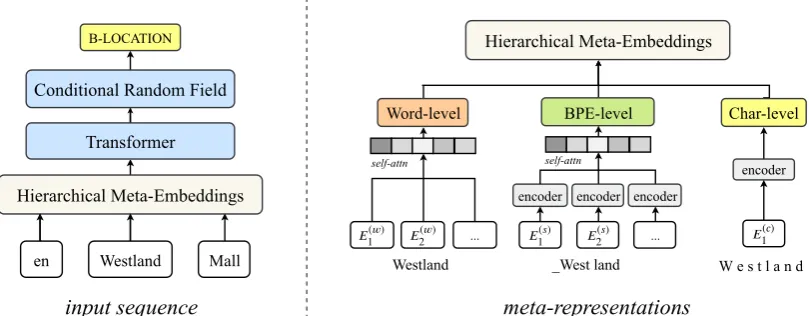
In this paper, we propose Hierarchical Meta-Embeddings (HME)1which learns how to com-bine different pre-trained monolingual embed-dings in word, subword, and character-level into a single language-agnostic lexical representation without using specific language identifiers. To address the issue of different segmentations, we add a Transformer (Vaswani et al.,2017) encoder
self-attn
BPE-level Char-level
( )
1 ( )2 ...
encoder encoder encoder
( )
1 ( )2 ...
encoder
( ) 1
en Westland Mall Transformer
W e s t l a n d _West land
Westland
Word-level B-LOCATION
Hierarchical Meta-Embeddings
input sequence
Conditional Random Field
Hierarchical Meta-Embeddings
self-attn
[image:2.595.92.497.65.223.2]meta-representations
Figure 1: Hierarchical Meta-Embeddings (HME) architecture for Named Entity Recognition (NER) task. Left: Transformer-CRF architecture for Named Entity Recognition. Right: HME accept words, BPEs, and characters inputs.
which learns the important subwords in a given sentence. We evaluate our model on the task of Named Entity Recognition for English-Spanish code-switching data, and we use Transformer-CRF, a transformer-based encoder for sequence labeling based on the implementation of Winata et al. (2019). Our experimental results confirm that HME significantly outperforms the state-of-the-art system inabsolute F1 score. The analysis shows that in the task of English-Spanish mixed texts not only similar languages like Portuguese or Catalan help, but also seemingly distant languages from Celtic origin also significantly increase the performance.
2 Related Work
Embeddings Previous works have extensively explored different representations such as word (Mikolov et al., 2013; Pennington et al., 2014;
Grave et al.,2018;Xu et al.,2018), subword ( Sen-nrich et al.,2016;Heinzerling and Strube,2018), and character (dos Santos and Zadrozny, 2014;
Wieting et al., 2016). Lample et al. (2016) has successfully concatenated character and word em-beddings to their model, showing the potential of combining multiple representations. Liu et al.
(2019) proposed to leverage word and subword embeddings into the application of unsupervised machine translation.
Meta-embeddings Recently, there are studies on combining multiple word embeddings in pre-processing steps (Yin and Schütze, 2016;
Muromägi et al., 2017; Bollegala et al., 2018;
Coates and Bollegala, 2018). Later, Kiela et al.
(2018) introduced a method to dynamically learn word-level meta-embeddings, which can be ef-fectively used in a supervised setting. Winata et al. (2019) proposed an idea to leverage multi-ple embeddings from different languages to gen-erate language-agnostic meta-representations for mixed-language data.
3 Hierarchical Meta-Embeddings
We propose a method to combine word, subword, and character representations to create a mixture of embeddings. We generate a multilingual meta-embeddings of word and subword, and then, we concatenate them with character-level embeddings to generate final word representations, as shown in Figure1. Letw be a sequence of words with n elements, where w = [w1, . . . , wn]. Each word can be tokenized into a list of subwords
s = [s1, . . . , sm] and a list of characters c =
[c1, . . . , cp]. The list of subwords s is gener-ated using a functionf; s = f(w). Function f maps a word into a sequence of subwords. Fur-ther, let E(w), E(s), and E(c) be a set of word, subword, and character embedding lookup tables. Each set consists of different monolingual dings. Each element is transformed into a embed-ding vector in Rd. We denote subscripts {i,j} as
element and embedding language index, and su-perscripts(w,s,c)as word, subword, and character.
3.1 Multilingual Meta-Embeddings (MME)
as word and subword. We apply a projection matrixWj to transform the dimensions from the original space xi,j ∈ Rd to a new shared space
x0i,j ∈Rd
0
. Then, we calculateattention weights αi,j ∈ Rd
0
with a non-linear scoring function φ (e.g., tanh) to take important information from each individual embedding x0i,j. Then, MME is calculated by taking the weighted sum of the pro-jected embeddingsx0i,j:
x0i,j =Wj ·xi,j, (1)
αi,j =
exp(φ(x0i,j))
Pn
k=1exp(φ(x
0
i,k))
, (2)
ui = n
X
j=1
αi,jx0i,j. (3)
3.2 Mapping Subwords and Characters to Word-Level Representations
We propose to map subword into word rep-resentations and choose byte-pair encodings (BPEs) (Sennrich et al.,2016) since it has a com-pact vocabulary. First, we apply f to segment words into sets of subwords, and then we ex-tract the pre-trained subword embedding vectors
x(i,js)∈Rdfor languagej.
Since, each language has a different f, we replace the projection matrix with Trans-former (Vaswani et al., 2017) to learn and com-bine important subwords into a single vector rep-resentation. Then, we create u(is) ∈ Rd0
which represents the subword-level MME by taking the weighted sum ofx0(i,js) ∈Rd0
.
x0(i,js)=Encoder(x(i,js)), (4)
u(is) =
n
X
j=1
αi,jx0(i,js). (5)
To combine character-level representations, we apply an encoder to each character.
u(ic) =Encoder(xi)∈Rd
0
. (6)
We combine the word-level, subword-level, and character-level representations by concatenation
uHM Ei = (u(iw),u(is),u(ic)), where u(iw) ∈ Rd0 and u(is) ∈ Rd0
are word-level MME and BPE-level MME, and u(ic) is a character embedding. We randomly initialize the character embedding and keep it trainable. We fix all subword and word pre-trained embeddings during the training.
3.3 Sequence Labeling
To predict the entities, we use Transformer-CRF, a transformer-based encoder followed by a Condi-tional Random Field (CRF) layer (Lafferty et al.,
2001). The CRF layer is useful to constraint the dependencies between labels.
h=Transformer(u), h0 =CRF(h). (7)
The best output sequence is selected by a forward propagation using the Viterbi algorithm.
4 Experiments
4.1 Experimental Setup
We train our model for solving Named Entity Recognition on English-Spanish code-switching tweets data fromAguilar et al.(2018). There are nine entity labels with IOB format. The training, development, and testing sets contain 50,757, 832, and 15,634 tweets, respectively.
We use FastText word embeddings trained from Common Crawl and Wikipedia (Grave et al.,
2018) for English (es), Spanish (es), including four Romance languages: Catalan (ca), Por-tuguese (pt), French (fr), Italian (it), and a Ger-manic language: German (de), and five Celtic languages as the distant language group: Bre-ton (br), Welsh (cy), Irish (ga), Scottish Gaelic (gd), Manx (gv). We also add the English Twitter GloVe word embeddings (Pennington et al.,2014) and BPE-based subword embeddings from Heinz-erling and Strube(2018).
We train our model in two different settings:(1) multilingual setting, we combine main languages (en-es) with Romance languages and a Germanic language, and (2) cross-lingual setting, we use Romance and Germanic languages without main languages. Our model contains four layers of transformer encoders with a hidden size of 200, four heads, and a dropout of 0.1. We use Adam op-timizer and start the training with a learning rate of 0.1 and an early stop of 15 iterations. We replace user hashtags and mentions with <USR>, emoji
with<EMOJI>, and URL with<URL>. We
eval-uate our model usingabsolute F1 scoremetric.
4.2 Baselines
com-Model
Multilingual embeddings Cross-lingual embeddings main
languages
+ closely-related languages
+ distant languages
closely-related languages
distant languages en-es ca-pt ca-pt-de-fr-it br-cy-ga-gd-gv ca-pt ca-pt-de-fr-it br-cy-ga-gd-gv
Flat word-level embeddings
CONCAT 65.3±0.38 64.99±1.06 65.91±1.16 65.79±1.36 58.28±2.66 64.02±0.26 50.77±1.55
LINEAR 64.61±0.77 65.33±0.87 65.63±0.92 64.95±0.77 60.72±0.84 62.37±1.01 53.28±0.41
Multilingual Meta-Embeddings (MME)(Winata et al.,2019)
Word 65.43±0.67 66.63±0.94 66.8±0.43 66.56±0.4 61.75±0.56 63.23±0.29 53.43±0.37
Hierarchical Meta-Embeddings (HME)
+ BPE 65.9±0.72 67.31±0.34 67.26±0.54 66.88±0.37 63.44±0.33 63.78±0.62 60.19±0.63
+ Char 65.88±1.02 67.38±0.84 65.94±0.47 66.1±0.33 61.97±0.6 63.06±0.69 57.5±0.56
[image:4.595.73.526.61.209.2]+ BPE + Char 66.55±0.72 67.8±0.31 67.07±0.49 67.02±0.16 63.9±0.22 64.52±0.35 60.88±0.84
Table 1: Results (percentage F1 mean and standard deviation from five experiments). Multilingual: with main languages,Cross-lingual: without main languages.
Model F1
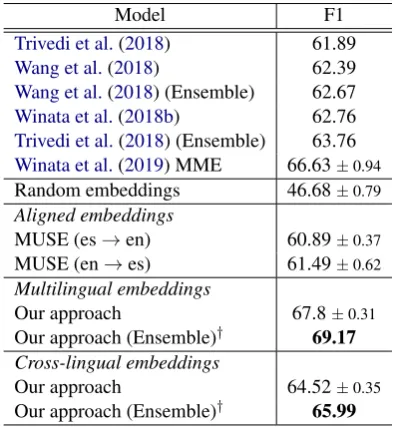
Trivedi et al.(2018) 61.89 Wang et al.(2018) 62.39 Wang et al.(2018) (Ensemble) 62.67 Winata et al.(2018b) 62.76 Trivedi et al.(2018) (Ensemble) 63.76 Winata et al.(2019) MME 66.63±0.94
Random embeddings 46.68±0.79 Aligned embeddings
MUSE (es→en) 60.89±0.37
MUSE (en→es) 61.49±0.62 Multilingual embeddings
Our approach 67.8±0.31
Our approach (Ensemble)† 69.17
Cross-lingual embeddings
Our approach 64.52±0.35
Our approach (Ensemble)† 65.99
Table 2: Comparison to existing works. Ensemble: We run a majority voting scheme from five different models.
putation.
xCON CATi = [xi,1, ...,xi,n]. (8)
LINEAR We sum all word embeddings into a single word vector with equal weight. This method combines embeddings without consider-ing the importance of each of them.
xLIN EARi =
n
X
j=0
x0i,j. (9)
Random Embeddings We use randomly initial-ized word embeddings and keep it trainable to cal-culate the lower-bound performance.
Aligned Embeddings We align English and Spanish FastText embeddings using CSLS with
two scenarios. We set English (en) as the source language and Spanish (es) (en → es) as the tar-get language, and vice versa (es → en). We run MUSE by using the code prepared by the authors ofConneau et al.(2017).2
5 Results & Discussion
In general, from Table 1, we can see that word-level meta-embeddings even without subword or character-level information, consistently perform better than flat baselines (e.g., CONCAT and LIN-EAR) in all settings. This is mainly because of the attention layer which does not require addi-tional parameters. Furthermore, comparing our approach to previous state-of-the-art models, we can clearly see that our proposed approaches all significantly outperform them.
From Table 1, in Multilingual setting, which trains with the main languages, it is evident that adding both closely-related and distant language embeddings improves the performance. This shows us that our model is able to leverage the lexical similarity between the languages. This is more distinctly shown in Cross-lingual setting as using distant languages significantly perform less than using closely-related ones (e.g.,ca-pt). Inter-estingly, for distant languages, when adding sub-words, we can still see a drastic performance in-crease. We hypothesize that even though the char-acters are mostly different, the lexical structure is similar to our main languages.
On the other hand, adding subword inputs to the model is consistently better than characters. This is due to the transfer of the information from the pre-trained subword embeddings. As shown in
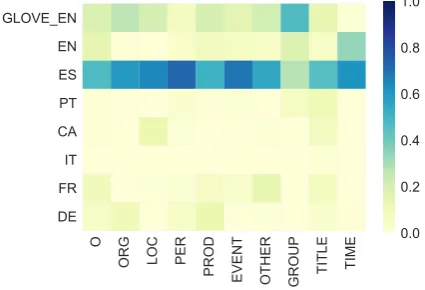
[image:4.595.82.282.261.475.2]Figure 2: Heatmap of attention over languages from a validation sample.Left: word-level MME,Right: BPE-level MME. We extract the attention weights from a multilingual model (en-es-ca-pt-de-fr-it).
2
25* /2& 3(5 352'
(9(17 27+(5 *5283 7,7/( 7,0(
'( )5 ,7 &$ 37 (6 (1 */29(B(1
Figure 3: The average of attention weights for word embeddings versus NER tags from the validation set.
ble 1, subword embeddings is more effective for distant languages (Celtic languages) than closely-related languages such as Catalan or Portuguese.
Moreover, we visualize the attention weights of the model in word and subword-level to interpret the model dynamics. From the left image of Fig-ure2, in word-level, the model mostly chooses the correct language embedding for each word, but also combines with different languages. Without any language identifiers, it is impressive to see that our model learns to attend to the right lan-guages. The right side of Figure 2, which shows attention weight distributions for subword-level, demonstrates interesting behaviors, in which for most English subwords, the model leverages ca, fr, anddeembeddings. We hypothesize this is be-cause the dataset is mainly constructed with Span-ish words, which can also be verified from Fig-ure3in which most NER tags are classified ases.
6 Conclusion
We propose Hierarchical Meta-Embeddings (HME) that learns how to combine multiple monolingual word-level and subword-level embeddings to create language-agnostic represen-tations without specific language information. We achieve the state-of-the-art results on the task of Named Entity Recognition for English-Spanish code-switching data. We also show that our model can leverage subword information very effectively from languages from different roots to generate better word representations.
Acknowledgments
This work has been partially funded by
ITF/319/16FP and MRP/055/18 of the Inno-vation Technology Commission, the Hong Kong SAR Government, and School of Engineering Ph.D. Fellowship Award, the Hong Kong Uni-versity of Science and Technology, and RDC 1718050-0 of EMOS.AI. We sincerely thank the three anonymous reviewers for their insightful comments on our paper.
References
Gustavo Aguilar, Fahad AlGhamdi, Victor Soto, Mona Diab, Julia Hirschberg, and Thamar Solorio. 2018. Named entity recognition on code-switched data: Overview of the calcs 2018 shared task. In Proceed-ings of the Third Workshop on Computational Ap-proaches to Linguistic Code-Switching, pages 138– 147, Melbourne, Australia. Association for Compu-tational Linguistics.
[image:5.595.75.288.290.435.2]lo-cally: locally linear meta-embedding of words. In
Proceedings of the 27th International Joint Con-ference on Artificial Intelligence, pages 3970–3976. AAAI Press.
Joshua Coates and Danushka Bollegala. 2018. Frus-tratingly easy embedding–computing meta-embeddings by averaging source word meta-embeddings. InProceedings of the 2018 Conference of the North American Chapter of the Association for Computa-tional Linguistics: Human Language Technologies, Volume 2 (Short Papers), pages 194–198.
Alexis Conneau, Guillaume Lample, Marc’Aurelio Ranzato, Ludovic Denoyer, and Hervé Jégou. 2017. Word translation without parallel data. arXiv preprint arXiv:1710.04087.
Edouard Grave, Piotr Bojanowski, Prakhar Gupta, Ar-mand Joulin, and Tomas Mikolov. 2018. Learning word vectors for 157 languages. In Proceedings of the International Conference on Language Re-sources and Evaluation (LREC 2018).
Benjamin Heinzerling and Michael Strube. 2018. Bpemb: Tokenization-free pre-trained subword em-beddings in 275 languages. In Proceedings of the Eleventh International Conference on Language Re-sources and Evaluation (LREC-2018).
Douwe Kiela, Changhan Wang, and Kyunghyun Cho. 2018. Dynamic meta-embeddings for improved sen-tence representations. In Proceedings of the 2018 Conference on Empirical Methods in Natural Lan-guage Processing, pages 1466–1477.
John D. Lafferty, Andrew McCallum, and Fernando Pereira. 2001. Conditional random fields: Prob-abilistic models for segmenting and labeling se-quence data. InICML.
Guillaume Lample, Miguel Ballesteros, Sandeep Sub-ramanian, Kazuya Kawakami, and Chris Dyer. 2016. Neural architectures for named entity recognition. InProceedings of the 2016 Conference of the North American Chapter of the Association for Computa-tional Linguistics: Human Language Technologies, pages 260–270.
Zihan Liu, Yan Xu, Genta Indra Winata, and Pascale Fung. 2019. Incorporating word and subword units in unsupervised machine translation using language model rescoring. InProceedings of the Fourth Con-ference on Machine Translation (Volume 2: Shared Task Papers, Day 1), pages 275–282, Florence, Italy. Association for Computational Linguistics.
Tomas Mikolov, Ilya Sutskever, Kai Chen, Greg S Cor-rado, and Jeff Dean. 2013. Distributed representa-tions of words and phrases and their compositional-ity. InAdvances in neural information processing systems, pages 3111–3119.
Avo Muromägi, Kairit Sirts, and Sven Laur. 2017. Lin-ear ensembles of word embedding models. In Pro-ceedings of the 21st Nordic Conference on Compu-tational Linguistics, pages 96–104.
Jeffrey Pennington, Richard Socher, and Christopher Manning. 2014. Glove: Global vectors for word representation. InProceedings of the 2014 confer-ence on empirical methods in natural language pro-cessing (EMNLP), pages 1532–1543.
Cícero Nogueira dos Santos and Bianca Zadrozny. 2014. Learning character-level representations for part-of-speech tagging. InICML.
Rico Sennrich, Barry Haddow, and Alexandra Birch. 2016. Neural machine translation of rare words with subword units. InProceedings of the 54th Annual Meeting of the Association for Computational Lin-guistics (Volume 1: Long Papers), volume 1, pages 1715–1725.
Shashwat Trivedi, Harsh Rangwani, and Anil Ku-mar Singh. 2018. Iit (bhu) submission for the acl shared task on named entity recognition on code-switched data. In Proceedings of the Third Work-shop on Computational Approaches to Linguistic Code-Switching, pages 148–153.
Ashish Vaswani, Noam Shazeer, Niki Parmar, Jakob Uszkoreit, Llion Jones, Aidan N Gomez, Łukasz Kaiser, and Illia Polosukhin. 2017. Attention is all you need. InAdvances in neural information pro-cessing systems, pages 5998–6008.
Changhan Wang, Kyunghyun Cho, and Douwe Kiela. 2018. Code-switched named entity recognition with embedding attention. In Proceedings of the Third Workshop on Computational Approaches to Linguis-tic Code-Switching, pages 154–158.
John Wieting, Mohit Bansal, Kevin Gimpel, and Karen Livescu. 2016. Charagram: Embedding words and sentences via character n-grams. InProceedings of the 2016 Conference on Empirical Methods in Nat-ural Language Processing, pages 1504–1515.
Genta Indra Winata, Zhaojiang Lin, and Pascale Fung. 2019. Learning multilingual meta-embeddings for code-switching named entity recognition. In Pro-ceedings of the 4th Workshop on Representation Learning for NLP (RepL4NLP-2019), pages 181– 186.
Genta Indra Winata, Andrea Madotto, Chien-Sheng Wu, and Pascale Fung. 2018a. Code-switching language modeling using syntax-aware multi-task learning. In Proceedings of the Third Workshop on Computational Approaches to Linguistic Code-Switching, pages 62–67.
Peng Xu, Andrea Madotto, Chien-Sheng Wu, Ji Ho Park, and Pascale Fung. 2018. Emo2vec: Learn-ing generalized emotion representation by multi-task training. In Proceedings of the 9th Workshop on Computational Approaches to Subjectivity, Senti-ment and Social Media Analysis, pages 292–298.