Proceedings of the 2019 Conference on Empirical Methods in Natural Language Processing
3356
On NMT Search Errors and Model Errors: Cat Got Your Tongue?
Felix Stahlberg∗ and Bill Byrne University of Cambridge Department of Engineering
Trumpington St, Cambridge CB2 1PZ, UK
{fs439,wjb31}@cam.ac.uk
Abstract
We report on search errors and model errors in neural machine translation (NMT). We present an exact inference procedure for neural se-quence models based on a combination of beam search and depth-first search. We use our exact search to find the global best model scores under a Transformer base model for the entire WMT15 English-German test set. Sur-prisingly, beam search fails to find these global best model scores in most cases, even with a very large beam size of 100. For more than 50% of the sentences, the model in fact assigns its global best score to the empty translation, revealing a massive failure of neural models in properly accounting for adequacy. We show by constraining search with a minimum trans-lation length that at the root of the problem of empty translations lies an inherent bias to-wards shorter translations. We conclude that vanilla NMT in its current form requires just the right amount of beam search errors, which, from a modelling perspective, is a highly un-satisfactory conclusion indeed, as the model often prefers an empty translation.
1 Introduction
Neural machine translation (Kalchbrenner and Blunsom,2013;Sutskever et al.,2014;Bahdanau et al.,2015, NMT) assigns the probabilityP(y|x) of a translation y = y1J ∈ TJ of length J over
the target language vocabularyT for a source sen-tencex∈ SIof lengthIover the source language
vocabularySvia a left-to-right factorization using the chain rule:
logP(y|x) =
J X
j=1
logP(yj|y1j−1,x). (1)
The task of finding the most likely translationyˆ∈ T∗ for a given source sentencexis known as the
*Now at Google.
decodingorinferenceproblem:
ˆ
y= arg max
y∈T∗ P
(y|x). (2)
The NMT search space is vast as it grows expo-nentially with the sequence length. For example, for a common vocabulary size of |T | = 32,000, there are already more possible translations with 20 words or less than atoms in the observable universe (32,00020 1082). Thus, complete enumeration of the search space is impossible. The size of the NMT search space is perhaps the main reason why – besides some preliminary stud-ies (Niehues et al., 2017;Stahlberg et al.,2018b; Ott et al.,2018) – analyzing search errors in NMT has received only limited attention. To the best of our knowledge, none of the previous studies were able to quantify the number of search errors in un-constrained NMT due to the lack of an exact infer-ence scheme that – although too slow for practi-cal MT – guarantees to find the global best model score for analysis purposes.
Algorithm 1BeamSearch(x, n∈N+)
Input: x: Source sentence,n: Beam size
1: Hcur← {(,0.0)} {Initialize with empty translation prefix and zero score}
2: repeat
3: Hnext ← ∅
4: for all(y, p)∈ Hcurdo
5: ify|y|=< /s>then
6: Hnext← Hnext∪ {(y, p)} {Hypotheses ending with< /s>are not expanded}
7: else
8: Hnext← Hnext∪Sw∈T(y·w, p+ logP(w|x,y)){Add all possible continuations}
9: end if
10: end for
11: Hcur← {(y, p)∈ Hnext:|{(y0, p0)∈ Hnext:p0> p}|< n} {Selectn-best}
12: (˜y,p˜)←arg max(y,p)∈Hcurp 13: untily˜|y˜|=< /s>
14: return y˜
Algorithm 2DFS(x,y, p∈R, γ∈R)
Input: x: Source sentence
y: Translation prefix (default:) p:logP(y|x)(default: 0.0) γ: Lower bound
1: ify|y|=< /s>then
2: return (y, p){Triggerγupdate}
3: end if
4: y˜ ←⊥ {Initializey˜with dummy value} 5: for allw∈ T do
6: p0 ←p+ logP(w|x,y) 7: ifp0≥γthen
8: (y0, γ0)←DFS(x,y·w, p0, γ)
9: ifγ0 > γthen 10: (˜y, γ)←(y0, γ0)
11: end if
12: end if 13: end for 14: return (˜y, γ)
2 Exact Inference for Neural Models
Decoding in NMT (Eq.2) is usually tackled with beam search, which is a time-synchronous approx-imate search algorithm that builds up hypotheses from left to right. A formal algorithm description is given in Alg. 1. Beam search maintains a set of active hypothesesHcur. In each iteration, all
hypotheses inHcur that do not end with the
end-of-sentence symbol< /s>are expanded and col-lected inHnext. The bestnitems inHnext
consti-tute the set of active hypothesesHcur in the next
iteration (line 11 in Alg.1), wherenis the beam
size. The algorithm terminates when the best hy-pothesis in Hcur ends with the end-of-sentence
symbol< /s>. Hypotheses are calledcomplete if they end with< /s>andpartialif they do not. Beam search is the ubiquitous decoding algo-rithm for NMT, but it is prone to search errors as the number of active hypotheses is limited by n. In particular, beam search never compares partial hypotheses of different lengths with each other. As we will see in later sections, this is one of the main sources of search errors. How-ever, in many cases, the model score found by beam search is a reasonable approximation to the global best model score. Let γ be the model score found by beam search (p˜in line 12, Alg.1), which is a lower bound on the global best model score: γ ≤ logP(ˆy|x). Furthermore, since the conditionals logP(yj|yj−1 1,x) in Eq. 1 are
log-probabilities and thus non-positive, expanding a partial hypothesis is guaranteed to result in a lower model score, i.e.:1
∀j∈[2, J] : logP(y1j−1|x)>logP(yj1|x). (3)
Consequently, when we are interested in the global best hypothesisy, we only need to consider partialˆ hypotheses with scores greater thanγ. In our ex-act decoding scheme we traverse the NMT search space in a depth-first order, but cut off branches along which the accumulated model score falls be-low γ. During depth-first search (DFS), we up-dateγ when we find a better complete hypothesis.
1Equality in Eq. 3is impossible since probabilities are
Alg.2 specifies the DFS algorithm formally. An important detail is that elements inT are ordered such that the loop in line 5 considers the< /s> token first. This often updatesγearly on and leads to better pruning in subsequent recursive calls.2
Exact inference under length constraints Our admissible pruning criterion based onγ relies on the fact that the model score of a (partial) hy-pothesis is always lower than the score of any of its translation prefixes. While this monotonic-ity condition is true for vanilla NMT (Eq. 3), it does not hold for methods like length normaliza-tion (Jean et al., 2015; Boulanger-Lewandowski et al.,2013;Wu et al.,2016) or word rewards (He et al., 2016): Length normalization gives an ad-vantage to longer hypotheses by dividing the score by the sentence length, while a word reward di-rectly violates monotonicity as it rewards each word with a positive value. In Sec. 4 we show how our exact search can be extended to handle ar-bitrary length models (Murray and Chiang,2018; Huang et al.,2017;Yang et al.,2018) by introduc-ing length dependent lower boundsγk and report
initial findings on exact search under length nor-malization. However, despite being of practical use, methods like length normalization and word penalties are rather heuristic as they do not have any justification from a probabilistic perspective. They also do not generalize well as (without re-tuning) they often work only for a specific beam size. It would be much more desirable to fix the length bias in the NMT model itself.
3 Results without Length Constraints
We conduct all our experiments in this
sec-tion on the entire English-German WMT
news-test2015test set (2,169 sentences) with a Transformer base (Vaswani et al., 2017) model trained with Tensor2Tensor (Vaswani et al.,2018) on parallel WMT18 data excluding ParaCrawl. Our pre-processing is as described by Stahlberg et al. (2018a) and includes joint subword seg-mentation using byte pair encoding (Sennrich et al., 2016) with 32K merges. We report cased BLEU scores.3 An open-source implementation of our exact inference scheme is available in the
2
Note that the order in which the for-loop in line 5 of Alg.2iterates over T may be important for efficiency but does not affect the correctness of the algorithm.
3Comparable withhttp://matrix.statmt.org/
Search BLEU Ratio #Search errors #Empty
[image:3.595.310.522.63.105.2]Greedy 29.3 1.02 73.6% 0.0% Beam-10 30.3 1.00 57.7% 0.0% Exact 2.1 0.06 0.0% 51.8%
Table 1: NMT with exact inference. In the absence of search errors, NMT often prefers the empty translation, causing a dramatic drop in length ratio and BLEU.
28.8 29.0 29.2 29.4 29.6 29.8 30.0 30.2 30.4
54% 57% 60% 63% 66% 69% 72%
0.95 0.96 0.97 0.98 0.99 1.00 1.01 1.02 100 30 10 5 3 2 1
BLEU
Length ratio
#Search errors Beam size
[image:3.595.309.533.163.285.2]BLEU Length ratio
Figure 1: BLEU over the percentage of search er-rors. Large beam sizes yield fewer search errors but the BLEU score suffers from a length ratio below 1.
-12.2 -12.0 -11.8 -11.6 -11.4 -11.2 -11.0 -10.8
10 20 30 40 50 60 70 80 90 100 55% 60% 65% 70%
Log-likelihood #Search errors
Beam size Log-likelihood #Search errors
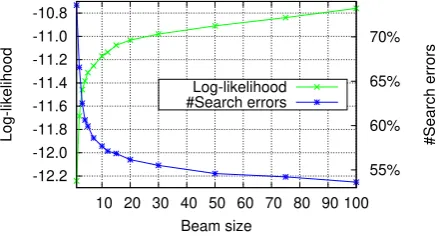
Figure 2: Even large beam sizes produce a large num-ber of search errors.
SGNMT decoder (Stahlberg et al.,2017,2018b).4 Our main result is shown in Tab. 1. Greedy and beam search both achieve reasonable BLEU scores but rely on a high number of search er-rors5 to not be affected by a serious NMT model error: For 51.8% of the sentences, NMT assigns the global best model score to the empty transla-tion, i.e. a single< /s>token. Fig. 1visualizes the relationship between BLEU and the number of search errors. Large beam sizes reduce the num-ber of search errors, but the BLEU score drops be-cause translations are too short. Even a large beam size of 100 produces 53.62% search errors. Fig.2 shows that beam search effectively reduces search
4
http://ucam-smt.github.io/sgnmt/html/,
simpledfsdecoding strategy.
5A sentence is classified as search error if the decoder
[image:3.595.311.531.352.470.2]0 200 400 600 800 1000 1200
[0.0,0.1](0.1,0.3](0.3,0.5](0.5,0.7](0.7,0.9](0.9,1.1](1.1,1.3](1.3,1.5](1.5,1.7](1.7,1.9]>1.9
#Sentences
Target/source ratio Reference
Exact Beam-10
Figure 3: Histogram over target/source length ratios.
Model Beam-10 Exact
BLEU #Search err. #Empty
LSTM∗ 28.6 58.4% 47.7%
SliceNet∗ 28.8 46.0% 41.2% Transformer-Base 30.3 57.7% 51.8% Transformer-Big∗ 31.7 32.1% 25.8%
Table 2: ∗: The recurrent LSTM, the convolutional SliceNet (Kaiser et al.,2017), and the Transformer-Big systems are strong baselines from a WMT’18 shared task submission (Stahlberg et al.,2018a).
errors with respect to greedy decoding to some de-gree, but is ineffective in reducing search errors even further. For example, Beam-10 yields 15.9% fewer search errors (absolute) than greedy decod-ing (57.68% vs. 73.58%), but Beam-100 improves search only slightly (53.62% search errors) despite being 10 times slower than beam-10.
The problem of empty translations is also vis-ible in the histogram over length ratios (Fig. 3). Beam search – although still slightly too short – roughly follows the reference distribution, but ex-act search has an isolated peak in [0.0,0.1] from the empty translations.
Tab.2demonstrates that the problems of search errors and empty translations are not specific to the
0% 20% 40% 60% 80% 100%
[0,10] [10,20) [20,30) [30,40) [40,50) [50,60] >60
Percentage
Source sentence length #Search errors #Empty global best #Search errors w/o empty trans.
Figure 4: Number of search errors under Beam-10 and empty global bests over the source sentence length.
0 100 200 300 400 500 600 700 800
[0.0,0.1](0.1,0.3](0.3,0.5](0.5,0.7](0.7,0.9](0.9,1.1](1.1,1.3](1.3,1.5](1.5,1.7](1.7,1.9]>1.9
#Sentences
Target/source ratio Reference
Exact Beam-10
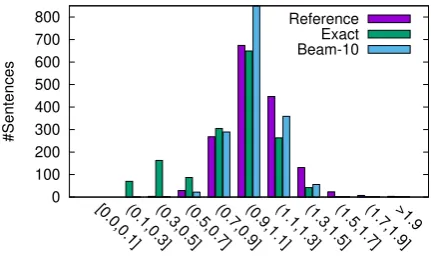
Figure 5: Histogram over length ratios with minimum translation length constraint of 0.25 times the source sentence length. Experiment conducted on 73.0% of the test set.
Transformer base model and also occur with other architectures. Even a highly optimized Trans-former Big model from our WMT18 shared task submission (Stahlberg et al., 2018a) has 25.8% empty translations.
Fig. 4 shows that long source sentences are more affected by both beam search errors and the problem of empty translations. The global best translation is empty for almost all sentences longer than 40 tokens (green curve). Even without sen-tences where the model prefers the empty transla-tion, a large amount of search errors remain (blue curve).
4 Results with Length Constraints
To find out more about the length deficiency we constrained exact search to certain translation lengths. Constraining search that way increases the run time as theγ-bounds are lower. Therefore, all results in this section are conducted on only a subset of the test set to keep the runtime under con-trol.6 We first constrained search to translations longer than 0.25 times the source sentence length and thus excluded the empty translation from the search space. Although this mitigates the prob-lem slightly (Fig.5), it still results in a peak in the (0.3,0.5]cluster. This suggests that the problem of empty translations is the consequence of an in-herent model bias towards shorter hypotheses and cannot be fixed with a length constraint.
We then constrained exact search to either the
6We stopped decoding if the decoder took longer than a
Search BLEU Ratio
Beam-10 37.0 1.00
[image:5.595.93.272.63.105.2]Exact for Beam-10 length 37.0 1.00 Exact for reference length 37.9 1.01
Table 3: Exact search under length constraints. Exper-iment conducted on 48.3% of the test set.
Search W/o length norm. With length norm. BLEU Ratio BLEU Ratio
Beam-10 37.0 1.00 36.3 1.03 Beam-30 36.7 0.98 36.3 1.04 Exact 27.2 0.74 36.4 1.03
Table 4: Length normalization fixes translation lengths, but prevents exact search from matching the BLEU score of Beam-10. Experiment conducted on 48.3% of the test set.
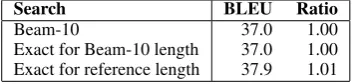
length of the best Beam-10 hypothesis or the ref-erence length. Tab.3shows that exact search con-strained to the Beam-10 hypothesis length does not improve over beam search, suggesting that any search errors between beam search score and global best score for that length are insignificant enough so as not to affect the BLEU score. The oracle experiment in which we constrained exact search to the correct reference length (last row in Tab.3) improved the BLEU score by 0.9 points.
A popular method to counter the length bias in NMT is length normalization (Jean et al., 2015; Boulanger-Lewandowski et al.,2013) which sim-ply divides the sentence score by the sentence length. We can find the global best translations un-der length normalization by generalizing our ex-act inference scheme to length dependent lower boundsγk. The generalized scheme7finds the best
model scores for each translation lengthkin a cer-tain range (e.g. zero to 1.2 times the source sen-tence length). The initial lower bounds are derived from the Beam-10 hypothesisybeamas follows:8
γk= (k+ 1)
logP(ybeam|x)
|ybeam|+ 1 . (4)
Exact search under length normalization does not suffer from the length deficiency anymore (last row in Tab.4), but it is not able to match our best BLEU score under Beam-10 search. This suggests that while length normalization biases search to-wards translations of roughly the correct length, it does not fix the fundamental modelling problem.
7
Available in our SGNMT decoder (Stahlberg et al.,2017, 2018b) assimplelendfsstrategy.
8We add 1 to the lengths to avoid division by zero errors.
5 Related Work
Other researchers have also noted that large beam sizes yield shorter translations (Koehn and Knowles, 2017). Sountsov and Sarawagi (2016) argue that this model error is due to the locally nor-malized maximum likelihood training objective in NMT that underestimates the margin between the correct translation and shorter ones if trained with regularization and finite data. A similar argu-ment was made byMurray and Chiang(2018) who pointed out the difficulty for a locally normalized model to estimate the “budget” for all remaining (longer) translations. Kumar and Sarawagi(2019) demonstrated that NMT models are often poorly calibrated, and that that can cause the length defi-ciency. Ott et al. (2018) argued that uncertainty caused by noisy training data may play a role. Chen et al.(2018) showed that the consistent best string problem for RNNs is decidable. We pro-vide an alternative DFS algorithm that relies on the monotonic nature of model scores rather than consistency, and that often converges in practice.
To the best of our knowledge, this is the first work that reports the exact number of search errors in NMT as prior work often relied on approxima-tions, e.g. vian-best lists (Niehues et al.,2017) or constraints (Stahlberg et al.,2018b).
6 Conclusion
We have presented an exact inference scheme for NMT. Exact search may not be practical, but it al-lowed us to discover deficiencies in widely used
NMT models. We linked deteriorating BLEU
scores of large beams with the reduction of search errors and showed that the model often prefers the empty translation – an evidence of NMT’s failure to properly model adequacy. Our investigations into length constrained exact search suggested that simple heuristics like length normalization are un-likely to remedy the problem satisfactorily.
Acknowledgments
This work was supported by the U.K. Engineering and Physical Sciences Research Council (EPSRC) grant EP/L027623/1 and has been performed us-ing resources provided by the Cambridge Tier-2 system operated by the University of Cambridge Research Computing Service9 funded by EPSRC Tier-2 capital grant EP/P020259/1.
[image:5.595.76.286.149.203.2]References
Dzmitry Bahdanau, Kyunghyun Cho, and Yoshua Ben-gio. 2015. Neural machine translation by jointly learning to align and translate. InICLR.
Nicolas Boulanger-Lewandowski, Yoshua Bengio, and Pascal Vincent. 2013. Audio chord recognition with recurrent neural networks. In ISMIR, pages 335– 340. Citeseer.
Yining Chen, Sorcha Gilroy, Andreas Maletti, Jonathan May, and Kevin Knight. 2018. Recurrent neu-ral networks as weighted language recognizers. In
Proceedings of the 2018 Conference of the North American Chapter of the Association for Computa-tional Linguistics: Human Language Technologies, Volume 1 (Long Papers), pages 2261–2271, New Orleans, Louisiana. Association for Computational Linguistics.
Wei He, Zhongjun He, Hua Wu, and Haifeng Wang. 2016. Improved neural machine translation with SMT features. InProceedings of the Thirtieth AAAI Conference on Artificial Intelligence, pages 151– 157. AAAI Press.
Liang Huang, Kai Zhao, and Mingbo Ma. 2017. When to finish? Optimal beam search for neural text generation (modulo beam size). In Proceedings of the 2017 Conference on Empirical Methods in Natural Language Processing, pages 2134–2139, Copenhagen, Denmark. Association for Computa-tional Linguistics.
S´ebastien Jean, Orhan Firat, Kyunghyun Cho, Roland Memisevic, and Yoshua Bengio. 2015. Montreal neural machine translation systems for WMT’15. In
Proceedings of the Tenth Workshop on Statistical Machine Translation, pages 134–140, Lisbon, Por-tugal. Association for Computational Linguistics.
Lukasz Kaiser, Aidan N Gomez, and Francois Chol-let. 2017. Depthwise separable convolutions for neural machine translation. arXiv preprint arXiv:1706.03059.
Nal Kalchbrenner and Phil Blunsom. 2013. Recurrent continuous translation models. In Proceedings of the 2013 Conference on Empirical Methods in Nat-ural Language Processing, pages 1700–1709. Asso-ciation for Computational Linguistics.
Philipp Koehn and Rebecca Knowles. 2017. Six chal-lenges for neural machine translation. In Pro-ceedings of the First Workshop on Neural Machine Translation, pages 28–39, Vancouver. Association for Computational Linguistics.
Aviral Kumar and Sunita Sarawagi. 2019. Calibration of encoder decoder models for neural machine trans-lation. arXiv preprint arXiv:1903.00802.
Kenton Murray and David Chiang. 2018. Correct-ing length bias in neural machine translation. In
Proceedings of the Third Conference on Machine
Translation: Research Papers, pages 212–223, Bel-gium, Brussels. Association for Computational Lin-guistics.
Jan Niehues, Eunah Cho, Thanh-Le Ha, and Alex Waibel. 2017. Analyzing neural MT search and model performance. In Proceedings of the First Workshop on Neural Machine Translation, pages 11–17.
Myle Ott, Michael Auli, David Grangier, et al. 2018. Analyzing uncertainty in neural machine translation. In International Conference on Machine Learning, pages 3953–3962.
Rico Sennrich, Barry Haddow, and Alexandra Birch. 2016. Neural machine translation of rare words with subword units. InProceedings of the 54th An-nual Meeting of the Association for Computational Linguistics (Volume 1: Long Papers), pages 1715– 1725, Berlin, Germany. Association for Computa-tional Linguistics.
Pavel Sountsov and Sunita Sarawagi. 2016. Length bias in encoder decoder models and a case for global conditioning. InProceedings of the 2016 Confer-ence on Empirical Methods in Natural Language Processing, pages 1516–1525, Austin, Texas. Asso-ciation for Computational Linguistics.
Felix Stahlberg, Adri`a de Gispert, and Bill Byrne. 2018a. The University of Cambridge’s machine translation systems for WMT18. In Proceedings of the Third Conference on Machine Translation: Shared Task Papers, pages 504–512, Belgium, Brus-sels. Association for Computational Linguistics.
Felix Stahlberg, Eva Hasler, Danielle Saunders, and Bill Byrne. 2017. SGNMT – A flexible NMT de-coding platform for quick prototyping of new mod-els and search strategies. InProceedings of the 2017 Conference on Empirical Methods in Natural Lan-guage Processing: System Demonstrations, pages 25–30. Association for Computational Linguistics.
Felix Stahlberg, Danielle Saunders, Gonzalo Iglesias, and Bill Byrne. 2018b. Why not be versatile? Ap-plications of the SGNMT decoder for machine trans-lation. InProceedings of the 13th Conference of the Association for Machine Translation in the Ameri-cas (Volume 1: Research Papers), pages 208–216. Association for Machine Translation in the Ameri-cas.
Ilya Sutskever, Oriol Vinyals, and Quoc V Le. 2014. Sequence to sequence learning with neural net-works. InAdvances in Neural Information Process-ing Systems, pages 3104–3112.
Ashish Vaswani, Noam Shazeer, Niki Parmar, Jakob Uszkoreit, Llion Jones, Aidan N Gomez, Łukasz Kaiser, and Illia Polosukhin. 2017. Attention is all you need. InAdvances in Neural Information Pro-cessing Systems, pages 5998–6008.
Yonghui Wu, Mike Schuster, Zhifeng Chen, Quoc V Le, Mohammad Norouzi, Wolfgang Macherey, Maxim Krikun, Yuan Cao, Qin Gao, Klaus Macherey, et al. 2016. Google’s neural ma-chine translation system: Bridging the gap between human and machine translation. arXiv preprint arXiv:1609.08144.