Proceedings of the 2nd Workshop on Deep Learning Approaches for Low-Resource NLP (DeepLo), pages 115–123
115
From Monolingual to Multilingual FAQ Assistant using
Multilingual Co-training
Mayur Patidar, Surabhi Kumari, Manasi Patwardhan, Shirish Karande Puneet Agarwal, Lovekesh Vig, Gautam Shroff
TCS Research, New Delhi, India
{patidar.mayur, surabhi.kumari6, manasi.patwardhan,
shirish.karande, puneet.a, lovekesh.vig, gautam.shroff}@tcs.com
Abstract
Recent research on cross-lingual transfer show state-of-the-art results on benchmark datasets using pre-trained language represen-tation models (PLRM) like BERT. These re-sults are achieved with the traditional train-ing approaches, such as Zero-shot with no data, Translate-train or Translate-test with ma-chine translated data. In this work, we propose an approach of “Multilingual Co-training” (MCT) where we augment the expert anno-tated dataset in the source language (English) with the corresponding machine translations in the target languages (e.g. Arabic, Span-ish) and fine-tune the PLRM jointly. We ob-serve that the proposed approach provides con-sistent gains in the performance of BERT for multiple benchmark datasets (e.g. 1.0% gain on MLDocs, and 1.2% gain on XNLI over translate-train with BERT), while requiring a single model for multiple languages. We fur-ther consider a FAQ dataset where the avail-able English test dataset is translated by ex-perts into Arabic and Spanish. On such a dataset, we observe an average gain of 4.9% over all other cross-lingual transfer protocols with BERT. We further observe that domain-specific joint pre-training of the PLRM us-ing HR policy documents in English along with the machine translations in the target lan-guages, followed by the joint finetuning, pro-vides a further improvement of 2.8% in aver-age accuracy.
1 Introduction
Achievement of scale, agility, and quality in sup-port functions of large enterprises is a key demand. Conversational systems are increasingly being de-ployed to this effect. Such systems try to clas-sify users’ utterances into one of the FAQ (Khu-rana et al.,2017), usually referred to as intent, and then show an answer that is mapped to the cho-sen intent. In specific geographies such as Europe,
Latin America, and India such FAQ based conver-sational systems may be required to work in more than one language. Similar requirements are also presented to us by many international consumer oriented businesses such as airlines, shipping com-panies, and banks.
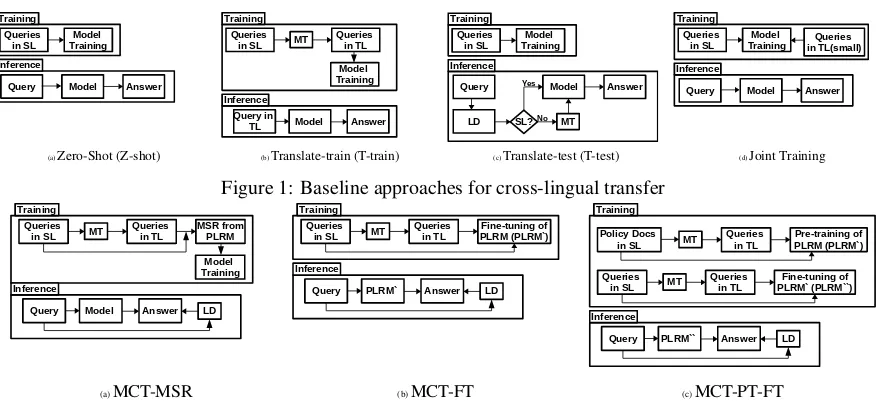
The straight-forward approach is to build a dif-ferent classification model for every language, which is hard to maintain because of manual ef-fort involved in preparing the training data in ev-ery language, and training time for evev-ery model. We therefore look into cross-lingual transfer learn-ing approaches such as a)Translate-Train (Schus-ter et al., 2019): here we translate the train-ing data from English1 into all the other guages and train a different model for every lan-guage; b) Translate-Test (Artetxe and Schwenk, 2018): here we maintain single model (usu-ally for English), and use machine translation at the inference time before using the classifica-tion model; c) Zero-shot (Artetxe and Schwenk, 2018): here we employ multi-lingual pre-trained language representation model (PLRM) such as LASER (Artetxe and Schwenk, 2018), and train the model in high resource language (English) only and use the target language at the inference time only; d) Joint training (Upadhyay et al., 2018a,b): here the same model is trained on all the languages on which it is expected to be used. All these approaches are also shown in Figure1. Either the accuracy of above mentioned models is low (Zero-Shot, or Translate-Test) or they are too hard to maintain in production system (Translate-Train, or Joint training). We therefore require an approach that performs better than all these ap-proaches and is easier to maintain.
In this paper, we propose a new method for cross-lingual transfer learning, i.e., Multi-Lingual
Co-Training (MCT). Here, we jointly train single model on all the languages (upto 15 languages), using different multi-lingual PLRMs. When the training data is not available for certain language, we use translate-train paradigm and use machine translations as the training data. To the best of our knowledge, such an approach has not been used by prior works in the related area. We demon-strate the efficacy of our approach on a real world dataset taken from “Watt” (Khurana et al.,2017) project. Finally, we also demonstrate the robust-ness on publicly available datasets such as XNLI (Conneau et al.,2018) and MLDoc (Schwenk and Li, 2018). For MLDoc dataset, MCT provides 1.0% gain for the 8 languages, whereas for the XNLI dataset it provides 1.2% gain for 15 lan-guages.
The rest of the paper is organized as follows: We describe our problem in Section 2 and the proposed approach in Section 3. We present the results of the proposed and other baseline ap-proaches in Section 4. We later describe related work in Section5and conclude in Section6.
2 Problem Description
A labeled dataset (D) for the deployed FAQ assistant in the source language (i.e., English) was created by HR domain experts using policy documents. It consists of a set of intents i.e.
D = {I1, I2, ..., In} where, each Ij comprises of a set of semantically similar queries Qj =
{qj1, qj2, ..., qjm} and a common corresponding answeransj i.e. Ij =< Qj, ansj >. Our objec-tive here is to find a relevant intentI correspond-ing to a user’s queryq and then retrieve and show the answer associated with that intent. This can be modeled as a multiclass sentence classification whereI = argmax
IjD
P(Ij/q).
In the context of a multilingual FAQ assistant, we assume that there exists complete overlap be-tween the intents of source and target languages (Ti,i = 1,2, ..., k) with no availability of human labeled data in any target language. The objec-tive in the case of multilingual FAQ assistant is similar to the monolingual case except that user is free to ask a query in any language. In a multilin-gual FAQ system, along with intent identification, a language detection module is also required to re-spond to a user’s query in an appropriate language.
3 Proposed Approach
In the context of a multilingual FAQ assistant, we assume that there exists complete overlap be-tween the intents of source and target languages (Ti,i= 1,2, ..., k) with no availability of human-labeled data in any target language. To create a labeled datasetDTi for a target languageTi, each set of semantically similar queriesQjin the source language are translated to the target language to obtainQjTi, using machine translation (MT)
2and ansjTiis created by the respective HR domain ex-perts.
To obtain a single multilingual labeled dataset
D0 comprising of data from the source as well as all the target languages, we combine D with all the datasets DTi created for all Ti. Each in-tent Ij =< Q
0
j, ans
0
j > in the final labeled dataset (D0) is comprised of queriesQ0j ={Qj ∪
QjTi ∪...,∪QjTk}and answersans
0
j ={ansj ∪
ansjTi ∪...,∪ansjTk}from the source and target languages.
We propose an approach referred to as Multilin-gual Co-training (MCT), where we use multilin-gual labeled datasetD0to train a multiclass classi-fier for intent identification. In this work, we pro-pose three variants of MCT, which differ in terms of how we train a classifier given multilingual la-beled datasetD0, which we discuss in next subsec-tions.
In all variants of MCT, we need a translation system only to create the dataset D0. Unlike translate-test, we do not require to translate each user query to source language during the infer-ence. Also, we need to maintain only a single mul-tilingual FAQ assistant for all languages. How-ever, in case of translate-train, in general, we need to create multiple FAQ assistants, one for each lan-guage. We useD0to train a multilingual FAQ sys-tem, which may not be the best but perform better than solely relying on representations from PLRM (zero-shot) for cross-lingual transfer.
3.1 MCT using Multilingual Sentence Representation (MCT-MSR)
MCT-MSR is the simplest variant of MCT, where we obtain vector representation for all the queries present in dataset D0 from the PLRM. Corre-sponding to each user query qt, we obtain vector representationqt ∈ Rdwheredis the dimension
Queries in SL TrainingModel
Query Answer Inference
Training
Model
(a)Zero-Shot (Z-shot)
Queries
in SL MT Queries in TL
Model Training
Query in
TL Model Answer Inference
Training
(b)Translate-train (T-train)
Queries in SL TrainingModel
Query Answer Inference Training MT Model LD SL? Yes No
(c)Translate-test (T-test)
Queries in SL TrainingModel
Query Answer Inference Training Model Queries in TL(small)
[image:3.595.77.517.58.262.2](d)Joint Training
Figure 1: Baseline approaches for cross-lingual transfer
Queries in SL MT
Queries in TL
MSR from PLRM
Query Model Answer Inference Training Model Training LD (a)MCT-MSR Queries in SL MT
Queries in TL
Fine-tuning of PLRM (PLRM`)
Query PLRM` Answer Inference
Training
LD
(b)MCT-FT
Queries in SL MT
Queries in TL
Fine-tuning of PLRM` (PLRM``)
Query PLRM`` Answer Inference
Training
LD Policy Docs
in SL MT
Queries in TL
Pre-training of PLRM (PLRM`)
(c)MCT-PT-FT
Figure 2: Proposed approaches for MCT
of query representation. We use these query repre-sentations to train a multiclass classifier by mini-mizing the categorical cross entropy loss as shown in Equation3, whereIi ∈I,Nis the total number of queries inD0,nis the number of intents inD0
andyis 1 only for the target intent and zero oth-erwise. We build the classifier using a two layered feed forward network as described in Equations1 and2whereW1,W2represent the weights andb1, b2 represent the biases of the two layers. We also
use dropout (Srivastava et al.,2014) for regulariza-tion andtanhas the nonlinear activation function.
Finally, as shown in Figure 2a, we use trained classifier with language detection module i.e., Multilingual FAQ assistant to answer user’s query in source or target language.
ot =dropout(tanh(W1∗qt+b1)) (1)
p(I |qt) =softmax(W2∗ot+b2) (2)
LCE =−
1 N N X t=1 n X i=1
y·log(p(Ii |qt)) (3)
3.2 MCT using Fine Tuning (MCT-FT)
In the recent work (Devlin et al.,2019;Lample and Conneau,2019;Wu and Dredze,2019), it is shown that fine-tuning of all or a few layers of PLRM on end task performs better than task-specific models. Unlike in MCT-MSR, in MCT-FT we use D0 to fine-tune all the parameters of PLRM along with the weightsW3and biasesb3of a task-specific
lin-ear layer as shown in Equation4which is similar to (Devlin et al.,2019). In Equation 4, qt refers to vector representation of user’s query i.e.,qt
ob-tained from PLRM.
p(I |qt) =softmax(W3∗qt+b3) (4)
Finally, as shown in Figure 2b, we use PLRM, obtained after fine-tuning with language detection module i.e., Multilingual FAQ assistant to answer user’s query in source or target language.
3.3 MCT via pre-training followed by fine-tuning (MCT-PT-FT)
In (Devlin et al., 2019), it is shown that addi-tional pre-training of PLRMs on domain-specific text corpus improve the performance on the end task. In this work, addition to D0, we also use policy documents to create our multilingual FAQ assistant. A policy document is a semi-structured document which contains information (e.g., pur-pose, applicability, approval workflow, etc.) about leave type in the form of tables, plain text, etc. In this work, we only use plain text from policy doc-uments. Due to unavailability of policy documents in the target languages, we use MT to translate them to target languages.
In MCT-PT-FT, we perform domain-specific pre-training of existing PLRM using policy docu-ments on tasks specific to PLRM. For example, we pre-train BERT (Devlin et al.,2019) using MLM and NSP tasks. Similar to MCT-FT, we fine-tune the PLRM obtained after pre-training on policy documents.
Table 1: We compare the existing baselines withMCT-MSRusingLASER,BERTandXLMas PLRMswithout
fine-tuningon “Leave Dataset”. Bold with ∗ denotes the best and underline denotes the second best average
classification accuracy on test set.
Language Code LASER(Artetxe and Schwenk,2018) XLM (MLM+TLM)(Lample and Conneau,2019) BERT(Devlin et al.,2019)
Z-shot T-train T-test MCT-MSR (Ours) Z-shot T-train T-test MCT-MSR (Ours) Z-shot T-train T-test MCT-MSR (Ours)
en 85.5 85.5 85.5 82.4 47.1 47.1 47.1 44.2 59.5 59.5 59.5 53.9
ar 45.6 52.4 48.7 58.1 4.7 13.1 23.1 17.4 3.9 18.5 22.8 19.1
es 63.6 73.3 63.9 72.3 17.5 29.9 28.0 29.8 6.6 35.1 28.7 31.5
[image:4.595.74.527.223.284.2]Average 64.9 70.4 66.0 70.9∗ 23.1 30.0 32.7∗ 30.5 23.3 37.7∗ 37.0 34.8
Table 2: We compare the existing baselines withMCT-FTusingWatt,BERTandXLMas PLRMswith
fine-tuningon “Leave Dataset”. Bold with∗denotes the best and underline denotes the second best average
classifica-tion accuracy on test set.
Language Code Watt (BiLSTM + SQRT-KLD)(Khurana et al.,2017) XLM (MLM+TLM)(Lample and Conneau,2019) BERT(Devlin et al.,2019)
Z-shot T-train T-test MCT-FT (Ours) Z-shot T-train T-test MCT-FT (Ours) Z-shot T-train T-test MCT-FT (Ours)
en 83.5 83.5 83.5 79.4 82.3 82.3 82.3 85.6 90.0 90.0 90.0 89.8
ar - 18.1 24.1 31.5 15.0 39.6 41.5 52.4 9.4 44.9 44.4 56.5
es - 56.3 34.0 63.9 28.0 62.7 50.1 72.2 26.5 78.5 58.5 81.8
Average - 52.6 47.2 58.3∗ 41.8 61.5 58.0 69.9∗ 42.0 71.1 64.3 76.0∗
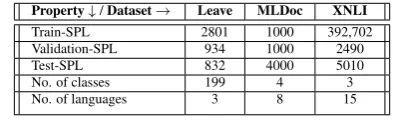
Table 3: Dataset description. SPL refers to Samples Per Language
Property↓/Dataset→ Leave MLDoc XNLI
Train-SPL 2801 1000 392,702
Validation-SPL 934 1000 2490
Test-SPL 832 4000 5010
No. of classes 199 4 3
No. of languages 3 8 15
4 Experiments and Results
In this section, we describe the various datasets and also give details of the different hyper-parameters of the models used in our experiments. We later present all the results and note some key observations from them.
4.1 Dataset Description
We evaluate proposed approaches on three datasets as shown in Table3.
Leave dataset (Khurana et al., 2017) is created by HR domain experts in English and for our pur-pose, we translate training and validation set in target languages (Arabic and Spanish) using MT, while test set is translated by respective target lan-guage experts.
MLDoc3(Schwenk and Li,2018) is a four class, multilingual document classification dataset con-taining news stories in eight languages, where stories in target languages are written by respec-tive target language experts. Similar to (Wu and Dredze, 2019), we take first two sentences from each document in our experiments and use NLTK4 for sentence tokenization.
3
https://trec.nist.gov/data/reuters/ reuters.html
4https://www.nltk.org/
The Cross-lingual Natural Language Inference (XNLI) (Conneau et al.,2018) dataset is an exten-sion of Multi-Genre Natural Language Inference (MultiNLI)5corpus, where objective is to classify a pair of sentences (premise and hypothesis) in one of the three classes. Validation and test set are translated by domain experts and the training set by a machine translation system in 14 target lan-guages.
4.2 Training Details
For training Watt, the final hyper-parameters are selected from the sets as mentioned in (Khurana et al.,2017). The datasets mentioned in the Table 3are not pre-processed in any form during our ex-periments. All the final hyper-parameters are se-lected based on the performance on a validation set. We use Adam (Kingma and Ba,2014) for op-timization and dropout for regularization (Srivas-tava et al.,2014). The batch size is selected from the set{16, 32}.
We use multilingual variants of PLRMs, viz. BERT6, XLM(MLM+TLM)7 (Lample and Con-neau,2019) and LASER8(Artetxe and Schwenk, 2018) in our experiments.
MCT-MSR The number of hidden units and layers are selected from the sets {512, 1024,
5
https://www.nyu.edu/projects/bowman/ multinli/
6
https://storage.googleapis.com/bert_ models/2018_11_23/multi_cased_L-12_ H-768_A-12.zip
7
https://dl.fbaipublicfiles.com/XLM/ mlm_tlm_xnli15_1024.pth
8https://github.com/facebookresearch/
[image:4.595.79.276.324.385.2]Table 4: We compare the results ofFine-tuningvsPre-training followed by Fine-tuningof various models on “Leave Dataset”. For MCT we use BERT as a PLRM. Bold with∗ denotes the best and underline denotes the second best average classification accuracy on test set.
Language Code Fine-tuning Pre-training followed by Fine-tuning
Z-shot T-train T-test MCT-FT (Ours) Z-shot T-train T-test MCT-PT-FT (Ours)
en 90.0 90.0 90.0 89.8 90.3 90.3 90.3 90.5
ar 9.4 44.9 44.4 56.5 10.9 44.9 44.8 59.4
es 26.5 78.5 58.5 81.8 30.8 79.2 60.0 86.4
Average 42.0 71.1 64.3 76.0∗ 44.0 71.5 65.0 78.8∗
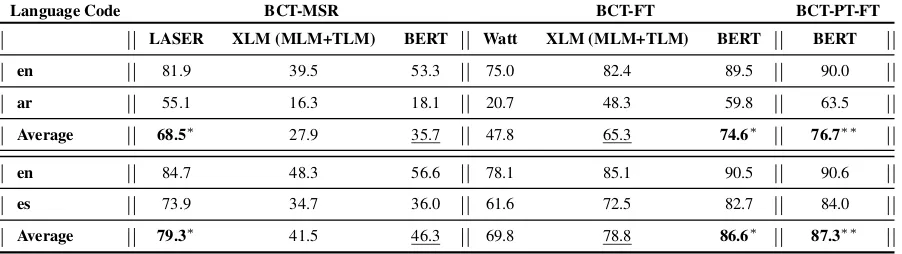
Table 5: We compare the results of different approaches to bilingual co-training (BCT) on “Leave Dataset”. We use LASER (Artetxe and Schwenk,2018), BERT (Devlin et al.,2019) and XLM (MLM+TLM) (Lample and Conneau, 2019) as PLRMs. Bold with∗ denotes the best and underline denotes the second best average classification accuracy on test set for each approach. Bold with∗∗denotes the overall best. The first three rows showcase results of the billingual models created on en-ar pair and later 3 rows on en-es pair.
Language Code BCT-MSR BCT-FT BCT-PT-FT
LASER XLM (MLM+TLM) BERT Watt XLM (MLM+TLM) BERT BERT
en 81.9 39.5 53.3 75.0 82.4 89.5 90.0
ar 55.1 16.3 18.1 20.7 48.3 59.8 63.5
Average 68.5∗ 27.9 35.7 47.8 65.3 74.6∗ 76.7∗∗
en 84.7 48.3 56.6 78.1 85.1 90.5 90.6
es 73.9 34.7 36.0 61.6 72.5 82.7 84.0
Average 79.3∗ 41.5 46.3 69.8 78.8 86.6∗ 87.3∗∗
2048} and {1, 2} respectively with tanh as the non-linearity. The learning rate and dropout are selected from the sets{1e−2,1e−3}and{0.1, 0.2, 0.3}respectively.
MCT-FT For fine-tuning of PLRMs based on the end task, we use dropout of0.1and the learn-ing rate is selected from the set{2e-5, 3e-5, 5e-5}. For MLDoc dataset, we also use L2 weight de-cay of0.01in addition to dropout for regulariza-tion. For XNLI (Conneau et al.,2018) and ML-Doc (Schwenk and Li, 2018) datasets, the num-ber of epochs for fine-tuning are selected from the set{3,4}. However for Leave dataset due to high number of classes and small data size, we have used early stopping.
MCT-PT-FTTo utilize domain-specific corpus i.e., policy documents, we have run additional steps of pre-training starting from the existing Multilingual BERT model. We have used a mask-ing probability of0.15, learning rate of2e−5,50% noise for data creation for NSP, batch size of 32 and a maximum of20masked LM predictions per sequence. The number of epochs for pre-training of BERT are selected from the set{5, 10, 15}.
4.3 Results And Discussion
In this work, we compare proposed approaches with existing baselines. For fair comparison, we compare proposed approaches with existing base-lines under different scenarios, i.e. use of PLRMs with/without finetuning and/or pre-training. In all our experiments we assume that the accuracy of the language detection (LD) module is100%. This is not an unreasonable assumption, as IP address, employee number, scripts and vocabulary can all be used together for language detection.
[image:5.595.76.527.270.397.2]Table 6: We compareMCT-FTwith the existing baselines on “MLDoc” (Schwenk and Li,2018) Dataset. We use BERT (Devlin et al.,2019;Wu and Dredze,2019) as a PLRM for MCT-FT. Bold with∗ denotes the best classification accuracy on test set for each language and also for the average across all languages.
Language Code Z-shot T-train MCT-FT(Ours)
MLDoc LASER BERT MLDoc BERT BERT
en 92.2 89.9 94.2 92.2 94.2 94.3∗
de 81.2 84.8 80.2 93.7 93.3 96.6∗
zh 74.7 71.9 76.9 87.3 89.3 91.7∗
es 72.5 77.3 72.6 94.5 95.7 96.0∗
fr 72.4 78.0 72.6 92.1 93.4 94.2∗
it 69.4 69.4 68.9 85.6 88.0∗ 87.7
ja 67.6 60.3 56.5 85.4 88.4 89.6∗
ru 60.8 67.8 73.7 85.7 87.5 87.7∗
Average 73.9 74.9 74.5 89.5 91.2 92.2∗
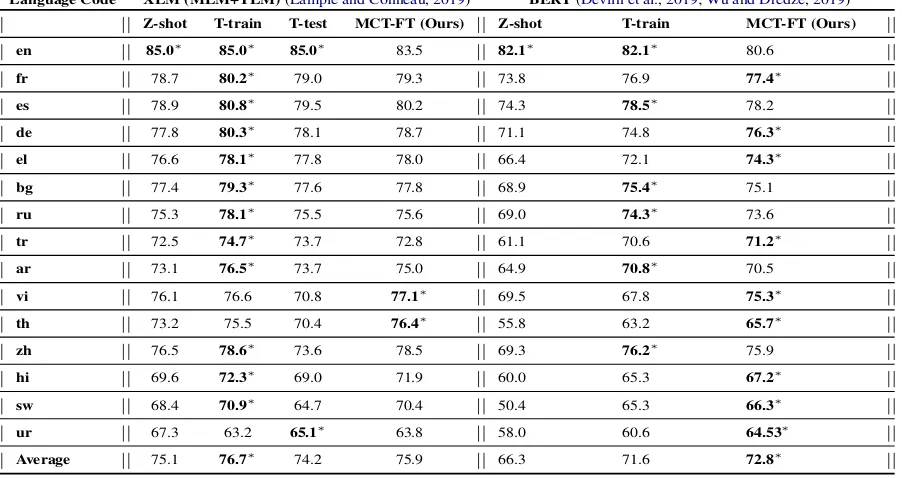
Table 7: We compareMCT-FT (Ours) with the existing baselines on “XNLI Dataset” (Conneau et al.,2018) Dataset. We use BERT and XLM (MLM+TLM) as PLRMs forMCT-FT (Ours). Bold with∗denotes the best classification accuracy on test set for each language and also for the average across all languages.
Language Code XLM (MLM+TLM)(Lample and Conneau,2019) BERT(Devlin et al.,2019;Wu and Dredze,2019)
Z-shot T-train T-test MCT-FT (Ours) Z-shot T-train MCT-FT (Ours)
en 85.0∗ 85.0∗ 85.0∗ 83.5 82.1∗ 82.1∗ 80.6
fr 78.7 80.2∗ 79.0 79.3 73.8 76.9 77.4∗
es 78.9 80.8∗ 79.5 80.2 74.3 78.5∗ 78.2
de 77.8 80.3∗ 78.1 78.7 71.1 74.8 76.3∗
el 76.6 78.1∗ 77.8 78.0 66.4 72.1 74.3∗
bg 77.4 79.3∗ 77.6 77.8 68.9 75.4∗ 75.1
ru 75.3 78.1∗ 75.5 75.6 69.0 74.3∗ 73.6
tr 72.5 74.7∗ 73.7 72.8 61.1 70.6 71.2∗
ar 73.1 76.5∗ 73.7 75.0 64.9 70.8∗ 70.5
vi 76.1 76.6 70.8 77.1∗ 69.5 67.8 75.3∗
th 73.2 75.5 70.4 76.4∗ 55.8 63.2 65.7∗
zh 76.5 78.6∗ 73.6 78.5 69.3 76.2∗ 75.9
hi 69.6 72.3∗ 69.0 71.9 60.0 65.3 67.2∗
sw 68.4 70.9∗ 64.7 70.4 50.4 65.3 66.3∗
ur 67.3 63.2 65.1∗ 63.8 58.0 60.6 64.53∗
Average 75.1 76.7∗ 74.2 75.9 66.3 71.6 72.8∗
multiple languages.
MCT-FT vs BaselinesIn second scenario (fine-tuning of PLRMs), we fine-tune PLRMs as de-scribed in subsection 3.2. However, Watt is not based on PLRMs and for comparison we train it from scratch as described in (Khurana et al., 2017). As LASER (Artetxe and Schwenk,2018) is typically used to obtain MSRs, we have not con-sidered it for comparison here. According to Ta-ble2, for Leave dataset, proposed approach MCT-FT performs significantly better than baseline ap-proaches in all cases and for BERT we gain4.9% in terms of average classification accuracy com-pared to translate-train. For MLDoc dataset we achieve better accuracy in seven out of eight
lan-guages with1.0%average improvement over ex-isting baselines as shown in Table 6. According to Table7, for XLM, baseline translate-train per-forms better than the proposed approach by0.8%. However, in case of BERT we achieve better ac-curacy in nine out of fifteen languages with an im-provement of1.2%in terms of average classifica-tion accuracy compared to translate-train.
[image:6.595.76.527.299.538.2]baselines and as well as the proposed approach MCT-PT-FT. According to Table 4, MCT-PT-FT outperforms translate-train by a margin of 7.3% and gains an improvement of2.8%over MCT-FT. MCT-PT-FT was tested on Leave dataset only as for other datasets their domain-specific unlabeled text corpora were unavailable.
Bilingual Co-training (BCT) For complete-ness, we also report results on bilingual co-training which is type of MCT, where unlike bilin-gual joint-training we use machine translated data for target language. According to Table5, BERT based MCT-PT-FT performs better for both lan-guage pairs i.e., en-es and en-ar as compared to MCT-MSR and MCT-FT.
Does noisy translation affect MCT ?
It is interesting to note, from Table4, the gains obtained by MCT-PT-FT over Translate-train on Spanish (es) (86.4%over79.2%) and Arabic (ar) (59.4% over 44.9%). Apart from these gains in performance, the poorer performance on ar
compared to es can be attributed to the noise induced by MT when translating the domain-specific words from English to target languages. To verify this, we translate the test set of English into es and ar (one set for each) using MT. We then evaluate the performance of MT in terms of BLEU (Papineni et al., 2002) score by consider-ing the manually labeled test sets ofesandaras the reference translations. These are found to be 40.0forarand63.0fores, further validating our observation regarding the noisy MT system. In fu-ture, one can consider approaches which compen-sate for the translator noise. For example, during MCT one could use different weights for each lan-guage in the cost function.
5 Related Work
In this section, we provide an outline of existing FAQ assistants, followed by an overview of the re-cent work on multilingual language modelling and cross-lingual transfer methods.
5.1 FAQ Assistants
Recent years have seen significant advances in conversational systems, with various models con-sidering context, affect, goal, external knowledge etc. However, all these systems can be categorized into two types i.e. those which seek to generate responses or those which use a retrieval based ap-proach. (Zhou et al., 2018;Pei and Li,2018) are
examples where the ability to generate responses is learnt from patterns in dialogues found in the training set. On the contrary, there exist several in-dustrial scenarios where the domain is sufficiently restricted, or there exist legal ramifications asso-ciated with the responses, and hence pre-defined answers are preferred. Therefore, research on re-trieval based conversational models continues to be active, for example see (Das et al.,2016; Lai et al.,2015). Our work builds upon the retrieval-based model for a domain-specific leave dataset used in (Khurana et al.,2017), where a Bi-LSTM based architecture was employed.
Multilingual and cross-lingual conversational models for virtual assistants are an emerging field of research. Some research work has been done to capture different languages in one conversational system. In (Gupta et al., 2018), machine trans-lation and information retrieval approaches were used for multilingual question answering in En-glish and Hindi languages. In (Schuster et al., 2019), the authors use different cross-lingual em-beddings eg. XLU (Schuster et al.,2019), ELMo (Peters et al.,2018), CoVe (McCann et al.,2017), etc. for cross-lingual learning in English, Spanish and Thai. In this paper, we propose an approach to extend an FAQ system to other languages such as Arabic and Spanish.
5.2 Multilingual Sentence Representation
BERT, XLM models (Devlin et al.,2019;Lample and Conneau,2019;Artetxe and Schwenk,2018) as base models and further fine-tune them with domain-specific and task-specific data.
5.3 Cross-Lingual Transfer
For low resource languages, due to insufficient (or no) data availability, it is difficult to get good task-specific accuracies. In case of complete unavail-ability of low resource language data, various ap-proaches are defined in the literature: (i) zero-shot approaches, which train task-specific models on high resource languages and then use these mod-els directly for low resource languages (Artetxe and Schwenk,2018). (ii) Using predefined word or sentence embeddings (Schwenk and Li,2018). (iii) Making use of translated high resource lan-guage data for training a low resource lanlan-guage model (Schuster et al., 2019). For cases where a small amount of low resource language data is available, there are approaches which make use of joint training using high resource language data augmented with a small amount of target (low re-source) language data, which leads to better task-specific accuracy for target languages than zero shot (Upadhyay et al.,2018a,b). These approaches are applicable for the bi-lingual as well as mul-tilingual settings. There are studies which help determine the applicability of using a particular high resource source language for a (set-of) low resource target language(s) (Lin et al.,2019). Our work is inspired by the joint-training approach of cross-lingual transfer, however, we assume un-availability of target language data and use ma-chine translations for the same.
6 Conclusions and Future Work
There are a few baseline observations that need to be highlighted before commenting upon the key conclusions about the proposed “Multi-lingual Co-training”. With regards to our Multilingual FAQ bot, when compared with Watt (Khurana et al.,2017), it seems that the use of PLRMs can improve the performance even for English. There-fore, it was reasonable to base the study in this work on the three recently proposed PLRMs, viz. LASER, BERT and XLM. With regards to cross-lingual transfer, if one were to use the PLRMs purely as feature extractors, then LASER provide the best baselines. Meanwhile, if one were to allow fine-tuning, then BERT provides the best
baselines. In both cases the best baseline is pro-vided by Translate-Train. The proposed variants MCT-MSR of LASER and MCT-FT of BERT are able to beat the corresponding baselines. In fact, one can observe that while Watt and XLM do not provide the best baselines for fine-tuning, even for these models, multilingual co-training does help. Finally, we explored the use of pre-training in the multilingual setting. While human translations have been used by LASER, the use of machine translations as a self-supervised language model-ing task has not been explored in the past. Trans-lation noise can potentially lead to a lot of er-ror propagation. However, we observed that use of translations for pre-training provides the best baseline with BERT, and a joint multilingual pre-training is able to beat this baseline.
As a part of the future work, we would like to explore distinct strategies for a further boost in the performance. We comment upon a few possibil-ities. (1) The essence of MCT lies in the use of target language translations. Translator noise can have a big impact on the performance, and training bias in favor of a particular language. We believe that there are several approaches that can be at-tempted to overcome such a challenge. One could identify a set of languages that can mutually ben-efit from and share a quality MT. Thus, instead of training a single model for all languages, one could train a model for each set. One can also bias the cost function by using language-specific weights; these weights could potentially be used to model translator noise. One could also use a training schedule (along with adapting the learn-ing rate) instead of weights to bias the trainlearn-ing in favor of a language or language set. (2) Finally, we admit, for the purposes of illustration, we have made a rather strict assumption of zero human-translated data. It remains of interest to explore the impact of a small volume of human translated data on the performance of MCT, further whether an MCT can be used to sample queries which if translated by a human can help to maximally boost performance, in an active learning framework.
References
Mikel Artetxe and Holger Schwenk. 2018. Mas-sively multilingual sentence embeddings for zero-shot cross-lingual transfer and beyond.CoRR.
Proceedings of the 2018 Conference on Empirical Methods in Natural Language Processing.
Arpita Das, Harish Yenala, et al. 2016. Together we stand: Siamese networks for similar question re-trieval. InProceedings of the 54th Annual Meeting of the Association for Computational Linguistics.
Jacob Devlin et al. 2019. BERT: pre-training of deep bidirectional transformers for language understand-ing. In Proceedings of the 2019 Conference of the North American Chapter of the Association for Computational Linguistics: Human Language Tech-nologies.
Akiko Eriguchi, Melvin Johnson, et al. 2018. Zero-shot cross-lingual classification using multilingual neural machine translation. CoRR.
Deepak Gupta, Surabhi Kumari, et al. 2018. MMQA: A Multi-domain Multi-lingual Question-Answering Framework for English and Hindi. InProceedings of the Eleventh International Conference on Lan-guage Resources and Evaluation (LREC 2018).
Karl Moritz Hermann and Phil Blunsom. 2014. Multi-lingual models for compositional distributed seman-tics. InProceedings of the 52nd Annual Meeting of the Association for Computational Linguistics.
Prerna Khurana, Puneet Agarwal, et al. 2017. Hybrid bilstm-siamese network for faq assistance. In Pro-ceedings of the 2017 ACM on Conference on Infor-mation and Knowledge Management (CIKM 2017).
Diederik P. Kingma and Jimmy Ba. 2014. Adam: A method for stochastic optimization.CoRR.
Siwei Lai, Liheng Xu, et al. 2015. Recurrent convo-lutional neural networks for text classification. In Proceedings of the Twenty-Ninth AAAI Conference on Artificial Intelligence.
Guillaume Lample and Alexis Conneau. 2019. Cross-lingual language model pretraining. CoRR.
Yu-Hsiang Lin, Chian-Yu Chen, et al. 2019. Choosing transfer languages for cross-lingual learning. InThe 57th Annual Meeting of the Association for Compu-tational Linguistics (ACL).
Bryan McCann, James Bradbury, et al. 2017. Learned in translation: Contextualized word vectors. In Ad-vances in Neural Information Processing Systems.
Kishore Papineni, Salim Roukos, Todd Ward, and Wei-Jing Zhu. 2002. Bleu: A method for automatic eval-uation of machine translation. InProceedings of the 40th Annual Meeting on Association for Computa-tional Linguistics.
Jiaxin Pei and Chenliang Li. 2018. S2SPMN: A sim-ple and effective framework for response generation with relevant information. In Proceedings of the 2018 Conference on Empirical Methods in Natural Language Processing.
Matthew Peters, Mark Neumann, et al. 2018. Deep contextualized word representations. In Proceed-ings of the 2018 Conference of the North American Chapter of the Association for Computational Lin-guistics: Human Language Technologies, Volume 1 (Long Papers).
Sebastian Schuster, Sonal Gupta, et al. 2019. Cross-lingual transfer learning for multiCross-lingual task ori-ented dialog. In Proceedings of the 2019 Confer-ence of the North American Chapter of the Associ-ation for ComputAssoci-ational Linguistics: Human Lan-guage Technologies.
Holger Schwenk and Xian Li. 2018. A corpus for multilingual document classification in eight lan-guages. In Proceedings of the Eleventh Interna-tional Conference on Language Resources and Eval-uation (LREC-2018).
Holger Schwenk, Ke Tran, et al. 2017. Learning joint multilingual sentence representations with neu-ral machine translation.CoRR.
Nitish Srivastava, Geoffrey E Hinton, et al. 2014. Dropout: a simple way to prevent neural networks from overfitting. Journal of Machine Learning Re-search.
Shyam Upadhyay, Manaal Faruqui, et al. 2018a. (al-most) zero-shot cross-lingual spoken language un-derstanding. InProceedings of the IEEE ICASSP.
Shyam Upadhyay, Nitish Gupta, et al. 2018b. Joint multilingual supervision for cross-lingual entity linking. InProceedings of the 2018 Conference on Empirical Methods in Natural Language Process-ing.
Shijie Wu and Mark Dredze. 2019. Beto, bentz, be-cas: The surprising cross-lingual effectiveness of bert. CoRR.
Katherine Yu, Haoran Li, et al. 2018. Multilin-gual seq2seq training with similarity loss for cross-lingual document classification. InThe 56th Annual Meeting of the Association for Computational Lin-guistics.