1
2
3
4
5
6
Answer: Cooling
Explanation
Question: Rain changed into hail.
What likely caused this change?
Answer: A liquid
Explanation
Question: What state of matter was
steam before being boiled on a stove?
Semi-structured Explanation Corpus
(WorldTree)
Automatically generate subgraphs
from explanations
Subgraphs merged and curated by a human using tool
Common subgraphs in larger graph
highlighted by human
Subgraphs converted into executable
constraint patterns
(”Inference Patterns”)
Use Inference Patterns to combine
information to answer and explain
unseen questions.
SOUR
CE
SY
NON
YM
CHANGE
KINDOF
REQUIRE
KINDOF
freezing changes from liquid to solid
boiling changes from liquid to gas
melting changes from solid to liquid
condensing requires cooling
freezing requires cooling
boiling requires heating
ice cream is a kind of solid
water is a kind of liquid
popsicles are a kind of solid
steam is a kid of gas
ice is a kind of solid
water is a kind of liquid
a stove is a source of heat
a fire is a source of heat
a freezer is a source of cooling
frozen rain is called hail
frozen CO2 is called dry ice
melting snow is called slush
CHANGE
KINDOF
KINDOF
melting changes from solid to liquid
ice cream is a kind of solid
popsicles are a kind of solid
water is a kind of liquid
CHANGE
KINDOF
popsicles are a kind of solid
freezing changes from liquid to solid
REQUIRE
freezing requires cooling
CHANGE
boiling changes from liquid to gas
KINDOF
steam is a kid of gas
<COS>
changes from
<State1>
to
<State2>
(Material) is a kind of
<State2>
(Material) is a kind of
<State1>
<COS>
requires (heating/cooling)
ice cream is a kind of solid
melting changes from solid to liquid
cream is a kind of liquid
melting requires heat
a sunlight is a source of heat
frozen rain is called hail
water is a kind of liquid
freezing changes from liquid to solid
ice is a kind of solid
freezing requires cooling
water is a kind of liquid
boiling changes from liquid to gas
steam is a kind of gas
boiling requires heat
a stove is a source of heat
Answer:
Addition of heat
Explanation
Question:
A bowl of ice cream melted
[image:2.595.73.531.62.279.2]
in the sun. What likely caused this?
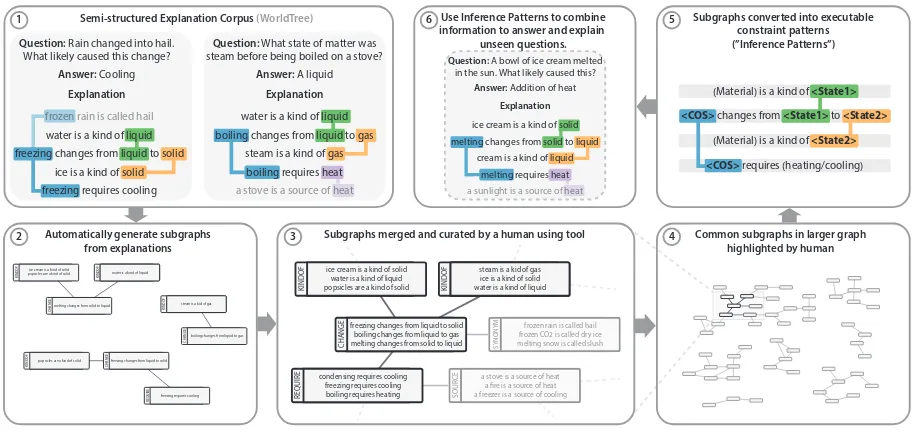
Figure 1:
An overview of our inference pattern extraction approach. A corpus of semi-structured explanations (2) is preprocessed
through a set of heuristics that generate a large number of small (often disconnected) subgraphs in a large graph (2). Those
subgraphs are merged and curated (3). Inference patterns, or subgraphs of nodes can then be extracted from the curated graph, by
the user (4). These patterns for executable constraint satisfaction patterns that can be executed over the knowledge base (5). In
this work we address steps 2 through 5, whereas using these inference patterns to answer and explain unseen questions (6) is part
of ongoing efforts.
a detailed explanation for their reasoning (
Jansen
et al.
,
2018
,
2016
), and such a low probability of
successfully traversing the knowledge graph places
strong limits on the length of inferences that can
be made (
Khashabi et al.
,
2019
). In response to
this challenge, a number of datasets such as
Hot-potQA (
Yang et al.
,
2018
) and WorldTree (
Jansen
et al.
,
2018
) have emerged to provide explicit gold
explanations that serve as training and evaluation
instruments for multi-hop inference models.
Jansen (
2017
) proposed combining “common
explanatory patterns”, or groups of frequently
inter-connected facts observed in explanations, as a
pos-sible means of mitigating the semantic drift
associ-ated with combining facts one at a time.
Human-authored explanations contain meaningful
connec-tions between their component facts. Each edge
in an explanatory pattern extracted from a
human-authored explanation is a high-confidence edge that
does not require a solver to use other more noisy
signals (such as lexical overlap) to populate,
reduc-ing the opportunity for semantic drift. An empirical
evaluation using the WorldTree explanation corpus
demonstrated that this approach could in principle
regenerate the majority of unseen gold
explana-tion graphs by using only 2 or 3 hops between
these “explanatory pattern” subgraphs, which is
substantially fewer hops than the up to 16 hops
required if aggregating single facts. The
disadvan-tages of this technique are that (a) it requires the
(currently manual) construction of a large corpus
of detailed explanations to learn these common
explanatory patterns from, which is an expensive
process, and (b) it requires developing automatic
or semi-automatic methods to abstract the structure
of training explanations to mitigate sparsity and
allow known explanations to generalize to unseen
scenarios.
In this work, we explore a hybrid
human-in-the-loop method and tool for abstracting the
struc-ture of common explanatory patterns found in the
WorldTree corpus of structured explanations. We
use this tool to extract 67 inference patterns,
speci-fied as constraint satisfaction patterns over a
knowl-edge base of tables, from detailed explanations to
standardized elementary science exam questions.
Our long-term interests are in generating a corpus
of common inference patterns at scale, and
con-structing an inference system that combines and
uses those patterns to answer questions and produce
detailed explanations for its answers. Conceptually,
this is similar to Explanation-Based Learning (
De-Jong and Mooney
,
1986
;
Baillargeon and DeJong
,
Grid Selector
Display edges from
Table X to Table Y
Graph Node
Indices
Regrouping
Controls
Column Edge Viewer and Editor
(manually edit edge constraints)
Observed Edges in Explanation Corpus
(from one fact, to another fact)
Plain text
Edge Label
(Optional)
Grouped Facts
Each colored
group represents
one edge
(and two nodes)
Nodes
represent
one or more
facts from a
single table
Edges
represent facts
in two tables
connecting
if they meet
specific
constraints
[image:5.595.77.521.60.448.2]
Graph Layout
Controls
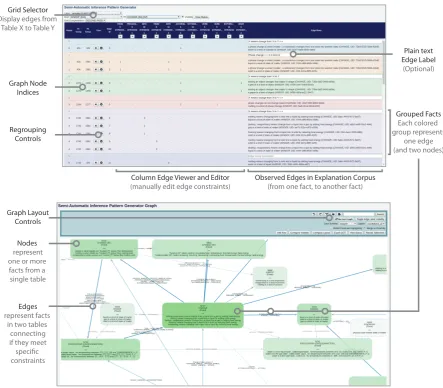
Figure 2:
A screenshot of the grid view (top) and graph view (bottom) of our inference pattern extraction tool. The constraint
view and the tablestore spreadsheet integration are not shown for space.
rows) together to perform the fact clustering
proce-dure. The graph view also allows the annotator to
highlight specific subgraphs to mark as inference
patterns, which enables further functionality in the
constraint view.
Grid View:
The grid view enables the curation
of the edges between nodes by visually displaying
them in an interface that allows the user to (a)
re-move automatically populated edges that are not
meaningful, (b) remove only part of edges (i.e.
spe-cific links between columns between two tables),
and (c) manually edit the automatic clustering by
dragging and dropping specific rows in one edge
group either into another existing group, or into a
new group.
Constraint View:
Once a user has identified and
marked a subgraph to extract as an inference
pat-tern, the constraint view allows “running” that
infer-ence pattern to generate all possible sets of rows in
the tablestore that satisfy that pattern’s constraints.
As subgraphs extracted directly from the large
cu-rated graph built from the explanation corpus tend
to require edits to their nodes and constraints before
they are generic and runnable inference patterns,
the constraint view also includes a number of
de-bugging tools to facilitate diagnosing constraints
that are unable to be satisfied.
3
Table View:
The tool also includes an interface to
a Google Sheet
4
storing a live copy of the
Table-store that the annotator can edit to refine existing
knowledge, or incorporate additional knowledge,
while curating and debugging inference patterns.
The tool runs in a Chrome browser window, and
is implemented as a Javascript application with
a node.js backend server. We make use of
Cy-3
We include exports from the constraint view tool for all
extracted patterns in our supplementary material.
Measure
Count
Graph Nodes:
Nodes before merging
700
Nodes after merging
540 (77%)
Graph Edges:
Edges before curation
637
Edges after curation
771 (21%)
Grid Row-to-Row Connections:
Row-to-row connections before curation
1384
Row-to-row connections modified
631 (46%)
Row-to-row connections removed
224 (16%)
Grid Edge Constraints:
[image:6.595.309.523.71.368.2]
Edge constraints before curation
2101
Edge constraints removed
133 (6%)
Edge constraints marked optional
27 (1%)
Table 2: Manual edits done to the automatically
gen-erated graph and grid during the merging and curation
steps. Values in parentheses represent percent change.
toscape.js (
Franz et al.
,
2015
) as a graph
visual-ization plugin, while primarily using the
CoSE-Bilkent graph layout algorithm (
Dogrusoz et al.
,
2009
) modified to allow variable edge lengths
based on the maximum degree of connected nodes
to make the graph easier to visualize when
assem-bling densely-connected patterns. The tool was
iterated for usability to maximize throughput for
the merging and curation steps, and includes
func-tionality for quickly finding knowledge in the graph
while seamlessly moving between graph
(graphi-cal) and grid (tabular) views, filtering subsets of
nodes and edges by various metrics (completeness,
table connection, user-selected utility rating), and
keeping track of where the annotator is in the
cu-ration workflow. A Scala preprocessing tool reads
in gold explanations (which can be filtered to
in-clude only subsets of questions by a question
clas-sification label, such as only
matter,
energy, or
life science
questions), applies the initial
cluster-ing heuristics, and outputs tab delimited files that
are then read in by the tool. Edges between rows
in WorldTree are determined by rows have
over-lapping content lemmas (defined as nouns, verbs,
adjectives, or adverbs), with Stanford CoreNLP
(
Manning et al.
,
2014
) used for lemmatization and
POS tagging.
3
Preliminary Evaluation
To evaluate the utility of our approach, we made use
of the tool to extract inference patterns present in
all questions in the training subset of the WorldTree
corpus categorized as belonging to the
Matter
topic,
one of the 9 broad science curriculum categories of
question topics, using the ARC question
classifica-Inference Pattern
Nodes
Edges
Alloys
5
4
Altitude*
8
10
Building requires measuring
11
13
Burning-Preventing Harm
12
15
Change of State
68
128
Chemical Changes
11
12
Containers contain things
6
6
Cooking Food
9
11
Electrical Conductivity
27
52
Friction
15
24
General Motion*
3
3
Ice Wedging*
4
4
Long lasting vs replacing*
5
4
Magnetism
14
20
Manufacturers use mats. for products
5
5
Measurements
22
34
Navigation lost at sea
6
7
Physical Changes
13
14
Seeing
19
29
Soil erosion*
6
6
Solutions - Dissolving substances*
4
5
Sources of Heat*
3
2
Sunlight as a source of energy*
14
30
Sunlight location and shadow size*
7
7
Taste*
9
11
Taxonomic Inheritance
2
1
Texture*
4
3
Thermal Conductivity
27
34
[image:6.595.74.291.73.224.2]
Touch-Hardness*
4
3
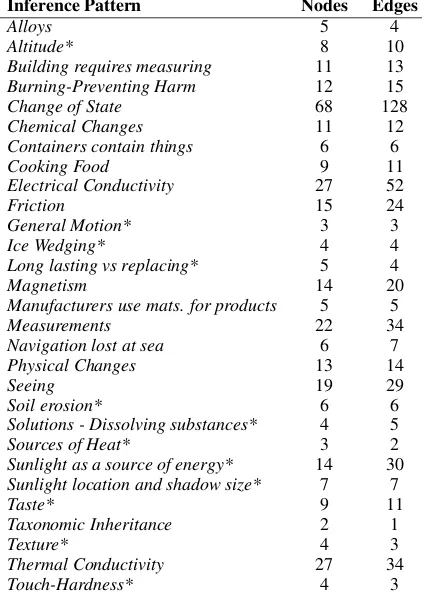
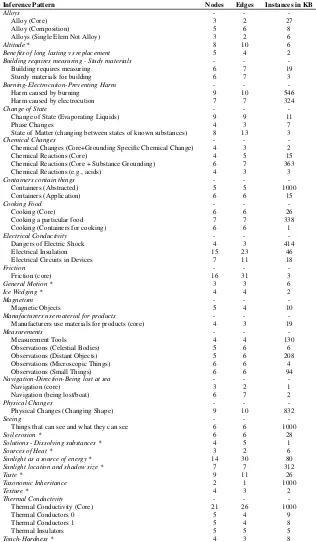
Table 3: A list of high-level inference patterns
discov-ered in the corpus of explanations for
Matter
science
exam questions using this tool. A full list of patterns is
provided in Table
5
(see
Appendix
). An asterisk (
*
)
signifies patterns that are partial or otherwise limited in
size because they overlap with other topics (e.g. from
Earth or Life Science) not examined in this preliminary
study.
tion labels of Xu et al. (
2019
). This represents 43
of 902 (5%) of questions and explanations in the
training corpus, covering topics such as Changes
of State of Matter
(e.g. melting, boiling),
Measur-ing Properties of Matter
(e.g. temperature, mass),
Physical vs Chemical Changes
(e.g. length vs
com-position), Properties of Materials
(e.g. electrical or
thermal conductivity, taste), Properties of Objects
(e.g. shape or volume), and Mixtures
(e.g. alloys).
3.1
Initial merging and curation
The preprocessing procedure generated 273 grids
for this subset of the explanation corpus,
represent-ing the specific pairs of tables (e.g. KINDOF
↔
[image:6.595.310.521.74.373.2]
MATERIAL NAME(0) ↔ MATERIAL NAME(0)
INTO(10) ↔ STATEOFMATTER(2)
HYPONYM(1) ↔ STATEOFMATTER(2)
PROCESS_NAME(0) ↔ PROCESS_NAME/ ACTION(0)
FROM(8) ↔ AGENT/OBJECT(3)
DIRECTION(7) ↔ PROCESS_NAME/ ACTION(0)
BY/THROUGH/HOW(14) ↔ DIRECTION(7)
BY/THROUGH/HOW(14) ↔ PATIENT(10)
INTO(10) ↔ HYPONYM(1)
FROM(8) ↔ HYPONYM(1)
AGENT/OBJECT(3) ↔ STATEOFMATTER(2)
(Change of state) means
FROM(8) ↔ STATEOFMATTER(2)
HYPONYM(1) ↔ STATEOFMATTER(2)
N821
KINDOF
***
liquid is a kind of state of matter
solid is a kind of state of matter
gas is a kind of state of matter
N823
CHANGE
***
boiling;evaporation means change from a liquid into a gas by adding heat energy
melting means changing from a solid into a liquid by adding heat energy
condensing means changing from a gas into a liquid by removing heat energy
N822
CHANGE-VEC
***
condensing is when gasses are cooled below their boiling point
boiling is when liquids are heated above their boiling point
melting is when solids are heated above their melting point
N813
KINDOF
***
liquid is a kind of state of matter
gas is a kind of state of matter
solid is a kind of state of matter
N824
PROTO-PROP-STATESOFMATTER1
***
water is in the liquid state , called liquid water , for temperatures between 273; 32; 0 and 373; 212; 100 K; F; C
water is in the gas state , called water vapor , for temperatures between 373; 212; 100 and 100000000000 K; F; C
water is in the solid state , called ice , for temperatures between 0; -459; -273 and 273; 32; 0 K; F; C
N820
CHANGE-VEC
***
cooling;colder means removing; reducing; decreasing; subtracting heat; temperature; thermal energy; heat energy
heating means adding; increasing heat; temperature; thermal energy; heat energy
N815
PROTO-PROP-STATESOFMATTER1
***
water is in the gas state , called water vapor , for temperatures between 373; 212; 100 and 100000000000 K; F; C
water is in the liquid state , called liquid water , for temperatures between 273; 32; 0 and 373; 212; 100 K; F; C
water is in the solid state , called ice , for temperatures between (0 ; -459 ; -273) and (273 ; 32 ; 0) (K ; F ; C)
HYPERNYM(4) ↔ OBJECT(2)
HYPONYM(1) ↔ ISMADEOF(6)
HYPERNYM(4) ↔ ISMADEOF(6)
HYPERNYM(4) ↔ ISMADEOF(6)
HYPONYM(1) ↔ OBJECT(2)
HYPONYM(1) ↔ ISMADEOF(6)
N1304
KINDOF
***
zinc is a kind of metal
N1307
MADEOF
***
brass is made of copper and zinc
N1310
KINDOF
(Fixed)
***
brass is a kind of alloy
bronze is a kind of alloy
N1311
MADEOF
(Fixed)
***
alloys are made of two or more metals
N1306
KINDOF
***
copper is a kind of metal
Alloys (composition)
HYPONYM(1) ↔ THING(2)
HYPONYM(1) ↔ ACTOR/AGENT/PROCESS(16)
HYPERNYM(4) ↔ AGENT/OBJECT(6)
HYPERNYM(4) ↔ OBJECT/PROPERTY(10)
HYPERNYM(4) ↔ THING(2)
HYPERNYM(4) ↔ ACTOR/AGENT/PROCESS(16)
HYPERNYM(4) ↔ OBJECT/PROPERTY(10)
HYPONYM(1) ↔ AGENT/OBJECT(6)
N1255
KINDOF
(Fixed)
***
a container is a kind of object
N1256
PROTO-ACTION
(Fixed)
Role of a container
***
a container contains (objects ; material ; substances)
N1254
PROTO-IF-THEN
(Fixed)
***
if a container contains something then that container touches that something
N1253
KINDOF
***
metal is a kind of material
gas is a kind of substance
N1252
KINDOF
Kinds of Containers
***
a (pan ; frying pan) is a kind of container for (cooking ; food)
Containers contain objects/materials
Connect on 'phase change' and 'change'
RESULT_AGENT(9) ↔ PROCESS_NAME(0)
[CONDITION_VERB(3) ↔ VERB(5)]
X means changing ... <-> X is a kind of phase change
PROCESS_NAME(0) ↔ HYPONYM(1)
Connect on 'phase change'
PROCESS_NAME(0) ↔ HYPERNYM(4)
N834
CHANGE
(Fixed)
***
a phase change is when matter; a substance changes from one state into another state
N829
CAUSE
(Fixed)
***
temperature changing can cause phase changes
N833
CHANGE
Change of State
***
melting means changing from a solid into a liquid by adding heat energy
N835
KINDOF
Phase Changes
***
melting is a kind of phase change
Phase Changes
ACTION(5) ↔ FOR/PURPOSE(6)
ACTION(20) ↔ ACTION(5)
x
HYPERNYM(4) ↔ AGENT/THING WHO USES(9)
OBJECT/PATIENT(9) ↔ BY/THROUGH/HOW(11)
SCOPE(11) ↔ AGENT/OBJECT(2)
ACTION(20) ↔ FOR/PURPOSE(6)
HYPERNYM(4) ↔ THING(2)
HYPERNYM(4) ↔ ACTOR/AGENT/PROCESS(16)
FOR/PURPOSE(7) ↔ FOR/PURPOSE(6)
PART(1) ↔ AGENT/OBJECT(2)
N1073
PARTOF
(Fixed)
***
eyes are usually part of an animal for seeing
the eyes are part of the head used for seeing
N1061
KINDOF
Kinds of Objects
***
a balloon is a kind of object
an article of clothing is a kind of object
an atom is a kind of object
N1060
USEDFOR
(Fixed)
***
eyes are used for seeing by animals by sensing light
N1063
SYNONYMY
(Fixed)
***
visible means able to be seen
N1059
KINDOF
Kinds of Animals
***
a human is a kind of animal
an insect is a kind of animal
an alligator is a kind of aquatic animal
an amphibian is a kind of animal
a baby is a kind of young animal
a bat is a kind of animal
N1062
PROTO-IF-THEN
(Fixed)
***
if an object reflects light toward the eye then that object can be seen
Animals see objects with eyes
[image:7.595.76.536.58.708.2]
State of Matter (changing between states of known substances)
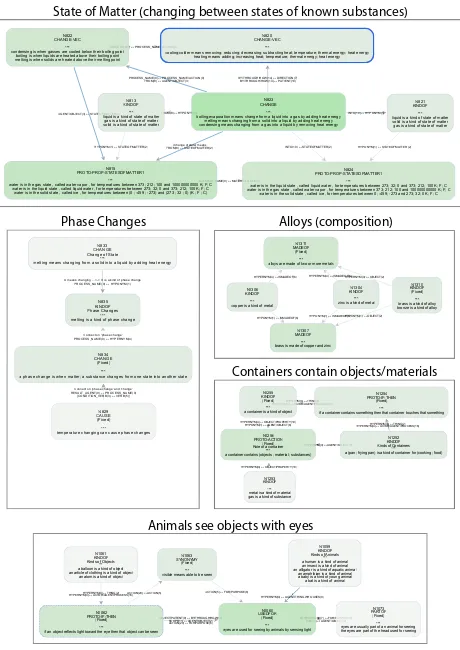
Figure 3:
Example inference patterns extracted from the WorldTree explanation corpus using this tool. Nodes represent one or