Proceedings of the 2011 Conference on Empirical Methods in Natural Language Processing, pages 304–312,
A Model of Discourse Predictions in Human Sentence Processing
Amit Dubey and Frank Keller and Patrick Sturt
Human Communication Research Centre, University of Edinburgh 10 Crichton Street, Edinburgh EH8 9AB, UK
{amit.dubey,frank.keller,patrick.sturt}@ed.ac.uk
Abstract
This paper introduces a psycholinguistic model of sentence processing which combines a Hidden Markov Model noun phrase chun-ker with a co-reference classifier. Both mod-els are fully incremental and generative, giv-ing probabilities of lexical elements condi-tional upon linguistic structure. This allows us to compute the information theoretic mea-sure of surprisal, which is known to correlate with human processing effort. We evaluate our surprisal predictions on the Dundee corpus of eye-movement data show that our model achieve a better fit with human reading times than a syntax-only model which does not have access to co-reference information.
1 Introduction
Recent research in psycholinguistics has seen a growing interest in the role ofpredictionin sentence processing. Prediction refers to the fact that the hu-man sentence processor is able to anticipate upcom-ing material, and that processupcom-ing is facilitated when predictions turn out to be correct (evidenced, e.g., by shorter reading times on the predicted word or phrase). Prediction is presumably one of the factors that contribute to the efficiency of human language understanding. Sentence processing is incremental
(i.e., it proceeds on a word-by-word basis); there-fore, it is beneficial if unseen input can be antici-pated and relevant syntactic and semantic structure constructed in advance. This allows the processor to save time and makes it easier to cope with the con-stant stream of new input.
Evidence for prediction has been found in a range of psycholinguistic processing domains. Semantic
prediction has been demonstrated by studies that show anticipation based on selectional restrictions: listeners are able to launch eye-movements to the predicted argument of a verb before having encoun-tered it, e.g., they will fixate an edible object as soon as they hear the word eat (Altmann and Kamide, 1999). Semantic prediction has also been shown in the context of semantic priming: a word that is pre-ceded by a semantically related prime or by a seman-tically congruous sentence fragment is processed faster (Stanovich and West, 1981; Clifton et al., 2007). An example forsyntactic prediction can be found in coordinate structures: readers predict that the second conjunct in a coordination will have the same syntactic structure as the first conjunct (Fra-zier et al., 2000). In a similar vein, having encoun-tered the wordeither, readers predict thator and a conjunct will follow it (Staub and Clifton, 2006). Again, priming studies corroborate this: Compre-henders are faster at naming words that are syntacti-cally compatible with prior context, even when they bear no semantic relationship to it (Wright and Gar-rett, 1984).
Predictive processing is not confined to the sen-tence level. Recent experimental results also provide evidence fordiscourse prediction. An example is the study by van Berkum et al. (2005), who used a con-text that made a target noun highly predictable, and found a mismatch effect in the ERP (event-related brain potential) when an adjective appeared that was inconsistent with the target noun. An example is (we give translations of their Dutch materials):
(1) The burglar had no trouble locating the secret family safe.
bigneubut unobtrusive paintingneu.
b. Of course, it was situated behind a bigcombut unobtrusive bookcasecom.
Here, the adjective big, which can have neutral or common gender in Dutch, is consistent with the pre-dicted nounpaintingin (1-a), but inconsistent with it in (1-b), leading to a mismatch ERP onbigin (1-b) but not in (1-a).
Previous results on discourse effects in sentence processing can also be interpreted in terms of pre-diction. In a classical paper, Altmann and Steed-man (1988) demonstrated that PP-attachment pref-erences can change through discourse context: if the context contains two potential referents for the tar-get NP, then NP-attachment of a subsequent PP is preferred (to disambiguate between the two refer-ents), while if the context only contains one target NP, VP-attachment is preferred (as there is no need to disambiguate). This result (and a large body of related findings) is compatible with an interpretation in which the processor predicts upcoming syntactic attachment based on the presence of referents in the preceding discourse.
Most attempts to model prediction in human lan-guage processing have focused on syntactic pre-diction. Examples include Hale’s (2001) surprisal model, which relates processing effort to the con-ditional probability of the current word given the previous words in the sentence. This approach has been elaborated by Demberg and Keller (2009) in a model that explicitly constructs predicted structure, and includes a verification process that incurs ad-ditional processing cost if predictions are not met. Recent work has attempted to integrate semantic and discourse prediction with models of syntactic processing. This includes Mitchell et al.’s (2010) approach, which combines an incremental parser with a vector-space model of semantics. However, this approach only provides a loose integration of the two components (through simple addition of their probabilities), and the notion of semantics used is restricted to lexical meaning approximated by word co-occurrences. At the discourse level, Dubey (2010) has proposed a model that combines an incre-mental parser with a probabilistic logic-based model of co-reference resolution. However, this model does not explicitly model discourse effects in terms
of prediction, and again only proposes a loose in-tegration of co-reference and syntax. Furthermore, Dubey’s (2010) model has only been tested on two experimental data sets (pertaining to the interaction of ambiguity resolution with context), no broad cov-erage evaluation is available.
The aim of the present paper is to overcome these limitations. We propose a computational model that captures discourse effects on syntax in terms of pre-diction. The model comprises a co-reference com-ponent which explicitly stores discourse mentions of NPs, and a syntactic component which adjust the probabilities of NPs in the syntactic structure based on the mentions tracked by the discourse com-ponent. Our model is HMM-based, which makes it possible to efficiently process large amounts of data, allowing an evaluation on eye-tracking cor-pora, which has recently become the gold-standard in computational psycholinguistics (e.g., Demberg and Keller 2008; Frank 2009; Boston et al. 2008; Mitchell et al. 2010).
The paper is structured as follows: In Section 2, we describe the co-reference and the syntactic mod-els and evaluate their performance on standard data sets. Section 3 presents an evaluation of the overall model on the Dundee eye-tracking corpus. The pa-per closes with a comparison with related work and a general discussion in Sections 4 and 5.
2 Model
fa-cilitation is modeled using the HMM’s emissions. The vocabulary of hidden states is described in Sec-tion 2.1 and the emission distribuSec-tion in SecSec-tion 2.2
2.1 Syntactic Model
A key feature of the co-reference component of our model (described below) is that syntactic analysis and co-reference resolution happen simultaneously. This could potentially slow down the syntactic anal-ysis, which tends to already be quite slow for ex-haustive surprisal-based incremental parsers. There-fore, rather than using full parsing, we use an HMM-based NP chunker which allows for a fast analysis. NP chunking is sufficient to extract NP discourse mentions and, as we show below, surprisal values computed using HMM chunks provide a useful fit on the Dundee eye-movement data.
To allow the HMM to handle possessive construc-tions as well as NP with simple modifiers and com-plements, the HMM decodes NP subtrees with depth of 2, by encoding the start, middle and end of a syntactic category X as ‘(X’, ‘X’ and ‘X)’, respec-tively. To reduce an explosion in the number of states, the category begin state ‘(X’ only appears at the rightmost lexical token of the constituent’s left-most daughter. Likewise, ‘X)’ only appears at the leftmost lexical token of the constituent’s rightmost daughter. An example use of this state vocabulary can be seen in Figure 1. Here, a small degree of re-cursion allows for the NP ((new york city’s) general obligation fund) to be encoded, with the outer NP’s left bracket being ‘announced’ at the token’s, which is the rightmost lexical token of the inner NP. Hid-den states also include part-of-speech (POS) tags, allowing simultaneous POS tagging. In the exam-ple given in Figure 1, the full state can be read by listing the labels written above a word, from top to bottom. For example, the full state associated with
’sis (NP-NP)-POS. As’s can also be a contraction ofis, another possible state for ’sis VBZ (without recursive categories as we are only interested in NP chunks).
The model uses unsmoothed bi-gram transition probabilities, along with a maximum entropy dis-tribution to guess unknown word features. The re-sulting distribution has the formP(tag|word)and is therefore unsuitable for computing surprisal values.
However, using Bayes’ theorem we can compute:
P(word|tag) =P(tag|word)P(word)
P(tag) (1)
which is what we need for surprisal. The pri-mary information from this probability comes from
P(tag|word), however, reasonable estimates of
P(tag)andP(word)are required to ensure the
prob-ability distribution is proper. P(tag) may be esti-mated on a parsed treebank. P(word), the
probabil-ity of a particular unseen word, is difficult to esti-mate directly. Given that our training data contains approximately 106words, we assume that this
prob-ability must be bounded above by 10−6. As an
ap-proximation, we use this upper bound as the proba-bility ofP(word).
Training The chunker is trained on sections 2– 22 of the Wall Street Journal section of the Penn Treebank. CoNLL 2000 included chunking as a shared task, and the results are summarized by Tjong Kim Sang and Buchholz (2000). Our chunker is not comparable to the systems in the shared task for sev-eral reasons: we use more training data, we tag si-multaneously (the CoNLL systems used gold stan-dard tags) and our notion of a chunk is somewhat more complex than that used in CoNLL. The best performing chunker from CoNLL 2000 achieved an F-score of 93.5%, and the worst performing system an F-score of 85.8%. Our chunker achieves a com-parable F-score of 85.5%, despite the fact that it si-multaneously tags and chunks, and only uses a bi-gram model.
2.2 Co-Reference Model
In a standard HMM, the emission probabilities are computed asP(wi|si)wherewiis theithword andsi
is theith state. In our model, we replace this with a
choice between two alternatives:
P(wi|si) =
λ
Pseen before(wi|si)
(1−λ)Pdiscourse new(wi|si) (2)
(NP NP NP NP)
(NP NP) (NP NP NP NP) NP (NP NP NP)
JJ NN IN NNP NNP NNP POS JJ NN NNS VBN RP DT NN NN strong demand for new york city ’s general obligation bonds propped up the municipal market
Figure 1: The chunk notation of a tree from the training data.
Variable Type
l,l0 List of trie nodes
w,wi Words
t Tag
n,n0 Trie nodes
l←List(root of mention trie) forw←w0towndo
l0←l l← /0
Clear tag freq array f t
Clear word freq array f wt fort∈tag setdo
forn∈l0 do
f t(t)← f t(t) +FreqO f(n,t)
n0←Getchild(w,t) ifn06= /0then
f wt(t)← f wt(t) +FreqO f(n0,w,t) l←n0::l
end if end for end for
Pseen before(w|t) =f t(t)/f wt(t) end for
Figure 2: Looking up entries from the NP Cache
rather a collection of all NPs mentioned so far in the document.
Using a collection of NPs rather than individual words complicates the decoding process. Ifmis the size of a document, andn is the size of the current sentence, decoding occurs inO(mn)time as opposed to O(n), as the collection of NPs needs to be ac-cessed at each word. However, we do not store the NPs in a list, but rather a trie. This allows decoding to occur in O(nlogm) time, which we have found to be quite fast in practise. The algorithm used to keep track of currently active NPs is presented in Figure 2. This shows how the distributionPseen before
is updated on a word-by-word basis. At the end of each sentence, the NPs of the Viterbi parse are added to the mention trie after having their leading arti-cles stripped. A weakness of the algorithm is that mentions are only added on a sentence-by-sentence basis (disallowing within-sentence references). Al-though the algorithm is intended to find whole-string matches, in practise, it will count any NP whose pre-fix matches as being co-referent.
corefer-ent (cf. Soon et al. 2001), and, moreover, the match-ing is done on an NP-by-NP basis, which is more suitable for finding entity coreference, rather than a word-by-word basis, which would be more suitable for lexical priming.
An appealing side-effect of using a simple co-reference decision rule which is applied tally is that it is relatively simple to incremen-tally compute the transitive closure of co-reference chains, resulting in the entity sets which are then used in evaluation.
The co-reference model only has one free param-eter,λ, which is estimated from the ACE-2 corpus. The estimate is computed by counting how often a repeated NP actually is discourse new. In the current implementation of the model,λis constant through-out the test runs. However, λ could possibly be a function of the previous discourse, allowing for more complicated classification probabilities.
3 Evaluation
3.1 Data
Our evaluation experiments were conducted upon the Dundee corpus (Kennedy et al., 2003), which contains the eye-movement record of 10 participants each reading 2,368 sentences of newspaper text. This data set has previously been used by Demberg and Keller (2008) and Frank (2009) among others.
3.2 Evaluation
Eye tracking data is noisy for a number of rea-sons, including the fact that experimental partici-pants can look at any word which is currently dis-played. While English is normally read in a left-to-right manner, readers often skip words or make regressions (i.e., look at a word to the left of the one they are currently fixating). Deviations from a strict left-to-right progression of fixations moti-vate the need for several different measures of eye movement. The model presented here predicts the Total Time that participants spent looking at a re-gion, which includes any re-fixations after looking away. In addition to total time, other possible mea-sures include (a) First Pass, which meamea-sures the ini-tial fixation and any re-fixations before looking at any other word (this occurs, for instance, if the eye initially lands at the start of a long word – the eye
will tend to re-fixate on a more central viewing lo-cation), (b) Right Bounded reading time, which in-cludes all fixations on a word before moving to the right of the word (i.e., re-fixations after moving left are included), and (c) Second Pass, which includes any re-fixation on a word after looking at any other word (be it to the left or the right of the word of inter-est). We found that the model performed similarly across all these reading time metrics, we therefore only report results for Total Time.
As mentioned above, reading measures are hy-pothesised to correlate with Surprisal, which is de-fined as:
S(wt) =−log(P(wt|w1...wt1) (3)
We compute the surprisal scores for the syntax-only HMM, which does not have access to co-reference information (henceforth referred to as ‘HMM’) and the full model, which combines the syntax-only HMM with the co-reference model (henceforth ‘HMM+Ref’). To determine if our Dundee corpus simulations provide a reasonable model of human sentence processing, we perform a regression anal-ysis with the Dundee corpus reading time measure as the dependent variable and the surprisal scores as the independent variable.
To account for noise in the corpus, we also use a number of additional explanatory variables which are known to strongly influence reading times. These include the logarithm of the frequency of a word (measured in occurrences per million) and the length of a word in letters. Two additional explana-tory variables were available in the Dundee corpus, which we also included in the regression model. These were the position of a word on a line, and which line in a document a word appeared in. As participants could only view one line at a time (i.e., one line per screen), these covariates are known as line position and screen position, respectively.
All the covariates, including the surprisal es-timates, were centered before including them in the regression model. Because the HMM and HMM+Ref surprisal values are highly collinear, the HMM+Ref surprisal values were added as residuals of the HMM surprisal values.
items add some randomness to the experiment, and either each participant’s responses for all items must be averaged (treating participants as a random fac-tor), or all participant’s responses for each item is averaged (treating items as a random factor). How-ever, in the present analysis we utilise a mixed ef-fects model, which allows both items and partici-pants to be treated as random factors.1
The are a number of criteria which can be used to test the efficacy of one regression model over an-other. These include the Aikake Information Cri-terion (AIC), the Bayesian Information CriCri-terion (BIC), which trade off model fit and number of model parameters (lower scores are better). It is also common to compare the log-likelihood of the mod-els (higher log-likelihood is better), in which case a χ2 can be used to evaluate if a model offers a
sig-nificantly better fit, given the number of parameters is uses. We test three models: (i) a baseline, with only low-level factors as independent variables; (ii) the HMM model, with the baseline factors plus sur-prisal computed by the syntax-only HMM; and (iii) the HMM+Ref model which includes the raw prisal values of the syntax-only HMM and the sur-prisal of the HMM+Ref models as computed as a residual of the HMM surprisal score. We compare the HMM and HMM+Ref to the baseline, and the HMM+Ref model against the HMM model.
Some of the data needed to be trimmed. If, due to data sparsity, the surprisal of a word goes to infinity for one of the models, we entirely remove that word from the analysis. This occurred seven times form the HMM+Ref model, but did not occur at all with the HMM model. Some of the eye-movement data was trimmed, as well. Fixations on the first and last words of a line were excluded, as were tracklosses. However, we did not trim any items due to
abnor-1We assume that each participant and item bias the reading time of the experiment. Such an analysis is known as having random intercepts of participant and item. It is also possible to assume a more involved analysis, known as random slopes, where the participants and items bias the slope of the predictor. The model did not converge when using random intercept and slopes on both participant and item. If random slopes on items were left out, the HMM regression model did converge, but not the HMM+Ref model. As the HMM+Ref is the model of inter-est random slopes were left out entirely to allow a like-with-like comparison between the HMM and HMM+Ref regression mod-els.
mally short or abnormally long fixation durations.
3.3 Results
The result of the model comparison on Total Time reading data is summarised in Table 1. To allow this work to be compared with other models, the lower part of the table gives the abosolute AIC, BIC and log likelihood of the baseline model, while the upper part gives delta AIC, BIC and log likelihood scores of pairs of models.
We found that both the HMM and HMM+Ref provide a significantly better fit with the reading time data than the Baseline model; all three crite-ria agree: AIC and BIC lower than for the base-line, and log-likelihood is higher. Moreover, the HMM+Ref model provides a significantly better fit than the HMM model, which demonstrates the bene-fit of co-reference information for modeling reading times. Again, all three measures provide the same result.
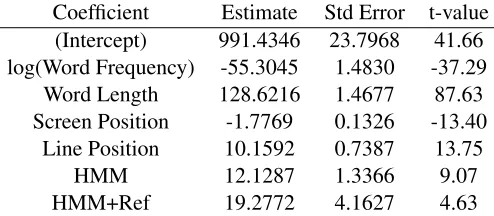
Table 2 corroborates this result. It list the mixed-model coefficients for the HMM+Ref model and shows that all factors are significant predic-tors, including both HMM surprisal and residualized HMM+Ref surprisal.
4 Related Work
There have been few computational models of hu-man sentence processing that have incorporated a referential or discourse-level component. Niv (1994) proposed a parsing model based on Com-binatory Categorial Grammar (Steedman, 2001), in which referential information was used to resolve syntactic ambiguities. The model was able to cap-ture effects of referential information on syntactic garden paths (Altmann and Steedman, 1988). This model differs from that proposed in the present pa-per, as it is intended to capture psycholinguistic pref-erences in a qualitative manner, whereas the aim of the present model is to provide a quantitative
From To ∆AIC ∆BIC ∆logLik χ2 Significance
Baseline HMM -80 -69 41 82.112 p< .001
Baseline HMM+Ref -99 -89 51 101.54 p< .001
HMM HMM+Ref -19 -8 11 21.424 p< .001
Model AIC BIC logLik
[image:7.612.114.500.70.165.2]Baseline 10567789 10567880 -5283886
Table 1: Model comparison (upper part) and absolute scores for the Baseline model (lower part)
Coefficient Estimate Std Error t-value
(Intercept) 991.4346 23.7968 41.66
log(Word Frequency) -55.3045 1.4830 -37.29
Word Length 128.6216 1.4677 87.63
Screen Position -1.7769 0.1326 -13.40
Line Position 10.1592 0.7387 13.75
HMM 12.1287 1.3366 9.07
HMM+Ref 19.2772 4.1627 4.63
Table 2: Coefficients of the HMM+Ref model on Total Reading Times. Note thatt>2 indicates that the factor in question is a significant predictor.
Spivey and Tanenhaus’s (1998) model was specifi-cally designed to provide a quantitative fit to reading times. However, the model lacked generality, being designed to deal with only one type of sentence. In contrast to both of these earlier models, the model proposed here aims to be general enough to provide estimated reading times for unrestricted text. In fact, as far as we are aware, the present paper represents the first wide-coverage model of human parsing that has incorporated discourse-level information.
5 Discussion
The primary finding of this work is that incorporat-ing discourse information such as co-reference into an incremental probabilistic model of sentence pro-cessing has a beneficial effect on the ability of the model to predict broad-coverage human parsing be-haviour.
Although not thoroughly explored in this paper, our finding is related to an ongoing debate about the structure of the human sentence processor. In par-ticular, the model of Dubey (2010), which also sim-ulates the effect of discourse on syntax, is aimed at examininginteractivityin the human sentence pro-cessor. Interactivity describes the degree to which human parsing is influenced by non-syntactic
fac-tors. Under theweakly interactive hypothesis, dis-course factors may prune or re-weight parses, but only when assuming thestrongly interactive hypoth-esis would we argue that the sentence processor pre-dicts upcoming material due to discourse factors. Dubey found that a weakly interactive model sim-ulated a pattern of results in an experiment (Grodner et al., 2005) which was previously believed to pro-vide epro-vidence for the strongly interactive hypothesis. However, as Dubey does not provide broad-coverage parsing results, this leaves open the possibility that the model cannot generalise beyond the experiments expressly modeled in Dubey (2010).
[image:7.612.182.429.199.307.2]against a weakly interactive approach, which may be sufficient to model individual phenomena (as shown by Dubey 2010), but is unlikely to be able to match the broad-coverage result we have presented here. We also note that psycholinguistic evidence for dis-course prediction (such as the context based lexi-cal prediction shown by van Berkum et al. 2005, see Section 1) is also evidence for strong interac-tivity; prediction goes beyond mere pruning or re-weighting and requires strong interactivity.
References
Gerry Altmann and Mark Steedman. Interaction with context during human sentence processing.
Cognition, 30:191–238, 1988.
Gerry T. M. Altmann and Yuki Kamide. Incremen-tal interpretation at verbs: Restricting the domain of subsequent reference. Cognition, 73:247–264, 1999.
Marisa Ferrara Boston, John T. Hale, Reinhold Kliegl, and Shravan Vasisht. Surprising parser actions and reading difficulty. InProceedings of ACL-08:HLT, Short Papers, pages 5–8, 2008. Charles Clifton, Adrian Staub, and Keith Rayner.
Eye movement in reading words and sentences. In R V Gompel, M Fisher, W Murray, and R L Hill, editors,Eye Movements: A Window in Mind and Brain, pages 341–372. Elsevier, 2007. Vera Demberg and Frank Keller. Data from
eye-tracking corpora as evidence for theories of syn-tactic processing complexity. Cognition, 109: 192–210, 2008.
Vera Demberg and Frank Keller. A computational model of prediction in human parsing: Unifying locality and surprisal effects. In Proceedings of the 29th meeting of the Cognitive Science Society (CogSci-09), 2009.
Amit Dubey. The influence of discourse on syntax: A psycholinguistic model of sentence processing. InProceedings of the 48th Annual Meeting of the Association for Computational Linguistics (ACL 2010), Uppsala, Sweden, 2010.
Stefan Frank. Surprisal-based comparison between a symbolic and a connectionist model of sentence processing. In 31st Annual Conference of the
Cognitive Science Society (COGSCI 2009), Ams-terdam, The Netherlands, 2009.
Lyn Frazier, Alan Munn, and Charles Clifton. Pro-cessing coordinate structure. Journal of Psy-cholinguistic Research, 29:343–368, 2000. Daniel J. Grodner, Edward A. F. Gibson, and
Du-ane Watson. The influence of contextual constrast on syntactic processing: Evidence for strong-interaction in sentence comprehension. Cogni-tion, 95(3):275–296, 2005.
John T. Hale. A probabilistic earley parser as a psy-cholinguistic model. InIn Proceedings of the Sec-ond Meeting of the North American Chapter of the Asssociation for Computational Linguistics, 2001.
A. Kennedy, R. Hill, and J. Pynte. The dundee cor-pus. InProceedings of the 12th European confer-ence on eye movement, 2003.
Jeff Mitchell, Mirella Lapata, Vera Demberg, and Frank Keller. Syntactic and semantic factors in processing difficulty: An integrated measure. In
Proceedings of the 48th Annual Meeting of the As-sociation for Computational Linguistics, Uppsala, Sweden, 2010.
M. Niv. A psycholinguistically motivated parser for CCG. InProceedings of the 32nd Annual Meet-ing of the Association for Computational LMeet-inguis- Linguis-tics (ACL-94), pages 125–132, Las Cruces, NM, 1994.
W. M. Soon, H. T. Ng, and D. C. Y. Lim. A ma-chine learning approach to coreference resolution of noun phrases. Computational Linguistics, 27 (4):521–544, 2001.
M. J. Spivey and M. K. Tanenhaus. Syntactic am-biguity resolution in discourse: Modeling the ef-fects of referential context and lexical frequency.
Journal of Experimental Psychology: Learning, Memory and Cognition, 24(6):1521–1543, 1998. Kieth E. Stanovich and Richard F. West. The effect
of sentence context on ongoing word recognition: Tests of a two-pricess theory. Journal of Exper-imental Psychology: Human Perception and Per-formance, 7:658–672, 1981.
either. . .or.Journal of Experimental Psychology:
Learning, Memory, and Cognition, 32:425–436, 2006.
Mark Steedman. The Syntactic Process. Bradford Books, 2001.
Erik F. Tjong Kim Sang and Sabine Buchholz. In-troduction to the conll-2000 shared task: Chunk-ing. In Proceedings of CoNLL-2000 and LLL-2000, pages 127–132. Lisbon, Portugal, 2000. Jos J. A. van Berkum, Colin M. Brown, Pienie
Zwit-serlood, Valesca Kooijman, and Peter Hagoort. Anticipating upcoming words in discourse: Evi-dence from erps and reading times.Journal of Ex-perimental Psychology: Learning, Memory and Cognition, 31(3):443–467, 2005.
Barton Wright and Merrill F. Garrett. Lexical deci-sion in sentences: Effects of syntactic structure.