Proceedings of the 2013 Conference on Empirical Methods in Natural Language Processing, pages 415–425,
Unsupervised Relation Extraction with General Domain Knowledge
Oier Lopez de Lacalle1,2 and Mirella Lapata1 1Institute for Language, Cognition and Computation
School of Informatics, University of Edinburgh, 10 Crichton Street, Edinburgh EH8 9AB 2IKERBASQUE, Basque Foundation for Science, Bilbao, Spain
[email protected], [email protected]
Abstract
In this paper we present an unsupervised ap-proach to relational information extraction. Our model partitions tuples representing an observed syntactic relationship between two named entities (e.g., “X was born in Y” and “X is from Y”) into clusters correspond-ing to underlycorrespond-ing semantic relation types (e.g.,BornIn,Located). Our approach incor-porates general domain knowledge which we encode as First Order Logic rules and auto-matically combine with a topic model devel-oped specifically for the relation extraction task. Evaluation results on the ACE 2007 English Relation Detection and Categoriza-tion (RDC) task show that our model outper-forms competitive unsupervised approaches by a wide margin and is able to produce clus-ters shaped by both the data and the rules.
1 Introduction
Information extraction (IE) is becoming increas-ingly useful as a form of shallow semantic analy-sis. Learning relational facts from text is one of the core tasks of IE and has applications in a variety of fields including summarization, question answer-ing, and information retrieval. Previous work (Sur-deanu and Ciaramita, 2007; Culotta and Sorensen, 2004; Zhou et al., 2007) has traditionally relied on extensive human involvement (e.g., hand-annotated training instances, manual pattern extraction rules, hand-picked seeds). Standard supervised techniques can yield high performance when large amounts of hand-labeled data are available for a fixed in-ventory of relation types (e.g., Employment, Lo-cated), however, extraction systems do not easily
generalize beyond their training domains and often must be re-engineered for each application. Un-supervised approaches offer a promising alternative which could lead to significant resource savings and more portable extraction systems.
It therefore comes as no surprise that latent topic analysis methods have been used for a variety of IE tasks. Yao et al. (2011), for example, propose a series of topic models which perform relation discovery by clustering tuples representing an ob-served syntactic relationship between two named en-tities (e.g., “X was born in Y” and “X is from Y”). The clusters correspond to semantic relations whose number or type is not known in advance. Their mod-els depart from standard Latent Dirichlet Allocation (Blei et al., 2003) in that a document consists of re-lation tuples rather than individual words; moreover, tuples have features each of which is generated in-dependently from a hidden relation (e.g., the words corresponding to the first and second entities, the type and order of the named entities). Since these features arelocal, they cannot capture more global constraints pertaining to the relation extraction task. Such constraints may take the form of restrictions on which tuples should be clustered together or not. For instance, different types of named entities may be indicative of different relations (ORG-LOC entities often express a Location relation whereas PER-PER entities express BusinessorFamily rela-tions) and thus tuples bearing these entities should not be grouped together. Another example are tuples with identical or similar features which intuitively should be clustered together.
In this paper, we propose an unsupervised ap-proach to relation extraction which does not
quire any relation-specific training data andallows to incorporate global constraints general express-ing domain knowledge. We encode domain knowl-edge as First Order Logic (FOL) rules and automati-cally integrate them with a topic model to produce clusters shaped by the data and the constraints at hand. Specifically, we extend the Fold-all (First-Order Logic latent Dirichlet Allocation) framework (Andrzejewski et al., 2011) to the relation extraction task, explain how to incorporate meaningful con-straints, and develop a scalable inference technique. In the presence of multiple candidate relation de-compositions for a given corpus, domain knowledge can steer the model towards relations which are best aligned with user and task modeling goals. We also argue that a general mechanism for encoding addi-tional modeling assumptions and side information can lessen the need for “custom” relation extraction model variants. Experimental results on the ACE-2007 Relation Detection and Categorization (RDC) dataset show that our model outperforms competi-tive unsupervised approaches by a wide margin and is able to uncover meaningful relations with only two general rule types.
Our contributions in this work are three-fold: a new model that modifies the Fold-all framework and extends it to the relation extraction task; a new for-malization of the logic rules applicable to topic mod-els defined over a rich set of features; and a proposal for mining the logic rulesautomaticallyfrom a cor-pus contrary to Andrzejewski et al. (2011) who em-ploy manually crafted seeds.
2 Related Work
A variety of learning paradigms have been applied to relation extraction. As mentioned earlier, super-vised methods have been shown to perform well in this task. The reliance on manual annotation, which is expensive to produce and thus limited in quantity, has provided the impetus for semi-supervised and purely unsupervised approaches. Semi-supervised methods use a small number of seed instances or patterns (per relation) to launch an iterative train-ing process (Riloff and Jones, 1999; Agichtein and Gravano, 2000; Bunescu and Mooney, 2007; Pan-tel and Pennacchiotti, 2006). The seeds are used to extract a new set of patterns from a large cor-pus, which are then used to extract more instances,
and so on. Unsupervised relation extraction meth-ods are not limited to a predefined set of target relations, but discover all types of relations found in the text. The relations represent clusters over strings of words (Banko et al., 2007; Hasegawa et al., 2004), syntactic patterns between entities (Yao et al., 2011; Shinyama and Sekine, 2006), or logical expressions (Poon and Domingos, 2009). Another learning paradigm is distant supervision which does not require labeled data but instead access to a rela-tional database such as Freebase (Mintz et al., 2009). The idea is to take entities that appear in some rela-tion in the database, find the sentences that express the relation in an unlabeled corpus, and use them to train a relation classifier.
Our own work adds an additional approach into the mix. We use a topic model to infer an arbi-trary number of relations between named entities. Although we do not have access to relation-specific information (either as a relational database or manu-ally annotated data), we impose task-specific con-straints which inject domain knowledge into the learning algorithm. We thus alleviate known prob-lems with the interpretability of the clusters obtained from topic models and are able to guide our model towards reasonable relations. Andrzejewski et al. (2011) show how to integrate First-Order Logic with vanilla LDA. We extend their formulation to relation tuples rather than individual words. Our model gen-erates a corpus of entity tuples which are in turn rep-resented by features and uses automatically acquired FOL rules. The idea of integrating topic modeling with FOL builds on research in probabilistic logic modeling such as Markov Logic Networks (Richard-son and Domingos, 2006). Schoenmackers et al. (2010) learn Horn clauses from web-scale text with aim of finding answers to a user’s query. Our work is complementary to theirs. We could make use of their rules to discover more accurate relations.
re-spect to the true target clustering. Although, the tar-get labels are not available in our case, we are able to show that the inclusion of domain knowledge yields clustering improvements.
3 Learning Setting
Our relation extraction task broadly adheres to the ACE specification guidelines. Our aim is to detect and characterize the semantic relations between two named entities. The input to our model is a corpus of documents, where each document is a bag of relation tuples which can be obtained from the output of any dependency parser. Each tuple represents a syntactic relationship between two named entity (NE) mentions, and consists of three components: the dependency path between the two mentions, the source NE, and the target NE. A dependency path is the concatenation of dependency edges and nodes along a path in the dependency tree. For example, the sentence “George Bush traveled to France on Thursday for a summit.” would yield the tuple[SOURCE:George Bush(PER),
PATH:→nsubj→traveled→prep→to→pobj→,
DES:France(LOC)]. The tuple here expresses the relation Located, however our model does not observe any relation labels during training. The model assigns tuples to clusters, corresponding to an underlying relation type. Each tuple instance can be then labeled with an identifier corresponding to the cluster (aka relation) it has been assigned to.
4 Modeling Framework
Our model builds on the work of Yao et al. (2011) who develop a series of generative probabilistic models for relation extraction. Specifically, we ex-tend their relational LDA model by interfacing it with FOL-rules. In the following, we first describe their approach in more detail and then present our extensions and modifications.
4.1 Relational LDA
Relational LDA is an extension to LDA with a sim-ilar generative story. LDA models each document as a mixture of topics, which are in turn character-ized as distributions over words. In relational LDA, each document is a mixture of relations over tuples representing syntactic relations between two named entities. The relation tuples are in turn generated a
by set of features drawn independently from the un-derlying relation distribution.
More technically, a multinomial distribution over relations θdi is drawn from a Dirichlet prior
(θ∼Dir(α)) at the document level. Relation tuples are generated from a multinomial distribution θdi
(zi|θdi ∼Mult(θdi)) and are represented withk
fea-tures. Each feature is drawn (independently) from a multinomial distribution selected by the relation assigned to tuplei(fik|zi, φzi ∼ Mult(φzi)).
Rela-tions are drawn from a Dirichlet prior (φ∼Dir(β)). In other words, each tuple in a document is assigned a hidden relation (z = z1...zN); each relation is represented by a multinomial distribution over fea-turesφr (Dirichlet prior β). φr is a vector withF dimensions each corresponding to a feature. Fi-nally, documents (j = 1...D) are associated with a multinomial distributionθj over relations (Dirichlet priorα). θj is a vector withR dimensions, one for each relation.
Figure 1 represents relational LDA model as a an undirected graphical model or factor graph (Bishop, 2006), ignoring for the moment the factor which connects thed, z, f1...k andovariables. Directed graphical models can be converted into undirected ones by adding edges between co-parents (Koller and Friedman, 2009). Each clique in the graph de-fines a potential function which replaces the condi-tional probabilities in the directed graph. Each max-imal clique is associated with a special factor node (the black squares) and clique members are con-nected to that factor. The probability of any specific configuration is calculated by multiplying the poten-tial functions and normalizing them. We adopt the factor graph representation as is it convenient for in-troducing logic rules into the model. The joint prob-ability of the model given the priors and the docu-ments (P(p,z, φ, θ|α, β,d)) is equivalent to:
R Y
r
p(φr|β) D Y
j
p(θj|α) N Y
i
θdi(zi)
Y
k∈pi
φzi(fk) (1)
whereθdi(zi) is thezi-th element in the vectorθdi
andφzi(fk)isfk-th feature in theφzi vector.
Figure 1: Relational LDA as a factor graph. Filled circles represent observed variables, empty circles are associated with latent variables or model hyperparame-ters, and plates indicate repeating structures. The black squares are the factor nodes and are associated with the potential functions corresponding to conditional indepen-dence among the variables. The model observesD doc-uments (d) consisting ofN tuples (p), each represented by a set of featuresf1,f2. . . fk.zrepresents the relation
type assignment to a tuple,θis the relation type propor-tion for a given document, andφ the relation type dis-tribution over the features. The logic factor (indicated with the arrow) connects the KB with the relational LDA model. Variableois an observed variable which contains the side information expressed in FOL.
As shown in Figure 1, the observed variables are represented by filled circles. In our case, our model sees the corpus (p, d), whered is the variable rep-resenting the document and the tuples (p) are repre-sented by a set of featuresf1,f2. . . fk in the graph. Empty circles are associated with latent variables to be estimated: z represents the relation type assign-ment to the tuple, θ is the relation type proportion for the given document, and φ is the relation type distribution over the features.
The features representing the tuples tap onto se-mantic information expressed by different surface forms and are an important part of the model. We use a subset of the features proposed in Yao et al. (2011) which we briefly describe below:
SOURCE This feature corresponds to the first en-tity mention of the tuple. In the sentence George Bushtraveled toFranceon Thursday for a summit., the value of this feature would beGeorge Bush.
Value Predicate Description
[image:4.612.103.270.65.230.2]zi =r Z(i, r) Latent relation type fk =v F(k, v) feature of relation tuple pi=i P(i, fk) tupleicontains featurefk di =j D(i, j) observed document
Table 1: Logical variables for Relational LDA. The vari-ablei ranges over tuples in the corpus (i = [1. . . N]), andkover features in the corpus (k= [1. . . F]).
DEST The feature corresponds to the second entity mention and its value would beFrancein the previ-ous example.
NEPAIR The feature indicates the type and order of two entity mentions in the tuple. This would be PER-ORG in our example.
PATH This feature refers to the dependency path between two entity mentions. In our sentence, the value of the feature would be
PATH:→nsubj→traveled→prep→to→pobj→.
TRIGGER Finally, trigger features are content words occurring in the dependency path. The path
PATH:→nsubj→traveled→prep→to→pobj→
con-tains only one trigger word, namely traveled. The intuition behind this feature is that paths sharing the same set of trigger words should be grouped in the same cluster.
4.2 First Order Logic and Relational LDA
We next couple relational LDA with global con-straints, which we express using FOL rules. We begin by representing relational LDA as a Markov Logic Network (Richardson and Domingos, 2006). We define a logical predicate for each model vari-able. For example, assigned relation variable (Z(i, r)) is true ifzi =rand false otherwise. Table 1 shows the mapping of model variables onto logical predicates. Logical rules are encoded in the form of a weighted FOL knowledge base (KB) which is then converted into Conjunctive Normal form:
KB ={(λ1, ψ1), ...,(λL, ψL)} (2)
set manually by the domain expert. The KB is tied to the probabilistic model via its groundings in the corpus. For each FOL ruleψl, letG(ψl) be the set of groundings, each mapping the free vari-ables inψl to a specific value. For example, in the rule∀i, j, p : F(i, Obama)∧F(j, W hiteHouse)∧
P(p, i)∧P(p, j) ⇒ Z(p, r)1, G consists of all the rules where the free variablesi, jandpare instanti-ated. At grounding time, we parse the corpus search-ing for the tuples that satisfy the logic rules and store the indices of the tuples that ground the rule. The stored indices are used to setψl to a specific value. For the (Obama, White House) example above, G consists ofF propositional rules for each observed feature, where i ∈ [1. . . F]. For each grounding (g∈G(ψl)) we define an indicator function:
1g(z,p,d,o) =
1, ifgis true under zandp,d,o 0, otherwise
(3)
wherezare relation assignments to tuples, pis the set of features in tuples, d are documents, and o the side information encoded in FOL. Contrary to Andrzejewski et al. (2011), we need to ground the rules while taking into account if the feature speci-fied in the rule is expressed by any tuple or the spe-cific given tuple, since we are assigning relations to tuples, and not directly to words.
Next, we define a Markov Random Field (MRF) which combines relational LDA with the FOL knowledge base. The MRF is defined over latent relation tuple assignmentsz, relation feature multi-nomials φ, and relation document multinomials θ (the feature set, document, and external informa-tion o are observed). Under this model the con-ditional probability P(z, φ, θ|α, β,p,d,o, KB) is proportional to:
exp
L X
l X
g∈G(ψl)
λl1g(z,p,d,o)
×
R Y
r
p(φr|β) D Y
j
p(θj|α) N Y
i
θdi(zi)
Y
k∈pi
φzi(fk)
(4)
The first term in Equation (4) corresponds to the logic factor in Figure 1 that groups variablesd, z,
1
This rule translates as “every tuple containingObamaand
White Houseas features should be in relation clusterr”.
f1, f2, . . . fk ando. The remaining terms in Equa-tion (4) refer to relaEqua-tional LDA. The goal of the model is to estimate the most likelyθandφfor the given observed state. Asz can not be marginalized out, we proceed with MAP estimation of (z,φ,θ), maximizing the log of the probability as in Andrze-jewski et al. (2011):
arg max z,φ,θ
L X
l X
g∈G(ψl)
λl1g(z,p,d,o)+
R X
r
logp(φr|β)+
N X
i
logθdi(zi)
Y
k∈pi
φzi(fk)
(5)
Once the parameters of the model are estimated (see Section 4.3 for details), we use the φ proba-bility distribution to assign a relation to a new test tuple. We select the relation that maximizes the probability arg maxrQki P(fi|φr) where f1. . . fk are features representing the tuple andrthe relation index.
4.3 Inference
Exact inference is intractable for both relational LDA and MLN models. In order to infer the most likely multinomial parametersφandθ, we applied the Alternating Optimization with Mirror Descent algorithm introduced in Andrzejewski et al. (2011). The algorithm alternates between optimizing the multinomial parameters (φ,θ), whilst holding the re-lation assignments (z) fixed, and vice-versa. At each iteration, the algorithm first finds the optimal (φ,θ) for a fixedz as the MAP estimate of the Dirichlet posterior:
φr(f)∝nrf +β−1 (6)
θj(r)∝njr+α−1 (7)
Equation (5), the algorithm needs only optimize the following term:
zi = arg max r=1...R
θdi(r)
Y
k∈pi
φzi(fk) (8)
The second part deals with the remainingzithat ap-pear in non-trivial groundings in the first term of Equation (5). We follow Andrzejewski et al. (2011) in relaxing (5) into a continuous optimization prob-lem and refer the reader to their paper for a more in depth treatment. Suffice it to say that once the binary variableszir ∈ {0,1}are relaxed to contin-uous valueszir ∈ [0,1], it is possible to introduce the relational LDA term in the equation and com-pute the gradient using the Entropic Mirror Descent Algorithm (Beck and Teboulle, 2003):
arg max z∈[0,1]|KB|
L X
l X
g∈G(ψl)
λl1g(z)+
X
i,r
zirlogθdi(r)
Y
k∈pi
φzi(fk)
s.tzir≥0, X
i,r
zir= 1
(9)
In every iteration the approximation algorithm randomly samples a term from the objective func-tion (Equafunc-tion (9)). The sampled term can be a particular ground rule g or the relational LDA term (P
rzirlogθdi(r)
Q
k∈piφzi(fk)) for some
uniformly sampled index i. The sampling of the terms is weighted according to the rule weight (λl) and the grounded value (G(ψl)) in the case of logic rules, and the size of corpus in tuples (|zKB|) for re-lational LDA. Once we choose termf and take the gradient, we can apply the Entropic Mirror Descent update:
zir ←
zirexp(ηOzirf)
P
r0zir0exp(ηOz ir0f)
(10)
Finally,ziis recovered by rounding toarg maxrzir. The main advantage of this approach is that it re-quires only a means to sample groundingsgfor each ruleψl, and can avoid fully grounding the FOL rules.
4.4 Logic Rules
Our model assigns relations to tuples rather than top-ics to words. Since our tuples are described in terms
of features our logic rules must reflect this too. For our experiments we defined two very general types of rules described below.
Must-link Tuple The motivation behind this rule is that tuples which share features probably express the same underlying relation. The rule must spec-ify which feature has to be shared for the tuples to be clustered together. For example, the rule be-low states that tuples containing the dependency pathPATH:→appos→president→prep→of→pobj→
should go in the same cluster:
∀i, j, k:F(i,PATH:is the president of)∧P(j, fi)
∧P(k, fi)⇒ ¬Z(j, t)∨Z(k, r)
Cannot-link Tuple We also define rules prohibit-ing tuples to be clustered together because they do not share any features. For example, tuples with ORG-LOC entities, probably express aLocation re-lation and should not be clustered together with PER-PER tuples, which in all likelihood express a different relationship (e.g.,Family). The rule below expresses this constraint:
∀i, j, k, l:F(i,NEPAIR:PER-PER)
∧F(j,NEPAIR:ORG-LOC)
∧P(k, fi)∧P(l, fj)⇒ ¬Z(k, r)∨ ¬Z(l, r)
The specification of the first order logic rules is an integral part of the model. The rules express knowledge about the task at hand, the domain in-volved, and the way the relation extraction problem is modeled (i.e., tuples expressed as features). So far, we have abstractly formulated the rules without explaining how they are specifically instantiated in our model. We could write them down by hand after inspecting some data or through consultation with a domain expert. Instead, we obtain logic rules au-tomaticallyfrom a corpus following the procedure described in Section 5.
5 Experimental Setup
Must-link Tuple
F(i,NEPAIR:PER-PER,TRIGGER:wife)∧P(j, fi)∧P(k, fi)⇒ ¬Z(j, t)∨Z(k, r) F(i,NEPAIR:PER-LOC,TRIGGER:die)∧P(j, fi)∧P(k, fi)⇒ ¬Z(j, t)∨Z(k, r) F(i,PATH:←nsubj←die→prep→in→pobj→)∧P(j, fi)∧P(k, fi)⇒ ¬Z(j, t)∨Z(k, r) F(i,SOURCE:Kobe,DEST:Lakers)∧P(j, fi)∧P(k, fi)⇒ ¬Z(j, t)∨Z(k, r)
Cannot-link Tuple
[image:7.612.91.524.60.208.2]F(i,NEPAIR:ORG-LOC)∧F(j,NEPAIR:PER-PER)∧P(k, fi)∧P(l, fj)⇒ ¬Z(k, r)∨ ¬Z(l, r) F(i,NEPAIR:LOC-LOC)∧F(j,TRIGGER:president)∧P(k, fi)∧P(l, fj)⇒ ¬Z(k, r)∨ ¬Z(l, r) F(i,NEPAIR:PER-LOC)∧F(j,TRIGER:member)∧P(k, fi)∧P(l, fj)⇒ ¬Z(k, r)∨ ¬Z(l, r) F(i,NEPAIR:PER-PER)∧F(j,TRIGER:sell)∧P(k, fi)∧P(l, fj)⇒ ¬Z(k, r)∨ ¬Z(l, r)
Table 2: Examples of automatically extracted Must-link and Cannot-link tuple rules.
named entities were automatically recognized and labeled with PER, ORG, LOC, and MISC (Finkel et al., 2005). Dependency paths for each pair of named entity mentions were extracted from the out-put of the MaltParser (Nivre et al., 2004). In our experiments, we discarded tuples with paths longer than 10 edges (Lin and Pantel, 2001). We evalu-ated our model on the test partition of the ACE 2007 (English) RDC dataset which is labeled with gold standard entity mentions and their relations. There are six general relation types and 18 subtypes. We used 25% of the ACE training partition as a devel-opment set for parameter tuning.
Logic Rule Extraction We automatically ex-tracted logic rules from the New York Times (NYT) corpus as follows. The intuition behind Must-link rules is that tuples with common features should cluster together. Although we do not know which features would yield the best rules, we naively assume that good features are frequently co-occurring features. Using the log-likelihood ratio (Dunning, 1993), we first discarded low confidence feature co-occurrences (p <0.05). Two features co-occur if they are both found within the same sentence. We then sorted the remaining co-occurrences by their frequency and retained the N-best ones. We only considered unigram and bigram features since higher-order ones tend to be sparse. An example of a bigram feature would be (PATH:←nsubj←grow→prep→in→pobj→, DEST:Chicago).
The main intuition behind Cannot-link rules is that tuples without any common features should not cluster together. So, if two features never
co-occur, they probably express different relations. For every unigram and bigram feature in the re-spective N-best list, we find the features it does not co-occur with in the NYT corpus. For ex-ample, NEPAIR:PER–LOC does not co-occur with
DEST:Yankees and the bigram DEST:United Na-tions, NEPAIR:PER–ORG does not co-occur with SOURCE:Mr. Bush, NEPAIR:PER–LOC.
Cannot-link rules are then based on such non-co-occurring feature pairs.
We optimizedN empirically on the development set. We experimented with values ranging from20 to500. We obtained 20 Must-link rules for coarse-grained relations and 400 rules for their subtypes. We extracted 1,814 Cannot-link rules for general re-lations (N = 50) and 34,522 rules for subtypes (N = 400). The number of features involved in the Must-link rules was 25 for coarse-grained relations and 422 for fine-grained relations. For Cannot-link rules, 62 features were involved in coarse-grained relations and 422 in fine-grained relations.
Examples of the rules we extracted are shown in Table 2. The first rule in the upper half of the ta-ble states that tuples must cluster together if their source and target entities are PER and contain the trigger wordwifein their dependency path. The sec-ond rule is similar, the source entity here is PER, the target LOC and the trigger word is die. Ac-cording to the third rule, tuples featuring the path
to-gether with PER-PER tuples. The second rule states that we cannot link LOC-LOC tuples with those whose trigger word ispresident, and so on.
Parameter Tuning Our framework has several parameters that must be adjusted for an optimal clus-tering solution. These include the hyperparame-tersα and β as well as the number of clusters. In addition, we have to assign a weight to each FOL rule grounding. An exhaustive search on the hy-perparameters and rule weights is not possible. We therefore followed a step-wise approximation proce-dure. First, we find the bestαandβ values, whilst varying the number of clusters. Once we have the best hyperparameters for each clustering, we set the weights for the FOL rules. We varied the number of relations from5to50. We experimented withα values in the range of[0.05−0.5]andβ values in the range of[0.05−0.5]. These values were opti-mized separately for coarse- and fine-grained rela-tions. Table 3 shows the optimal number of clusters for different model variants and relation types.
The FOL weights can also make a difference in the final output; the bigger the weight the more times the rule will be sampled in the Mirror Descent algorithm. We experimented with two weighting schemes: (a) we gave a weight of1or 0.5to each rule grounding and (b) we scaled the weights so as to make their contribution comparable to relational LDA. We obtained best results on the development set with the former scheme.
Baselines We compared our FOL relational LDA model against standard LDA (Blei et al., 2003) and relational LDA without the FOL component. In the case of standard LDA, we estimated topics (rela-tions) over words, and used the context of the en-tity mentions pairs as a bag of words feature to se-lect the most likely cluster at test time. Parameters for LDA and relational LDA were optimized follow-ing the same parameter tunfollow-ing procedure described above.
We also compared our model against the unsuper-vised method introduced in Hasegawa et al. (2004). Their key idea is to cluster pairs of co-occurring named entities according to the similarity of their surrounding contexts. Following their approach, we measured context similarity using the vector space model and the cosine metric and grouped NE pairs into clusters using a complete linkage hierarchical
clustering algorithm. We adopted the same parame-ter values as detailed in their paper (e.g., cosine sim-ilarity threshold, length of context vectors). At test time, instances were assigned to the relation cluster most similar to them (according to the cosine mea-sure).
Evaluation We evaluated the clusters obtained by our model and the comparison systems using the Fs-core measure introduced in the SemEval 2007 task (Agirre and Soroa, 2007); it is the harmonic mean of precision and recall defined as the number of cor-rect members of a cluster divided by the number of items in the cluster and the number of items in the gold-standard class, respectively.
6 Results
Our results are summarized in Table 3 which reports Fscore for (Hasegawa et al., 2004), LDA, relational LDA (RelLDA), and our model with the FOL com-ponent. To assess the impact of the rules on the clustering, we conducted several rule ablation stud-ies. We thus present results with a model that in-cludes both Must-link and Cannot-link tuple rules (CLT+MLT), and models that include either Must-link (MLT) or Cannot-Must-link (CLT) rules but not both. We show the performance of these models with the entire feature set (see (ALL) in the table) and with a subset consisting solely of NE pair related features (see (NEPAIR) in the table). We report results against coarse- and fine-grained relations (6 and 18 relation types in ACE, respectively). The table shows the optimal number of relation clusters (in parentheses) per model and relation type.
Model Subtype Type HASEGAWA 26.1 (12) 34.7 (12)
LDA 23.4 (10) 29.0 (5)
RelLDA 30.4 (40) 38.6 (5)
U-MLT (ALL) 36.6 (10) 48.0 (5)
U-CLT (ALL) 30.5 (5) 39.3 (5) U-CLT+MLT (ALL) 29.8 (5) 42.0 (5) U-MLT (NEPAIR) 36.5 (10) 47.2 (5) U-CLT (NEPAIR) 28.8 (50) 40.5 (5) U-CLT+MLT (NEPAIR) 30.9 (10) 41.5 (5)
[image:9.612.75.297.61.259.2]S-MLT (ALL) 37.0 (10) 47.0 (5) S-CLT (ALL) 31.4 (50) 40.9 (5) S-CLT+MLT (ALL) 32.3 (10) 42.5 (5) S-MLT (NEPAIR) 37.0 (10) 47.6 (10) S-CLT (NEPAIR) 31.4 (10) 40.1 (5) S-CLT+MLT (NEPAIR) 37.1 (10) 46.0 (5)
Table 3: Model performance on the ACE 2007 test set using Fscore. Results are shown for six main relation types and their subtypes (18 in total). (ALL) models con-tain rules extracted from the entire feature set. For (NE
-PAIR) models, rules were extracted fromNEPAIR-related features only. Prefix U- denotes models that use unsu-pervised rules; prefix S- highlights models using super-vised rules. The optimal number of relations per model is shown in parentheses.
that did not co-occur in any relation type and applied TF-IDF weighting. Again, we created rules for the 10 most discriminative features. We defined rules over the entire feature set (466 Must-link and 26,074 Cannot-link rules) and a subset containing only NE pairs. In Table 3, prefixes S- and U- indicate model variants with supervised and unsupervised rules, re-spectively.
Our results show that standard LDA is not suit-able for relation extraction. The obtained clusters are not informative enough to induce semantic re-lations, whereas RelLDA yields substantially bet-ter Fscores. This is not entirely surprising, given that RelLDA is a relation extraction specific model. Hasegawa et al.’s (2004) model lies somewhere in the middle between LDA and RelLDA. The com-bination of RelLDA with automatically extracted FOL rules improves over RelLDA across the board (see the U- models in Table 3). MLT rules deliver the largest improvement for both coarse and fine-grained relation types. In general, CLT models per-form worse as well as models using both types of rules (MLT+CLT). The inferior performance of the
rule combination may be due to the fact that MLT and CLT rules contain conflicting information and to a certain extent cancel each other out. The use of many rules might also negatively impact infer-ence, i.e., discriminative rules are sampled less and cannot influence the model towards a better solu-tion. Restricting the number of features and rules to named entity pairs only incurs a negligible drop in performance. This is good news for scaling pur-poses, since a small number of rules can greatly speed-up inference. Interestingly, model variants which use supervised FOL rules (see the prefix S-in Table 3) perform on par with unsupervised mod-els. Again, MLT rules perform best in the super-vised case, whereas CLT rules marginally improve over RelLDA.
We assessed whether differences in performance are statistically significant (p <0.05) using boot-strap resampling (Noreen, 1989). All models across all relation types are significantly better than LDA and Hasegawa et al. (2004). FOL-based models per-form significantly better than RelLDA, with the ex-ception of all CLT models and U-CLT+MLT (ALL). MLT models are significantly better than any other rule-based model, except those that only use NE
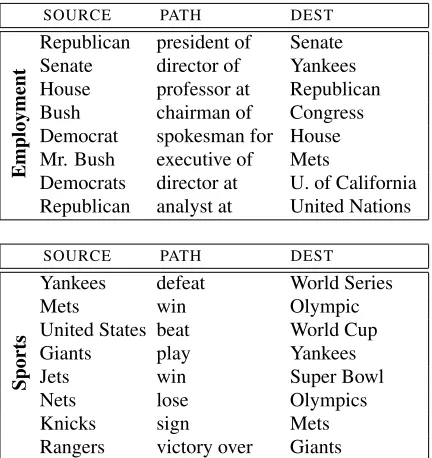
-PAIR features. We also measured whether differ-ent models agree on their topic assignmdiffer-ents using Cohen’s Kappa.2 RelLDA agrees least with MLT models and most with CLT models (i.e.,κ = 0.50 for U-MLT (ALL) andκ = 0.65for U-CLT (ALL)). This suggests that the CLT rules do not affect the output of RelLDA as much as MLT ones. Examples of relation clusters discovered by the U-MLT (ALL)
model are shown in Table 4.
A last note on parameter selection. Our experi-ments explored the parameter space extensively in order to examine any interactions between the in-duced relations and the logic rules. For most model variants inferring subtype relations, the preferred number of clusters is 10. For coarse-grained rela-tions, the optimal number of clusters is five. Over-all, we found that the quality of the output is highly correlated with the quality of the logic rules and that a fewgoodrules are more important than the opti-mal number of clusters. We consider these findings robust enough to apply across domains and datasets.
2
SOURCE PATH DEST
Republican president of Senate Senate director of Yankees House professor at Republican Bush chairman of Congress Democrat spokesman for House Mr. Bush executive of Mets
Democrats director at U. of California Republican analyst at United Nations
Employment
SOURCE PATH DEST
Yankees defeat World Series
Mets win Olympic
United States beat World Cup
Giants play Yankees
Jets win Super Bowl
Nets lose Olympics
Knicks sign Mets
Rangers victory over Giants
[image:10.612.77.293.62.291.2]Sports
Table 4: Clusters discovered by the U-MLT (ALL) model indicating employment- and sports-type relations. For the sake of readability, we do not display the syntactic depen-dencies between words in a path.
7 Conclusions
In this paper we presented a new model for unsu-pervised relation extraction which operates over tu-ples representing a syntactic relationship between two named entities. Our model clusters such tuples into underlying semantic relations (e.g., Located, Family) by incorporating general domain knowledge which we encode as First Order Logic rules. Specif-ically, we combine a topic model developed for the relation extraction task with domain relevant rules, and present an algorithm for estimating the param-eters of this model. Evaluation results on the ACE 2007 (English) RDC task show that our model out-performs competitive unsupervised approaches by a wide margin and is able to produce clusters shaped by both the data and the rules.
In the future, we would like to explore additional types of rules such as seed rules, which would as-sign tuples complying with the “seed” information to distinct relations. Aside from devising new rule types, an obvious next step would be to explore dif-ferent ways of extracting the rule set based on differ-ent criteria (e.g., the most general versus most spe-cific rules). Also note that in the current framework rule weights are set manually by the domain expert.
An appealing direction would be to learn these auto-matically e.g., via a procedure that optimizes some clustering objective. Finally, it should be interesting to use some form of distant supervision (Mintz et al., 2009) either as a means of obtaining useful rules or to discard potentially noisy or uninformative rules.
Acknowledgments
We gratefully acknowledge financial support from the Department of Education, Universities and Re-search of the Basque Government (BFI-2011-442). We also thank Limin Yao and Sebastian Riedel for sharing their corpus with us and the members of the Probabilistic Models reading group at the University of Edinburgh for helpful feedback.
References
Eugene Agichtein and Luis Gravano. 2000. Snowball: Extracting relations from large plain-text collections. InProceedings of the 5th ACM International Confer-ence on Digital Libraries, pages 85–94, San Antonio, Texas.
Eneko Agirre and Aitor Soroa. 2007. Semeval-2007 task 02: Evaluating word sense induction and discrim-ination systems. In Proceedings of the 4th Interna-tional Workshop on Semantic Evaluations, pages 7–12, Prague, Czech Republic.
David Andrzejewski, Xiaojin Zhu, Mark Craven, and Ben Recht. 2011. A framework for incorporating general domain knowledge into latent Dirichlet allocation us-ing first-order logic. InProceedings of the 22nd In-ternational Joint Conference on Artificial Intelligence, pages 1171–1177, Barcelona, Spain.
Michele Banko, Michael J. Cafarella, Stephen Soderland, Matthew Broadhead, and Oren Etzioni. 2007. Open information extraction from the web. InProceedings of the 20th International Joint Conference on Artificial Intelligence, pages 2670–2676, Hyderabad, India. Amir Beck and Marc Teboulle. 2003. Mirror
de-scent and nonlinear projected subgradient methods for convex optimization. Operations Research Letters, 31(3):167–175.
Christopher M. Bishop. 2006. Pattern Recognition and Machine Learning. Springer.
David M. Blei, Andrew Y. Ng, and Michael I. Jordan. 2003. Latent Dirichlet allocation. Journal of Machine Learning Research, 3:993–1022.
of the Association of Computational Linguistics, pages 576–583, Prague, Czech Republic.
Aron Culotta and Jeffrey Sorensen. 2004. Dependency tree kernels for relation extraction. InProceedings of the 42nd Meeting of the Association for Computational Linguistics, Main Volume, pages 423–429, Barcelona, Spain.
Ted Dunning. 1993. Accurate methods for the statistics of surprise and coincidence. Computational Linguis-tics, 19(1):61–74.
Jenny Rose Finkel, Trond Grenager, and Christopher Manning. 2005. Incorporating non-local informa-tion into informainforma-tion extracinforma-tion systems by Gibbs sam-pling. In Proceedings of the 43rd Annual Meeting of the Association for Computational Linguistics, pages 363–370, Ann Arbor, Michigan.
David Gondek and Thomas Hofmann. 2004. Non-redundant data clustering. InIEEE International Con-ference on Data Mining, pages 75–82. IEEE Computer Society.
Thomas L. Griffiths and Mark Steyvers. 2004. Finding scientific topics. PNAS, 101(1):5228–5235.
Takaaki Hasegawa, Satoshi Sekine, and Ralph Grishman. 2004. Discovering relations among named entities from large corpora. InProceedings of the 42nd Annual Meeting of the Association for Computational Linguis-tics, pages 415–422, Barcelona, Spain.
D. Koller and N. Friedman. 2009. Probabilistic Graphi-cal Models: Principles and Techniques. MIT Press. Dekang Lin and Patrick Pantel. 2001. DIRT – discovery
of inference rules from text. InProceedings of the 7th ACM SIGKDD International Conference on Knowl-edge Discovery and Data Mining, pages 323–328, San Francisco, California.
Mike Mintz, Steven Bills, Rion Snow, and Daniel Juraf-sky. 2009. Distant supervision for relation extraction without labeled data. InProceedings of the Joint Con-ference of the 47th Annual Meeting of the ACL and the 4th International Joint Conference on Natural Lan-guage Processing of the AFNLP, pages 1003–1011, Suntec, Singapore.
Joakim Nivre, Johan Hall, and Jens Nilsson. 2004. Memory-based dependency parsing. In Proceedings of the 8th Conference on Computational Natural Lan-guage Learning, pages 49–56, Boston, Massachusetts. Eric W. Noreen. 1989. Computer-intensive Methods for Testing Hypotheses: An Introduction. John Wiley and Sons Inc.
Patrick Pantel and Marco Pennacchiotti. 2006. Espresso: Leveraging generic patterns for automatically harvest-ing semantic relations. InProceedings of the 21st In-ternational Conference on Computational Linguistics
and 44th Annual Meeting of the Association for Com-putational Linguistics, pages 113–120, Sydney, Aus-tralia.
Hoifung Poon and Pedro Domingos. 2009. Unsuper-vised semantic parsing. InProceedings of the 2009 Conference on Empirical Methods in Natural Lan-guage Processing, pages 1–10, Suntec, Singapore. Matthew Richardson and Pedro Domingos. 2006.
Markov logic networks. Machine Learning, 62(1–2):107–136.
Ellen Riloff and Rosie Jones. 1999. Learning dictionar-ies for information extraction. InProceedings of the 16th International Joint Conference on Artificial Intel-ligence, pages 474–479, Stockholm, Sweden.
Stefan Schoenmackers, Jesse Davis, Oren Etzioni, and Daniel Weld. 2010. Learning first-order Horn clauses from web text. InProceedings of the 2010 Conference on Empirical Methods in Natural Language Process-ing, pages 1088–1098, Cambridge, MA, October. As-sociation for Computational Linguistics.
Yusuke Shinyama and Satoshi Sekine. 2006. Preemptive information extraction using unrestricted relation dis-covery. InProceedings of the Human Language Tech-nology Conference of the NAACL, Main Conference, pages 304–311, New York City, USA.
Mihai Surdeanu and Massimiliano Ciaramita. 2007. Ro-bust information extration with perceptrons. In Pro-ceedings of the NIST 2007 Automatic Content Extrac-tion Workshop.
Kiri Wagstaff, Claire Cardie, C Rogers, and S Schr¨odl. 2001. Constrained k-means clustering with back-ground knowledge. In International Conference on Machine Learning, pages 577–584. Morgan Kauf-mann.
Limin Yao, Aria Haghighi, Sebastian Riedel, and Andrew McCallum. 2011. Structured relation discovery using generative models. InProceedings of the 2011 Confer-ence on Empirical Methods in Natural Language Pro-cessing, pages 1456–1466, Edinburgh, Scotland, UK. GuoDong Zhou, Min Zhang, DongHong Ji, and