
Success with Style: Using Writing Style to Predict the Success of Novels
Vikas Ganjigunte Ashok Song Feng Yejin Choi
Department of Computer Science Stony Brook University Stony Brook, NY 11794-4400
vganjiguntea, songfeng, [email protected]
Abstract
Predicting the success of literary works is a curious question among publishers and aspir-ing writers alike. We examine the quantitative connection, if any, betweenwriting styleand successful literature. Based on novels over several different genres, we probe the predic-tive power of statistical stylometry in discrim-inating successful literary works, and identify characteristic stylistic elements that are more prominent in successful writings. Our study reports for the first time that statistical stylom-etry can be surprisingly effective in discrim-inating highly successful literature from less successful counterpart, achieving accuracy up to 84%. Closer analyses lead to several new insights into characteristics of the writing style in successful literature, including findings that are contrary to the conventional wisdom with respect to good writing style and readability.
1 Introduction
Predicting the success of novels is a curious ques-tion among publishers, professional book reviewers, aspiring and even expert writers alike. There are po-tentially many influencing factors, some of which concern the intrinsic content and quality of the book, such as interestingness, novelty, style of writing, and engaging storyline, but external factors such as so-cial context and even luck can play a role. As a re-sult, recognizing successful literary work is a hard task even for experts working in the publication in-dustries. Indeed, even some of the best sellers and award winners can go through several rejections
be-fore they are picked up by a publisher.1
Perhaps due to its obvious complexity of the prob-lem, there has been little previous work that attempts to build statistical models that predict the success of literary works based on their intrinsic content and quality. Some previous studies do touch on the no-tion of stylistic aspects in successful literature, e.g., extensive studies in Literature discuss literary styles of significant authors (e.g., Elleg˚ard (1962), Mc-Gann (1998)), while others consider content char-acteristics such as plots, charchar-acteristics of charac-ters, action, emotion, genre, cast, of the best-selling novels and blockbuster movies (e.g., Harvey (1953), Hall (2012), Yun (2011)).
All these studies however, are qualitative in na-ture, as they rely on the knowledge and insights of human experts on literature. To our knowledge, no prior work has undertaken a systematic quantitative investigation on the overarching characterization of the writing style in successful literature. In consid-eration of widely different styles of authorship (e.g., Escalante et al. (2011), Peng et al. (2003), Argamon et al. (2003)), it is not even readily clear whether there might be common stylistic elements that help discriminating highly successful ones from less suc-cessful counterpart.
In this work, we present the first study that in-vestigates this unstudied and unexpected connection between stylistic elements and the literary success. The key findings of our research reveal that there exists distinct linguistic patterns shared among
suc-1
E.g., Paul Harding’s “Tinkers” that won 2010 Pulitzer Prize for Fiction and J. K. Rowling’s “Harry Potter and the Philoso-pher’s Stone” that sold over 450 million copies.
cessful literature, at least within the same genre, making it possible to build a model with surprisingly high accuracy (up to 84%) in predicting the success of a novel. This result is surprising for two reasons. First, we tackle the hard task of predicting the suc-cess of novels written bypreviously unseenauthors, avoiding incidental learning of authorship signature, since previous research demonstrated that one can achieve very high accuracy in authorship attribution (as high as 96% in some experimental setup) (e.g., Raghavan et al. (2010), Feng et al. (2012)). Sec-ond, we aim to discriminate highly successful nov-els from less successful, but nonetheless published books written by professional writers, which are un-doubtedly of higher quality than average writings. It is important to note that the task we tackle here is much harder than discriminating highly success-ful works from those that have not even passed the scrutinizing eyes of publishers.
In order to quantify the success of literary works, and to obtain corresponding gold standard labels, one needs to first define “success”. For practi-cal convenience, we largely rely on the download counts available at Project Gutenberg as a surrogate to quantify the success of novels. For a small num-ber of novels however, we also consider award re-cipients (e.g., Pulitzer, Nobel), and Amazon’s sales records to define a novel’s success. We also ex-tend our empirical study to movie scripts, where we quantify the success of movies based on the aver-age review scores atimdb.com. We leave analysis based on other measures of literary success as future research.
In this study, we do not attempt to separate out success based on literary quality (award winners) from success based on popularity (commercial hit, often in spite of bad literary quality), mainly because it is not practically easy to determine whether the high download counts are due to only one reason or the other. We expect that in many cases, the two different aspects of success are likely to coincide, however. In the case of the corpus obtained from Project Gutenberg, where most of our experiments are conducted, we expect that the download counts are more indicative of success based on the literary quality (which then may have resulted in popularity) rather than popularity without quality.
We examine several genres in fiction and movie
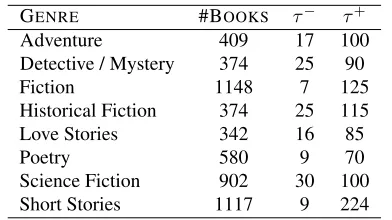
GENRE #BOOKS τ− τ+
Adventure 409 17 100
Detective / Mystery 374 25 90
Fiction 1148 7 125
Historical Fiction 374 25 115 Love Stories 342 16 85
Poetry 580 9 70
[image:2.612.327.523.59.169.2]Science Fiction 902 30 100 Short Stories 1117 9 224
Table 1: # of books available per genre at Gutenberg with download thresholds used to define more successful (≥ τ+) and less successful (≤τ−) classes.
scripts, e.g., adventure stories, mystery, fiction, his-torical fiction, sci-fi, short stories, as well as poetry, and present systematic analyses based on lexical and syntactic features which have been known to be ef-fective in a variety of NLP tasks ranging from au-thorship attribution (e.g., Raghavan et al. (2010)), genre detection (e.g., Rayson et al. (2001), Douglas and Broussard (2000)), gender identification (e.g., Sarawgi et al. (2011)) and native language detection (e.g., Wong and Dras (2011)).
Our empirical results demonstrate that (1) statis-tical stylometry can be surprisingly effective in dis-criminating successful literature, achieving accuracy up to 84%, (2) some elements of successful styles are genre-dependent while others are more univer-sal. In addition, this research results in (3) find-ings that are somewhat contrary to the conventional wisdom with respect to the connection between suc-cessful writing styles and readability, (4) interesting correlations between sentiment / connotation and the literary success, and finally, (5) comparative insights between fiction and nonfiction with respect to the successful writing style.
2 Dataset Construction
For our experiments, we procure novels from project Gutenberg2. Project Gutenberg houses over40,000
books available for free download in electronic for-mat and provides a catalog containing brief descrip-tions (title, author, genre, language, download count, etc.) of these books. We experiment with genres in Table 1, which have sufficient number of books al-lowing us to construct reasonably sized datasets.
We use the download counts in Gutenberg-catalog
2
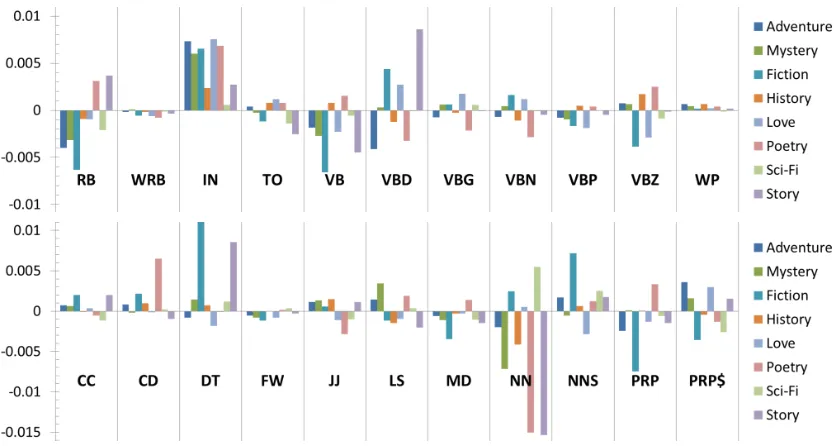
Figure 1: Differences in POS tag distribution between more successful and less successful books across different genres. Negative (positive) value indicates higher percentage in less (more) successful class.
as a surrogate to measure the degree of success of novels. For each genre, we determine a lower bound (τ+) and an upper bound (τ−) of download counts as
shown in Table 1 to categorize the available books as more successful and less successful respectively. These thresholds are set to obtain at least50books for each class, and for each genre. To balance the data, for each genre, we construct a dataset of100
novels (50per class).
We make sure that no single author has more than
2 books in the resulting dataset, and in the major-ity of the cases, only one book has been taken from each author.3 Furthermore, we make sure that the books from the same author do not show up in both training and test data. These constraints make sure that we learn general linguistic patterns of success-ful novels, rather than a particular writing style of a few successful authors.
3 Methodology
In what follows, we describe five different aspects of linguistic styles we measure quantitatively. The first three correspond to the features that have been fre-quently utilized in previous studies in related tasks,
3
The complete list of novels used for each genre in our dataset is available at http://www.cs.stonybrook. edu/˜ychoi/successwithstyle/
e.g., genre detection (e.g., Kessler et al. (1997)) and authorship attribution (e.g., Stamatatos (2009)), while the last two are newly explored in this work.
I. Lexical Choices: unigrams and bigrams.
II. Distribution of Word Categories: Many
pre-vious studies have shown that the distribution of part-of-speech (POS) tags alone can reveal surpris-ing insights on genre and authorship (e.g., Koppel and Schler (2003)), hence we examine their distri-butions with respect to the success of literary works.
III. Distribution of Grammar Rules: Recent
studies reported that features based on CFG rules are helpful in authorship attribution (e.g., Raghavan et al. (2010), Feng et al. (2012)). We experiment with four different encodings of production rules:
• Γ: lexicalized production rules (all production rules, including those with terminals)
• ΓG: lexicalized production rules prepended with the grandparent node.
• γ: unlexicalized production rules (all produc-tion rules except those with terminals).
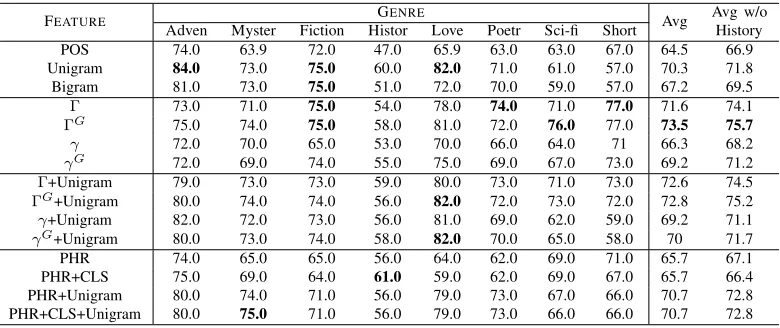
FEATURE GENRE Avg Avg w/o History Adven Myster Fiction Histor Love Poetr Sci-fi Short
POS 74.0 63.9 72.0 47.0 65.9 63.0 63.0 67.0 64.5 66.9 Unigram 84.0 73.0 75.0 60.0 82.0 71.0 61.0 57.0 70.3 71.8 Bigram 81.0 73.0 75.0 51.0 72.0 70.0 59.0 57.0 67.2 69.5
Γ 73.0 71.0 75.0 54.0 78.0 74.0 71.0 77.0 71.6 74.1
ΓG 75.0 74.0 75.0 58.0 81.0 72.0 76.0 77.0 73.5 75.7 γ 72.0 70.0 65.0 53.0 70.0 66.0 64.0 71 66.3 68.2 γG 72.0 69.0 74.0 55.0 75.0 69.0 67.0 73.0 69.2 71.2
Γ+Unigram 79.0 73.0 73.0 59.0 80.0 73.0 71.0 73.0 72.6 74.5
[image:4.612.111.501.60.224.2]ΓG+Unigram 80.0 74.0 74.0 56.0 82.0 72.0 73.0 72.0 72.8 75.2 γ+Unigram 82.0 72.0 73.0 56.0 81.0 69.0 62.0 59.0 69.2 71.1 γG+Unigram 80.0 73.0 74.0 58.0 82.0 70.0 65.0 58.0 70 71.7 PHR 74.0 65.0 65.0 56.0 64.0 62.0 69.0 71.0 65.7 67.1 PHR+CLS 75.0 69.0 64.0 61.0 59.0 62.0 69.0 67.0 65.7 66.4 PHR+Unigram 80.0 74.0 71.0 56.0 79.0 73.0 67.0 66.0 70.7 72.8 PHR+CLS+Unigram 80.0 75.0 71.0 56.0 79.0 73.0 66.0 66.0 70.7 72.8
Table 2: Classification results in accuracy (%).
IV. Distribution of Constituents: PCFG
gram-mar rules are overly specific to draw a big picture on the distribution of large, recursive syntactic units. We hypothesize that the distribution of constituents can serve this purpose, and that it will reveal inter-esting and more interpretable insights into writing styles in highly successful literature. Despite its rel-ative simplicity, we are not aware of previous work that looks at the distribution of constituents directly. In particular, we are interested in examining the dis-tribution of phrasal and/or clausal tags as follows: (i) Phrasal tag percent (PHR) - percentage distribu-tion of phrasal tags.4 (ii) Clausal tag percent (CLS) - percentage distribution of clausal tags.
V. Distribution of Sentiment and Connotation:
Finally, we examine whether the distribution of sen-timent and connotation words, and their polarity, has any correlation with respect to the success of literary works. We are not aware of any previous work that looks into this connection.
4 Prediction Performance
We use LibLinear SVM (Fan et al., 2008) with L2 tuned over training data, and all performance is based on 5-fold cross validation. We take1000 sen-tences from the beginning of each book. POS fea-tures are encoded as unit normalized frequency and all other features are encoded as tf-idf.5
4
The percentage of any phrasal tag is the count of occurrence of that tag over the sum of counts of all phrasal tags.
5
POS tags are obtained using the Stanford POS tagger (Toutanova and Manning, 2000), and parse trees are based on the Stanford parser (Klein and Manning, 2003).
Prediction Results Table 2 shows the
classifica-tion results. The best performance reaches as high as 84% in accuracy. In fact, in all genres except for history, the best performance is at least 74%, if not higher. Another notable observation is that even in the poetry genre, which is not prose, the ac-curacy gets as high as 74%. This level of perfor-mance is not entirely anticipated, given that (1) the test data consists of books written only by previously unseen authors, and (2) each author has widely dif-ferent writing style, and (3) we do not have training data at scale, and (4) we aim to tackle the hard task of discriminating highly successful ones from less successful, but nonetheless successful ones, as all of them were, after all, good enough to be published.6
Prediction with Varying Thresholds of
Down-load Counts Before we proceed to comprehensive
analysis of writing style that are prominent in more successful literature (§5), in Table 3, we present how the prediction accuracy varies as we adjust the defi-nition of more-successful and less-successful litera-ture, by gradually increasing (decreasing) the thresh-oldτ−(τ+). As we reduce the gap betweenτ−and τ+, the performance decreases, which shows that in-deed there are notable statistical differences in lin-guistic patterns between novels with high and low download counts, and the stylistic difference mono-tonically increases (thereby higher prediction accu-racy) as we increase the gap between two classes.
6In our pilot study, we also experimented with the binary
τ− τ+ A
CCURACY
[image:5.612.315.538.58.320.2]17 100 84.0 25 90 78.4 35 80 77.6 45 70 76.4 55 60 73.5
Table 3: Accuracy (%) with varying thresholds of down-load counts for ADVENTUREwith unigram features.
This is particularly interesting as the size of training data set is actually monotonically decreasing (mak-ing it harder to achieve high accuracy) while we in-crease the separation betweenτ−andτ+.
5 Analysis of Successful Writing Styles
5.1 Insights Based on Lexical Choices
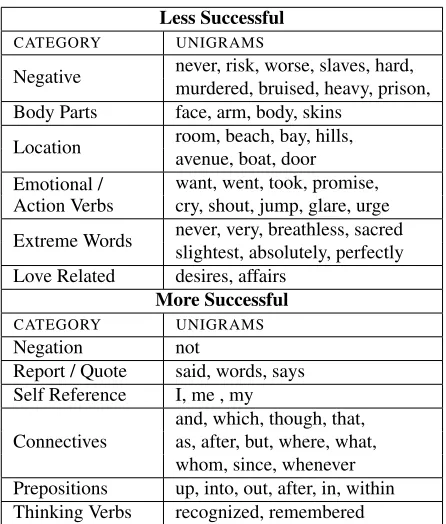
It is apparent from Table 2 that unigram features yield curiously high performance in many genres. We therefore examine discriminative unigrams for ADVENTURE, shown in Table 4. Interestingly, less
successful books rely on verbs that are explicitly de-scriptive of actions and emotions (e.g., “wanted”, “took”, “promised”, “cried”, “cheered”, etc.), while more successful books favor verbs that describe thought-processing (e.g., “recognized”, “remem-bered”), and verbs that serve the purpose of quotes and reports (e.g,. “say”). Also, more successful books use discourse connectives and prepositions more frequently, while less successful books rely more on topical words that could be almost clich´e, e.g., “love”, typical locations, and involve more ex-treme (e.g., “breathless”) and negative words (e.g., “risk”).
5.2 Distribution of Sentiment & Connotation
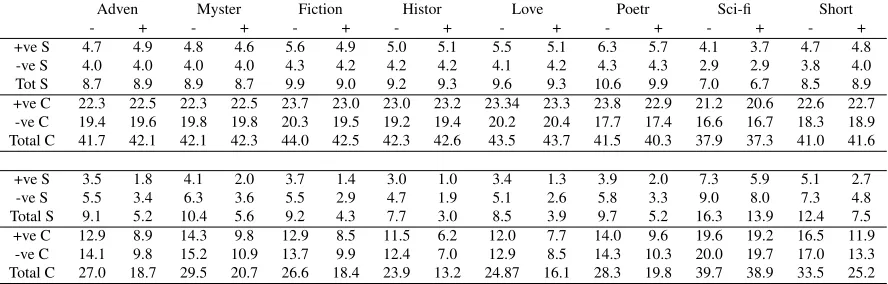
We also determine the distribution of sentiment and connotation words separately for each class (Table 5) to check if there exists a connection with respect to successful writing styles.7 We first compare dis-tribution of sentiment and connotation for the entire words. As can be seen in Table 5 –Top, there are not notable differences. However, when we compare distribution only with respect to discriminative uni-grams only (i.e., features with non-zero weights), as
7
We use MPQA subjectivity lexicon (Wilson et al., 2005) and connotation lexicon (Feng et al., 2013) for determining sen-timent and connotation of words respectively.
Less Successful
CATEGORY UNIGRAMS
Negative never, risk, worse, slaves, hard, murdered, bruised, heavy, prison, Body Parts face, arm, body, skins
Location room, beach, bay, hills, avenue, boat, door Emotional / want, went, took, promise, Action Verbs cry, shout, jump, glare, urge
Extreme Words never, very, breathless, sacred slightest, absolutely, perfectly Love Related desires, affairs
More Successful
CATEGORY UNIGRAMS
Negation not
Report / Quote said, words, says Self Reference I, me , my
Connectives
[image:5.612.134.237.61.134.2]and, which, though, that, as, after, but, where, what, whom, since, whenever Prepositions up, into, out, after, in, within Thinking Verbs recognized, remembered
Table 4: Discriminative unigrams for ADVENTURE.
shown in Table 5 –Bottom, we find substantial dif-ferences in all genres. In particular, discriminative unigrams that characterize less successful novels in-volve significantly more sentiment-laden words.
5.3 Distribution of Word Categories
Summarized analysis of POS distribution across all genres is reported in Table 6. It can be seen that prepositions, nouns, pronouns, determiners and ad-jectives are predictive of highly successful books whereas less successful books are characterized by higher percentage of verbs, adverbs, and foreign words. Per genre distributions of POS tags are vi-sualized in Figure 1. Interestingly, some POS tags show almost universal patterns (e.g., prepositions (IN), NNP, WP, VB), while others are more genre-specific.
In Relation to Journalism Style The work of
Adven Myster Fiction Histor Love Poetr Sci-fi Short
- + - + - + - + - + - + - + - +
+ve S 4.7 4.9 4.8 4.6 5.6 4.9 5.0 5.1 5.5 5.1 6.3 5.7 4.1 3.7 4.7 4.8 -ve S 4.0 4.0 4.0 4.0 4.3 4.2 4.2 4.2 4.1 4.2 4.3 4.3 2.9 2.9 3.8 4.0 Tot S 8.7 8.9 8.9 8.7 9.9 9.0 9.2 9.3 9.6 9.3 10.6 9.9 7.0 6.7 8.5 8.9 +ve C 22.3 22.5 22.3 22.5 23.7 23.0 23.0 23.2 23.34 23.3 23.8 22.9 21.2 20.6 22.6 22.7
-ve C 19.4 19.6 19.8 19.8 20.3 19.5 19.2 19.4 20.2 20.4 17.7 17.4 16.6 16.7 18.3 18.9 Total C 41.7 42.1 42.1 42.3 44.0 42.5 42.3 42.6 43.5 43.7 41.5 40.3 37.9 37.3 41.0 41.6
+ve S 3.5 1.8 4.1 2.0 3.7 1.4 3.0 1.0 3.4 1.3 3.9 2.0 7.3 5.9 5.1 2.7 -ve S 5.5 3.4 6.3 3.6 5.5 2.9 4.7 1.9 5.1 2.6 5.8 3.3 9.0 8.0 7.3 4.8 Total S 9.1 5.2 10.4 5.6 9.2 4.3 7.7 3.0 8.5 3.9 9.7 5.2 16.3 13.9 12.4 7.5 +ve C 12.9 8.9 14.3 9.8 12.9 8.5 11.5 6.2 12.0 7.7 14.0 9.6 19.6 19.2 16.5 11.9
[image:6.612.85.529.61.203.2]-ve C 14.1 9.8 15.2 10.9 13.7 9.9 12.4 7.0 12.9 8.5 14.3 10.3 20.0 19.7 17.0 13.3 Total C 27.0 18.7 29.5 20.7 26.6 18.4 23.9 13.2 24.87 16.1 28.3 19.8 39.7 38.9 33.5 25.2
Table 5: Top: Distribution of sentiment (connotation) among entire unigrams. Bottom: distribution of sentiment (connotation) among discriminative unigrams. ’S’ and ’C’ stand for sentiment and connotation respectively.
More Successful
CATEGORY SUB-CATEGORY DIFF
Prepositions General 0.00592 Determiners General 0.00226
Nouns Plural 0.00189
Proper (Singular) 0.00016 Coord. conj. General 0.00118
Numbers General 0.00102
Pronouns
Posesseive 0.00081 General WH 0.00042 Possessive WH 5.4E-05
Adjectives General 0.00102 Superlative 0.00011
Less Successful
CATEGORY SUB-CATEGORY DIFF
Adverbs General -0.00272
General WH -0.00028
Verbs
Base -0.00239
Non-3rd sing. present -0.00084 Past tense -0.00041 Past participle -0.00039 3rd person sing. present -0.00036
Modal -0.00091
Foreign General -0.00067
Symbols General -0.00018
[image:6.612.78.299.249.565.2]Interjections General -0.00016
Table 6: Top discriminative POS tags.
successful books tend to bear closer resemblance to informative articles.
5.4 Distribution of Constituents
It can be seen in Table 2 that deep syntactic fea-tures expressed in terms of different encodings of production rules consistently yield good
perfor-mance across almost all genres. Production rules are overly specific to gain more generalized, in-terpretable, high-level insights however (Feng et al., 2012). Therefore, similarly as word categories (POS), we consider the categories of nonterminal nodes of the parse trees, in particular, phrasal and clausal tags, as they represent the gist of constituent structure that goes beyond shallow syntactic infor-mation represented by POS.
Table 8 shows how the distribution of phrasal and clausal tags differ for successful books when com-puted over all genres. Positive (negative) DIFF val-ues indicate that the corresponding tags are favored in more successful (less successful) books when counted across all genres. We also report the num-ber of genres (#Genres) in which the individual dif-ference is positive / negative.
In terms of phrasal tags, we find that more suc-cessful books are composed of higher percentage of PP, NP and wh-noun phrases (WHNP), whereas less successful books are composed of higher percentage of VP, adverb phrases (ADVP), interjections (INTJ) and fragments (FRAG). Notice that this observation is inline with our earlier findings with respect to the distribution of POS.
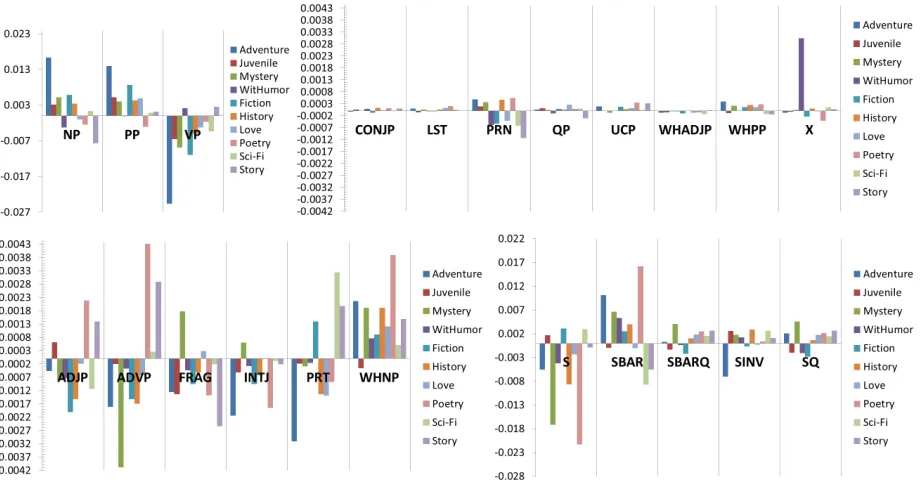
In regard to clausal tags, more successful books involve more clausal tags that are necessary for com-plex sentence structure and inverted sentence struc-ture (SBAR, SBARQ and SQ) whereas less success-ful books rely more on simple sentence structure (S). Figure 2 shows the visualization of the distribution of these phrasal and clausal tags.
Figure 2: Difference between phrasal and clausal tag percentage distributions of more successful and less successful books across different genres. Specifically, we plotD−–D+, whereD+is the phrasal tag distribution (in %) of more successful books andD−is the phrasal tag distribution (in %) of less successful books.
READABILITYINDICES More Succ. Less Succ.
FOG index 9.88 9.80
Flesch index 87.48 87.64
Table 7: Readability: Lower FOG and higher Flesch in-dicate higher readability (numbers in Boldface).
tags alone can yield classification performance that are generally better than that of POS tags, in spite of the very small feature set (26 tags in total). In fact, constituent tags deliver the best performance in case of historical fiction genre (Table 2).
Connection to Readability Pitler and Nenkova
(2008) provide comprehensive insights into assess-ment of readability. In their work, among the most discriminating features characterizing text with bet-ter readability is increased use of verb phrases (VP). Interestingly, contrary to the conventional wisdom – that readability is of desirable quality of good writ-ings – our findwrit-ings in Table 2 suggest that the in-creased use of VP correlates strongly with the writ-ing style of the opposite spectrum of highly success-ful novels.
As a secondary way of probing the connection
be-tween readability and the writing style of successful literature, we also compute two different readabil-ity measures that have been used widely in prior literature (e.g., Sierra et al. (1992), Blumenstock (2008), Ali et al. (2010)): (i) Flesch reading ease score (Flesch, 1948), (ii) Gunning FOG index (Gun-ning, 1968). The overall weighted average readabil-ity scores are reported in Table 7. Again, we find that less successful novels have higher readability com-pared to more successful ones.
The work of Sawyer et al. (2008) provides yet another interesting contrasting point, where the au-thors found that award winning academic papers in marketing journals correlate strongly with increased readability, characterized by higher percentage of simple sentences. We conjecture that this opposite trend is likely to be due to difference between fic-tion and nonficfic-tion, leaving further investigafic-tion as future research.
In sum, our analysis reveals an intriguing and unexpected observation on the connection between
con-Phrasal + − DIFF #+Gen/#−Gen
ADJP 0.030 0.031 -6E-4 5/3
ADJP 0.030 0.031 -6E-4 5/3
ADVP 0.052 0.054 -0.002 2/6
CONJP 3E-4 3E-4 2E-5 5/3
FRAG 0.008 0.008 -1E-4 2/6
LST 2E-4 1E-4 5E-5 6/2
NAC 9E-6 6E-6 3E-6 5/3
NP 0.459 0.453 0.005 6/2
NX 1E-4 1E-4 -4E-7 3/5
PP 0.122 0.117 0.005 7/1
PRN 0.005 0.004 2E-4 4/4
PRT 0.010 0.010 -5E-4 3/5
QP 0.001 0.001 7E-5 6/2
RRC 8E-5 8E-5 6E-6 6/2
UCP 8E-4 7E-4 1E-4 8/0
VP 0.292 0.300 -0.008 1/7
WHADJP 2E-4 2E-4 -5E-5 1/7
WHAVP 0 0 0
-WHNP 0.013 0.012 0.001 8/0
WHPP 0.001 9E-4 1E-4 6/2
X 0.001 0.001 -4E-5 4/4
Clausal + − DIFF +Gen/#−Gen
SBAR 0.166 0.164 0.002 4/4
SQ 0.020 0.018 0.002 7/1
SBARQ 0.014 0.013 0.001 7/1
SINV 0.018 0.018 -6E-5 5/3
[image:8.612.311.540.58.398.2]S 0.781 0.785 -0.004 3/5
Table 8: Overall Phrasal / Clausal Tag Distribution and analysis. All values are rounded to [3-5] decimal places.
fused as causation, between readability and literary success. We conjecture that the conceptual complex-ity of highly successful literary work might require syntactic complexity that goes against readability.
6 Literature beyond Project Gutenberg
One might wonder how the prediction algorithms trained on the dataset based on Project Gutenberg might perform on books not included at Guten-berg. This section attempts to address such a ques-tion. Due to the limited availability of electronically available books that are free of charge however, we could not procure more than a handful of books.8
6.1 Highly Successful Books
First, we apply the classifiers trained on the Project Gutenberg dataset (all genres merged) on a few ex-tremely successful novels (Pulitzer prize, National Award recipients, etc). Table 9 shows the results of
8
We report our prediction results on all books beyond Project Gutenberg of which we managed to get electronic copies, i.e., the results in Table 9 are not cherry-picked.
MORE SUCCESSFUL
BOOK (Q) PDKL U PDKL Su SΓ∗
“Don Quixote” 0.139 0.152 + +
– Miguel De Cervantes
“Other Voices, Other Rooms” 0.014 0.010 + + – Truman Capote
“The Fixer” 0.013 0.015 + +
– Bernard Malamud
“Robinson Crusoe” 0.042 0.051 + + – Daniel Defoe
“The old man and the sea” 0.065 0.060 + + – Ernest Hemingway
“A Tale of Two Cities” 0.027 0.030 + + – Charles Dickens
“Independence Day” 0.031 0.026 + + – Richard Ford
“Rabbit At Rest” 0.047 0.048 + + – John Updike
“American Pastoral” 0.039 0.043 + + – Philip Roth
“Dr Jackel and Mr. Hyde” 0.036 0.037 + + – Robert Stevenson
LESS SUCCESSFUL
“The lost symbol” 0.046 0.042 -
-– Dan Brown
“The magic barrel” 0.0288 0.0284 + -– Bernard Malamud
“Two Soldiers” 0.130 0.117 - +
– William Faulkner
[image:8.612.81.295.63.365.2]“My life as a man” 0.046 0.052 - + – Philip Roth
Table 9: Prediction on books beyond Gutenberg. Shaded entries indicate incorrect predictions.
two classification options: (1) KL-divergence based, and (2) unigram-feature based.
Although KL-divergence based prediction was not part of the classifiers that we explored in the pre-vious sections, we include it here mainly to provide better insights as to which well-known books share closer structural similarity to either more or less suc-cessful writing style. As a probability model, we use the distributions of phrasal tags, as those can give us insights on deep syntactic structure while suppress-ing potential noises due to topical variances. Table 9 shows symmetrised KL-divergence between each of the previously unseen novels and the collection of books from Gutenberg corresponding to more suc-cessful (less sucsuc-cessful) labels. For prediction, the label with smaller KL is chosen.
predictions on7out of10books, a surprisingly high performance based on mere 26 features. Of course, considering only the distribution of phrasal tags is significantly less informed than considering numer-ous other features that have shown substantially bet-ter performance, e.g., unigrams and CFG rewrite rules. Therefore, we also present the SVM classi-fier trained on unigram features. It turns out uni-gram features are powerful enough to make correct predictions for all ten books in Table 9.
Hemingway and Minimalism It is good to think
about where and why KL-divergence-based ap-proach fails. In fact, when we included Heming-way’sThe Old Man and the Seainto the test set, we were expecting some level of confusions when rely-ing only on high-level syntactic structure, as Hem-ingway’s signature style is minimalism, with 70% of his sentences corresponding to simple sentences. Not surprisingly, more adequately informed clas-sifiers, e.g., SVM with unigram features, are still able to recognize Hemingway’s writings as those of highly successful ones.
6.2 Less Successful Books
In order to obtain less successful books, we consider theAmazon seller’s rankincluded in the product de-tails of a book. The less successful books considered in Table 9 had an Amazon seller’s rank beyond200k (higher rank indicating less commercial success) ex-cept Dan Brown’s The lost symbol, which we in-cluded mainly because of negative critiques it had attracted from media despite its commercial success. As shown in Table 9, all three classifiers make (ar-guably) correct predictions on Dan Brown’s book.9 This result also supports our earlier assumption on the nature of novels available at Project Gutenberg — that they would be more representative of liter-ary success than general popularity (with or without literary quality).
7 Predicting Success of Movie Scripts
We have seen successful results in the novel domain, but can stylometry-based prediction work on very different domains, such as screenplays? Unlike nov-els, movie scripts are mostly in dialogues, which
9
Most notable pattern based on phrasal tag analysis is a sig-nificantly increased use of fragments (FRAG), which associates strongly with less successful books in our dataset.
FEATURE Adven Fanta Roman Thril
POS 62.0 58.0 61.7 56.0
Unigram 62.0 81.3 70.0 80.0
Bigrams 73.3 84.7 80.8 76.0
Γ 66.0 81.3 70.0 76.0
ΓG 62.0 69.3 86.7 60.0
γ 62.0 81.3 78.3 76.0 γG 69.3 77.3 77.5 68.0
Γ+Uni 62.0 85.3 70.0 76.0
ΓG+Uni 54.7 81.3 70.0 76.0 γ+Uni 58.0 89.3 70.0 76.0 γG+Uni 58.0 84.7 70.0 76.0
PHR 46.0 42.7 65.8 80.0
PHR+CLR 76.7 31.3 65.8 80.0
PHR+Uni 62.0 81.3 70.0 80.0
PHR+CLR+Uni 62.0 81.3 70.0 80.0
Table 10: Classification results on movie dialogue data (rating≥8 vs rating≤5.5).
are likely to be more informal. Also, what to keep in mind is that much of the success of movies de-pends on factors beyond the quality of writing of the scripts, such as the quality of acting, the popularity of actors, budgets, artistic taste of directors and pro-ducers, editing and so forth.
We use the Movie Script Dataset introduced in Danescu-Niculescu-Mizil and Lee (2011). It in-cludes the dialogue scripts of 617 movies. The aver-age rating of all movies is 6.87. We consider movies with IMDb rating ≥ 8 as “more successful”, the ones with IMDb rating≤ 5.5 as “less successful”. We combine all the dialogues of each movie and filter out the movies with less than 200 sentences. There are 11 genres (“ADVENTURE”, “FANTASY”, “ROMANCE”, “THRILLER”, “ACTION”, “COMEDY”, “CRIME”, “DRAMA”, “HORROR”, “MYSTERY”, “SCI
-FI”) with 15 movies or more per class, we take 15 movies per class and perform classification tasks with the same experiment setting as Table 2.
Table 10, we show some of the example genres with relatively successful outcome, reaching as high as 89.3% accuracy in FANTASY genre. We would
movies. The second reason is due to many other ex-ternal factors that can also influence the success of movies, as discussed earlier.
8 Related Work
Predicting success of novels and movies: To the
best of our knowledge, our work is the first that pro-vides quantitative insights into the unstudied con-nection between the writing style and the success of literary works. There have been some previous work that aims to gain insights into the secret recipe of successful books, but most were qualitative, based only on a dozen of books, focusing mainly on the high-level content of the books, such as the per-sonalities of protagonists, antagonists, the nature of plots (e.g., Harvey (1953), Yun (2011)). In con-trast, our work examines a considerably larger col-lection of books (800 in total) over eight different sub-genres, providing insights into lexical, syntac-tic, and discourse patterns that characterize the writ-ing styles commonly shared among the successful literature. Another relevant work has been on a dif-ferent domain of movies (Yun, 2011), however, the prediction is based only on external, non-textual in-formation such as the reputation of actors and direc-tors, and the power of distribution systems etc, with-out analyzing the actual content of the movie scripts.
Text quality and readability: Louis (2012)
ex-plored various features that measure the quality of text, which has some high-level connections to our work. Combining the insights from Louis (2012) with our results, we find that the characteristics of text quality explored in Louis (2012), readability of text in particular, do not correspond to the prominent writing style of highly successful literature. There have been a number of other work that focused on predicting and measuring readability (e.g., Kate et al. (2010), Pitler and Nenkova (2008), Schwarm and Ostendorf (2005), Heilman and Eskenazi (2006) and Collins-Thompson et al. (2004)) employing various linguistic features.
There is an important difference however, in re-gard to the nature of the selected text for analysis: most studies in readability focus on differentiating good writings from noticeably bad writings, often involving machine generated text or those written by ESL students. In contrast, our work essentially
deals with differentiating good writings from even better writings. After all, all the books that we an-alyzed are written by expert writers who passed the scrutinizing eyes of publishers, hence it is reason-able to expect that the writing quality of even less successful books is respectful.
Predicting success among academic papers: In
the domain of academic papers, which belongs to the broad genre of non-fiction, the work of Sawyer et al. (2008) investigated the stylistic characteris-tics of award winning papers in marketing journals, and found that the readability plays an important role. Combined with our study which focuses on fic-tion and creative writing, it suggests that the recipe for successful publications can be very different de-pending on whether it belongs to fiction or nonfic-tion. The work of Bergsma et al. (2012) is also somewhat relevant to ours in that their work in-cluded differentiating the writing styles of workshop papers from major conference papers, where the lat-ter would be generally considered to be more suc-cessful.
9 Conclusion
We presented the first quantitative study that learns to predict the success of literary works based on their writing styles. Our empirical results demonstrated that statistical stylometry can be surprisingly effec-tive in discriminating successful literature, achiev-ing accuracy up to 84% in the novel domain and 89% in the movie domain. Furthermore, our study resulted in several insights including: lexical and syntactic elements of successful styles, the connec-tion between successful writing style and readabil-ity, the connection between sentiment / connotation and the literary success, and last but not least, com-parative insights between successful writing styles of fiction and nonfiction.
Acknowledgments This research was supported
References
Omar Ali, Ilias N Flaounas, Tijl De Bie, Nick Mosdell, Justin Lewis, and Nello Cristianini. 2010. Automat-ing news content analysis: An application to gender bias and readability. Journal of Machine Learning Research-Proceedings Track, 11:36–43.
Shlomo Argamon, Moshe Koppel, Jonathan Fine, and Anat Rachel Shimoni. 2003. Gender, genre, and writ-ing style in formal written texts. TEXT-THE HAGUE THEN AMSTERDAM THEN BERLIN-, 23(3):321– 346.
Shane Bergsma, Matt Post, and David Yarowsky. 2012. Stylometric analysis of scientific articles. In Proceed-ings of the 2012 Conference of the North American Chapter of the Association for Computational Linguis-tics: Human Language Technologies, pages 327–337. Association for Computational Linguistics.
Joshua E Blumenstock. 2008. Automatically assessing the quality of wikipedia articles.
Kevyn Collins-Thompson, James P. Callan, and James P. Callan. 2004. A language modeling approach to pre-dicting reading difficulty. InHLT-NAACL, pages 193– 200.
Cristian Danescu-Niculescu-Mizil and Lillian Lee. 2011. Chameleons in imagined conversations: A new ap-proach to understanding coordination of linguistic style in dialogs. InProceedings of the Workshop on Cognitive Modeling and Computational Linguistics, ACL 2011.
Dan Douglas and Kathleen M Broussard. 2000. Long-man grammar of spoken and written english. TESOL Quarterly, 34(4):787–788.
Alvar Elleg˚ard. 1962. A Statistical method for determin-ing authorship: the Junius Letters, 1769-1772, vol-ume 13. G¨oteborg: Acta Universitatis Gothoburgen-sis.
Hugo J Escalante, Thamar Solorio, and M Montes-y G´omez. 2011. Local histograms of character n-grams for authorship attribution. InProceedings of the 49th Annual Meeting of the Association for Compu-tational Linguistics: Human Language Technologies, volume 1, pages 288–298.
Rong-En Fan, Kai-Wei Chang, Cho-Jui Hsieh, Xiang-Rui Wang, and Chih-Jen Lin. 2008. Liblinear: A library for large linear classification. The Journal of Machine Learning Research, 9:1871–1874.
Song Feng, Ritwik Banerjee, and Yejin Choi. 2012. Characterizing stylistic elements in syntactic struc-ture. In Proceedings of the 2012 Joint Conference on Empirical Methods in Natural Language Process-ing and Computational Natural Language LearnProcess-ing, pages 1522–1533. Association for Computational Lin-guistics.
Song Feng, Jun Sak Kang, Polina Kuznetsova, and Yejin Choi. 2013. Connotation lexicon: A dash of senti-ment beneath the surface meaning. InProceedings of the 51th Annual Meeting of the Association for Com-putational Linguistics (Volume 2: Short Papers), Sofia, Bulgaria, Angust. Association for Computational Lin-guistics.
Rudolph Flesch. 1948. A new readability yardstick. Journal of applied psychology, 32(3):221.
Robert Gunning. 1968. The technique of clear writing. McGraw-Hill New York.
James W Hall. 2012. Hit Lit: Cracking the Code of the Twentieth Century’s Biggest Bestsellers. Random House Digital, Inc.
John Harvey. 1953. The content characteristics of best-selling novels. Public Opinion Quarterly, 17(1):91– 114.
Michael Heilman and Maxine Eskenazi. 2006. Language learning: Challenges for intelligent tutoring systems. In Proceedings of the workshop of intelligent tutor-ing systems for ill-defined tutortutor-ing systems. Eight in-ternational conference on intelligent tutoring systems, pages 20–28.
Rohit J Kate, Xiaoqiang Luo, Siddharth Patwardhan, Martin Franz, Radu Florian, Raymond J Mooney, Salim Roukos, and Chris Welty. 2010. Learning to predict readability using diverse linguistic features. In Proceedings of the 23rd International Conference on Computational Linguistics, pages 546–554. Associa-tion for ComputaAssocia-tional Linguistics.
Brett Kessler, Geoffrey Numberg, and Hinrich Sch¨utze. 1997. Automatic detection of text genre. In Proceed-ings of the 35th Annual Meeting of the Association for Computational Linguistics and Eighth Conference of the European Chapter of the Association for Computa-tional Linguistics, pages 32–38. Association for Com-putational Linguistics.
Dan Klein and Christopher D Manning. 2003. Ac-curate unlexicalized parsing. In Proceedings of the 41st Annual Meeting on Association for Computa-tional Linguistics-Volume 1, pages 423–430. Associ-ation for ComputAssoci-ational Linguistics.
Moshe Koppel and Jonathan Schler. 2003. Exploit-ing stylistic idiosyncrasies for authorship attribution. In Proceedings of IJCAI’03 Workshop on Computa-tional Approaches to Style Analysis and Synthesis, vol-ume 69, page 72. Citeseer.
Annie Louis. 2012. Automatic metrics for genre-specific text quality. Proceedings of the 2012 Conference of the North American Chapter of the Association for Computational Linguistics: Human Language Tech-nologies: Student Research Workshop, page 54. Jerome McGann. 1998. The Poetics of Sensibility: A
Fuchun Peng, Dale Schuurmans, Shaojun Wang, and Vlado Keselj. 2003. Language independent author-ship attribution using character level language mod-els. In Proceedings of the tenth conference on Eu-ropean chapter of the Association for Computational Linguistics-Volume 1, pages 267–274. Association for Computational Linguistics.
Emily Pitler and Ani Nenkova. 2008. Revisiting read-ability: a unified framework for predicting text qual-ity. InProceedings of the Conference on Empirical Methods in Natural Language Processing, EMNLP ’08, pages 186–195, Stroudsburg, PA, USA. Associ-ation for ComputAssoci-ational Linguistics.
Sindhu Raghavan, Adriana Kovashka, and Raymond Mooney. 2010. Authorship attribution using proba-bilistic context-free grammars. InProceedings of the ACL 2010 Conference Short Papers, pages 38–42. As-sociation for Computational Linguistics.
Paul Rayson, Andrew Wilson, and Geoffrey Leech. 2001. Grammatical word class variation within the british national corpus sampler. Language and Com-puters, 36(1):295–306.
Ruchita Sarawgi, Kailash Gajulapalli, and Yejin Choi. 2011. Gender attribution: tracing stylometric evi-dence beyond topic and genre. InProceedings of the Fifteenth Conference on Computational Natural Lan-guage Learning, pages 78–86. Association for Com-putational Linguistics.
Alan G Sawyer, Juliano Laran, and Jun Xu. 2008. The readability of marketing journals: Are award-winning articles better written? Journal of Marketing, 72(1):108–117.
Sarah E. Schwarm and Mari Ostendorf. 2005. Read-ing level assessment usRead-ing support vector machines and statistical language models. In Proceedings of the 43rd Annual Meeting on Association for Computa-tional Linguistics, ACL ’05, pages 523–530, Strouds-burg, PA, USA. Association for Computational Lin-guistics.
Arlene E Sierra, Mark A Bisesi, Terry L Rosenbaum, and E James Potchen. 1992. Readability of the radiologic report.Investigative radiology, 27(3):236–239. Efstathios Stamatatos. 2009. A survey of modern
au-thorship attribution methods. Journal of the Ameri-can Society for information Science and Technology, 60(3):538–556.
Kristina Toutanova and Christopher D. Manning. 2000. Enriching the knowledge sources used in a maximum entropy part-of-speech tagger. In In EMNLP/VLC 2000, pages 63–70.
Theresa Wilson, Janyce Wiebe, and Paul Hoffmann. 2005. Recognizing contextual polarity in phrase-level sentiment analysis. InProceedings of the conference
on Human Language Technology and Empirical Meth-ods in Natural Language Processing, pages 347–354. Association for Computational Linguistics.
Sze-Meng Jojo Wong and Mark Dras. 2011. Exploiting parse structures for native language identification. In Proceedings of the Conference on Empirical Methods in Natural Language Processing, pages 1600–1610. Association for Computational Linguistics.
![Table 8: Overall Phrasal / Clausal Tag Distribution andanalysis. All values are rounded to [3-5] decimal places.](https://thumb-us.123doks.com/thumbv2/123dok_us/1369171.670190/8.612.311.540.58.398/table-overall-phrasal-clausal-distribution-andanalysis-rounded-decimal.webp)