Fast Joint Compression and Summarization via Graph Cuts
Xian Qian and Yang Liu The University of Texas at Dallas 800 W. Campbell Rd., Richardson, TX, USA
{qx,yangl}@hlt.utdallas.edu
Abstract
Extractive summarization typically uses sen-tences as summarization units. In contrast, joint compression and summarization can use smaller units such as words and phrases, re-sulting in summaries containing more infor-mation. The goal of compressive summariza-tion is to find a subset of words that max-imize the total score of concepts and cut-ting dependency arcs under the grammar con-straints and summary length constraint. We propose an efficient decoding algorithm for fast compressive summarization using graph cuts. Our approach first relaxes the length con-straint using Lagrangian relaxation. Then we propose to bound the relaxed objective func-tion by the supermodular binary quadratic pro-gramming problem, which can be solved ef-ficiently using graph max-flow/min-cut. S-ince finding the tightest lower bound suffers from local optimality, we use convex relax-ation for initializrelax-ation. Experimental results on TAC2008 dataset demonstrate our method achieves competitive ROUGE score and has good readability, while is much faster than the integer linear programming (ILP) method.
1 Introduction
Automatic multi-document summarization helps readers get the most important information from large amounts of texts. Summarization techniques can be roughly divided into two categories: extrac-tive and abstracextrac-tive. Extracextrac-tive summarization casts the summarization task as a sentence selection prob-lem: identifying important summary sentences from
one or multiple documents. Many methods have been developed in the past decades, including super-vised approaches that use classifiers to predict sum-mary sentences, graph based approaches to rank the sentences, and recent global optimization methods such as integer linear programming (Gillick et al., 2008) (ILP) and submodular maximization methods (Lin and Bilmes, 2011). Though extractive summa-rization is popular because of its simplicity and high readability, it has limitations in that it selects each sentence as a whole, and thus may miss informative partial sentences.
To improve the informativeness, joint com-pression and summarization was proposed (Berg-Kirkpatrick et al., 2011), which uses words as sum-marization units, unlike extractive sumsum-marization where each sentence is a basic undecomposable u-nit. To achieve better readability, manually defined grammar constraints or automatically learned mod-els based on syntax trees are added during the sum-marization process. Up to now, the state of the art compressive systems are based on integer linear pro-gramming (ILP). Because ILP suffers from expo-nential complexity, word-based compression sum-marization is an order of magnitude slower than sentence-based extraction.
One common way to solve an ILP problem is to use its LP relaxation and round the results. How-ever Berg-Kirkpatrick et al. (2011) found that LP relaxation gave poor results, finding unacceptably suboptimal solutions. For speedup, they proposed a two stage method where they performed some sen-tence selection in the first step to reduce the number of candidates. Despite their empirical success, such
a pruning approach has its inherent problem in that it may eliminate correct sentences in the first step. Recently, Almeida and Martins (2013) proposed a fast joint decoding algorithm based on dual decom-position. For fast convergence, they added quadratic penalty terms to alleviate the learning rate problem.
In this paper, we propose an efficient decoding al-gorithm for fast ILP based compressive summariza-tion using graph cuts. Our assumpsummariza-tion is that all con-cepts are word n-grams and non-negatively scored. The rationale for the non-negativity assumption is s-traightforward: the score of a concept reflects its in-formativeness, hence should be non-negative. Given a set of documents, each word is associated with a binary variable, indicating whether the word is se-lected in the summary. Our idea is to approximate the ILP as a binary quadratic programming problem where coefficients of all quadratic terms are non-negative. It is well known that such binary quadrat-ic function is supermodular, and its maximum can be solved efficiently using graph max-flow/min-cut. Hence the key is to find the coefficients of the super-modular binary quadratic function (SBQF) so that its maximum is close to the optimal ILP objective function. Our solution consists of 3 steps. First, we show that the subtree deletion model and gram-mar constraints can be eliminated by adding SBQF-s to the objective function. Second, we relax the summary length constraint using Lagrangian relax-ation. Third, we propose a family of SBQFs that are lower bounds of the ILP objective function. S-ince finding the tightest lower bound suffers from local optimality, we choose to use convex relaxation for initialization. To demonstrate our technique, we conduct experiments on Text Analysis Conference (TAC) datasets using the same train/test splits as pre-vious work (Berg-Kirkpatrick et al., 2011). We com-pare our approach with the state-of-the-art ILP based approach in terms of summary quality (ROUGE s-cores and sentence quality) and speed. Experimen-tal results show that our proposed method achieves competitive performance with ILP, while about 100 times faster.
2 Compressive Summarization
2.1 Extractive Summarization
As our method is an approximation of ILP based method, we first briefly review the ILP based extrac-tive summarization and compressive summarization. Gillick and Favre (2009) introduced the concept-based ILP for summarization. A concept is a basic semantic unit. They used word bigrams as such lan-guage concepts. Their system achieved the highest ROUGE score on the TAC 2009 evaluation. This approach selects sentences so that the total score of language concepts appearing in the summary is maximized. The association between the language concepts and sentences serves as the constraints, in addition to the summary length constraint.
Formally, given a set of sentencesS ={sn}Nn=1, extractive summarization can be represented by a bi-nary vectory, whereyn indicates whether sentence
sn is selected. LetC = {c1, . . . cJ}denote the set of concepts in S, e.g., word bigrams (Gillick and Favre, 2009). Each conceptcj is associated with a given score wj and a binary variablevj indicating ifcj is selected in the summary. Letnjk denote the index of the sentence containing thekthoccurrence of conceptcj, andln denote the length of sentence
sn. The ILP based extractive summarization system can be formulated as below:
max y,v
J
∑
j=1 wjvj
s.t. vj =
∪
k
ynjk 1≤j≤J (1)
N
∑
i=1
ynln≤L
v,yare binary
The first constraint is imposed by the relation be-tween concept selection and sentence selection: s-electing a sentence leads to the selection of all the concepts it contains, and selecting a concept only happens when it is present in at least one of the se-lected sentences. The second constraint is the sum-mary length constraint.
exam-ple, the ICSI system (Gillick et al., 2008) removed the sentences that are too short or have non-overlap with the queries, and concepts with document fre-quency less than 3, resulting in95.8 sentences and about 80 concepts per topic on the TAC2009 dataset. Therefore the actual scale of ILP is rather small after pruning (e.g., 176 variables and 372 constraints per topic). Empirical studies showed that such small s-cale ILP can be solved within a few seconds (Gillick and Favre, 2009).
2.2 Compressive Summarization
The quality of sentence-based extractive summariza-tion is limited by the informativeness of the orig-inal sentences and the summary length constraint. To remove the unimportant part from a long sen-tence, sentence compression is proposed to generate more informative summaries (Liu and Liu, 2009; Li et al., 2013a). Recent studies show that joint sen-tence compression and extraction, namely compres-sive summarization, outperforms pipeline systems that run extractive summarization on the compressed sentences or compress selected summary sentences (Martins and Smith, 2009; Berg-Kirkpatrick et al., 2011; Chali and Hasan, 2012). In Berg-Kirkpatrick et al. (2011), compressive summarization inte-grates the concept model for extractive summariza-tion (Gillick and Favre, 2009) and subtree delesummariza-tion model for sentence compression. The score of a compressive summary consists of two parts, scores of selected concepts, and scores of the broken arcs in the dependency parse trees. The selected word-s muword-st word-satiword-sfy the length conword-straint and grammar constraints that include subtree constraint and some manually defined hard constraints.
Formally, let x = x1. . . xI denote the word se-quence of documents, wheres1 =x1, . . . xl1
corre-sponds to the first sentence,s2 =xl1+1, . . . , xl1+l2
corresponds to the second sentence, and so on. A compressive summary can be represented by a bi-nary vectorz, where zi indicates whether word xi is selected in the summary. Letahmdenote the arc
xh → xm in the dependency parse tree of the cor-responding sentence containing words xh and xm, andA ={ahm}denote the set of dependency arcs. The subtree constraint ensures that word xm is se-lected only if its head xh is selected. In order to guarantee the readability, grammar constraints are
added to prohibit the breaks of some specific arc-s. For example, Clarke and Lapata (2008) nev-er deleted an arc whose dependency label is SUB, OBJ, PMOD, SBAR or VC. In this paper, we use
B ⊆ A to denote the set of these arcs that must not be broken in summarization. We useojk to de-note the indices of words corresponding to thekth
occurrence of cj. For example, suppose the jth conceptEuropean Unionappears twice in the doc-ument: x22x23 = x50x51 =European Union, then oj1={22,23}, oj2 ={50,51}.
The compressive summarization model can be formulated as an integer programming problem
max z,v
J
∑
j=1
wj·vj+
∑
ahm∈A
wahmzh(1−zm)
s.t. vj =
∪
k
∏
i∈ojk
zi ∀j
∑
i
zi≤L
zh ≥zm ∀ahm∈ A (2)
zh =zm ∀ahm∈ B
z,vare binary
According to the subtree deletion model, the score of arcahmis included ifzh = 1andzm = 0, which can be formulated aswahm ·zh(1−zm). The first
constraint is similar to that in extractive summariza-tion, that is, a concept is selected if and only if any of its occurrence is selected. The third and fourth constraints are the subtree constraints and manual-ly defined grammar constraints respectivemanual-ly. In the rest of the paper, without loss of generality, we re-move the fourth constraint by directly substituting one variable for the other.
3 Fast Decoding via Graph Cuts
In this section, we introduce our fast decoding al-gorithm. We assume that all the concepts are word n-grams, and their scores are negative. The non-negativity assumption can reduce the computational complexity, but is also reasonable: the score of a concept denotes its informativeness, hence should be non-negative. For example, Li et al. (2013b) proposed to use the estimated normalized frequen-cies of concepts as scores, which are essentially non-negative. The basic idea of our method is to approx-imate the above optimization problem (2) by the su-permodular binary quadratic programming (SBQP) problem:
max z
∑
i
βizi+
∑
ij
αijzizj
s.t. zis binary (3)
where αij ≥ 0. It is known that such a binary quadratic function is supermodular, and its maxi-mum can be solved efficiently using graph max-flow/min-cut (Billionnet and Minoux, 1985; Kol-mogorov and Zabih, 2004). Now the problem is to find the optimalα, βfor a good approximation.
3.1 Formulate Grammar Constraints and Subtree Deletion Model by SBQF
We show that the subtree deletion model can be for-mulated equivalently using SBQF. First, we can e-liminate the constraintzh ≥zmby adding a penalty term to the objective function. That is,
max f(z)
s.t. zh ≥zm
zis binary
is equivalent to
max f(z)− ∞(1−zh)zm
s.t. zis binary
We can see that the penalty term−∞(1−zh)zm ex-cludeszh = 0, zm = 1 from the feasible set, and forzh ≥zm, both problems have the same objective function value. Hence the two problems are equiva-lent. Notice that the coefficient of quadratic term in
−∞(1−zh)zm is positive, hence the penalty term is supermodular.
Now we eliminate the third constraint in problem (2) using the penalized objective function described above. Note that the fourth constraint has been elim-inated by variable substitution, we have
max z,v
J
∑
j=1
wj·vj+
∑
ahm∈A
wahmzh(1−zm)
−∞ ∑
ahm∈A
(1−zh)zm
s.t. vj =
∪
k
∏
i∈ojk
zi ∀j (4)
∑
i
zi≤L
z,vare binary
We can see that for each arc ahm, there must be a positive quadratic term +∞zhzm in the objective function, which guarantees the supermodularity of the objective function, no matter whatwahm is.
3.2 Eliminate Length Constraint Using Lagrangian Relaxation
Problem (4) is NP-hard, because for any feasiblev, it is a SBQP with a length constraint. Since size con-strained minimum cut problem is generally NP-hard (Nagano et al., 2011), Problem (4) can not be cast as a SBQP as long as P̸=NP. One popular way to deal with the size constrained optimization problem is Lagrangian relaxation. We introduce Lagrangian multiplierλto the length constraint in Problem (4), and get
min
λ maxz,v
J
∑
j=1
wj·vj+
∑
ahm∈A
wahmzh(1−zm)
−∞ ∑
ahm∈A
(1−zh)zm
+λ(L−∑
i
zi)
s.t. vj =
∪
k
∏
i∈ojk
zi ∀j (5)
λ≥0
z,vare binary
each word is penalized byλ— with larger λ, few-er words are selected. Hence the summary length can be adjusted byλ. The optimalλcan be found using binary search. We maintain an upper bound
λmax, and a lower boundλmin, which is initially0. In each iteration, we chooseλ = 12(λmax+λmin) and search the optimalz. If the duality gap vanish-es, i.e.,λ(L−∑izi) = 0and
∑
izi ≤ L, then we get the global solution of Problem (4). Otherwise, if∑izi > L, then the currentλis too small, so we set λmin = λ; otherwise,λ > 0 and
∑
izi < L, we setλmax =λ. The search process terminates if
λmax−λminis less than a predefined threshold.
3.3 EliminatevUsing Supermodular Relaxation
Now we consider the inner maximization Problem (5). It is still not a SBQP, since the objective func-tion is not a linear funcfunc-tion ofzizj. We propose to approximate the objective function using SBQP. Our solution consists of two steps. First we relax the first constraint of Problem (5) by bounding the objec-tive function with a family of supermodular pseudo boolean functions (Boros and Hammer, 2002). Sec-ond we reformulate these pseudo boolean functions equivalently as quadratic functions.
Similar to the bounding strategy in (Qian and Liu, 2013), we relax the logical disjunction by lineariza-tion. Using the fact that for any binary vectora, we have
∪
ai = max
p∈∆ ∑
i
piai
where∆denotes the probability simplex
∆ ={p|∑ k
pk= 1, pk≥0}
We have
vj =
∪
k
∏
i∈ojk zi
= max pj∈∆
∑
k
pjk
∏
i∈ojk zi
Plug the equation above into the objective function of Problem (5), we get the following optimization
problem
max z,p
J
∑
j=1
∑
k
pjkwj
∏
i∈ojk zi
+ ∑
ahm∈A
wahmzh(1−zm)
−∞ ∑
ahm∈A
(1−zh)zm
+λ(L−∑
i
zi)
s.t. zis binary (6)
pj ∈∆ ∀j
LetQ(p,z)denote the objective function of Prob-lem (6). Givenp, we can see thatQis a supermod-ular pseudo boolean function because coefficients of all non-linear terms are non-negative. Using the fact that for any binary vector a = [a1, . . . ar]T,
ai ∈ {0,1},1≤i≤r,
r
∏
i=1
ai = max b∈{0,1}
( r ∑
i=1
ai−r+ 1
) b
(Freedman and Drineas, 2005), we get the following equivalent optimization problem of Problem (6)
max z,p,q
J
∑
j=1 ∑
k
pjkwjqjk
∑
i∈ojk
zi− |ojk|+ 1
+ ∑
ahm∈A
wahmzh(1−zm)
−∞ ∑
ahm∈A
(1−zh)zm
+λ(L−∑
i
zi)
s.t. z,qare binary (7)
pj ∈∆ ∀j
where|ojk|is the size ofojk.
subgradient. That is
pnewj =P∆ (
pj+
∂R ∂pj
α )
(8)
whereα >0is the step size in line search, and func-tionP∆(q)denotes the projection ofq onto the fea-sible set∆
P∆(q) = min
p∈∆∥p−q∥2
which can be solved efficiently by sorting (Duchi et al., 2008).
3.4 InitializepUsing Convex Relaxation
SinceRis non-concave, searching its maximum us-ing subgradient method suffers from local optimali-ty. Though one can use techniques such as branch-and-bound for exact inference (Qian and Liu, 2013; Gormley and Eisner, 2013), here for fast decoding, we use convex relaxation to choose a good seed p(0). Recall thatpjk denotes the percentage of the
kthoccurrence contributing tocj. The largerpjk is, the more likely the kth occurrence is selected. To estimate such likelihood, we replace the binary con-straint in extractive summarization (Problem (1)) by 0 ≤ y,v ≤ 1, since solving a relaxed LP is much faster than ILP. Supposey∗ is the optimal solution for such a relaxed LP problem, we initializepby
pjk =
y∗njk ∑
ky∗njk
(9)
If for allk,yn∗jk = 0, then we initializepjk using uniform distribution
pjk =
1 |oj|
where|oj|is the frequency ofcj.
3.5 Summary
For clarity, we summarize our decoding algorithm in Algorithm 1. Initialλmaxcan be arbitrarily large. In our experiments, we setλmax =
∑
jwj, which em-pirically guarantees the summary length∑izi ≤L when λ = λmax. The choice of the step size for updating p is similar to the projected subgradien-t mesubgradien-thod in dual decomposisubgradien-tion (Koo esubgradien-t al., 2010).
Algorithm 1 Compressive Summarization via Graph Cuts
Require: Scores of concepts {wj} and arcs {wahm}, max summary lengthL.
Ensure: Compressive summarizationz∗, wherezi
indi-cates whether theithword is selected.
Solve the relaxed LP of Problem (1) (replace the binary constraint by0≤y,v≤1) to gety.
Initializep(0)using Eq (9).
Initialize sufficient largeλmax, andλmin= 0
whileλmax−λmin> ϵdo
Setλ=12(λmin+λmax)
Setp=p(0). repeat
Fix p, solve Problem (7) to get z using max-flow/min-cut.
Updatepusing Eq (8). untilconvergence if∑izi> Lthen
λmin=λ
else if∑izi< Lthen λmax=λ
else break end if end while
4 Features and Hard Constraints
We choose discriminative models to learn the scores of concepts and arcs. For conceptcj, its score is
wj =θTconceptfconcept(cj)
where fconcept(cj) is the feature vector of cj, and
θconcept is the corresponding weight vector of fea-ture fconcept(cj). Similarly, score wahm is defined
as
wahm =θ
T
arcfarc(ahm)
Though our algorithm can handle general word n-gram concepts, we restrict the concepts to word bi-grams, which have been widely used recently in the sentence-based ILP extractive summarization sys-tems. For a concept cj, we define the following features, some of which have been used in previous work (Brandow et al., 1995; Aker and Gaizauskas, 2009; Edmundson, 1969; Radev, 2001; Li et al., 2013b). All of these features are non-negative.
• Stop word ratio: ratio of stop words incj. The value can be{0,0.5,1}.
• Similarity with topic title: the number of com-mon words in these two strings, divided by the length of the longer string.
• Document ratio: percentage of documents con-tainingcj.
• Sentence ratio: percentage of sentences con-tainingcj.
• Sentence-title similarity: word uni-gram/bigrams cosine similarity between the sentence containingcj and the topic title. For concepts appearing in multiple sentences, we choose the maximal similarity.
• Sentence-query similarity: word uni-gram/bigram cosine similarity between the sentence containingcj and the topic query (concatenation of topic title and description). For concepts appearing in multiple sentences, we choose the maximal similarity.
• Sentence position: position of the sentence containing cj in the document. For concepts appearing in multiple sentences, we choose the minimum.
• Sentence length: length of the sentence con-tainingcj. For concepts appearing in multiple sentences, we choose the maximum.
• Paragraph starter: binary feature indicating whether cj appears in the first sentence of a paragraph.
For subtree deletion model, we define the follow-ing features for arcahm.
• POS tags of head wordxh and child wordxm and their concatenations.
• Dependency label of arcahmand its parent arc.
• Wordxmifxmis a conjunction word or prepo-sition word. Word xh if xm is a conjunction word or preposition word.
• Binary feature indicating whether the modifier
xmis a temporal word such asFriday.
We also define some hard constraints for subtree deletion to improve the readability of the generated compressed sentences.
• C0Arcahmcan be cut only if one of the two conditions holds: (1) there is a comma, colon, or semicolon between the head and the modifi-er; (2) the modifier word is a preposition (POS tag is IN) or a wh-word, such as what, who, whose(corresponds to POS tagIN, WDT, WP, WP$, WRB).
• C1 Arcs with dependency labels SUB, OBJ, PRD, SBARorVCcan not be cut.
• C2Arcs in set phrases like so far, more than, according tocan not be cut.
• C3All arcs in coordinate structures can not be cut, such ascats and dogs.
Note that compared with previous work, our com-pression is more conservative. Constraint C0 al-lows only a small portion of arcs to be cut. This is based on our observation of the sentence com-pression corpus: removing preposition phrases (PP) or sub-clauses can greatly reduce the length of sen-tence, while hurting the readability little. Cutting other arcs likeNMODusually removes only one or two words, and possibly affects the sentence’s read-ability.
5 Experimental Results
5.1 Experimental Setup
Corpus Sent. Words Topics Train TAC2009 4,216 117,304 44 CL08 3,178 52,624 N/A Develop TAC2010 2,688 72,609 46 Test TAC2008 4,518 123,946 48
Table 1: Corpus statistics. Training data consist of two parts, TAC2009 for learning the concept mod-el, CL08 (Clarke and Lapata, 2008) for learning the subtree deletion model.
development set for various parameter tuning. Table 1 has the descriptions of all the data used.
We choose averaged perceptron for fast training. The number of iterations is tuned on the develop-ment data. Remind that our algorithm is based on the assumption that scores of concepts are non-negative,
∀j, wj ≥0. We assume that feature vectorfconcept is non-negative (e.g., term frequency, n-gram fea-tures), thenθconcept ≥0is required to guarantee the non-negativity ofwj. Therefore, we projectθconcept onto the non-negative space after each iteration. S-ince training is offline, we use ILP based exact in-ference for accurate learning.1
To control the contributions of the concept mod-el and the subtree dmod-eletion modmod-el, we introduce a parameterµ, and modify the original maximization problem (Problem 2) to:
max z,v
J
∑
j=1
wj·vj +µ×
∑
ahm∈A
wahmzh(1−zm)
We tuneµon TAC2010 dataset. For max-flow/min-cut, in our experiments, we implemented the im-proved shortest augmented path (SAP) method (Ed-monds and Karp, 1972).
For performance measure of the summaries, we use both ROUGE and linguistic quality. ROUGE has been widely used for summarization perfor-mance and can measure the informativeness of the summaries (content match between system and ref-erence summaries). Since joint compression and summarization tends to pick isolated words to max-imize the information coverage in the system gener-ated summaries, it may have poor readability. There-fore we conduct human evaluation for the
linguis-1we choose the GLPK as our ILP solver, which is used in
(Berg-Kirkpatrick et al., 2011)
tic quality for various systems. The linguistic qual-ity consists of two parts. One evaluates the gram-mar quality within a sentence. Annotators gram-marked if a compressed sentence is grammatically correc-t. Typical grammar errors include lack of verb or subordinate clause. The other evaluates the coher-ence between sentcoher-ences, including the order of sen-tences and irrelevant sensen-tences. For compressive summaries, we removed the sentences with gram-mar errors when evaluating coherence. The overall linguistic quality score is the combined score of the percentage of grammatically correct sentences and the correct ordering of the summary sentences. The score is scaled and ranges from 1 (bad) to 10 (good).
5.2 Results on the Development Set
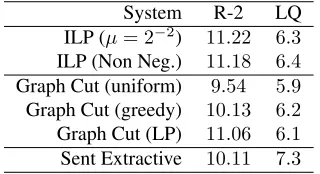
We conducted a series of experiments on the de-velopment dataset to investigate the effect of the non-negative score assumption, SBQP approxima-tion, and initialization. First, we build a stan-dard ILP based compressive summarizer without the non-negative score assumption. We varied µ over
{2−4,2−3, . . .24}and selected the optimalµ= 2−2
according to both ROUGE-2 score and linguistic quality. This interpolation weight is used in all the other experiments.
To study the impact of the non-negative score as-sumption, we build another summarizer by replac-ing the concept model with the one trained under the non-negative constraint. We also compared three d-ifferent initialization strategies forp. The first one is uniform initialization, i.e.,pjk = |o1j|. The second one is a greedy approach, where extractive summa-rization is obtained by greedy search (i.e., add the top ranked sentence iteratively), then we use the cor-respondingyand Eq (9) to initializep. The last one is our convex relaxation method described in Sec-tion 3.4.
System R-2 LQ ILP (µ= 2−2) 11.22 6.3 ILP (Non Neg.) 11.18 6.4 Graph Cut (uniform) 9.54 5.9 Graph Cut (greedy) 10.13 6.2 Graph Cut (LP) 11.06 6.1 Sent Extractive 10.11 7.3
Table 2: Experimental results on developmen-t dadevelopmen-tasedevelopmen-t. R-2 and LQ are shordevelopmen-t for ROUGE-2 score multiplied by 100, and linguistic quality respective-ly.
5.3 Results on Test Dataset
Table 3 shows the summarization results for various systems on the TAC2008 data set. We show both the summarization performance and the speed2 of the system. The presented systems include our graph-cut based method, the ILP based compression and summarization, and the sentence-based extractive summarization. ILP 2-step refers to the 2-step fast decoding strategy proposed by (Berg-Kirkpatrick et al., 2011).
We also list the performance of some state-of-the-art systems, including the two ICSI systems (Gillick et al., 2008), the compressive summarization sys-tem of Berg-Kirkpatrick et al. (2011) (GBK’11), the multi-aspect ILP system of Woodsend and Lapa-ta (2012)(WL’12) and the dual decomposition based system (Almeida and Martins, 2013) (AM’13). Note that for these referred systems since the linguistic quality results are not comparable due to different judgment methods. For our graph-cut based method, to study the tradeoff between the readability of the summary and the ROUGE scores, we present two versions for this method: one uses all the constraints (C0-C3), the other does not use C0.
We can see that our proposed method balanced speed and quality. Compared with ILP, we achieved competitive ROUGE scores, but with about 100x speedup. Our method is also faster than the 2-step ILP system. We also tried another state-of-the-art LP solver, Gurobi version 5.53, it achieves0.17 sec-onds per topic, much faster than GLPK, but
stil-2For fair comparison, we only recode the running time for
decoding. Other time costs like feature extraction, IO opera-tions are excluded.
3
www.gurobi.com
System R-2 R-SU4 LQ sec.
Graph Cut 11.74 14.54 6.5 0.056 Graph Cut w/o C0 12.05 14.71 5.4 0.053
ILP 11.86 14.62 6.6 5.5
ILP (Non Neg.) 11.82 14.60 6.6 5.2 ILP (2-step) 11.72 14.49 6.5 1.1 Sent Extractive 11.06 13.93 7.1 0.13
ICSI-1 11.0 13.4 - 0.38†
ICSI-2 11.1 14.3 -
-BGK’11 11.70 14.38 6.5†
-WL’12 11.37 14.47 -
[image:9.612.311.552.60.206.2]-AM’13 12.30+ 15.18+ 4.2† 0.41†
Table 3: Experimental results on TAC2008 dataset. Columns 2-5 are scores of 2, ROUGE-SU4, linguistic quality, and speed (seconds per top-ic). ROUGE-2 and ROUGE-SU4 scores are multi-plied by 100. All the experiments are conducted on the platform Intel Core i5-2500 CPU 3.30GHz. † numbers are not directly comparable due to differ-ent annotations or platforms. +extra resources are used.
l slower than ours. Regarding the grammar con-straints used in our system, from the two result-s for our graph-cut baresult-sed method, we can result-see that adding constraint C0 significantly decreases the R-2 score but improves the language quality. This shows that word-based joint compression and summariza-tion can improve ROUGE score; however, we need to keep in mind about linguistic quality and find a tradeoff between the ROUGE score and the linguis-tic quality. Almeida and Martins (2013) trained their model on extra corpora using multi-task learning, and achieved better results than ours. The results of our system and theirs showed that Lagrangian re-laxation based method combined with combinatorial optimization algorithms such as dynamic program-ming or minimum cut can exploit the inner structure of problems and achieve significant speedup over ILP.
India’s space agency is ready to send a man to spacewithin sev-en years if the governmsev-ent gives the nod, while preparations have lready begun for the launch of an unmanned lunar mission, a top official said. India will launch more missions to the moon if its maiden unmanned spacecraft Chandrayaan-1, slated to be launched by 2008, is successful a top space fficial said Tuesday.The Unit-ed States, the European Space Agency,China, Japan and India are all planning lunar missionsduring the ext decade.India is “a step ahead”of China in satellite technology and can surpass Beijing in space research by tapping the talent of its huge pool of young scientists, India’s space research chief said Monday. The space agencies of India and France signed an agreement on Friday to co-operatein launching a satellite in four years that will help make climate predictions more accurate.The Indian Space Research Or-ganization (ISRO) has short-listed experiments from five nation-s including the United Statenation-s,Britain and Germany, for a slot on India’s unmanned moon mission Chandrayaan-1 to be undertaken by 2006-2007, the Press Trust of India (PTI) reported Monday.A three-member Afghan delegation is in Bangalore seeking help to set up a high-tech telemedicine facilityin 10 Afghan cities linked via Indian satellites, Indo-Asian News Service reported Saturday.
A woman was killed in Mississippiwhen a tree crashed on her car, becoming the 11th fatality blamed on the powerful Hurricane Kat-rina that slammed the US Gulf coast after pounding Florida, local TV reported Monday.The bill for the Hurricane Katrina disaster ef-fort has so far reached 2.87 billion dollars, federal officials said on Tuesday. The official death toll from Hurricane Katrina has risen to 118 people in and around the swamped cityof New Orleans, officials said Thursday. The Foreign Ministry on Friday reported the first confirmed deathof a Guatemalan due to Hurricane Kat-rina in the United States. The Ugandan government has pledged 200,000 US dollars toward relief and rebuilding effortsin the after-math of Hurricane Katrina, local press reported on Friday. Swiss Reinsurance Co., the world’s second largest reinsurance company on Monday doubled to 40 billion US dollars its initial estimate of the global insured losses caused by Hurricane Katrina in the United States.
The A380 ’superjumbo’, which will be presented to the world in a lavish ceremony in southern France on Tuesday, will be prof-itable from 2008,its maker Airbus told the French financial news-paper La Tribune. The A380 will take over from the Boeing 747 as the biggest jetin the skies.An association of residents living n-ear Paris’s Charles-de-Gaulle airport on Wednesday denounced the noise pollution generated by the giant Airbus A380,after the new airliner’s maiden flight. One problem that Airbus is encountering with its new A380 is that the craft pushes the envelope on the max-imum sizeof a commercial airplane. With a whisper more than a roar, the largest passenger airliner ever built, the Airbus 380, took off on its maiden flight Wednesday.
“When she came in,she was in good spirits,” a prison staffer told the New York Daily News.Martha Stewart, the American celebrity homemaker who had her own cooking and home improvement TV show, reported to a federal prison in Alderson, West Virginia, on Friday to serve a five-month sentence for lying about a stock sale.
Home fashion guru Martha Stewart said on Friday thatshe has ad-justed to prison life and is keeping busy behind barssince reporting a week ago to a federal penal camp in West Virginia, where she is serving a five-month sentence for lying about a stock sale.The lawyer said he did not knowwhat she is writing, but Stewart has suggested since her conviction that she might write a book about her recent experience with the legal system. Walter Dellinger, the lawyer leading the appeal, said on NBC’s “Today” thatStewart is exploring “innovative ways to do microwave cooking” The lawyer said he did not knowwith her fellow inmates. As Martha Stewart arrives at the red-brick federal prison in Alderson, W. Va., on Fri-day to begin a five-month sentence, the company she founded is focused bothon life without her and on life once she returns.
In most cases, the removed phrases do not hurt the readability of the summaries. The errors are mainly caused by the break of sub-clauses or main claus-es that are separated by commas, for example, the fourth sentence in the last summary,The lawyer said he did not knowwhat she is writing.The compressed sentence is grammatically correct, but semantically incomplete. Other errors are due to the lack of verb, subject, or object, or incorrect removal of PP, such as the last sentence of the last summary.
6 Conclusion
In this paper, we propose a fast decoding algorith-m for coalgorith-mpressive sualgorith-malgorith-marization using graph cuts. Our idea is to approximate the original ILP prob-lem using supermodular binary quadratic program-ming (SBQP) problem. Under the assumption that scores of concepts are non-negative, we eliminate subtree constraints and grammar constraints, and relax the length constraint and non-supermodular part of the problem step by step. Our experimen-tal results showed that the graph cut based method achieved competitive performance compared to ILP, while about 100 times faster.
There are several possibilities for further research involving our graph cut algorithms. One idea is to apply it to the language model based compression method (Clarke and Lapata, 2008). The other is to adapt it to social media text summarization task, where text is much more noisy. As graph cut is a general method, applying it to other binary struc-tured learning tasks is also an interesting direction.
Acknowledgments
We’d like to thank three anonymous reviewers for their valuable comments. This work is partly sup-ported by NSF award IIS-0845484 and DARPA un-der Contract No. FA8750-13-2-0041. Any opinions expressed in this material are those of the authors and do not necessarily reflect the views of the fund-ing agencies.
References
Miguel Almeida and Andre Martins. 2013. Fast and ro-bust compressive summarization with dual decompo-sition and multi-task learning. InProceedings of ACL, pages 196–206, August.
Taylor Berg-Kirkpatrick, Dan Gillick, and Dan Klein. 2011. Jointly learning to extract and compress. In Proceedings of ACL-HLT, pages 481–490, June. A. Billionnet and M. Minoux. 1985. Maximizing a
su-permodular pseudoboolean function: A polynomial al-gorithm for supermodular cubic functions. Discrete Applied Mathematics, 12(1):1 – 11.
Endre Boros and Peter L. Hammer. 2002. Pseudo-boolean optimization. Discrete Applied Mathematics, 123(1C3):155 – 225.
Ronald Brandow, Karl Mitze, and Lisa F. Rau. 1995. Automatic condensation of electronic publications by sentence selection. Information Processing & Man-agement, 31(5):675 – 685.
Yllias Chali and Sadid A. Hasan. 2012. On the effective-ness of using sentence compression models for query-focused multi-document summarization. InCOLING, pages 457–474.
James Clarke and Mirella Lapata. 2008. Global in-ference for sentence compression: An integer linear programming approach. J. Artif. Intell. Res. (JAIR), 31:399–429.
John Duchi, Shai Shalev-Shwartz, Yoram Singer, and Tushar Chandra. 2008. Efficient projections onto the L1-ball for learning in high dimensions. In Proceed-ings of ICML, pages 272–279.
Jack Edmonds and Richard M. Karp. 1972. Theoret-ical improvements in algorithmic efficiency for net-work flow problems.J. ACM, 19(2):248–264, April. H. P. Edmundson. 1969. New methods in automatic
ex-tracting. J. ACM, 16(2):264–285, April.
Daniel Freedman and Petros Drineas. 2005. Energy min-imization via graph cuts: Settling what is possible. In CVPR (2), pages 939–946.
Dan Gillick and Benoit Favre. 2009. A scalable global model for summarization. InProceedings of the Work-shop on Integer Linear Programming for Natural Lan-guage Processing, pages 10–18, June.
Dan Gillick, Benoit Favre, and Dilek Hakkani-Tur. 2008. The ICSI summarization system at tac 2008. In Pro-ceedings of the Text Understanding Conference. Matthew R. Gormley and Jason Eisner. 2013.
Noncon-vex global optimization for latent-variable models. In Proceedings of ACL, pages 444–454, August.
Vladimir Kolmogorov and Ramin Zabih. 2004. What en-ergy functions can be minimized via graph cuts. IEEE Transactions on Pattern Analysis and Machine Intelli-gence, 26:65–81.
Terry Koo, Alexander M. Rush, Michael Collins, Tommi Jaakkola, and David Sontag. 2010. Dual decomposi-tion for parsing with non-projective head automata. In Proceedings of EMNLP 2010, pages 1288–1298, Oc-tober.
Chen Li, Fei Liu, Fuliang Weng, and Yang Liu. 2013a. Document summarization via guided sentence com-pression. InProceedings of EMNLP (to appear), Oc-tober.
Chen Li, Xian Qian, and Yang Liu. 2013b. Using super-vised bigram-based ILP for extractive summarization. InProceedings of ACL, pages 1004–1013, August. Hui Lin and Jeff Bilmes. 2011. A class of submodular
functions for document summarization. In Proceed-ings of ACL, pages 510–520, June.
Fei Liu and Yang Liu. 2009. From extractive to abstrac-tive meeting summaries: Can it be done by sentence compression? InProceedings of ACL-IJCNLP 2009, pages 261–264, August.
Andr´e F. T. Martins and Noah A. Smith. 2009. Summa-rization with a joint model for sentence extraction and compression. InProceedings of the Workshop on In-teger Linear Programming for Natural Langauge Pro-cessing, ILP ’09, pages 1–9.
Kiyohito Nagano, Yoshinobu Kawahara, and Kazuyuk-i AKazuyuk-ihara. 2011. SKazuyuk-ize-constraKazuyuk-ined submodular mKazuyuk-in- min-imization through minimum norm base. In ICML, pages 977–984.
Xian Qian and Yang Liu. 2013. Branch and bound algo-rithm for dependency parsing with non-local features. TACL, 1:105–151.
Dragomir R. Radev. 2001. Experiments in single and multidocument summarization using mead. InIn First Document Understanding Conference.