A Systematic Comparison of Phrase Table Pruning Techniques
Richard Zens and Daisy Stanton and Peng Xu
Google Inc.
{zens,daisy,xp}@google.com
Abstract
When trained on very large parallel corpora, the phrase table component of a machine translation system grows to consume vast computational resources. In this paper, we in-troduce a novel pruning criterion that places phrase table pruning on a sound theoretical foundation. Systematic experiments on four language pairs under various data conditions show that our principled approach is superior to existing ad hoc pruning methods.
1 Introduction
Over the last years, statistical machine translation has become the dominant approach to machine translation. This is not only due to improved mod-eling, but also due to a significant increase in the availability of monolingual and bilingual data. Here are just two examples of very large data resources that are publicly available:
• The Google Web 1T 5-gram corpus available from the Linguistic Data Consortium consist-ing of the 5-gram counts of about one trillion words of web data.1
• The 109-French-English bilingual corpus with about one billion tokens from the Workshop on Statistical Machine Translation (WMT).2
These enormous data sets yield translation models that are expensive to store and process. Even with
1
LDC catalog No. LDC2006T13
2
http://www.statmt.org/wmt11/translation-task.html
modern computers, these large models lead to a long experiment cycle that hinders progress. The situa-tion is even more severe if computasitua-tional resources are limited, for instance when translating on hand-held devices. Then, reducing the model size is of the utmost importance.
The most resource-intensive components of a sta-tistical machine translation system are the language model and the phrase table. Recently, compact rep-resentations of the language model have attracted the attention of the research community, for instance in Talbot and Osborne (2007), Brants et al. (2007), Pauls and Klein (2011) or Heafield (2011), to name a few. In this paper, we address the other problem of any statistical machine translation system: large phrase tables.
Johnson et al. (2007) has shown that large por-tions of the phrase table can be removed without loss in translation quality. This motivated us to perform a systematic comparison of different pruning meth-ods. However, we found that many existing methods employ ad-hoc heuristics without theoretical foun-dation.
The pruning criterion introduced in this work is inspired by the very successful and still state-of-the-art language model pruning criterion based on en-tropy measures (Stolcke, 1998). We motivate its derivation by stating the desiderata for a good phrase table pruning criterion:
• Soundness: The criterion should optimize some well-understood information-theoretic measure of translation model quality.
• Efficiency: Pruning should be fast, i. e., run lin-early in the size of the phrase table.
• Self-containedness: As a practical considera-tion, we want to prune phrases from an existing phrase table. This means pruning should use only information contained in the model itself.
• Good empirical behavior: We would like to be able to prune large parts of the phrase table without significant loss in translation quality.
Analyzing existing pruning techniques based on these objectives, we found that they are commonly deficient in at least one of them. We thus designed a novel pruning criterion that not only meets these objectives, it also performs very well in empirical evaluations.
Thenovel contributionsof this paper are:
1. a systematic description of existing phrase table pruning methods.
2. a new, theoretically sound phrase table pruning criterion.
3. an experimental comparison of several pruning methods for several language pairs.
2 Related Work
The most basic pruning methods rely on probabil-ity and count cutoffs. We will cover the techniques that are implemented in the Moses toolkit (Koehn et al., 2007) and the Pharaoh decoder (Koehn, 2004) in Section 3. We are not aware of any work that ana-lyzes their efficacy in a systematic way. It is thus not surprising that some of them perform poorly, as our experimental results will show.
The work of Johnson et al. (2007) is promis-ing as it shows that large parts of the phrase ta-ble can be removed without affecting translation quality. Their pruning criterion relies on statisti-cal significance tests. However, it is unclear how this significance-based pruning criterion is related to translation model quality. Furthermore, a compari-son to other methods is missing. Here we close this gap and perform a systematic comparison. The same idea of significance-based pruning was exploited in (Yang and Zheng, 2009; Tomeh et al., 2009) for hi-erarchical statistical machine translation.
A different approach to phrase table pruning was undertaken by Eck et al. (2007a; 2007b). They rely on usage statistics from translating sample data, so it is not self-contained. However, it could be combined with the methods proposed here.
Another approach to phrase table pruning is trian-gulation (Chen et al., 2008; Chen et al., 2009). This requires additional bilingual corpora, namely from the source language as well as from the target lan-guage to a third bridge lanlan-guage. In many situations this does not exist or would be costly to generate.
Duan et al. (2011), Sanchis-Trilles et al. (2011) and Tomeh et al. (2011) modify the phrase extrac-tion methods in order to reduce the phrase table size. The work in this paper is independent of the way the phrase extraction is done, so those approaches are complementary to our work.
3 Pruning Using Simple Statistics
In this section, we will review existing pruning methods based on simple phrase table statistics. There are two common classes of these methods: ab-solute phrase table pruning and relative phrase table pruning.
3.1 Absolute pruning
Absolute pruning methods rely only on the statistics of a single phrase pair ( ˜f ,e)˜. Hence, they are in-dependent of other phrases in the phrase table. As opposed to relative pruning methods (Section 3.2), they may prune all translations of a source phrase. Their application is easy and efficient.
• Count-based pruning. This method prunes a phrase pair ( ˜f ,˜e) if its observation count
N( ˜f ,˜e)is below a thresholdτc:
N( ˜f ,˜e)< τc (1)
• Probability-based pruning. This method prunes a phrase pair( ˜f ,e)˜ if its probability is below a thresholdτp:
p(˜e|f)˜ < τp (2)
Here the probabilityp(˜e|f˜)is estimated via rel-ative frequencies.
3.2 Relative pruning
A potential problem with the absolute pruning meth-ods is that it can prune all occurrences of a source phrasef˜.3 Relative pruning methods avoid this by considering the full set of target phrases for a spe-cific source phrasef˜.
• Threshold pruning. This method discards those phrases that are far worse than the best target phrase for a given source phrasef˜. Given a pruning threshold τt, a phrase pair ( ˜f ,e)˜ is
discarded if:
p(˜e|f˜)< τt·max ˜ e
n p(˜e|f˜)
o
(3)
• Histogram pruning. An alternative to thresh-old pruning is histogram pruning. For each source phrasef˜, this method preserves theK
target phrases with highest probabilityp(˜e|f˜)
or, equivalently, their countN( ˜f ,e)˜.
Note that, except for count-based pruning, none of the methods take the frequency of the source phrase into account. As we will confirm in the empirical evaluation, this will likely cause drops in translation quality, since frequent source phrases are more use-ful than the infrequent ones.
4 Significance Pruning
In this section, we briefly review significance prun-ing followprun-ing Johnson et al. (2007). The idea of sig-nificance pruning is to test whether a source phrase
˜
f and a target phrasee˜co-occur more frequently in a bilingual corpus than they should just by chance. Using some simple statistics derived from the bilin-gual corpus, namely
• N( ˜f)the count of the source phrasef˜
• N(˜e)the count of the target phrasee˜
• N( ˜f ,e)˜ the co-occurence count of the source phrasef˜and the target phrasee˜
• Nthe number of sentences in the bilingual cor-pus
3Note that it has never been systematically investigated
whether this is a real problem or just speculation.
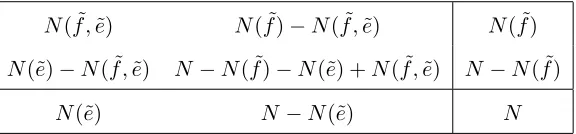
we can compute the two-by-two contingency table in Table 1.
Following Fisher’s exact test, we can calculate the probability of the contingency table via the hyperge-ometric distribution:
ph(N( ˜f ,e)) =˜
N( ˜f)
N( ˜f ,˜e)
· N−N( ˜f)
N(˜e)−N( ˜f ,˜e)
N N(˜e)
(4)
The p-value is then calculated as the sum of all probabilities that are at least as extreme. The lower thep-value, the less likely this phrase pair occurred with the observed frequency by chance; we thus prune a phrase pair( ˜f ,e)˜ if:
∞
X
k=N( ˜f ,˜e) ph(k)
> τF (5)
for some pruning thresholdτF. More details of this
approach can be found in Johnson et al. (2007). The idea of using Fisher’s exact test was first explored by Moore (2004) in the context of word alignment.
5 Entropy-based Pruning
In this section, we will derive a novel entropy-based pruning criterion.
5.1 Motivational Example
In general, pruning the phrase table can be consid-ered as selecting a subset of the original phrase table. When doing so, we would like to alter the original translation model distribution as little as possible. This is a key difference to previous approaches: Our goal is to removeredundantphrases, whereas previ-ous approaches usually try to remove low-quality or unreliable phrases. We believe this to be an advan-tage of our method as it is certainly easier to measure the redundancy of phrases than it is to estimate their quality.
N( ˜f ,e)˜ N( ˜f)−N( ˜f ,˜e) N( ˜f)
N(˜e)−N( ˜f ,˜e) N−N( ˜f)−N(˜e) +N( ˜f ,˜e) N−N( ˜f)
[image:4.612.164.452.60.127.2]N(˜e) N−N(˜e) N
Table 1: Two-by-two contingency table for a phrase pair( ˜f ,˜e).
Source Phrasef˜ Target Phrase˜e N( ˜f ,e)˜ p(˜e|f˜)
le the 7.6 M 0.7189
gouvernement government 245 K 0.4106
franc¸ais French 51 K 0.6440
of France 695 0.0046
le gouvernement franc¸ais the French government 148 0.1686
[image:4.612.135.475.165.302.2]the government of France 11 0.0128
Table 2: Example phrases from the French-English phrase table (K=thousands, M=millions).
same translation were generated from the remain-ing, shorter, phrases? Removing the phrasethe gov-ernment of Francewould increase this cost dramat-ically. Given the shorter phrases from the table, the probability would be 0.7189· 0.4106 ·0.0046 = 0.0014∗, which is about an order of a magnitude smaller than the original probability of0.0128.
On the other hand, composing the phrase the French governmentout of shorter phrases has prob-ability0.7189·0.4106·0.6440 = 0.1901, which is very close to the original probability of0.1686. This means it is safe to discard the phrasethe French gov-ernment, since the translation cost remains essen-tially unchanged. By contrast, discarding the phrase
the government of Francedoes not have this effect: it leads to a large change in translation cost.
Note that here the pruning criterion only considers redundancy of the phrases, not the quality. Thus, we are not saying that the government of France is a better translation thanthe French government, only that it is less redundant.
∗
We use the assumption that we can simply multiply the probabilities of the shorter phrases.
5.2 Entropy Criterion
Now, we are going to formalize the notion of re-dundancy. We would like the pruned modelp0(˜e|f˜)
to be as similar as possible to the original model
p(˜e|f)˜. We use conditional Kullback-Leibler di-vergence, also called conditional relative entropy (Cover and Thomas, 2006), to measure the model similarity:
D(p(˜e|f)˜||p0(˜e|f))˜
=X
˜ f
p( ˜f)X ˜ e
p(˜e|f˜) log "
p(˜e|f˜) p0(˜e|f)˜
#
(6)
=X
˜ f ,˜e
p(˜e,f˜)hlogp(˜e|f)˜ −logp0(˜e|f)˜i(7)
Computing the best pruned model of a given size would require optimizing over all subsets with that size. Since that is computationally infeasible, we in-stead apply the equivalent approximation that Stol-cke (1998) uses for language modeling. This as-sumes that phrase pairs affect the relative entropy roughly independently.
We can then choose a pruning threshold τE and
prune those phrase pairs with a contribution to the relative entropy below that threshold. Thus, we
prune a phrase pair( ˜f ,e)˜, if
p(˜e,f˜)hlogp(˜e|f˜)−logp0(˜e|f˜)i< τE (8)
We now address how to assign the probability
p0(˜e|f˜) under the pruned model. A phrase-based system selects among different segmentations of the source language sentence into phrases. If a segmen-tation into longer phrases does not exist, the system has to compose a translation out of shorter phrases. Thus, if a phrase pair ( ˜f ,e)˜ is no longer available, the decoder has to use shorter phrases to produce the same translation. We can therefore decompose the pruned model scorep0(˜e|f˜)by summing over all segmentationssK1 and all reorderingsπK1 :
p0(˜e|f˜) = X
sK
1 ,π1K
p(sK1 , π1K|f)˜ ·p(˜e|sK1 , πK1 ,f˜) (9)
Here the segmentation sK1 divides both the source and target phrases intoK sub-phrases:
˜
f = ¯fπ1...fπK¯ ande˜= ¯e1...¯eK (10)
The permutation πK1 describes the alignment of those sub-phrases, such that the sub-phrase ¯ek is
aligned tof¯πk. Using the normal phrase translation
model, we obtain:
p0(˜e|f˜) = X
sK
1,π1K
p(sK1 , π1K|f˜) K Y
k=1
p(¯ek|fπk¯ ) (11)
Virtually all phrase-based decoders use the so-called maximum-approximation, i. e. the sum is re-placed with the maximum. As we would like the pruning criterion to be similar to the search criterion used during decoding, we do the same and obtain:
p0(˜e|f˜)≈ max sK
1 ,πK1
K Y
k=1
p(¯ek|f¯πk) (12)
Note that we also drop the segmentation probabil-ity, as this is not used at decoding time. This leaves the pruning criterion a function only of the model
p(˜e|f˜)as stored in the phrase table. There is no need for a special development or adaptation set. We can determine the best segmentation using dynamic pro-gramming, similar to decoding with a phrase-based
model. However, here the target side is constrained to the given phrasee˜.
It can happen that a phrase is not compositional, i. e., we cannot find a segmentation into shorter phrases. In these cases, we assign a small, constant probability:
p0(˜e|f˜) =pc (13)
We found that the valuepc = e−10works well for many language pairs.
5.3 Computation
In our experiments, it was more efficient to vary the pruning thresholdτE without having to re-compute
the entire phrase table. Therefore, we computed the entropy criterion in Equation (8) once for the whole phrase table. This introduces an approximation for the pruned model score p0(˜e|f˜). It might happen that we prune short phrases that were used as part of the best segmentation of longer phrases. As these shorter phrases should not be available, the pruned model score might be inaccurate. Although we be-lieve this effect is minor, we leave a detailed experi-mental analysis for future work.
One way to avoid this approximation would be to perform entropy pruning with increasing phrase length. Starting with one-word phrases, which are trivially non-compositional, the entropy criterion would be straightforward to compute. Proceed-ing to two-word phrases, one would decompose the phrases into sub-phrases by looking up the proba-bilities of some of the unpruned one-word phrases. Once the set of unpruned two-word phrases was ob-tained, one would continue with three-word phrases, etc.
6 Experimental Evaluation
6.1 Data Sets
In this section, we describe the data sets used for the experiments. We perform experiments on the pub-licly available WMT shared translation task for the following four language pairs:
• German-English
• Czech-English
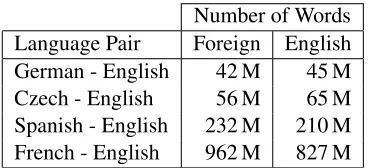
Number of Words Language Pair Foreign English German - English 42 M 45 M Czech - English 56 M 65 M Spanish - English 232 M 210 M French - English 962 M 827 M
Table 3: Training data statistics. Number of words in the training data (M=millions).
• French-English
For each pair, we train two separate system, one for each direction. Thus it can happen that a phrase is pruned for X-to-Y, but not for Y-to-X.
These four language pairs represent a nice range of training corpora sizes, as shown in Table 3.
6.2 Baseline System
Pruning experiments were performed on top of the following baseline system. We used a phrase-based statistical machine translation system similar to (Zens et al., 2002; Koehn et al., 2003; Och and Ney, 2004; Zens and Ney, 2008). We trained a 4 -gram language model on the target side of the bilin-gual corpora and a second 4-gram language model on the provided monolingual news data. All lan-guage models used Kneser-Ney smoothing.
The baseline system uses the common phrase translation models, such asp(˜e|f˜) andp( ˜f|e)˜, lex-ical models, word and phrase penalty, distortion penalty as well as a lexicalized reordering model (Zens and Ney, 2006).
The word alignment was trained with six itera-tions of IBM model 1 (Brown et al., 1993) and 6 it-erations of the HMM alignment model (Vogel et al., 1996) using a symmetric lexicon (Zens et al., 2004). The feature weights were tuned on a development set by applying minimum error rate training (MERT) under the Bleu criterion (Och, 2003; Macherey et al., 2008). We ran MERT once with the full phrase table and then kept the feature weights fixed, i. e., we did
notrerun MERT after pruning to avoid adding un-necessary noise. We extract phrases up to a length of six words. The baseline system already includes phrase table pruning by removing singletons and keeping up to 30 target language phrases per source phrase. We found that this does not affect
8 10 12 14 16 18 20 22 24 26 28
1 2 4 8
BLEU[%]
Number of Phrases [millions] Prob Thres Hist
Figure 1: Comparison of probability-based pruning methods for German-English.
tion quality significantly4. All pruning experiments are done on top of this.
6.3 Results
In this section, we present the experimental results. Translation results are reported on the WMT’07 news commentary blind set.
We will show translation quality measured with the Bleu score (Papineni et al., 2002) as a function of the phrase table size (number of phrases). Being in the upper left corner of these figures is desirable.
First, we show a comparison of several probability-based pruning methods in Figure 1. We compare
• Prob. Absolute pruning based on Eq. (2).
• Thres. Threshold pruning based on Eq. (3).
• Hist. Histogram pruning as described in Sec-tion 3.2.5
We observe that these three methods perform equally well. There is no difference between abso-lute and relative pruning methods, except that the two relative methods (Thres and Hist) are limited by
4
The Bleu score drops are as follows: English-French 0.3%, French-English 0.4%, Czech-English 0.3%, all other are less than 0.1%.
5
Instead of usingp(˜e|f˜)one could use the weighted model score includingp( ˜f|e˜), lexical weightings etc.; however, we found that this does not give significantly different results; but it does introduce a undesirable dependance between feature weights and phrase table pruning.
[image:6.612.324.532.64.218.2]the number of source phrases. Thus, they reach a point where they cannot prune the phrase table any further. The results shown are for German-English; the results for the other languages are very similar. The results that follow use only the absolute prun-ing method as a representative for probability-based pruning.
In Figures 2 through 5, we show the transla-tion quality as a functransla-tion of the phrase table size. We vary the pruning thresholds to obtain different phrase table sizes. We compare four pruning meth-ods:
• Count. Pruning based on the frequency of a phrase pair, c.f. Equation (1).
• Prob. Pruning based on the absolute probabil-ity of a phrase pair, c.f. Equation (2).
• Fisher. Pruning using significance tests, c.f. Equation (5).
• Entropy. Pruning using the novel entropy cri-terion, c.f. Equation (8).
Note that the x-axis of these figures is on a logarith-mic scale, so the differences between the methods can be quite dramatic. For instance, entropy pruning requires less than a quarter of the number of phrases needed by count- or significance-based pruning to achieve a Spanish-English Bleu score of 34 (0.4 mil-lion phrases compared to 1.7 milmil-lion phrases).
These results clearly show how the pruning meth-ods compare:
1. Probability-based pruning performs poorly. It should be used only to prune small fractions of the phrase table.
2. Count-based pruning and significance-based pruning perform equally well. They are much better than probability-based pruning.
3. Entropy pruning consistently outperforms the other methods across translation directions and language pairs.
Figures 6 and 7 show compositionality statistics for the pruned Spanish-English phrase table (we ob-served similar results for the other language pairs).
Total number of phrases 4 137 M
Compositional 3 970 M
Non-compositional 167 M of those: one-word phrases 85 M no segmentation 82 M
Table 4: Statistics of phrase compositionality (M=millions).
Each figure shows the composition of the phrase ta-ble for a type of pruning for different phrase tata-bles sizes. Along the x-axis, we plotted the phrase ta-ble size. These are the same phrase tata-bles used to obtain the Bleu scores in Figure 2 (left). The dif-ferent shades of grey correspond to difdif-ferent phrase lengths. For instance, in case of the smallest phrase table for count-based pruning, the 1-word phrases account for about 30% of all phrases, the 2-word phrases account for about35%of all phrases, etc.
With the exception of the probability-based prun-ing, the plots look comparable. The more aggres-sive the pruning, the larger the percentage of short phrases. We observe that entropy-based pruning re-moves many more long phrases than any of the other methods. The plot for probability-based pruning is different in that the percentage of long phrases ac-tually increases with more aggressive pruning (i. e. smaller phrase tables). A possible explanation is that probability-based pruning doesnottake the fre-quency of the source phrase into account. This difference might explain the poor performance of probability-based pruning.
To analyze how many phrases are compositional, we collect statistics during the computation of the entropy criterion. These are shown in Table 4, ac-cumulated across all language pairs and all phrases, i. e., including singleton phrases. We see that 96% of all phrases are compositional (3 970 million out of 4 137 million phrases). Furthermore, out of the 167 million non-compositional phrases, more than half (85 million phrases), are trivially non-compositional: they consist only of a single source or target language word. The number of non-trivial non-compositional phrases is, with 82 million or 2% of the total number of phrases, very small.
18 20 22 24 26 28 30 32 34 36 38
0.01 0.1 1 10 100
BLEU[%]
Number of Phrases [M] Prob
Count Fisher Entropy
10 15 20 25 30 35 40
0.01 0.1 1 10 100
BLEU[%]
Number of Phrases [M] Prob
[image:8.612.100.513.41.181.2]Count Fisher Entropy
Figure 2: Translation quality as a function of the phrase table size for Spanish-English (left) and English-Spanish (right).
10 15 20 25 30 35 40
0.1 1 10 100 1000
BLEU[%]
Number of Phrases [M] Prob
Count Fisher Entropy
5 10 15 20 25 30 35 40
0.1 1 10 100 1000
BLEU[%]
Number of Phrases [M] Prob
[image:8.612.101.514.221.362.2]Count Fisher Entropy
Figure 3: Translation quality as a function of the phrase table size for French-English (left) and English-French (right).
6 8 10 12 14 16 18 20 22 24 26
0.001 0.01 0.1 1 10 100
BLEU[%]
Number of Phrases [M] Prob
Count Fisher Entropy
4 6 8 10 12 14 16
0.001 0.01 0.1 1 10 100
BLEU[%]
Number of Phrases [M] Prob
Count Fisher Entropy
Figure 4: Translation quality as a function of the phrase table size for Czech-English (left) and English-Czech (right).
8 10 12 14 16 18 20 22 24 26 28
0.001 0.01 0.1 1 10
BLEU[%]
Number of Phrases [M] Prob
Count Fisher Entropy
2 4 6 8 10 12 14 16 18 20
0.001 0.01 0.1 1 10
BLEU[%]
Number of Phrases [M] Prob
Count Fisher Entropy
Figure 5: Translation quality as a function of the phrase table size for German-English (left) and English-German (right).
[image:8.612.99.518.387.526.2] [image:8.612.100.517.550.695.2]0 20 40 60 80 100
10 100
Percentage of Phrases [%]
Number of Phrases [millions] Prob
6-word 5-word 4-word 3-word 2-word 1-word
0 20 40 60 80 100
0.01 0.1 1 10 100
Percentage of Phrases [%]
Number of Phrases [millions] Count
[image:9.612.104.513.68.210.2]6-word 5-word 4-word 3-word 2-word 1-word
Figure 6: Phrase length statistics for Spanish-English for probability-based (left) and count-based pruning (right).
0 20 40 60 80 100
0.01 0.1 1 10 100
Percentage of Phrases [%]
Number of Phrases [millions] Fisher
6-word 5-word 4-word 3-word 2-word 1-word
0 20 40 60 80 100
0.01 0.1 1 10 100
Percentage of Phrases [%]
Number of Phrases [millions] Entropy
6-word 5-word 4-word 3-word 2-word 1-word
Figure 7: Phrase length statistics for Spanish-English for significance-based (left) and entropy-based pruning (right).
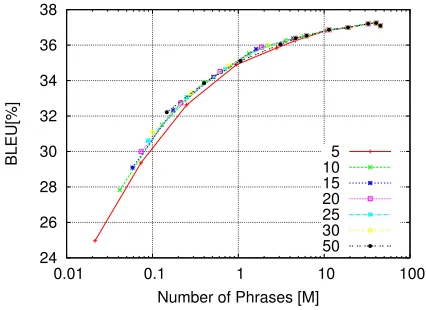
pc for non-compositional phrases.6 The results
shown are for Spanish-English; additional experi-ments for the other languages and translation direc-tions showed very similar results. Overall, there is no big difference between the values. Hence, we chose a value of10for all experiments.
The results in Figure 2 to Figure 5 show that entropy-based pruning clearly outperforms the al-ternative pruning methods. However, it is a bit hard to see from the graphs exactly how much ad-ditional savings it offers over other methods. In Ta-ble 5, we show how much of the phrase taTa-ble we have to retain under various pruning criteria with-out losing more than one Bleu point in translation quality. We see that probability-based pruning al-lows only for marginal savings. Count-based and significance-based pruning results in larger savings between 70% and 90%, albeit with fairly high
vari-6The values are in neg-log-space, i. e., a value of10
corre-sponds topc=e−10.
ability. Entropy-based pruning achieves consistently high savings between 85% and 95% of the phrase ta-ble. It always outperforms the other pruning meth-ods and yields significant savings on top of count-based or significance-count-based pruning methods. Of-ten, we can cut the required phrase table size in half compared to count or significance based pruning.
[image:9.612.102.515.243.385.2]Method ES-EN EN-ES DE-EN EN-DE FR-EN EN-FR CS-EN EN-CS Prob 77.3 % 82.7 % 61.2 % 67.3 % 84.8 % 94.1 % 85.6 % 86.3 % Count 24.9 % 11.9 % 19.9 % 14.3 % 11.4 % 9.0 % 20.2 % 10.4 % Fisher 23.5 % 12.6 % 21.7 % 14.0 % 14.5 % 13.6 % 31.9 % 9.9 % Entropy 7.2% 6.0% 10.2% 11.1% 7.1% 8.1% 14.8% 6.4%
Table 5: To what degree can we prune the phrase table without losing more than 1 Bleu point? The table shows percentage of phrases that we have to retain. ES=Spanish, EN=English, FR=French, CS=Czech, DE=German.
24 26 28 30 32 34 36 38
0.01 0.1 1 10 100
BLEU[%]
Number of Phrases [M] 5 10 15 20 25 30 50
Figure 8: Translation quality (Bleu) as a function of the phrase table size for Spanish-English for entropy pruning with different constantspc.
7 Conclusions
Phrase table pruning is often addressed in an ad-hoc way using the heuristics described in Section 3. We have shown that some of those do not work well. Choosing the wrong technique can result in sig-nificant drops in translation quality without saving much in terms of phrase table size. We introduced a novel entropy-based criterion and put phrase ta-ble pruning on a sound theoretical foundation. Fur-thermore, we performed a systematic experimental comparison of existing methods and the new entropy criterion. The experiments were carried out for four language pairs under small, medium and large data conditions. We can summarize our conclusions as follows:
• Probability-based pruning performs poorly when pruning large parts of the phrase table. This might be because it does not take the fre-quency of the source phrase into account.
• Count-based pruning performs as well as
18 20 22 24 26 28 30 32 34 36 38
0.01 0.1 1 10 100
BLEU[%]
Number of Phrases [M] Length
[image:10.612.82.295.191.346.2]Prob Count Fisher Entropy
Figure 9: Translation quality (Bleu) as a function of the phrase table size for Spanish-English.
significance-based pruning.
• Entropy-based pruning gives significantly larger savings in phrase table size than any other pruning method.
• Compared to previous work, the novel entropy-based pruning often achieves the same Bleu score with only half the number of phrases.
8 Future Work
Currently, we take only the model p(˜e|f˜) into ac-count when looking for the best segmentation. We might obtain a better estimate by also consider-ing the distortion costs, which penalize reorderconsider-ing. We could also include other phrase models such as
p( ˜f|˜e)and the language model.
The entropy pruning criterion could be applied to hierarchical machine translation systems (Chiang, 2007). Here, we might observe even larger reduc-tions in phrase table size as there are many more en-tries.
[image:10.612.327.536.192.345.2]References
Thorsten Brants, Ashok C. Popat, Peng Xu, Franz J. Och, and Jeffrey Dean. 2007. Large language mod-els in machine translation. In Proceedings of the 2007 Joint Conference on Empirical Methods in Nat-ural Language Processing and Computational Natu-ral Language Learning (EMNLP-CoNLL), pages 858– 867, Prague, Czech Republic, June. Association for Computational Linguistics.
Peter F. Brown, Stephen A. Della Pietra, Vincent J. Della Pietra, and Robert L. Mercer. 1993. The mathemat-ics of statistical machine translation: Parameter esti-mation. Computational Linguistics, 19(2):263–311, June.
Yu Chen, Andreas Eisele, and Martin Kay. 2008. Improving statistical machine translation efficiency by triangulation. In Proceedings of the Sixth In-ternational Conference on Language Resources and Evaluation (LREC’08), Marrakech, Morocco, May. European Language Resources Association (ELRA). http://www.lrec-conf.org/proceedings/lrec2008/. Yu Chen, Martin Kay, and Andreas Eisele. 2009.
In-tersecting multilingual data for faster and better sta-tistical translations. In Proceedings of Human Lan-guage Technologies: The 2009 Annual Conference of the North American Chapter of the Association for Computational Linguistics, pages 128–136, Boulder, Colorado, June. Association for Computational Lin-guistics.
David Chiang. 2007. Hierarchical phrase-based trans-lation. Computational Linguistics, 33(2):201–228, June.
Thomas M. Cover and Joy A. Thomas. 2006. Elements of information theory. Wiley-Interscience, New York, NY, USA.
Nan Duan, Mu Li, and Ming Zhou. 2011. Improving phrase extraction via MBR phrase scoring and prun-ing. In Proceedings of MT Summit XIII, pages 189– 197, Xiamen, China, September.
Matthias Eck, Stephan Vogel, and Alex Waibel. 2007a. Estimating phrase pair relevance for machine transla-tion pruning. InProceedings of MT Summit XI, pages 159–165, Copenhagen, Denmark, September.
Matthias Eck, Stephan Vogel, and Alex Waibel. 2007b. Translation model pruning via usage statistics for sta-tistical machine translation. In Human Language Technologies 2007: The Conference of the North American Chapter of the Association for Computa-tional Linguistics; Companion Volume, Short Papers, pages 21–24, Rochester, New York, April. Association for Computational Linguistics.
Kenneth Heafield. 2011. KenLM: Faster and smaller language model queries. InProceedings of the Sixth
Workshop on Statistical Machine Translation, pages 187–197, Edinburgh, Scotland, July. Association for Computational Linguistics.
Howard Johnson, Joel Martin, George Foster, and Roland Kuhn. 2007. Improving translation quality by dis-carding most of the phrasetable. InProceedings of the 2007 Joint Conference on Empirical Methods in Nat-ural Language Processing and Computational Natu-ral Language Learning (EMNLP-CoNLL), pages 967– 975, Prague, Czech Republic, June. Association for Computational Linguistics.
Philipp Koehn, Franz Joseph Och, and Daniel Marcu. 2003. Statistical phrase-based translation. InHuman Language Technology Conf. / North American Chap-ter of the Assoc. for Computational Linguistics An-nual Meeting (HLT-NAACL), pages 127–133, Edmon-ton, Canada, May/June.
Philipp Koehn, Hieu Hoang, Alexandra Birch, Chris Callison-Burch, Marcello Federico, Nicola Bertoldi, Brooke Cowan, Wade Shen, Christine Moran, Richard Zens, Chris Dyer, Ondˇrej Bojar, Alexandra Constan-tine, and Evan Herbst. 2007. Moses: Open source toolkit for statistical machine translation. In45th An-nual Meeting of the Assoc. for Computational Linguis-tics (ACL): Poster Session, pages 177–180, Prague, Czech Republic, June.
Philipp Koehn. 2004. Pharaoh: a beam search decoder for phrase-based statistical machine translation mod-els. In6th Conf. of the Assoc. for Machine Translation in the Americas (AMTA), pages 115–124, Washington DC, September/October.
Wolfgang Macherey, Franz Och, Ignacio Thayer, and Jakob Uszkoreit. 2008. Lattice-based minimum error rate training for statistical machine translation. In Pro-ceedings of the 2008 Conference on Empirical Meth-ods in Natural Language Processing, pages 725–734, Honolulu, HI, October. Association for Computational Linguistics.
Robert C. Moore. 2004. On log-likelihood-ratios and the significance of rare events. InProceedings of the 2004 Conference on Empirical Methods in Natural Language Processing, pages 333–340.
Franz Josef Och and Hermann Ney. 2004. The align-ment template approach to statistical machine transla-tion. Computational Linguistics, 30(4):417–449, De-cember.
Franz Josef Och. 2003. Minimum error rate training in statistical machine translation. In41st Annual Meet-ing of the Assoc. for Computational LMeet-inguistics (ACL), pages 160–167, Sapporo, Japan, July.
the Assoc. for Computational Linguistics (ACL), pages 311–318, Philadelphia, PA, July.
Adam Pauls and Dan Klein. 2011. Faster and smaller n-gram language models. In Proceedings of the 49th Annual Meeting of the Association for Computational Linguistics: Human Language Technologies, pages 258–267, Portland, Oregon, USA, June. Association for Computational Linguistics.
German Sanchis-Trilles, Daniel Ortiz-Martinez, Je-sus Gonzalez-Rubio, Jorge Gonzalez, and Francisco Casacuberta. 2011. Bilingual segmentation for phrasetable pruning in statistical machine translation. InProceedings of the 15th Conference of the European Association for Machine Translation, pages 257–264, Leuven, Belgium, May.
Andreas Stolcke. 1998. Entropy-based pruning of back-off language models. InProc. DARPA Broadcast News Transcription and Understanding Workshop, pages 270–274.
David Talbot and Miles Osborne. 2007. Smoothed Bloom filter language models: Tera-scale LMs on the cheap. In Proceedings of the 2007 Joint Conference on Empirical Methods in Natural Language Process-ing and Computational Natural Language LearnProcess-ing (EMNLP-CoNLL), pages 468–476, Prague, Czech Re-public, June. Association for Computational Linguis-tics.
Nadi Tomeh, Nicola Cancedda, and Marc Dymetman. 2009. Complexity-based phrase-table filtering for sta-tistical machine translation. In Proceedings of MT Summit XII, Ottawa, Ontario, Canada, August. Nadi Tomeh, Marco Turchi, Guillaume Wisniewski,
Alexandre Allauzen, and Franc¸ois Yvon. 2011. How good are your phrases? Assessing phrase quality with single class classification. InProceedings of the Inter-national Workshop on Spoken Language Translation, pages 261–268, San Francisco, California, December. Stephan Vogel, Hermann Ney, and Christoph Tillmann. 1996. HMM-based word alignment in statistical trans-lation. In16th Int. Conf. on Computational Linguistics (COLING), pages 836–841, Copenhagen, Denmark, August.
Mei Yang and Jing Zheng. 2009. Toward smaller, faster, and better hierarchical phrase-based SMT. In Pro-ceedings of the ACL-IJCNLP 2009 Conference Short Papers, pages 237–240, Suntec, Singapore, August. Association for Computational Linguistics.
Richard Zens and Hermann Ney. 2006. Discriminative reordering models for statistical machine translation. InHuman Language Technology Conf. / North Ameri-can Chapter of the Assoc. for Computational Linguis-tics Annual Meeting (HLT-NAACL): Workshop on Sta-tistical Machine Translation, pages 55–63, New York City, NY, June.
Richard Zens and Hermann Ney. 2008. Improvements in dynamic programming beam search for phrase-based statistical machine translation. InProceedings of the International Workshop on Spoken Language Transla-tion, pages 195–205, Honolulu, Hawaii, October. Richard Zens, Franz Josef Och, and Hermann Ney.
2002. Phrase-based statistical machine translation. In M. Jarke, J. Koehler, and G. Lakemeyer, editors,25th German Conf. on Artificial Intelligence (KI2002), vol-ume 2479 of Lecture Notes in Artificial Intelligence (LNAI), pages 18–32, Aachen, Germany, September. Springer Verlag.
Richard Zens, Evgeny Matusov, and Hermann Ney. 2004. Improved word alignment using a symmetric lexicon model. In 20th Int. Conf. on Computational Linguistics (COLING), pages 36–42, Geneva, Switzer-land, August.