A Beam-Search Decoder for Grammatical Error Correction
Daniel Dahlmeier1 and Hwee Tou Ng1,2
1NUS Graduate School for Integrative Sciences and Engineering 2Department of Computer Science, National University of Singapore
{danielhe,nght}@comp.nus.edu.sg
Abstract
We present a novel beam-search decoder for grammatical error correction. The decoder iteratively generates new hypothesis correc-tions from current hypotheses and scores them based on features of grammatical correctness and fluency. These features include scores from discriminative classifiers for specific er-ror categories, such as articles and preposi-tions. Unlike all previous approaches, our method is able to perform correction of whole sentences with multiple and interacting er-rors while still taking advantage of powerful existing classifier approaches. Our decoder achieves an F1 correction score significantly higher than all previous published scores on the Helping Our Own (HOO) shared task data set.
1 Introduction
Grammatical error correction is an important prob-lem in natural language processing (NLP) that has attracted an increasing amount of interest over
the last few years. Grammatical error correction
promises to provide instantaneous accurate feedback to language learners, e.g., learners of English as a Second Language (ESL).
The dominant paradigm that underlies most er-ror correction systems to date is multi-class clas-sification. A classifier is trained to predict a word
from aconfusion set of possible correction choices,
given some feature representation of the surround-ing sentence context. Dursurround-ing testsurround-ing, the classifier predicts the most likely correction for each test in-stance. If the prediction differs from the observed
word used by the writer and the classifier is suffi-ciently confident in its prediction, the observed word is replaced by the prediction. Although considerable progress has been made, the classification approach suffers from some serious shortcomings. Each clas-sifier corrects a single word for a specific error cat-egory individually. This ignores dependencies be-tween the words in a sentence. Also, by conditioning on the surrounding context, the classifier implicitly assumes that the surrounding context is free of gram-matical errors, which is often not the case. Finally, the classifier typically has to commit to a single one-best prediction and is not able to change its deci-sion later or explore multiple corrections. Instead of correcting each word individually, we would like to perform global inference over corrections of whole sentences which can contain multiple and interact-ing errors.
An alternative paradigm is to view error correc-tion as a statistical machine translacorrec-tion (SMT) prob-lem from “bad” to “good” English. While this ap-proach can naturally correct whole sentences, a stan-dard SMT system cannot easily incorporate mod-els for specific grammatical errors. It also suffers from the paucity of error-annotated training data for grammar correction. As a result, applying a stan-dard SMT system to error correction does not pro-duce good results, as we show in this work.
In this work, we present a novel beam-search de-coder for grammatical error correction that com-bines the advantages of the classification approach
and the SMT approach. Starting from the
origi-nal input sentence, the decoder performs an itera-tive search over possible sentence-level hypotheses
to find the best sentence-level correction. In each
iteration, a set ofproposersgenerates new
ses by making incremental changes to the
hypothe-ses found so far. A set of experts scores the new
hypotheses on criteria of grammatical correctness. These experts include discriminative classifiers for specific error categories, such as articles and prepo-sitions. The decoder model calculates the overall hy-pothesis score for each hyhy-pothesis as a linear com-bination of the expert scores. The weights of the de-coder model are discriminatively trained on a devel-opment set of error-annotated sentences. The high-est scoring hypotheses are kept in the search beam for the next iteration. This search procedure contin-ues until the beam is empty or the maximum number of iterations has been reached. The highest scoring hypothesis is returned as the sentence-level correc-tion. We evaluate our proposed decoder in the con-text of the Helping Our Own (HOO) shared task on grammatical error correction (Dale and Kilgarriff,
2011). Our decoder achieves an F1score of 25.48%
which improves upon the current state of the art. The remainder of this paper is organized as fol-lows. The next section gives an overview of related work. Section 3 describes the proposed beam-search decoder. Sections 4 and 5 describe the experimental setup and results, respectively. Section 6 provides further discussion. Section 7 concludes the paper.
2 Related Work
In this section, we summarize related work in gram-matical error correction. For a more detailed review, the readers can refer to (Leacock et al., 2010).
The classification approach to error correction has mainly focused on correcting article and preposition errors (Knight and Chander, 1994; Han et al., 2006; Chodorow et al., 2007; Tetreault and Chodorow, 2008; Gamon, 2010; Dahlmeier and Ng, 2011b; Ro-zovskaya and Roth, 2011). The advantage of the classification approach is that it can make use of powerful machine learning algorithms in connection with arbitrary features from the sentence context. Typical features include surrounding N-grams, part-of-speech (POS) tags, chunks, etc. In fact, a consid-erable amount of research effort has been invested in finding better features.
The SMT approach to error corrections has
re-ceived comparatively less attention. Brockett et
al.(2006) use an SMT system to correct errors
in-volving mass noun errors. Because no large anno-tated learner corpus was available, the training data was created artificially from non-learner text. Lee and Seneff (2006) describe a lattice-based correc-tion system with a domain-specific grammar for spo-ken utterances from the flight domain. The work in (D´esilets and Hermet, 2009) uses simple round-trip translation with a standard SMT system to correct grammatical errors. Dahlmeier and Ng (2011a) cor-rect collocation errors using phrase-based SMT and paraphrases induced from the writer’s native lan-guage. Park and Levy (2011) propose a noisy chan-nel model for error correction. While their motiva-tion to correct whole sentences is similar to ours, their proposed generative method differs
substan-tially from our discriminative decoder. Park and
Levy’s model does not allow the use of discrim-inative expert classifiers as our decoder does, but instead relies on a bigram language model to find grammatical corrections. Indeed, they point out that the language model often fails to distinguish gram-matical and ungramgram-matical sentences.
To the best of our knowledge, our work is the first discriminatively trained decoder for whole-sentence grammatical error correction.
3 Decoder
In this section, we describe the proposed beam-search decoder and its components.
The task of the decoder is to find the best hypoth-esis (i.e., the best corrected sentence) for a given in-put sentence. To accomplish this, the decoder needs to be able to perform two tasks: generating new hypotheses from current ones, and discriminating good hypotheses from bad ones. This is achieved
by two groups of modules which we callproposers
combina-tion of the expert scores. Note that in our decoder, each hypothesis corresponds to a complete sentence. This makes it easy to apply syntactic processing, like POS tagging, chunking, and dependency pars-ing, which provides necessary features for the expert models. The highest scoring hypotheses are kept in the search beam for the next iteration. The search ends when the beam is empty or the maximum num-ber of iterations has been reached. The highest scor-ing hypothesis found durscor-ing the search is returned as the sentence-level correction. The modular design of the decoder makes it easy to extend the model to new error categories by adding specific proposers and experts without having to change the decoding algorithm.
3.1 Proposers
The proposers generate new hypotheses, given a hy-pothesis. Because the number of possible hypothe-ses grows exponentially with the sentence length, enumerating all possible hypotheses is infeasible. Instead, each proposer only makes a small incre-mental change to the hypothesis in each iteration. A change corresponds to a correction of a single word or phrase. We experiment with the following pro-posers in this work. Additional propro-posers for other error categories can easily be added to the decoder.
• SpellingGenerate a set of new hypotheses, by replacing a misspelled word with each correc-tion proposed by a spellchecker.
• ArticlesFor each noun phrase (NP), generate two new hypotheses by changing the observed
article. Possible article choices are a/an, the,
and the empty article.
• Prepositions For each prepositional phrase (PP), generate a set of new hy-potheses by changing the observed preposition. For each preposition, we define a confusion set of possible corrections.
• Punctuation insertion Insert commas, peri-ods, and hyphens based on a set of simple rules.
• Noun numberFor each noun, change its num-ber from singular to plural or vice versa.
3.2 Experts
The experts score hypotheses on particular aspects of grammaticality to help the decoder to discrim-inate grammatical hypotheses from ungrammatical ones. We employ two types of expert models. The first type of expert model is a standard N-gram lan-guage model. The lanlan-guage model expert is not spe-cialized for any particular type of error. The second type of experts is based on linear classifiers and is specialized for particular error categories. We use the following classifier experts in our work. The fea-tures for the classifier expert models include feafea-tures from N-grams, part-of-speech (POS) tags, chunks, web-scale N-gram counts, and dependency parse trees. Additional experts can easily be added to the decoder.
• Article expertPredict the correct article for a noun phrase.
• Preposition expertPredict the correct preposi-tion for a preposipreposi-tional phrase.
• Noun number expertPredict whether a noun should be in the singular or plural form.
The outputs of the experts are used as hypothesis features in the decoder, as described in the next sec-tion.
3.3 Hypothesis Features
Each hypothesis is associated with a vector of real-valued features which are indicators of grammatical-ity and are computed from the output of the expert
models. We call these featureshypothesis features
to distinguish them from the features of the expert classifiers. The simplest hypothesis feature is the log probability of the hypothesis under the N-gram language model expert. To avoid a bias towards shorter hypotheses, we normalize the probability by the length of the hypothesis:
scorelm =
1
|h|logP r(h), (1)
wherehis a hypothesis sentence and|h|is the
hy-pothesis length in tokens.
For the classifier-based experts, we define two
the hypothesis under the expert model:
scoreavg =
1
n
n X
i=1
uTf(xhi, yih), (2)
whereuis the expert classifier weight vector,xhi and
yh
i are the feature vector and the observed class,
re-spectively, for the i-th instance extracted from the
hypothesis h (e.g., the i-th NP in the hypothesis
for the article expert), and f is a feature map that
computes the expert classifier features. The average score reflects how much the expert model “likes” the hypothesis. The second expert score, which we call
delta score, is the maximum difference between the highest scoring class and the observed class in any instance from the hypothesis:
scoredelta= max
i,y
uTf(xhi, y)−uTf(xhi, yih).
(3) Generally speaking, the delta score measures how much the model “disagrees” with the hypothesis.
Finally, each hypothesis has a number of
correc-tion count featuresthat keep track of how many cor-rections have been made to the hypothesis so far. For example, there is a feature that counts how often the
article correction→thehas been applied. We also
add aggregated correction count features for each error category, e.g., how many article corrections have been applied in total. The correction count fea-tures allow the decoder to learn a bias against over-correcting sentences and to learn which types of cor-rections are more likely and which are less likely.
3.4 Decoder Model
The hypothesis features described in the previous subsection are combined to compute the score of a hypothesis according to the following linear model:
s=wTfE(h), (4)
where w is the decoder model weight vector and
fE is a feature map that computes the hypothesis
features described above, given a set of expertsE.
The weight vectorwis tuned on a development set
of error-annotated sentences using the PRO ranking
optimization algorithm (Hopkins and May, 2011).1
1We also experimented with the MERT algorithm (Och, 2003) but found that PRO achieved better results.
PRO performs decoder parameter tuning through a pair-wise ranking approach. The algorithm starts by sampling hypothesis pairs from the N-best list of the decoder. The metric score for each hypothesis in-duces a ranking of the two hypotheses in each pair. The task of finding a weight vector that correctly ranks hypotheses can then be reduced to a simple bi-nary classification task. In this work, we use PRO to
optimize the F1correction score, which is defined in
Section 4.2. PRO requires a sentence-level score for
each hypothesis. As F1 score is not decomposable,
we optimize sentence-level F1 score which serves
as an approximation of the corpus-level F1 score.
Similarly, Hopkins and May optimize a sentence-level BLEU approximation (Lin and Och, 2004) in-stead of the corpus-level BLEU score (Papineni et al., 2002). We observed that optimizing
sentence-level F1score worked well in practice in our
experi-ments.
3.5 Decoder Search
Given a set of proposers, experts, and a tuned de-coder model, the dede-coder can be used to correct new unseen sentences. This is done by performing a search over possible hypothesis candidates. The decoder starts with the input sentence as the initial hypothesis, i.e., assuming that all words are correct. It then performs a beam search over the space of possible hypotheses to find the best hypothesis
cor-rection ˆh for an input sentencee. The search
hand→hands
In→F or
On→About hands→hand
In→At
In→Into
On→By In→Of
In→At
In→F or
the→an In→On
the→an In→F or
→an
In→At
On→T o In→W ith
the→ In→W ith
→the
In→W ith
Tothe other hand .. score = 6.32
Aboutthe other hand .. score = 9.71
Forother hands .. score = 7.00
Onanother hand .. score = 2.48
On other hand .. score = 4.94
... Atother hands ..
score = 5.34
Atthe other hands .. score = 6.05
Forthe other hands .. score = 9.05
Withthe other hands .. score = 5.25
In the otherhand, they might be right score = 11.69
... ...
In other hands , they might be right . score = 9.10
Intothe other hand .. score = 5.47
Forthe other hand .. score = 10.75
Atthe other hand .. score = 9.40 Inanother hand
.. score = 3.96
Intheother hands , they might be right . score = 9.63 Inanother ..
score = -1.58
Onthe other hand , they might be right score = 15.36
Ofthe other hand .. score = 8.94
In otherhand.. score = 8.29
... Withother hands ..
score = 6.31
Bythe other hand .. score = 5.80
[image:5.612.73.530.57.266.2]Withthe other hand .. score = 8.69
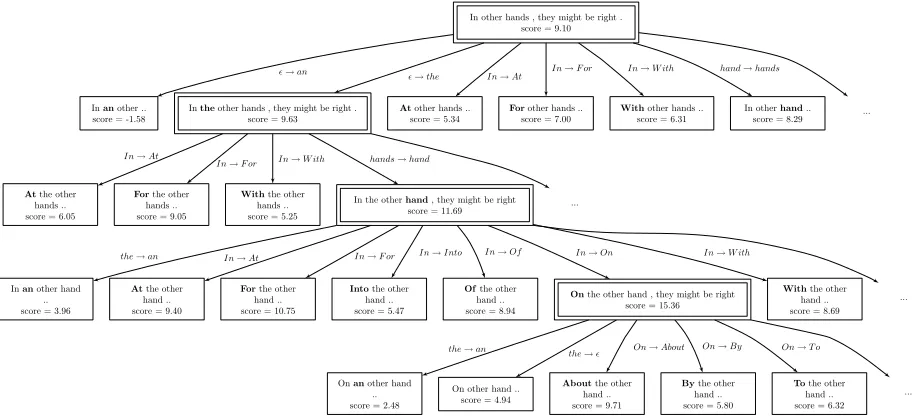
Figure 1: Example of a search tree produced by the beam-search decoder for the inputIn other hands, they might be right. The highest scoring hypothesis found isOn the other hand, they might be right. Some hypotheses are omitted due to space constraints.
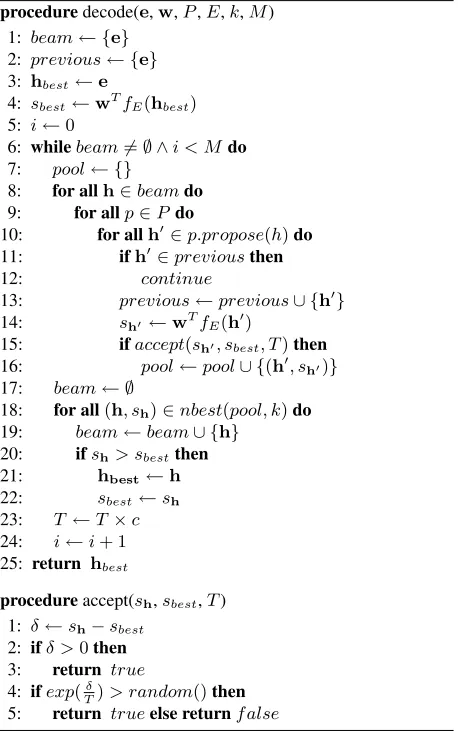
the score of the best hypothesis and the “tempera-ture” of the system. We lower the temperature after each iteration according to an exponential cooling schedule. Hypotheses that have been explored be-fore are not considered again to avoid cycles in the search. From all hypotheses in the pool, we select
the topkhypotheses and add them to the beam for
the next search iteration. The decoding algorithm is shown in Algorithm 1. The decoder can be
con-sidered an anytime algorithm(Russell and Norvig,
2010), as it has a current best hypothesis correction available at any point of the search, while gradually improving the result by searching for better hypothe-ses. An example of a search tree produced by our decoder is shown in Figure 1.
The decoding algorithm shares some similarities with the beam-search algorithm frequently used in SMT. There is however a difference between SMT decoding and grammar correction decoding that is worth pointing out. In SMT decoding, every input word needs to be translated exactly once. In con-trast, in grammar correction decoding, the majority
of the words typically do not need any correction
(in the HOO data, for example, there are on aver-age 6 errors per 100 words). On the other hand,
some words might requiremultiplecorrections, for
example spelling correction followed by noun
num-ber correction. Errors can also be inter-dependent, where correcting one word makes it necessary to change another word, for example to preserve agree-ment. Our decoding algorithm has the option to cor-rect some words multiple times, while leaving other words unchanged.
4 Experiments
We evaluate our decoder in the context of the HOO shared task on grammatical error correction. The goal of the task is to automatically correct errors in academic papers from NLP. The readers can refer to the overview paper (Dale and Kilgarriff, 2011) for details. We compare our proposed method with two baselines: a phrase-based SMT system (described in Section 4.3) and a pipeline of classifiers (described in Section 4.4).
4.1 Data
We split the HOO development data into an equal
sized training (HOO-TRAIN) and tuning
(HOO-TUNE) set. The official HOO test data (HOO-TEST)
fa-Algorithm 1The beam-search decoding algorithm. e: original sentence, w: decoder weight vector, P: set of proposers,E: set of experts,k: beam width,M: maxi-mum number of iterations,T, c: initial temperature and cooling schedule for simulated annealing (0< c <1).
proceduredecode(e,w,P,E,k,M) 1: beam← {e}
2: previous← {e} 3: hbest←e
4: sbest←wTfE(hbest)
5: i←0
6: whilebeam6=∅ ∧i < Mdo
7: pool← {}
8: for allh∈beamdo
9: for allp∈Pdo
10: for allh0∈p.propose(h)do
11: ifh0∈previousthen
12: continue
13: previous←previous∪ {h0} 14: sh0←wTfE(h0)
15: ifaccept(sh0, sbest, T)then 16: pool←pool∪ {(h0, sh0)} 17: beam← ∅
18: for all(h, sh)∈nbest(pool, k)do 19: beam←beam∪ {h}
20: ifsh> sbestthen
21: hbest←h 22: sbest←sh 23: T ←T×c
24: i←i+ 1
25: return hbest
procedureaccept(sh,sbest,T)
1: δ←sh−sbest
2: ifδ >0then
3: return true
4: ifexp(δ
T)> random()then
5: return trueelse returnf alse
vor of specific systems participating in the shared task. We obtain both the original and the final offi-cial gold-standard annotations and report evaluation results on both annotations.
We use the ACL Anthology2 as training data for
the expert models. We crawl all non-OCR docu-ments from the anthology, except those docudocu-ments that overlap with the HOO data. Section headers, references, etc. are automatically removed. The Web 1T 5-gram corpus (Brants and Franz, 2006) is used for language modeling and collecting web N-gram counts. Table 1 gives an overview of the data sets.
2http://www.aclweb.org/anthology-new/
Data Set Sentences Tokens
HOO-TRAIN 467 11,373
HOO-TUNE 472 11,435
HOO-TEST 722 18,790
[image:6.612.72.301.120.486.2]ACL-ANTHOLOGY 943,965 22,465,690
Table 1: Overview of the data sets.
4.2 Evaluation
We evaluate performance by computing precision,
recall, and F1correction score without bonus as
de-fined in the official HOO report (Dale and
Kilgar-riff, 2011)3. F1 correction score is simply the F1
measure (van Rijsbergen, 1979) between the
correc-tions (called edits in HOO) proposed by a system
and the gold-standard corrections. Let{e1, . . . ,en}
be a set of test sentences and let {g1, . . . ,gn} be
the set of gold-standard edits for the sentences. Let
{h1, . . . ,hn}be the set of corrected sentences
out-put by a system. One difficulty in the evaluation is
that the set of system edits {d1, . . . ,dn} between
the test sentences and the system outputs is ambigu-ous. For example, assume that the original test
sen-tence isThe data is similar with test set., the system
output isThe data is similar to the test set., and the
gold-standard edits are two correctionswith → to,
→ thethat change with to toand insert the
be-foretest set. The official HOO scorer however
ex-tracts a single system edit with → to the for this
instance. As the extracted system edit is different from the gold-standard edits, the system would be
considered wrong, although it proposes the exact
same corrected sentence as the gold standard
ed-its. This problem has also been recognized by the HOO shared task organizers (see (Dale and Kilgar-riff, 2011), Section 5).
Our MaxMatch(M2) scorer (Dahlmeier and Ng, 2012) overcomes this problem through an efficient algorithm that computes the set of system edits which has the maximum overlap with the
gold-standard edits. We use the M2 scorer as the main
evaluation metric in our experiments. Additionally, we also report results with the official HOO scorer. Once the set of system edits is extracted, precision,
recall, and F1measure are computed as follows.
3
P =
Pn
i=1|di∩gi|
Pn i=1|di|
(5)
R =
Pn
i=1|di∩gi|
Pn i=1|gi|
(6)
F1 = 2×
P ×R
P +R (7)
We note that the M2 scorer and the HOO scorer
ad-here to the same score definition and only differ in the way the system edits are computed. For statisti-cal significance testing, we use sign-test with boot-strap re-sampling (Koehn, 2004) with 1,000 sam-ples.
4.3 SMT Baseline
We build a baseline error correction system, using the MOSES SMT system (Koehn et al., 2007). Word alignments are created automatically on “good-bad”
parallel text from HOO-TRAINusing GIZA++ (Och
and Ney, 2003), followed by phrase extraction us-ing the standard heuristic (Koehn et al., 2003). The maximum phrase length is 5. Parameter tuning is
done on the HOO-TUNE data with the PRO
al-gorithm (Hopkins and May, 2011) implemented in MOSES. The optimization objective is sentence-level BLEU (Lin and Och, 2004). We note that the objective function is not the same as the final
evalu-ation F1score. Also, the training and tuning data are
small by SMT standards. The aim for the SMT base-line is not to achieve a state-of-the-art system, but to serve as the simplest possible baseline that uses only off-the-shelf software.
4.4 Pipeline Baseline
The second baseline system is a pipeline of classifier-based and rule-based correction steps. Each step takes sentence segmented plain text as in-put, corrects one particular error category, and feeds the corrected text into the next step. No search or global inference is applied. The correction steps are:
1. Spelling errors
2. Article errors
3. Preposition errors
4. Punctuation errors
5. Noun number errors
We use the following tools for syntactic
process-ing: OpenNLP4 for POS tagging, YamCha (Kudo
and Matsumoto, 2003) for constituent chunking, and the MALT parser (Nivre et al., 2007) for depen-dency parsing. For language modeling, we use Ran-dLM (Talbot and Osborne, 2007).
For spelling correction, we use GNU Aspell5.
Words that contain upper-case characters inside the word or are shorter than four characters are excluded from spell checking. The spelling dictionary is aug-mented with all words that appear at least 10 times
in the ACL-ANTHOLOGYdata set.
Article correction is cast as a multi-class
clas-sification problem. As the learning algorithm,
we choose multi-class confidence-weighted (CW) learning (Crammer et al., 2009) which has been shown to perform well for NLP problems with high dimensional and sparse feature spaces. The
possi-ble classes are the articlesa,the, and the empty
ar-ticle . The article an is normalized as a and
re-stored later using a rule-based heuristic. We con-sider all NPs that are not pronouns and do not have a
non-article determiner, e.g.,this, that. The classifier
is trained on over 5 million instances from
ACL-ANTHOLOGY. We use a combination of features proposed by (Rozovskaya et al., 2011) (which in-clude lexical and POS N-grams, lexical head words, etc.), web-scale N-gram count features from the Web 1T 5-gram corpus following (Bergsma et al., 2009), and dependency head and child features. During testing, a correction is proposed if the pre-dicted article is different from the observed article used by the writer, and the difference between the confidence score for the predicted article and the confidence score for the observed article is larger than a threshold. Threshold parameters are tuned
via a grid-search on the HOO-TUNEdata. We tune
a separate threshold value for each class.
Preposition correction and noun number correc-tion are analogous to article correccorrec-tion. They differ only in terms of the classes and the features. For preposition correction, the classes are 36 frequent
English prepositions6. The features are surrounding
4http://opennlp.sourceforge.net
5
http://aspell.net
6
lexical N-grams, web-scale N-gram counts, and de-pendency features following (Tetreault et al., 2010). The preposition classifier is trained on 1 million
training examples from the ACL-ANTHOLOGY. For
noun number correction, the classes are singular
andplural. The features are lexical N-grams, web-scale N-gram counts, dependency features, the noun lemma, and a binary countability feature. The noun number classifier is trained on over 5 million
exam-ples from ACL-ANTHOLOGY. During testing, the
singular or plural word surface form is generated us-ing WordNet (Fellbaum, 1998) and simple heuris-tics. Punctuation correction is done using a set of simple rules developed on the HOO development data.
At the end of every correction step, all proposed corrections are filtered using a 5-gram language model from the Web 1T 5-gram corpus and only corrections that strictly increase the normalized lan-guage model score of the sentence are applied.
4.5 Decoder
We experiment with different decoder configura-tions with different proposers and expert models. In the simplest configuration, the decoder only has the spelling proposer and the language model ex-pert. We then add the article proposer and expert, the preposition proposer and expert, the punctua-tion proposer, and finally the noun number proposer and expert. We refer to the final configuration with
all proposers and experts as thefull decoder model.
Note that error categories are corrected jointly and not in sequential steps as in the pipeline.
To make the results directly comparable to the pipeline, the decoder uses the same resources as the pipeline. As the expert models, we use a 5-gram language model from the Web 1T 5-gram corpus
with the Berkeley LM (Pauls and Klein, 2011)7 in
the decoder and the CW-classifiers described in the last section. The spelling proposer uses the same spellchecker as the pipeline, and the punctuation proposer uses the same rules as the pipeline. The beam width and the maximum number of iterations are set to 10. In earlier experiments, we found that larger values had no effect on the result. The
simu-underneath, until, up, upon, with, within, without
7Berkeley LM is written in Java and was easier to integrate into our Java-based decoder than RandLM.
lated annealing temperatureTis initialized to 10 and
the exponential cooling schedulecis set to 0.9. The
decoder weight vector is initialized as follows. The weight for the language model score and the weights for the classifier expert average scores are initialized
to1.0, and the weights for the classifier expert delta
scores are initialized to−1.0. The weights for the
correction count features are initialized to zero. For
PRO optimization, we use the HOO-TUNEdata and
the default PRO parameters from (Hopkins and May, 2011): we sample 5,000 hypothesis pairs from the N-best list (N = 100) for every input sentence and keep the top 50 sample pairs with the highest
dif-ference in F1 measure. The weights are optimized
using MegaM (Daum´e III, 2004) and interpolated with the previous weight vector with an interpola-tion parameter of 0.1. We normalize feature val-ues to avoid having features on a larger scale dom-inate features on a smaller scale. We linearly scale
all hypothesis features to a unit interval[0,1]. The
minimum and maximum values for each feature are estimated from the development data. We use an early stopping criterion that terminates PRO if the objective function on the tuning data drops. To bal-ance the skewed data where samples without errors greatly outnumber samples with errors, we give a higher weight to sample pairs where the decoder proposed a valid correction. We found a weight of 20 to work well, based on initial experiments on
the HOO-TUNEdata. We keep all these parameters
fixed for all experiments.
5 Results
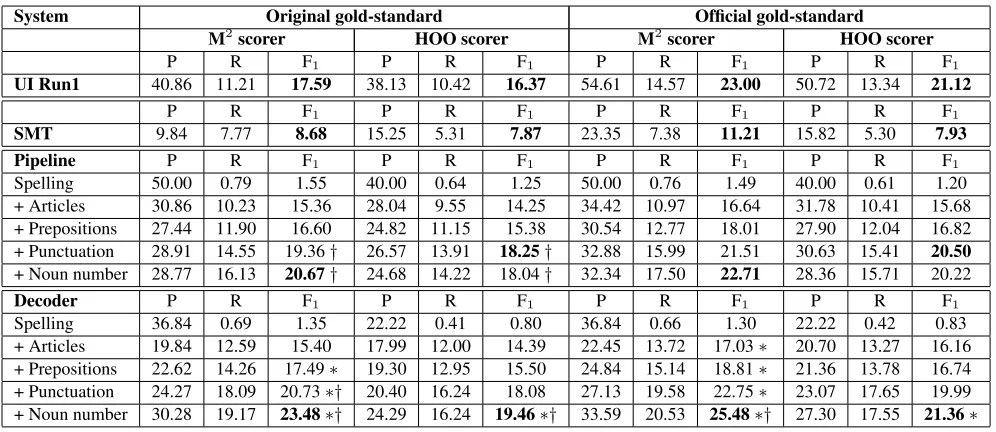
The complete results of our experiments are shown in Table 2. Each row contains the results for one error correction system. Each system is scored on the original and official gold-standard annotations,
both with the M2scorer and the official HOO scorer.
This results in four sets of precision, recall, and F1
scores for each system. The best published result to date on this data set is the UI Run1 system from the HOO shared task. We include their system as a reference point.
System Original gold-standard Official gold-standard
M2scorer HOO scorer M2scorer HOO scorer
P R F1 P R F1 P R F1 P R F1
UI Run1 40.86 11.21 17.59 38.13 10.42 16.37 54.61 14.57 23.00 50.72 13.34 21.12
P R F1 P R F1 P R F1 P R F1
SMT 9.84 7.77 8.68 15.25 5.31 7.87 23.35 7.38 11.21 15.82 5.30 7.93
Pipeline P R F1 P R F1 P R F1 P R F1
Spelling 50.00 0.79 1.55 40.00 0.64 1.25 50.00 0.76 1.49 40.00 0.61 1.20
+ Articles 30.86 10.23 15.36 28.04 9.55 14.25 34.42 10.97 16.64 31.78 10.41 15.68 + Prepositions 27.44 11.90 16.60 24.82 11.15 15.38 30.54 12.77 18.01 27.90 12.04 16.82 + Punctuation 28.91 14.55 19.36† 26.57 13.91 18.25† 32.88 15.99 21.51 30.63 15.41 20.50
+ Noun number 28.77 16.13 20.67† 24.68 14.22 18.04† 32.34 17.50 22.71 28.36 15.71 20.22
Decoder P R F1 P R F1 P R F1 P R F1
Spelling 36.84 0.69 1.35 22.22 0.41 0.80 36.84 0.66 1.30 22.22 0.42 0.83
[image:9.612.71.569.55.271.2]+ Articles 19.84 12.59 15.40 17.99 12.00 14.39 22.45 13.72 17.03∗ 20.70 13.27 16.16 + Prepositions 22.62 14.26 17.49∗ 19.30 12.95 15.50 24.84 15.14 18.81∗ 21.36 13.78 16.74 + Punctuation 24.27 18.09 20.73∗† 20.40 16.24 18.08 27.13 19.58 22.75∗ 23.07 17.65 19.99 + Noun number 30.28 19.17 23.48∗† 24.29 16.24 19.46∗† 33.59 20.53 25.48∗† 27.30 17.55 21.36∗
Table 2: Experimental results on HOO-TEST. Precision, recall, and F1score are shown in percent. The best F1score for each system is highlighted in bold. Statistically significant improvements (p <0.01) over the pipeline baseline are marked with an asterisk (∗). Statistically significant improvements over the UI Run1 system are marked with a dagger (†). All improvements of the pipeline and the decoder over the SMT baseline are statistically significant.
annotations is the largest for the UI Run1 system which confirms the suspected bias of the official gold-standard annotations in favor of participating
systems. Second, the scores computed with the M2
scorer are higher than the scores computed with the official HOO scorer. With more error categories and more ambiguity in the edits segmentation, the gap between the scorers widens. In the case of the full pipeline and decoder model, the HOO scorer even
shows a decreasein F1 score when the score
actu-ally goes up as shown by the M2 scorer. We
there-fore focus on the scores of the M2scorer from now
on. The SMT baseline achieves 8.68% and 11.21%
F1on the original and official gold standard,
respec-tively. Although the worst system in our experi-ments, it would still have claimed the third place in the HOO shared task. One problem is certainly the small amount of training data. Another reason is that the phrase-based model is unaware of syntactic structure and cannot express correction rules of the
formN P → the N P. Instead, it has to have seen
the exact correction rule, e.g.,house→the house,
in the training data. As a result, the model does not generalize well. The pipeline achieves state-of-the-art results. Each additional correction step improves the score. Our proposed decoder achieves the best
result. When only a few error categories are cor-rected, the pipeline and the decoder are close to each other. When more error categories are added, the gap between the pipeline and the decoder becomes
larger. The full decoder model achieves an F1score
of 23.48% and 25.48% on the original and official gold standard, respectively, which is statistically sig-nificantly better than both the pipeline system and the UI Run1 system.
6 Discussion
PRO iteration P R F1 1 14.13 20.17 16.62 2 19.71 20.85 20.27 3 23.12 21.03 22.02 4 24.35 20.85 22.47 5 25.53 20.51 22.75 6 26.27 20.34 22.93 7 27.25 20.68 23.52
[image:10.612.106.265.55.162.2]8 26.73 19.83 22.77
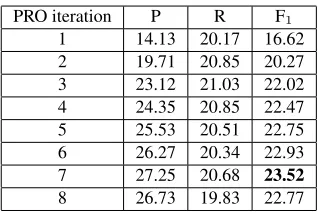
Table 3: PRO tuning of the full decoder model on
HOO-TUNE
Feature Weight
a→the -1.3660
a→ 0.5253
the→a -0.9997
the→ 0.0532
→a 0.0694
→the -0.0529
Table 4: Example of PRO-tuned weights for article cor-rection count features for the full decoder model.
We found that PRO tuning is very important to achieve good performance for our decoder. Most importantly, PRO tunes the correction count features that bias the decoder against over-correcting sen-tences thus improving precision. But PRO is also able to improve recall during tuning. Table 3 shows the trajectory of the performance for the full decoder
model during PRO tuning on HOO-TUNE. After
PRO tuning has converged, we inspect the learned weight vector and observe some interpretable pat-terns learned by PRO. First, the language model score and all classifier expert average scores receive positive weights, while all classifier expert delta scores receive negative weights, in line with our ini-tial intuition described in Section 3.3. Second, most correction count features receive negative weights, thus acting as a bias against correction if it is not necessary. Finally, the correction count features re-veal which corrections are more likely and which are less likely. For example, article replacement errors
are less common in the HOO-TUNEdata than
arti-cle insertions or deletions. The weights learned for the article correction count features shown in Table 4 reflect this.
Although our decoder achieves state-of-the-art re-sults, there remain many error categories which the decoder currently cannot correct. This includes, for
example, verb form errors (Much research (have→
has) been put into . . .) and lexical choice errors (The (concerned → relevant) relation . . .). We believe that our decoder provides a promising framework to build grammatical error correction systems that in-clude these types of errors in the future.
7 Conclusion
We have presented a novel beam-search decoder for grammatical error correction. The model performs end-to-end correction of whole sentences with mul-tiple, interacting errors, is discriminatively trained, and incorporates existing classifier-based models for
error correction. Our decoder achieves an F1
correc-tion score of 25.48% on the HOO shared task which outperforms the current state of the art on this data set.
Acknowledgments
This research is supported by the Singapore Na-tional Research Foundation under its InternaNa-tional Research Centre @ Singapore Funding Initiative and administered by the IDM Programme Office.
References
S. Bergsma, D. Lin, and R. Goebel. 2009. Web-scale N-gram models for lexical disambiguation. In Proceed-ings of IJCAI.
T. Brants and A. Franz. 2006. Web 1T 5-gram corpus version 1.1. Technical report, Google Research. C. Brockett, W. B. Dolan, and M. Gamon. 2006.
Cor-recting ESL errors using phrasal SMT techniques. In
Proceedings of COLING-ACL.
M. Chodorow, J. Tetreault, and N.R. Han. 2007. De-tection of grammatical errors involving prepositions. InProceedings of the 4th ACL-SIGSEM Workshop on Prepositions.
K. Crammer, M. Dredze, and A. Kulesza. 2009. Multi-class confidence weighted algorithms. InProceedings of EMNLP.
D. Dahlmeier and H.T. Ng. 2011a. Correcting seman-tic collocation errors with L1-induced paraphrases. In
Proceedings of EMNLP.
D. Dahlmeier and H.T. Ng. 2011b. Grammatical error correction with alternating structure optimization. In
Proceedings of ACL.
[image:10.612.146.225.205.286.2]R. Dale and A. Kilgarriff. 2011. Helping Our Own: The HOO 2011 pilot shared task. In Proceedings of the 2011 European Workshop on Natural Language Gen-eration.
H. Daum´e III. 2004. Notes on CG and LM-BFGS optimization of logistic regression. Paper available at http://pub.hal3.name#daume04cg-bfgs, implementation available athttp://hal3.name/ megam/.
A. D´esilets and M. Hermet. 2009. Using automatic roundtrip translation to repair general errors in second language writing. InProceedings of MT-Summit XII. C. Fellbaum, editor. 1998. WordNet: An electronic
lexi-cal database. MIT Press, Cambridge,MA.
M. Gamon. 2010. Using mostly native data to correct errors in learners’ writing: A meta-classifier approach. InProceedings of HLT-NAACL.
N.R. Han, M. Chodorow, and C. Leacock. 2006. De-tecting errors in English article usage by non-native speakers. Natural Language Engineering, 12(02). M. Hopkins and J. May. 2011. Tuning as ranking. In
Proceedings of EMNLP.
K. Knight and I. Chander. 1994. Automated postediting of documents. InProceedings of AAAI.
P. Koehn, F.J. Och, and D. Marcu. 2003. Statisti-cal phrase-based translation. InProceedings of HLT-NAACL.
P. Koehn, H. Hoang, A. Birch, C. Callison-Burch, M. Federico, N. Bertoldi, B. Cowan, W. Shen, C. Moran, R. Zens, C. Dyer, O. Bojar, A. Constantin, and E. Herbst. 2007. Moses: Open source toolkit for statistical machine translation. InProceedings of ACL Demonstration Session.
P. Koehn. 2004. Statistical significance tests for machine translation evaluation. InProceedings of EMNLP. T Kudo and Y. Matsumoto. 2003. Fast methods for
kernel-based text analysis. InProceedings of ACL. C. Leacock, M. Chodorow, M. Gamon, and J. Tetreault.
2010. Automated Grammatical Error Detection for Language Learners. Morgan & Claypool Publishers. J. Lee and S. Seneff. 2006. Automatic grammar
correc-tion for second-language learners. In Proceedings of Interspeech.
C.-Y. Lin and F.J. Och. 2004. ORANGE: a method for evaluating automatic evaluation metrics for machine translation. InProceedings of COLING.
J. Nivre, J. Hall, J. Nilsson, A. Chanev, G. Eryigit, S. K¨ubler, S. Marinov, and M. Marsi. 2007. Malt-Parser: A language-independent system for data-driven dependency parsing. Natural Language Engi-neering, 13.
F.J. Och and H. Ney. 2003. A systematic comparison of various statistical alignment models. Computational Linguistics, 29(1).
F.J. Och. 2003. Minimum error rate training in statistical machine translation. InProceedings of ACL.
K. Papineni, S. Roukos, T. Ward, and W.-J. Zhu. 2002. BLEU: A method for automatic evaluation of machine translation. InProceedings of ACL.
Y. A. Park and R. Levy. 2011. Automated whole sentence grammar correction using a noisy channel model. InProceedings of ACL.
A. Pauls and D. Klein. 2011. Faster and smaller N-gram language models. InProceedings of ACL-HLT. A. Rozovskaya and D. Roth. 2011. Algorithm
selec-tion and model adaptaselec-tion for ESL correcselec-tion tasks. In
Proceedings of ACL-HLT.
A. Rozovskaya, M. Sammons, J. Gioja, and D. Roth. 2011. University of Illinois system in HOO text cor-rection shared task. InProceedings of the Generation Challenges Session at the 13th European Workshop on Natural Language Generation.
S. Russell and P. Norvig, 2010.Artificial Intelligence: A Modern Approach, chapter 27. Prentice Hall.
D. Talbot and M. Osborne. 2007. Randomised language modelling for statistical machine translation. In Pro-ceedings of ACL.
J. Tetreault and M. Chodorow. 2008. The ups and downs of preposition error detection in ESL writing. In Pro-ceedings of COLING.
J. Tetreault, J. Foster, and M. Chodorow. 2010. Using parse features for preposition selection and error de-tection. InProceedings of ACL.