To Study the Characteristics of Jute Polyester
Composite for Randomly Distributed Fiber
Reinforcement
A. A. Shaikh and S.A. Channiwala
Abstract - Composite material is formed by two or more constituents at macroscopic level and the form of fiber plays vital role in property of composite. The short random fibers are very useful for creating complex shape specifically for automobile industry. Present work contains the development of predictive model for jute and polyester composite based on the experimental data. The empirical model development is based on few models available in literature to simplify the predictive equation with minimum variables. The deviation obtained for jute polyester composite experimental data compared with available models is high due to unavailability of interfacial condition. The present predictive model is within -0.15% which clearly indicates the need of incorporation of interfacial condition due to adhesion between different constituents of composite.
Key Words: Short, Random, Fiber, Model, Mold.
I. INTRODUCTION
The formation of composite takes place by combination of materials at a macroscopic structure level and not at microscopic level as in the case of alloys and polymer blends. The composites are extremely attractive for air craft, automobile and many other applications. The reason for their increased use in present era focus around weight saving and economy of construction by tailoring material to structural application[1]. The tensile strength of a fiber is many times greater than the same material in bulk. Thus, it is apparent that when high strength fibers are used effectively in a matrix composite, the strength level above those of bulk material can be produced [2]. Fiber reinforcements are basically additives. They are used to modify optical, mechanical or surface properties of the matrix material, mainly for reduction in material cost, improvements in properties, performance, service life of end product, achieving ease of processing, reduction in processing cost and minimizing degradation during process and over a period of usage. The fiber matrix interface is the critical factor that determines the extent to which the potential properties of the composite will be achieved and maintained during the use [3].
Manuscript received March 5, 2010.
A. A. Shaikh is with Mechanical Engineering Department of S.V. National Institute of Technology, Surat-395007, INDIA (phone: +91-261-2201695; e-mail: aas@ med.svnit.ac.in. ).
S.A. Channiwala is with Mechanical Engineering Department of S.V. National Institute of Technology, Surat, INDIA (phone: +91-261-2201574; e-mail: sac@ med.svnit.ac.in.)
Normally composites are formed by using high strength fibers such as carbon, graphite, Kevlar, boron, sic etc, for their optimum property utilization in various applications. However, there is enough potential for agro based product as a additives / reinforcement in the formation of composite material. Hemp, jute, kenaf, coir, cotton, sisal, bamboo and their plants etc, are also found to be feasible reinforcement materials [4]. Numerous attempts are already made to study properties of jute and other natural fiber in combination with thermosetting and thermoplastics in a last two decades [5]. The development of natural fiber composites in India is based on the strategy of preventing depletion of forest resources as well as ensuring good economic returns for the
cultivation of natural fibers [6]. Jute and coir based
composites have been developed in India as substitutes for plywood and medium density fiber boards, these composite boards especially for low-cost housing needs[7]. The reduction in fiber length, breakage in fiber and orientation of fiber all these parameters are the basic cause of reducing strength of composite. The case of short randomly distributed fiber is an envelope comprising of all these discouraging parameters. However, the randomly distributed fiber is the simplest feasible form to produce complex components. The automobile parts having complex geometry becomes easily feasible with short random reinforcement [8,9]. The present work is an attempt to study the characteristics of jute polyester composite using short random reinforcement.
II. PREDICTIVE MODEL
To determine modulus, strength etc using the properties and arrangements of constituent fibers and matrix material micro mechanic analysis is used while macro mechanic analysis provides analytical solution for thick composite made by number of plies, where individual ply may have individual characteristics which are governed by micro mechanic model. Considering long continuous reinforcement of fiber the lamina strength and modulus can be predicted by rule of mixture.
c f
v
f m mv
………(1)c f f m m
E
E v
E v
………(2)c
is strength of composite,
fis strength of fiber andm
of fibers.
E
cis strength of composite,E
fis modulus of fiber andE
mis modulus of matrix material. Literature also highlights attempt made for property prediction of long fiber composite as a function of volume fraction of fiber and matrix property, the composite property may be superior or inferior based on selection of reinforcement or filler. Manera [10] experimented with glass and polyesterresin in the
v
f range of 10 to 40 % and verified with thecorrelation derived by Puck in terms of volume fraction of fiber and property of matrix as:
11
(3.92
f0.89)
E
Em
v
……….(3)E11 is longitudinal modulus, Em is matrix modulus.
V.Kavacevic [11] experimented with poly vinyl acetate reinforced with calcium carbonate and proposed the correlation as a polynomial fit in terms of volume fraction of fiber and strength of matrix material as :
1
b d
c p
a
fc
f
……….(4)The constants a, b, c and d can be obtained from experimentation while
p is strength of polymer and
fis volume fraction of fiber. Gibson [8] mentions the importance of fiber length for reducing property of composite. Neilson [12], Whitney [13], Crawford [14] and Oscar Holfman [15] highlights the property of composite reduced as loading of fiber orientation turns form longitudinal to transverse. The longitudinal properties of composite are observed to be far superior then its transverse property in case of coir and polyester observed by Geethamma [16].The short random fiber is combination case to reduce the property of composite due to reduced length of reinforcement and different orientation of fibers embedded in to matrix. Choon [9] carried out study of stress distribution along a short fiber in fiber reinforced plastics i.e. fiber length is less than the matrix length in RVE and its axis makes an angle with direction of loading, based on which geometric parameter R is considered. The model for modulus is represented as modification of simple rule of mixture as;
2 111
1
1
1
/
f f f m f mv E
R
E
v
R
E
E R E
...(5)Crowfard reviewed the oldest model of Cox [14] for predicting the property of randomly distributed fiber based on the longitudinal and transverse property by giving different weightage factors to these properties as:
1 2
3
5
8
8
E
E
E
………(6)Neilson [12] provided the concept of fiber efficiency to consider ineffective load transfer by fiber. He proposed the model based on the concept of averaging in terms of integral equation. Manera [10] reported numerical approximation for the glass reinforcement in the range of 0.1 to 0.4. He reviewed the puck’s approximation and
compared the experimental results with empirical model given below:
16
8
(
2
)
45
9
f f m m
E
V
E
E
E
……..…….(7)Choon [9] considers weightage factors in contribution of fiber and matrix as a reduction factor R, Manera[10] also consider weightage factor for both fiber and matrix contribution as a multiple with constituent properties, while Cox[14] consider weightage factor for longitudinal modulus and transverse modulus where both are function of constituent properties. The empirical relations developed by Manera [10] and Kavacevic [11] for long fiber composite is simple in terms of matrix property and volume fraction of fiber.
The present work also simplifies the prediction model in terms of matrix property and volume fraction of fibers considering weightage factor for fiber and matrix as considered by Choon, Manera and Cox. The weightage
factors W1 and W2 are assumed to be contributing towards
fiber and matrix contribution, and the predictive equation is further derived as shown below;
1 2
1 2
1 2 2
1 2 2
1 2 2
1
2 2
1
c f f m m
f f m f
f f m m f
f f m f m
f f m m
f
f m m
m
c f
E
E v W
E v W
E v W
E W
v
E v W
E W
E W v
E v W
E W v
E W
v
E W
E W
E W
E W
v E
W
E W
E
E
v
A
B
This model depends on constituent’s properties as well as weightage factor but it can be represented in further simplified form as:
c m f
E
E
a v
b
where, f 1 2 2
m
E W
a
W
and b
W
E
and m f 1 2 m 2
m
E W
A
E
W
and B
E W
E
The A and B are calculated using method of least square, which facilitates finding of coefficients as well as the weightage factors W1 and W2 of finalized form of model.
III. EXPERIMENTAL
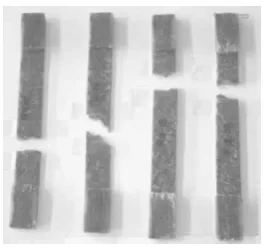
available for measuring the strength of wires and the measurement of the strength of casted neat resin is carried out as per ASTM D 638-90 . The casted specimens of resin are made in a specially prepared wooden mold, while composite specimens with short random jute reinforcement were made in another wooden mold to prepare five specimens simultaneously as shown in Fig.1. The strength of the composite has been measured as per ASTM D 3039-78 using Tensometer as shown in Fig.2. The strength of jute composite with randomly distributed fiber arrangement is measured at this stage of experimental investigation. The strain was measured from final and initial length of specimen. Here, the fibers are taken in the form of short fibers having approximate length of 1 to 3 mm with random distribution. The fiber volume fraction is varied in the range of 12 % to 25 %. Few such samples are shown photographically in Fig. 3
[image:3.595.366.498.82.206.2]
Fig. 1 Wooden Mold
Fig. 2 Tensometer for strength testing
IV. SIMULATION METHODOLOGY
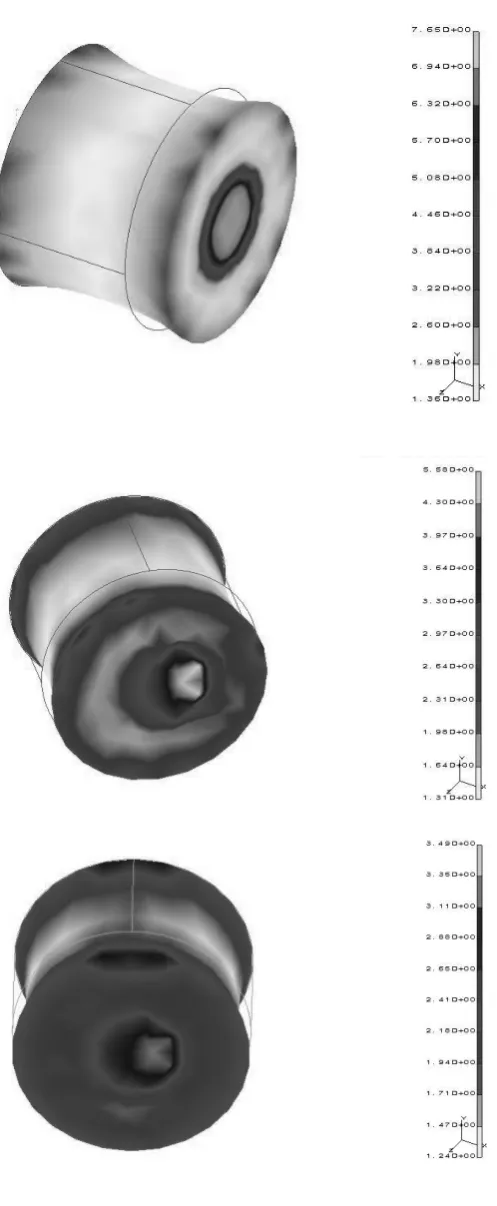
The study of composite simulation by FEA packages has extensively been reported in literature [17,18,19,20, and 21]. However, most of the investigations are based on the condition of perfect bonding between fiber and matrix. The representative volume element is modeled in IDEAS by considering internal diameter (fiber) as 100 mm and outer diameter is kept as per the volume fraction. They are extruded for the length of 100 mm to build the solid core and solid ring of matrix.
Fig.3 Specimens of Short Random Jute Fiber Composite
Fig.4. Stress Results (IDEAS) in Fiber and Matrix for 00, 300, 450 and 900 Reinforcement
V. RESULTS AND DISCUSSIONS
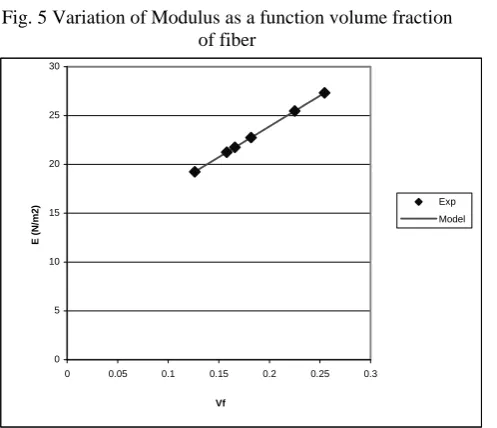
The variation of modulus with respect to
v
f for short andrandomly distributed fiber composite subjected to longitudinal loading is depicted in Fig. 5. The figure also gives comparative idea about results with the models used from literature and simulated results from IDEAS software. The linear increase in strength with increase of
v
f in the range of 12 to 25% is observed in line with the study of Horio referred by Neilson [12]. Also, the relative magnitude of the strength with respect to long continuous fiber at samef
v
level is quite less because the strength is significantlyaffected by anisotropy and length of fibers as observed by Gibson [1] and Nelson [12].
The most important assumption made in this analysis is that the interface bonding is perfect and property predicted is based on experimental strain values. In all cases, one observation is common that the predictions are always on higher side as compared to experimental results. This is basically due to unavailability of either theoretical or experimental evidences for defining the interphase property in case of random distribution of short fibers. The publish models do not give this information in explicit manner and this forms the major limitation in prediction using these soft wares.
Comparative assessment for the prediction of modulus using models of Neilson [12], Gibson [1] and Manera’s [10] approximation for short randomly distributed fiber composite indicates that these models are not capable to handle the predictions within close error levels. Similarly, FEM simulation also reveals that there is a need to define interface properties and the assumptions of perfect bonding no longer holds true for such cases. In light of this fact the proposed model which represents the rule of mixture modified by the interfacial properties is adopted by considering the additional reduction factors in terms of constants. This model is solved using method of least
square. The value a and b finally obtained are 63.06 and
11.28, respectively. The predicted modulus value as compared to present experimental results is shown in Fig. 6. It is worth to observe that the average deviation is of the order of –0.15 % which clearly establishes the validity of present correlation.
0 5 10 15 20 25 30 35 40 45 50
0 0.05 0.1 0.15 0.2 0.25 0.3
Vf
E (N
/m
2)
[image:5.595.50.291.301.470.2]Exp Neilson Horio Puck Cox Ideas
Fig. 5 Variation of Modulus as a function volume fraction of fiber
0 5 10 15 20 25 30
0 0.05 0.1 0.15 0.2 0.25 0.3
Vf
E (N
/m
2) Exp
Model
Fig. 6 Comparison of developed Predictive model with Experimental data
VI. CONCLUSION
Based on extensive experimental investigations on the modulus of the jute polyester composite under short random fiber arrangements, finite element approach using available software packages, and derivations of model for predicting the modulus of jute reinforced composite for short random fiber arrangements and comparative assessments with published models & experimental results, the following comprehensive conclusions may be drawn:
1. The modulus of short random fibers composite
increases linearly under longitudinal loading condition as the volume fraction of fiber increases. The correlation of the following form adequately represents the present experimental data within - 0.15 %.
c m f
E
E
a v
b
The constant a and b are found to be 63.06 and
11.28, respectively, for the experiments conducted
in the
v
f range of 12% to 25%. The modulus ofcomposite for short random reinforcement is
observed to be in the range of 20.30 N/m2 to
28.64 N/m2 for the same
v
f range.2. The predictions of modulus of composites and
constituents are based on assumptions of perfect bonding and experimental strain values. The FEA package IDEAS are higher as compare to experimental results. This is basically due to inattention of interphase.
3. The comparative assessment of published models
reveals that all models are over predicting. This is due to the assumptions considered such as fibers are not porous, ignorance of interfacial factors etc. The case of jute fiber is entirely different due to presence of anisotropy, porosity and the interphase, whose volume will vary with different fiber arrangements.
REFERENCES
1 R. F. Gibson, “Principle of composite material mechanics”, McGraw Hill series in mechanical engineering, New York international edition (1994), pp 1-4.
2 H. S Katz, “Handbook of reinforcements for plastic”, and Van Nostrand Reinhold Company Inc. New York, 1987, pp 7-8. 3 J. L. O’Dell, “Natural fibers in resin transfer molded composite”,
Fourth international conference on wood fiber plastic composite, (2000), pp.280.
4 R.M. Rowell, “Potential for composite from jute and allied fibers”, International symposium on bio composites and blends based on jute and allied fibers. Dec-1-2 (1994), pp 1-8.
5 R. Davidson and N.L.Hancox, “Development of jute based Composite Era”, International symposium on bio composites and blends based on jute and allied fibers (1994), pp 83.
[image:5.595.49.298.482.696.2]future”, Proceedings of the International Conference & Exhibition on Reinforced Plastics-ICERP 2002 IIT-Madras, February 7-9, (2002). pp. 25-36.
7 A. K.Rana & A. Mandal, “Jute composites: Processes, products and properties”, Jute Confo –96, PSG college of technology, Coimbatour.16-17 (may –96), pp 90-102.
8 R.F.Gibson, S.K.Chaturvedi, C.T.Sun, “Complex moduli of aligned discontinuous Fiber reinforced polymer Composite”, Journal of Material Science, 17, (1982), pp. 3499-3509.
9 C. T.Chon, C.T. Sun, “Stress distributions along a short fiber in reinforced plastic”, Journal Of Material Science, 15, (1980), 931-938.
10 M. Manera, “Elastic properties of randomly oriented short fiber glass Composite”, Journal of Composite Material, Vol-11, (1977), 235-247.
11 V.Kavacevic, “Tensile properties of calcium carbonate reinforced poly (vinyl acetate)”, Adhesion science technology, Vol 10, No 12, (1996), pp.1273-1285.
12 L.E.Neilson, & P.E. Chen, “Young's module of composite filled with randomly oriented fibers”, Journal of materials, (1968), 352-358.
13 J.M.Whitney, “Elastic moduli of unidirectional composite with anisotropic filaments”, Journal of composite material vol-1, (1967), pp. 180-193.
14 R.J. Crawford, “Plastic and rubber engineering design and application”, Mechanical engineering publication, London (1985), pp.235
15 O. Hoffman, “ The brittle strength of orthotropic material ”, Journal of Composite Material, Vol-1, (1967), pp. 200-206.
16 V.G.Geethamma, “Short coir fiber reinforced natural rubber composites: evaluation of strength and interfacial adhesion”, International symposium on bio-composites and blends based jute and allied fibers, Dec-1-2, (1994), New Delhi, pp51.
17 A.E. Bogdanovich and I.Kizhakkethara, “Three-dimensional finite element analysis of double – lap composite-adhesive bonded joint using submodeling approach”, Composites, 30, (1999) pp 537-551. 18 P.Denizet, “A finite element using equivalent material for
composite structure of revolution”, ICCM- II , (1978),1145-1161. 19 W. Sun, “Computer modeling and FEA simulation for composite
single fiber pull-out”, Journal of Thermoplastic Composite Materials, Vol. 14, (4), 2001, pp. 327-343.
20 H. Tai, “Equivalent thermal conductivity of 2D & 3Dorthogonaly fiber reinforced composite in 1D heat flow”, Journal of Composite Technology & Research, Vol-18, No-3,(1996) pp. 221-227. 21 S. Amijma, Akira Yoshida and Toru fujii, “Strength and stress