A Regularized Competition Model for Question Di
ffi
culty Estimation in
Community Question Answering Services
Quan Wang† Jing Liu‡ Bin Wang† Li Guo†
†Institute of Information Engineering, Chinese Academy of Sciences, Beijing, P. R. China
{wangquan,wangbin,guoli}@iie.ac.cn
‡Harbin Institute of Technology, Harbin, P. R. China [email protected]
Abstract
Estimating questions’ difficulty levels is an important task in community question answering (CQA) services. Previous stud-ies propose to solve this problem based on the question-user comparisons extract-ed from the question answering threads. However, they suffer from data sparseness problem as each question only gets a lim-ited number of comparisons. Moreover, they cannot handle newly posted question-s which get no compariquestion-sonquestion-s. In thiquestion-s pa-per, we propose a novel question diffi cul-ty estimation approach called Regularized Competition Model (RCM), which natu-rally combines question-user comparisons and questions’ textual descriptions into a unified framework. By incorporating tex-tual information, RCM can effectively deal with data sparseness problem. We further employ a K-Nearest Neighbor approach to estimate difficulty levels of newly post-ed questions, again by leveraging textu-al similarities. Experiments on two pub-licly available data sets show that for both well-resolved and newly-posted question-s, RCM performs the estimation task sig-nificantly better than existing methods, demonstrating the advantage of incorpo-rating textual information. More interest-ingly, we observe that RCM might provide an automatic way to quantitatively mea-sure the knowledge levels of words.
1 Introduction
Recent years have seen rapid growth in communi-ty question answering (CQA) services. They have been widely used in various scenarios, including general information seeking on the web1,
knowl-1http://answers.yahoo.com/
edge exchange in professional communities2, and
question answering in massive open online cours-es (MOOCs)3, to name a few.
An important research problem in CQA is how to automatically estimate the difficulty lev-els of questions, i.e., question difficulty estima-tion (QDE). QDE can benefit many applications. Examples include 1) Question routing. Routing questions to appropriate answerers can help ob-tain quick and high-quality answers (Li and K-ing, 2010; Zhou et al., 2009). Ackerman and McDonald (1996) have demonstrated that rout-ing questions by matchrout-ing question difficulty lev-el with answerer expertise levlev-el will make better use of answerers’ time and expertise. This is even more important for enterprise question answering and MOOCs question answering, where human resources are expensive. 2) Incentive mechanism design. Nam et al. (2009) have found that win-ning point awards offered by reputation system-s isystem-s a driving factor for usystem-ser participation in C-QA services. Assigning higher point awards to more difficult questions will significantly improve user participation and satisfaction. 3) Linguistics analysis. Researchers in computational linguistics are always interested in investigating the correla-tion between language and knowledge, to see how the language reflects one’s knowledge (Church, 2011). As we will show in Section 5.4, QDE pro-vides an automatic way to quantitatively measure the knowledge levels of words.
Liu et al. (2013) have done the pioneer work on QDE, by leveraging question-user comparison-s extracted from the quecomparison-stion ancomparison-swering threadcomparison-s. Specifically, they assumed that the difficulty lev-el of a question is higher than the expertise levlev-el of the asker (i.e. the user who asked the question), but lower than that of the best answerer (i.e. the us-er who provided the best answus-er). A TrueSkill
al-2http://stackoverflow.com/ 3http://coursera.org/
gorithm (Herbrich et al., 2006) was further adopt-ed to estimate question difficulty levels as well as user expertise levels from the pairwise compar-isons among them. To our knowledge, it is the on-ly existing work on QDE. Yang et al. (2008) have proposed a similar idea, but their work focuses on a different task, i.e., estimating difficulty levels of tasks in crowdsourcing contest services.
There are two major drawbacks of previous methods: 1)data sparseness problemand 2) cold-start problem. By the former, we mean that un-der the framework of previous work, each question is compared only twice with the users (once with the asker and the other with the best answerer), which might not provide enough information and contaminate the estimation accuracy. By the latter, we mean that previous work only deals with well-resolved questions which have received the best answers, but cannot handle newly posted question-s with no anquestion-swerquestion-s received. In many real-world applications such as question routing and incentive mechanism design, however, it is usually required that the difficulty level of a question is known in-stantly after it is posted.
To address the drawbacks, we propose further exploiting questions’ textual descriptions (e.g., ti-tle, body, and tags) to perform QDE. Preliminary observations have shown that a question’s diffi cul-ty level can be indicated by its textual descrip-tion (Liu et al., 2013). We take advantage of the observations, and assume that if two questions are close in their textual descriptions, they will also be close in their difficulty levels, i.e., the smooth-ness assumption. We employ manifold regular-ization (Belkin et al., 2006) to characterize the assumption. Manifold regularization is a well-known technique to preserve local invariance in manifold learning algorithms, i.e., nearby points are likely to have similar embeddings (Belkin and Niyogi, 2001). Then, we propose a novel Reg-ularized Competition Model (RCM), which for-malizes QDE as minimizing a loss on question-user comparisons with manifold regularization on questions’ textual descriptions. As the smoothness assumption offers extra information for inferring question difficulty levels, incorporating it will ef-fectively deal with data sparsity. Finally, we adopt a K-Nearest Neighbor approach (Cover and Hart, 1967) to perform cold-start estimation, again by leveraging the smoothness assumption.
Experiments on two publicly available data sets
collected from Stack Overflow show that 1) RCM performs significantly better than existing meth-ods in the QDE task for both well-resolved and cold-start questions. 2) The performance of RCM is insensitive to the particular choice of the term weighting schema (determines how a question’s textual description is represented) and the similar-ity measure (determines how the textual similarsimilar-ity between two questions is measured). The results demonstrate the advantage of incorporating textu-al information for QDE. Qutextu-alitative antextu-alysis fur-ther reveals that RCM might provide an automatic way to quantitatively measure the knowledge lev-els of words.
The main contributions of this paper include: 1) We take fully advantage of questions’ textual de-scriptions to address data sparseness problem and cold-start problem which previous QDE methods suffer from. To our knowledge, it is the first time that textual information is introduced in QDE. 2) We propose a novel QDE method that natural-ly combines question-user comparisons and ques-tions’ textual descriptions into a unified frame-work. The proposed method performs QDE sig-nificantly better than existing methods. 3) We demonstrate the practicability of estimating diffi -culty levels of cold-start questions purely based on their textual descriptions, making various applica-tions feasible in practice. As far as we know, it is the first work that considers cold-start estimation. 4) We explore how a word’s knowledge level can be automatically measured by RCM.
The rest of the paper is structured as follows. Section 2 describes the problem formulation and the motivation of RCM. Section 3 presents the de-tails of RCM. Section 4 discusses cold-start esti-mation. Section 5 reports experiments and results. Section 6 reviews related work. Section 7 con-cludes the paper and discusses future work.
2 Preliminaries
2.1 Problem Formulation
A CQA service provides a platform where people can ask questions and seek answers from others. Given a CQA portal, consider a specific catego-ry where questions on the same topic are asked and answered, e.g., the “C++programming” cat-egory of Stack Overflow. When an askerua posts
by the asker or voted by the community. The an-swerer who provides the best answer is called the best answererub. The other answerers are denoted
byO= {uo1,uo2,· · · ,uoM
}. A question answering
thread (QA thread) is represented as a quadruplet (q,ua,ub,O). Collecting all such QA threads in the
category, we getMusers andNquestions, denoted byU= {u1,u2,· · · ,uM}andQ={q1,q2,· · ·,qN}
respectively. Each user um is associated with an
expertise score θm, representing his/her expertise
level. A largerθmindicates a higher expertise
lev-el of the user. Each questionqnis associated with
a difficulty scoreβn, representing its difficulty
lev-el. A larger βn indicates a higher difficulty level
of the question. Difficulty scores (as well as ex-pertise scores) are assumed to be comparable with each other in the specified category. Besides, each questionqnhas a textual description, and is
repre-sented as a V-dimensional term vector dn, where
Vis the vocabulary size.
The question difficulty estimation (QDE) task aims to automatically learn the question diffi cul-ty scores (βn’s) by utilizing the QA threadsT =
{(q,ua,ub,O) :q∈ Q}as well as the question
de-scriptions D = {d1,d2,· · ·,dN} in the specified
category. Note that in Section 2 and Section 3, we consider estimating difficulty scores of resolved questions, i.e., questions with the best answers se-lected or voted. Estimating difficulty scores of un-resolved questions, e.g., newly posted ones, will be discussed in Section 4.
2.2 Competition-based Methods
Liu et al. (2013) have proposed a competition-based method for QDE. The key idea is to 1) ex-tract pairwise competitions from the QA threads and 2) estimate question difficulty scores based on extracted competitions.
To extract pairwise competitions, it is assumed that question difficulty scores and user expertise scores are expressed on the same scale. Given a QA thread (q,ua,ub,O), it is further assumed that: Assumption 1 (pairwise comparison assumption)
The difficulty score of question q is higher than the expertise score of the asker ua, but lower than that
of the best answerer ub. Moreover, the expertise
score of the best answerer ub is higher than that
of the asker ua, as well as any answerer inO.4
4The difficulty score of questionqis not assumed to be
lower than the expertise score of any answerer inO, since such a user may just happen to see the question and respond to it, rather than knowing the answer well.
Given the assumption, there are (|O|+3) pairwise competitions extracted from the QA thread, in-cluding 1) one competition between the question q and the asker ua, 2) one competition between
the question q and the best answerer ub, 3) one
competition between the best answereruband the
askerua, and 4)|O|competitions between the best
answererub and each of the answerers inO. The
question q is the winner of the first competition, and the best answererub is the winner of the
re-maining (|O|+2) competitions. These pairwise competitions are denoted by
Cq={ua≺q,q≺ub,ua≺ub,uo1≺ub,· · ·,uoM≺ub
},
wherei ≺ jmeans that competitor jbeats com-petitoriin a competition. Let
C=∪
q∈Q
Cq (1)
be the set containing all the pairwise competitions extracted fromT.
Given the competition set C, Liu et al. (2013) further adopted a TrueSkill algorithm (Herbrich et al., 2006) to learn the competitors’ skill level-s (i.e. the quelevel-stion difficulty scores and the us-er expus-ertise scores). TrueSkill assumes that the practical skill level of each competitor follows a normal distributionN(µ, σ2), whereµis the
aver-age skill level andσ is the estimation uncertain-ty. Then it updates the estimations in an online mode: for a newly observed competition with its win-loss result, 1) increase the average skill level of the winner, 2) decrease the average skill level of the loser, and 3) shrink the uncertainties of both competitors as more data has been observed. Yang et al. (2008) have proposed a similar competition-based method to estimate tasks’ difficulty levels in crowdsourcing contest services, by leveraging PageRank (Page et al., 1999) algorithm.
2.3 Motivating Discussions
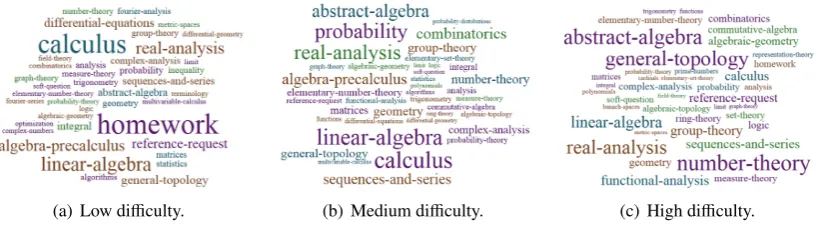
(a) Low difficulty. (b) Medium difficulty. (c) High difficulty.
Figure 1: Tag clouds of SO/Math questions with different difficulty levels.
Taking advantage of additional metadata has been demonstrated to be an effective way of deal-ing with data sparsity in various applications such as collaborative filtering (Claypool et al., 1999; Schein et al., 2002) and personalized search (Dou et al., 2007; Sugiyama et al., 2004). The ratio-nale behind is to bridge the gap among users/items by leveraging their similarities based on the meta-data. As for QDE, preliminary observations have shown that a question’s difficulty level can be in-dicated by its textual description (Liu et al., 2013). As an example, consider the QA threads in the “mathematics” category of Stack Overflow. Di-vide the questions into three groups: 1) low dif-ficulty, 2) medium difficulty, and 3) high diffi cul-ty, according to their difficulty scores estimated by TrueSkill. Figure 1 visualizes the frequency dis-tribution of tags in each group, where the size of each tag is in proportion to its frequency in the group. The results indicate that the tags associ-ated with the questions do have the ability to re-flect the questions’ difficulty levels, e.g., low dif-ficulty questions usually have tags such as “home-work” and “calculus”, while high difficulty ones usually have tags such as “general topology” and “number theory”. We further calculate the Pearson correlation coefficient (Rodgers and Nicewander, 1988) between 1) the gap between the averaged difficulty scores in each two groups and 2) the Euclidean distance between the aggregated textu-al descriptions in each two groups . The result is r=0.6424, implying that the difficulty gap is posi-tively correlated with the textual distance. In other words, the more similar two questions’ textual de-scriptions are, the more close their difficulty levels are. Therefore, we take the textual information to bridge the difficulty gap among questions, by as-suming that
Assumption 2 (smoothness assumption) If two
questions qi and qj are close in their textual
de-scriptionsdianddj, they will also be close in their
difficulty scoresβi andβj.
The smoothness assumption brings us additional information about question difficulty scores by in-ferring textual similarities. It serves as a supple-ment to the pairwise competitions, and might help address the data sparseness problem which previ-ous methods suffer from.
3 Modeling Text Similarities for QDE
This section presents a novel Regularized Compe-tition Model (RCM) for QDE, which combines the pairwise competitions and the textual descriptions into a unified framework. RCM can alleviate the data sparseness problem and perform more accu-rate estimation.
3.1 Regularized Competition Model
We start with several notations. As question dif-ficulty scores can be directly compared with user expertise scores, we take questions as pseudo user-s. Let θ¯ ∈ RM+N denote the skill levels (i.e. the
expertise scores and the difficulty scores) of all the (pseudo) users:
¯
θi = {
θi, 1≤i≤ M,
βi−M, M<i≤ M+N,
where ¯θiis thei-th entry ofθ. The first¯ Mentries
are the user expertise scores, denoted byθ¯u∈RM.
The last N entries are the question difficulty s-cores, denoted byθ¯q∈RN. Let ¯θi(u)and ¯θ(iq)denote
thei-th entries ofθ¯uandθ¯qrespectively.
Exploiting Pairwise Competitions. We define
a loss on each pairwise competitioni≺ j:
ℓ(θ¯i,θ¯j )
=max(0, δ−(θ¯j−θ¯i ))p
, (2)
measuring the inconsistency between the expect-ed outcome and the actual outcome. If the gap is larger than a predefined thresholdδ, competitor j would probably beat competitor i in the compe-tition, which coincides with the actual outcome. Then the loss will be zero. Otherwise, there is a higher chance that competitor jloses the competi-tion, which goes against the actual outcome. Then the loss will be greater than zero. The smaller the gap is, the higher the chance of inconsistency be-comes, and the greater the loss will be. Note that the thresholdδ can take any positive value since we do not pose a norm constraint onθ.¯5 Without
loss of generality we takeδ = 1 throughout this paper. As we will show in Section 3.2, the loss de-fined in Eq. (2) has some similarity with the SVM loss (Chapelle, 2007). We name it hinge loss when p=1, and quadratic loss whenp=2.
Given the competition set C, estimating skil-l skil-leveskil-ls of (pseudo) users then amounts to soskil-lving the following optimization problem:
min
¯
θ
∑
(i≺j)∈C
ℓ(θ¯i,θ¯j )
+ λ21θ¯Tθ¯, (3)
where the first term is the empirical loss measur-ing the total inconsistency; the second term is a regularizer to prevent overfitting; andλ1 ≥ 0 is a
trade-offcoefficient. It is also a competition-based QDE method, called Competition Model (CM).
Exploiting Question Descriptions. Manifold
regularization is a well-known technique used in manifold learning algorithms to preserve local in-variance, i.e., nearby points are likely to have sim-ilar embeddings (Belkin and Niyogi, 2001). In QDE, the smoothness assumption expresses sim-ilar “invariance”, i.e., nearby questions (in terms of textual similarities) are likely to have similar difficulty scores. Hence, we characterize the as-sumption with the following manifold regularizer:
R = 1
2
N ∑
i=1
N ∑
j=1
(
¯
θ(iq)−θ¯(jq))2wi j
= θ¯TqD¯θq−θ¯TqW¯θq=θ¯TqL¯θq, (4)
where wi j is the textual similarity between
ques-tioniand question j;W ∈ RN×N is the similarity
matrix with the (i,j)-th entry beingwi j;D∈RN×N
is a diagonal matrix with thei-th entry on the diag-onal beingdii=∑Nj=1wi j; andL=D−W∈RN×N
5Given any ¯θ
i, ¯θj, andδ, there always exists a linear
trans-formation which keeps the sign of(δ−(θ¯j−θ¯i
))
unchanged.
is the graph Laplacian (Chung, 1997). Minimizing R results in the smoothness assumption: for any questionsiand j, if their textual similaritywi j is
high, the difficulty gap(θ¯(iq)−θ¯(jq))2will be small.
A Hybrid Method. Combining Eq. (3) and
Eq. (4), we obtain RCM, which amounts to the following optimization problem:
min
¯
θ
∑
(i≺j)∈C
ℓ(θ¯i,θ¯j )
+ λ21θ¯Tθ¯+ λ22θ¯TqL¯θq. (5)
Here λ2 ≥ 0 is also a trade-off coefficient. The
advantages of RCM include 1) It naturally formal-izes QDE as minimizing a manifold regularized loss function, which seamlessly integrates both the pairwise competitions and the textual description-s. 2) By incorporating textual information, it can address the data sparseness problem which previ-ous methods suffer from, and perform significantly better in the QDE task.
3.2 Learning Algorithm
Redefine thek-th pairwise competition (assumed to be carried out between competitorsiand j) as (xk,yk).xk∈RM+Nindicates the competitors:
x(ik)=1,x(jk)=−1,andx(lk)=0 for anyl,i,j,
where x(lk) is the l-th entry of xk. yk ∈ {1,−1}is
the outcome: if competitor i beats competitor j, yk = 1; otherwise,yk = −1. The objective in Eq.
(5) can then be rewritten as
L(θ¯)=∑|C|
k=1
max(0,1−yk (
¯
θTxk ))p
+ 12θ¯TZ¯θ,
where Z=
(
λ1IM 0
0 λ1IN+λ2L
)
is a block matrix; IM ∈
RM×M andIN ∈ RN×N are identity matrices; p =
1 corresponds to the hinge loss, and p = 2 the quadratic loss. It is clear that the loss defined in Eq. (2) has the same format as the SVM loss.
The objectiveLis differentiable for the quadrat-ic loss but non-differentiable for the hinge loss. We employ a subgradient method (Boyd et al., 2003) to solve the optimization problem. The al-gorithm starts at a pointθ¯0and, as many iterations
as needed, moves fromθ¯t toθ¯t+1 in the direction
of the negative subgradient:
¯
θt+1 =θ¯t−γt∇L (
¯
θt )
Algorithm 1Regularized Competition Model Require: competition setCand description setD
1: θ¯0←1
2: fort=0 :T−1do 3: Kt←
{
k: 1−yk
(
¯
θTtxk
) >0} 4: ∇L(θ¯t
)
←calculated by Eq. (6) 5: θ¯t+1←θ¯t−γt∇L
(
¯
θt
)
6: Θt+1←
{
¯
θ0,θ¯1,· · ·,θ¯t+1
}
7: θ¯t+1←arg minθ¯∈Θt+1L (
¯
θ) 8: end for
9: return ¯θT
whereγt >0 is the learning rate. The subgradient
is calculated as
∇L(θ¯t
)
= Z¯θt−
∑
k∈Ktykxk, p=1,
Z¯θt+2 ∑ k∈Ktxkx
T kθ¯t−2 ∑
k∈Ktykxk, p=2,
(6)
where Kt = {k: 1−yk(θ¯Tt xk)>0}. As it is not
always a descent method, we keep track of the best point found so far (Boyd et al., 2003):
¯
θt+1=arg min¯ θ∈Θt+1L
(¯
θ),
whereΘt+1 =
{ ¯
θ0,θ¯1,· · · ,θ¯t+1
}
. The whole proce-dure is summarized in Algorithm 1.
Convergence. For constant learning rate (i.e.,
γt = γ), Algorithm 1 is guaranteed to converge to
within some range of the optimal value, i.e.,
lim
t→∞L
( ¯
θt )
− L∗< ϵ,
whereL∗denotes the minimum ofL(·), andϵis a
constant defined by the learning rateγ. For more details, please refer to (Boyd et al., 2003). During our experiments, we set the iteration number as T =1000 and the learning rate asγt =0.001, and
convergence was observed.
Complexity. For both the hinge loss and the
quadratic loss, the time complexity (per itera-tion) and the space complexity of RCM are both O(|C|+ηN2). Here, |C| is the total number of
competitions, M and N are the numbers of user-s and queuser-stionuser-s reuser-spectively, and ηis the ratio of non-zero entries in the graph LaplacianL.6 In the
analysis, we have assumed that M ≪ ηN2 and
N ≪ηN2.
6Owing to the sparse nature of questions’ textual
descrip-tions, the graph LaplacianLis usually sparse, with about 70% entries being zero according to our experiments.
4 Cold-Start Estimation
Previous sections discussed estimating difficulty s-cores of resolved questions, from which pairwise competitions could be extracted. However, for newly posted questions without any answers re-ceived, no competitions could be extracted and none of the above methods work. We call it the cold-start problem.
We heuristically apply a K-Nearest Neighbor (KNN) approach (Cover and Hart, 1967) to cold-start estimation, again by leveraging the smooth-ness assumption. The key idea is to propagate difficulty scores from well-resolved questions to cold-start ones according to their textual simi-larities. Specifically, suppose that there exists a set of well-resolved questions whose diffi cul-ty scores have already been estimated by a QDE method. Given a cold-start question q∗, we first
pickK well-resolved questions that are closest to q∗ in textual descriptions, referred to as the
near-est neighbors. The difficulty score of question q∗
is then predicted as the averaged difficulty scores of its nearest neighbors. The KNN method bridges the gap between cold-start and well-resolved ques-tions by inferring their textual similarities, and might effectively deal with the cold-start problem.
5 Experiments
We have conducted experiments to test the eff ec-tiveness of RCM in estimating difficulty scores of both well-resolved and cold-start questions. More-over, we have explored how a word’s difficulty lev-el can be quantitativlev-ely measured by RCM.
5.1 Experimental Settings
Data Sets. We obtained a publicly available
da-ta set of Sda-tack Overflow between July 31, 2008 and August 1, 20127, containing QA threads in
various categories. We considered the categories of “C++programming” and “mathematics”, and randomly sampled about 10,000 QA threads from each category, denoted by SO/CPP and SO/Math respectively. For each question, we took the title and body fields as its textual description. For both data sets, stop words in a standard list8and words
whose total frequencies are less than 10 were re-moved. Table 1 gives the statistics of the data sets.
7http://blog.stackoverflow.com/category/cc-wiki-dump/ 8http://jmlr.org/papers/volume5/lewis04a/
# users # questions # competitions # words SO/CPP 14,884 10,164 50,043 2,208 SO/Math 6,564 10,528 40,396 2,009
Table 1: Statistics of the data sets.
For evaluation, we randomly sampled 600 ques-tion pairs from each data set, and asked annotators to compare the difficulty levels of the questions in each pair. We had two graduate students ma-joring in computer science annotate the SO/CPP questions, and two majoring in mathematics an-notate the SO/Math questions. For each question, only the title, body, and tags were exposed to the annotators. Given a question pair (q1,q2), the
an-notators were asked to give one of the three labels: q1 ≻ q2, q2 ≻ q1, or q1 = q2, which
respective-ly means that questionq1 has a higher, lower, or
equal difficulty level compared with question q2.
We used Cohen’s kappa coefficient (Cohen, 1960) to measure the inter-annotator agreement. The re-sult is κ = 0.7533 on SO/CPP and κ = 0.8017 on SO/Math, indicating that the inter-annotator a-greement is quite substantial on both data sets. Af-ter removing the question pairs with inconsisten-t labels, we goinconsisten-t 521 annoinconsisten-tainconsisten-ted SO/CPP question pairs and 539 annotated SO/Math question pairs.
We further randomly split the annotated ques-tion pairs into development/test/cold-start sets, with the ratio of 2:2:1. The first two sets were used to evaluate the methods in estimating difficulty s-cores of resolved questions. Specifically, the de-velopment set was used for parameter tuning and the test set was used for evaluation. The last set was used to evaluate the methods in cold-start esti-mation, and the questions in this set were excluded from the learning process of RCM as well as any baseline method.
Baseline Methods. We considered three
base-line methods: PageRank (PR), TrueSkill (TS), and CM, which are based solely on the pairwise com-petitions.
• PR first constructs a competitor graph, by creating an edge from competitori to com-petitor j if j beats i in a competition. A PageRank algorithm (Page et al., 1999) is then utilized to estimate the relative impor-tance of the nodes, i.e., question difficulty s-cores and user expertise ss-cores. The damping factor was set from 0.1 to 0.9 in steps of 0.1. • TS has been applied to QDE by Liu et al.
(2013). We set the model parameters in the same way as they suggested.
• CM performs QDE by solving Eq. (3). We setλ1in{0,0.01,0.02,0.05,0.1,0.2,0.5,1}.
We compared RCM with the above baseline meth-ods. In RCM, both parametersλ1andλ2were set
in{0,0.01,0.02,0.05,0.1,0.2,0.5,1}.
Evaluation Metric. We employed accuracy
(ACC) as the evaluation metric:
ACC= # correctly judged question pairs# all question pairs .
A question pair is regarded as correctly judged if the relative difficulty ranking given by an estima-tion method is consistent with that given by the annotators. The higher the accuracy is, the better a method performs.
5.2 Estimation for Resolved Questions
The first experiment tested the methods in estimat-ing difficulty scores of resolved questions.
Estimation Accuracies. We first compared the
estimation accuracies of PR, TS, CM, and RCM on the test sets of SO/CPP and SO/Math, obtained with the best parameter settings determined by the development sets. Table 2 gives the results, where “H” denotes the hinge loss and “Q” the quadratic loss. In RCM, to calculate the graph LaplacianL, we adopted Boolean term weighting schema and took Jaccard coefficient as the similarity measure. From the results, we can see that 1) RCM perform-s perform-significantly better than the baperform-seline methodperform-s on both data sets (t-test, p-value<0.05), demonstrat-ing the advantage of exploitdemonstrat-ing questions’ textu-al descriptions for QDE. 2) The improvements of RCM over the baseline methods on SO/Math are greater than those on SO/CPP, indicating that the textual descriptions of the SO/Math questions are more powerful in reflecting their difficulty level-s. The reason is that the SO/Math questions are much more heterogeneous, belonging to various subfields of mathematics. The difficulty gaps a-mong different subfields are sometimes obvious (e.g., a question in topology in general has a high-er difficulty level than a question in linear algebra), making the textual descriptions more powerful in distinguishing the difficulty levels.
Graph Laplacian Variants. We further
PR TS CM RCM
H Q H Q
SO/CPP 0.5876 0.6134 0.6340 0.6753 0.7371 0.7268 SO/Math 0.6067 0.6109 0.6527 0.6820 0.7699 0.7699
Table 2: ACC of different methods for well-resolved questions.
Notation Definition
Boolean v(w,q)= 1, if wordwoccurs in questionq 0, otherwise
TF-1 v(w,q)=f(w,q), the number of occurrences TF-2 v(w,q)=log (f(w,q)+1)
TF-3 v(w,q)=0.5+ 0.5×f(w,q) max{f(w,q) :w∈q}
TFIDF-1 v(w,q)=TF-1×log |Q| |{q∈Q:w∈q}|
TFIDF-2 v(w,q)=TF-2×log |Q| |{q∈Q:w∈q}|
TFIDF-3 v(w,q)=TF-3×log |Q| |{q∈Q:w∈q}|
Cosine Sim (d1,d2)= d
T
1d2
∥d1∥×∥d2∥∈[0,1]
Jaccard Sim (d1,d2)= d
T
1d2
∥d1∥2+∥d2∥2−∥d1∥×∥d2∥∈[0,1]
Table 3: Different term weighting schemas and similarity measures.
Laplacian. The term weighting schema deter-mines how a question’s textual description is rep-resented. We explored a Boolean schema, three TF schemas, and three TFIDF schemas (Salton and Buckley, 1988). The similarity measure de-termines how the textual similarity between two questions is calculated. We explored the Co-sine similarity and the Jaccard coefficient (Huang, 2008). Detailed descriptions are given in Table 3.
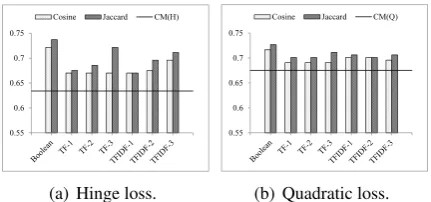
Figure 2 and Figure 3 show the estimation ac-curacies of the RCM variants on the test sets of SO/CPP and SO/Math respectively, again obtained with the best parameter settings determined by the development sets. The performance of CM is also given (the straight lines in the figures).9
From the results, we can see that 1) All the RCM variants can improve over CM on both data sets, and most of the improvements are significant (t-test, p-value < 0.05). This further demonstrates that the effectiveness of incorporating textual de-scriptions is not affected by the particular choice of the term weighting schema or similarity mea-sure. 2) Boolean term weighting schema performs the best, considering different similarity measures, loss types, and data sets collectively. 3) Jaccard
9CM performs better than PR and TS on both data sets.
0.55 0.6 0.65 0.7 0.75
Cosine Jaccard CM(H)
(a) Hinge loss.
0.55 0.6 0.65 0.7 0.75
Cosine Jaccard CM(Q)
[image:8.595.310.526.58.159.2](b) Quadratic loss.
Figure 2: ACC of RCM variants for well-resolved questions on SO/CPP.
0.6 0.65 0.7 0.75 0.8
Cosine Jaccard CM(H)
(a) Hinge loss.
0.6 0.65 0.7 0.75 0.8
Cosine Jaccard CM(Q)
(b) Quadratic loss.
Figure 3: ACC of RCM variants for well-resolved questions on SO/Math.
coefficient performs as well as Cosine similari-ty on SO/Math, but almost consistently better on SO/CPP. Throughout the experiments, we adopted Boolean term weighting schema and Jaccard coef-ficient to calculate the graph Laplacian.
5.3 Estimation for Cold-Start Questions
The second experiment tested the methods in es-timating difficulty scores of cold-start questions. We employed Boolean term weighting schema to represent a cold-start question, and utilized Jac-card Coefficient to select its nearest neighbors.
[image:8.595.310.526.210.312.2]0.45 0.55 0.65 0.75
11 12 13 14 15 16 17 18 19 20
A
c
c
u
ra
c
y
K
PR TS CM(H)
[image:9.595.91.273.59.163.2]CM(Q) RCM(H) RCM(Q)
Figure 4: ACC of different methods for cold-start questions on SO/CPP.
0.5 0.6 0.7 0.8
6 7 8 9 10 11 12 13 14 15
A
c
c
u
ra
c
y
K
PR TS CM(H)
[image:9.595.308.527.62.94.2]CM(Q) RCM(H) RCM(Q)
Figure 5: ACC of different methods for cold-start questions on SO/Math.
design feasible in practice. 2) As the value of K varies, RCM (the red/blue solid line) performs al-most consistently better than CM with the same loss type (the red/blue dotted line), as well as PR and TS (the gray dotted lines), showing the advan-tages of RCM in the cold-start estimation. 3) The cold-start estimation accuracies on SO/Math are higher than those on SO/CPP, again demonstrating that the textual descriptions of the SO/Math ques-tions are more powerful in reflecting their diffi cul-ty levels. This is consistent with the phenomenon observed in Section 5.2.
5.4 Difficulty Levels of Words
The third experiment explored how a word’s diffi -culty level can be measured by RCM automatical-ly and quantitativeautomatical-ly.
On both SO/CPP and SO/Math, we evenly split the range of question difficulty scores (estimated by RCM) into 10 buckets, and assigned questions to the buckets according to their difficulty scores. A larger bucket ID indicates a higher difficulty lev-el. Then, given a word w, we calculated its fre-quency in each bucket as follows:
fi(w)= # questions in bucket# all questions in bucketiwherewioccurs.
To make the frequency meaningful, buckets with less than 50 questions were discarded. We picked
PR TS CM RCM
H Q H Q
[image:9.595.324.509.163.267.2]SO/CPP 0.5870 0.5413 0.6120 0.6304 0.6380 0.6609 SO/Math 0.6411 0.6305 0.6653 0.7263 0.6958 0.7442
Table 4: Averaged ACC of different methods for cold-start questions.
0 0.4 0.8 1.2
3 3.5 4 4.5 5 5.5 6 6.5 7
O
cc
u
rr
en
ce
f
re
q
u
e
n
c
y
Question buckets
array string virtual multithread
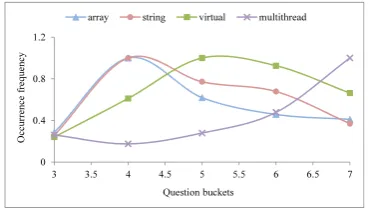
Figure 6: Frequencies of different words in the buckets on SO/CPP.
four words from each data set as examples. Their normalized frequencies in different buckets are shown in Figure 6 and Figure 7. On SO/CPP, we can observe that “array” and “string” occur most frequently in questions with lower diffi cul-ty levels, “virtual” higher, and “multithread” the highest. It coincides with the intuition: “array” and “string” are usually related to some basic con-cepts in programming language, while “virtual” and “multithread” usually discuss more advanced topics. Similar phenomena can be observed on SO/Math. The results indicate that RCM might provide an automatic way to measure the diffi cul-ty levels of words.
6 Related Work
[image:9.595.89.277.214.318.2]0 0.4 0.8 1.2
4 5 6 7 8 9
O
cc
u
rr
en
ce
f
re
q
u
en
cy
Question buckets
[image:10.595.91.273.59.163.2]homework calculus ring topology
Figure 7: Frequencies of different words in the buckets on SO/Math.
The most relevant work to ours is a pairwise comparison based approach proposed by Liu et al. (2013) to estimate question difficulty levels in C-QA services. They have also demonstrated that a similar approach can be utilized to estimate us-er expus-ertise levels (Liu et al., 2011). Yang et al. (2008) and Chen et al. (2013) have also proposed pairwise comparison based methods, for task dif-ficulty estimation and rank aggregation in crowd-sourcing settings. Our work differs from previous pairwise comparison based methods in that it fur-ther utilizes textual information, formalized as a manifold regularizer.
Manifold regularization is a geometrically mo-tivated framework for machine learning, enforcing the learning model to be smooth w.r.t. the geomet-rical structure of data (Belkin et al., 2006). Within the framework, dimensionality reduction (Belkin and Niyogi, 2001; Cai et al., 2008) and semi-supervised learning (Zhou et al., 2004; Zhu and Lafferty, 2005) algorithms have been constructed. In dimensionality reduction, manifold regulariza-tion is utilized to guarantee that nearby points will have similar low-dimensional representations (Cai et al., 2008), while in semi-supervised learning it is utilized to ensure that nearby points will have similar labels (Zhou et al., 2004). In our work, we assume that nearby questions (in terms of textual similarities) will have similar difficulty levels.
Predicting reading difficulty levels of text is also a relevant problem (Collins-Thompson and Callan, 2004; Schwarm and Ostendorf, 2005). It is a key to automatically finding materials at ap-preciate reading levels for students, and also helps in personalized web search (Collins-Thompson et al., 2011). In the task of predicting reading dif-ficulty levels, documents targeting different grade levels are taken as ground truth, which can be eas-ily obtained from the web. However, there is no
naturally annotated data for our QDE task on the web. Other related problems include query dif-ficulty estimation for search engines (Carmel et al., 2006; Yom-Tov et al., 2005) and question dif-ficulty estimation for automatic question answer-ing systems (Lange et al., 2004). In these tasks, query/question difficulty is system-oriented and ir-relevant with human knowledge, which is a diff er-ent setting from ours.
7 Conclusion and Future Work
In this paper, we have proposed a novel method for estimating question difficulty levels in CQA ser-vices, called Regularized Competition Model (R-CM). It takes fully advantage of questions’ textu-al descriptions besides question-user comparisons, and thus can effectively deal with data sparsity and perform more accurate estimation. A K-Nearest Neighbor approach is further adopted to estimate difficulty levels of cold-start questions. Experi-ments on two publicly available data sets show that RCM performs significantly better than exist-ing methods in the estimation task, for both well-resolved and cold-start questions, demonstrating the advantage of incorporating textual informa-tion. It is also observed that RCM might automat-ically measure the knowledge levels of words.
As future work, we plan to 1) Enhance the ef-ficiency and scalability of RCM. The complexity analysis in Section 3.2 indicates that storing and processing the graph Laplacian is a bottleneck of RCM. We would like to investigate how to deal with the bottleneck, e.g., via parallel or distribut-ed computing. 2) Apply RCM to non-technical domains. For non-technical domains such as the “news and events” category of Yahoo! Answer-s, there might be no strongly distinct notions of “experts” and “non-experts”, and it might be more difficult to distinguish between “hard questions” and “easy questions”. It is worthy investigating whether RCM still works on such domains.
Acknowledgments
References
Mark S. Ackerman and David W. McDonald. 1996. Answer garden 2: merging organizational memory
with collaborative help. InProceedings of the 1996
ACM Conference on Computer Supported Coopera-tive Work, pages 97–105.
Mikhail Belkin and Partha Niyogi. 2001. Laplacian eigenmaps and spectral techniques for embedding
and clustering. InAdvances in Neural Information
Processing Systems, pages 585–591.
Mikhail Belkin, Partha Niyogi, and Vikas Sindhwani. 2006. Manifold regularization: a geometric frame-work for learning from labeled and unlabeled
ex-amples. Journal of Machine Learning Research,
7:2399–2434.
Stephen Boyd, Lin Xiao, and Almir Mutapcic. 2003.
Subgradient methods. Lecture Notes of EE392o,
S-tanford University.
Deng Cai, Xiaofei He, Xiaoyun Wu, and Jiawei Han. 2008. Non-negative matrix factorization on
mani-fold. InProceedings of the 8th IEEE International
Conference on Data Mining, pages 63–72.
David Carmel, Elad Yom-Tov, Adam Darlow, and Dan
Pelleg. 2006. What makes a query difficult? In
Proceedings of the 29th International ACM SIGIR Conference on Research and Development in Infor-mation Retrieval, pages 390–397.
Olivier Chapelle. 2007. Training a support
vec-tor machine in the primal. Neural Computation,
19(5):1155–1178.
Xi Chen, Paul N. Bennett, Kevyn Collins-Thompson, and Eric Horvitz. 2013. Pairwise ranking
aggrega-tion in a crowdsourced setting. InProceedings of the
6th ACM International Conference on Web Search and Data Mining, pages 193–202.
Fan RK. Chung. 1997. Spectral Graph Theory,
vol-ume 92.
Kenneth Church. 2011. How many multiword
expres-sions do people know. InProceedings of the
ACL-HLT Workshop on Multiword Expressions: from Parsing and Generation to the Real World, pages 137–144.
Mark Claypool, Anuja Gokhale, Tim Miranda, Pavel Murnikov, Dmitry Netes, and Matthew Sartin. 1999. Combining content-based and collaborative filters in
an online newspaper. In Proceedings of the ACM
SIGIR workshop on Recommender Systems.
Jacob Cohen. 1960. A coefficient of
agreemen-t for nominal scales. Educational and Psychological
Measurement, 20(1):37–46.
Kevyn Collins-Thompson and James P. Callan. 2004. A language modeling approach to predicting reading
difficulty. InProceedings of the 2004 Conference of
the North American Chapter of the Association for Computational Linguistics: Human Language Tech-nologies, pages 193–200.
Kevyn Collins-Thompson, Paul N Bennett, Ryen W White, Sebastian de la Chica, and David Sontag. 2011. Personalizing web search results by reading
level. InProceedings of the 20th ACM
Internation-al Conference on Information and Knowledge Man-agement, pages 403–412.
Thomas Cover and Peter Hart. 1967. Nearest neighbor
pattern classification. IEEE Transactions on
Infor-mation Theory, 13(1):21–27.
Zhicheng Dou, Ruihua Song, and Ji Rong Wen. 2007. A large-scale evaluation and analysis of
personal-ized search strategies. In Proceedings of the 16th
International Conference on World Wide Web, pages 581–590.
Ralf Herbrich, Tom Minka, and Thore Graepel. 2006.
Trueskill: a bayesian skill rating system. In
Ad-vances in Neural Information Processing Systems, pages 569–576.
Anna Huang. 2008. Similarity measures for text
doc-ument clustering. In Proceedings of the 6th New
Zealand Computer Science Research Student Con-ference, pages 49–56.
Rense Lange, Juan Moran, Warren R. Greiff, and Lisa
Ferro. 2004. A probabilistic rasch analysis of
ques-tion answering evaluaques-tions. In Proceedings of the
2004 Conference of the North American Chapter of the Association for Computational Linguistics: Hu-man Language Technologies, pages 65–72.
Baichuan Li and Irwin King. 2010. Routing tions to appropriate answerers in community
ques-tion answering services. InProceedings of the 19th
ACM International Conference on Information and Knowledge Management, pages 1585–1588. Jing Liu, Young-In Song, and Chin-Yew Lin. 2011.
Competition-based user expertise score estimation. In Proceedings of the 34th International ACM SI-GIR Conference on Research and Development in Information Retrieval, pages 425–434.
Jing Liu, Quan Wang, Chin-Yew Lin, and Hsiao-Wuen
Hon. 2013. Question difficulty estimation in
com-munity question answering services. In
Proceed-ings of the 2013 Conference on Empirical Methods in Natural Language Processing, pages 85–90. Kevin Kyung Nam, Mark S. Ackerman, and Lada A.
Adamic. 2009. Questions in, knowledge in?: a s-tudy of naver’s question answering community. In
Proceedings of the SIGCHI Conference on Human Factors in Computing Systems, pages 779–788. Larry Page, Sergey Brin, Rajeev Motwani, and Terry
Winograd. 1999. The pagerank citation ranking:
bringing order to the web. Technical Report,
Joseph Lee Rodgers and W. Alan Nicewander. 1988.
Thirteen ways to look at the correlation coefficient.
The American Statistician, 42(1):59–66.
Gerard Salton and Christopher Buckley. 1988.
Term-weighting approaches in automatic text retrieval.
In-formation Processing & Management, 24(5):513– 523.
Andrew I. Schein, Alexandrin Popescul, Lyle H. Ungar, and David M. Pennock. 2002. Methods and
met-rics for cold-start recommendations. In
Proceed-ings of the 25th International ACM SIGIR Confer-ence on Research and Development in Information Retrieval, pages 253–260.
Sarah E. Schwarm and Mari Ostendorf. 2005. Reading level assessment using support vector machines and
statistical language models. In Proceedings of the
43rd Annual Meeting on Association for Computa-tional Linguistics, pages 523–530.
Kazunari Sugiyama, Kenji Hatano, and Masatoshi Yoshikawa. 2004. Adaptive web search based on
user profile constructed without any effort from
user-s. InProceedings of the 13th International
Confer-ence on World Wide Web, pages 675–684.
Peter Welinder, Steve Branson, Serge Belongie, and Pietro Perona. 2010. The multidimensional
wis-dom of crowds. InAdvances in Neural Information
Processing Systems, pages 2424–2432.
Jacob Whitehill, Paul Ruvolo, Tingfan Wu, Jacob Bergsma, and Javier R Movellan. 2009. Whose vote should count more: optimal integration of
la-bels from labelers of unknown expertise. In
Ad-vances in Neural Information Processing Systems, pages 2035–2043.
Jiang Yang, Lada Adamic, and Mark Ackerman. 2008. Competing to share expertise: the taskcn knowledge
sharing community. InProceedings of the 2nd
In-ternational AAAI Conference on Weblogs and Social Media.
Elad Yom-Tov, Shai Fine, David Carmel, and Adam
Darlow. 2005. Learning to estimate query difficulty:
including applications to missing content detection
and distributed information retrieval. In
Proceed-ings of the 28th International ACM SIGIR Confer-ence on Research and Development in Information Retrieval, pages 512–519.
Dengyong Zhou, Olivier Bousquet, Thomas Navin Lal, Jason Weston, and Bernhard Sch¨olkopf. 2004.
Learning with local and global consistency. In
Ad-vances in Neural Information Processing Systems, pages 321–328.
Yanhong Zhou, Gao Cong, Bin Cui, Christian S. Jensen, and Junjie Yao. 2009. Routing questions to
the right users in online communities. In
Proceed-ings of the 25th IEEE International Conference on Data Engineering, pages 700–711.
Dengyong Zhou, John C Platt, Sumit Basu, and Y-i Mao. 2012. LearnY-ing from the wY-isdom of crowds
by minimax entropy. InAdvances in Neural
Infor-mation Processing Systems, pages 2204–2212.
Xiaojin Zhu and John Lafferty. 2005. Harmonic
mix-tures: combining mixture models and graph-based methods for inductive and scalable semi-supervised
learning. In Proceedings of the 22nd