Automatic recognition of habituals:
a three-way classification of clausal aspect
Annemarie Friedrich Manfred Pinkal Department of Computational Linguistics Saarland University, Saarbr¨ucken, Germany
{afried,pinkal}@coli.uni-saarland.de
Abstract
This paper provides the first fully au-tomatic approach for classifying clauses with respect to their aspectual properties as habitual, episodic or static. We bring together two strands of previous work, which address only the related tasks of the episodic-habitual and stative-dynamic distinctions, respectively. Our method combines different sources of information found to be useful for these tasks. We are the first to exhaustively classifyallclauses of a text, achieving up to 80% accuracy (baseline 58%) for the three-way classifi-cation task, and up to 85% accuracy for related subtasks (baselines 50% and 60%), outperforming previous work. In addi-tion, we provide a new large corpus of Wikipedia texts labeled according to our linguistically motivated guidelines.
1 Introduction
In order to understand the function of a clause within a discourse, we need to know the clause’s aspectual properties. The distinction between dy-namic and stative lexical aspect, as in exam-ples (1a) and (1b) respectively, is fundamental (Vendler, 1957). Its automatic prediction has been addressed previously (Siegel and McKeown, 2000; Zarcone and Lenci, 2008; Friedrich and Palmer, 2014).
(1) (a) Bill drank a coffee after lunch. (dynamic) (b) Bill likes coffee. (stative)
In this work, we focus onhabitualityas another fundamental aspectual property. While example (1a) is an episodicsentence, i.e., a sentence ex-pressing information about a particular event, the same dynamic verb can be used to characterize the default behavior of an individual or of a kind in a certain type of situation (2).
(2) (a) Bill usually drinks coffee after lunch. (habitual)
(b) Italians drink coffee after lunch. (habitual)
The entailment properties of episodic and ha-bitual (orcharacterizing) sentences differ substan-tially. Also, they have different functions in dis-course. The episodic event expressed by (1a) is typically embedded in the temporal structure of a narration. The habitual sentence (2a) can be used, e.g., as an explanation (why Bill is still sitting at the table), or in a contrastive context (today, he or-dered a grappa instead). Generic sentences with
kind-referring subjects (2b) can also be habitual, generalizing at the same time over typical mem-bers of this kind and over situations in which they typically carry out some action.
Habitual sentences do not move narrative time, similar to stative clauses such as (1b). Carlson (2005) considers habituals to be aspectually sta-tive. Since there are clear differences between or-dinary statives such as (1b) and habituals, we ap-ply a three-way distinction for clausal aspect in this work. We classify clauses as one of the three categorieshabitual,episodicandstatic.1
Through its impact on entailment properties and temporal discourse structure, the determination of clausal aspect is relevant to various natural lan-guage processing applications requiring text un-derstanding, such as novelty detection (Soboroff and Harman, 2005), knowledge extraction from text (Van Durme, 2010) or question answering (Llorens et al., 2015). Using aspectual informa-tion has been shown to improve temporal relainforma-tion identification (Costa and Branco, 2012).
Some languages (e.g., Czech or Swahili) have systematic morphological markers of habituality
1For clarity, we use the labelstaticfor the clausal aspect
of non-episodic and non-habitual sentences. We reserve sta-tive, which is more common in the literature, for the lexical aspectual class.
(Dahl, 1985). In other languages, there are cues for habituality, such as the simple present in En-glish, and the use of certain adverbials (Dahl, 1995). The automatic recognition of habitual sen-tences for the latter languages is non-trivial. The work in this paper targets the English language; we leave recognition of habituality in other lan-guages to future work.
The only previous work on categorizing sen-tences as episodic or habitual we know of is by Mathew and Katz (2009). They do not attempt to categorize arbitrary sentences in ‘free text’, how-ever, but work with a corpus of selected sentences and use gold standard parse information for their experiments. In particular, they consider clauses containing lexically dynamic verbs only.
In this work, we address the task of an exhaus-tive classification of all clauses of a text into the three aspectual classes habitual, episodic, and
static. Static sentences include lexically stative clauses as well as negated or modalized clauses containing a dynamic main verb. A computa-tional model for identifying episodic and habitual clauses clearly needs to address this third class as well if it is to be applied in a realistic set-ting. Linguistically, the determination of clausal aspect depends on the recognition of the verb’s lexical aspectual class (stative or dynamic), and on the recognition of any aspectual markers or transformations, such as use of the perfect tense, negations or modals. Our work builds on re-sults for the related subtasks (Mathew and Katz, 2009; Siegel and McKeown, 2000; Friedrich and Palmer, 2014), using both context-based and verb-type based information.
Our major contributions are: (i) We create a cor-pus of 102 Wikipedia texts whose about 10,000 clauses are annotated as episodic, static or habitual with substantial agreement. This corpus allows for studying the range of linguistic phenomena related to the clause types as defined above (compared to previous work which uses only a small set of verbs and sentences), and provides a basis for future re-search. (ii) We provide the first fully automatic ap-proach for this classification task, combining two classification tasks (lexical aspectual class and ha-bituality) that have been treated separately in pre-vious work. For an exhaustive classification of clauses of free text, these two classification tasks need to be addressed jointly. We show two dif-ferent feature sets (verb-type based features and
context-based features) to have different impact on the two subtasks, and to be complementary for our full three-way task.
We reach accuracies of nearly 85% for the two subtasks of identifying static clauses and distin-guishing episodic and habitual clauses (majority class baselines are 60% and 50% respectively). A joint model for the three-way classification task reaches an accuracy of 80% (baseline 60%). In ad-dition, we show that the verb-type based linguis-tic indicator features generalize well across verb types on our tasks: for verbs unseen in the training data, accuracies drop only by 2-5%.
2 Theoretical background and annotation guidelines
In this section, we give an overview of the seman-tic theory related to habituals, at the same time introducing our annotation guidelines for marking clauses ashabitual,episodicorstatic.
2.1 Habituality
Habitual sentences express regularities in terms of generalizations over events and activities. In se-mantic theory, habituals are formally represented using a quantifier-like operator GEN (Krifka et al., 1995):
(3) GEN[s](sis an after-dinner situation& Bill
is involved ins; Billdrinks a coffee ins) In the semi-formal representation (3) of sen-tence (2a) above, GEN binds a variable s ranging over situations, the first argument restricts the sit-uation type, and the second argument provides the activity that is typically carried out by the protago-nist in the respective situations. The GEN operator is similar to the universal quantifier of predicate logic. However, habitual sentences tolerate excep-tions: (2a) is true even if Bill does not drink a cof-fee after every lunch. Also note that habituals are not restricted to what one would consider a matter of habit; they can also have inanimate subjects, as illustrated by (4).
(4) Glass breaks easily. (habitual)
2.2 Clausal and lexical aspectual class
like, know, own). Thefundamental aspectual class
(Siegel and McKeown, 2000) of a verb in context describes whether it is used in a stative or dynamic sense before any aspectual markers or transforma-tions (such as use of the past/present perfect or modals) have been applied. It is a function of the main verb and a select group of complements (it may differ per verb which ones are important). For example, the fundamental lexical aspectual class of the verb make with the subject Mary and the objectcakein (5) is dynamic. English clauses in past or present perfect such as (5) are static, as they focus on the post-state of an event rather than the event itself (Katz, 2003).
(5) Mary has made a cake. (static)
Habituals with verbs of dynamic aspectual class are by far more frequent in our corpus,2but there are also instances of stative verbs used in a habit-ual way, as for example (6).
(6) Sloths sometimes sit on top of branches. (habitual,stativelexical aspectual class)
2.3 Modality and negation
Modalized (7) and negated sentences (8) tend to be static: they do not express information about a particular event, but refer to actual or possible states of the world.
(7) Mary can swim. (static)
(8) Mary didn’t go swimming yesterday. (static)
The above definitions of habituality and stativ-ity are generally agreed upon in literature. How-ever, the interaction of these phenomena is by no means trivial (Hacquard, 2009), and required mak-ing some decisions durmak-ing the design of our an-notation guidelines. Here, we explain these deci-sions, which are all motivated by a clause’s entail-ment properties.
One difficult issue is how to interpret and mark negated sentences such as (9a) whose positive ver-sion (9b) is habitual.
(9) (a) John does not smoke. (habitual) (b) John smokes. (habitual)
2The distribution of lexical aspectual class of verbs is
generally skewed towards dynamic (Friedrich and Palmer, 2014).
Sentence (9a) can be considered either static
because of the negation (It is not the case that John smokes), or as habitual because it charac-terizes John’s behavior (In any relevant situation, John does not smoke). Both decisions are possible (Garrett, 1998), we decide for the latter possibility. This decision is supported by the observation that (9a) is similar in its entailment properties to (10), which due to the frequency adverbialneverclearly generalizes over relevant situations (though note that this is not a linguistic test).
(10) John never smokes. (habitual)
Likewise, we mark modalized sentences as ha-bitual if they have a strong implicature that an event has actually happened regularly (Hacquard, 2009), as in (11). In contrast, (7) is static as it does not imply that Mary actually swims regularly. (11) I had to eat an apple every day. (habitual)
The above example shows that modality and ha-bituality are interweaved and sometimes hard to identify. Nevertheless, we reach substantial agree-ment in the annotation of our corpus (see Sec-tion 4.2).
Finally, some habituals have a dispositional
reading, indicating ability/capability (Men´endez-Benito, 2012). Example (12) can be paraphrased by (13), as it does not indicate that the car is ac-tually driven this fast regularly, it only states its maximum speed.
(12) This car goes 200 kph. (13) This car can go 200 kph.
3 Related work
The task of predicting fundamental aspectual classaims to determine whether the verb is used in a stative or dynamic sense. This task predicts the aspectual class of a verb in context before any aspectual markers or transformations (such as use of the perfect or modals) have been applied. Siegel and McKeown (2000) propose the use of linguis-tic indicators (explained in Section 5.2); Friedrich and Palmer (2014) show the importance of us-ing context-based features in addition. Zarcone and Lenci (2008) classify occurrences of 28 Italian verbs according to Vendlers classes state, process, accomplishment and achievement.
episodic sentences’ . The authors randomly select 1052 sentences for 57 verbs from the Penn Tree-Bank (Marcus et al., 1993) and manually mark them with regard to whether they arehabitualor
episodic. They focus on verbs that are lexically dynamic and discuss a variety of syntactic fea-tures, which they extract from gold standard parse trees. Their aim is to study the ability of syntactic features alone to identify habitual sentences.
Xue and Zhang (2014) annotate verbs with the four event types habitual event, state, on-going event andepisodic eventwith the aim of improv-ing tense prediction for Chinese. Recent related work (Williams, 2012; Williams and Katz, 2012) extracts typical durations (in term of actual time measures) for verb lemmas from Twitter. They distinguish episodic and habitual uses of the verbs, using the method of Mathew and Katz (2009).
4 Data
In this section, we describe the data sets used in our experiments.3
4.1 Penn TreeBank (M&K) data set
Mathew and Katz (2009) randomly select sen-tences for several verbs from the WSJ and Brown corpus sections of the Penn Treebank. They re-quire the verb to be lexically dynamic. Sentences are marked as habitual or episodic, further de-tails on the annotation guidelines are not specified. Their data set contains 2743 annotated sentences for 239 distinct verb types. Mathew and Katz re-move verb types with highly skewed distributions of labels, but their filtered data set is not available. We follow their filtering approach, but we could not replicate their filtering step. Our final data set contains 1230 sentences for 54 distinct verb types. Mathew and Katz (2009) state that their data set comprises 1052 examples for 57 verb stems. We aimed at producing a similar distribution of la-bels: our data set contains 73.3% episodic cases, M&K’s version has 73.1%.
4.2 Wikipedia corpus
We select 102 texts from a variety of domains from Wikipedia, as we expect an encyclopedia to con-tain many habitual sentences. We use the dis-course parser SPADE (Soricut and Marcu, 2003)
3All data sets are freely available from
www.coli.uni-saarland.de/projects/sitent. We thank Thomas A. Mathew and Graham Katz for allowing us to publish their data set.
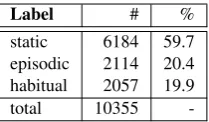
Label # %
static 6184 59.7 episodic 2114 20.4 habitual 2057 19.9
total 10355
-Table 1: Wikipedia data, distribution of labels for clausal aspect.
to automatically segment the first 70 sentences of each article into clauses. A clause is approxi-mately defined as a finite verb phrase. Each clause is then labeled asstatic,episodicorhabitual. De-tails on our annotation scheme have been given in Section 2. Annotators are allowed to skip non-finite clauses (e.g., headlines only containing a noun phrase). This happened in about 14% of all pre-segmented clauses. The final Wikipedia data consists of 10355 labeled clauses. Table 1 gives statistics for the distribution of labels.
The data set was labeled by three paid annota-tors, all students of computational linguistics. An-notators were given a written manual and a short training on documents not included in the corpus. Agreement on the Wikipedia data is 0.61 in terms of Fleiss’κ, which indicates substantial agreement (Landis and Koch, 1977). The gold standard that we use in our experiments is constructed via ma-jority voting. The gold standard contains the cases where at least two annotators agreed on the label. We found only 86 cases where all annotators dis-agree, and manual inspection shows that most of these cases are related to disagreements on the lex-ical aspectual class that coincide with an attention slip by one of the annotators.
5 Method
In this section, we describe our computational models for determining clausal aspect.
5.1 CONTEXT-BASEDfeatures
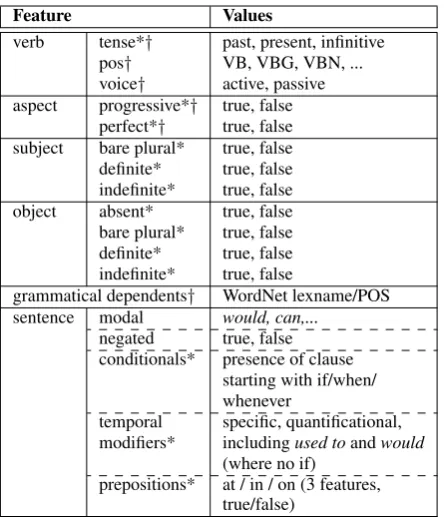
Table 2 shows the syntactic-semantic features, which we call CONTEXT-BASED as they are ex-tracted from the context of each verb occurrence that we classify. This feature set comprises the features proposed by Mathew and Katz (2009) and the ones proposed by Friedrich and Palmer (2014). In addition, we use the features modal
[image:4.595.365.470.61.122.2]pro-Feature Values
verb tense*† past, present, infinitive pos† VB, VBG, VBN, ... voice† active, passive aspect progressive*† true, false
perfect*† true, false subject bare plural* true, false definite* true, false indefinite* true, false object absent* true, false bare plural* true, false definite* true, false indefinite* true, false
grammatical dependents† WordNet lexname/POS sentence modal would, can,...
negated true, false conditionals* presence of clause
starting with if/when/ whenever
temporal specific, quantificational, modifiers* includingused toandwould
(where no if) prepositions* at / in / on (3 features,
[image:5.595.72.295.60.319.2]true/false)
Table 2: CONTEXT-BASED features. Used by: *Mathew and Katz (2009),†Friedrich and Palmer (2014).
vided by Loaiciga et al. (2014). The values of the grammatical dependents’ features are the Word-Net (Miller, 1995) lexical filename of the depen-dent’s lemma, or, if not available, the dependepen-dent’s part-of-speech tag. Quantificational adverbs are temporal modifiers such as always, occasionally
or weekly.4 Specific temporal adverbs are, ac-cording to a heuristic proposed by Mathew (2009), phrase children marked with the part-of-speech tag TMP and whose child is a prepositional phrase. Noun phrases with one of the determinersthe, this, that, these, those, each, every, all, as well as pos-sessives, pronouns, proper names and quantified phrases are definite. NPs with determinersa, an, many, most, some, and cases of modifying adjec-tives without determiners (e.g., few) or cardinal numbers (part-of-speech tag CD) are indefinite. Mathew (2009) describes their features in detail.
5.2 TYPE-BASEDfeatures
This feature set consists of the verb-type based linguistic indicator features of Siegel and McKe-own (2000). The computation of these features is based on a large parsed, but otherwise un-annotated background corpus. For each verb type (i.e., lemma), these features count how often the
4The complete list of quantificational adverbs used is
given by Mathew (2009), page 36.
Feature Example Feature Example frequency - continuous continually
present says adverb endlessly
past said evaluation better
future will say adverb horribly perfect had won manner furiously progressive is winning adverb patiently negated not/never temporal again particle up/in/... adverb finally
no subject - in-PP in an hour
[image:5.595.308.528.62.183.2]for-PP for an hour
Table 3: TYPE-BASEDfeature set (linguistic
indi-cators) and examples for lexical items associated with each indicator, following Siegel and McKe-own (2000).
verb occurs with each of the linguistic indicators as listed in Table 3. Except for the frequency fea-ture, these values are normalized by the number of occurrences of the verb type. For example, if the verb typewinoccurs 1000 times in the parsed background corpus, of which 100 times with per-fect aspect, the value of the linguistic indicator feature perfect is 0.1 for the verb type win. For any instance whose verb’s lemma is win, 0.1 will be the value of the featureperfect, in other words, all instances of the same verb type receive the same TYPE-BASED feature values. Linguis-tic indicator features have recently been applied successfully on the related task of classifying the lexical aspectual class of verbs by Friedrich and Palmer (2014), who extract the linguistic indica-tors from an automatically parsed version of the AFE and XIE parts of Gigaword. We use their database of linguistic indicator values.5
5.3 Algorithm
In order to investigate in which circumstances the task of predicting a clause’s label (habitual,
episodic or static) can be addressed jointly, or whether a pipelined approach is better, we ap-ply the following methods. Our JOINT model learns the decision boundaries for the three classes jointly, i.e., as a three-way classification task. In addition, we present a CASCADEDmodel, which uses two models learned for the two different sub-tasks: (a) identifying static clauses and (b) distin-guishing episodic and habitual clauses.
First, we train a model to distinguish thestatic
class from the other two. In this learning step, we simply map all the clauses labeled asepisodicand
5www.coli.uni-saarland.de/projects/
habitualto the classnon-staticand learn the deci-sion boundary between the two classesstaticand
non-static. Second, we train a model to distin-guish theepisodic from thehabitual class. This model is trained on the subset of examples labeled with either of these two classes.
In the CASCADED model, first, the static vs.
non-static model is applied. The CASCADED model labels all instances automatically labeled as
staticin this first step, and then applies the second model (episodic vs. habitual) on all remaining instances.
We train Random Forest classifiers (Breiman, 2001) using Weka (Hall et al., 2009) for each step and also for the JOINT model. Besides provid-ing a robust performance, Random Forest classi-fiers can easily deal with both categorical and nu-meric features. This is relevant as our CONTEXT -BASED features are categorical while the TYPE -BASEDfeatures are numeric. In our experiments, we will compare the impact of the different feature sets on each subtask and on the JOINTmodel.
5.4 Baseline: Mathew and Katz (2009)
As a baseline, we also report results for the subset of our CONTEXT-BASEDfeatures used by Mathew and Katz (2009) and call this subset MK. Mathew and Katz (2009) find a J48 decision tree and a Naive Bayes classifier to work best. We replicate their results for the decision tree in Section 6.2.
6 Experiments and discussion
This section describes our experiments. First, we reproduce the experiments of Mathew and Katz (2009), who use manually created syntactic parses, in a purely automatic setting.
The data set and experiments of Mathew and Katz (2009) focus on the episodic-habitual distinc-tion using a set of sentences selected for a small set of verbs, and their feature design focuses on syn-tactic properties of the clauses found in this an-notated data set. In the further experiments, we turn to the Wikipedia data, which contains annota-tions for full texts. We expect the Wikipedia data to cover the range of habitual and episodic expres-sions more fully, and in addition, allows for study-ing the task of separatstudy-ing static sentences from the other two classes. As we will show, this latter task profits from including features relevant to the stative-dynamic distinction on the lexical level.
We first present experimental results for the two
subtasks (described in Section 5.3). Our CAS -CADED model first identifies static clauses, and then classifies the remaining clauses as episodic or habitual. For reasons of readability, we first report on our experiments for the episodic-habitual dis-tinction using both the M&K and Wikipedia data sets. Using the Wikipedia data, we then report on the results for the static vs. non-static distinction. Finally, we turn to the full task of the three-ways distinction.
6.1 Experimental setting
We report results for 10-fold cross validation (CV) with two different settings: In the RANDOM CV setting, we randomly distribute the instances over the folds, putting all instances of one document into the same fold. In the UNSEEN VERBS CV setting, we simulate the case of not having labeled training data for a particular verb type by putting all instances of one verb type into the same fold.
We compute the information retrieval statistics of precision (P), recall (R) and F1-measure per class, where F1 is the harmonic mean of P and R, F1 = 2∗P∗R
P+R . Macro-average P is computed as the (unweighted) average of the P scores of the classes, and macro-average R is computed like-wise. Macro-average F1 is the harmonic mean of macro-average P and macro-average R. We use McNemar’s test withp < 0.01to compute statis-tical signficance of differences in accuracies. In our tables, we indicate that two results differ sig-nificantly by marking them with the same symbols (we only show this when scores are close).
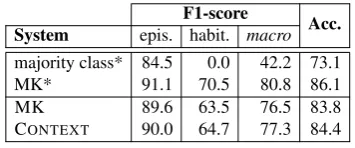
6.2 M&K data: episodic vs. habitual
other feature sets or combinations thereof (the ta-ble shows the results for our CONTEXT-based fea-ture set); the M&K feafea-ture set designed for this corpus captures its variation well.
We have used a J48 decision tree in this section for comparability with previous work. In all fol-lowing sections, we present results using Random Forest classifiers as described in Section 5.3.
F1-score Acc. System epis. habit. macro majority class* 84.5 0.0 42.2 73.1
MK* 91.1 70.5 80.8 86.1
MK 89.6 63.5 76.5 83.8
[image:7.595.307.529.61.167.2]CONTEXT 90.0 64.7 77.3 84.4
Table 4: Results for episodic vs. habitual, J48 decision tree, data from Mathew and Katz (2009). *Numbers from original paper.
6.3 Wikipedia: episodic vs. habitual
We study the classification task of distinguishing
episodicandhabitualsentences using the subset of the Wikipedia data having one of these two la-bels (4171 instances). This task parallels the ex-periment of Mathew and Katz (2009) described above. We conduct two experiments, once using the RANDOMCV setting and once using the UN -SEEN VERBS setting. Table 5 shows the results. The distribution of instances is nearly 50:50 in the gold standard (see Section 4, Table 1), and the ma-jority classes in the respective training folds differ (this is the reason for the different baseline scores). For reasons of space we do not show the other scores here; macro-average F1-scores have (al-most) the same values as accuracy, the F1-scores for episodic and habitual are similar to each other in each case.
Our findings are as follows: TYPE-BASED features outperform the majority class baseline,
Features RANDOMCV UNSEEN VERBS
majority class 42.1 46.3
lemma 65.4 46.3
TYPE 68.1 53.9
MK 82.3 ‡81.4
CONTEXT *†82.8 ‡83.8
+ lemma *84.3
CONTEXT+ TYPE †85.1 83.1
+ lemma 84.0
Table 5:Wikipedia:Accuracyofepisodicvs ha-bitual, 4171 instances, 10-fold cross validation, *†‡differences statistically significant.
RANDOMCV UNSEEN VERBS Features F1 Acc. F1 Acc. majority class 37.4 59.7 37.4 59.7‡
MK 67.5 *69.5 59.2 62.7‡
CONTEXT 70.3 *71.7 62.8 64.9‡
+ lemma 81.9 †82.8
TYPE 78.8 79.3 72.2 73.2‡
CONTEXT+ TYPE 83.6 †84.1 78.4 79.2‡
[image:7.595.92.270.178.252.2]+ lemma 83.8 84.4
Table 6: Wikipedia: static vs non-static. All 10355 instances, 10-fold cross validation.*†‡ dif-ferences statistically significant.
which means that some verbs have a preference for being used as either episodic or habitual. The CONTEXT-BASEDfeatures work remarkably well. If training data of the same verb type is available, adding the TYPE-BASEDfeatures or the lemma to the CONTEXT-BASEDfeatures results in improve-ments; this is not the case in the UNSEEN VERBS setting. The latter setting shows that the additional contextual features (compared to the MK subset) are important: our corpus indeed covers a broader range of phenomena than the M&K data set.
6.4 Wikipedia: static vs. non-static
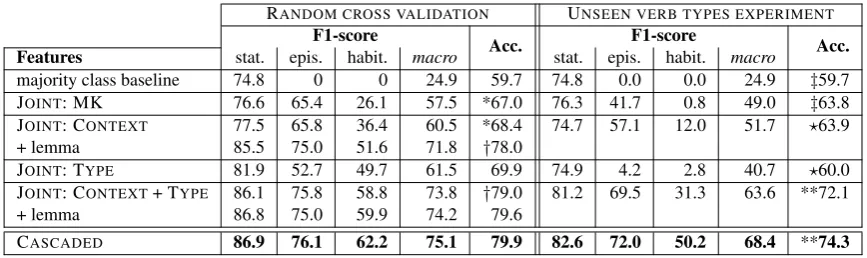
[image:7.595.76.287.610.716.2]RANDOM CROSS VALIDATION UNSEEN VERB TYPES EXPERIMENT F1-score Acc. F1-score Acc. Features stat. epis. habit. macro stat. epis. habit. macro
majority class baseline 74.8 0 0 24.9 59.7 74.8 0.0 0.0 24.9 ‡59.7
JOINT: MK 76.6 65.4 26.1 57.5 *67.0 76.3 41.7 0.8 49.0 ‡63.8
JOINT: CONTEXT 77.5 65.8 36.4 60.5 *68.4 74.7 57.1 12.0 51.7 ?63.9
+ lemma 85.5 75.0 51.6 71.8 †78.0
JOINT: TYPE 81.9 52.7 49.7 61.5 69.9 74.9 4.2 2.8 40.7 ?60.0
JOINT: CONTEXT+ TYPE 86.1 75.8 58.8 73.8 †79.0 81.2 69.5 31.3 63.6 **72.1
+ lemma 86.8 75.0 59.9 74.2 79.6
[image:8.595.82.516.61.190.2]CASCADED 86.9 76.1 62.2 75.1 79.9 82.6 72.0 50.2 68.4 **74.3
Table 7: Wikipedia: static vs. episodicvs. habitual. 10355 instances, 10-fold cross validation. The CASCADED model uses the best models from Table 6 and Table 5. *† ‡?** differences statistically significant.
It is worth noting that even for verbs not seen in the training data, high accuracies and F1-scores of almost 80% can be reached.
6.5 Wikipedia: combined task
In this section, we describe our experiments for the three-way classification task ofstatic,episodic
andhabitualclauses, as in a realistic classification setting, a clause may belong to either of thesethree
classes. We investigate whether a pipelined CAS -CADED approach is better, or whether the JOINT model profits from learning the decision bound-aries between all three classes jointly. The results for this task are presented in Table 7. Both the CONTEXT-BASED and the TYPE-BASED features when used alone improve over the majority class baseline by about 10% in accuracy in the RAN -DOMCV setting, and only by about 4% in the UN -SEEN VERBS setting. In the latter setting, all fea-ture sets when used alone are ineffective for identi-fying habituals. This indicates that the CONTEXT -BASEDfeatures only ‘pick up’ on some type-based information in the RANDOM CV case. The best models for this JOINTclassification task use both the CONTEXT-BASEDand the TYPE-BASED fea-ture sets: F1-scores and accuracy increase remark-ably. Again, in the RANDOM CV setting, using the lemma results in a large performance gain, though using the TYPE-BASEDfeatures is benefi-cial, and, in the UNSEEN VERBSsetting, essential. We apply the CASCADEDmodel as described in Section 5.3, training and testing the models for the subtasks in each fold. In the RANDOM CV set-ting, the accuracy of the CASCADEDapproach is not significantly better than the one of the JOINT approach, though F1-scores for the less frequent
episodic and habitual classes both increase. In
the UNSEEN VERBS setting, however, the differ-ence is remarkable: macro-average F1-score creases by almost 5% (absolute) and accuracy in-creases by 2.2%. Most notably, the F1-score for the habitual class increases from 0.31 to 0.50 (due to an increase in recall). To conclude, the CAS -CADEDapproach is favorable as it works more ro-bustly both for verb types seen or unseen in the training data.
6.6 Feature ablation
In the above sections, we have compared the two major feature groups of CONTEXT-BASED and TYPE-BASEDfeatures. In addition, we ablate each single feature from the best results for each exper-iment. For all classification tasks, we found fea-tures reflecting tense and grammatical aspect to be most important, both for the CONTEXT-BASED and TYPE-BASEDfeatures. In general, we observe that no single feature has a big impact on the re-sults, accuracy drops only by at most 1-2%. This shows that our feature set is quite robust and some of the features (e.g., part-of-speech tag of the verb and tense) reflect partially redundant information. However, using only the best features results in a significant performance drop by several percent-age points in the various settings, which means that though single features may not have a large impact, overall, the models for this classification task profit from including many diverse features.
are important, including those indicating how of-ten the verb type occurs withadverbs of manner,
negation and in-PPs in the background corpus. For the combined three-way task, we found the main verb’s lemma and the direct object to have most impact. Of the TYPE-BASED features, the
for-PP,presentandtemporal adverbialwere most important. In the UNSEEN VERBS setting, many linguistic indicator features (among others past,
progressive,negation) play a greater role, as well as information about the object, subject and tense.
7 Conclusion
In this paper, we have presented an approach for classifying the aspect of a clause as habitual,
episodic or static. Clearly, when exhaustively classifying all clauses of a text, the static class cannot be ignored; we have shown that we can sep-arate these instances from episodic and habitual instances, most of which are lexically dynamic, with high accuracy. Our model for distinguishing episodic and habitual sentences integrates a wide range of contextual information and outperforms previous work. Previous work has only addressed the classification of lexical aspectual class and the automatic distinction of episodic and habitual sen-tences. Our work is the first bringing together two strands of work relevant to classifying clausal as-pect, and we have shown that sources of informa-tion relevant to these two underlying aspectual dis-tinctions are relevant for our three-way classifica-tion task.
We have shown that for distinguishing static sentences from the other two, TYPE-BASED
and CONTEXT-BASED information is needed; for distinguishing episodic and habitual clauses, CONTEXT-BASED features are most important. Our experimental results show that the three-way classification task is most effectively approached by combining both contextual and verb-type based information. Especially for verbs unseen in the training data, we found the CASCADEDapproach to work better. It is hard for the JOINTapproach to identify habitual clauses; while in the CASCADED approach, performance for both steps is high and adds up.
We found the overall performance of this task to be about 80% accuracy, and 75% macro-average F1-score. These scores suggest that this method may be usable as a preprocessing step for further temporal processing.
8 Future work
Our models do not yet take discourse information into account. Consider example (14) by Mathew and Katz (2009): The second sentence is habitual, but the only indicator for this is sentence-external.
(14) John rarely ate fruit. He just ate oranges. (habitual)
In some preliminary experiments, we tried to leverage the discourse context of a clause for its classification by means of incorporating the gold standard label of the previous clause as a feature. This did not result in significant performance im-provements. However, further experiments trying to incorporate discourse information are due, and, due to our new corpus of fully annotated texts, now possible.
Another related research direction is the clas-sification of the different types of static clauses, e.g., the different senses of modality (Ruppenhofer and Rehbein, 2012). As mentioned before, a finer classification of the temporal structure of clauses is needed, among others identifying the lexical as-pectual class as well asviewpoint aspectas perfec-tivevs.imperfective(Smith, 1997).
Finally, the next steps in this line of research are to integrate the aspectual information attributed to clauses by our model into models of temporal dis-course structure, which in turn are useful for infor-mation extraction and text understanding tasks in general. Costa and Branco (2012) are the first to show that aspectual information is relevant here; we hope to show in the future that temporal pro-cessing profits from integrating more fine-grained aspectual information.
Acknowledgments
References
Leo Breiman. 2001. Random forests. Machine learn-ing, 45(1):5–32.
Greg Carlson, 2005. The Encyclopedia of Language and Linguistics, chapter Generics, Habituals and It-eratives. Elsevier.
Francisco Costa and Ant´onio Branco. 2012. Aspec-tual type and temporal relation classification. In Proceedings of the 13th Conference of the European Chapter of the Association for Computational Lin-guistics, pages 266–275. Association for Computa-tional Linguistics.
¨Osten Dahl. 1985. Tense and aspect systems. Oxford, Blackwell.
¨Osten Dahl. 1995. The marking of the generic/episodic distinction in tense-aspect systems. The generic book, pages 412–425.
Annemarie Friedrich and Alexis Palmer. 2014. Auto-matic prediction of aspectual class of verbs in con-text. In Proceedings of the 52nd Annual Meet-ing of the Association for Computational LMeet-inguistics (ACL). Baltimore, USA.
Andrew Garrett. 1998. On the origin of auxiliary do. English Language and Linguistics, 2(02):283–330. Valentine Hacquard. 2009. On the interaction of aspect
and modal auxiliaries. Linguistics and Philosophy, 32(3):279–315.
Mark Hall, Eibe Frank, Geoffrey Holmes, Bernhard Pfahringer, Peter Reutemann, and Ian H. Witten. 2009. The WEKA data mining software: an update. ACM SIGKDD explorations newsletter, 11(1):10– 18.
Graham Katz. 2003. On the stativity of the English perfect. Perfect explorations, pages 205–234. Dan Klein and Christopher D Manning. 2002. Fast
ex-act inference with a fex-actored model for natural lan-guage parsing. InAdvances in neural information processing systems, pages 3–10.
Manfred Krifka, Carlson Gregory N Pelletier, Fran-cis Jeffry, Alice ter Meulen, Gennaro Chierchia, and Godehard Link. 1995. Genericity: An introduction. The generic book, pages 1–124.
J Richard Landis and Gary G Koch. 1977. The mea-surement of observer agreement for categorical data. biometrics, pages 159–174.
Hector Llorens, Nathanael Chambers, Naushad Uz-Zaman, Nasrin Mostafazadeh, James Allen, and James Pustejovsky. 2015. SemEval-2015 Task 5: QA TEMPEVAL - Evaluating Temporal Informa-tion Understanding with QuesInforma-tion Answering. In 9th International Workshop on Semantic Evaluation (SemEval 2015), pages 46–54, Denver, Colorado.
Sharid Loaiciga, Thomas Meyer, and Andrei Popescu-Belis. 2014. English-French Verb Phrase Align-ment in Europarl. InProceedings of LREC 2014. Mitchell P Marcus, Mary Ann Marcinkiewicz, and
Beatrice Santorini. 1993. Building a large anno-tated corpus of english: The penn treebank. Compu-tational linguistics, 19(2):313–330.
Thomas A. Mathew and Graham E. Katz. 2009. Su-pervised categorization for habitual versus episodic sentences. In Sixth Midwest Computational Lin-gustics Colloquium, Bloomington, Indiana. Indiana University.
Thomas A. Mathew. 2009. Supervised categorization for habitual versus episodic sentences. Master’s the-sis, Faculty of the Graduate School of Arts and Sci-ences of Georgetown University.
Paula Men´endez-Benito. 2012. On dispositional sen-tences. Genericity, 43:276.
George A Miller. 1995. Wordnet: a lexical database for english. Communications of the ACM, 38(11):39–41.
Josef Ruppenhofer and Ines Rehbein. 2012. Yes we can!? annotating the senses of english modal verbs. InProceedings of the 8th International Conference on Language Resources and Evaluation (LREC), pages 24–26.
Eric V Siegel and Kathleen R McKeown. 2000. Learning methods to combine linguistic indica-tors: Improving aspectual classification and reveal-ing lreveal-inguistic insights. Computational Linguistics, 26(4):595–628.
Carlota S. Smith. 1997. The Parameter of Aspect, volume 43 ofStudies in Linguistics and Philosophy. Springer.
Ian Soboroff and Donna Harman. 2005. Nov-elty detection: The trec experience. In Proceed-ings of Human Language Technology Conference and Conference on Empirical Methods in Natural Language Processing, pages 105–112, Vancouver, British Columbia, Canada, October. Association for Computational Linguistics.
Radu Soricut and Daniel Marcu. 2003. Sentence level discourse parsing using syntactic and lexical infor-mation. In Proceedings of the 2003 Conference of the North American Chapter of the Association for Computational Linguistics on Human Language Technology-Volume 1, pages 149–156. Association for Computational Linguistics.
Benjamin D Van Durme. 2010. Extracting implicit knowledge from text. Ph.D. thesis, University of Rochester.
Jennifer Williams and Graham Katz. 2012. Extracting and modeling durations for habits and events from twitter. In Proceedings of the 50th Annual Meet-ing of the Association for Computational LMeet-inguis- Linguis-tics: Short Papers - Volume 2, ACL ’12, pages 223– 227, Stroudsburg, PA, USA. Association for Com-putational Linguistics.
Jennifer Williams. 2012. Extracting fine-grained dura-tions for verbs from twitter. InProceedings of ACL 2012 Student Research Workshop, pages 49–54. As-sociation for Computational Linguistics.
Nianwen Xue and Yuchen Zhang. 2014. Buy one get one free: Distant annotation of chinese tense, event type, and modality. Proceedings of LREC-2014, Reykjavik, Iceland.