Semantic Kernels for Semantic Parsing
Iman Saleh
Faculty of Computers and Information Cairo University
Alessandro Moschitti, Preslav Nakov, Llu´ıs M`arquez, Shafiq Joty
ALT Research Group
Qatar Computing Research Institute
{amoschitti,pnakov,lmarquez,sjoty}@qf.org.qa
Abstract
We present an empirical study on the use of semantic information for Concept Seg-mentation and Labeling (CSL), which is an important step for semantic parsing. We represent the alternative analyses out-put by a state-of-the-art CSL parser with tree structures, which we rerank with a classifier trained on two types of seman-tic tree kernels: one processing structures built with words, concepts and Brown clusters, and another one using semantic similarity among the words composing the structure. The results on a corpus from the restaurant domain show that our semantic kernels exploiting similarity measures out-perform state-of-the-art rerankers.
1 Introduction
Spoken Language Understanding aims to inter-pret user utterances and to convert them to logical forms or, equivalently, to database queries, which can then be used to satisfy the user’s information needs. This process is known as Concept Segmen-tation and Labeling (CSL), also called semantic parsing in the speech community: it maps utter-ances into meaning representations based on se-mantic constituents. The latter are basically word sequences, often referred to as concepts, attributes or semantic tags. CSL makes it easy to convert spoken questions such as “cheap lebanese restau-rants in doha with take out” into database queries. First, a language-specific semantic parser tok-enizes, segments and labels the question:
[Pricecheap] [Cuisinelebanese] [Otherrestaurants in]
[Citydoha] [Otherwith] [Amenitytake out]
Then, label-specific normalizers are applied to the segments, with the option to possibly relabel mislabeled segments:
[Price low] [Cuisine lebanese] [City doha] [Amenity
carry out]
Finally, a database query is formed from the list of labels and values, and is then executed against the database, e.g., MongoDB; a backoff mecha-nism may be used if the query has not succeeded. {$and [{cuisine:"lebanese"},{city:"doha"},
{price:"low"},{amenity:"carry out"}]} The state-of-the-art of CSL is represented by conditional models for sequence labeling such as Conditional Random Fields (CRFs) (Lafferty et al., 2001) trained with simple morphological and lexical features. The basic CRF model was im-proved by means of reranking (Moschitti et al., 2006; Dinarelli et al., 2012) using structural ker-nels (Moschitti, 2006). Although these meth-ods exploited sentence structure, they did not use syntax at all. More recently, we applied shal-low syntactic structures and discourse parsing with slightly better results (Saleh et al., 2014). How-ever, the most obvious models for semantic pars-ing, i.e., rerankers based on semantic structural kernels (Bloehdorn and Moschitti, 2007b), had not been applied to semantic structures yet.
In this paper, we study the impact of semantic information conveyed by Brown Clusters (BCs) (Brown et al., 1992) and semantic similarity, while also combining them with innovative features. We use reranking, similarly to (Saleh et al., 2014), to select the best hypothesis annotated with con-cepts predicted by a local model. The competing hypotheses are represented as innovative trees en-riched with the semantic concepts and BC labels. The trees can capture dependencies between sen-tence constituents, concepts and BCs. However, extracting explicit features from them is rather difficult as their number is exponentially large. Thus, we rely on (i) Support Vector Machines (Joachims, 1999) to train the reranking functions and on (ii) structural kernels (Moschitti, 2010; Moschitti, 2012; Moschitti, 2013) to automatically encode tree fragments that represent syntactic and semantic dependencies from words and concepts.
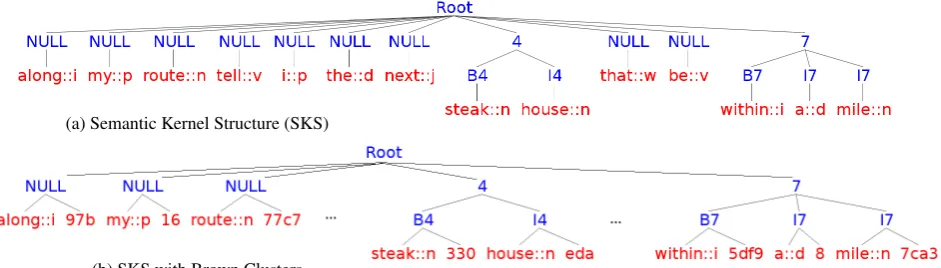
(a) Semantic Kernel Structure (SKS)
[image:2.595.64.535.65.199.2](b) SKS with Brown Clusters
Figure 1: CSL structures: standard and with Brown Clusters.
We further apply a semantic kernel (SK), namely the Smoothed Partial Tree Kernel (Croce et al., 2011), which uses the lexical similarity be-tween the tree nodes, while computing the sub-structure space. This is the first time that SKs are applied to reranking hypotheses. This (i) makes the global sentence structure along with concepts available to the learning algorithm, and (ii) enables computing the similarity between lexicals in syn-tactic patterns that are enriched by concepts.
We tested our models on the Restaurant do-main. Our results show that: (i) The basic CRF parser, which uses Markov CRF, or semi-CRF (Sarawagi and Cohen, 2004), is already very accurate; it achieves F1 scores over 83%,
mak-ing any further improvement very hard. (ii) The upper-bound performance of the reranker is very high as well, i.e., the correct annotation is gen-erated in the list of the first 100 hypotheses in 98.72% of the cases. (iii) SKs significantly im-prove over the semi-CRF baseline and our pre-vious state-of-the-art reranker exploiting shallow syntactic patterns (Saleh et al., 2014), as shown by extensive comparisons using several systems. (iv) Making BCs effective requires a deeper study.
2 Related Work
One of the early approaches to CSL was that of Pieraccini et al. (1991), where the word se-quences and concepts were modeled using Hid-den Markov Models (HMMs) as observations and hidden states, respectively. Generative models were exploited by Seneff (1989) and Miller et al. (1994), who used stochastic grammars for CSL. Other discriminative models followed such preliminary work, e.g., (Rubinstein and Hastie, 1997; Santaf´e et al., 2007; Raymond and Riccardi, 2007). CRF-based models are considered to be the state of the art in CSL (De Mori et al., 2008).
Another relevant line of research are the seman-tic kernels, i.e., kernels that use lexical similarity between features. One of the first that applyed LSA was (Cristianini et al., 2002), whereas (Bloe-hdorn et al., 2006; Basili et al., 2006) used Word-Net. Semantic structural kernels of the type we use in this paper were first introduced in (Bloe-hdorn and Moschitti, 2007a; Bloe(Bloe-hdorn and Mos-chitti, 2007b). The most advanced model based on tree kernels, which we also use in this paper, is the Smoothed PTK (Croce et al., 2011).
3 Reranking for CSL
Reranking is applied to a list ofN annotation hy-potheses, which are generated and sorted by the probability to be globally correct as estimated us-ing local classifiers or global classifiers that only use local features. Then, a reranker, typically a meta-classifier, tries to select the best hypothe-sis from the list. The reranker can exploit global information, and specifically, the dependencies between the different concepts, which are made available by the local model. We use semi-CRFs for the local model as they yield the highest ac-curacy in CSL (when using a single model) and preference reranking for the global reranker.
3.1 Preference Reranking (PR)
PR uses a classifier C, which takes a pair of hy-potheseshHi, Hjiand decides whetherHiis
bet-ter than Hj. Given a training question Q,
posi-tive and negaposi-tive examples are built for training the classifier. Let H1 be the hypothesis with the
lowest error rate with respect to the gold standard among all hypotheses generated for question Q. We adopt the following approach for example gen-eration: the pairshH1, Hii(i = 2,3, . . . , N) are
positive examples, whilehHi, H1iare considered
At testing time, given a new question Q0,C clas-sifies all pairshHi, Hjigenerated from the
anno-tation hypotheses of Q0: a positive classification is a vote forHi, otherwise the vote is forHj, where
the classifier score can be used as a weighted vote.
Hkare then ranked according to the number (sum)
of the votes (weighted by score) they receive. We build our reranker with SVMs using the following kernel: K(hH1, H2i,hH10, H20i) =
φ(hH1, H2i) · φ(hH10, H20i) , φ(H1) −
φ(H2) · φ(H10) −φ(H20)
= φ(H1)φ(H10) + φ(H2)φ(H20) −φ(H1)φ(H20)− φ(H2)φ(H10) =
S(H1, H10) + S(H2, H20) − S(H1, H20) −
S(H2, H10). We considerHas a tuplehT,~vi
com-posed of a treeT and a feature vector~v. Then, we defineS(H, H0) =S
TK(T, T0) +Sv(~v,~v0), where
STK computes one of the tree kernel functions
defined in 3.2 and 3.3; andSvis a kernel (see 3.4),
e.g., linear, polynomial, Gaussian, etc.
3.2 Tree kernels (TKs)
TKs measure the similarity between two structures in terms of the number of substructures they share. We use two types of tree kernels: (i) Partial Tree Kernel (PTK), which can be effectively applied to both constituency and dependency parse trees (Moschitti, 2006). It generates all possible con-nected tree fragments, e.g., sibling nodes can be also separated and can be part of different tree fragments: a fragment is any possible tree path, and other tree paths are allowed to depart from its nodes. Thus, it can generate a very rich feature space. (ii) The smoothed PTK or semantic kernel (SK) (Croce et al., 2011), which extends PTK by allowing soft matching (i.e., via similarity compu-tation) between nodes associated with different but related lexical items. The node similarity can be derived from manually annotated resources, e.g., WordNet or Wikipedia, as well as using corpus-based clustering approaches, e.g., latent semantic analysis (LSA), as we do in this paper.
3.3 Semantic structures
Tree kernels allow us to compute structural simi-larities between two trees; thus, we engineered a special structure for the CSL task. In order to cap-ture the structural dependencies between the se-mantic tags,1 we use a basic tree (see for
exam-ple Figure 1a), where the words of a sentence are tagged with their semantic tags.
1They are associated with the following IDs: 0-Other,
1-Rating, 2-Restaurant, 3-Amenity, 4-Cuisine, 5-Dish, 6-Hours, 7-Location, and 8-Price.
More specifically, the words in the sentence constitute the leaves of the tree, which are in turn connected to the pre-terminals containing the semantic tags in BIO notation (‘B’=begin, ‘I’=inside, ‘O’=outside). The BIO tags are then generalized in the upper level, and joined to the Root node. Additionally, part-of-speech (POS) tags2 are added to each word by concatenating
it with the string “::L”, where L is the first let-ter of the POS-tags of the words, e.g.,along, my
androute, receive i, p and n, which are the first letters of the POS-tags IN, PRN and NN, respec-tively. SK applied to the above structure can gen-erate powerful semantic patterns such as [Root [4-Cuisine [similar to(stake house)]][7-Loc [simi-lar to(within a mile)]]], e.g., for correctly labeling new clauses likePizza Parlor in three kilometers. The BC labels, represented as cluster IDs, are sim-ply added as siblings of words as shown in Fig. 1b.
3.4 Feature Vectors
For the sake of comparison, we also devoted some effort towards engineering a set of features to be used in a flat feature-vector representation. These features can be used in isolation to learn the reranking function, or in combination with the kernel-based approach (as a composite kernel us-ing a linear combination). They belong to the fol-lowing four categories: (i) CRF-based: these in-clude the basic features used to train the initial semi-CRF model; (ii)n-gram based: we collected 3- and 4-grams of the output label sequence at the level of concepts, with artificial tags inserted to identify the start (‘S’) and end (‘E’) of the se-quence.3 (iii) Probability-based, computing the
probability of the label sequence as an average of the probabilities at the word level in the N-best list; and (iv) DB-based: a single feature encoding the number of results returned from the database when constructing a query using the conjunction of all semantic segments in the hypothesis.
4 Experiments
The experiments aim at investigating the role of feature vectors, PTK, SK and BCs in reranking. We first describe the experimental setting and then we move into the analysis of the results.
2We use the Stanford tagger (Toutanova et al., 2003). 3For instance, if the output sequence is
Train Devel. Test Total
semi-CRF 6,922 739 1,521 9,182 Reranker 7,000 3,695 7,605 39,782
Table 1: Number of instances and pairs used to train the semi-CRF and rerankers, respectively.
4.1 Experimental setup
Dataset. In our experiments, we used questions
annotated with semantic tags, which were col-lected through crowdsourcing on Amazon Me-chanical Turk and made available4by McGraw et
al. (2012). We split the dataset into training, de-velopment and test sets. Table 1 shows the num-ber of examples and example pairs we used for the semi-CRF and the reranker, respectively. We subsequently split the training data randomly into 10 folds. We used cross-validation, i.e., iteratively training with 9 folds and annotating the remaining fold, in order to generate theN-best lists of hy-potheses for the entire training dataset. We com-puted the 100-best hypotheses for each example. We then used the development dataset to test and tune the hyper-parameters of our reranking model. The results on the development set, which we will present in Section 4.2 below, were obtained us-ing semi-CRF and rerankus-ing models trained on the training set.
Data representation. Each hypothesis is
repre-sented by a semantic tree, a feature vector (ex-plained in Section 3), and two extra features: (i) the semi-CRF probability of the hypothesis, and (ii) its reciprocal rank in theN-best list.
Learning algorithm. We used the
SVM-Light-TK5 to train the reranker with a combination of
tree kernels and feature vectors (Moschitti, 2006; Joachims, 1999). We used the default parameters and a linear kernel for the feature vectors. As a baseline, we picked the best-scoring hypothesis in the list, i.e., the output by the regular semi-CRF parser. The setting is exactly the same as that de-scribed in (Saleh et al., 2014).
Evaluation measure.In all experiments, we used
the harmonic mean of precision and recall (F1)
(van Rijsbergen, 1979), computed at the token level and micro-averaged across the different se-mantic types.6
4http://groups.csail.mit.edu/sls/downloads/restaurant/ 5http://disi.unitn.it/moschitti/Tree-Kernel.htm
6We do not consider ‘Other’ to be a semantic type; thus,
we did not include it in the F1calculation.
N 1 2 5 10 100
[image:4.595.87.274.63.94.2]F1 83.03 87.76 92.63 95.23 98.72
Table 2: Oracle F1score forN-best lists.
Brown Clusters. Clustering groups of similar
words together provides a way of generalizing them. In this work, we explore the use of Brown clusters (Brown et al., 1992) in both feature vec-tors and tree kernels. The Brown clustering al-gorithm uses an n-gram class model. It first as-signs each word to a distinct cluster, and then it merges different clusters in a bottom-up fashion. The merge step is done in a way that minimizes the loss in average mutual information between clus-ters. The outcome is hierarchical clustering, which we use in our reranking algorithm. To create the Brown clusters, we used the Yelp dataset of re-views.7 It contains 335,022 reviews about 15,585
businesses; 5,575 of the businesses and 233,839 of the reviews are restaurant-related. This dataset is very similar to the dataset of queries about restau-rants we use in our experiments.
Similarity matrix for SK.We compute the
lexi-cal similarity for SK by applying LSA (Furnas et al., 1988) to Tripadvisor data. The dataset and the exact procedure for creating the LSA matrix are described in (Castellucci et al., 2013; Croce and Previtali, 2010).
4.2 Results
Oracle accuracy. Table 2 shows the oracle F1
score forN-best lists of different lengths, i.e., the F1 that is achieved by picking the best candidate
in the N-best list for various values ofN. Con-sidering 5-best lists yields an increase in oracle F1
of almost ten absolute points. Going up to 10-best lists only adds 2.5 extra F1 points. The complete
100-best lists add 3.5 extra F1 points, for a total
of 98.72. This very high value is explained by the fact that often the total number of different anno-tations for a given question is smaller than 100. In our experiments, we will focus on 5-best lists.
Baseline accuracy.We computed F1for the
semi-CRF model on both the development and the test sets, obtaining 83.86 and 83.03, respectively.
Learning Curves. The semantic information in
terms of BCs or semantic similarity derived by LSA can have a major impact in case of data scarcity. Therefore, we trained our reranking mod-els with increasing sizes of training data.
Development set
79 80 81 82 83 84 85 86
0 1000 2000 3000 4000 5000 6000 7000
F1
-‐m
ea
su
re
Training data size
PTK SK
PTK+BC PTK+all
PTK+BC+all Baseline
79 80 81 82 83 84 85 86
0 1000 2000 3000 4000 5000 6000 7000
F1
-‐m
ea
su
re
Training data size
PTK SK SK+BC PTK+all SK+all SK+BC+all Baseline
Test set
74 76 78 80 82 84 86
0 1000 2000 3000 4000 5000 6000 7000
F1
-‐m
ea
su
re
Training data size
PTK SK PTK+BC PTK+all PTK+BC+all Baseline
79 80 81 82 83 84 85
0 1000 2000 3000 4000 5000 6000 7000
F1
-‐m
ea
su
re
Training data size
PTK SK
[image:5.595.59.536.69.372.2]SK+BC PTK+all SK+all SK+BC+all Baseline
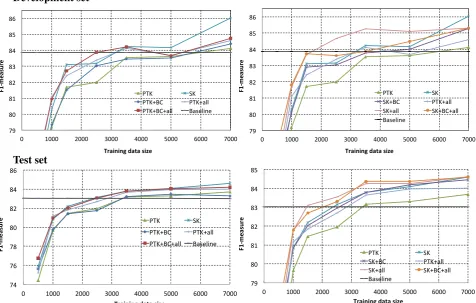
Figure 2: Learning curves for different reranking models on the development and on the testing sets.
The first two graphs in Fig. 2 show the plots on the development set whereas the last two are computed on the test set. The reranking models reported are Baseline, PTK, PTK+BC, PTK+all (features), PTK+BC+all, SK, SK+BC, SK+all and SK+BC+all.8 We can see that: (i) PTK alone, i.e.,
without semantic information, has the lowest ac-curacy; (ii) BCs do not improve significantly any model; (iii) SK almost always achieves the high-est accuracy; (iv) PTK+all (i.e., the model also us-ing features) improves on PTK, but its accuracy is lower than for any model using SK, i.e., us-ing semantic similarity; and (v) all features pro-vide an initial boost to SK, but as soon as the data increases, their impact decreases.
5 Conclusion and Future Work
In summary, the learning curves clearly show the good generalization ability of SK, which improve the CRF baseline using little data (∼3,000). The semantic kernel significantly improves over the semi-CRF baseline and our previous state-of-the-art reranker exploiting shallow syntactic patterns (Saleh et al., 2014), which corresponds to PTK+all in the above comparison.
8Models are split between 2 plots in order to ease reading.
The improvement falls between 1-2 absolute percent points. This is remarkable as (i) it corre-sponds to ∼10% relative error reduction, and (ii) the state-of-the-art baseline system is very difficult to beat, as confirmed by the low impact of tradi-tional features and BCs. Although the latter can generalize over concepts and words, their use is not straightforward, resulting in no improvement.
In the future, we plan to investigate the use of semantic similarity from distributional and other sources (Mihalcea et al., 2006; Pad´o and Lapata, 2007), e.g., Wikipedia (Strube and Ponzetto, 2006; Mihalcea and Csomai, 2007), Wiktionary (Zesch et al., 2008), WordNet (Pedersen et al., 2004; Agirre et al., 2009), FrameNet, VerbNet (Shi and Mihalcea, 2005), BabelNet (Navigli and Ponzetto, 2010), and LSA, and for different domains.
Acknowledgments
References
Eneko Agirre, Enrique Alfonseca, Keith Hall, Jana Kravalova, Marius Pasca, and Aitor Soroa. 2009. A study on similarity and relatedness using distribu-tional and wordnet-based approaches. In Proceed-ings of Human Language Technologies: The 2009 Annual Conference of the North American Chap-ter of the Association for Computational Linguistics, pages 19–27, Boulder, Colorado, June.
Roberto Basili, Marco Cammisa, and Alessandro Mos-chitti. 2006. A semantic kernel to classify texts with very few training examples. Informatica (Slovenia), 30(2):163–172.
Stephan Bloehdorn and Alessandro Moschitti. 2007a. Combined syntactic and semantic kernels for text classification. InAdvances in Information Retrieval - Proceedings of the 29th European Conference on Information Retrieval (ECIR 2007), pages 307–318, Rome, Italy.
Stephan Bloehdorn and Alessandro Moschitti. 2007b. Structure and semantics for expressive text kernels. In Proceedings of the 16th ACM Conference on Information and Knowledge Management (CIKM 2007), pages 861–864, Lisbon, Portugal.
Stephan Bloehdorn, Roberto Basili, Marco Cammisa, and Alessandro Moschitti. 2006. Semantic kernels for text classification based on topological measures of feature similarity. InProceedings of the 6th IEEE International Conference on Data Mining (ICDM 06), pages 808–812, Hong Kong.
Peter F. Brown, Peter V. deSouza, Robert L. Mer-cer, Vincent J. Della Pietra, and Jenifer C. Lai. 1992. Class-based n-gram models of natural lan-guage. Computational Linguistics, 18(4):467–479. Giuseppe Castellucci, Simone Filice, Danilo Croce,
and Roberto Basili. 2013. UNITOR: Combining Syntactic and Semantic Kernels for Twitter Senti-ment Analysis. InSecond Joint Conference on Lex-ical and Computational Semantics (*SEM), Volume 2: Proceedings of the Seventh International Work-shop on Semantic Evaluation (SemEval 2013), pages 369–374, Atlanta, Georgia, USA.
Nello Cristianini, John Shawe-Taylor, and Huma Lodhi. 2002. Latent Semantic Kernels. Journal of Intelligent Information Systems, 18(2):127–152. Danilo Croce and Daniele Previtali. 2010.
Mani-fold learning for the semi-supervised induction of framenet predicates: An empirical investigation. In Proceedings of the 2010 Workshop on GEometrical Models of Natural Language Semantics, pages 7–16, Uppsala, Sweden.
Danilo Croce, Alessandro Moschitti, and Roberto Basili. 2011. Structured lexical similarity via con-volution kernels on dependency trees. In Proceed-ings of the 2011 Conference on Empirical Methods in Natural Language Processing, pages 1034–1046, Edinburgh, Scotland, UK.
Renato De Mori, Frederic B´echet, Dilek Hakkani-T¨ur, Michael McTear, Giuseppe Riccardi, and Gokhan Tur. 2008. Spoken Language Understanding. IEEE Signal Processing Magazine, 25:50–58.
Marco Dinarelli, Alessandro Moschitti, and Giuseppe Riccardi. 2012. Discriminative reranking for spoken language understanding. IEEE Transac-tions on Audio, Speech and Language Processing, 20(2):526–539.
G. W. Furnas, S. Deerwester, S. T. Dumais, T. K. Lan-dauer, R. A. Harshman, L. A. Streeter, and K. E. Lochbaum. 1988. Information retrieval using a sin-gular value decomposition model of latent semantic structure. InProceedings of the 11th annual inter-national ACM SIGIR conference on Research and development in information retrieval (SIGIR ’88), pages 465–480, New York, USA.
Thorsten Joachims. 1999. Making large-scale SVM learning practical. In B. Schlkopf, C. Burges, and A. Smola, editors, Advances in Kernel Methods -Support Vector Learning. MIT Press, Cambridge, MA, USA.
John D. Lafferty, Andrew McCallum, and Fernando C. N. Pereira. 2001. Conditional random fields: Probabilistic models for segmenting and labeling se-quence data. InProceedings of the Eighteenth Inter-national Conference on Machine Learning (ICML 2001), pages 282–289, Williamstown, MA, USA.
Ian McGraw, Scott Cyphers, Panupong Pasupat, Jingjing Liu, and Jim Glass. 2012. Automating crowd-supervised learning for spoken language sys-tems. InProceedings of the 13th Annual Conference of the International Speech Communication Asso-ciation (INTERSPEECH 2012), pages 2473–2476, Portland, OR, USA.
Rada Mihalcea and Andras Csomai. 2007. Wikify! linking documents to encyclopedic knowledge. In Proceedings of the sixteenth ACM conference on Conference on information and knowledge manage-ment (CIKM 2007), pages 233–242, Lisbon, Portu-gal.
Rada Mihalcea, Courtney Corley, and Carlo Strappa-rava. 2006. Corpus-based and knowledge-based measures of text semantic similarity. In Proceed-ings of the 21st National Conference on Artificial In-telligence - Volume 1 (AAAI 2006), pages 775–780, Boston, MA, USA.
Scott Miller, Richard Schwartz, Robert Bobrow, and Robert Ingria. 1994. Statistical Language Process-ing usProcess-ing Hidden UnderstandProcess-ing Models. In Pro-ceedings of the workshop on Human Language Tech-nology (HLT 1994), pages 278–282, Plainsboro, NJ, USA.
joint inference. InProceedings of the Tenth Confer-ence on Computational Natural Language Learning (CoNLL-X), pages 61–68, New York City, USA. Alessandro Moschitti. 2006. Efficient convolution
ker-nels for dependency and constituent syntactic trees. InProceedings of the 17th European Conference on Machine Learning (ECML 2006), pages 318–329, Berlin, Germany.
Alessandro Moschitti. 2010. Kernel engineering for fast and easy design of natural language ap-plications. In Coling 2010: Kernel Engineering for Fast and Easy Design of Natural Language Applications–Tutorial notes, pages 1–91, Beijing, China.
Alessandro Moschitti. 2012. State-of-the-art kernels for natural language processing. In Tutorial Ab-stracts of ACL 2012, page 2, Jeju Island, Korea. Alessandro Moschitti. 2013. Kernel-based learning to
rank with syntactic and semantic structures. In Tu-torial abstracts of the 36th Annual ACM SIGIR Con-ference, page 1128, Dublin, Ireland.
Roberto Navigli and Simone Paolo Ponzetto. 2010. Babelnet: Building a very large multilingual seman-tic network. InProceedings of the 48th annual meet-ing of the association for computational lmeet-inguistics (ACL 2010), pages 216–225, Uppsala, Sweden. Sebastian Pad´o and Mirella Lapata. 2007.
Dependency-based construction of semantic space models. Computational Linguistics, 33(2):161–199. Ted Pedersen, Siddharth Patwardhan, and Jason Miche-lizzi. 2004. Wordnet::similarity - measuring the relatedness of concepts. In HLT-NAACL 2004: Demonstration Papers, pages 38–41, Boston, Mas-sachusetts, USA.
Roberto Pieraccini, Esther Levin, and Chin-Hui Lee. 1991. Stochastic Representation of Conceptual Structure in the ATIS Task. In Proceedings of the Fourth Joint DARPA Speech and Natural Language Workshop, pages 121–124, Los Altos, CA, USA. Christian Raymond and Giuseppe Riccardi. 2007.
Generative and Discriminative Algorithms for Spo-ken Language Understanding. In Proceedings of the 8th Annual Conference of the Interna-tional Speech Communication Association (INTER-SPEECH 2007), pages 1605–1608, Antwerp, Bel-gium, August.
Y. Dan Rubinstein and Trevor Hastie. 1997. Discrimi-native vs Informative Learning. In Proceedings of the Third International Conference on Knowledge Discovery and Data Mining (KDD-1997), pages 49– 53, Newport Beach, CA, USA.
Iman Saleh, Scott Cyphers, Jim Glass, Shafiq Joty, Llu´ıs M`arquez, Alessandro Moschitti, and Preslav Nakov. 2014. A study of using syntactic and seman-tic structures for concept segmentation and labeling.
InProceedings of the 25th International Conference on Computational Linguistics, COLING ’14, pages 193–202, Dublin, Ireland.
G. Santaf´e, J.A. Lozano, and P. Larra˜naga. 2007. Discriminative vs. Generative Learning of Bayesian Network Classifiers. InProceedings of the 9th Euro-pean Conference on Symbolic and Quantitative Ap-proaches to Reasoning with Uncertainty (ECSQARU 2007), pages 453–546, Hammamet, Tunisia. Sunita Sarawagi and William W. Cohen. 2004.
Semi-markov conditional random fields for information extraction. InAdvances in Neural Information Pro-cessing Systems 17 (NIPS 2004), Vancouver, British Columbia, Canada.
Stephanie Seneff. 1989. TINA: A Probabilistic Syn-tactic Parser for Speech Understanding Systems. In Proceedings of the International Conference on Acoustics, Speech, and Signal Processing (ICASSP-89), pages 711–714, Glasgow, UK.
Lei Shi and Rada Mihalcea. 2005. Putting pieces to-gether: Combining framenet, verbnet and wordnet for robust semantic parsing. InComputational Lin-guistics and Intelligent Text Processing, pages 100– 111. Springer Berlin Heidelberg.
Michael Strube and Simone Paolo Ponzetto. 2006. Wikirelate! computing semantic relatedness using wikipedia. InProceedings of the 21st National Con-ference on Artificial Intelligence (AAAI’06), pages 1419–1424, Boston, Massachusetts, USA.
Kristina Toutanova, Dan Klein, Christopher D. Man-ning, and Yoram Singer. 2003. Feature-rich part-of-speech tagging with a cyclic dependency network. InProceedings of the 2003 Human Language Tech-nology Conference of the North American Chap-ter of the Association for Computational Linguis-tics (HLT-NAACL 2003), pages 173–180, Edmon-ton, Canada.
Cornelis J. van Rijsbergen. 1979. Information Retrieval. Butterworth-Heinemann Newton, MA, USA.