Proceedings of the Third Conference on Machine Translation (WMT), Volume 2: Shared Task Papers, pages 632–636
Ensemble Sequence Level Training for Multimodal MT:
OSU-Baidu WMT18 Multimodal Machine Translation System Report
Renjie Zheng∗1 Yilin Yang∗1 Mingbo Ma†1,2 Liang Huang†2,1
1School of EECS, Oregon State University, Corvallis, OR 2Baidu Research, Sunnyvale, CA
[email protected] {yilinyang721, cosmmb, liang.huang.sh}@gmail.com
Abstract
This paper describes multimodal machine translation systems developed jointly by Ore-gon State University and Baidu Research for WMT 2018 Shared Task on multimodal trans-lation. In this paper, we introduce a simple approach to incorporate image information by feeding image features to the decoder side. We also explore different sequence level training methods including scheduled sampling and re-inforcement learning which lead to substantial improvements. Our systems ensemble several models using different architectures and train-ing methods and achieve the best performance for three subtasks: En-De and En-Cs in task 1 and (En+De+Fr)-Cs task 1B.
1 Introduction
In recent years, neural text generation has at-tracted much attention due to its impressive gen-eration accuracy and wide applicability. In addi-tion to demonstrating compelling results for ma-chine translation (Sutskever et al.,2014;Bahdanau et al.,2014), by simple adaptation, similar models have also proven to be successful for summariza-tion (Rush et al.,2015;Nallapati et al.,2016), im-age or video captioning (Venugopalan et al.,2015; Xu et al., 2015) and multimodal machine trans-lation (Elliott et al.,2017;Caglayan et al.,2017; Calixto and Liu, 2017; Ma et al., 2017), which aims to translate the caption from one language to another with the help of the corresponding image. However, the conventional neural text gener-ation models suffer from two major drawbacks. First, they are typically trained by predicting the next word given the previous ground-truth word. But at test time, the models recurrently feed their own predictions into it. This “exposure bias” (Ranzato et al.,2015) leads to error accumulation
∗ Equal contribution
† Contributions made while at Baidu Research
during generation at test time. Second, the models are optimized by maximizing the probability of the next ground-truth words which is different from the desired non-differentiable evaluation metrics, e.g. BLEU.
Several approaches have been proposed to tackle the previous problems.Bengio et al.(2015) propose scheduled sampling to alleviate “exposure bias” by feeding back the model’s own predictions with a slowly increasing probability during train-ing. Furthermore, reinforcement learning (Sutton et al.,1998) is proven to be helpful to directly opti-mize the evaluation metrics in neural text genera-tion models training. Ranzato et al. (2015) suc-cessfully use the REINFORCE algorithm to di-rectly optimize the evaluation metric over multi-ple text generation tasks. Rennie et al. (2017); Liu et al. (2017) achieve state-of-the-art on im-age captioning using REINFORCE with baseline to reduce training variance.
Moreover, many existing works show that neu-ral text generation models can benefit from model ensembling by simply averaging the outputs of different models (Elliott et al.,2017;Rennie et al., 2017). Garmash and Monz(2016) claim that it is essential to introduce diverse models into the en-semble. To this end, we ensemble models with various architectures and training methods.
This paper describes our participation in the WMT 2018 multimodal tasks. Our submitted sys-tems include a series of models which only con-sider text information, as well as multimodal mod-els which also include image information to ini-tialize the decoders. We train these models using scheduled sampling and reinforcement learning. The final outputs are decoded by ensembling those models. To the best of our knowledge, this is the first multimodal machine translation system that achieves the state-of-the-art using sequence level learning methods.
3
A bird … water <s> Ein
…
Encoder Decoder
himg
hd
[he:he]
Vogel
[image:2.595.74.293.73.190.2]CNN
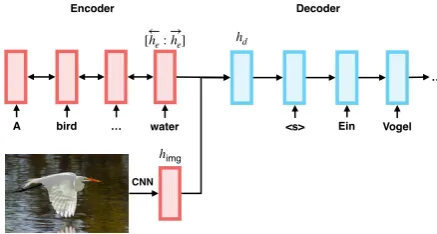
Figure 1: Multimodal Machine Translation Model
2 Methods
Our model is based on the sequence-to-sequence RNN architecture with attention (Bahdanau et al., 2014). We incorporate image features to initialize the decoder’s hidden state as shown in Figure 1. Originally, this hidden state is initialized using the concatenation of last encoder’s forward and back-ward hidden states, −→he and←h−e resp. We propose
to use the sum of encoder’s output and image fea-tureshimg to initialize the decoder. Formally, we
have the final initialization statehdas:
hd= tanh(We[−→he;h←−e] +Wimghimg+b). (1)
whereWe andWimg project the encoder and
im-age feature vector into the decoder hidden state dimensionality andb is the bias parameter. This approach has been previously explored byCalixto and Liu(2017).
As discussed previously, translation systems are traditionally trained using cross entropy loss. To overcome the discrepancy between training and inference distributions, we train our models using scheduled sampling (Bengio et al., 2015) which mixes the ground truth with model predictions, further adopting the REINFORCE algorithm with baseline to directly optimize translation metrics.
2.1 Scheduled Sampling
When predicting a token yˆt, scheduled sampling
uses the previous model predictionyˆt−1with
prob-ability or the previous ground truth prediction yt−1 with probability1−. The model prediction
ˆ
yt−1 is obtained by sampling a token according to
the probability distribution byP(yt−1|ht−1). At
the beginning of training, the sampled token can be very random. Thus, the probabilityis set very low initially and increased over time.
One major limitation of scheduled sampling is that at each time step, the target sequences can be
incorrect since they are randomly selected from the ground truth data or model predictions, re-gardless of how input was chosen (Ranzato et al., 2015). Thus, we use reinforcement learning tech-niques to further optimize models on translation metrics directly.
2.2 Reinforcement Learning
FollowingRanzato et al.(2015) andRennie et al. (2017), we use REINFORCE with baseline to di-rectly optimize the evaluation metric.
According to the reinforcement learning litera-ture (Sutton et al., 1998), the neural network, θ, defines a policypθ, that results in an “action” that
is the prediction of next word. After generating the end-of-sequence term (EOS), the model will get a rewardr, which can be the evaluation metric, e.g. BLEU score, between the golden and generated sequence. The goal of training is to minimize the negative expected reward.
L(θ) =−Ews∼pθ[r(ws)]. (2)
where sentencews= (ws
1, ..., wTs).
In order to compute the gradient ∇θL(θ), we
use the REINFORCE algorithm, which is based on the observation that the expected gradient of a non-differentiable reward function can be com-puted as follows:
∇θL(θ) =−Ews∼pθ[r(ws)∇θlogpθ(ws)]. (3)
The policy gradient can be generalized to com-pute the reward associated with an action value
relativeto a reference reward orbaselineb:
∇θL(θ) =−Ews∼p θ[(r(w
s)−b)∇
θlogpθ(ws)].
(4) The baseline does not change the expected gra-dient, but importantly, it can reduce the variance of the gradient estimate. We use the baseline in-troduced inRennie et al.(2017) which is obtained by the current model with greedy decoding at test time.
b=r( ˆws) (5)
wherewˆsis generated by greedy decoding.
For each training case, we approximate the ex-pected gradient with a single samplews∼pθ:
Train Dev. Vocab. Vocab. after BPE
En 2,900 1,014 10,212 7,633
De 2,900 1,014 18,726 5,942
Fr 2,900 1,014 11,223 6,457
[image:3.595.279.513.70.196.2]Cs 2,900 1,014 22,400 8,459
Table 1: Statistics of Flickr30K Dataset
2.3 Ensembling
In our experiments with relatively small train-ing dataset, the translation qualities of models with different initializations can vary notably. To make the performance much more stable and im-prove the translation quality, we ensemble dif-ferent models during decoding to achieve better translation.
To ensemble, we take the average of all model outputs:
ˆ yt=
N
X
i=1
ˆ yit
N (7)
where yˆi
t denotes the output distribution of ith
model at positiont. Similar toZhou et al.(2017), we can ensemble models trained with different ar-chitectures and training algorithms.
3 Experiments 3.1 Datasets
We perform experiments using Flickr30K (Elliott et al.,2016) which are provided by the WMT or-ganization. Task 1 (Multimodal Machine Trans-lation) consists of translating an image with an English caption into German, French and Czech. Task 1b (Multisource Multimodal Machine Trans-lation) involves translating parallel English, Ger-man and French sentences with accompanying im-age into Czech.
As shown in Table1, both tasks have 2900 train-ing and 1014 validation examples. For prepro-cessing, we convert all of the sentences to lower case, normalize the punctuation, and tokenize. We employ byte-pair encoding (BPE) (Sennrich et al., 2015) on the whole training data including the four languages and reduce the source and target lan-guage vocabulary sizes to 20k in total.
3.2 Training details
The image feature is extracted using ResNet-101 (He et al., 2016) convolutional neural network
En-De En-Fr En-Cs
NMT 39.64 58.36 31.27
NMT+SS 40.19 58.67 31.38
NMT+SS+RL 40.60 58.80 31.73
MNMT 39.27 57.92 30.84
MNMT+SS 39.87 58.80 31.21
MNMT+SS+RL 40.39 58.78 31.36
NMT Ensemble 42.54 61.43 33.15
MIX Ensemble 42.45 61.45 33.11
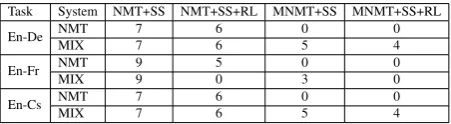
Table 2: BLEU scores of different approaches on the validation set. Details of the ensemble models are described in Table9.
trained on the ImageNet dataset. Our implemen-tation is adapted from Pytorch-based OpenNMT (Klein et al.,2017). We use two layered bi-LSTM (Sutskever et al., 2014) as the encoder and share the vocabulary between the encoder and the de-coder. We adopt length reward (Huang et al., 2017) on En-Cs task to find the optimal sentence length. We use a batch size of 50, SGD optimiza-tion, dropout rate as 0.1 and learning rate as 1.0. Our word embeddings are randomly initialized of dimension 500.
To train the model with scheduled sampling, we first set probabilityas 0, and then gradually in-crease it 0.05 every 5 epochs until it’s 0.25. The re-inforcement learning models are trained based on those models pre-trained by scheduled sampling.
3.3 Results for task 1
To study the performance of different approaches, we conduct an ablation study. Table2 shows the BLEU scores on validation set with different mod-els and training methods. Generally, modmod-els with scheduled sampling perform better than baseline models, and reinforcement learning further im-proves the performance. Ensemble models lead to substantial improvements over the best single model by about +2 to +3 BLEU scores. How-ever, by including image information, MNMT
per-Task System NMT+SS NMT+SS+RL MNMT+SS MNMT+SS+RL
En-De NMTMIX 77 66 05 04
En-Fr NMT 9 5 0 0
MIX 9 0 3 0
En-Cs NMTMIX 77 66 05 04
[image:3.595.309.535.671.733.2]Rank BLEU METEOR TER
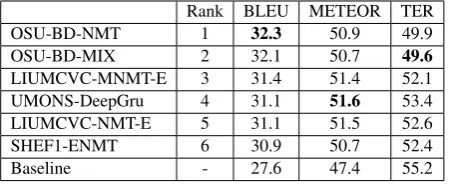
OSU-BD-NMT 1 32.3 50.9 49.9
OSU-BD-MIX 2 32.1 50.7 49.6
LIUMCVC-MNMT-E 3 31.4 51.4 52.1
UMONS-DeepGru 4 31.1 51.6 53.4
LIUMCVC-NMT-E 5 31.1 51.5 52.6
SHEF1-ENMT 6 30.9 50.7 52.4
[image:4.595.74.300.69.161.2]Baseline - 27.6 47.4 55.2
Table 4: En-De results on test set. 17 systems in total. (Only including constrained models).
Rank BLEU METEOR TER
LIUMCVC-MNMT-E 1 39.5 59.9 41.7
UMONS 2 39.2 60 41.8
LIUMCVC-NMT-E 3 39.1 59.8 41.9
OSU-BD-NMT 4 39.0 59.5 41.2
SHEF-MLT 5 38.9 59.8 41.5
OSU-BD-MIX 9 38.6 59.3 41.5
[image:4.595.309.532.69.172.2]Baseline - 28.6 52.2 58.8
Table 5: En-Fr results on test set. 14 systems in total. (Only including constrained models).
Rank BLEU METEOR TER OSU-BD-NMT 1 30.2 29.5 50.7
[image:4.595.73.298.208.302.2]OSU-BD-MIX 2 30.1 29.7 51.2 SHEF1-ENMT 3 29.0 29.4 51.1 SHEF-LT 4 28.3 29.1 51.7 SHEF-MLT 5 28.2 29.1 51.7 SHEF1-MFS 6 27.8 29.2 52.4 Baseline - 26.5 27.7 54.4
Table 6: En-Cs results on test set. 8 systems in total. (Only including constrained models).
En-Cs Fr-Cs De-Cs (En+Fr+De)-Cs
NMT 31.27 28.48 26.96 29.47
MNMT 30.84 27.02 25.99 29.23
Table 7: BLEU scores on validation set for task 1B
forms better than NMT only on the En-Fr task with scheduled sampling.
Table4, 5and6show the test set performance of our models on En-De, En-Fr and En-Cs sub-tasks with other top performance models. We rank those models according to BLEU. Our submitted systems rank first in BLEU and TER on En-De and En-Cs subtasks.
3.4 Results for task 1B
Table 7 shows the results on validation set with-out sequence training. En-Cs, Fr-Cs, De-Cs are models trained from one language to another. (En+Fr+De)-Cs models are trained using multiple source data. Similar to the Shuffle method
dis-Rank BLEU METEOR TER OSU-BD-NMT 1 26.4 28.0 52.1
OSU-BD-MIX 1 26.4 28.2 52.7 SHEF1-ARNN 3 25.2 27.5 53.9 SHEF-CON 4 24.7 27.6 52.1
SHEF-MLTC 5 24.5 27.5 52.5 SHEF1-ARF 6 24.1 27.1 54.6 Baseline - 23.6 26.8 54.2
Table 8: Task 1B multi-source translation results on test set. 6 systems in total.
Task System Num† BLEU MET. TER NumModel Rank ‡ BLEU MET. TERTeam Rank
En-De NMTMIX 1111 12 45 21 5 1 3 1
En-Fr NMTMIX 1111 49 109 13 6 3 5 1
En-Cs NMTMIX 66 12 12 13 3 1 1 1 En-Cs NMT 6 1 2 1 3 1 1 1 (1B) MIX 6 1 1 5
Table 9: Rank of our models.†represents the total
number of models. ‡ represents the total number
of teams.
cussed in multi-reference training (Zheng et al., 2018), we randomly shuffle the source data in all languages and train using a traditional attention based-neural machine translation model in every epoch. Since we do BPE on the whole train-ing data, we can share the vocabulary of different languages during training. The results show that models trained using single English to Czech data perform much better than the rest.
Table8shows results on test set. The submitted systems are the same as those used in En-Cs task of task 1. Although we only consider the English source during training, our proposed systems still rank first among all the submissions.
4 Conclusions
We describe our systems submitted to the shared WMT 2018 multimodal translation tasks. We use sequence training methods which lead to substan-tial improvements over strong baselines. Our en-sembled models achieve the best performance in BLEU score for three subtasks: En-De, En-Cs of task 1 and (En+De+Fr)-Cs task 1B.
Acknowledgments
[image:4.595.302.535.217.301.2] [image:4.595.73.298.347.451.2]References
Dzmitry Bahdanau, Kyunghyun Cho, and Yoshua Ben-gio. 2014. Neural machine translation by jointly learning to align and translate. CoRR.
Samy Bengio, Oriol Vinyals, Navdeep Jaitly, and Noam Shazeer. 2015. Scheduled sampling for se-quence prediction with recurrent neural networks. InAdvances in Neural Information Processing Sys-tems, pages 1171–1179.
Ozan Caglayan, Walid Aransa, Adrien Bardet, Mer-cedes Garc´ıa-Mart´ınez, Fethi Bougares, Lo¨ıc Bar-rault, Marc Masana, Luis Herranz, and Joost van de Weijer. 2017. Lium-cvc submissions for wmt17 multimodal translation task. InProceedings of the Second Conference on Machine Translation, pages 432–439.
Iacer Calixto and Qun Liu. 2017. Incorporating global visual features into attention-based neural machine translation. InProceedings of the 2017 Conference on Empirical Methods in Natural Language Pro-cessing, pages 992–1003.
D. Elliott, S. Frank, K. Sima’an, and L. Specia. 2016. Multi30k: Multilingual english-german image de-scriptions. Proceedings of the 5th Workshop on Vi-sion and Language, pages 70–74.
Desmond Elliott, Stella Frank, Lo¨ıc Barrault, Fethi Bougares, and Lucia Specia. 2017. Findings of the second shared task on multimodal machine transla-tion and multilingual image descriptransla-tion. In Proceed-ings of the Second Conference on Machine Transla-tion, pages 215–233.
Ekaterina Garmash and Christof Monz. 2016. Ensem-ble learning for multi-source neural machine transla-tion. InProceedings of COLING 2016, the 26th In-ternational Conference on Computational Linguis-tics: Technical Papers, pages 1409–1418.
Kaiming He, Xiangyu Zhang, Shaoqing Ren, and Jian Sun. 2016. Deep residual learning for image recog-nition. Conference on Computer Vision and Pattern Recognition CVPR.
Liang Huang, Kai Zhao, and Mingbo Ma. 2017. When to finish? optimal beam search for neural text gener-ation (modulo beam size). InEMNLP 2017.
G. Klein, Y. Kim, Y. Deng, J. Senellart, and A. M. Rush. 2017. Opennmt: Open-source toolkit for neu-ral machine translation.ArXiv e-prints.
Siqi Liu, Zhenhai Zhu, Ning Ye, Sergio Guadarrama, and Kevin Murphy. 2017. Improved image caption-ing via policy gradient optimization of spider. In Proc. IEEE Int. Conf. Comp. Vis, volume 3, page 3.
Mingbo Ma, Dapeng Li, Kai Zhao, and Liang Huang. 2017. Osu multimodal machine translation system report. InProceedings of the Second Conference on Machine Translation, pages 465–469.
Ramesh Nallapati, Bowen Zhou, and Mingbo Ma. 2016. Classify or select: Neural architectures for extractive document summarization. CoRR. Marc’Aurelio Ranzato, Sumit Chopra, Michael Auli,
and Wojciech Zaremba. 2015. Sequence level train-ing with recurrent neural networks. arXiv preprint arXiv:1511.06732.
Steven J Rennie, Etienne Marcheret, Youssef Mroueh, Jarret Ross, and Vaibhava Goel. 2017. Self-critical sequence training for image captioning. InCVPR, volume 1, page 3.
Alexander M. Rush, Sumit Chopra, and Jason Weston. 2015. A neural attention model for abstractive sen-tence summarization.
Rico Sennrich, Barry Haddow, and Alexandra Birch. 2015. Neural machine translation of rare words with subword units. arXiv preprint arXiv:1508.07909.
Ilya Sutskever, Oriol Vinyals, and Quoc V. Le. 2014. Sequence to sequence learning with neural net-works. Proceedings of the 27th International Con-ference on Neural Information Processing Systems.
Richard S Sutton, Andrew G Barto, et al. 1998. Rein-forcement learning: An introduction. MIT press.
Subhashini Venugopalan, Marcus Rohrbach, Jeffrey Donahue, Raymond J. Mooney, Trevor Darrell, and Kate Saenko. 2015. Sequence to sequence - video to text. InICCV.
Kelvin Xu, Jimmy Ba, Ryan Kiros, Kyunghyun Cho, Aaron Courville, Ruslan Salakhudinov, Rich Zemel, and Yoshua Bengio. 2015. Show, attend and tell: Neural image caption generation with visual atten-tion. Proceedings of the 32nd International Confer-ence on Machine Learning (ICML-15).
Renjie Zheng, Mingbo Ma, and Huang Liang. 2018. Multi-reference training with pseudo-references for neural translation and text generation. arXiv preprint arXiv:1808.09564.