133
The Hebrew Universal Dependency Treebank:
Past, Present and Future
Shoval Sadde
Open University of Israel
Amit Seker
Open University of Israel
Reut Tsarfaty
Open University of Israel
Abstract
The Hebrew treebank (HTB), consisting of 6221 morpho-syntactically annotated newspa-per sentences, has been the only resource for training and validating statistical parsers and taggers for Hebrew, for almost two decades now. During these decades, the HTB has gone through a trajectory of automatic and semi-automatic conversions, until arriving at its UDv2 form. In this work we manually validate the UDv2 version of the HTB, and, according to our findings, we apply scheme changes that bring the UD HTB to the same theoretical grounds as the rest of UD. Our experimental parsing results with UDv2New confirm that improving the coherence and in-ternal consistency of the UD HTB indeed leads to improved parsing performance. At the same time, our analysis demonstrates that there is more to be done at the point of intersection of UD with other linguistic processing layers, in particular, at the points where UD interfaces external morphological and lexical resources.
1 Introduction
The Hebrew Treebank (HTB), initially introduced by Sima’an et al. (2001), is the first, and so far only, gold standard for morphologically and syn-tactically annotated sentences in Modern Hebrew. It was created with the main goal in mind to enable the development of statistical models for morpho-logical and syntactic parsing for Hebrew, but also to facilitate linguistic investigations into the struc-ture and distribution of linguistic Semitic phenom-ena. The pilot version of Sima’an et al. (2001) has been minimal — it consisted of 500 sentences, morphologically and syntactically annotated by hand. This modest start, however, defined lin-guistic conventions and annotation principles that would continue to affect many treebank versions derived from the HTB for many years, including theuniversal dependencies(UD) HTB version.
During these two decades, the HTB has ex-panded from 500 to 6221 sentences and changed several forms. The different versions of the tree-bank reflect different theories and formal rep-resentation types, that in turn reflect different, and sometimes contradictory, linguistic annotation principles. The reasons for these differences were sometimes practical, e.g., a new version was de-rived to answer an emerging technological need, and sometimes socio-academic, e.g., because dif-ferent teams adopted difdif-ferent linguistic theories as their underlying annotation principles.
The HTB thus enabled the development of many statistical morphological and syntactic pro-cessing models (Adler, 2007; Bar-haim et al., 2008; Shacham and Wintner, 2007; Tsarfaty, 2006;Goldberg and Tsarfaty,2008;Goldberg and Elhadad,2009;Tsarfaty,2010;Goldberg and El-hadad, 2010, 2011; More and Tsarfaty, 2016; More et al., In Press), but these models were trained on vastly different versions of the tree-bank, obeying different theories and annotation schemes, which then rendered the reported results mostly non-comparable.
Ideally, the current UDv2 version would make for such a standard Hebrew resource. Unfortu-nately though, many of the conversion processes since Sima’an et al. (2001) to the present UDv2 have been automatic or semi-automatic, with no point of systematic qualitative validation. This re-sulted in odd, and sometime plain wrong, depen-dency structures, with respect to the UD scheme.
In this work we take the opportunity to vali-date the UDv2 HTB, by manually going through the published trees, identifying systematic errors or annotation inconsistencies, and locating cases where the annotated structures contradict the UD guidelines (or spirit). We identified and corrected three main points of failure in the UD HTB: (i) the classification of argument types, deriving from the classification in the original HTB (ii) a mix-up of morphological and syntactic properties, where morphological features serve as syntactic sub-relations and vice versa, and (iii) a mix up of language-specific versus universal phenomena, where label sub-typing is exploited to indicate a supposedly language-specific phenomenon, which in fact has a designated universal label elsewhere.
Based on these corrections, we present a revised version of the HTB that we call UDv2New. We use UDv2 and UDv2New to train a morphosyntac-tic parser (More et al.,In Press) and provide base-line results on Hebrew UD parsing, in both ideal and realistic scenarios. Comparing our Hebrew parsing results on UDv2 and UDv2New, we verify that the improvement of linguistic coherence and annotation consistency has also led to improved parsing performance. Lessons learned from our empirical analysis concern the systematic organi-zation of natural language grammar in UD, and in particular (i) the need to standardize the inter-face of UD treebanks to external morphological and lexical resources, and (ii) the need to organize the form-function mapping in a language-specific vs. family-specific vs. strictly-universal relations taxonomy, within and across treebanks.
The remainder of this paper is organized as fol-lows. In Section 2 we describe the trajectory of the HTB from its inception to UDv2. In Section3 we present our validation process and the scheme changes we applied. In Section 4 we present raw-to-dependencies Hebrew parsing results and in Section5we share our future plans and lessons learned. Finally, in Section6we conclude.
2 Previous Work and the Trajectory of the Modern Hebrew Treebank
Following the first treebanking efforts, in English (Marcus et al.,1993), Chinese (Xue et al.,2005), and Arabic (Maamouri and Bies,2004), and with the surge of interest in developing statistical, broad-coverage, parsing models, Sima’an et al. (2001) introduced a pilot treebanking study and a Hebrew treebank (HTB), which included 500 sen-tences from the Hebrew newspaperha’aretz, mor-phologically segmented and morpho-syntactically annotated with part-of-speech tags, morphological features, and labeled phrase-structure trees. Fol-lowing the annotation practices at the time, much of the tagging and labeling scheme was adopted almost as is from the UPenn Treebank (Marcus et al.,1993). However, due to its rich morphology and Semitic phenomena, several annotation deci-sions in the HTB diverged from these practices.
Firstly, the basic units that appear as leaves of the trees are not space-delimited tokens, but seg-mented units that we call morphemes.1 Various prefixes that mark independent function words, including2 B (in), L (to), M (from), F (that), KF(when) andH (definite article) are segmented away from their host. In addition, pronominal suf-fixes that appear on top of function words are also segmented away. So, the tokensFLW(of him),LK (to you), and AITM (with them), are segmented intoFL(of) +HWA(he) ,L(to) +ATH(you) ,EM (with) +HM (them) respectively.3
The POS tags labeling scheme in the HTB in-cludes quite a few changes from PTB, including the addition of special tags lexicalizing important functional elements in Hebrew: AT (for the ac-cusative marker), H (the definite article), POSS (the possesive marker), and HAM (the yes/no question marker). In addition, the HTB introduces the NNT, JJT, CDT labels, marking the construct-state variants of NN, JJ, CD in the PTB, and a spe-cific tag MOD that tags modifier words which is neither an adjective nor an adverb. On top of that, all open class POS tags as well as auxiliaries have been marked for their inflectional features (gender, number, person, time), yielding in total hundreds of possible fine-grained POS categories.
1
In the UD terminology these are called syntactic words.
2We use the transliteration ofSima’an et al.(2001), and
describe the transliteration in our supplementary material.
3Note that while combining
The syntactic labels in the phrase structure trees of the HTB were adopted from the Penn Tree-bank (PTB) almost as is, with the addition of a PREDP label for marking verbless predicates. The syntactic trees themselves looked superficially like the PTB but they differ in several aspects. Due to word-order freedom at the clause level, S-level categories present a flat structure, where the po-sitions of the arguments do not entail anything about their grammatical function. The HTB pro-vided 3 types of manually verified function tags to indicate such functions: SUBJect, OBJect, and COMplement, the latter marking obligatory argu-ments of the verb. Finally the HTB defined three types of null elements: *T* marking phonologi-cally empty anaphors, *PRO* for pro-drop sub-jects, and *NONE* for elliptical elements.
The work of Guthmann et al.(2008) extended the HTB to 6501 sentences, in a manually-validated automatic process.4 During this pro-cess they further added a systematic marking of mother-daughterdependencies. That is — due to feature-spreading in Hebrew, morphological fea-tures of phrases may be contributed by different daughters, and not necessarily via a singlehead. So they marked each daughter with the role it plays in determining its mothers’ features (gender, number, tense, etc.). Using these feature-based dependencies, they performed feature-percolation from daughter to mother, so that phrasal nodes are also marked with their morphological signatures.5 Still, the phrase-structure trees yielded by HTB-trained parsers were not useful for downstream ap-plications in Hebrew. This is because Hebrew is a relatively-free word order language, where the po-sition of a constituent does not entail its grammat-ical function or semantic role. This in particular precludes the use of well known ‘head tables’ for selecting a single head and deriving labeled and unlabeled dependencies. To overcome this, Tsar-faty (2010) devised a set of rules based on the daughter-dependencies, function tags and empty elements, to automatically derive the relational-realizational(RR) version of the HTB. In the RR HTB, each node is marked with its relational net-work (an unordered set of grammatical functions) mapped to the ordered syntactic constituents. The RR HTB retained the morphological conventions and core non-core distinction of the original HTB.
4
Excluding repeated sentences, we have 6221 trees.
5This marking did not specify a single
head since a mother node could have multipledaughter-dependencies.
In a parallel effort, and with the surge of inter-est in dependency parsing (Buchholz and Marsi, 2006;Nivre et al.,2007),6 Goldberg(2011) auto-matically converted the HTB into its first, unla-beled, dependency version. The automatic conver-sion procedure assumed that heads are functional rather than lexical. As a result, the coordination marker would head coordination structures, the ac-cusative marker would head direct object phrases, and so on. On top of that, in order to remain com-patible with the wide-coverage lexicon ofItai and Wintner(2008), this version of the HTB adopted the POS tags scheme ofAdler(2007), rather than the POS tags ofSima’an et al.(2001)
Based on this version, Goldberg and Elhadad (2009) presented the first Hebrew dependency parsing results, onlyunlabeled attachment scores (UAS) at this point. Here too, as with the phrase-structure trees, it was impossible to devise an ex-ternal procedure that would infer dependency la-bels for the unlabeled arcs — and there were no labeled dependencies to train such a labeler on.
At that point, where the need for Hebrew la-beled dependencies had become pressing, Tsar-faty (2013) presented the Unified-Stanford De-pendencies (Unified-SD) version of the HTB, ex-tending the Stanford dependencies (SD) scheme to cover both morphological and syntactic phe-nomena. Similar to SD, U-SD assumed a label-ing hierarchy, with several changes: the hierarchy now included branches forhead-types (hd), depen-dency types (dep), andfunctional types (func). In particular, dependencies in the func branch mark syntactic functions that are in fact interchangeable with morphology, when considering these func-tions from a typological perspective.
Tsarfaty used the U-SD labels to edit three ver-sions of the HTB: (i) to mark the original phrase-structure trees in the HTB with the labels as dash-features, (ii) to relabel the relational networks in RR trees with U-SD labels, and (iii) to de-rive a labeled dependencies version of the HTB. As with the unlabeled dependencies of Goldberg, the U-SD HTB assumed functional heads across the board, and the POS tags layer was again changed to comply with the wide-coverage lexi-con (HEBLEX) ofItai and Wintner (2008). The labeled dependencies treebank of U-SD then pro-vided the Hebrew section of the SPMRL shared tasks (Seddah et al.,2013,2014).
3 The Hebrew UD Treebank
3.1 Overview
The RR version of the Unified-SD HTB provided the basis for automatically converting the Hebrew trees into UDv1 trees. The UD HTB assumes the same segmentation principles as the first edition of the HTB, segmenting off prefixes and suffixes, with the addition of splitting off genitive pronom-inal clitics from nouns.
Goldberg and Tsarfaty(2014) devised an auto-matic process that chooses alexical head in each relational network of each constituent in the RR treebank. They also mapped the fine-grained POS categories to the coarse-grained UPOS categories in UD, and remaining POS distinctions in HebLex (HebBinyan, construct-states, etc.) are stored in FEATS. The label set of U-SD was automatically mapped to UD, and relations from U-SD outside of UD were kept as relation:subtype.
The conversion of UDv1 to UDv2 was also done automatically, by augmenting the script of Gold-berg and Tsarfaty(2014). Points of failure of the UDv1 version of the HTB to comply with UDv2 were identified by aiming to locate skewed distri-butions of tags or labels, and they were corrected in the conversion script on a case by case basis. This process has stopped when the treebank com-plied with the UDv2 validation script. The con-verted HTB is documented on the UD webpage.7
3.2 Validation
The present version of UDv2 thus results from a sequence of automatic and semi-automatic conver-sions on the trees of Guthmann et al.(2008). In order to validate the current UDv2 trees, we re-viewed the list of UD POS tags, relation labels and features, and for each of these items we identi-fied the dependency structures in the HTBdev set that contain them. At this point, for each item, a linguist characterized the role such item actually fulfills in the Hebrew grammatical structures, (as opposed to the role it was designed to fulfill in the UD scheme).
During this process the linguist documented er-rors and inconsistencies that were found, either be-tween the realistic use of a function in the UDv2 HTB and the UDv2 guidelines, or simply attesting insufficient or incorrect coverage of the linguistic
7http://universaldependencies.org/
treebanks/he_htb/index.html.
structure that this particular label, tag or feature is supposed to describe.
This validation process8 was conducted on the entire HTB UDv2dev set9and it was followed by a sequence of discussions in which our research team, consisting of two linguists, two NLP spe-cialists, and a senior NLP researcher, discussed possible solutions for each error. The discus-sions were focused on explicitly assessing the merits of each solution alternative according to the six criteria of the Mannings Law. That is: lin-guistically adequate, typologically adequate, suit-able for rapid, consistent annotation, suitsuit-able for parsing with high accuracy, easily comprehended by non-linguists, and provides good support for downstream NLP tasks.10 After narrowing down the list of adequate solutions, the final decision about which revisions to make leaned on their portance and feasibility. For example, a very im-portant, yet easily executable revision was to sim-ply replace all instances of prepositionaliobjwith obl. Just as important, but far more complex, was to switch between a head and a dependent in the case of structures containingauxiliaries(e.g., modals, as we illustrate shortly).
All revisions were made with the python Pan-das package, and they were applied to all, dev, train and test, sets. Revisions were made with respect to linguistic patterns that refer to existing labels, tags or features, with no consideration of any particular (lexicalized) Hebrew words. Fur-thermore, we refrained from manual changes of specific errors, considering that their source might be a vaster problem, to be dealt with in the future. As an example for simple edits, consider adding a label compound:affix. For this, all rows contain-ing the feature ‘Prefix=Yes’ had to be retrieved, and the label was changed tocompound:affix. As a more complex case, consider the case involving modality mentioned above. Here, all rows with the xcomp label were retrieved. For each row, if the head had a morphological feature ‘Verb-Type=Mod’, the head’s label was relabeled ‘aux’,
8
It is important to note that our analysis proceeded label-by-label, and tag-by-tag, which is a faster process than going through the treebank trees one-by-one. But it also bears the risk of missing out rare peculiarities and singleton errors.
9In this work we primarily aimed to correct the main
is-sues that appeared across the board, rather than tackling id-iosyncratic or incidental errors. So, observing thedev setwas enough, as it well reflects the main linguistic phenomena in the language.
ID FORM UPOSTAG FEATS HEAD DEPREL
6 IS AUX VerbType=Mod 0 root
7 LPNWT VERB VerbForm=Inf 6 xcomp
6 IS AUX VerbType=Mod 7 aux
[image:5.595.312.491.195.265.2]7 LPNWT VERB VerbForm=Inf 0 root
Table 1: Turning Auxiliary Heads into Modal Depen-dents. The top pair represents the UDv2 structure, the lower pair represents the UDv2New revision.
the row itself was relabeled with the original la-bel of the head, and the numbers were changed respectively in the ’HEAD’ column (see Table1).
3.3 Revision
Adhering to UDv2 guidelines provided an oppor-tunity to make a consistent decision about topics under debate, and to generally revise inconsisten-cies in the system. Our revisions typically fall un-der one of the following three categories: pred-icate/argument types distinctions (3.3.1), mor-phological vs. syntactic distinctions (3.3.2), and Hebrew-specific vs. universal distinctions (3.3.3).
3.3.1 Predicate Argument Types Distinctions
Open Clausal Complements. In the UDv2 HTB, predicative complements were labeled adv-mod when adjectival. Following the UDv2 guide-lines, we label them xcomp, as they are subordi-nated predicates, after all, even if not verbal.
63 H ZWKIM AINM NRAIM MIWXDIM
nummod
det:def
nsubj
advmod root
xcomp
Figure 1: UDv2New treatment of predicative comple-ments as xcomp rather than advmod. The adjective MI-WXDIM’special’ is a complement ofNRAIM’look’
“63 63
H-ZWKIM
DET-winner.PL.M
AINM be.NEG.PL.M
NRAIM look.PL.M
MIWXDIM.” special.PL.M
‘The 63 winners do not look special’
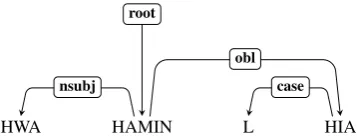
Argument iobj vs. obl. Some UD definitions stand in clear contrast with the canonical syntac-tic analysis of Hebrew. Perhaps the most salient case is of core arguments. The canonical view of Hebrew core arguments (Coffin and Bolozky (2005) p. 290) is of a direct object, marked by
an accusative case when definite, and an indirect object, marked by an oblique case marker when a pronoun, and preceded by a preposition when common or proper noun. UDv2 dedicates an iobj (indirect object) relation to secondary core argu-ments which are not preceded by prepositions, and arguments which do follow a preposition are la-beled obl, whether core or non-core. We revised the labels accordingly.
HWA HAMIN L HIA
nsubj root
case obl
Figure 2: The nounHIA, following the prepositionL, although being a core argument of the verbHAMIN, is labeled obl in UDv2New, as opposed to iobj in previous versions.
“HWA he.3SG.M
HAMIN believe.Tsg.PST
L-HIA.”
DAT-she.3SG.F
’He believed her’
Predicate types: the case of auxiliaries As part of the shift towards a lexically-driven analysis, structural changes were made to sentences con-taining auxiliary elements and copulas. There are three main sets of these: (i) Auxiliary el-ements marking modality, (ii) Auxiliary verbs which mostly mark habituality, but occasionally participate in negation or tense inflection when the predicate has no past/future form, and (iii) Positive or negative copulars.
Modals do not constitute any uniform syntactic class in Hebrew, and there is an ongoing debate as to the POS of each modal expression (cf. Netzer et al.(2007)). In line with Netzer et al’s conclu-sion, these are tagged as AUX in the UD HTB. In UDv2, the modal served as the head of the clause, while the following predicate was labeled xcomp, as it is consistently realized in Hebrew in infini-tive form. As of UDv2New, those modals which are tagged as AUX are also labeled aux, and the subsequent predicate receives the label which was attributed to the modal. See Table1.
[image:5.595.77.289.470.538.2]in UDv2New. Finally, consistency across sets ii and iii was achieved by unifying the labeling of copular verbs as cop regardless of their inflection, whereas previous versions labeled past and future inflections of copular verbs as aux.
3.3.2 Morphology vs. Syntax
Eliminating acl:inf to acl. The automatic con-version to UD has kept fine-grained labels as sub-relations, resulting with the language-specific la-bel acl:inf. Since the UD guidelines permit in-finitive structures in acl, it is unnecessary to mark infinity as a sub-relation. Moreover, all cases of acl:inf bear the feature ’VerbForm=Inf’. So elimi-nating the morphological feature inf from the sub-relation acl:inf does not lead to any information loss.
“NSIWN-W attempt.SG.M-POSS
H-AXRWN
DET-last FL
POSS
MILR Miller LHFIG
get.INF
KSPIM” money.PL
’Miller’s last attempt to get money’
NSIWN FL HWA LHFIG KSPIM
ROOT
case:gen nmod:poss
acl
[image:6.595.78.300.376.440.2]obj
Figure 3: The label acl:inf was reduced into simply acl for the infinitive verbLHFIG(to get)
Adding compound:affix This new relation is dedicated to non-standalone words, which func-tion semantically like affixes, but syntactically sur-face as separate words, at times separated by a hy-phen and in others by white-space. A subset of these words are loan words (mainly from English, like ’non’, ’multi’ etc.) where originally they sur-face syntactically as affixes. In UDv2 these items were marked by the feature Prefix=Yes. However, since they mark a certain type of Hebrew com-pounds, we used sub-typing to indicate it.11 In “KLL-EWLMIT” for example, KLL’uni-’ is se-mantically a prefix toEWLMIT ’worldly’, but in Hebrew the two are separate words.
3.3.3 HTB-to-UD: language-specific representation with relation:subtype
As UD aspires to present a set of tags which are relevant to as many languages as possible,
natu-11All analyses are visualized in the supp. materials.
rally many language-specific phenomena are left unanswered. To allow representation of these, the UD scheme allows for sub-relations in the form of relation:subtype, as exemplified above. How-ever, although originally aiming toward coverage of language-specific phenomena, this structure can be frequently seen as a subtype of relation which is present in many languages (e.g. nsubj:pass, which is in use for subjects of passive sentences - not unique to any one language or even a family of languages). In our revision to adhere to UDv2 guidelines, we tried as much as possible to nar-row the use of relation:subtype to Hebrew-specific phenomena, eliminating any hierarchical structure of dependency relations. As a result, the follow-ing subtypes were reduced to their parent relation: (i) det:quant, originally marking an arbitrary sub-set of existential quantifiers, was reduced to sim-ply det , and (ii) advmod:phrase, originally mark-ing multi-word adverbials, were re-structured as advmod+fixed, in line with the UD guidelines for multi-word-expressions.
From conj:discourse to parataxis An interest-ing case is with labels not used at all in the older versions of the UD HTB, while language-specific labels stand to mark their function. The UD la-bel parataxis, for instance, describes a relation be-tween two (or more) sentences which are syntacti-cally independent (i.e. do not stand in subordina-tion or conjuncsubordina-tion relasubordina-tion to one another), but are thematically connected, and consequently punctu-ated as the same sentence. Previously, this relation was labeled in the HTB as conj:discourse, sim-ply classifying conjunctions that are not explicitly marked as of type discourse. In our revised ver-sion, we comply with UD guidelines and label this relation ’parataxis’.
while AT and FL were converted into PART. As there is no real difference between AT and FL and prepositions according to the UDv2 scheme, and as they are in no way particles, we converted them into ADP.
3.4 Unsolved Issues
Some inconsistencies in the treebank were spotted but not yet fixed as their automatic full retrieval and change is more complicated 12. For exam-ple,it-extraposition construction is represented in UDv2 by a combination of nsubj and ccomp or advcl, but should be a combination of expl+csubj, as defined in the guidelines (see example 9 in the supplements).
In another case, lack of congruence was found between our treatment of participles and Adler et al. (2008). The feature of VerbForm=Part marks both deverbal nouns and present tense clauses, as in the following sentence.
“EFRWT ten.PL.F
ANFIM person.PL.M
MGIEIM arrive.PTCP
M-TAILND from-Thailand
L-ISRAL” to-Israel
’Tens of people come from Thailand to Is-rael.’
Hebrew makes various uses of the dative case, some of them fulfill purely discursive functionality (Borer and Grodzinsky,1986). The current repre-sentation of the dative case marker in UDv2New does not give way to all possible meanings, in-cluding experiencer dative (Berman,1982) as op-posed to ethical dative, the regular dative where the dative argument is subcategorized by the verb. The current UDv2 guidelines do not distinguish between the different types of dative, so an edu-cated decision must be made locally as for how to tell them apart.
– IS LW HMIWMNWT HNXWCH BFBIL
LHIWT MWFL
’Hehas what it takes to be a governer.’
– HRAF HIHWDI MMCIALNWPTNTIM. ’The Jewish mind invents(us)patents’
– HW QRALHFQRNIT ’He calledhera liar.’
12For reasons of brevity we do not discuss all of them in
this work.
4 HTB Experiments and Parsing Results
Goal: We wish to examine the empirical impact of our effort to correct the treebank and retain lin-guistic (as well as cross-treebank) coherence in its annotation scheme. Indeed, ease of parsing should not be the indication for selecting one scheme over another, but the hypothesis is that, withinone and the same set of guidelines, a version that presents better coherence and consistency will also be more suitable for statistical training and will yield better results.
Settings: To gauge the effect of our revision we conducted two sets of experiments: one with the HTB UDv2 version used in the recent shared task, and another our revised UDv2New. We use the syntactic evaluation script provided by the CoNLL shared task 2018. We train on the portion defined as train set and report results on the dev set. For training and parsing we usedyap,13 a transition-based morphosyntactic parser written in go, which includes a morphological analyzer, a morphologi-cal disambiguator, and syntactic parser. In previ-ous workyapwas shown to obtain state of the art results on Hebrew parsing using the SPMRL ver-sion of the treebank (More et al.,In Press). Here we report its performance on the UD HTB.
Scenarios: Because of its rich morphology and orthographic convention to attach or fuse adposi-tions and pronominals onto open-class categories, there is severe ambiguity in the morphological analysis of the Hebrew input tokens. This is fur-ther magnified by the lack of diacritics in Hebrew written texts. Hence, it is unknown upfront how many morphemes (in the HTB terminology) or syntactic words (in the UD terminology) are in the space-delimited tokens. We examine two kinds of scenarios:
• ideal:assuming gold morphological analysis and disambiguation given by an oracle.
• realistic: assuming automatically predicted morphological analysis and disambiguation.
We useyapfor predicting morphological analysis (MA) and morphological disambiguation (More, 2016), and we contrast the use of a data-driven lex-icon baselinelexwith an external broad-coverage lexiconHebLex. To gauge the effect of the lexical
coverage of the morphological resource, we con-trast each variant with aninfusedscenario, where the correct analysis is injected into the lattice. Note that the input in the infused cases is still high as there are many MA alternatives. However, the correct morphological disambiguation is guaran-teed to be one of the morphological MA provided to the system as input.
Results: Table2shows the parsing results in an ideal scenario, assuming gold morphology. Here we see that there is a consistent improvement for all metrics. This supports our conjecture that a more consistent and coherent annotation of the treebank will benefit parsing, and it corroborates a wider conjecture, that, when it comes to super-vised learning, the quality of the annotated data is as important as the learning algorithm (and maybe more important).
Table 3 shows the parsing results in realistic scenarios, where we assume automatically pre-dicted morphological analysis and disambigua-tion. As expected, the results substantially drop relative to the ideal scenario. Also expected is the result that assuming an external broad-coverage lexicon substantially improves the results relative to a data-driven lexicon learned from the treebank. The result that seems less expected here is that, as opposed to the ideal scenario, we see no improve-ment in the results of UDv2New relative to UDv2. For some of the metrics the results slightly drop.
This drop could be either due to parser errors, or due to the lack of lexical coverage of the lexi-con with respect to our revised UDv2New scheme. To test this, we execute aninfusedscenario where the morphological analysis lattices are guaranteed to also include the correct analysis. Here we see a substantial improvement for both types of lex-ica, on all the different metrics, for the UDv2New version. This result suggests that the drop has in-deed been due to the insufficient lexical coverage of the resources, or due to mismatches between the lexicon and the new scheme. As far as the statis-tical components for morphological and syntactic analysis and disambiguation go, the revised ver-sion helps the parser obtain better disambiguation, in line of our results in the gold experiments.
5 Discussion and Lessons Learned
The original HTB (Sima’an et al., 2001; Guth-mann et al., 2008) has seen many revisions all of which executed automatically, or
semi-UDv2 Shared-Task Version LAS MLAS BLEX he htb-ud-dev-yap-gold 79.51 72.76 47.76
UDv2New Revised Version LAS MLAS BLEX he htb-ud-dev-yap-gold 81.24 75.58 50.16
Table 2: Parsing Results of the HTBdevset for UDv2 vs UDv2New, in an idealparsing scenario assuming GOLD morphology.
UDv2 Shared-Task Version LAS MLAS BLEX he htb-dev-yapbaselinelex 51.99 37.62 29.50 he htb-dev-yapheblex 60.71 39.53 33.82 he htb-dev-yapbaselinelex-infused 58.45 43.70 32.94 he htb-dev-yapheblex-infused 71.19 61.08 41.71
UDv2New Revised Version LAS MLAS BLEX he htb-dev-yap-baselinelex 52.42 38.08 30.32 he htb-dev-yapheblex 60.34 37.95 34.71 he htb-dev-yap-baselinelex-infused 58.54 44.06 33.30 he htb-dev-yapheblex-infused 73.66 64.73 44.32
Table 3: Parsing Results of the HTBdevset for UDv2 vs UDv2New, in arealisticparsing scenario assuming PREDICTED morphology. We compare a data-driven
baselinelexicon with an external lexicon,heblex, and we contrastuninfusedorinfusedsetting for both
automatically. Our endeavor here has been to manually verify the current version of the UD HTB resulting analyses, and to correct lingering errors. Apart from being linguistically justified, this process has proven to be also empirically valu-able, as indeed this revision has led to a improve-ment in parsing results.
Much work is still needed in order to bring the level of performance to be adequate for down-stream applications, in particular in realistic sce-narios. We conjecture that in order to obtain de-cent performance, the work on the treebank should be complemented by adapting language-specific lexica to the set of guidelines for word segmenta-tion and for representing morphology, as defined by UD. Even when external lexica assumes the same labeling scheme as UD, gaps between the theories underlying the development of these re-sources could lead to lack of coverage that sub-stantially harms parsing performance.
while the features column is exploited to express syntactic properties. We argue that clearer guide-lines are needed in the general UD scheme, in-structing directly what kind of linguistic informa-tion should go where, by which formal means.
Furthermore, it seems to us that the language-specific mechanisms are exploited for express-ing phenomena that could potentially be cross-linguistic, or at least shared by a language fam-ily. An example to this is the feature HebBinyan in the UD HTB, which stores the value of the mor-phological template of the verb. The phenomenon ofBinyan(a root-template construction) is clearly not Hebrew specific — in fact all Semitic lan-guages have Binyanim (morphological construc-tions) in their grammar, so we see no good rea-son for not unifying this feature across the Semitic sub-family. Same goes with marking construct state nouns, a phenomenon that extends beyond Semitic languages, and is currently marked differ-ently in each language (Hebrew, Arabic, Persian, etc.).
We propose that the next major revision of the UD treebank scheme could ideally focus on the universal organization of the grammar, and will center around these themes:
• subtypes:A universal inventory and manage-ment of the sub-label system which will de-fine what linguistic phenomena can count as subtype of a label, and will maintain cross-linguistic consistency in its use for shared phenomena.
• features: A universal inventory and man-agement of features which will define what can count as a feature, and will foster cross-linguistic reuse.
• lexical resources: For languages that have external lexica, especially in the case of mor-phologically rich and resource scarce lan-guages, an effort is needed to verify that the labeling scheme theoretical guidelines un-derlying lexica are harmonized with the UD guidelines. Such lexica can be made avail-able via the CoNLL-UL format (More et al., 2018) to benefit the entire UD community.
• semantic applications:in addition to aligning lexical resources, it is important to advance the usability of UD in down-stream applica-tion scenarios, by making available the addi-tional layer ofenhanceddependencies.
6 Conclusion
In this paper we describe the long and multi-phased process of coming-into-existence of the Hebrew version of the HTB. Most of the process has consisted of automatic conversions between different schemes. In this work we manually ver-ified the recent UD HTB version and corrected lingering errors. The revised version is more lin-guistically and cross-linlin-guistically consistent and obtains better parsing results in scenarios that are not dependent on the coverage of external lexica. Our future plans include a comprehensive revision of the lexical and morphological resources associ-ated with the UD scheme, to improve the empir-ical parsing results in realistic scenarios, and the addition of enhanced dependencies, which would be more adequate for downstream semantic tasks.
Acknowledgments
We thank the ONLP team at the Open Univer-sity of Israel for fruitful discussions throughout the process. We further thank two anonymous reviewers for their detailed and insightful com-ments. This research is supported by the European Research Council, ERC-StG-2015 scheme, Grant number 677352, and by the Israel Science Foun-dation (ISF), Grant number 1739/26, for which we are grateful.
References
Meni Adler. 2007. Hebrew Morphological Disam-biguation: An Unsupervised Stochastic Word-based Approach. Ph.D. thesis, Ben-Gurion University of the Negev, Beer-Sheva, Israel.
Meni Adler, Yael Dahan Netzer, Yoav Goldberg, David Gabay, and Michael Elhadad. 2008. Tagging a he-brew corpus: the case of participles. InLREC. Cite-seer.
Roy Bar-haim, Khalil Sima’an, and Yoad Winter. 2008. Part-of-speech tagging of Modern Hebrew text. Nat-ural Language Engineering, 14(2):223–251.
Ruth A Berman. 1982. Dative marking of the affectee role: Data from modern hebrew.
Hagit Borer and Yosef Grodzinsky. 1986. Syntactic cliticization and lexical cliticization: The case of he-brew dative clitics in the syntax of pronominal cli-tics. Syntax and semantics, 19:175–217.
Sabine Buchholz and Erwin Marsi. 2006. CoNLL-X shared task on multilingual dependency parsing. In
Edna Amir Coffin and Shmuel Bolozky. 2005.A refer-ence grammar of Modern Hebrew. Cambridge Uni-versity Press.
Yoav Goldberg. 2011. Automatic syntactic processing of Modern Hebrew. Ben Gurion University of the Negev.
Yoav Goldberg and Michael Elhadad. 2009. Hebrew dependency parsing: Initial results. In Proceed-ings of the 11th International Conference on Parsing Technologies, IWPT ’09, pages 129–133, Strouds-burg, PA, USA. Association for Computational Lin-guistics.
Yoav Goldberg and Michael Elhadad. 2010. Easy first dependency parsing of modern hebrew. In Pro-ceedings of the NAACL HLT 2010 First Workshop on Statistical Parsing of Morphologically-Rich Lan-guages, SPMRL ’10, pages 103–107, Stroudsburg, PA, USA. Association for Computational Linguis-tics.
Yoav Goldberg and Michael Elhadad. 2011. Joint He-brew segmentation and parsing using a PCFGLA lat-tice parser. InProceedings of ACL.
Yoav Goldberg and Reut Tsarfaty. 2008. A sin-gle framework for joint morphological segmentation and syntactic parsing. InProceedings of ACL.
Yoav Goldberg and Reut Tsarfaty. 2014. Htb to ud con-version.
Noemie Guthmann, Yuval Krymolowski, Adi Milea, and Yoad Winter. 2008. Automatic annotation of morpho-syntactic dependencies in a modern hebrew treebank. LOT Occasional Series, 12:77–90.
Alon Itai and Shuly Wintner. 2008. Language re-sources for hebrew. Language Resources and Eval-uation, 42(1):75–98.
Mohamed Maamouri and Ann Bies. 2004. Develop-ing an arabic treebank: Methods, guidelines, proce-dures, and tools. InProceedings of the Workshop on Computational Approaches to Arabic Script-based Languages, Semitic ’04, pages 2–9, Stroudsburg, PA, USA. Association for Computational Linguis-tics.
Mitchell P. Marcus, Mary Ann Marcinkiewicz, and Beatrice Santorini. 1993. Building a large annotated corpus of english: The penn treebank. Comput. Lin-guist., 19(2):313–330.
Amir More. 2016. Joint Morpho-Syntactic Processing of Morphologically Rich Languages in a Transition-Based Framework. Ph.D. thesis, The Interdisci-plinary Center, Herzliya.
Amir More, ¨Ozlem C¸ etino˘glu, C¸ a˘gri C¸ ¨oltekin, Nizar Habash, Benoˆıt Sagot, Djam´e Seddah, Dima Taji, and Reut Tsarfaty. 2018. Conll-ul: Universal mor-phological lattices for universal dependency parsing. In11th Language Resources and Evaluation Confer-ence.
Amir More, Amit Seker, Victoria Basmova, and Reut Tsarfaty. In Press. Joint transition-based models for morpho-syntactic parsing: Parsing strategies for mrls and a case study from modern hebrew. In
Transactions of ACL.
Amir More and Reut Tsarfaty. 2016. Data-driven mor-phological analysis and disambiguation for morpho-logically rich languages and universal dependencies. In Proceedings of COLING, pages 337–348. The COLING 2016 Organizing Committee.
Yael Dahan Netzer, Meni Adler, David Gabay, and Michael Elhadad. 2007. Can you tag the modal? you should. In Proceedings of the 2007 Workshop on Computational Approaches to Semitic Languages: Common Issues and Resources, SEMITIC@ACL 2007, Prague, Czech Republic, June 28, 2007, pages 57–64.
Joakim Nivre, Johan Hall, Sandra K¨ubler, Ryan Mc-Donald, Jens Nilsson, Sebastian Riedel, and Deniz Yuret. 2007. The CoNLL 2007 shared task on de-pendency parsing. In Proceedings of the CoNLL Shared Task Session of EMNLP-CoNLL 2007, pages 915–932.
Djam´e Seddah, Sandra K¨ubler, and Reut Tsarfaty. 2014. Introducing the spmrl 2014 shared task on parsing morphologically-rich languages. In Pro-ceedings of the First Joint Workshop on Statisti-cal Parsing of MorphologiStatisti-cally Rich Languages and Syntactic Analysis of Non-Canonical Languages, pages 103–109, Dublin, Ireland. Dublin City Uni-versity.
Djam´e Seddah, Reut Tsarfaty, Sandra K¨ubler, Marie Candito, Jinho D. Choi, Rich´ard Farkas, Jen-nifer Foster, Iakes Goenaga, Koldo Gojenola Gal-letebeitia, Yoav Goldberg, Spence Green, Nizar Habash, Marco Kuhlmann, Wolfgang Maier, Joakim Nivre, Adam Przepi´orkowski, Ryan Roth, Wolfgang Seeker, Yannick Versley, Veronika Vincze, Marcin Woli´nski, Alina Wr´oblewska, and Eric Villemonte de la Clergerie. 2013. Overview of the SPMRL 2013 shared task: A cross-framework evaluation of pars-ing morphologically rich languages. In Proceed-ings of the Fourth Workshop on Statistical Parsing of Morphologically-Rich Languages, pages 146–182, Seattle, Washington, USA. Association for Compu-tational Linguistics.
Danny Shacham and Shuly Wintner. 2007. Morpho-logical disambiguation of Hebrew: A case study in classifier combination. InProceedings of the 2007 Joint Conference on Empirical Methods in Natural Language Processing and Computational Natural Language Learning (EMNLP-CoNLL), pages 439– 447, Prague, Czech Republic. Association for Com-putational Linguistics.
Reut Tsarfaty. 2006. Integrated morphological and syntactic disambiguation for modern Hebrew. In
Proceedings ACL-CoLing Student Research Work-shop, pages 49–54, Stroudsburg, PA, USA. ACL.
Reut Tsarfaty. 2010. Relational-realizational parsing. Ph.D. thesis.
Reut Tsarfaty. 2013. A unified morphosyntactic scheme for stanford dependencies. InProceedings of ACL.
Reut Tsarfaty, Joakim Nivre, and Evelina Andersson. 2012. Joint evaluation of morphological segmenta-tion and syntactic parsing. InProceedings of ACL, ACL ’12, pages 6–10, Stroudsburg, PA, USA.
Reut Tsarfaty, Joakim Nivre, and Evelina Ndersson. 2011. Evaluating dependency parsing: robust and heuristics-free cross-nnotation evaluation. In Pro-ceedings of the Conference on Empirical Methods in Natural Language Processing, pages 385–396. As-sociation for Computational Linguistics.