Proceedings of the 9th Workshop on Computational Approaches to Subjectivity, Sentiment and Social Media Analysis, pages 24–30
24
Creating a Dataset for Multilingual Fine-grained Emotion-detection
Using Gamification-based Annotation
Emily ¨Ohman Kaisla Kajava J¨org Tiedemann Timo Honkela
University of Helsinki [email protected]
Abstract
This paper introduces a gamified framework for fine-grained sentiment analysis and emo-tion detecemo-tion. We present a flexible tool, Sen-timentator, that can be used for efficient an-notation based on crowd sourcing and a self-perpetuating gold standard. We also present a novel dataset with multi-dimensional anno-tations of emotions and sentiments in movie subtitles that enables research on sentiment preservation across languages and the creation of robust multilingual emotion detection tools. The tools and datasets are public and open-source and can easily be extended and applied for various purposes.
1 Introduction
Sentiment analysis and emotion detection is a cru-cial component in many practical applications but also defines a great challenge in natural language processing and artificial intelligence. Detecting emotions is crucial in human-computer interac-tion, and human behavior in communication is to a large degree affected by the emotional states that are created in a message. These states are typi-cally fine-grained and fuzzy covering various di-mensions of human feelings and attitudes. Nev-ertheless, it is often the practice to consider sen-timents and emotions as very coarse and discrete features that can be detected with simple classi-fiers on a small scale of a few classes.
In our work, we focus on a high-dimensional model of emotions that allows a more natural and fine-grained classification and, furthermore, we tackle emotion detection in a multilingual setting. One of the biggest issues that stand in the way of creating reliable emotion detection algorithms is the lack of properly annotated datasets for training and testing purposes, especially in the case of the dimensionality that we consider and the multilin-gual support that we envision. This is the reason
why we createdSentimentator, a new annotation tool that facilitates the efficient creation of appro-priate datasets (Ohman and Kajava¨ ,2018).
The main contribution of the paper is the frame-work based on a gamified environment that we develop to efficiently build large-scale resources. Our setup results in aself-perpetuatinggold stan-dard, which is initialized by seed sentences that are annotated by experts and augmented by crowd an-notators. A combination of correlation-based scor-ing and rankscor-ing makes it possible to build datasets with weighted judgments based on the annotator confidence that we measure. Initial rankings are based on the comparison to seed annotation only but they will be adjusted dynamically once the cor-relation between crowd annotators allows to esti-mate further reliability scores. The main idea is that we can trust annotators that provide identical or at least similar judgments as other reliable an-notators. With this scheme, we can move away from the use of limited seed sentences for con-fidence estimation to a more dynamic and self-perpetuating gold standard.
Another fundamental decision in our setup is the use of multilingual material on which to base our annotations. We are interested in the cross-lingual use of emotions and the development of multilingual classifiers (see Ohman et al.¨ , 2016). Therefore, we start with sentences extracted from movie subtitles (English originals in our case) for which we also have plenty of translations into a large number of languages. Movies contain a lot of emotional content and, as a side effect, it is in-teresting to see how that is reflected in subtitles and their translations.
ends with a concluding discussion.
2 Related Work
Sentiment analysis is a widely studied task in nat-ural language processing. Most of the existing datasets applied in sentiment analysis use binary or ternary annotation schemes (positive-negative, or positive, negative, and neutral) (Andreevskaia and Bergler, 2007), or some kind of combination of these (i.e. the addition of e.g. ”mixed” (Saif et al.,2013)). This is not enough if the aim is to detect emotions rather than overarching sentiment (de Albornoz et al., 2012; Li and Hovy, 2017; Cambria et al.,2013). Furthermore, many of the existing datasets or tools (Munezero et al.,2015; Eryigit et al., 2013; Musat et al., 2012; Kakko-nen and KakkoKakko-nen, 2011; Calefato et al., 2017; Saif et al.,2013;Abdul-Mageed and Ungar,2017) are domain-dependent (often Twitter data) and/or document-level. Very few of these are also open data or open source.
An important questions is whether to show wider context or not. Boland et al. (2013) show that context can lead to the effect of double weighting for fine-grained annotations. For that reason, we also opted for the annotation of isolated sentences even though our tools would easily sup-port other setups.
2.1 Crowd-sourcing Annotations
The annotation of datasets can be very costly and time consuming (Andreevskaia and Bergler,2007; Devitt and Ahmad,2008) if done by expert anno-tators. Crowd-sourcing can often be a cheaper al-ternative to hiring expert annotators, and has been used successfully by several researchers to create different types of datasets (Turney,2002; Green-hill et al.,2014;Mohammad and Turney,2013).
However, one issue with using non-experts to solicit annotations is that there is a risk of the qual-ity suffering. Our solution to annotation-reliabilqual-ity related issues is gamification, which will be dis-cussed in detail in section3.
2.2 Theory of Emotion
The underlying theory of emotion for Sentimen-tator is Plutchik’s theory of emotion (Plutchik, 1980). The eight core emotions he proposes are anger, anticipation, disgust, fear, joy, sadness, surprise, and trust. He uses a wheel, or flower, to illustrate these emotions. For a more intuitive
[image:2.595.317.513.101.295.2]interface, we have inverted the wheel (see figure 1).
Figure 1: Inverted wheel of emotions
Although Sentimentatortakes into account the intensity of the emotions, the complexity of the annotation task does not increase linearly with the number of classes this produces. It is possible to annotate for all 24+1 emotions, but only use the eight core emotions for classification, which was done very successfully byAbdul-Mageed and Un-gar(2017).
Using Euclidean distance on the inverted wheel to calculate the similarity of annotations, we can see that annotations forneutraland low intensity emotions are in fact quite similar. This means we can avoid unnecessarily dismissing an annotation as noise, as might be the case if a more traditional interface was used where neutral was a separate category from low-intensity emotions.
2.3 Classification
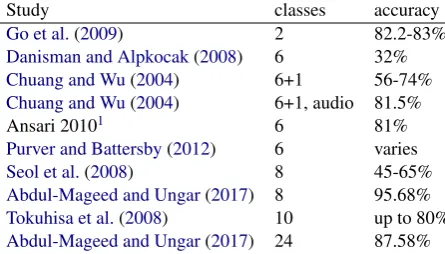
Table 1 shows the accuracies achieved by a few other multidimensional approaches (generally those of Ekman (1971)) using various classifi-cation methods such as SVMs, neural networks, maximum entropy, Na¨ıve Bayes, and k-Nearest Neighbor to name a few. When more classes are included in a model, accuracies achieved are typi-cally lower than what binary or ternary models of sentiment analysis achieve (Purver and Battersby, 2012;Tokuhisa et al., 2008), with the exception ofAbdul-Mageed and Ungar(2017) who apply a gated recurrent neural network model.
Study classes accuracy
Go et al.(2009) 2 82.2-83%
Danisman and Alpkocak(2008) 6 32%
Chuang and Wu(2004) 6+1 56-74%
Chuang and Wu(2004) 6+1, audio 81.5%
Ansari 20101 6 81%
Purver and Battersby(2012) 6 varies
Seol et al.(2008) 8 45-65%
Abdul-Mageed and Ungar(2017) 8 95.68%
Tokuhisa et al.(2008) 10 up to 80%
[image:3.595.74.297.63.190.2]Abdul-Mageed and Ungar(2017) 24 87.58%
Table 1: Accuracies achieved by previous studies
Although the data and methods are different, it seems reasonable to expect accuracies between 30-70% depending on the category for an initial multiclass classification. Depending on the avail-ability, we will try to apply our model to the same datasets that have been used in the studies listed in table1in order to directly compare results.
3 Gamifying the Annotation Platform
Our goal is to implement efficient crowd-sourcing throughgamification. Gamification refers the use of game elements in environments that are not typ-ically games (Deterding et al.,2011;Hamari and Koivisto,2013). Previous research shows that one can achieve a high number of quality annotations by non-experts by using carefully considered gam-ified aspects such as (1) Relatedness (connected to other players), (2) Competence (mastering the game problems), and (3) Autonomy (control of own life) (Musat et al.,2012).
Robson et al. (2015) posits that gamification can change behavior by tapping into motivational drivers of human behavior: reinforcements and emotions. The emotions we want to elicit are of course enjoyment, but negative emotions such as disappointment can also increase commitment and a desire to increase one’s competence. Sim-ilarly, both positive and negative reinforcements increase repetitive behavior in players (Robson et al.,2015).
Our platform offers players leaderboards and statistics about both their immediate and longterm progress (relatedness). Progress, rank and prestige are important measures that help players feel com-pensated for the work they are doing within the game (competence). Rank has an additional func-tion in our platform; as we lack a gold standard against which to compare the annotations we re-ceive, we use rank to determine noisy annotations
and noisy annotators. Furthermore, the player can see how each of their choice affects their standing in the ranks.
The dataset that the experiments in this paper rely on is our validated seed sentences. These sentences will be used as a type of seeded gold standard. What this means is that annotators will annotate both non-seed sentences and seed sen-tences. They receive a score from their annota-tion based on similarity with gold annotaannota-tions that determines their rank. In practice, rank is equiv-alent with confidence level. With enough partic-ipants, players will also be ranked according to how closely their annotations match those of high-ranked annotators. We, thus, have the option to include only the least noisy, highest quality anno-tations in our dataset.
In order to compare annotations, we map them on the inverted Plutchik’s wheel we propose in Figure1projected on a standard two-dimensional space with coordinates [x, y], where the least tense emotions are at the center and the most in-tense at the tips of the petals. The origin of our emotion space is located in the center of the wheel and represents the case of a neutral expression.
We can then calculate the distanceD(Gx, Gy)
between any pair of points corresponding to emo-tion labels GX and Gy by computing the
Eu-clidean distance normalized by the maximum dis-tance that can be observed between opposite emo-tions with maximum intensity. Assuming that ge-ometric location expresses the relatedness of emo-tions, this distance metric takes into account all different types of similarities/dissimilarities be-tween annotations, including labels that combine neighboring emotions.
The distance metric is the basis for the compu-tation of annocompu-tation confidenceCxfor new
anno-tation Gx that we obtain. We define annotation confidence as
Cx=Rannotator∗ 1
N n X
n=1
(1−Cn∗D(Gx, Gn))
where Gn ∈ {G1, .., GN} are annotations of the same instance (sentence) from the current gold standard with corresponding confidence scores
{C1, .., CN}.2 In other words, we add an aver-aged penalty for annotations that differ from exist-ing gold annotations weighted by their confidence scores. Note that our seed annotationsGsobtain
2Note that we setC
a perfect confidenceCs= 1. Another component
of the confidence score is the rank of the annota-tor based on the score Rannotator. This score is initialized with one and will be updated by each submitted annotation. Currently, we use a simple average over annotation confidence scores of that particular annotator:
Rannotator =
1
M M X
m=1
Cm
Our self-perpetuating gold standard with ranking-based confidence ratings will reduce the need for manual screening and will ensure that we can receive consistent emotion annotations with a measurable confidence attached to them.
4 Creating the Dataset
For the seed data, we used the following proce-dure: On completed expert annotation, another ex-pert annotates the same sentences with the data or-der randomized. Ambiguous sentences were re-viewed and the correct class was agreed upon. In some cases where no agreement could be reached the sentence was excluded from the seed dataset.
Our data collection will be unique in that it will provide a fine-grained multi-dimensional open source dataset for sentiment analysis and emo-tion detecemo-tion in various languages. Annotaemo-tion is on-going and the first real dataset will be avail-able later in 2018. For now we have a set of sentences with validated annotations that we will use as our seed data to get the gamified annota-tion started. This dataset has already been used to investigate sentiment preservation in Finnish, French, and Italian (Kajava,2018).
We wanted to make the dataset as useful as pos-sible to as many researchers as pospos-sible from the beginning. This is why we selected an open par-allel corpus, namely the OPUS movie subtitles corpus (Tiedemann, 2012;Lison and Tiedemann, 2016). From this collection, approximately 9,000 English sentences were annotated into the follow-ing emotion classes: anger, anticipation,disgust, joy,fear,sadness,surprise, andtrust. This yielded a preliminary dataset of between 649 to 908 sen-tences per class (see table4). For the classification experiments, we did not take into account the mea-sure of emotion intensity that we introduce later in our annotation framework, which is also part of the seed sentence annotation.
ang ant dis fea joy sad sur tru Total train 816 739 775 615 876 633 583 737 5,774 test 92 84 87 70 99 72 66 83 653
Table 2: Emotion distribution in seed data
We also keep the metadata and therefore all sentences can be paired with a particular movie, genre, time period, as well as its counterpart in an-other language. This is valuable information for future research avenues.
We expect to have a full dataset by the end of the year as we will be collecting at least 100 000 anno-tations in September-October of 2018 from crowd annotators (students). Snow et al.(2008) suggest using four non-experts to match the quality of one expert annotator, however, gamification, seed sen-tences, and rank-validation means that fewer an-notations per sentence might be sufficient using our platform. Inter-annotator agreement is on av-erage around 70-90% depending on the type of annotation and who is doing the annotation work (expert vs. non-expert) (Nowak and R¨uger,2010), and this is where annotator agreement was for our data as well, varying between classes.
Based on initial timed annotations, a typical an-notator can be expected to annotate up to 10 sen-tences per minute. This means that it only takes just over one hour to annotate around 600 sen-tences. If every annotator is asked to annotate 1000 sentences, this should not take more than a few hours each on average taking the learning curve into account. The students are encouraged to annotate in languages other than English as well, resulting in at least two or three separate datasets with an expected minimum of 40 000 annotations each. We currently have preliminary datasets for English, Italian, French, and Finnish.
5 Validation of the Data Quality
and 10%, respectively.
The MLP network used in this work is a three-layer network. The model creates a lexicon from the dataset using a bag-of-words approach, em-ploying it for extracting a set of features for each class. We use Adam for training the network and apply Rectified Linear Unit (ReLu) activiation functions in the hidden layers of feed-forward net-work.
Classifier Accuracy
NB 0.5069
[image:5.595.310.521.63.154.2]MLP 0.5023
Table 3: Overall classification accuracy
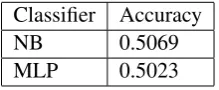
As can be seen in table 3, the baseline classi-fiers perform reasonably well for such a small data set and such a fine-grained task. Note that we did spend any time on optimizing features and hyper-parameters to obtain a better performance. The purpose of this study is entirely to test the feasi-bility of fine-grained classification and validity of our seed data.
In the confusion matrix for the best perform-ing classifier (see Table 4), we can see that there is some significant confusion between anger and fear, between disgust and sadness and also surpris-ingly between trust and fear. These are the same classes that others have struggled to distinguish (e.g. (Purver and Battersby, 2012)), which is re-assuring that our data is in good shape. With this promising performance on our pilot data set (de-spite its limited size) we are encouraged to pro-ceed with future experiments and the more fine-grained distinctions we propose that take intensity into account.
These experiments also demonstrate that the seed data is sufficient for initial classifications and that we can go ahead in developing our gami-fied strategy of getting more annotations based on correlations between annotators and their level of trust, which will initially be based on the compar-ison to the validated seed sentences.
6 Conclusions
In this paper, we present an open annotation tool for fine-grained emotion detection and a dataset of seed sentences that can be used to gamify the annotation efforts. The classification results show that the dataset is reliable enough to be used as seed sentences, indicating that gamification based
ang ant dis fea joy sad sur tru <- classified as
62 3 10 3 5 1 3 5 anger
9 43 6 1 5 1 5 14 anticipation
25 6 29 5 9 3 3 7 disgust
11 8 6 20 2 6 5 12 fear
2 4 5 1 77 2 3 5 joy
7 2 8 5 12 30 2 6 sadness
5 4 10 4 13 1 25 4 surprise
[image:5.595.127.237.194.239.2]5 3 5 3 16 3 2 45 trust
Table 4: Confusion matrix for NB-based classification of the test set.
on the seed data is a viable option for compil-ing sentiment datasets, and that multidimensional classification yields acceptable results even with a small dataset. However, already with our lim-ited validation experiments we can see that the choice of model and learning algorithm influences the quality of the resulting classifier. This is an im-portant outcome that needs to be considered when designing tools with scarce resources. We will continue to monitor performance to measure the impact of gamification and cross-lingual transfer on classification performance.
7 Discussion and Future Work
As our system collects both coarse (ternary) senti-ment annotations, and fine-grained emotion anno-tations, a future option could be to apply the suc-cessful approach demonstrated byTokuhisa et al. (2008), and utilize the coarser sentiment polarity to pre-classify data before emotion classification, and then implement a k-nearest neighbors algo-rithm on the larger dataset. Our platform does not show context by default, however, it is easy to add the context of the target segment to be annotated if required for a different type of project.
References
Muhammad Abdul-Mageed and Lyle Ungar. 2017. Emonet: Fine-grained emotion detection with gated recurrent neural networks. In Proceedings of the 55th Annual Meeting of the Association for Compu-tational Linguistics (Volume 1: Long Papers), vol-ume 1, pages 718–728.
Jorge Carrillo de Albornoz, Laura Plaza, and Pablo Gerv´as. 2012. Sentisense: An easily scalable concept-based affective lexicon for sentiment anal-ysis.
Alina Andreevskaia and Sabine Bergler. 2007. Clac and clac-nb: Knowledge-based and corpus-based approaches to sentiment tagging. In Proceedings of the 4th international workshop on semantic eval-uations, pages 117–120. Association for Computa-tional Linguistics.
Katarina Boland, Andias Wira-Alam, and Reinhard Messerschmidt. 2013. Creating an annotated corpus for sentiment analysis of german product reviews.
Fabio Calefato, Filippo Lanubile, and Nicole Novielli. 2017. Emotxt: a toolkit for emotion recognition from text.arXiv preprint arXiv:1708.03892.
Erik Cambria, Bj¨orn Schuller, Yunqing Xia, and Catherine Havasi. 2013. New avenues in opinion mining and sentiment analysis. IEEE Intelligent Systems, 28(2):15–21.
Ze-Jing Chuang and Chung-Hsien Wu. 2004. Multi-modal emotion recognition from speech and text.
International Journal of Computational Linguistics & Chinese Language Processing, Volume 9, Num-ber 2, August 2004: Special Issue on New Trends of Speech and Language Processing, 9(2):45–62.
Taner Danisman and Adil Alpkocak. 2008. Feeler: Emotion classification of text using vector space model. In AISB 2008 Convention Communica-tion, Interaction and Social Intelligence, volume 1, page 53.
Sebastian Deterding, Miguel Sicart, Lennart Nacke, Kenton O’Hara, and Dan Dixon. 2011. Gamifi-cation. using game-design elements in non-gaming contexts. In CHI’11 extended abstracts on human factors in computing systems, pages 2425–2428. ACM.
Ann Devitt and Khurshid Ahmad. 2008. Sentiment analysis and the use of extrinsic datasets in evalu-ation. InLREC.
Paul Ekman. 1971. Universals and cultural differences in facial expressions of emotion. InNebraska sym-posium on motivation. University of Nebraska Press.
G¨ulsen Eryigit, Fatih Samet Cetin, Meltem Yanik, Tanel Temel, and Ilyas C¸ ic¸ekli. 2013. Turksent: A sentiment annotation tool for social media. In
LAW@ ACL, pages 131–134.
Alec Go, Richa Bhayani, and Lei Huang. 2009. Twit-ter sentiment classification using distant supervision.
CS224N Project Report, Stanford, 1(12).
Anita Greenhill, Kate Holmes, Chris Lintott, Brooke Simmons, Karen Masters, Joe Cox, and Gary Gra-ham. 2014. Playing with science: Gamised aspects of gamification found on the online citizen science project-zooniverse. InGAMEON’2014. EUROSIS.
Juho Hamari and Jonna Koivisto. 2013. Social moti-vations to use gamification: An empirical study of gamifying exercise. InECIS, page 105.
Kaisla Kajava. 2018. Cross-lingual sentiment preser-vation in binary and multi-dimensional classifica-tion.
Tuomo Kakkonen and Gordana Gali´c Kakkonen. 2011. Sentiprofiler: creating comparable visual profiles of sentimental content in texts. Language Technolo-gies for Digital Humanities and Cultural Heritage, 62:189–204.
Jiwei Li and Eduard Hovy. 2017. Reflections on senti-ment/opinion analysis. InA Practical Guide to Sen-timent Analysis, pages 41–59. Springer.
Pierre Lison and J¨org Tiedemann. 2016. Opensub-titles2016: Extracting large parallel corpora from movie and tv subtitles.
Saif M. Mohammad and Peter D. Turney. 2013. Crowdsourcing a word-emotion association lexicon. 29(3):436–465.
Myriam Munezero, Calkin Suero Montero, Maxim Mozgovoy, and Erkki Sutinen. 2015. Emotwitter–a fine-grained visualization system for identifying en-during sentiments in tweets. InInternational Con-ference on Intelligent Text Processing and Compu-tational Linguistics, pages 78–91. Springer.
Claudiu-Cristian Musat, Alireza Ghasemi, and Boi Faltings. 2012. Sentiment analysis using a novel hu-man computation game. InProceedings of the 3rd Workshop on the People’s Web Meets NLP: Collabo-ratively Constructed Semantic Resources and Their Applications to NLP, pages 1–9, Stroudsburg, PA, USA. Association for Computational Linguistics.
Stefanie Nowak and Stefan R¨uger. 2010. How reliable are annotations via crowdsourcing: a study about inter-annotator agreement for multi-label image an-notation. InProceedings of the international con-ference on Multimedia information retrieval, pages 557–566. ACM.
Emily ¨Ohman, Timo Honkela, and J¨org Tiedemann. 2016. The challenges of multi-dimensional senti-ment analysis across languages. PEOPLES 2016, page 138.
F. Pedregosa, G. Varoquaux, A. Gramfort, V. Michel, B. Thirion, O. Grisel, M. Blondel, P. Pretten-hofer, R. Weiss, V. Dubourg, J. Vanderplas, A. Pas-sos, D. Cournapeau, M. Brucher, M. Perrot, and E. Duchesnay. 2011. Scikit-learn: Machine learning in Python. Journal of Machine Learning Research, 12:2825–2830.
Robert Plutchik. 1980. A general psychoevolutionary theory of emotion. Theories of emotion, 1:3–31.
Matthew Purver and Stuart Battersby. 2012. Experi-menting with distant supervision for emotion classi-fication. In Proceedings of the 13th Conference of the European Chapter of the Association for Com-putational Linguistics, pages 482–491. Association for Computational Linguistics.
Karen Robson, Kirk Plangger, Jan H. Kietzmann, Ian McCarthy, and Leyland Pitt. 2015. Is it all a game? understanding the principles of gamification. Busi-ness Horizons, 58(4):411 – 420.
Hassan Saif, Miriam Fernandez, Yulan He, and Harith Alani. 2013. Evaluation datasets for twitter senti-ment analysis: a survey and a new dataset, the sts-gold.
Yong-Soo Seol, Dong-Joo Kim, and Han-Woo Kim. 2008. Emotion recognition from text using knowledge-based ann. InITC-CSCC: International Technical Conference on Circuits Systems, Comput-ers and Communications, pages 1569–1572.
Rion Snow, Brendan O’Connor, Daniel Jurafsky, and Andrew Y Ng. 2008. Cheap and fast—but is it good?: evaluating non-expert annotations for natu-ral language tasks. InProceedings of the conference on empirical methods in natural language process-ing, pages 254–263. Association for Computational Linguistics.
Jorg Tiedemann. 2012. Parallel data, tools and inter-faces in opus. InProceedings of the Eight Interna-tional Conference on Language Resources and Eval-uation (LREC’12), Istanbul, Turkey. European Lan-guage Resources Association (ELRA).
Ryoko Tokuhisa, Kentaro Inui, and Yuji Matsumoto. 2008. Emotion classification using massive exam-ples extracted from the web. InProceedings of the 22nd International Conference on Computational Linguistics-Volume 1, pages 881–888. Association for Computational Linguistics.