Location Aware Multimedia Narratives
A thesis submitted to
The University of Dublin, Trinity College
For the degree of
Doctor of Philosophy
Valentina Nisi
School of Computer Science and Statistics
University of Dublin
DECLARATION
The work submitted in this thesis is, except where otherwise stated, entirely that of the author and has not been submitted as an exercise for a degree at this or any other university
Signed:
-ii-
PERMISSION TO LEND OR COPY
I agree that the library of the University of Dublin, Trinity College Dublin has permission to lend or copy this thesis
Signed:
-iii-
DEDICATION
-iv-
ACKNOWLEDGMENTS
This thesis has been a long journey that would have never been completed without the help
and support of a great number of people: friends, colleagues and experts in the various and
different fields that the interdisciplinary research approach relies upon. It will be difficult to
thank them all in the appropriate way, and I hope I will be excused if for reasons of brevity I
cannot mention them all by name.
First of all I wish to thank my supervisor Dr. Mads Haahr, who was there all along the good
and the bad times and believed in this work even during the most challenging moments that
we went through. It has been a long and windy journey we did together. It would have not
have been possible without all of your support, encouragment and patience!
And in order of appearance in my research journey, I wish to thank Marie Redmond and all
the MScMM multimedia lecturers and colleagues who inspired me to dive into the new and
challenging research topic of location-based stories and inteactive narratives. Glorianna
Davenport with who this journey started and was made possible. I wish to thank all the
members of the Story Networks research group at Media Lab Europe, in particular Jennica
Falk and Alison Woods whose warm and caring friendship made me feel at home even in the
toughest moments. I also wish to thank Colin Harris who introduced me to Ireland,
computers and research discipline. I wish to thank Linda Doyle who supported and
encouraged me to take the first steps into the research arena. A special thanks to Paolo Dini
who supported me during the year I worked with him and his research group at Media Lab
Europe, encouraging and stimulating me with questions, structure and wonderful discussions
about complexity, physics and its social relevance. I wish to acknowledge all my colleagues
and the staff at Media Lab Europe and Trinity College Dublin who helped in every phase of
the research and story production and all the actors, narrators, and production help for the
audiovisual productions. Unfortunately it is impossible to mention you all!
A special thanks to Ian Oakley without whom the MPL system would not exist and who
-v-
Matt Karau who provided me with a warm and friendly “shelter” during the last months of
writing.
I would like to thank Dr. Cristina Quinlann whose openmindness and skills made it possible
to connect different disciplines together into a coherent evaluation plan. A special thanks to
my friend Elise, who listened to all my complaints during the first months of writing and my
flatmates Mads, Rainer and Tilman who supported me and listened to all my complaints for
the rest of the time! Thanks to all my “users” who tested and re-tested the sytem with me.
Thanks to Christine, now happily living in Barcelona, for her discussion and suggestion in
the first evaluation phase.
I also wish to thank the colleagues and staff from the Distributed Systems Group of Trinity
College Dublin and in particular the CARMEN project colleagues and the Higher Education
Authority who supported it.
And last but definitely not least, huge thanks to Helena King, who painstakingly checked all
my English spelling and phrasing and spent so much time with me going through all the
thesis word by word. Helena, I can never thank you enough for that!
I also want to thank all my family who supported me all these years, even if they were far
away, and my sister Raffaella, who thanks to Skype, it nearly felt she was here with me most
-vi-
ABSTRACT
During the 1980s and the early 1990s, a considerable number of technology and application
trends were concerned with location transparency and virtual spaces, overcoming the
limitations of the physical space. Artists and technologists imagination was stimulated by the potential and the possibilities of Networked, Online, Virtual Reality (VR) technologies
developed around ideas of connecting people and sharing information, beyond the restraints
of their physical locations. Through the World Wide Web, information was made available to
people regardless of their physical location. VR technologies and simulations were used to
create immersive experiences for people to move around computer-generated spaces such as
3D museums or archaeological sites reproductions, making the real space were the people
were actually based, transparent.
The last half of the 1990s and the first years of the succeeding decade has seen a different
trend in technology: the development and popular uptake of mobile media and wireless
networks technologies. Mobile technologies such as phones and handheld computers
distinguish themselves from their predecessors by their ability to deliver and extract data
from the physical space at different times and locations. The increasing popularity of these
technologies brings to the foreground the importance of physical space. Real space combined
with mobile, wireless, location-aware technology becomes a primary platform for mobile
media applications. Because of the difference in the use of space between mobile
technologies and their static predecessors, new design principles are defining the poetic and
the potential for cultural and narrative augmentation of space. This thesis contributes to the
exploration of mobile media identifying a specific kind of applications: Location Aware
Multimedia Stories (LAMS) and outlining aesthetic principles and guidelines for mobile
narrative production end evaluation.
Narrative is a structure of the human mind for organizing events in time and space. It goes
back millennia and it has used different media across times and cultures. In contrast with
stories delivered through linear media, such as books or films, often, in interactive narratives
the story experience progresses through the readers’ choices, and the immersive paradigm is
-vii-
audience interrupts their suspension of disbelief and makes their choices as external
observers. For those narrative experiences that require constant immersion as a necessary
characteristic of the engagement of the reader with the interactive the story, the experience
can be weakened by the switch between the immersive state and the awareness of process. The approach to interactive narrative described in this thesis is intended to alleviate this
problem. LAMS foster the audience’s active engagement in the story by letting them
physically explore the real space in order to progress the narrative experience. The audience’s active exploration of the story world will provide them with a sense of agency without
disrupting the immersive feeling. The resonance between the narrated events and the real
place, created by overlapping the real world with the story space, reduces the dichotomy
between immersive and interactive experiences.
Furthermore, beyond its architectural layout, a place is a complex space, made of colors,
smells, temperature, sounds as well as history, personal and shared memories and anecdotes.
The work described in the thesis is based on the idea that access to memories and stories
relating to a place can be used to transform and complete our perception of it, enhancing the
poetic potential of the place and enriching the experience of the person traversing it. The
story’s emotional impact is tied to the real place surrounding the viewer. The place is merged
with the story in the audience’s mind. Furthermore LAMS can also function as memories
catalysts providing an incentive for people to retrieve memories and stories that relate to the
place where the experience is set. To achieve this result, we identify and focus on a particular
branch of locative media: Location-Aware Multimedia Stories (LAMS), where the place, its
stories and the people that use the space are central to the investigation. The spatial
distribution of the story in the relevant locations is considered a design element and
expressive tool for the author. Two LAMS systems were produced and analysed to identify a
set of guidelines for the design of LAMS. One system, the Hopstory narrative, investigates
how buildings can be used as containers of stories. A multiple point of view narrative
structure unfolds through the audience’s exploration of an enclosed architectural space. The
audience maintains engagement and immersion in the narrative through the exploration of the
real space, merging it with the story experience. The other system, the Media Portrait of the
Liberties (MPL), captures local community anecdotes and memories in the form of
-viii-
Local residents and more transient visitors, roam the neighbourhood streets and access stories
and memories of the place. A user study was specifically researched, designed and conducted
to examine the audience reactions to the location-aware narrative. The study shows that, as a
result of the experience, locals feel stimulated to recall anecdotes, engage in storytelling
activity among themselves as well as with people not familiar with the area. People external
to the local community, engage in a treasure hunt for stories through the physical exploration
of the area and end up with a deeper awareness of space perceived as a place. The findings
resulting from the detailed MPL evaluation are described in details in the discussion chapter.
From the discussion, a set of design principles for authors of Location-Aware Multimedia
Stories is distilled. These principles form the main contribution of this thesis to the field of
-ix-
TABLE OF CONTENTS
1 CHAPTER INTRODUCTION... 1
1.1 INTRODUCTION... 1
1.2 INTRODUCING LOCATIVE MEDIA... 1
1.2.1 FROM SPACE TO PLACE: A LOCATION-AWARE APPROACH. ... 3
1.2.2 THE POTENTIAL OF STORIES IN THE CONTEXT OF PLACES... 4
1.3 THE IMMERSION CHALLENGE... 6
1.4 THE THESIS... 8
1.5 CONTRIBUTIONS... 11
1.6 THESIS ROADMAP... 13
2 CHAPTER BACKGROUND... 14
2.1 NARRATIVE, INTERACTIVITY AND IMMERSION... 14
2.2 NARRATIVE AND STRUCTURE... 14
2.3 DIGITAL NARRATIVES AND INTERACTIVITY... 18
2.4 THE IMMERSION CHALLENGE... 21
2.5 LAMS: A PRACTICAL APPROACH TO THE IMMERSIVE CHALLENGE... 22
2.6 CONCLUSIONS: LOCATION-BASED NARRATIVES... 23
2.7 SUMMARY... 24
3 CHAPTER STATE OF THE ART... 25
3.1 INTRODUCTION... 25
3.2 SELECTION CRITERIA... 25
3.3 REVIEW STRATEGY... 28
3.4 JANET CARDIFF’S AUDIO AND VIDEO WALKS... 29
3.4.1THE MISSING VOICE (CASE STUDY B)(1999) ... 30
3.4.2THE TELEPHONE CALL (2001) ... 30
3.4.3HER LONG BLACK HAIR (2004)... 32
3.4.4ANALYSIS OF CARDIFF’S WALKS... 33
3.5 JEREMY HIGHT, JEFF KNOWLTON AND NAOMI SPELLMAN NARRATIVE ARCHAEOLOGY... 37
3.5.134NORTH 118WEST (2002) ... 37
3.5.2ANALYSIS... 39
3.6 TERI RUEB’S SOUND SPECIFIC INSTALLATIONS... 44
3.6.1INVISIBLE CITIES/SOUNDING BALTIMORE (2001) ... 44
3.6.2ANALYSIS... 46
3.7 [MURMUR] TORONTO BASED ART COLLECTIVE... 51
3.7.1[MURMUR] PROJECT (2003)... 51
3.7.2ANALYSIS... 52
3.8 MIT MEDIA LAB INTERACTIVE CINEMA RESEARCH GROUP AND MOBILE CINEMA. 56 3.8.1ANOTHER ALICE (2000-2002) ... 58
3.8.2MIT IN POCKET (20022005) ... 60
-x-
3.8.4ANALYSIS... 62
3.9 RIMINI PROTOKOLL... 69
3.9.1CALL CUTTA (2005)... 69
3.9.2ANALYSIS... 72
3.10 MOBILE BRISTOL CONTEXT SPECIFIC LOCATION AWARE DRAMA... 74
3.10.1RIOT!1831(2005) ... 74
3.10.2ANALYSIS... 75
3.11 ANALYSIS... 80
3.12 SYNTHESIS: LAMS... 85
3.13 SUMMARY... 85
4 CHAPTER CASE STUDY 1: HOPSTORY... 86
4.1 INTRODUCTION... 86
4.2 BUILDINGS AS CONTAINERS FOR STORIES... 86
4.3 HOPSTORY DESIGN AND METHODOLOGY... 90
4.3.1THE STORY DESIGN AND STRUCTURE... 91
4.4 IMPLEMENTATION OF THE HOPSTORY 1.0 ... 98
4.4.1THE TECHNOLOGY... 98
4.4.2THE HOPSTORY 1.0INSTALLATION... 100
4.4.3AUDIENCE REACTIONS TO HOPSTORY 1.0... 101
4.5 MODIFICATIONS FOR HOPSTORY 2.0... 106
4.5.1HOPSTORY 2.0DESIGN... 107
4.5.2TECHNICAL IMPLEMENTATION... 110
4.5.3EVALUATION... 111
4.6 SUMMARY... 113
5 CHAPTER CASE STUDY 2: THE MEDIA PORTRAIT OF THE LIBERTIES... 116
5.1 INTRODUCTION... 116
5.2 IN TO THE REAL... 117
5.3 PRELIMINARY RESEARCH... 119
5.3.1HISTORICAL PROFILE OF THE DUBLIN LIBERTIES... 119
5.3.2ELECTRONIC POSTCARDS FROM THE LIBERTIES:STORIES FROM THE STREETS... 121
5.3.3THE LIBERTIES COMMUNITY... 122
5.4 DESIGN METHODOLOGY FOR THE STORIES... 123
5.4.1REAL STORIES AS CONTENT FOR AN INTERACTIVE NARRATIVE... 123
5.4.2PRODUCTION PHASE... 124
5.4.3MODULAR STORY STRUCTURE... 127
5.5 TECHNOLOGICAL IMPLEMENTATION... 129
5.5.1CONTENT MODEL... 129
5.5.2THE MPLPLATFORM... 132
5.5.3THE MPLINTERFACE... 134
5.6 REFLECTIONS ON THE MPL DEVELOPMENT PROCESS... 138
5.6.1THE CONTENT AUTHORSHIP... 139
5.7 SUMMARY... 140
6 CHAPTER EVALUATION OF THE MPL... 142
6.1 EVALUATION STRATEGY... 142
6.1.1GENERAL ISSUES WITH THE EVALUATION OF INTERDISCIPLINARY PROJECTS... 142
-xi-
6.2 PILOT STUDY... 144
6.3 FIRST USER STUDY... 147
6.3.1PARTICIPANTS AND CONFIGURATION... 148
6.3.2ANALYSIS OF RESIDENTS’REACTIONS... 150
6.3.3ANALYSIS OF NON-RESIDENTS’REACTIONS... 152
6.3.4ANALYSIS OF MEDIA EXPERTS’REACTIONS... 153
6.3.5REFLECTIONS AND CONCLUSIONS... 154
6.4 SECOND USER STUDY... 157
6.4.1PARTICIPANTS AND CONFIGURATION... 157
6.4.2ANALYSIS OF COMMUNITY GROUP REACTIONS... 159
6.4.3ANALYSIS OF THE DUBLINERS GROUP REACTIONS... 168
6.4.4ANALYSIS OF THE FOREIGNERS GROUP REACTIONS... 179
6.5 REFLECTIONS ON THE SECOND USER STUDY... 187
6.5.1THE TECHNOLOGY... 187
6.5.2INTERFACE DESIGN... 189
6.5.3LAMSEXPERIENCE DESIGN... 190
6.5.4MEMORIES AND RECOLLECTIONS... 192
6.6 CONCLUSIONS FROM THE SECOND USER STUDY... 193
6.7 CONCLUSIONS OF THE MPL EVALUATION PROCESS... 195
7 CHAPTER DESIGN GUIDELINES... 198
7.1 HOPSTORY LAMS... 198
7.2 MEDIA PORTRAIT OF THE LIBERTIES LAMS ... 199
7.3 DESIGN GUIDELINES... 200
7.3.1THE USE OF REAL SPACE... 200
7.3.2ORCHESTRATING THE LAMSEXPERIENCE AS A WHOLE... 201
7.3.3THE NARRATIVES... 202
7.4 GENERAL REMARKS... 203
7.5 SUMMARY... 204
8 CHAPTER CONCLUSIONS... 205
8.1 ACHIEVEMENTS... 205
8.2 CONTRIBUTIONS... 207
8.3 FUTURE WORK... 208
8.4 CLOSING REMARKS... 210
APPENDIX A MPL CONTENT MODEL... 213
APPENDIX B QUESTIONNAIRE TEMPLATE ... 215
APPENDIX C DVD... 217
APPENDIX D DVD... 217
-xii-
INDEX OF FIGURES
Figure 1.1 Hopstory II. Right side of the image: Hopstory II hardware consisting in a Bluetooth enabled PDA. To the left of the image: screenshot detail of the graphical interface representing the building where the story takes place and the position of the cat shaped Bluetooth stations where the story information can be retrieved. ...9
Figure 1.2 Early sketch for the Media Portrait of the Liberties graphical interface. Square icons representing different states of the available content are superimposed to a map of the area where the content is distributed. ...10 The icons are depicting a representative frame selected from the audiovisual story they stand for. Semi- transparent icons with a blue Halo represent stories yet to be seen by the viewer while fully colored ones have already been viewed. ...10
Figure 3.1 Projects reviewed in the state of the art chapter grouped by authors and in chronological 27
Figure 3.2 Image illustrating the use of photographs in Janet Cardiff project: Her Long Black Hair. Picture retrieved from the Artcritical.com website ...32
Figure 3.3 Photograph illustrating users experiencing the 34 North 118 West project downtown Los Angeles, near the rail tracks where one of the stories takes place. Photograph from Jeremy Hight’s article “Narrative Archaeology”, on Streetnotes magazine website...39
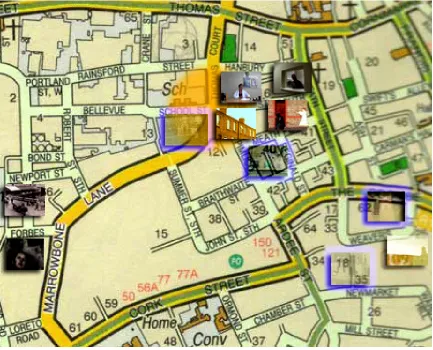
Figure 3.4 Image from the [murmur] website illustrating a user listening to a story from the phone interface of the [murmur] project. In the background is visible a green sign that indicates the presence of content related to that locations and the number the user has to dial in order to listen to it. ...52
Figure 3.5 Authoring application screenshot (upper part of the picture) and mobile device (bottom part of the picture) showing a video clip from the 15 minutes project. The authoring tools as well as the mobile display are part of the M-Views platform. The illustration is a screenshot from Pengkai Pan’s PhD thesis...57
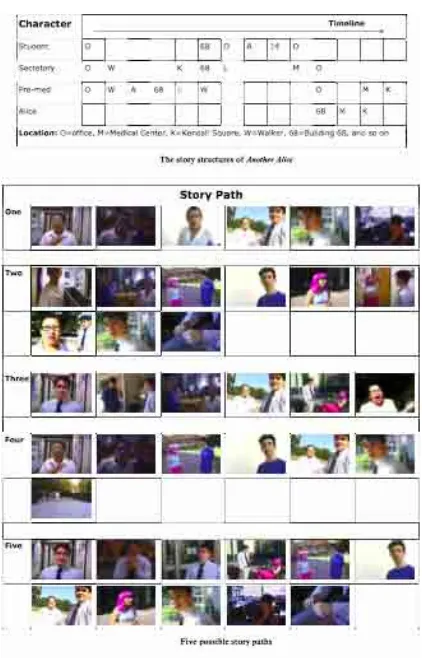
Figure 3.6 Screenshot of the M-Views authoring platform. The picture in particular illustrates different possible story paths in the Another Alice mobile story. The illustration is a screen shot from Pengkai Pan’s PhD thesis ...59
Figure 3.7 Screenshot of the Authoring tools of M-Views. The picture illustrates in particular different story locations on the MIT campus. Through this interface the authors can place a nd move content to be available at different locations of the campus. Illustration from Pengkai Pan’s PhD thesis ...61
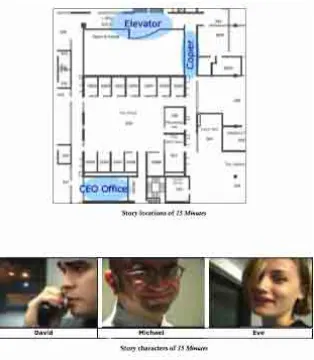
Figure 3.8 screenshot from M-Views authoring tool. Above, a map of the locations where the story content is retrievable. Below are three screenshots of main characters of 15 Minutes. Picture from Pengkai Pan’s PhD thesis ...62
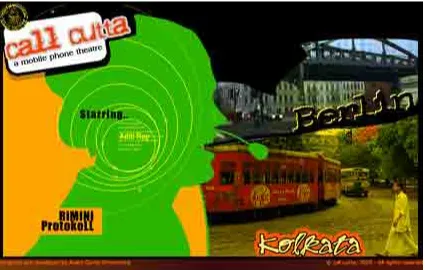
Figure 3.9 Screenshot from Rimini Protokol’s website illustrating the Call Cutta project...71
Figure 3.10 Map of Queen’s Square where the Riot!1831 interactive play is located. On the side of the right-hand side of the map there are some photographs of the important landmarks of the square, from top to bottom: the custom house, the statue of King William and Mrs Would’s house ...75
-xiii-
capture the authentic feel of the Hopstore as a Hopstore given by its stonewalls and dark lighting conditions. These atmosphere were captured in the Hopstory audiovisual in order to enhance the resonance between the story clips and the building itself...88
Figure 4.1 The structural storyboarding grid for Hopstory, space is reflected on the X axis of the grid while time is reflected on the Y axis . The initial storyboard for the Hopstory LAMS needed to capture the scene essential description as well as the characters movements through the building. Short description of the character actions were written on colored post it notes. Each post it has a different color depending on the point of view from which the action was described. Then each post it was positioned in relations to the time and space where the scene was going to be retrieve by the viewers.94
Figure 4.2 Working scheme for the storyboard structure. The grid illustrates the spatio-temporal construct of the Hopstory, indicating the position of each character and of the ambient scenes at any given time. Time is reported on the Y axis and space is referred as Post (1, 2..etc) on the X axis. A number of these charts were produced before finding the final structure for the story and the position of all the Hosptory scenes...95
Figure 4.3 Two screenshots from the Hopstory audiovisual content. To the left: Early morning: the foreman cycling to work at dawn and to the right: ambient scene of a street of the Liberties
neighbourhood, surrounding the Hopstore. ...96
Figure 4.4 Screenshots showing a sequence of frames of the girl character passing through the building. Attention was paid in the framing so to include the stone walls in the pictures to enable viewers to confront the visuals of the story with the real space surrounding them. ...97
Figure 4.5. Screenshots from the boy character‘s story. The selected frames a selection from the first scene to the last one of the boy’s character story. Attention was paid to maintain the same mood and atmosphere through out the character day...97
Figure 4.6 Photographs showing the iButton fob and how it is pressed in its receptor in the above part of the picture. Below the picture shows a Hop Store cat sculpture with receptor in position. ...99
Figure 4.7 Visual aids for the audience of the Hopstory experience. Above: a picture of the Hopstore floor with screenshots from the different story characters present at different locations of the floor space, representing a visualization of the Hopstory concept. Below: a map of the Hopstore floor where the Hopstory takes place with the cat where story content is available to the audience. ...102
Figure 4.8 Screenshot from the Boy’s story: the Boy behind the alcove. The video clip of this scene was available to the audience in front of the window featuring in the background of the shot in order to connect the audience experience of the building with the story world. ...104
Figure 4.9 A sketch for the redesign of the Hopstory 2.0 interface on a mobile device. The screen of the device shows a map of the building where the Hosptory experience takes place as well as the
characters encountered while roaming the space. In the bottom right corner the icon of the cat alerts the viewer when a cat station with available content has been found. ...106
Figure 4.10 On the left: Picture of the iPAQ Screen as the Hopstory 2.0 starts up. On the right: a close up of as the screen interface featuring the map of the building where the Hopstory takes place. ...107
Figure 4.11 On the left the picture shows a Bluetooth enable Cat node detail. On the right the picture shows a detail of the working interface with the map of the building, a character icon and the cat icon. ...108
-xiv-
Figure 4.13 Pictures of Interface details. To the left, the user is starting the applications through the touch screen interface. To the right: detail of the mobile device screen reporting of how many story
clips have been collected so far by the audience member and when. ...109
Figure 4.14 Picture illustrating some details of the Hopstory authoring software. Interface for the Story structure planning (above) and set up of the locations where the story is distributed in the real space of the building (below)...110
Figure 5.1 Selection of frames from the MPL story video clips. ...125
Figure 5.2 Community residents participating in the “Mickey Murphy’s Yard” story filming session. After the shooting, a storytelling and socializing session started spontaneously with local inhabitants of the neighbourhood. Photograph used as Courtesy of the author Rob Bourke ...126
Figure 5.3 Picture of The set of the traditional music session in “Mickey Murphy’s Yard”. Courtesy of Rob Bourke ...127
Figure 5.4 XML file starting the content model...130
Figure 5.5 XML section with description of characters ...131
Figure 5.6 XML description of one piece of content, corresponding to one story fragment ...131
Figure 5.7 The MPL mobile device interface. The pictures shows the GPS enabled iPAQ interface, showing a map of the Liberties neighbourhood and a number of authoring tools and navigations aids such as the radar, on the bottom right of the screen and the Developer’s Toolbar at the top of the screen. ...133
Figure 5.8 The picture show the developer’s toolbar: Detailed view with numbers corresponding to the button functions explained in the text below...135
Figure 5.9 Picture showing two screenshots of the graphical interface of the MPL. To the left: navigation aids such as the map, the radar, the green dots and the story icons as they would appear on the device used to experience the MPL. To the right: a text explanation of the functions of each icon present on the screen during the users experience of the MPL. ...138
Figure 6.2 Picture of the iPAQ device interface displaying different types of story icons depending on their relations to the location and the users history. ...188
Figure 6.3 Picture of the iPAQ interface: Story Icons completed with a play icon on the top right corner of the square, indicating the videoclip is available for viewing. The green dots on the map act as story placeholders and indicate where the story material is positioned in the neighbourhood. . ...190
INDEX OF TABLES Table 3.1 Location-based multimedia stories characteristics summary...81
Table 6.1 List of all participants of the first user study ...150
Table 6.2 Summary of the Community data extracted from the questionnaires ...163
Table 6.3 Summary of the Dubliners data extracted from the questionnaires...171
-1-
1
CHAPTER
INTRODUCTION
1.1Introduction
This thesis deals with the general area of location-aware multimedia applications. It stems
from the idea of using space and place as design elements in the construction and production
of audiovisual narrative artefacts. Fictional and real stories can be conceived, set and
produced and subsequently embedded in the actual locations to which they relate. These
narratives can be experienced by its audiences as they walk through the real space where the
stories are set, through mobile digital technologies. Experiencing the stories in the locations
they relate to strengthen the audience’s immersion in the narrative and contributes to creating
a sense of place in the audience’s mind by adding history and atmosphere to the space. This
chapter introduces the concept of Location-Aware Multimedia Stories (LAMS) as
cinematically rendered stories that are related to specific locations and embedded in real
space through location-aware mobile technologies. LAMS combine the mobility of the
audience with spatial distribution of the story content, challenging the immersive paradigm in
interactive multi-treaded narratives and creating a sense of place out of the surrounding
space. The next section of this chapter positions LAMS within the broader area of Locative
Media. Subsequently, the chapter considers the concepts of space and place and the ways in
which LAMS can build on these concepts by being spatially distributed in the real world.
1.2Introducing Locative Media
The term “Locative Media” refers to media applications that make use of mobile location
tracking technologies to combine content with location. Mark Tuters, head of the “Networked
publics” research group at the Annenberg Centre for Communication, University of Southern
California, writes: “Locative media refers to a mobile media movement in which location and
time are considered essential to the work” (Tuters 2005).
Researchers and artists in this domain have experimented with how the context in which the
user is situated can be incorporated in the user experience. The term was coined at the
Locative Media Workshop (RIXC 2003) organised by the Center for New Media Culture
-2-
Locative Art Network (PLAN) consortium in 2004 (Steve Benford, Drew Hemment et al.
2004), to describe the shift that is taking place in digital media as mobile and portable
technologies have become mainstream. Essentially, this shift relates to the fact that a users’
context and their movements through space need to be taken into consideration and
incorporated in the design process for a mobile system. Locative media encompasses a
number of different fields and applications: from games to art projects and academic
research. Authoring tools as well as games and narrative experiences are crafted to explore
the potential of locative media as a platform for expression and communication. To map the
territory of locative media in relation to this thesis, we distinguish between the following
areas:
• Location-aware tour guides (Abowd 1997)
• Authoring tools for annotating space (Lane 2003)
• Location based games (Steve Benford and 2006), (Steve Benford and Nick
Tandavanitj 2005)
• Location-aware narrative-driven projects (Pan 2001), (Teri 2005)
This last category is of particular relevance for this thesis. For this reason we subdivide it
further in:
1) Mobile distributed narratives, which deliver a narrative experience to a mobile
audience independently of where the story occurred or was initially conceived,
produced and demonstrated (David Crow 2003)
2) Site-specific narrative experiences: narratives that tell stories of particular places
through mobile technologies (Knowlton 2002), ([murmur] 2003-ongoing)
This latter type of narrative possesses a unique relationship to specific locations, and it is
-3-
1.2.1 From Space to Place: a Location-Aware Approach.
The difference between space and place is hard to define. It seems to us that while space
holds more concrete and identifiable qualities, such as coordinates and position, the
characteristics of place are more subtle. When we become familiar with a space it becomes a
place in our minds. Dean and Miller (Dean Tacita 2005) highlight this fact in their catalogue
Place. Scottish writer Samuel Smiles, who wrote about a “sense of place: something we rather feel than understand, an indistinct region of awareness.” (Smiles 1859). Stories are one
element that can transform spaces into places. As also note, Thomas Hardy also notes as he
writes in the Woodlanders (Hardy 2005) to belong in a place is:
To know all about those invisible ones of the days gone by, whose feet have traversed
the fields. What bygone domestic dramas of love, jealousy, revenge or
disappointment have been enacted in the cottages, the mansion, the street or on the
green.
Location-aware applications, and Location-aware Multimedia Stories in particular, address
the point raised by Hardy. They offer a way to present new information to people who do not
know the space as well as to those who are familiar with the place, often surprising them with
stories and anecdotes they were not aware of. Embedding meaningful content about a place in
the related location transforms the perception of that place in many ways: it can make the
space seem more familiar, or conversely, by presenting content that is at odds with a person’s
perceptions, it can lead to a process of de-familiarization. Smiles suggests that we all should
maintain an active engagement with a place, rather than relying on feelings of familiarity
about it.On a similar note, Proust argues that we should keep seeing a place, the same place,
with new eyes (Proust 1981). Locative media in general, has the potential to highlight, to
make us aware of, aspects of a place that we usually do not notice, that slip silently beneath
our perceptual radar. LAMS, in particular have the potential to stimulate a new view of
familiar places and hence to encourage a new kind of “sightseeing” among local residents, or
to draw visitors from other areas of the locale as well as tourists to locations that they would
-4-
express its history and personality, and stimulates the audience by augmenting the perception
of the space with stories, memories and a palpable atmosphere. Tourists as well as residents
see the space from a broader point of view, which can challenge their preconceptions or lead
them to form an entirely new vision of the space, transforming it into a familiar place. As
Dean and Miller (Dean Tacita 2005) state:
If a place is seen simply as a site, it is easily sacrificed for the national good, its
necessities and the global market. If the ‘secondary’ qualities of the place are denied it
becomes easier to destroy it. In a society that operates on a principle of economic
utility, the benefits presented by developers, investors or corporations are easier to
grasp than a more intangible sense of place, with its related notions of authenticity,
character and identity.
Any place can be considered a process of historical and narrative interpretations, a continuous
merging and superimposing of stories and locations. Combining location-aware applications
and cinematic mobile stories together we have the opportunity to bring these “secondary and
intangible qualities” of places to the foreground, allowing stories and spaces to enhance each
other and offering a new way of experiencing the significant but intangible sense of a place.
1.2.2 The Potential of Stories in the Context of Places
The idea of “place” has always been a critical matter to human thought in various disciplines.
Aristotele, in book IV of Physics, tells us that the question of what place is presents many
difficulties, and that an examination of all the relevant facts seems to lead to different
conclusions . Are space and place interchangable synonymous? Geographer Yu Fu Tuan
remarked: “ When space feels familiar to us, it has become a place” (Tuan 2001). Reflecting
on the nature of place and how we construct it, has been the concern in almost every area of
human activity from philosophy to geography. But this is hardly surprising — places, in the
form of a conjunction of the space through which we move and the time that we spend there,
are where we live. But these two dimensions (space and time) are woven together in a
complex relationship. How can we phrase and contextualise such a complex and dynamic
-5-
Sequential, multi-branch, multiple point of view, non-linear story structures, all deal with
content in terms of spatial and chronological organization. Furthermore, it is arguable that
narrative, when viewed as a cognitive model, is a mechanism for making sense of human
existence through time and space: a simplification and distillation of the enormous quantities
of information that make up our world into more manageable, meaningful and understandable
chunks. Furthermore, space and time have strong organizational properties: we naturally
order things either chronologically, through calendars and history books, or spatially.
Architectural forms have, in fact, served to structure knowledge since the time of the Greek
philosophers, and philosophy is the discipline that eventually led to the mnemonic techniques
developed during the Renaissance (Yates 1966). Moreover, Mark Meadows in his book on
the Art of interactive narratives, reminds us that:
Narrative and architecture have been woven together for millennia. Religious
architecture contains processional passages that tell us about events that have passed
or will come to pass (Meadows 2003)
Space is also a driving metaphor in digital technologies and interface design. The desktop
metaphor is an example of how we think about the entirely haphazard virtual contents of a
computer, and this metaphor can be summed up in one word: spatially. The spatial metaphor
is also a helpful interpretative scenario in interactive textuality (Ryan 2001a)
In this mapping, the text as a whole is a territory, the links are roads, the textual units,
destinations, the reader is a traveller or navigator, clicking is a mode of transportation
and the itinerary selected by the traveller is a story
Through mobile technologies we are able to take this metaphor further and challenge the
sedentary paradigm by bringing information into the real world, merging the physical space
with the digital. Unlike Virtual Reality (VR) technologies such as the CAVE Virtual Reality
System1 or Augmented Reality (AR) systems with head-mounted displays, portable devices
1
-6-
such as Personal Digital Assistants (PDAs) and smart phones do not try to mimic the real
world; instead they let you inhabit it. They enable the coupling of audio-visual content with
location in a different way: by allowing a person to experience virtual information and a real
place simultaneously. With the recent and rapid developments in the area of mobile digital
devices, the time is now ripe to use such devices to experiment with a new form of narrative
experience: Location-Aware Multimedia Stories. The mobile wireless and eminently portable
technologies available today provide new possibilities to creatively combine narrative with
real locations.
In the narrative domain, there is a long tradition of technological development leading to new
forms of story architecture and experience. From the ancient oral storytelling traditions,
through the development of pictograms, alphabets and printed media, not to mention moving
image technologies such as film and video, story authors can be seen to adopt and adapt
technology to produce new types of narrative. With linear media technologies, such as most
print and film, the author has the responsibility to order the content into a fixed time
sequence. Viewers can choose to respect this or not (by arriving late at the cinema, switching
off television, or jumping between the pages of a book), but are unable to fundamentally alter
it. For these narrative forms, the order of the presentation of the material represents an
important part of the process of authorship. However, this is not true of new, digitally
mediated types of narrative. From hypertext to interactive films, recent technologies have
encouraged a range of experiments that attempt to change the relationship between author,
content and audience. When considering locative media narratives there is yet another
element to take into account: the context, or place, in which a story can be experienced.
1.3The Immersion Challenge
In an interactive narrative (where the reader or viewer makes choices that affect the
progression of the story), the moment in which a choice is made is also a moment in which
the audience must interrupt their suspension of disbelief, their involvement and immersion in
the story, and make a choice as external observers of the story (Ryan 1999). In narratives
-7-
disrupts the story experience and can cause frustration (Bizzocchi 2003). A starting point of
the research being presented here has been how to alleviate this conflict.
However The definition of immersion as an outcome from mediated experiences can lead to
confusion. Bizzocchi, in his essay on games and narratives (Bizzocchi 2007) states that the
concept of immersion can have at least two distinct forms. These two distinct immersive
states, “suspension of disbelief” and “flow”, both emerging out of engaging with mediated
experiences, are fundamentally different. “Suspension of disbelief” is the oldest from, best
expressed by Coleridge as the willing surrender to the pleasure of the story (Coleridge, 1906,
Ch. XIV). Flow on the other hand, as defined by Csikszentmihalty, is the immersion of active
engagements with dynamic process (Csikszentmihalyi 1990)
Jim Bizzocchi in his paper Ceremony of Innocence and the subversion of Interface: A case study in Interactive narrative (Bizzocchi 2003), refers to a series of discussions among filmmakers (Bizzocchi 1994) on the creative possibilities emerging from interactive media.
He reports that the filmmakers themselves, after playing with a number of story based CD
Roms mentioned that they felt a basic contradiction between a state of narrative immersion,
intended as the classic suspension of disbelief defined by Coleridge (Coleridge 1952, c1906)
and the process of interaction. Bizzocchi later in the paper summarizes that eight years after
the experiment took place, although interactive narrative craft has progressed considerably,
the relationship between interaction and narrative immersion is still problematic. Later in the
paper Bizzocchi continues:
If we accept that the exercise of overt interaction has the capacity to disrupt some types
of narrative experience, what are the implications? And in particular what are the
implications for the creator of interactive narrative? Can we identify some strategies for
interactive narrative design that help to suture any potential disjuncture?
Accepting the above implications Bizzocchi continues:
There is a potential inconsistency between the experience of story and the process of
interaction. Many interactive narratives ask the interactor to switch between an
-8-
oscillation has the potential to disrupt the narrative experience.
Bizzocchi’s wording of the above paragraph, and in particular the use of potential before
inconsistency and disruption implies that the inconsistency or disruption does not occur for every reader or player and not in all the interactive narrative experiences. Only those
narrative experiences that require constant immersion as a necessary characteristic in the
engagement of the reader with the interactive work will be weakened by the switch between
the immersive state of immediacy and a hypermediated awareness of process.
Stories available to their audiences only in specific locations of a real space require their
audiences to physically explore the space in search of story fragments. This active
exploration fosters the audience’s engagement with the story and provides motivation for
them to continue with the narrative experience. Furthermore, because of the synergy exerted
on the narrative by being present in the real world, that is, in the very same places that appear
in the story, the audience’s feelings of immersion in the story world are strengthened. The
key issue being addressed in this thesis is how we can bring stories outside. The immersion as
well as the transformation of spaces into places are motivations of this thesis drawn from the
theory of and the experience with interactive narratives. Chapter 2 of this thesis examines in
further detail the problem of maintaining immersion in interactive narratives and the
possibility of addressing interactive narrative’s immersion issues through the use of space as
a design element.
1.4The Thesis
By addressing challenges pertaining to different disciplines, this research explores how
LAMS can enhance spaces, transforming them into places: how to reduce the dichotomy
between immersion and interaction, and how to stimulate, and eventually incorporate,
audience feedback into the creative process of crafting interactive stories.
In the emerging genre of LAMS, many disciplines come together. The process involves
various stages of authoring, capturing, designing and production. Not only must stories be
researched, written and dramatically rendered, but they must also be translated into visual
-9-
viewing must be carefully constructed. Through an interdisciplinary approach, two
location-based story projects were implemented and analysed for the research presented here. This
thesis focuses on the multiple processes involved, describes the design and production and
discusses in detail two locative story systems: HopStory and the Media Portrait of the
Liberties (MPL). Both of these systems were created taking into account the poetics of both
narrative and place. Each project takes a different approach to LAMS.
The HopStory (Figure 1.1) investigates how buildings can be used as containers of stories. A
multiple-point-of-view narrative unfolds through the audience’s exploration of an enclosed
architectural space. The audience maintains engagement and immersion in the narrative
through the exploration of the real space, merging it with the story experience.
Figure 1.1 Hopstory II. Right side of the image: Hopstory II hardware consisting in a Bluetooth enabled PDA. To the left of the image: screenshot detail of the graphical interface representing the building where the story takes place and the position of the cat shaped Bluetooth stations where the story information can be retrieved.
The Media Portrait of the Liberties (MPL) (Figure1.2) captures local community anecdotes
and memories in the form of multimedia fragments and embeds them in the real space of the
neighbourhood of Dublin’s Liberties. Local residents and transient visitors roam the
neighbourhood streets and access stories and memories of the place using mobile
aware devices. A user study was conducted to examine the audience reactions to the
location-aware narrative experience. By capturing and reporting the audience members’ reactions to
these locative story systems, the current research uncovers valuable insights into the
application of narrative in locative media systems. This practical, hands-on approach to
-10-
[image:26.595.72.505.131.481.2]production, and of a methodology for gauging audience reactions.
-11- 1.5Contributions
New media formats call for narrative architectures that take into consideration their flexible
and dynamic capabilities, hence the necessity to design and tell stories in new ways, taking
into account these new media characteristics. In doing so we have to pay particular attention
to the immersive feeling generated by traditional narrative experiences and analyse how this
feeling can be transposed to dynamically delivered content in interactive narratives. In order
to achieve positive results in building interactive and immersive narrative experiences, we
need to design stories that include the user choice as an aesthetic pleasure of an interactive
narrative experience. We need to experiment, build and test interactive mobile story
experiences, taking the audience feedback into account in the design practice. During the
process of building and evaluating our LAMS systems we have uncovered insights on many
aspects of locative media and narrative, from the design to production, to gauging and
recording audience reactions. These insights can be summarised as follows:
1) An interdisciplinary approach to LAMS and in the concrete experience it contains
in its descriptions of the design, production and evaluation of locative story systems
identifies design guidelines for future locative stories systems set in urban
environments. Through a detailed evaluation of one such system, MPL, we also make
concrete suggestions regarding software and information architecture, and
user-interface design, for location-aware story systems. In this way, this thesis provides an
experiential handbook from which others can learn about real prototypes and audience
reactions to them.
2) By embedding stories in physical space we challenge the immersive paradigm in
interactive stories. The physical browsing of real space in order to progress the
narrative experience alleviates the disruption of suspension of disbelief caused by the
act of choice and enhances the sense of agency and participation in the story world.
Furthermore we envisage LAMS functioning as place enhancers for it’s audiences in
general and memory and story catalyst for people already familiar with the place.
-12-
3) The development of the two location-aware cinematic stories is an aesthetic
contribution to the interactive, distributed-narrative domain and a key element for
determining our main contributions.
From these insights we derived our contributions to the field of locative media design,
highlighting the potential of LAMS applications. The contributions distilled from these
experiences involve:
• LAMS can help in relieving the disruption of immersion (suspension of disbelief) in
narratives that request user interaction in order to be experienced. We alleviate the
disruption of the immersive feeling in the interactive narrative experience by
co-locating the viewer and the narrative experience in the same locale where the story
took place, letting the viewer physically browse the real space in order to progress the
story experience.
• LAMS can function as place enhancers; they enhance spaces, transforming them into
places. Geographical co-ordinates and historical records do not give us the feeling of a
place but instead provide information about the space. Annotating a space with its
stories and anecdotes transforms the architectural and geographical space into a place.
• LAMS can provide incentives for the physical exploration of our urban landscapes,
with particular emphasis on forgotten or disadvantaged neighbourhoods. Audiences
composed of local residents as well as occasional visitors and tourists are enriched by
the experience and are left with a changed perception of the space and of the place.
People inhabiting the areas targeted by LAMS are stimulated in recalling and revisiting memories and stories of their place. As a consequence to this they develop a dialogue not only with the authors but also, and more importantly, among themselves
and their own memories, stories and histories. Such initiatives, if adopted and
sustained by communities, become growing repositories of local stories and culture,
providing a new kind of forum for recalling and celebrating the past and reflecting on
-13- 1.6Thesis Roadmap
Having introduced the research topic of location-based stories this thesis continues with six
further chapters. Chapter 2 describes the background on which this research is based,
describing the field of interactive narrative and defining terms and paradigms. Chapter 3
presents a state-of-the-art review of LAMS. Chapters 4 and 5 describe in detail the two
location-based story projects, the HopStory and the Media Portrait of the Liberties. Each of
these chapters presents sections on the design and production of its respective project and on
the reactions that each project engendered in its audience. Chapter 6 presents a detailed
evaluation of the MPL project, which was designed to capture the reactions of members of a
diverse audience to the work. Tourists, residents from the area in which the system was set,
and visitors from other neighbourhoods were accompanied on tours of the Liberties area
while experiencing the MPL system. The results of this process are catalogued and
documented and, through qualitative methods, subsequently analysed. The findings from this
evaluation are described in detail. Chapter 7 concludes with a reflection on location-based
stories, generalizing the findings from the detailed study of the MPL project and pointing to
-14-
2
CHAPTER
BACKGROUND
2.1 Narrative, Interactivity and Immersion
The purpose of this chapter is to give sufficient background information in order to make the
remainder of this thesis understandable. The chapter first provides an overview of narrative
theory and the different methods for structuring narrative content. It then introduces the
concept of interactivity and explains how it can be applied to narrative content. Next, it
presents a discussion of immersion in both literary and interactive texts, introducing the
incompatibility between interactive narrative and the feeling of immersion, a concept known
in literary theory as suspension of disbelief (Ryan 1999). Finally, the chapter examines how stories related to and delivered in real space can enhance the feeling of immersion in
interactive narrative experiences and how LAMS represent a promising field for
experimentation and possibly for significant discoveries that will influence the future of
storytelling.
2.2 Narrative and Structure
Narrative is a way for humans to make sense of their lives and position themselves in the
world. Wallace argues that if the structures at the basis of fictional narrative are the same as
those underlying history, biographies and the sense of the pattern of our lives, then narrative
structures are how we rebuild what happens and what matters to us as humans into stories
(Wallace 1986). In literary terms, narrative structure is referred to as plot, a term derived from Aristotle’s poetics. Plot in Aristotelian terms, is a combination of temporal succession
and causality, whereby events move from a stable point to complication to another
equilibrium point. We can visualize it as an inverted V (Wallace 1986).
The Aristotelian model, however, is only one type of structure that exists in narrative. Other
structures exist, for example, for poems, epic tales, collections of anecdotes regarding
specific themes, traditional folktales and oral storytelling, where the narrated events do not
-15-
Authors have been using classic narrative structures (deriving from the Aristotelian view of
narrative) for thousands of years. By doing so, they have accumulated knowledge and
practices in creating compelling and immersive narrative experiences within this framework.
Since the advent of digital media and hypertext, authors have started experimenting with
these technologies for narrative purposes. Following Ryan’s classification, classical narrative
structures have been adopted for interactive narrative purposes:
• The sequential narrative form (for example a diary or chronicle), is a list of events
written down in chronological order. Its interactive correspondent is a hypertext
system, in which each reading of the interlinked collection of lexias (the unit used to describe the smallest story fragment in hypertext) would generate a different sequence
of life events for the same character.
• The causal narrative, or problem-solving scheme, is conceived retrospectively: the narrator links together events in a causal chain. In interactive systems, adventure
games, for example, would usually adopt causal narrative structures. The player is
assigned a task and she progresses towards her goal by solving a series of problems
such as breaking free from a dungeon or overcoming a series of obstacles.
• In dramatic narrative, the author designs the path of the audience or readers through
the sequence of events that compose the narrative.The need to steer the user towards
a certain goal without revealing this purpose (in order not to spoil its effect) makes
dramatic structure the fullest and most immersive form of narrative, and at the same
time the most problematic for interactive design. I
Through the above classifications, Ryan shows us that we can indeed adapt the classical
linear narrative structures derived from Aristotle’s model to interactive stories (Ryan 2001a) .
Ryan illustrates how the sequential model can be transformed in a multiple path sequence of
events narrating a character’s life from different perspectives, and she demonstrates that
causal narrative structures lend themselves well to adventure games, for example. However,
the flexibility of computational media in storing, arranging, retrieving and presenting content
non--16-
linear, or non-sequential, modular, multi-branching and inclusive of multiple points of view.
A detailed discussion about the meaning of the terms linear, non-linear and non-sequential in
relation to electronic texts is given by Aarseth (Aarseth 1997). An overview of the numerous
possibilities of the electronic medium in structuring content is offered in the taxonomy of
interactive structures, set out by Ryan (Ryan 2001a). She lists the different types of
networked structures underlying interactive texts and describes how the story fragments
(lexias) can be connected together to form particular kind of structures. She enumerates
structures such as the graph, the vector and the flow chart and describes the different
mechanisms for linking these structures: unidirectional, bi-directional and circular paths. She
makes the following distinctions:
The complete graph, where paths are bi-directional. All the story fragments or lexias
are connected. The links can be used in both directions, to move from fragment A to
B and from fragment B to A.
The network, a hypertext style decision map allowing circuits. Lexias are linked to
each other through decision points, where the reader can choose to follow one or
another path through the story. Not all lexias are connected to each other, however,
and only certain paths are possible. Circuits or circular paths are also possible with
this structure, with the resulting possibility that the reader might end up on an already
experienced lexia.
The tree branching, where paths through the story resemble an inverse tree structure.
Starting from the first option (root), the reader is progressively presented with story
nodes and has to choose in which direction to progress the story (branches). All the
paths are unidirectional, from top to bottom, and every traversal of the tree story
structure produces a well-formed plot.
The vector with side branches. The story has a main plot direction that follows the direction of the vector. From this main flow of events, some side paths lead to
-17-
offers to the viewer the opportunity to explore side events that add to the main plot
but do not fundamentally change it. All the side branches return to the main vector.
The maze, or the adventure game structure. Viewers are challenged to explore a
space that has the characteristics of a maze. They have to find their way through it
and reach the exit.
The directed network or flow chart. In a manner similar to that of the multi-branching structure, the flowchart allows the reader to progress through the story by choosing
one path over another, in order to reach one or more conclusions. The links are
unidirectional, but there can be circular paths that result in readers looping around the
same lexias until they change their choices.
The hidden story. This interactive story model consists of two layers. One is the set
of events to be reconstructed, in a fixed, chronologically ordered sequence. The
second layer consists of the network of choices presented to the reader in order to
discover the facts of the story of the first layer. An interactive murder mystery, for
example, or a computer game such as “Myst” (Myst website 2006) would make use
of this structure.
The braided plot: the house of many windows. Multiple storylines run in parallel.
Each storyline offers different events and points of view of different characters on the
same main story plot.
The action space or epic wandering and story world. A story world is authored and the participant is free to explore it at the macro level. When the participant reaches a
particular site of the story world, the system takes control and guides him or her into
a self-contained adventure where the participant is manly a spectator of the events.
After outlining this classification, Ryan concludes that the potential of networks and
non-linear structures to generate a well-formed story is inversely proportional to their degree of
-18-
narrative is rigorously controlled by limiting decision points in the text, storytelling is not the
fundamental strength of the works based on these interactive structures (Ryan 2001a).
Instead, the key strengths lie in focusing on the local level of small and self-contained lexias
and the multimedia capabilities of the electronic medium, rather than its literary qualities.
Systems of links create flexible, customisable experiences through a collection of
semi-autonomous fragments, providing the satisfaction of an immediate experience of pictures,
sounds and short video. This leaves the user free to roam the collection of fragments without
feeling disrupted or constrained to retrieve the whole collection of lexias to complete the
experience (Ryan 2001a). In this perspective, LAMS follow the shift of digital narrative
towards smaller stories as opposed to grand narrative schemes. They provide their audience
with instant gratification in the form of video and sound at the moment of interaction, and
while physically navigating the story space. Increased enjoyment, or “magic moments”
(Reid Josephine 2005), is elicited as the audience members recognise and merge the story
they are experiencing through the digital medium with the real environment that they are
traversing.
2.3 Digital Narratives and Interactivity
The Concise Oxford Dictionary defines:
Interact: (verb, intransitive) act reciprocally; act on each other.
Interaction: (noun) reciprocal action or influence.
Interactive: (adjective) 1. reciprocally active; acting upon or influencing each other. 2. (of a computer or other electronic device) allowing a two-way flow of information between it and
a user, responding to the user’s input. (Oxford Dictionary 1995)
A system is said to be interactive when the user’s input modifies the system’s output. Murray
identifies interactivity and immersion as two key aesthetic elements of interactive narrative,
and she derives these elements from the combinations of the four main characteristics of
digital environments (Murray 1997). Murray argues that digital environments comprise the
following qualities:
-19-
• Participatory: they request the user’s participation in performing a task, for example
clicking on an icon to open a document.
• Spatial: they arrange data in a spatial way. The user can therefore use a spatial
metaphor to browse the content of the digital environment.
• Encyclopaedic: their capacity for storing information is superior to any other medium
ever invented.
Thus, procedural and participatory characteristics of digital media give the user the feeling of
interacting with the system, while immersion, or suspension of disbelief, is invoked by the
encyclopaedic and spatial qualities of the digital medium. The feeling of immersion in a
computer-mediated narrative is facilitated by the possibility of navigating a vast amount of
information.
In the case of narratives distributed in real space, a great part of the interactivity resides in the
physical navigation of the story structure. This action combines the sense of agency gained
by exploring a real place with selective interactivity (Ryan 2001a) where the user is encouraged to choose which link (or path) to follow in order to progress the story experience.
With this type of interactivity the audience input does not modify or influence the content
itself, but selects the order in which it is presented (p. 205) Furthermore Brenda Laurel,
points out that the sense of agency generated by the task of exploring a real space functions
as a highly interactive element in the user experience (Laurel 1991). Laurel adds that there
are other feelings besides the ability to change the course of events in a story that come into
play in the experience of an interactive narrative work. One of the most significant of these is
the feeling of being free to wander and explore a space. In addition, Laurel recognises that
beside the quantitative measures of interactivity, such as frequency (how often the user can
interact), range (how many choices are presented to the user), significance (how much the
user input affects the system), there is another factor that contributes to the experience: the
degree to which the users feel engaged and motivated to participate in the action. Successful
orchestration of these variables helps in creating a feeling of participation or agency in the
story and encourages sensory immersion. The coupling of kinesthetic input and visual



![Figure 3.4 Image from the [murmur] website illustrating a user listening to a story from the phone interface of the [murmur] project](https://thumb-us.123doks.com/thumbv2/123dok_us/1378901.671730/68.595.195.401.86.401/figure-image-murmur-website-illustrating-listening-interface-project.webp)