A Bootstrapping Method for Learning Semantic Lexicons using
Extraction Pattern Contexts
Michael Thelen and Ellen Riloff
School of Computing
University of Utah
Salt Lake City, UT 84112 USA
{
thelenm,riloff
}
@cs.utah.edu
Abstract
This paper describes a bootstrapping al-gorithm called Basilisk that learns high-quality semantic lexicons for multiple cate-gories. Basilisk begins with an unannotated corpus and seed words for each semantic category, which are then bootstrapped to learn new words for each category. Basilisk hypothesizes the semantic class of a word based on collective information over a large body of extraction pattern contexts. We evaluate Basilisk on six semantic categories. The semantic lexicons produced by Basilisk have higher precision than those produced by previous techniques, with several cate-gories showing substantial improvement.
1
Introduction
In recent years, several algorithms have been devel-oped to acquire semantic lexicons automatically or semi-automatically using corpus-based techniques. For our purposes, the termsemantic lexiconwill refer to a dictionary of words labeled with semantic classes (e.g., “bird” is ananimaland “truck” is avehicle).
Semantic class information has proven to be useful for many natural language processing tasks, includ-ing information extraction (Riloff and Schmelzen-bach, 1998; Soderland et al., 1995), anaphora resolu-tion (Aone and Bennett, 1996), quesresolu-tion answering (Moldovan et al., 1999; Hirschman et al., 1999), and prepositional phrase attachment (Brill and Resnik, 1994). Although some semantic dictionaries do exist (e.g., WordNet (Miller, 1990)), these resources often do not contain the specialized vocabulary and jargon that is needed for specific domains. Even for rela-tively general texts, such as the Wall Street Journal (Marcus et al., 1993) or terrorism articles (MUC-4 Proceedings, 1992), Roark and Charniak (Roark and Charniak, 1998) reported that 3 of every 5 terms
generated by their semantic lexicon learner were not present in WordNet. These results suggest that auto-matic semantic lexicon acquisition could be used to enhance existing resources such as WordNet, or to produce semantic lexicons for specialized domains.
We have developed a weakly supervised bootstrap-ping algorithm called Basilisk that automatically generates semantic lexicons. Basilisk hypothesizes the semantic class of a word by gathering collective evidence about semantic associations from extraction pattern contexts. Basilisk also learns multiple se-mantic classes simultaneously, which helps constrain the bootstrapping process.
First, we present Basilisk’s bootstrapping algo-rithm and explain how it differs from previous work on semantic lexicon induction. Second, we present empirical results showing that Basilisk outperforms a previous algorithm. Third, we explore the idea of learning multiple semantic categories simultaneously by adding this capability to Basilisk as well as an-other bootstrapping algorithm. Finally, we present results showing that learning multiple semantic cat-egories simultaneously improves performance.
2
Bootstrapping using Collective
Evidence from Extraction Patterns
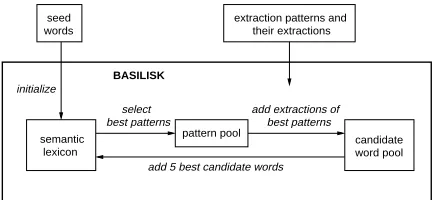
Basilisk (Bootstrapping Approach to SemantIc Lexicon Induction using Semantic Knowledge) is a weakly supervised bootstrapping algorithm that au-tomatically generates semantic lexicons. Figure 1 shows the high-level view of Basilisk’s bootstrapping process. The input to Basilisk is an unannotated text corpus and a few manually defined seed words for each semantic category. Before bootstrapping begins, we run an extraction pattern learner over the corpus which generates patterns to extract ev-ery noun phrase in the corpus.
The bootstrapping process begins by selecting a subset of the extraction patterns that tend to ex-tract the seed words. We call this the pattern pool.
The nouns extracted by these patterns become can-didates for the lexicon and are placed in acandidate word pool. Basilisk scores each candidate word by gathering all patterns that extract it and measur-ing how strongly those contexts are associated with words that belong to the semantic category. The five best candidate words are added to the lexicon, and the process starts over again. In this section, we describe Basilisk’s bootstrapping algorithm in more detail and discuss related work.
extraction patterns and their extractions
add extractions of best patterns best patterns
select
pattern pool semantic
lexicon words seed
candidate word pool
BASILISK
initialize
add 5 best candidate words
Figure 1: Basilisk Algorithm
2.1 Basilisk
The input to Basilisk is a text corpus and a set of seed words. We generated seed words by sorting the words in the corpus by frequency and manually identifying the 10 most frequent nouns that belong to each cat-egory. These seed words form the initial semantic lexicon. In this section we describe the learning pro-cess for a single semantic category. In Section 3 we will explain how the process is adapted to handle multiple categories simultaneously.
To identify new lexicon entries, Basilisk relies on extraction patterns to provide contextual evi-dence that a word belongs to a semantic class. As our representation for extraction patterns, we used the AutoSlog system (Riloff, 1996). AutoSlog’s extraction patterns represent linguistic expressions that extract a noun phrase in one of three syntac-tic roles: subject, direct object, or prepositional phrase object. For example, three patterns that would extract people are: “<subject>was arrested”, “murdered <direct object>”, and “collaborated with
<pp object>”. Extraction patterns represent linguis-tic contexts that often reveal the meaning of a word by virtue of syntax and lexical semantics. Extraction patterns are typically designed to capture role rela-tionships. For example, consider the verb “robbed” when it occurs in the active voice. The subject of “robbed” identifies the perpetrator, while the direct object of “robbed” identifies the victim or target.
Before bootstrapping begins, we run AutoSlog ex-haustively over the corpus to generate an extraction
Generate all extraction patterns in the corpus and record their extractions.
lexicon ={seed words}
i:= 0
BOOTSTRAPPING
1. Score all extraction patterns
2. pattern pool = top ranked 20+ipatterns 3. candidate word pool = extractions
of patterns inpattern pool
4. Score candidate words incandidate word pool 5. Add top 5 candidate words tolexicon
[image:2.612.77.296.200.300.2]6. i:=i+ 1 7. Go to Step 1.
Figure 2: Basilisk’s bootstrapping algorithm
pattern for every noun phrase that appears. The patterns are then applied to the corpus and all of their extracted noun phrases are recorded. Figure 2 shows the bootstrapping process that follows, which we explain in the following sections.
2.1.1 The Pattern Pool and Candidate Pool
The first step in the bootstrapping process is to score the extraction patterns based on their tendency to extract known category members. All words that are currently defined in the semantic lexicon are con-sidered to be category members. Basilisk scores each pattern using the RlogF metric that has been used for extraction pattern learning (Riloff, 1996). The score for each pattern is computed as:
RlogF(patterni) = Fi
Ni ∗log2(Fi) (1)
where Fi is the number of category members ex-tracted by patterni and Ni is the total number of nouns extracted bypatterni. Intuitively, theRlogF
metric is a weighted conditional probability; a pat-tern receives a high score if a high percentage of its extractions are category members, or if a moderate percentage of its extractions are category members and it extracts a lot of them.
The top N extraction patterns are put into a pat-tern pool. Basilisk uses a value of N=20 for the first iteration, which allows a variety of patterns to be considered, yet is small enough that all of the pat-terns are strongly associated with the category.1
1“Depleted” patterns are not included in this set. A
The purpose of thepattern poolis to narrow down the field of candidates for the lexicon. Basilisk col-lects all noun phrases (NPs) extracted by patterns in thepattern pooland puts the head noun of each NP into thecandidate word pool. Only these nouns are considered for addition to the lexicon.
As the bootstrapping progresses, using the same value N=20 causes the candidate pool to become stagnant. For example, let’s assume that Basilisk performs perfectly, adding only valid category words to the lexicon. After some number of iterations, all of the valid category members extracted by the top 20 patterns will have been added to the lexicon, leav-ing only non-category words left to consider. For this reason, thepattern poolneeds to be infused with new patterns so that more nouns (extractions) become available for consideration. To achieve this effect, we increment the value of N by one after each boot-strapping iteration. This ensures that there is always at least one new pattern contributing words to the candidate word poolon each successive iteration.
2.1.2 Selecting Words for the Lexicon
The next step is to score the candidate words. For each word, Basilisk collects every pattern that ex-tracted the word. All extraction patterns are used during this step, not just the patterns in the pat-tern pool. Initially, we used a scoring function that computes the average number of category members extracted by the patterns. The formula is:
score(wordi) =
Pi
X
j=1 Fj
Pi (2)
where Pi is the number of patterns that extract
wordi, and Fj is the number of distinct category members extracted by pattern j. A word receives a high score if it is extracted by patterns that also have a tendency to extract known category members. As an example, suppose the word “Peru” is in the candidate word pool as a possible location. Basilisk finds all patterns that extract “Peru” and computes the average number of known locations extracted by those patterns. Let’s assume that the three patterns shown below extract “Peru” and that the underlined words are known locations. “Peru” would receive a score of (2+3+2)/3 = 2.3. Intuitively, this means that patterns that extract “Peru” also extract, on average, 2.3 known location words.
“was killed in<np>”
Extractions: Peru, clashes, a shootout, El Salvador, Colombia
“<np>was divided”
Extractions: the country, the Medellin cartel, Colombia, Peru, the army, Nicaragua
“ambassador to <np>”
Extractions: Nicaragua, Peru, the UN, Panama
Unfortunately, this scoring function has a problem. The average can be heavily skewed by one pattern that extracts a large number of category members. For example, suppose wordwis extracted by 10 pat-terns, 9 which do not extract any category members but the tenth extracts 50 category members. The average number of category members extracted by these patterns will be 5. This is misleading because the only evidence linking wordw with the semantic category is a single, high-frequency extraction pat-tern (which may extract words that belong to other categories as well).
To alleviate this problem, we modified the scor-ing function to compute the averagelogarithmof the number of category members extracted by each pat-tern. The logarithm reduces the influence of any sin-gle pattern. We will refer to this scoring metric as theAvgLog function, which is defined below. Since
log2(1) = 0, we add one to each frequency count so that patterns which extract a single category mem-ber contribute a positive value.
AvgLog(wordi) =
Pi
X
j=1
log2(Fj+ 1)
Pi (3)
Using this scoring metric, all words in the candi-date word poolare scored and the top five words are added to the semantic lexicon. Thepattern pooland the candidate word pool are then emptied, and the bootstrapping process starts over again.
2.1.3 Related Work
and Singer, 1999; Cucerzan and Yarowsky, 1999)). (Collins and Singer, 1999) used contextual informa-tion of a different sort than we do. Furthermore, our research aims to learn general nouns (e.g., “artist”) rather than proper nouns, so many of the features commonly used to great advantage for named entity recognition (e.g., capitalization and title words) are not applicable to our task.
The algorithm most closely related to Basilisk is meta-bootstrapping (Riloff and Jones, 1999), which also uses extraction pattern contexts for semantic lexicon induction. Meta-bootstrapping identifies a single extraction pattern that is highly correlated with a semantic category and then assumes that all of its extracted noun phrases belong to the same cat-egory. However, this assumption is often violated, which allows incorrect terms to enter the lexicon. Riloff and Jones acknowledged this issue and used a second level of bootstrapping (the “Meta” boot-strapping level) to alleviate this problem. While meta-bootstrapping trusts individual extraction pat-terns to make unilateral decisions, Basilisk gath-ers collective evidence from a large set of extrac-tion patterns. As we will demonstrate in Sec-tion 2.2, Basilisk’s approach produces better re-sults than meta-bootstrapping and is also consid-erably more efficient because it uses only a single bootstrapping loop (meta-bootstrapping uses nested bootstrapping). However, meta-bootstrapping pro-duces category-specific extraction patterns in addi-tion to a semantic lexicon, while Basilisk focuses ex-clusively on semantic lexicon induction.
2.2 Single Category Results
To evaluate Basilisk’s performance, we ran experi-ments with the MUC-4 corpus (MUC-4 Proceedings, 1992), which contains 1700 texts associated with ter-rorism. We used Basilisk to learn semantic lexicons for six semantic categories: building, event,
hu-man,location,time, andweapon. Before we ran
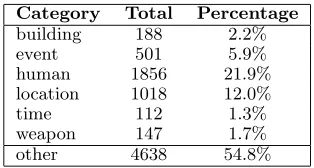
these experiments, one of the authors manually la-beled every head noun in the corpus that was found by an extraction pattern. These manual annota-tions were the gold standard. Table 1 shows the breakdown of semantic categories for the head nouns. These numbers represent a baseline: an algorithm that randomly selects words would be expected to get accuracies consistent with these numbers.
Three semantic lexicon learners have previously been evaluated on the MUC-4 corpus (Riloff and Shepherd, 1997; Roark and Charniak, 1998; Riloff and Jones, 1999), and of these meta-bootstrapping achieved the best results. So we implemented the meta-bootstrapping algorithm ourselves to directly
Category Total Percentage
building 188 2.2%
event 501 5.9%
human 1856 21.9% location 1018 12.0%
time 112 1.3%
[image:4.612.348.505.70.154.2]weapon 147 1.7% other 4638 54.8%
Table 1: Breakdown of semantic categories
compare its performance with that of Basilisk. A difference between the original implementation and ours is that our version learns individual nouns (as does Basilisk) instead of noun phrases. We believe that learning individual nouns is a more conservative approach because noun phrases often overlap (e.g., “high-power bombs” and “incendiary bombs” would count as two different lexicon entries in the origi-nal meta-bootstrapping algorithm). Consequently, our meta-bootstrapping results differ from those re-ported in (Riloff and Jones, 1999).
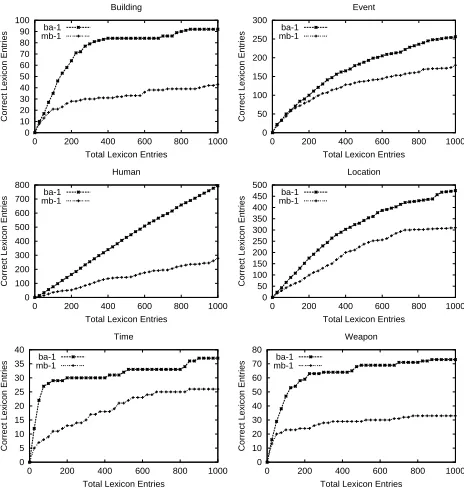
Figure 3 shows the results for Basilisk (ba-1) and meta-bootstrapping (mb-1). We ran both algorithms for 200 iterations, so that 1000 words were added to the lexicon (5 words per iteration). The X axis shows the number of words learned, and the Y axis shows how many were correct. The Y axes have different ranges because some categories are more prolific than others. Basilisk outperforms meta-bootstrapping for every category, often substantially. For the human and location categories, Basilisk learned hundreds of words, with accuracies in the 80-89% range through much of the bootstrapping. It is worth noting that Basilisk’s performance held up well on the human and location categories even at the end, achieving 79.5% (795/1000) accuracy for humans and 53.2% (532/1000) accuracy for locations.
3
Learning Multiple Semantic
Categories Simultaneously
We also explored the idea of bootstrapping multiple semantic classes simultaneously. Our hypothesis was that errors of confusion2between semantic categories can be lessened by using information about multi-ple categories. This hypothesis makes sense only if a word cannot belong to more than one semantic class. In general, this is not true because words are often polysemous. But within a limited domain, a word usually has a dominant word sense. Therefore we make a “one sense per domain” assumption (similar
2We use the termconfusionto refer to errors where a
0 10 20 30 40 50 60 70 80 90 100
0 200 400 600 800 1000
Correct Lexicon Entries
Total Lexicon Entries Building ba-1 mb-1 0 50 100 150 200 250 300
0 200 400 600 800 1000
Correct Lexicon Entries
Total Lexicon Entries Event ba-1 mb-1 0 100 200 300 400 500 600 700 800
0 200 400 600 800 1000
Correct Lexicon Entries
Total Lexicon Entries Human ba-1 mb-1 0 50 100 150 200 250 300 350 400 450 500
0 200 400 600 800 1000
Correct Lexicon Entries
Total Lexicon Entries Location ba-1 mb-1 0 5 10 15 20 25 30 35 40
0 200 400 600 800 1000
Correct Lexicon Entries
Total Lexicon Entries Time ba-1 mb-1 0 10 20 30 40 50 60 70 80
0 200 400 600 800 1000
Correct Lexicon Entries
Total Lexicon Entries Weapon
ba-1 mb-1
Figure 3: Basilisk and Meta-Bootstrapping Results, Single Category
to the “one sense per discourse” observation (Gale et al., 1992)) that a word belongs to a single semantic category within a limited domain. All of our ex-periments involve the MUC-4 terrorism domain and corpus, for which this assumption seems appropriate.
[image:5.612.69.301.75.320.2]3.1 Motivation
Figure 4 shows one way of viewing the task of se-mantic lexicon induction. The set of all words in the corpus is visualized as a search space. Each cate-gory owns a certain territory within the space (de-marcated with a dashed line), representing the words that are true members of that category. Not all ter-ritories are the same size, since some categories have more members than others.
A B C D E F 0000000000000000 0000000000000000 0000000000000000 0000000000000000 0000000000000000 0000000000000000 0000000000000000 0000000000000000 0000000000000000 0000000000000000 0000000000000000 0000000000000000 0000000000000000 0000000000000000 0000000000000000 0000000000000000 0000000000000000 0000000000000000 0000000000000000 0000000000000000 0000000000000000 0000000000000000 0000000000000000 0000000000000000 0000000000000000 0000000000000000 0000000000000000 0000000000000000 0000000000000000 0000000000000000 0000000000000000 0000000000000000 0000000000000000 0000000000000000 0000000000000000 0000000000000000 0000000000000000 0000000000000000 0000000000000000 0000000000000000 1111111111111111 1111111111111111 1111111111111111 1111111111111111 1111111111111111 1111111111111111 1111111111111111 1111111111111111 1111111111111111 1111111111111111 1111111111111111 1111111111111111 1111111111111111 1111111111111111 1111111111111111 1111111111111111 1111111111111111 1111111111111111 1111111111111111 1111111111111111 1111111111111111 1111111111111111 1111111111111111 1111111111111111 1111111111111111 1111111111111111 1111111111111111 1111111111111111 1111111111111111 1111111111111111 1111111111111111 1111111111111111 1111111111111111 1111111111111111 1111111111111111 1111111111111111 1111111111111111 1111111111111111 1111111111111111 1111111111111111
Figure 4: Bootstrapping a Single Category
Figure 4 illustrates what happens when a semantic lexicon is generated for a single category. The seed words for the category (in this case, category C) are represented by the solid black area in category C’s territory. The hypothesized words in the growing lexicon are represented by a shaded area. The goal of the bootstrapping algorithm is to expand the area of hypothesized words so that it exactly matches the category’s true territory. If the shaded area expands beyond the category’s true territory, then incorrect words have been added to the lexicon. In Figure 4, category C has claimed a significant number of words that belong to categories B and E. When generating a lexicon for one category at a time, these confusion errors are impossible to detect because the learner has no knowledge of the other categories.
[image:5.612.318.536.276.413.2]A C D E F B 0000000000 0000000000 0000000000 0000000000 0000000000 0000000000 0000000000 0000000000 0000000000 0000000000 0000000000 0000000000 0000000000 0000000000 0000000000 0000000000 0000000000 0000000000 0000000000 0000000000 0000000000 0000000000 0000000000 0000000000 0000000000 1111111111 1111111111 1111111111 1111111111 1111111111 1111111111 1111111111 1111111111 1111111111 1111111111 1111111111 1111111111 1111111111 1111111111 1111111111 1111111111 1111111111 1111111111 1111111111 1111111111 1111111111 1111111111 1111111111 1111111111 1111111111 0000000000000 0000000000000 0000000000000 0000000000000 0000000000000 0000000000000 0000000000000 0000000000000 0000000000000 0000000000000 0000000000000 0000000000000 0000000000000 0000000000000 0000000000000 0000000000000 0000000000000 0000000000000 0000000000000 0000000000000 0000000000000 1111111111111 1111111111111 1111111111111 1111111111111 1111111111111 1111111111111 1111111111111 1111111111111 1111111111111 1111111111111 1111111111111 1111111111111 1111111111111 1111111111111 1111111111111 1111111111111 1111111111111 1111111111111 1111111111111 1111111111111 1111111111111 00000000000 00000000000 00000000000 00000000000 00000000000 00000000000 00000000000 00000000000 00000000000 00000000000 00000000000 00000000000 00000000000 00000000000 00000000000 00000000000 00000000000 11111111111 11111111111 11111111111 11111111111 11111111111 11111111111 11111111111 11111111111 11111111111 11111111111 11111111111 11111111111 11111111111 11111111111 11111111111 11111111111 11111111111 00000000000 00000000000 00000000000 00000000000 00000000000 00000000000 00000000000 00000000000 00000000000 00000000000 00000000000 00000000000 00000000000 00000000000 00000000000 11111111111 11111111111 11111111111 11111111111 11111111111 11111111111 11111111111 11111111111 11111111111 11111111111 11111111111 11111111111 11111111111 11111111111 11111111111 00000000000000000 00000000000000000 00000000000000000 00000000000000000 00000000000000000 00000000000000000 00000000000000000 00000000000000000 00000000000000000 11111111111111111 11111111111111111 11111111111111111 11111111111111111 11111111111111111 11111111111111111 11111111111111111 11111111111111111 11111111111111111 0000000000000000 0000000000000000 0000000000000000 0000000000000000 0000000000000000 0000000000000000 0000000000000000 0000000000000000 0000000000000000 0000000000000000 0000000000000000 0000000000000000 0000000000000000 0000000000000000 0000000000000000 0000000000000000 0000000000000000 0000000000000000 0000000000000000 0000000000000000 0000000000000000 0000000000000000 1111111111111111 1111111111111111 1111111111111111 1111111111111111 1111111111111111 1111111111111111 1111111111111111 1111111111111111 1111111111111111 1111111111111111 1111111111111111 1111111111111111 1111111111111111 1111111111111111 1111111111111111 1111111111111111 1111111111111111 1111111111111111 1111111111111111 1111111111111111 1111111111111111 1111111111111111 000000 000000 000000 000000 000000 000000 111111 111111 111111 111111 111111 111111
Figure 5: Bootstrapping Multiple Categories
Figure 5 shows the same search space when lexi-cons are generated for six categories simultaneously. If the lexicons cannot overlap, then we constrain the ability of a category to overstep its bounds. Cate-gory C is stopped when it begins to encroach upon the territories of categories B and E because words in those areas have already been claimed.
3.2 Simple Conflict Resolution
[image:5.612.77.294.573.697.2]0 20 40 60 80 100 120
0 200 400 600 800 1000
Correct Lexicon Entries
Total Lexicon Entries Building
ba-M ba-1
0 50 100 150 200 250 300
0 200 400 600 800 1000
Correct Lexicon Entries
Total Lexicon Entries Event
ba-M ba-1
0 100 200 300 400 500 600 700 800
0 200 400 600 800 1000
Correct Lexicon Entries
Total Lexicon Entries Human
ba-M ba-1
0 100 200 300 400 500 600
0 200 400 600 800 1000
Correct Lexicon Entries
Total Lexicon Entries Location
ba-M ba-1
0 5 10 15 20 25 30 35 40
0 200 400 600 800 1000
Correct Lexicon Entries
Total Lexicon Entries Time
ba-M ba-1
0 10 20 30 40 50 60 70 80 90
0 200 400 600 800 1000
Correct Lexicon Entries
Total Lexicon Entries Weapon
[image:6.612.72.544.76.322.2]ba-M ba-1
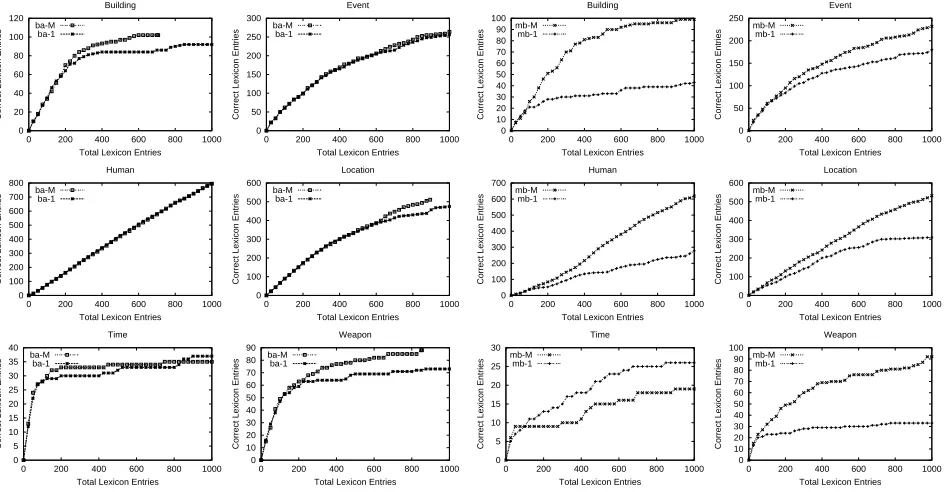
Figure 6: Basilisk, MCAT vs. 1CAT
is assigned to the category for which it receives the highest score. In Section 3.4, we will present empiri-cal results showing how this simple conflict resolution scheme affects performance.
3.3 A Smarter Scoring Function for Multiple Categories
Simple conflict resolution helps the algorithm recognize when it has encroached on another cate-gory’s territory, but it does not actively steer the bootstrapping in a more promising direction. A more intelligent way to handle multiple categories is to incorporate knowledge about other categories directly into the scoring function. We modified Basilisk’s scoring function to prefer words that have strong evidence for one category but little or no evidence for competing categories. Each wordwi in thecandidate word poolreceives a score for category
ca based on the following formula:
diff(wi,ca) = AvgLog(wi,ca) - max
b6=a (AvgLog(wi,cb))
whereAvgLogis the candidate scoring function used previously by Basilisk (see Equation 3) and the max function returns the maximum AvgLog value over all competing categories. For example, the score for each candidate location word will be its AvgLog
score for the location category minus its
maxi-mumAvgLog score for all other categories. A word is ranked highly only if it has a high score for the
0 10 20 30 40 50 60 70 80 90 100
0 200 400 600 800 1000
Correct Lexicon Entries
Total Lexicon Entries Building
mb-M mb-1
0 50 100 150 200 250
0 200 400 600 800 1000
Correct Lexicon Entries
Total Lexicon Entries Event
mb-M mb-1
0 100 200 300 400 500 600 700
0 200 400 600 800 1000
Correct Lexicon Entries
Total Lexicon Entries Human
mb-M mb-1
0 100 200 300 400 500 600
0 200 400 600 800 1000
Correct Lexicon Entries
Total Lexicon Entries Location
mb-M mb-1
0 5 10 15 20 25 30
0 200 400 600 800 1000
Correct Lexicon Entries
Total Lexicon Entries Time
mb-M mb-1
0 10 20 30 40 50 60 70 80 90 100
0 200 400 600 800 1000
Correct Lexicon Entries
Total Lexicon Entries Weapon
mb-M mb-1
Figure 7: Meta-Bootstrapping, MCAT vs. 1CAT
targeted category and there is little evidence that it belongs to a different category. This has the effect of steering the bootstrapping process away from am-biguous parts of the search space.
3.4 Multiple Category Results
We will use the abbreviation 1CAT to indicate that only one semantic category was bootstrapped, and MCAT to indicate that multiple semantic categories were simultaneously bootstrapped. Figure 6 com-pares the performance of Basilisk-MCAT with con-flict resolution (ba-M) against Basilisk-1CAT (ba-1). Most categories show small performance gains, with
the building, location, and weapon categories
benefitting the most. However, the improvement usually doesn’t kick in until many bootstrapping it-erations have passed. This phenomenon is consistent with the visualization of the search space in Figure 5. Since the seed words for each category are not gener-ally located near each other in the search space, the bootstrapping process is unaffected by conflict reso-lution until the categories begin to encroach on each other’s territories.
0 20 40 60 80 100 120
0 200 400 600 800 1000
Correct Lexicon Entries
Total Lexicon Entries Building
ba-M+ ba-M mb-M
0 50 100 150 200 250 300
0 200 400 600 800 1000
Correct Lexicon Entries
Total Lexicon Entries Event
ba-M+ ba-M mb-M
0 100 200 300 400 500 600 700 800 900
0 200 400 600 800 1000
Correct Lexicon Entries
Total Lexicon Entries Human
ba-M+ ba-M mb-M
0 100 200 300 400 500 600
0 200 400 600 800 1000
Correct Lexicon Entries
Total Lexicon Entries Location
ba-M+ ba-M mb-M
0 5 10 15 20 25 30 35 40 45
0 200 400 600 800 1000
Correct Lexicon Entries
Total Lexicon Entries Time
ba-M+ ba-M mb-M
0 10 20 30 40 50 60 70 80 90 100
0 200 400 600 800 1000
Correct Lexicon Entries
Total Lexicon Entries Weapon
[image:7.612.345.507.66.472.2]ba-M+ ba-M mb-M
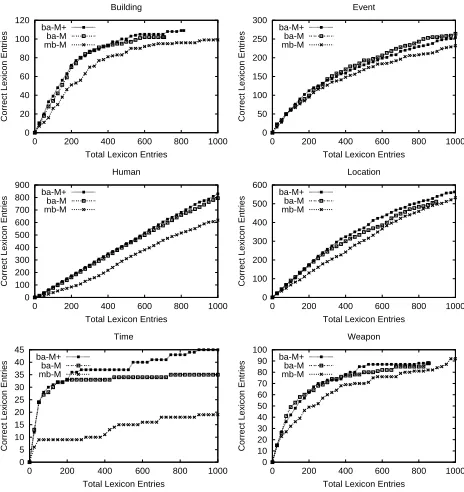
Figure 8: MetaBoot-MCAT vs. Basilisk-MCAT vs. Basilisk-MCAT+
more pronounced than for Basilisk. It seems that Basilisk was already doing a better job with errors of confusion, so meta-bootstrapping had more room for improvement.
Finally, we evaluated Basilisk using thediffscoring function to handle multiple categories. Figure 8 com-pares all three MCAT algorithms, with the smarter diff version of Basilisk labeled as ba-M+. Over-all, this version of Basilisk performs best, showing a small improvement over the version with simple conflict resolution. Both multiple category versions of Basilisk also consistently outperform the multiple category version of meta-bootstrapping.
Table 2 summarizes the improvement of the best version of Basilisk over the original meta-bootstrapping algorithm. The left-hand column rep-resents the number of words learned and each cell in-dicates how many of those words were correct. These results show that Basilisk produces substantially bet-ter accuracy and coverage than meta-bootstrapping. Figure 9 shows examples of words learned by Basilisk. Inspection of the lexicons reveals many un-usual words that could be easily overlooked by some-one building a dictionary by hand. For example, the words “deserter” and “narcoterrorists” appear in a variety of terrorism articles but they are not com-monly used words in general.
We also measured the recall of Basilisk’s lexicons after 1000 words had been learned, based on the gold
Total MetaBoot Basilisk
Words 1CAT MCAT+
building
100 21 (21.0%) 39 (39.0%) 200 28 (14.0%) 72 (36.0%) 500 33 (6.6%) 100 (20.0%) 800 39 (4.9%) 109 (13.6%) 1000 43 (4.3%) n/a
event
100 61 (61.0%) 61 (61.0%) 200 89 (44.5%) 114 (57.0%) 500 146 (29.2%) 186 (37.2%) 800 172 (21.5%) 240 (30.0%) 1000 190 (19.0%) 266 (26.6%)
human
100 36 (36.0%) 84 (84.0%) 200 53 (26.5%) 173 (86.5%) 500 143 (28.6%) 431 (86.2%) 800 224 (28.0%) 681 (85.1%) 1000 278 (27.8%) 829 (82.9%)
location
100 54 (54.0%) 84 (84.0%) 200 99 (49.5%) 175 (87.5%) 500 237 (47.4%) 371 (74.2%) 800 302 (37.8%) 509 (63.6%) 1000 310 (31.0%) n/a
time
100 9 (9.0%) 30 (30.0%) 200 13 (6.5%) 33 (16.5%) 500 21 (4.2%) 37 (7.4%) 800 25 (3.1%) 43 (5.4%) 1000 26 (2.6%) 45 (4.5%)
weapon
100 23 (23.0%) 42 (42.0%) 200 24 (12.0%) 62 (31.0%) 500 29 (5.8%) 85 (17.0%) 800 33 (4.1%) 88 (11.0%) 1000 33 (3.3%) n/a
Table 2: Lexicon Results
standard data shown in Table 1. The recall results range from 40-60%, which indicates that a good per-centage of the category words are being found, al-though there are clearly more category words lurking in the corpus.
4
Conclusions
[image:7.612.69.301.75.321.2]demon-Building: theatre store cathedral temple palace penitentiary academy houses school mansions
Event: ambush assassination uprisings sabotage takeover incursion kidnappings clash shoot-out
Human: boys snipers detainees commandoes extremists deserter narcoterrorists demonstrators cronies missionaries
Location: suburb Soyapango capital Oslo regions cities neighborhoods Quito corregimiento
Time: afternoon evening decade hour March weeks Saturday eve anniversary Wednesday
Weapon: cannon grenade launchers firebomb car-bomb rifle pistol machineguns firearms
Figure 9: Example Semantic Lexicon Entries
strated that learning multiple semantic categories si-multaneously improves the meta-bootstrapping algo-rithm, which suggests that this is a general observa-tion which may improve other bootstrapping algo-rithms as well.
5
Acknowledgments
This research was supported by the National Science Foundation under award IRI-9704240.
References
Chinatsu Aone and Scott William Bennett. 1996. Ap-plying machine learning to anaphora resolution. In
Connectionist, Statistical, and Symbolic Approaches to Learning for Natural Language Understanding, pages 302–314. Springer-Verlag, Berlin.
E. Brill and P. Resnik. 1994. A Transformation-based Approach to Prepositional Phrase Attachment Disambiguation. In Proceedings of the Fifteenth In-ternational Conference on Computational Linguistics (COLING-94).
S. Caraballo. 1999. Automatic Acquisition of a Hypernym-Labeled Noun Hierarchy from Text. In
Proceedings of the 37th Annual Meeting of the Associ-ation for ComputAssoci-ational Linguistics, pages 120–126.
M. Collins and Y. Singer. 1999. Unsupervised Models for Named Entity Classification. InProceedings of the Joint SIGDAT Conference on Empirical Me thods in Natural Language Processing and Very Large Corpora
(EMNLP/VLC-99).
S. Cucerzan and D. Yarowsky. 1999. Language Inde-pendent Named Entity Recognition Combining Morph ological and Contextual Evidence. In Proceedings of the Joint SIGDAT Conference on Empirical Me thods in Natural Language Processing and Very Large Cor-pora (EMNLP/VLC-99).
W. Gale, K. Church, and David Yarowsky. 1992. A method for disambiguating word senses in a large cor-pus. Computers and the Humanities, 26:415–439.
Niyu Ge, John Hale, and Eugene Charniak. 1998. A sta-tistical approach to anaphora resolution. In Proceed-ings of the Sixth Workshop on Very Large Corpora.
M. Hearst. 1992. Automatic Acquisition of Hy-ponyms from Large Text Corpora. InProceedings of the Fourteenth International Conference on Computa-tional Linguistics (COLING-92).
Lynette Hirschman, Marc Light, Eric Breck, and John D. Burger. 1999. Deep Read: A reading comprehension system. InProceedings of the 37th Annual Meeting of the Association for Computational Linguistics.
M. Marcus, B. Santorini, and M. Marcinkiewicz. 1993. Building a Large Annotated Corpus of English: The Penn Treebank. Computational Linguistics, 19(2):313–330.
George Miller. 1990. Wordnet: An on-line lexical database. InInternational Journal of Lexicography.
Dan Moldovan, Sanda Harabagiu, Marius Pa¸sca, Rada Mihalcea, Richard Goodrum, Roxana Gˆirju, and Vasile Rus. 1999. Lasso: A tool for surfing the
an-swer net. InProceedings of the Eighth Text REtrieval Conference (TREC-8).
MUC-4 Proceedings. 1992. Proceedings of the Fourth Message Understanding Conference (MUC-4). Mor-gan Kaufmann, San Mateo, CA.
E. Riloff and R. Jones. 1999. Learning Dictionaries for Information Extraction by Multi-Level Bootstrapping. InProceedings of the Sixteenth National Conference on Artificial Intelligence.
E. Riloff and M. Schmelzenbach. 1998. An Empirical Approach to Conceptual Case Frame Acquisition. In
Proceedings of the Sixth Workshop on Very Large Cor-pora, pages 49–56.
E. Riloff and J. Shepherd. 1997. A Corpus-Based Ap-proach for Building Semantic Lexicons. In Proceed-ings of the Second Conference on Empirical Methods in Natural Language Processing, pages 117–124.
E. Riloff. 1996. Automatically Generating Extraction Patterns from Untagged Text. In Proceedings of the Thirteenth National Conference on Artificial Intelli-gence, pages 1044–1049. The AAAI Press/MIT Press.
B. Roark and E. Charniak. 1998. Noun-phrase Co-occurrence Statistics for Semi-automatic Semantic Lexicon Construction. InProceedings of the 36th An-nual Meeting of the Association for Computational Linguistics, pages 1110–1116.