Abstract—The machine tools are known to be the ubiquitous
instruments of modern manufacturing and they formed the bases for industrial development. Incredible dynamism in machine tools development requires an assessment based on utilization level, and determines the scope of job for economic choice of machine tools. The factors that were considered paramount for the assessment included labour versatility (age, sex, experience); maintainability (number of breakdown and preventive maintenance stoppage, maintenance complexity, available machine hours); functionality (frequency of use, demand rate); and level of technological innovation/acquisition as related to some factors included rate of turnover, customer satisfaction, reduction in price and raw materials. Forty structured questionnaires were administered among the selected machine tools industries in Nigeria to collect data on the afore-stated factors, among others. Descriptive statistical method based on percentages was utilized for evaluating the performances of the identified factors. Maintainability performance was determined using maintenance ratio based on percentage stoppage of identified machine tools including lathe, milling and drilling machines. The results obtained showed that lack of experience and retraining of personnel had militated against effective utilization of machine tools in Nigerian industries. Speedy pace of technological innovation/acquisition in the machine tools industries had been hindered by goods importation and high cost of fuel.
Index Terms—Industrial development, machine tools,
operational profitability, technological innovation.
I. INTRODUCTION
Machine tools played a vital role in the development of many countries. It supports virtually every aspect of material standard of living [1]. Machine tools are important because they are the ubiquitous instruments of modern manufacturing
Manuscript received March 18, 2010. This work was supported by the Industrial and Production Engineering research group of the Federal University of Technology, Akure, Nigeria, under Grant IPE000052.
B. Kareem is with the University of Benin, P.M.B. 1154, Benin City, Nigeria, on sabbatical leave from the Federal University of Technology, P.M.B. 704, Akure, Nigeria (phone: +234-803-373-7251, email:
[email protected], [email protected]).
O.O. Awopetu, is with the Federal University of Technology, P.M.B. 704, Akure, Nigeria (e-mail: [email protected]).
P.K. Oke is with the Federal University of Technology, P.M.B. 704, Akure, Nigeria (e-mail: [email protected]).
B.O. Akinnuli is with the Federal University of Technology, P.M.B. 704, Akure, Nigeria (e-mail: [email protected]).
S.P. Ayodeji is with the Federal University of Technology, P.M.B. 704, Akure, Nigeria (e-mail: [email protected], [email protected]). P.B. Mogaji is with the Federal University of Technology, P.M.B. 704, Akure, Nigeria (e-mail: [email protected]).
and occupied an iconic position in debates on industrial modernization. The recent changes from conventional system to numerical control (NC), and computer numerical control (CNC) systems, among others, have created incredible dynamism in advancement of industrial production processes [2]. This technological advancement has given solution to difficulty of engaging in mass production with little efforts [3], [4]. It is now possible to machine multi- products on the machine tools such as lathe, milling, drilling and shaping machines, to the required precision at barely credible speeds.
Nonetheless, solving the technological challenges of mass-production may not be enough in developing economy, where resources such as manpower, experience and training requirements for operating the high technology equipment are scarce to get [5], [6], [9]-[11]. Instead, the choice of machine tools in such economy may be determined base on operational effectiveness in terms of maintainability (repair complexity), kind of labour available, (skilled, trainee, experienced, and aged), level of technological awareness (low, or high), demand rate (job complexity), and functionality of machine tools (turning, shaping and planning). A proper management of these influencing factors of operational effectiveness of machine tools would enhance economic use of resource during the machining processes. Traditionally, machine tools are being selected based on factors such as cost, capacity, reliability and risk involved. Selected machinery can still undergo make or buy analysis. Make or buy analysis is carried out on machinery in order to determine technological-know-how of producing it or cost of procurement.
The technological capability of producing machine tool is limited in most of the developing countries [7], [8], [12]-[17]. This made the second option of buying analysis be more pronounced. In this situation, assessment of operational effectiveness of such procured machines in terms of maintainability, reliability, skill requirements, and among others, becomes important.
II. METHODOLOGY
Factors that affected operational effectiveness of machine tools in developing countries such as Nigeria were identified. These factors included: personnel requirements (including sex composition, age distribution, marital status, and year of experience); level of technology acquisition (to sustain technological innovation (TIN), economical and political threat (EPT), rate of turnover (RTO), customer satisfaction (CSA), export and import (EIM), privatization (PRI), government tariff (TAG), motivation policy (MPO),
An Assessment of Machine Tools Utilisation
Effectiveness in the Developing Economy
intensive system in place (INS), price of fuel (RPF), raw material usage (RMA), and machine tool versatility (VMA) ); frequency of use of machine tools (including lathe and milling machine); machine tools repair complexity; functional ability; and function based on frequency of use.
Operational effectiveness of machine tools was ascertained by administering forty four (44) structured questionnaires on the identified factors influencing operation effectiveness of the existing machine tools in the production industries located in Osogbo, Lagos, among other cities of Nigeria. Reponses from the questionnaire on the identified factors were analysed using descriptive statistical methods based on percentages. Further analysis based on weighted percentage was carried out on factors such as functionality and frequency of use of machine tools. Maintenance complexity was measured, based on established percentage stoppages for breakdown, preventive or predictive maintenance under unit, series and mass production system. Maintenance complexity was estimated using (1), and (2) as:
b
= (S
bx
R
c) / (R
cx
H
m) (1)p
= (S
px
R
c) / (R
cx
H
m) (2)Where;
b
,
p = percentage stoppage for breakdown andpreventive maintenance, respectively.
b
S
,S
p = monthly breakdown and preventive maintenancestoppage.
c
R
= repair complexity of machine tools.m
H
= available hours of machine in a month.III. RESULTSANDDISCUSSION
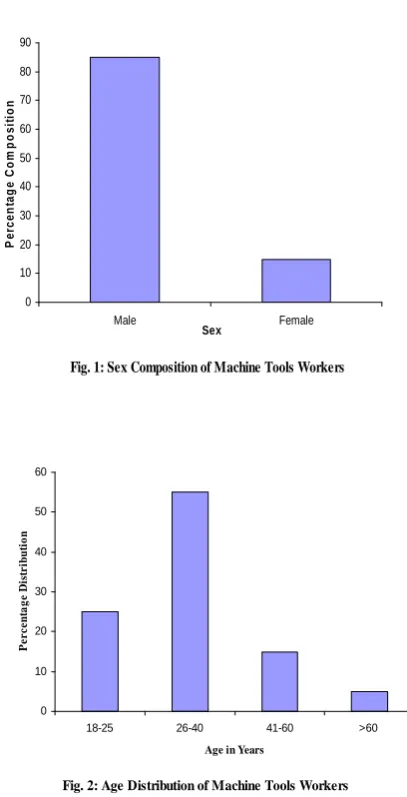
[image:2.595.322.526.68.467.2]The quantity of male and female involved in the machine tool industries is shown in Fig. 1. The results obtained showed that about 85% of the personnel were male while the balance of 15% was female. This has indicated that the large proportion of male employees in machine tools industries were supportive to production enhancement. The age distribution of the workers (Fig. 2) revealed that there were younger personnel in the machine tool industry than older people. The higher percentage (55%) obtained was the age of young personnel, then there is high potential for effective performance. In case of marital status of the workers (Fig. 3) there were more married workers (60%) than single. Therefore, there will be stability of labour in the industry since married workers are less prone to mobility than single ones. The rate of labour turnover will increase as a result of worker stability enjoyed by the industry.
Fig. 1: Sex Composition of Machine Tools Workers 0
10 20 30 40 50 60 70 80 90
Male Female
Sex
P
e
rcen
ta
g
e
C
o
m
p
o
s
it
io
n
Fig. 2: Age Distribution of Machine Tools Workers
0 10 20 30 40 50 60
18-25 26-40 41-60 >60
Age in Years
Percen
ta
g
e D
is
trib
u
ti
o
[image:2.595.325.514.82.246.2]n
Fig. 3: Marital Status of Machine Tools Workers 0
10 20 30 40 50 60 70
Single Married
Status
P
e
rce
n
tag
e
o
f W
o
rker
s
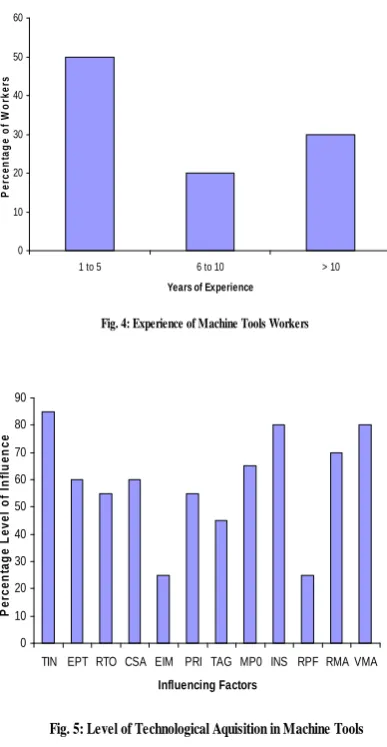
[image:2.595.318.527.506.639.2]technological innovation in Nigerian machine tools industry is excellent (about 85%). Some other factors were also supportive to technological attainment; these included intensive system, versatility of machine, and raw material availability. However, export and import, and price of fuel have hindered greatly the operation effectiveness of machine tools industries.
[image:3.595.319.497.52.221.2]The result of analysis based on frequency of use of the identified models of machine tool is presented in Fig. 6. It was shown that all the identified machine tools were both occasionally and often used. The machine tools such as lathe, milling, drilling, circular saw, among others were always in use in many industries, whereas hobbing, corner locking and plate shearing processes were rarely used. However, the frequency of use of machine tools in developing economy was appreciable in enhancing operational effectiveness.
Fig. 4: Experience of Machine Tools Workers
0 10 20 30 40 50 60
1 to 5 6 to 10 > 10
Years of Experience
[image:3.595.65.259.275.649.2]P er ce n tag e o f W o rker s
Fig. 5: Level of Technological Aquisition in Machine Tools 0 10 20 30 40 50 60 70 80 90
TIN EPT RTO CSA EIM PRI TAG MP0 INS RPF RMA VMA
Influencing Factors P e rc e nt a ge L e v e l o f I nf lue nc e
Fig. 6: Frequency of Use of Machine Tools 0 20 40 60 80 100 120 E ngi ne Lat he M il lin g D rill in g H obbi ng C or ner Loc k ing B roac hi ng Pr e s s P lat e S hear Ra d ia l D ri ll V e rt ic a l D ril l C ir c ul ar S aw R o ll in g B endi ng T ur re t Lat he S hapi ng G ri ngi ng Machine Tools/Operations P e rc e nt a ge Fr e q ue n c y of U s e Always Quite Often Occassionally
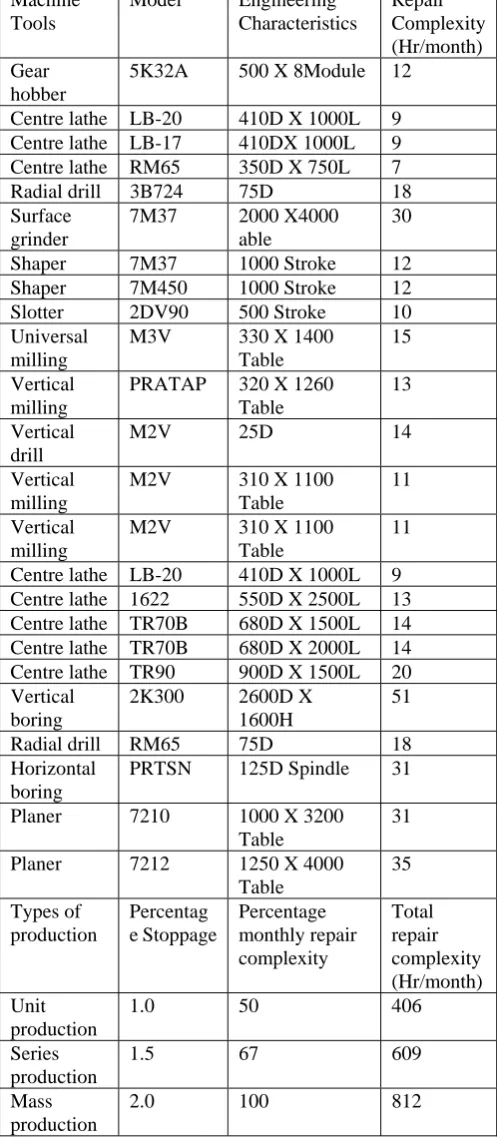
Maintenance complexity determines the magnitude of percentage stoppages for carrying out repair and preventive maintenance. The results of the maintenance complexity (Table I and Fig. 7) established that machine tools can easily be maintained. Both repair and preventative maintenance complexities were estimated as 406, 609 and 812 hrs/month, respectively for unit, series, and mass production using established maintenance stoppages of 1 %, 1.5 %, and 2 %. This indicated that more maintenance crews will be required under mass production than unit and series categories. The functional and weighted percentages results (Fig. 8) showed that all the identified machine tools were capable of carrying out their intended functions. However, there was disparity between the estimated functional ability and function based on the frequency of use. Results similar to this were gotten for the mentioned cases under weighted estimation. Surprisingly, the functional demand of centre lathe which had 60 % of functional ability was 14.4 %. In the case of milling operations, functional demand was estimated as 16.6% over its 50 % functional ability. This showed that milling operations were demanded more than lathe operations (Figs. 8 and 9).
Fig. 7: Monthly Repair Complexity of Machine Tools 0 20 40 60 80 100 120
Unit Production Series Production Mass Production
Types of Production
[image:3.595.65.263.278.428.2] [image:3.595.328.551.554.707.2]Table I: Monthly Repair Complexity of Machine Tools
Machine Tools
Model Engineering Characteristics
Repair Complexity (Hr/month) Gear
hobber
5K32A 500 X 8Module 12 Centre lathe LB-20 410D X 1000L 9 Centre lathe LB-17 410DX 1000L 9 Centre lathe RM65 350D X 750L 7
Radial drill 3B724 75D 18
Surface grinder
7M37 2000 X4000
able
30
Shaper 7M37 1000 Stroke 12
Shaper 7M450 1000 Stroke 12
Slotter 2DV90 500 Stroke 10
Universal milling
M3V 330 X 1400 Table
15 Vertical
milling
PRATAP 320 X 1260 Table
13 Vertical
drill
M2V 25D 14
Vertical milling
M2V 310 X 1100 Table
11 Vertical
milling
M2V 310 X 1100 Table
11 Centre lathe LB-20 410D X 1000L 9 Centre lathe 1622 550D X 2500L 13 Centre lathe TR70B 680D X 1500L 14 Centre lathe TR70B 680D X 2000L 14 Centre lathe TR90 900D X 1500L 20 Vertical
boring
2K300 2600D X
1600H
51
Radial drill RM65 75D 18
Horizontal boring
PRTSN 125D Spindle 31
Planer 7210 1000 X 3200 Table
31 Planer 7212 1250 X 4000
Table
35 Types of
production
Percentag e Stoppage
Percentage monthly repair complexity
Total repair complexity (Hr/month) Unit
production
1.0 50 406
Series production
1.5 67 609
Mass production
2.0 100 812
Fig. 8: Utilisation based on Functional Ability 0
10 20 30 40 50 60 70
Engi ne L
athe Drilling
Turre t La
the Shapi
ng Grin
ding Millin
g
Broac hing
Honn ing
Machine Tools/Operations
P
e
rc
e
nt
a
ge
Fu
nc
ti
on
Actual Function
Weighted Function
Fig. 9: Function of Machine Tools based on Frequency of Use
0 2 4 6 8 10 12 14 16 18
Engi ne La
the Drilli
ng
Turre t La
the Shap
ing Grind
ing Milli
ng
Broa chin
g Honn
ing
Machine Tools/Operations
P
e
rc
e
nt
a
ge
F
unc
ti
o
n
Actual Function
Weighted Function
IV. CONCLUSION
Operational effectiveness of the machine tools industry in developing countries such as Nigeria was assessed. The factors identified to be influencing the operational effectiveness were skill of personnel, level of technology acquisition, functional ability, demand, and maintenance complexity. Descriptive statistical analysis based on percentages was used to determine level of response for the stated factors. Analysis based on maintenance stoppage was used to evaluate maintenance complexity of the identified machine tools.
From the results it can be concluded that:
i. The existing personnel in the machine tools industry, has potential of sustaining the operational effectiveness except that more experienced personnel are needed to support the existing staff. Training and retraining of staff may also assist in this direction.
[image:4.595.47.296.69.642.2]some areas of high fuel cost, export and import markets.
iii. Frequencies of use of machine tools were supportive to economy of operation in all the identified machine tools but there were laxities in few areas of hobbling, locking and shearing operations.
iv. Maintenance complexity of the machine tools was within the control, and the outcomes were highly supportive to mass production with increased maintenance crew.
v. Milling machine showed highest weighted functional ability as compared to other machine tools. This showed that the expected jobs that required milling operations were more than other operations.
vi. Centre lathe and turret lathes were highly favoured by its level of utilization weighting scale. This showed that lathe was frequency used for facing and turning operations before the use of other machine tools such as milling, for complex operations. Generally, the machine tools industry in Nigeria has potential to operate effectively with special care for personnel in terms of experience acquisition through training and retraining in-house or abroad.
ACKNOWLEDGMENT
B. Kareem thanks the managements of the Federal University of Technology, Akure, Nigeria and the University of Benin, Benin City, Nigeria for providing an enabling environment, which is conducive for carrying out this study.
REFERENCES
[1] C.O. Afolayan, “Raw Material Development for Machinery and Manufacturing”, Proceedings of the National Engineering Conference
and Annual General Meeting, 2004, pp 1-9.
[2] D. Finegold, The Decline of the US Machine Tools Industry and
Prospects for its Sustainable Recovery, Rand, Santa Monica, CA.
1994.
[3] L. Godkin, “Problem and Practicalities of Technology Transfer: a Survey of the Literature”, International Journal of Technology
Management, Vol. 3, No. 5, 1988, pp 587-599.
[4] H.W. Gottinger, “A Strategic Management Decision Support Tool for Technology Management”, Technology Management, Vol. 4, No. 2, 1989, pp 23-29.
[5] B. Kolade, “Capital Goods Development and Production in Nigeria Viewed from the Perspective of the Iron and Steel Industry”,
Proceedings of the Nigerian Economic Society Annual Conference,
Minna, May 1990, pp 77-78.
[6] G.O.A Laditan, “Technology Acquisition and Endogenous Technology Capabilities Accumulation- The Case of Nitrogenous Fertilizer Plant in Nigeria”, The Journal of the Nigerian Institute of
Social and Economic Research, Vol.15, No. 1 and 2, 2000, pp 89-108.
[7] O. Olaniyan, “Development of Databse Software for Evaluating Capacity Build-Up of a Machine Tools Industry”, M.Eng. Thesis, the Federal University of Technology, Akure, Nigeria, Unpublished. [8] A.O. Olaoye, “Total Productivity Trends in Nigeria Manufacturing
Industries”, Nigerian Journal of Economic and Social Studies, Vol. 27, No. 3, 1985, pp 317-324.
[9] A.W. Obi, “Perspective Planning for Nigeria’s Capital Goods Sector”,
Nigerian Journal of Economic and Social Studies, Vol. 31, No. 1,
1989, pp 47-64.
[10] A. Offiong, and E.F. Nsien, “A Markov- Chain Application of Technical Manpower Forecasting in Manufacturing Firm”, Nigerian Journal of Industrial and Systems Studies, Vol. 2, No. 2, 2003, pp 6-13. [11] A.O. Oke, A.A. Aderoba, and T.O. Adebisi, “Perspective of Electricity
Supply and Demand in Nigeria”, Nigerian Journal of Industrial and Systems Studies, Vol. 2, No. 4, 2007, pp 12-23.
[12] B. Oni, “A Framework of Technology Capacity Building in Nigeria: Lessons from Developed Countries”, Institute for World Economics
and International Management, University of Bremen, Germany.
1999.
[13] NMT, Nigerian Machine Tools Guide Brief Magazine, Osogbo, Nigeria, 1994a.
[14] NMT, Nigerian Machine Tools House Magazine, Osogbo, Nigeria, 1994b. .
[15] K. Philip,: Marketing Management Analysis: Planning and Control, McGraw-Hill, New Jersey, 1984.
[16] M. Radnor, “Technology Acquisition Strategies and Processes- A Reconsideration of the Make Verses Buy Decision”, International
Journal of Technology Management, Special Publication on Role of
Technology in Corporate Policy, 1991, pp 113-135. [17] D.M. Smith, Industrial Location: An Economic Geographical