RelaxCor Participation in CoNLL Shared Task on Coreference Resolution
Emili Sapena, Llu´ıs Padr´o and Jordi Turmo∗ TALP Research Center
Universitat Polit`ecnica de Catalunya Barcelona, Spain
{esapena, padro, turmo}@lsi.upc.edu
Abstract
This paper describes the participation of
RELAXCOR in the CoNLL-2011 shared
task: “Modeling Unrestricted Coreference in Ontonotes“. RELAXCORis a constraint-based graph partitioning approach to coreference resolution solved by relaxation labeling. The approach combines the strengths of groupwise classifiers and chain formation methods in one global method.
1 Introduction
The CoNLL-2011 shared task (Pradhan et al., 2011) is concerned with intra-document coreference reso-lution in English, using Ontonotes corpora. The core of the task is to identify which expressions (usually NPs) in a text refer to the same discourse entity.
This paper describes the participation of RELAX -COR and is organized as follows. Section 2 de-scribes RELAXCOR, the system used in the task. Next, Section 3 describes the tuning needed by the system to adapt it to the task issues. The same sec-tion also analyzes the obtained results. Finally, Sec-tion 4 concludes the paper.
2 System description
RELAXCOR(Sapena et al., 2010a) is a coreference resolution system based on constraint satisfaction. It represents the problem as a graph connecting any
∗
Research supported by the Spanish Science and Innova-tion Ministry, via the KNOW2 project (TIN2009-14715-C04-04) and from the European Community’s Seventh Framework Programme (FP7/2007-2013) under Grant Agreement number 247762 (FAUST)
pair of candidate coreferent mentions and applies re-laxation labeling, over a set of constraints, to decide the set of most compatible coreference relations. This approach combines classification and cluster-ing in one step. Thus, decisions are taken consider-ing the entire set of mentions, which ensures consis-tency and avoids local classification decisions. The RELAXCORimplementation used in this task is an improved version of the system that participated in the SemEval-2010 Task 1 (Recasens et al., 2010).
The knowledge of the system is represented as a set of weighted constraints. Each constraint has an associated weight reflecting its confidence. The sign of the weight indicates that a pair or a group of men-tions corefer (positive) or not (negative). Only con-straints over pairs of mentions were used in the cur-rent version of RELAXCOR. However, RELAXCOR
can handle higher-order constraints. Constraints can be obtained from any source, including a training data set from which they can be manually or auto-matically acquired.
The coreference resolution problem is represented as a graph with mentions in the vertices. Mentions are connected to each other by edges. Edges are as-signed a weight that indicates the confidence that the mention pair corefers or not. More specifically, an edge weight is the sum of the weights of the con-straints that apply to that mention pair. The larger the edge weight in absolute terms, the more reliable. RELAXCOR uses relaxation labeling for the
res-olution process. Relaxation labeling is an iterative algorithm that performs function optimization based on local information. It has been widely used to solve NLP problems. An array of probability values
is maintained for each vertex/mention. Each value corresponds to the probability that the mention be-longs to a specific entity given all the possible enti-ties in the document. During the resolution process, the probability arrays are updated according to the edge weights and probability arrays of the neighbor-ing vertices. The larger the edge weight, the stronger the influence exerted by the neighboring probability array. The process stops when there are no more changes in the probability arrays or the maximum change does not exceed anepsilonparameter.
2.1 Attributes and Constraints
For the present study, all constraints were learned automatically using more than a hundred attributes over the mention pairs in the training sets. Usual at-tributes were used for each pair of mentions (mi,mj)
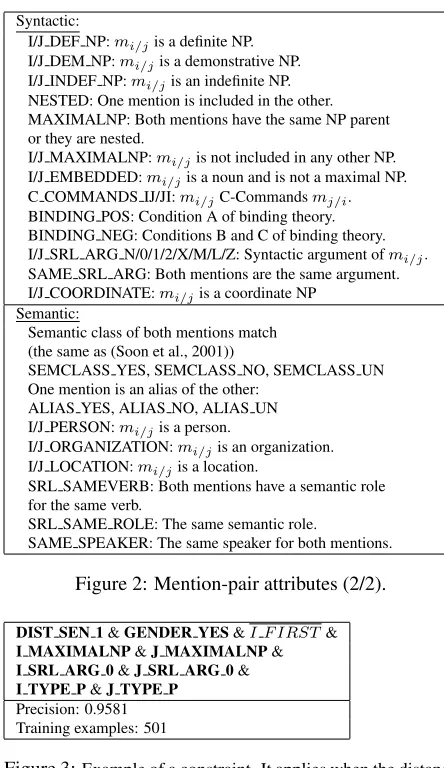
–wherei < jfollowing the order of the document– , like those in (Sapena et al., 2010b), but bina-rized for each possible value. In addition, a set of new mention attributes were included such as SAME SPEAKER when both mentions have the same speaker1(Figures 1 and 2).
A decision tree was generated from the train-ing data set, and a set of constraints was extracted with the C4.5 rule-learning algorithm (Quinlan, 1993). The so-learned constraints are conjunctions of attribute-value pairs. The weight associated with each constraint is the constraint precision minus a balance value, which is determined using the devel-opment set. Figure 3 is an example of a constraint.
2.2 Training data selection
Generating an example for each possible pair of mentions produces an unbalanced dataset where more than 99% of the examples are negative (not coreferent), even more considering that the mention detection system has a low precision (see Section 3.1). So, it generates large amounts of not coref-erent mentions. In order to reduce the amount of negative pair examples, a clustering process is run using the positive examples as the centroids. For each positive example, only the negative examples with distance equal or less than a threshold d are included in the final training data. The distance is computed as the number of different attribute values
1This information is available in the column ”speaker“ of
the corpora.
Distance and position:
Distance betweenmiandmjin sentences:
DIST SEN 0: same sentence DIST SEN 1: consecutive sentences DIST SEN L3: less than 3 sentences Distance betweenmiandmjin phrases:
DIST PHR 0, DIST PHR 1, DIST PHR L3 Distance betweenmiandmjin mentions:
DIST MEN 0, DIST MEN L3, DIST MEN L10 APPOSITIVE: One mention is in apposition with the other. I/J IN QUOTES:mi/jis in quotes or inside a NP
or a sentence in quotes.
I/J FIRST:mi/jis the first mention in the sentence.
Lexical:
STR MATCH: String matching ofmiandmj
PRO STR: Both are pronouns and their strings match PN STR: Both are proper names and their strings match NONPRO STR: String matching like in Soon et al. (2001) and mentions are not pronouns.
HEAD MATCH: String matching of NP heads TERM MATCH: String matching of NP terms I/J HEAD TERM:mi/jhead matches with the term
Morphological:
The number of both mentions match:
NUMBER YES, NUMBER NO, NUMBER UN The gender of both mentions match:
GENDER YES, GENDER NO, GENDER UN Agreement: Gender and number of both mentions match: AGREEMENT YES, AGREEMENT NO, AGREEMENT UN Closest Agreement:miis the first agreement found
looking backward frommj: C AGREEMENT YES,
C AGREEMENT NO, C AGREEMENT UN I/J THIRD PERSON:mi/jis 3rd person
I/J PROPER NAME:mi/jis a proper name
I/J NOUN:mi/jis a common noun
ANIMACY: Animacy of both mentions match (person, object) I/J REFLEXIVE:mi/jis a reflexive pronoun
I/J POSSESSIVE:mi/jis a possessive pronoun
[image:2.612.312.539.56.447.2]I/J TYPE P/E/N:mi/jis a pronoun (p), NE (e) or nominal (n)
Figure 1: Mention-pair attributes (1/2).
inside the feature vector. After some experiments over development data, the value ofdwas assigned to 5. Thus, the negative examples were discarded when they have more than five attribute values dif-ferent than any positive example. So, in the end, 22.8% of the negative examples are discarded. Also, both positive and negative examples with distance zero (contradictions) are discarded.
2.3 Development process
The current version of RELAXCOR includes a pa-rameter optimization process using the development data sets. The optimized parameters arebalanceand
Syntactic:
I/J DEF NP:mi/jis a definite NP.
I/J DEM NP:mi/jis a demonstrative NP.
I/J INDEF NP:mi/jis an indefinite NP.
NESTED: One mention is included in the other. MAXIMALNP: Both mentions have the same NP parent or they are nested.
I/J MAXIMALNP:mi/jis not included in any other NP.
I/J EMBEDDED:mi/jis a noun and is not a maximal NP.
C COMMANDS IJ/JI:mi/jC-Commandsmj/i.
BINDING POS: Condition A of binding theory. BINDING NEG: Conditions B and C of binding theory. I/J SRL ARG N/0/1/2/X/M/L/Z: Syntactic argument ofmi/j.
SAME SRL ARG: Both mentions are the same argument. I/J COORDINATE:mi/jis a coordinate NP
Semantic:
Semantic class of both mentions match (the same as (Soon et al., 2001))
SEMCLASS YES, SEMCLASS NO, SEMCLASS UN One mention is an alias of the other:
ALIAS YES, ALIAS NO, ALIAS UN I/J PERSON:mi/jis a person.
I/J ORGANIZATION:mi/jis an organization.
I/J LOCATION:mi/jis a location.
SRL SAMEVERB: Both mentions have a semantic role for the same verb.
SRL SAME ROLE: The same semantic role.
SAME SPEAKER: The same speaker for both mentions.
Figure 2: Mention-pair attributes (2/2).
DIST SEN 1&GENDER YES&I F IRST& I MAXIMALNP&J MAXIMALNP& I SRL ARG 0&J SRL ARG 0& I TYPE P&J TYPE P
[image:3.612.70.292.52.436.2]Precision: 0.9581 Training examples: 501
Figure 3:Example of a constraint. It applies when the distance betweenmiandmjis exactly 1 sentence, their gender match,
both are maximal NPs, both are argument 0 (subject) of their respective sentences, both are pronouns, andmiis not the first
mention of its sentence. The final weight will beweight = precision−balance.
the number of neighbors reduces the computational cost significantly and improves overall performance too. Optimizing this parameter depends on proper-ties like document size and the quality of the infor-mation given by the constraints.
[image:3.612.316.535.54.240.2]The development process calculates a grid given the possible values of both parameters: from 0 to 1 for balance with a step of 0.05, and from 2 to 14 for pruning with a step of 2. Both parameters were empirically adjusted on the development set for the evaluation measure used in this shared task: the un-weighted average of MUC (Vilain et al., 1995), B3 (Bagga and Baldwin, 1998) and entity-based CEAF (Luo, 2005).
Figure 4:Development process. The figure shows MUC’s pre-cision (red), recall (green), and F1(blue) for each balance value with pruning adjusted to 6.
3 CoNLL shared task participation
RELAXCORhas participated in the CoNLL task in the Closed mode. All the knowledge required by the feature functions is obtained from the annotations of the corpora and no external resources have been used with the exception of WordNet (Miller, 1995), gender and number information (Bergsma and Lin, 2006) and sense inventories. All of them are allowed by the task organization and available in their web-site.
There are many remarkable features that make this task different and more difficult but realistic than previous ones. About mention annotation, it is important to emphasize that singletons are not an-notated, mentions must be detected by the system and the mapping between system and true mentions is limited to exact matching of boundaries. More-over, some verbs have been annotated as corefering mentions. Regarding the evaluation, the scorer uses the modification of (Cai and Strube, 2010), unprece-dented so far, and the corpora was published very re-cently and there are no published results yet to use as reference. Finally, all the preprocessed information is automatic for the test dataset, carring out some noisy errors which is a handicap from the point of view of machine learning.
3.1 Mention detection system
The mention detection system extracts one mention for every NP found in the syntactic tree, one for ev-ery pronoun and one for evev-ery named entity. Then, the head of every NP is determined using part-of-speech tags and a set of rules from (Collins, 1999). In case that some NPs share the same head, the larger NP is selected and the rest discarded. Also the mention repetitions with exactly the same bound-aries are discarded. In addition, nouns with capital letters and proper names not included yet, that ap-pear two or more times in the document, are also in-cluded. For instance, the NP “an Internet business” is added as a mention, but also “Internet” itself is added in the case that the word is found once again in the document.
As a result, taking into account that just exact boundary matching is accepted, the mention detec-tion achieves an acceptable recall, higher than 90%, but a low precision (see Table 1). The most typ-ical error made by the system is to include ex-tracted NPs that are not referential (e.g., predicative and appositive phrases) and mentions with incorrect boundaries. The incorrect boundaries are mainly due to errors in the predicted syntactic column and some mention annotation discrepancies. Further-more, verbs are not detected by this algorithm, so most of the missing mentions are verbs.
3.2 Results analysis
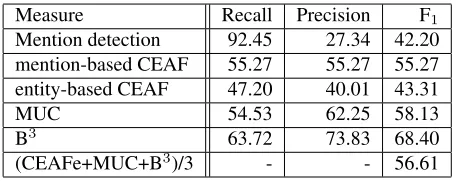
The results obtained by RELAXCOR can be found in Tables 1 and 2. Due to the lack of annotated sin-gletons, mention-based metrics B3 and CEAF pro-duce lower scores –near 60% and 50% respectively– than the ones typically achieved with different anno-tations and mapping policies –usually near 80% and 70%. Moreover, the requirement that systems use automatic preprocessing and do their own mention detection increase the difficulty of the task which ob-viously decreases the scores in general.
The measure which remains more stable on its scores is MUC given that it is link-based and not takes singletons into account anyway. Thus, it is the only one comparable with the state of the art right now. The results obtained with MUC scorer show an improvement of RELAXCOR’s recall, a feature that
needed improvement given the previous published
Measure Recall Precision F1
Mention detection 92.45 27.34 42.20
mention-based CEAF 55.27 55.27 55.27
entity-based CEAF 47.20 40.01 43.31
MUC 54.53 62.25 58.13
B3 63.72 73.83 68.40
(CEAFe+MUC+B3)/3 - - 56.61
Table 1:Results on the development data set
Measure Recall Precision F1
mention-based CEAF 53.51 53.51 53.51
entity-based CEAF 44.75 38.38 41.32
MUC 56.32 63.16 59.55
B3 62.16 72.08 67.09
BLANC 69.50 73.07 71.10
[image:4.612.313.541.56.147.2](CEAFe+MUC+B3)/3 - - 55.99
Table 2:Official test results
results with a MUCs recall remarkably low (Sapena et al., 2010b).
4 Conclusion
The participation of RELAXCOR to the CoNLL shared task has been useful to evaluate the system using data never seen before in a totally automatic context: predicted preprocessing and system men-tions. Many published systems typically use the same data sets (ACE and MUC) and it is easy to un-intentionally adapt the system to the corpora and not just to the problem. This kind of tasks favor com-parisons between systems with the same framework and initial conditions.
The obtained performances confirm the robust-ness of RELAXCORand a recall improvement. And the overall performance seems considerably good taking into account the unprecedented scenario. However, a deeper error analysis is needed, specially in the mention detection system with a low precision and the training data selection process which may be discarding positive examples that could help im-proving recall.
Acknowledgments
References
Amit Bagga and Breck Baldwin. 1998. Algorithms for scoring coreference chains. InProceedings of the Lin-guistic Coreference Workshop at LREC 98, pages 563– 566, Granada, Spain.
S. Bergsma and D. Lin. 2006. Bootstrapping path-based pronoun resolution. In Proceedings of the 21st In-ternational Conference on Computational Linguistics and the 44th annual meeting of the Association for Computational Linguistics, pages 33–40. Association for Computational Linguistics.
Jie Cai and Michael Strube. 2010. Evaluation met-rics for end-to-end coreference resolution systems. In Proceedings of SIGDIAL, pages 28–36, University of Tokyo, Japan.
M. Collins. 1999. Head-driven statistical models for natural language parsing. Ph.D. thesis, University of Pennsylvania.
Xiaoqiang Luo. 2005. On coreference resolution per-formance metrics. In Proceedings of the Joint Con-ference on Human Language Technology and Empir-ical Methods in Natural Language Processing (HLT-EMNLP 2005, pages 25–32, Vancouver, B.C., Canada. G.A. Miller. 1995. WordNet: a lexical database for
En-glish.
Sameer Pradhan, Lance Ramshaw, Mitchell Marcus, Martha Palmer, Ralph Weischedel, and Nianwen Xue. 2011. Conll-2011 shared task: Modeling unrestricted coreference in ontonotes. In Proceedings of the Fif-teenth Conference on Computational Natural Lan-guage Learning (CoNLL 2011), Portland, Oregon, June.
J.R. Quinlan. 1993.C4.5: Programs for Machine Learn-ing. Morgan Kaufmann.
Marta Recasens, Llu´ıs M`arquez, Emili Sapena,
M. Ant`onia Mart´ı, Mariona Taul´e, V´eronique Hoste, Massimo Poesio, and Yannick Versley. 2010. Semeval-2010 task 1: Coreference resolution in multi-ple languages. InProceedings of the 5th International Workshop on Semantic Evaluation, pages 1–8, Up-psala, Sweden, July. Association for Computational Linguistics.
Emili Sapena, Llu´ıs Padr´o, and Jordi Turmo. 2010a. A Global Relaxation Labeling Approach to Coreference Resolution. InProceedings of 23rd International Con-ference on Computational Linguistics, COLING, Bei-jing, China, August.
Emili Sapena, Llu´ıs Padr´o, and Jordi Turmo. 2010b. Re-laxCor: A Global Relaxation Labeling Approach to Coreference Resolution. In Proceedings of the ACL Workshop on Semantic Evaluations (SemEval-2010), Uppsala, Sweden, July.
W.M. Soon, H.T. Ng, and D.C.Y. Lim. 2001. A
Machine Learning Approach to Coreference Resolu-tion of Noun Phrases. Computational Linguistics, 27(4):521–544.
Marc Vilain, John Burger, John Aberdeen, Dennis
Con-nolly, and Lynette Hirschman. 1995. A