Message Routing Algorithm with Additional
Node-Information for Capability-Aware Object
Management in P2P Networks
Takuji Tachibana
∗Abstract—In large-scale heterogeneous P2P net-works, it is indispensable to manage objects based on node’s capabilities. In order to achieve this end, capability-aware object management based on Skip List has been proposed. However, in this method, the number of hops for message routing increases as the number of nodes becomes large. In this paper, for the capability-aware object management, we pro-pose a new message routing algorithm s in order to decrease the number of hops. In our proposed algo-rithm, additional node-information is included in a transmitting message and this information is used so that a node does not receive the same message dou-bly. Each node can use our proposed algorithm sim-ply, and its implementation is easy. We evaluate the performance of the proposed method by simulation. Numerical examples show that the proposed method can decrease the average number of hops in any cases. In addition, the maximum number of hops decreases significantly when the number of nodes is large.
Keywords: P2P networks, message routing, Skip List, object management, additional information
1
Introduction
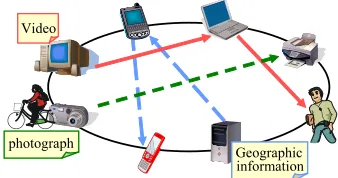
Peer-to-Peer (P2P) networks have been widely used over the Internet for many applications, for example, Inter-net telephony, distributed data storages, data streaming, and online games. In the future, it is supposed that such P2P applications are utilized by various nodes such as high-performance computer, mobile hand-held devices, and sensor nodes [1, 2] (see Fig. 1).
[image:1.595.341.510.227.316.2]In such heterogeneous P2P networks, for managing ob-jects by considering node’s capabilities, [3] has proposed capability-aware object management based on SkipNet [4, 5]. This method utilizes two identifications called
TypeID and HashID. TypeID is assigned to each node according to its own capabilities such as forwarding capa-bility, data-storage capacapa-bility, and mobility. On the other hand, HashID is assigned to each node for providing load balancing among similar types of nodes. Message routing
∗Graduate School of Information Science, Nara Institute of
Sci-ence and Technology, Ikoma, Nara 630-0192, Japan. Tel/Fax: +81-743-72-5352/5359 Email: [email protected]
photograph Geographic information Video
Figure 1: Node structure and message routing.
for storing and searching objects is performed according to TypeID and HashID.
By using this method, an object can be stored in a node with the specified capabilities or searched from a node with the specified capabilities. The load balancing can also be provided among nodes with similar capabilities. However, when the message routing based on TypeID is performed, a message is likely to be routed to multiple nodes with the same TypeID, increasing the number of hops. In addition, when the message routing based on HashID is performed, a message is likely to be traversed on a node doubly, increasing the number of hops. As a result, the capability-aware object management can not provide sufficient performance in terms of the number of hops for message routing.
In [6], shortcut message routing has been proposed in order to decrease the number of hops for TypeID-based message routing. With this method, a message is always forwarded to a node with different TypeID at two hops. However, the number of hops for TypeID-based message routing is much smaller than that for HashID-based mes-sage routing. Therefore, the method in [6] is not so effec-tive for decreasing the total number of hops.
Table 1: Assignment of four-digit TypeID.
0 1
w C(w)≥1 Gbps C(w)<1 Gbps x C(x)≥50 Gbytes C(x)<50 Gbytes y C(y) = low C(y) = high z C(z) = high C(z) = low
compare the performance of the proposed method with that of the conventional method [3].
The rest of the paper is organized as follows. Section 2 introduces the capability-aware object management [3], and Section 3 explains the proposed message routing al-gorithm. Numerical examples are shown in Section 4 and finally, conclusions are presented in Section 5.
2
Capability-Aware Object Management
2.1
Overview
The capability-aware object management has been pro-posed in order to manage objects by considering node’s capabilities in large-scale heterogeneous P2P networks [3]. This method is based on SkipNet, and it utilizes two identifications calledTypeIDandHashID.
[image:2.595.74.266.98.161.2]TypeID is assigned to each node for specifying its ca-pabilities such as forwarding capability and data-storage capability. For example, when four-digit TypeID (wxyz) is used, the first digit (w) denotes forwarding capabil-ity, the second digit (x) data-storage capability, the third digit (y) mobility, and the fourth digit (z) availability, and then each digit number is determined as shown in Ta-ble 1. On the other hand, HashID is assigned to each node by applying a collision-resistant hash function. Node’s IP address or others are used as arguments of the hash func-tion.
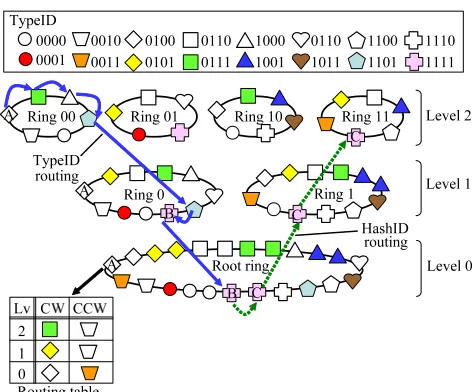
Figure 2 shows a node structure for the capability-aware object management in a case of four-digit TypeID. In this structure, there are one or more rings at each level, and rings at level i are obtained by splitting a ring at level i−1 into multiple disjoint sets. The number of levels is H + 1 when the number of digits of HashID is
H. Each node belongs to a ring at every level so thati -digits prefix of HashID is shared by other nodes. Because nodes are sorted by TypeID at each ring, nodes with the same TypeID, i.e., similar capabilities, are located in a ring sequentially.
Each node has a routing table which includes neighbor nodes at each level (see node A in Fig. 2). Figures 3 and 4 show two message routing algorithms. In Source node A sends a message which includes destination TypeID and HashID. At first, the message is routed based on TypeID
Ring 01
Level 0 Level 1
Root ring
Ring 0 Ring 1
Ring 00 Ring 10 Ring 11 Level 2
0001 0000 0010
0011 0100 0101
0110 0111
1000 1001
0110 1011
1100 1101
1110 1111 TypeID
CW CCW
0 2 1 Lv
Routing table A A A
TypeID
HashID routing routing
C C
C
B B
Figure 2: Node structure and message routing.
as shown in Fig. 3 (solid lines in Fig. 2). When the mes-sage arrives at a node with the destination TypeID, the message routing based on TypeID terminates (node B in Fig. 2).
Just after the termination of the message routing based on TypeID, the message is routed based on HashID as shown in Fig. 4 (dotted lines in Fig. 2). This message routing is performed only among nodes with the desti-nation TypeID. When the message is received by a node whose HashID is closest to the destination HashID, the message routing based on HashID terminates.
As an example of how the capability-aware object man-agement is used, we can consider the following case. When a driver tries to listen a favorite song, the driver inputs its title and file type into the software. In this software, TypeID of the music file is determined from its file type, and HashID is determined with a hash func-tion from its title. Then, message routing starts in the P2P network to find a destination node with the mu-sic file based on the determined TypeID and HashID. If the message reaches the destination node, the driver can download the object from this node.
2.2
Drawbacks
SendMsg(TypeID, HashID, msg) {
if(LongestPrefix(TypeID, localNode.TypeID) == 0) msg.dir = RandomDirection();
else if(TypeID < localNode.TypeID) msg.dir = false; // CounterClockwise else
msg.dir = true; // Clockwise
msg.TypeID = TypeID; msg.HashID = HashID; RouteByTypeID(msg);
}
RouteByTypeID(msg) {
h = localNode.MaxRoutingTableHeight; while(h >= 0) {
if(LiesBetween(msg.dir, localNode.TypeID, localNode.RoutingTable.[h][msg.dir].TypeID , msg.TypeID ) == false ) {
h--; continue; }
if(LiesBetween(msg.dir, localNode.TypeID, localNode.RoutingTable.[h][msg.dir].TypeID , msg.TypeID ) == true ) {
NextCandidateNode = localNode.RoutingTable.[h][msg.dir]; if(CheckIfAlreadyVisited(msg, NextCandidateNode))
{
h--; continue; }
msg.AlreadyVisited(localNode);
SendtoNode(NextCandidateNode, msg); return; }
}
if( localNode.TypeID != msg.TypeID ) {
NegativeAck(msg); return; }
msg.dir = true; RouteByHashID(msg); }
Figure 3: Routing algorithm based on TypeID.
routing.
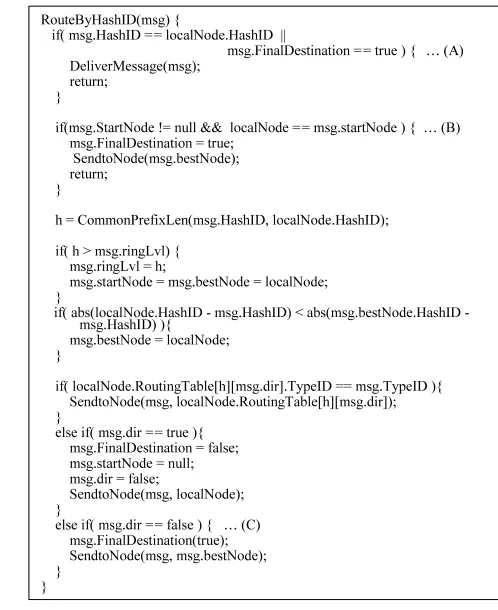
In addition, the message routing based on HashID is per-formed as shown in Fig. 6. Each node checks whether TypeID of its neighbor node is the same as its own TypeID, and the node forwards the message to the neigh-bor node if the neighneigh-bor node has the same TypeID (see (1) of Fig. 6). At this time, when HashID of the neigh-bor node is the most closest to the destination HashID, the information about the neighbor node is stored in the message as the best node. When the neighbor node of a node has a different TypeID, the current node reverses the routing direction and continues the message routing (see (2) of Fig. 6). The HashID-based message routing terminates when the node with the destination HashID is found (see (A) of Fig. 4), when the message routing for both directions finishes (see (C) of Fig. 4 and (3) of Fig. 6(a)), or when a node receive the message again in the initial direction if ring structure is constructed (see (B) of Fig. 4). In this message routing, some nodes may receive the message twice. When the number of nodes with destination TypeID is large, the number of hops for
RouteByHashID(msg) {
if( msg.HashID == localNode.HashID ||
msg.FinalDestination == true ) { … (A) DeliverMessage(msg);
return; }
if(msg.StartNode != null && localNode == msg.startNode ) { … (B) msg.FinalDestination = true;
SendtoNode(msg.bestNode); return;
}
h = CommonPrefixLen(msg.HashID, localNode.HashID); if( h > msg.ringLvl) {
msg.ringLvl = h;
msg.startNode = msg.bestNode = localNode; }
if( abs(localNode.HashID - msg.HashID) < abs(msg.bestNode.HashID -msg.HashID) ){ msg.bestNode = localNode;
}
if( localNode.RoutingTable[h][msg.dir].TypeID == msg.TypeID ){ SendtoNode(msg, localNode.RoutingTable[h][msg.dir]); }
else if( msg.dir == true ){ msg.FinalDestination = false; msg.startNode = null; msg.dir = false;
SendtoNode(msg, localNode); }
else if( msg.dir == false ) { … (C) msg.FinalDestination(true); SendtoNode(msg, msg.bestNode); }
}
Figure 4: Routing algorithm based on HashID.
HashID-based message routing increases.
[6] has proposed shortcut message routing which can de-crease the number of hops for TypeID-based message routing. With this method, a message can be forwarded to a node with different TypeID at two hops. However, the number of hops for TypeID-based message routing is much smaller than that for HashID-based message rout-ing. Therefore, this method cannot decrease the total number of hops significantly.
d
Level 0 Root ring
Ring 1 Ring 0
CCW CW
0 1 Lv
Routing table of node C
Level 1
A B
B A
C D E F G
C D F E G
CCW CW
0 1 Lv
Routing table of node E
B D
A D
D F
B G
TypeID: X
CW: Clockwise CCW: Counter
[image:3.595.295.544.69.374.2]Clockwise
[image:3.595.315.541.587.718.2](1) (2)
[image:4.595.310.544.69.368.2](3)
Figure 6: Node structure for message routing based on HashID.
(1)
(2)
(4)
(3)
A
Information about
start node A
Information about
start node A
Information about
[image:4.595.89.251.154.255.2]start node A
Figure 7: Hash-based message routing with the proposed method.
3
Message Routing Algorithm with
Ad-ditional Information
In this paper, we propose a new message routing algo-rithm for the HashID-based message routing. In our pro-posed method, additional node-information is used for HashID-based message routing. Here, the additional in-formation specifies a node from which HashID-based mes-sage routing starts at a level (see node A in Fig. 7). Every time the level of HashID-based message routing changes, this node-information is also updated by a new start node.
The additional node-information is used in the following (see Fig. 7).
(1) When a node receives a message and the ring-level increases, the node updates information about start node in the message.
(2) The node forwards a message to a neighbor node along the initial direction according to the conven-tional Hash-based message routing.
(3) A border node receives the message, the node checks the information of the start node in the message.
(4) The border node forwards the message to the start node directly.
(5) The start node forwards to the message to another neighboring node along the opposite direction.
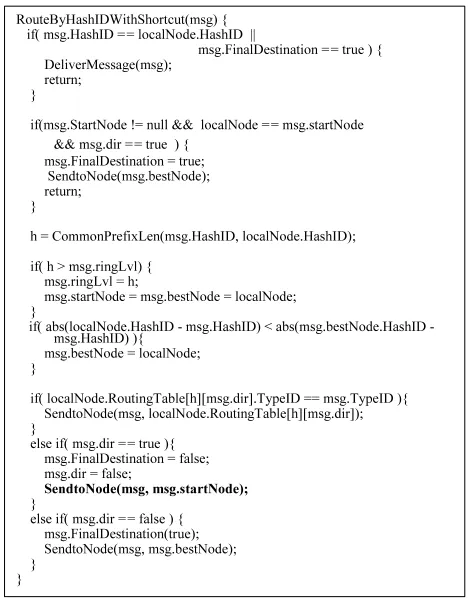
Figure 8 shows the detailed routing algorithm for HashID message routing. Here, the message transmission from a border node to the start node is highlighted in boldface type. As shown in this figure, it is easy to implement the shortcut message routing for HashID.
RouteByHashIDWithShortcut(msg) { if( msg.HashID == localNode.HashID ||
msg.FinalDestination == true ) { DeliverMessage(msg);
return; }
if(msg.StartNode != null && localNode == msg.startNode && msg.dir == true ) {
msg.FinalDestination = true; SendtoNode(msg.bestNode); return;
}
h = CommonPrefixLen(msg.HashID, localNode.HashID); if( h > msg.ringLvl) {
msg.ringLvl = h;
msg.startNode = msg.bestNode = localNode; }
if( abs(localNode.HashID - msg.HashID) < abs(msg.bestNode.HashID -msg.HashID) ){ msg.bestNode = localNode;
}
if( localNode.RoutingTable[h][msg.dir].TypeID == msg.TypeID ){ SendtoNode(msg, localNode.RoutingTable[h][msg.dir]); }
else if( msg.dir == true ){ msg.FinalDestination = false; msg.dir = false;
Sendtoode(msg, msg.startode);
}
else if( msg.dir == false ) { msg.FinalDestination(true); SendtoNode(msg, msg.bestNode); }
}
Figure 8: Proposed HashID-based routing algorithm.
4
Numerical Examples
In this section, we evaluate the performance of the pro-posed method by simulation. We assume that the num-ber of P2P nodes isN and the number of objects which should be managed isM =⌊N/2⌋.
In this P2P network, a four-digit TypeID is assigned to each node and each object. For the simplicity, in the following, we denote four-digit TypeID with decimal number format, for example, TypeID 0101 is denoted as TypeID 5. We assume that TypeID i (0 ≤ i ≤ 15) is assigned to a node (an object) with probability γi (σi).
On the other hand, HashID is denoted as 128 bits binary string, and it is assigned to a node (an object) with a hash function.
0
10
20
30
40
0
2000
4000
6000
8000
10000
Number of hops
[image:5.595.68.265.71.234.2]Number of nodes
Conventional
Shortcut
Conventional
Shortcut
Figure 9: Average number of hops for HashID-based mes-sage routing.
0
100
200
300
0
2000
4000
6000
8000
10000
Number of hops
Number of nodes
Conventional
Shortcut
Figure 10: Maximum number of hops for HashID-based message routing.
4.1
Impact of Number of Nodes
In this subsection, we investigate how the number of hops changes by using the proposed method as the number of hops increases. Here, TypeIDiis assigned to a node and an object with probabilities γi=0.0625 and σi=0.0625,
respectively.
[image:5.595.325.522.71.235.2]Figure 9 shows the average number of hops for HashID-based message routing. From Fig. 9, we find that the average numbers of hops for both methods increases the number of nodes N increases, as expected. However, the average number of hops for the proposed method is smaller than that for the conventional method, regardless of the number of nodes. This result shows that the pro-posed method can decrease the average number of hops for HashID-based message routing. The difference be-tween the numbers of hops for both methods does not change so much. Therefore, the effectiveness of the pro-posed method does not become small.
Figure 10 also shows the maximum number of hops for HashID-based message routing, respectively. From this
0
10
20
30
40
0
2000
4000
6000
8000
10000
Number of hops
[image:5.595.69.267.281.439.2]Number of nodes
Conventional
Shortcut
Conventional
Shortcut
Figure 11: Average number of hops for the proposed and conventional methods.
0
100
200
300
0
2000
4000
6000
8000
10000
Number of hops
Number of nodes
Conventional
Shortcut
Figure 12: Maximum number of hops for the proposed and conventional methods.
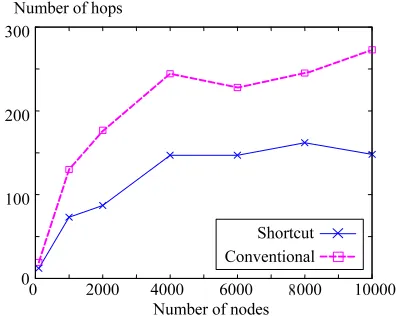
figure, we can also find that the maximum number of hops for the proposed method is smaller than that for the conventional method, regardless of the number of nodes. In especial, the proposed method can decrease the maxi-mum number of hops for HashID-based message routing by about 45 % when the number of nodes is 10,000.
The performances for the total number of hops are shown in Figs. 11 and 12. In Figs. 9 to 12, we can ob-serve that results for total number of hops are similar to those for HashID-based message routing. This de-notes that HashID-based message routing is dominant. From Figs. 11 and 12, we can conclude that the pro-posed method is effective to decrease the number of hops and the effectiveness increases as the number of nodes becomes large.
4.2
Impact of TypeID Assignment
[image:5.595.326.522.288.446.2]0
50
100
150
200
250
0
2000
4000
6000
8000
10000
Number of hops
Number of nodes
Conventional
Shortcut
Ave Worst
Conventional
Shortcut
[image:6.595.327.521.71.233.2]Ave Worst
Figure 13: Average and maximum numbers of hops for HashID-based message routing in case 1.
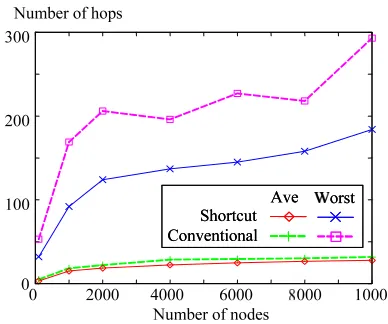
case 2. In case 1, γ0 = 0.5, γ1 =γ2 = 0.1, γ3 = γ4 =
0.05, γ5 =· · · =γ14 = 0.02, γ15 = 0.0, and σ0 = · · · = σ15 = 0.0625. In case 2, on the other hand, γ0 =· · · = γ15 = 0.0625, σ0 =· · · = σ9 = 0.02, σ10 =σ11 = 0.05, σ12=σ13= 0.1,σ14= 0.2, andσ15= 0.3.
Figure 13 shows the average and maximum numbers of hops for HashID-based message routing against the num-ber of nodes N for case 1. From this figure, we find that the proposed method can decrease the average and maximum numbers of hops for HashID-based message routings. The proposed method can decrease the aver-age number of hops for HashID-based messaver-age routing decreases by 10 % and the maximum number of hops decreases by 40 %.
Figure 14 also shows the average and maximum num-bers of hops for HashID-based message routing for case 2. From this figure, we can also observe that the pro-posed method can decrease significantly the number of hops for HashID-based message routing. As a result, the proposed method is effective when there are a large num-ber of nodes with different capabilities.
5
Conclusions
In this paper, for the capability-aware object manage-ment based on SkipNet, we proposed a message routing algorithm in order to decrease the number of hops. In our proposed routing algorithm, additional node-information is used so that a node does not receive the same mes-sage twice. The proposed method can be implemented and used simply. We evaluate the number of hops for the proposed method by simulation. From simulation results, we found that our proposed method can decrease the av-erage number of hops for HashID-based message rout-ings. As the number of nodes increases, the effectiveness of the proposed becomes large. In addition, the proposed method can decrease the maximum number of hops sig-nificantly. We also found that our proposed method is
ef-0
100
200
300
0
2000
4000
6000
8000
10000
Number of hops
Number of nodes
Conventional
Shortcut
Ave Worst
Conventional
Shortcut
Ave Worst
Figure 14: Average and maximum numbers of hops for HashID-based message routing in case 2.
fective in large-scale heterogeneous P2P networks, where a large number of nodes with different capabilities have participated and a large variety of objects are managed. From the above results, it is expected that the proposed method is a promising method in large-scale P2P net-works for ubiquitous computing environments.
References
[1] Hu, J., Li, M., Yu, H., Zheng, W., “Tourist: A Self-Adaptive Structured Overlay in Heterogeneous P2P Networks,”Technical Report THTR-CS-HPC-2006-001, 2006.
[2] Xu, Z., Mahalingam, M., Karlsson, M., “Turning Heterogeneity into an Advantage in Overlay Rout-ing,”IEEE INFOCOM 2003, 4/03.
[3] Tomimoto, T., Tachibana, T., Sugimoto, K., “Capability-Aware ID Assignment and Message Routing based on SkipList in Large-Scale Heteroge-neous P2P Networks,”IEEE Globecom 2007, 11/07.
[4] Pugh, W., “Skip Lists: A Probabilistic Alternative to Balanced Trees,” Workshop on Algorithms and Data Structures, 7/03.
[5] Harvey, N., Jones, M., Saroiu, S., Theimer, M., Wol-man, A., “SkipNet: A Scalable Overlay Network with Practical Locality Properties,” 4th USENIX Symposium on Internet Technologies and Systems, 3/03.
[image:6.595.70.265.72.233.2]