When a Red Herring is Not a Red Herring: Using Compositional Methods
to Detect Non-Compositional Phrases
Julie Weeds, Thomas Kober, Jeremy Reffin and David Weir
TAG Laboratory, Department of Informatics University of Sussex, Brighton, BN1 9QH, UK
{J.E.Weeds, T.Kober, J.P.Reffin, D.J.Weir}@sussex.ac.uk
Abstract
Non-compositional phrases such as red herringand weakly compositional phrases such asspelling beeare an integral part of natural language (Sag et al., 2002). They are also the phrases that are difficult, or even impossible, for good compositional distributional models of semantics. Com-positionality detection therefore provides a good testbed for compositional methods. We compare an integrated compositional distributional approach, using sparse high dimensional representations, with the ad-hoc compositional approach of applying simple composition operations to state-of-the-art neural embeddings.
1 Introduction
One current focus within the field of distribu-tional semantics is enabling systems to make in-ferences about phrase-level or sentence-level sim-ilarity. One popular approach (Mitchell and Lap-ata, 2010) is to build phrase or sentence-level rep-resentations by composing word-level representa-tions and then measuring similarity directly. Suc-cess is usually measured in terms of correlation with human similarity judgments. However, eval-uating measures of phrase-level similarity directly against human judgments of similarity ignores the problem that it is not always possible to determine meaning in a compositional manner. If we com-pose the meaning representations forredand her-ring, we might expect to get a very different repre-sentation from the one which could be directly in-ferred from corpus observations of the phrasered herring. Thus any judgements of the similarity of two composed phrases may be confounded by the degree to which those phrases are compositional.
In this paper, we use a compound noun com-positionality dataset (Reddy et al., 2011) to inves-tigate the extent to which the underlying defini-tion of context has an effect on a model’s ability to support composition. We compare the Anchored Packed Tree (APT) model (Weir et al., 2016),
where composition is an integral part of the distri-butional model, with the commonly employed ap-proach of applying na¨ıve compositional operations to state-of-the-art distributional representations.
2 Background
Context definition Example features Proximity (+-2) recently,graduated, folded Typed dep. rel. hNMOD, graduatedi,
hNSUBJ, foldedi Untyped dep. rel. graduated,folded Typed dep. path hNMOD, graduatedi,
hNSUBJ, foldedi, hNSUBJ.DOBJ, clothesi, hNMOD.AMOD, recentlyi, hNSUBJ.DOBJ.AMOD, dryi Untyped dep. path recently, graduated, folded, dry,
[image:1.595.307.525.402.530.2]clothes
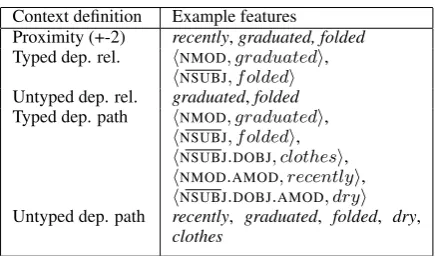
Table 1: Possible contextual features ofstudent
Consider the occurrence of the word student in the sentence “The recently graduated student folded the dry clothes.” Different distributional representations leverage the context, e.g., the fact that the target word student has occurred in the context folded, in different ways. Table 1 illus-trates the contextual features which might be gen-erated for student given different definitions of context. The most commonly used definition of context, in both traditional count-based represen-tations and in more recent distributed embeddings, is proximity, i.e., the contextual features of a word occurrence are all those words which occur within a certain context window around the occurrence. However, contextual features may also be defined
in terms of dependency relations. For example, in a dependency parse of the sentence we would ex-pect to see a direct-object relation fromfolded to student. Contextual features based on dependency relations may be typed (i.e., include the name of the dependency relation) or untyped (Baroni and Lenci, 2010). Pad´o and Lapata (2007) proposed using dependency paths to define untyped contex-tual features; here any word in the context which has a dependency path to the target is considered a contextual feature. Weeds et al. (2014) proposed using dependency paths to define typed contextual features which could be used to align representa-tions before composition. This idea is further re-fined in the APTframework of Weir et al. (2016).
Na¨ıve composition of distributional representa-tions, e.g., using pointwise addition and multipli-cation, has proved very popular and effective. In an evaluation across 3 different benchmark tasks (Dinu et al., 2013), the lexical function model (Ba-roni and Zamparelli, 2010) was shown to be con-sistently the best-performing, but in the compo-sition of adjective-noun phrases, simple additive and multiplicative models were highly competi-tive. Milajevs et al. (2014) compared neural word representations with count-based vectors on 4 dif-ferent tasks using a variety of na¨ıve and tensor-based compositional models. The neural word representations consistently outperformed the tra-ditional count-based vectors. Considering the re-sults for the neural word representations, point-wise addition outperformed all of the other com-positional models considered on 3 of the tasks.
Typed distributional representations cannot be straightforwardly composed using na¨ıve opera-tions (Weeds et al., 2014). The APT approach
(Weir et al., 2016) overcomes this problem by defining contextual features in terms of complete dependency paths and then ensuring that the rep-resentations of target words are properly aligned before composition. For example, to carry out the composition of student with folded in the exam-ple sentence, it is necessary to align the repre-sentations. This can be done by offsetting all of the features ofstudent by its dependency relation (NSUBJ) with folded. Intuitively we are viewing
the representation ofstudentfrom the perspective of actions (i.e., verbs) which are likely to be car-ried out by students. This view can be straightfor-wardly composed with the representation offolded because the representations are aligned i.e., they
have features of the same type (e.g.,DOBJ).
3 Compositionality of compound nouns
Compositionality detection (Reddy et al., 2011) involves deciding whether a given multiword ex-pression is compositional or not i.e., whether the meaning can be understood from the literal mean-ing of its parts. Reddy et al. (2011) introduced a dataset consisting of 90 compound nouns along with human judgments of their literality or com-positionally at both the constituent and the phrase level. All judgments are given on a scale of 0 to 5, where 5 is high. For example, the phrasespelling beeis deemed to have high literalness in its use of the first constituent, low literalness in its use of the second constituent and a medium level of literal-ness with respect to the whole phrase.
Assuming the distributional hypothesis (Harris, 1954), the observed co-occurrences of composi-tional target phrases are highly likely to have oc-curred with one or both of the constituents inde-pendently. On the other hand, the observed co-occurrences of non-compositional target phrases are much less likely to have occurred with ei-ther of the constituents independently. Thus, a good compositionality function, without any ac-cess to the observed co-occurrences of the target phrases, is highly likely to return vectors which are similar to observed phrasal vectors for compo-sitional phrases but much less likely to return sim-ilar vectors for non-compositional phrases. Ac-cordingly, as observed elsewhere (Reddy et al., 2011; Salehi et al., 2015; Yazdani et al., 2015), compositional methods can be evaluated by cor-relating the similarity of composed and observed phrase representations with the human judgments of compositionality. A similar idea is also ex-plored by Kiela and Clark (2013) who detect non-compositional phrases by comparing the neigh-bourhoods of phrases where individual words have been substituted for similar words.
state-of-the-art on this dataset1. For consistency with the experiments of Reddy et al. (2011), the corpus used in this experiment is the same fully-annotated version of the web-derived ukWaC cor-pus (Ferraresi et al., 2008). This corcor-pus has been tokenised, POS-tagged and lemmatised with Tree-Tagger (Schmid, 1994) and dependency-parsed with the Malt Parser (Nivre, 2004). It contains about1.9billion tokens.
In order to create a corpus which contains com-pound nouns, we further preprocessed the corpus by identifying occurrences of the 90 target com-pound nouns and recombining them into a single lexical item. We then created a number of elemen-tary representations for every token in the corpus.
3.1 Untyped contextual features
For each word and compound phrase, neural rep-resentations were constructed using the word2vec tool (Mikolov et al., 2013). Whilst it is not pos-sible or appropriate to carry out an exhaustive parameter search, we experiment with a num-ber of commonly used and recommended param-eter settings. We investigate both the cbow and skip-gram models with 50, 100 and 300 di-mensions and experiment with the subsampling threshold, trying10−3,10−4and10−5. As
recom-mended in the documentation, we use a window size of 5 for cbow and of 10 for skip-gram. Early experiments with different composition op-erations, showedaddto be the only promising op-tion. Similarity between composed and observed representations is computed using the cosine mea-sure.
3.2 Typed contextual features
For each word and compound phrase, elementary APT representations were constructed using the
method and recommended settings of Weir et al. (2016). For efficiency, we did not consider paths of length 3 or more. In relation to the construction of the elementary APTs, the most obvious
parame-ter is the nature of the weight associated with each feature. We consider both the use of probabilities2 and positive pointwise mutual information (PPMI)
1Hermann et al. (2012) proposed using generative models
for modeling the compositionality of noun-noun compounds. Using interpolation to mitigate the sparse data problem, their model beat the baseline of weighted addition on the Reddy et al. (2011) evaluation task when trained on the BNC. How-ever, these results were still significantly lower than those re-ported by Reddy et al. (2011) using the larger ukWaC corpus.
2referred to as normalised counts by Weir et al. (2016)
values. Levy et al. (2015) showed that the use of context distribution smoothing (α = 0.75) in the PMI calculation can lead to performance compara-ble with state-of-the-art word embeddings on word similarity tasks. We use this modified definition of PMI and experiment withα = 0.75andα= 1.3
Having constructed elementary APTs, the APT
composition process involves aligning and com-posing these elementary APTs. We investigate us-ing FINT, which takes the minimum of each of the constituent’s feature values and FUNI, which performs pointwise addition. Following Reddy et al. (2011), when using theFUNIoperation, we ex-periment with weighting the contributions of each constituent to the composed APT representation
using the parameter,h. For example, ifA2 is the
APT associated with the head of the phrase and
Aδ
1 is the properly aligned APT associated with
the modifier whereδis the dependency path from the head to the modifier (e.g. NMODorAMOD), the
composition operations can be defined as:
G
INT
n
Aδ
1,A2 o
(1)
G
UNI
n
(1−h)Aδ
1, hA2 o
(2)
We have also considered composition without alignment of the modifier’s APT, i.e, usingA1:
G
INT
{A1,A2} (3)
G
UNI
{(1−h)A1, hA2} (4)
In general, one would expect there to be lit-tle overlap between APTs which have not been
properly aligned. However, in the case where δ is the NMOD relation, i.e., the internal relation in
the vast majority of the compound phrases, both modifier and head are nouns and therefore there may well be considerable overlap between their unaligned dependency features. In order to exam-ine the contribution of both the aligned and un-aligned APTs in the composition process, we used
a hybrid method where the composed representa-tion is defined as:
G
INT
n
(qAδ1+ (1−q)A1),A2 o
(5)
3α = 1corresponds to the standard definition of PMI
Embedding method t =
10−3 t10−4= t10−5=
cbow, 50d 0.73 0.65 0.62
cbow, 100d 0.74 0.65 0.64
cbow, 300d 0.70 0.70 0.67
skip-gram, 50d 0.59 0.64 0.62
skip-gram, 100d 0.62 0.64 0.64
[image:4.595.73.293.62.146.2]skip-gram, 300d 0.63 0.64 0.68
Table 2: Averageρusing neural word embeddings
G
UNI
n
(1−h)(qAδ
1+ (1−q)A1), hA2 o
(6)
In the case where representations consist of APTweights which are probabilities, PPMI is
es-timated after composition. Therefore we refer to this as compose-first (CF) in contrast to compose-second (CS) where composition is carried out after PPMI calculations. In both cases, the cosine mea-sure is applied to vectors made up PPMI values in order to calculate the similarity of the observed and composed representations.
4 Results
We used repeated 3-fold cross-validation to enable us to estimate4the model parametershandq. Re-sults for all models are then reported in terms of average Spearman rank correlation scores (ρ) of phrase compositionality scores with human judge-ments on the corresponding testing samples. We used a sufficiently large number of repetitions that errors are all small (≤0.0015) and thus any differ-ence observed which is greater than0.005is sta-tistically significant at the95% level. Boldface is used to indicate the best performing configuration of parameters for a particular model.
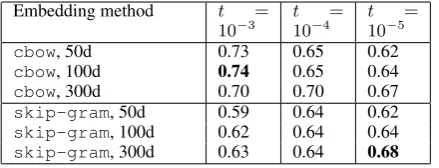
Table 2 summarises results for different pa-rameter settings for the neural word embeddings. Looking at the results in Table 2, we see that the cbow model significantly outperforms the skip-grammodel. Using thecbowmodel with 100 dimensions and a subsampling threshold of t = 10−3 gives a performance of 0.74 which
is significantly higher than the previous state-of-the-art reported in Reddy et al. (2011). Since both of these models are based on untyped co-occurrences, this performance gain can be seen as the result of implicit parameter optimisation.
Table 3 summarises results for different com-position operations and parameter settings using
[image:4.595.305.532.62.152.2]4Across all models, optimal values were in the range
[0.3,0.5].
Compositional Model PPMIα= 1 PPMIα= 0.75
CF CS CF CS
AlignedF
INT(Eq. 1) 0.72 0.70 0.75 0.72
AlignedF
UNI(Eq. 2) 0.71 0.72 0.72 0.75
UnalignedF
INT(Eq. 3) 0.74 0.72 0.72 0.73
UnalignedF
UNI(Eq. 4) 0.77 0.75 0.78 0.77
HybridF
INT(Eq. 5) 0.74 0.73 0.73 0.73
HybridF
UNI(Eq. 6) 0.78 0.78 0.79 0.76
Table 3: Averageρusing APTrepresentations.
APTrepresentations. We see that the results using
standard PPMI (α = 1) significantly outperform the result reported in Reddy et al. (2011), which demonstrates the superiority of a typed depen-dency space over an untyped dependepen-dency space. Smoothing the PPMI calculation with a value of α = 0.75 generally has a further small positive effect. On average, the results when probabilities are composed and PPMI is calculated as part of the similarity calculation (CF) are slightly higher than the results when PPMI weights are composed (CS) . Regarding different composition operations,
F
UNI generally outperforms
F
INT. In general, the unaligned model outperforms the aligned model. However, a small but statistically significant per-formance gain is generally made using the hybrid model. Therefore aligned APT composition and
unaligned APTcomposition are predicting
differ-ent contexts for compound nouns which all con-tribute to a better estimate of the compositionality of the phrase.
5 Conclusions and further work
We have shown that combining traditional com-positional methods with state-of-the-art low-dimensional word representations can improve re-sults over the state-of-the-art. Further improve-ments can be achieved using an integrated compo-sitional distributional approach based on APT
rep-resentations. This approach maintains syntactic structure within the contextual features of words which is then central to the compositional pro-cess. We argue that some knowledge of syntac-tic structure is crucial in the fine-grained under-standing of language. Since compositionality de-tection also provides a way of evaluating compo-sitional methods without confounding judgements of phrase similarity with judgements of composi-tionality, it appears that the APTapproach to
types of phrase. For example, it would be interest-ing to apply these models in German and evaluate their performance on a German noun-noun com-pound compositionality dataset (Schulte im Walde et al., 2013; Schulte im Walde et al., 2016).
References
Marco Baroni and Alessandro Lenci. 2010. Dis-tributional memory: A general framework for corpus-based semantics. Computational Linguis-tics, 36(4):673–721, December.
Marco Baroni and Roberto Zamparelli. 2010. Nouns are vectors, adjectives are matrices: Representing adjective-noun constructions in semantic space. In
Proceedings of the 2010 Conference on Empirical Methods in Natural Language Processing, pages 1183–1193, Cambridge, MA, October. Association for Computational Linguistics.
Georgiana Dinu, Nghia The Pham, and Marco Baroni. 2013. General estimation and evaluation of compo-sitional distributional semantic models. In Proceed-ings of the Workshop on Continuous Vector Space Models and their Compositionality, pages 50–58, Sofia, Bulgaria, August. Association for Computa-tional Linguistics.
Adriano Ferraresi, Eros Zanchetta, Marco Baroni, and Silvia Bernardini. 2008. Introducing and evaluating ukwac, a very large web-derived corpus of english. InProceedings of the WAC4 Workshop at LREC. Zellig Harris. 1954. Distributional structure. Word,
10:146–162.
Karl Moritz Hermann, Phil Blunsom, and Stephen Pul-man. 2012. An unsupervised ranking model for noun-noun compositionality. In *SEM 2012: The First Joint Conference on Lexical and Computa-tional Semantics – Volume 1: Proceedings of the main conference and the shared task, and Volume 2: Proceedings of the Sixth International Workshop on Semantic Evaluation (SemEval 2012), pages 132– 141, Montr´eal, Canada, 7-8 June. Association for Computational Linguistics.
Douwe Kiela and Stephen Clark. 2013. Detecting compositionality of multi-word expressions using nearest neighbours in vector space models. In Pro-ceedings of the 2013 Conference on Empirical Meth-ods in Natural Language Processing, pages 1427– 1432, Seattle, Washington, USA, October. Associa-tion for ComputaAssocia-tional Linguistics.
Omer Levy, Yoav Goldberg, and Ido Dagan. 2015. Im-proving distributional similarity with lessons learned from word embeddings. Transactions of the Associ-ation for ComputAssoci-ational Linguistics, 3:211–225. Tomas Mikolov, Kai Chen, Greg Corrado, and
Jef-frey Dean. 2013. Efficient estimation of word
representations in vector space. arXiv preprint arXiv:1301.3781.
Dmitrijs Milajevs, Dimitri Kartsaklis, Mehrnoosh Sadrzadeh, and Matthew Purver. 2014. Evaluating neural word representations in tensor-based compo-sitional settings. In Proceedings of the 2014 Con-ference on Empirical Methods in Natural Language Processing (EMNLP), pages 708–719, Doha, Qatar, October. Association for Computational Linguistics. Jeff Mitchell and Mirella Lapata. 2010. Composition in distributional models of semantics. Cognitive Sci-ence, 34(8):1388–1429.
Joakim Nivre. 2004. Incrementality in determinis-tic dependency parsing. InProceedings of the ACL Workshop on Incremental Parsing, pages 50–57. Sebastian Pad´o and Mirella Lapata. 2007.
Dependency-based construction of semantic space models. Computational Linguistics, 33(2):161–199, June.
Siva Reddy, Diana McCarthy, and Suresh Manand-har. 2011. An empirical study on compositional-ity in compound nouns. In Proceedings of 5th In-ternational Joint Conference on Natural Language Processing, pages 210–218, Chiang Mai, Thailand, November. Asian Federation of Natural Language Processing.
Ivan Sag, Timothy Baldwin, Francis Bond, Ann Copes-take, and Dan Flickinger. 2002. Multiword expres-sions: A pain in the neck for NLP. InProceedings of the Third International Conference on Intelligent Text Processing and Computational Linguistics (CI-CLING 2002), pages 1–15, Mexico City, Mexico. Bahar Salehi, Paul Cook, and Timothy Baldwin. 2015.
A word embedding approach to predicting the com-positionality of multiword expressions. In Proceed-ings of the 2015 Conference of the North Ameri-can Chapter of the Association for Computational Linguistics: Human Language Technologies, pages 977–983, Denver, Colorado, May–June. Association for Computational Linguistics.
Helmut Schmid. 1994. Probabilistic part-of-speech tagging using decision trees. InProceedings of the International Conference on New Methods in Lan-guage Processing, Manchester, UK.
Sabine Schulte im Walde, Stefan Muller, and Stephan Roller. 2013. Exploring vector space models to predict the compositionality of German noun-noun compounds. InProceedings of the 2nd Joint Con-ference on Lexical and Computational Semantics (*SEM), Atlanta, USA, June.
Julie Weeds, David Weir, and Jeremy Reffin. 2014. Distributional composition using higher-order de-pendency vectors. InProceedings of the 2nd Work-shop on Continuous Vector Space Models and their Compositionality (CVSC), pages 11–20, Gothen-burg, Sweden, April. Association for Computational Linguistics.
David Weir, Julie Weeds, Jeremy Reffin, and Thomas Kober. 2016. Aligning packed dependency trees: a theory of composition for distributional semantics.
Computational Linguistics, special issue on Formal Distributional Semantics, 42(4):727–761, Decem-ber.