Off-line Optimization for Earley-style HPSG Processing
G u i d o M i n n e n , D a l e Gerdemann~ Thilo GStz *
Sonderforschungsbereich 340
University of Tfibingen
Wilhelmstr. 113
72074-Tfibingen
Germany
E-mail: [email protected] uebingen.de
A b s t r a c t
A novel approach to HPSG based natural language processing is described that uses an off-line compiler to automatically prime a declarative g r a m m a r for generation or parsing, and inputs the primed g r a m m a r to an advanced Earley-style processor. This way we provide an elegant solution to the problems with e m p t y heads and efficient bidirectional processing which is illustrated for the special case of HPSG generation. Ex- tensive testing with a large HPSG g r a m m a r revealed some i m p o r t a n t constraints on the form of the grammar.
1
Introduction
Bidirectionality of g r a m m a r is a research topic in natural language processing that is enjoying increas- ing attention (Strzalkowski, 1993a). This is mainly due to the clear theoretical and practical advantages of bidirectional g r a m m a r use (see, among others, Appelt, 1987). We address this topic in describing a novel approach to HPSG (Pollard and Sag, 1994) based language processing that uses an off-line com- piler to automatically prime a declarative g r a m m a r for generation or parsing, and hands the primed g r a m m a r to an advanced Earley processor. The de- veloped techniques are direction independent in the sense that they can be used for both generation and parsing with HPSG grammars. In this paper, we fo- cus on the application of the developed techniques in the context of the comparatively neglected area
o f HPSG generation.
Shieber (1988) gave the first use of Earley's al- gorithm for generation, but this algorithm does not
* T h e p r e s e n t e d r e s e a r c h was s p o n s o r e d by 'l~eilpro -
jekt B4 "Constraints on Grammar for Efficient Genera- tion" of the Sonderforschungsbereich 340 "Sprachtheo- retische Grundlagen fiir die Computerllnguistik" of the
use the prediction step to restrict feature instantia- tions on the predicted phrases, and thus lacks goal- directedness. Though Gerdemann (1991) showed how to modify the restriction function to make top- down information available for the b o t t o m - u p com- pletion step, Earley generation with top-down pre- diction still has a problem in that generating the sub- parts of a construction in the wrong order might lead to massive nondeterminacy or even nontermination. Gerdemann (1991) partly overcame this problem by incorpQrating a head-driven strategy into Earley's algorithm. However, evaluating the head of a con- struction prior to its dependent subparts still suffers from efficiency problems when the head of a con- struction is either missing, displaced or underspec- ified. Furthermore, Martinovid and Strzalkowski (1992) and others have observed that a simple head- first reordering of the g r a m m a r rules m a y still make insufficient restricting information available for gen- eration unless the form of the g r a m m a r is restricted to unary or binary rules.
presented as approaches to the inversion of parser- oriented grammars into grammars suitable for gen- eration. However, both approaches can just as well take a declarative grammar specification as input to produce generator and/or parser-oriented grammars
as in Dymetman et al. (1990). In this paper we adopt the latter theoretically more interesting per- spective.
We developed a compiler for off-line optimization of phrase structure rule-based typed feature struc- ture grammars which generalizes the techniques de- veloped in the context of the DIA, and we advanced a typed extension of the Earley-style generator of Gerdemann (1991). Off-line compilation (section 3) is used to produce grammars for the Earley-style generator (section 2). We show that our use of off- line grammar optimization overcomes problems with empty or displaced heads. The developed techniques are extensively tested with a large HPSG grammar for partial vP topicallzation in German (iiinrichs et al., 1994). This uncovered some important constraints on the form of the phrase structure rules (phrase structure rules) in a grammar imposed by the com- piler (section 4).
2
A d v a n c e d Earley Generation
As Shieber (1988) noted, the main shortcoming of Earley generation is a lack of goal-directedness that results in a proliferation of edges. Gerdemann (1991) tackled this shortcoming by modifying the restric- tion function to make top-down information avail- able for the bottom-up completion step. Gerde- mann's generator follows a head-driven strategy in order to avoid inefficient evaluation orders. More specifically, the head of the right-hand side of each grammar rule is distinguished, and distinguished categories are scanned or predicted upon first. The resulting evaluation strategy is similar to that of the head-corner approach (Shieber et al., 1990; Gerde- mann and IIinrichs, in press): prediction follows the main flow of semantic information until a lex- ical pivot is reached, and only then are the head- dependent subparts of the construction built up in a bottom-up fashion. This mixture of top-down and bottom-up information flow is crucial since the top- down semantic information from the goal category must be integrated with the bottom-up subcatego- rization information from the lexicon. A strict top- down evaluation strategy suffers from what may be called
head-recursion,
i.e. the generation analog of left recursion in parsing. Shieber et al. (1990) show that a top-down evaluation strategy will fail for rules such as vP --* vp x, irrespective of the order of eval- uation of the right-hand side categories in the rule. By combining the off-line optimization process with a mixed bottom-up/top-down evaluation strategy, we can refrain from a complete reformulation of the grammar as, for example, in Minnen et al. (1995).2.1 O p t i m i z a t i o n s
We further improved a typed extension of Gerde- mann's Earley generator with a number of tech- niques that reduce the number of edges created dur- ing generation. Three optimizations were especially helpful. The first supplies each edge in the chart with two indices, a
backward index
pointing to the state in the chart that the edge is predicted from, and aforward index
poinfing to the states that are predicted from the edge. By matching forward and backward indices, the edges that must be combined for completion can be located faster. This index- ing technique, as illustrated below, improves upon the more complex indices in Gerdemann (1991) and is closely related to OLDT-resolution (Tamaki and Sato, 1986).1)
active(Xo---~Xl*X2,1~2~
2) active(X:--~.Y1Y2,~3))
3)
active(X2---*Y1.Y2, i, y
4)
passive(X2
--+ Y1 I/2 o, 2)Active edge 2 resulted from active edge 1 through prediction. The backward index of edge 2 is there- fore identified with the forward index of edge 1. Completion of an active edge results in an edge with identical backward index. In the case of our exam- ple, this would be the steps from edge 2 to edge 3 and edge 3 to edge 4. As nothing gets predicted from a passive edge (4), it does not have a forward index. In order to use passive edge 4 for completion of an active edge, we only need to consider those edges which have a forward index identical to the backward index of 4.
The second optimization creates a table of the cat- egories which have been used to make predictions from. As discussed in Gerdemann (1991), such a ta- ble can be used to avoid redundant predictions with- out a full and expensive subsumption test. The third indexes lexical entries which is necessary to obtain constant-time lexical access.
The optimizations of our Earley-generator lead to significant gains in efficiency. However, despite these heuristic improvements, the problem of goal- directedness is not solved.
2.2 E m p t y H e a d s
Empty or displaced heads present the principal goal- directedness problem for any head-driven generation approach (Shieber et al., 1990; K6nig, 1994; Gerde- mann and IIinrichs, in press), where empty head refers not just to a construction in which the head
phonology does not guide generation, the phonologi- cal realization of the head of a construction plays no part in the generation of that construction. To bet- ter illustrate the problem that underspecified heads pose, consider the sentence:
Hal Karl Marie geki~'flt f
Has Karl Marie kissed? "Did Karl kiss Mary?"
for which we adopt the argument composition anal- ysis presented in Hinrichs and Nakazawa (1989): the subeat list of the auxiliary verb is partially instan- tiated in the lexicon and only becomes fully instan- tiated upon its combination with its verbal comple- ment, the main verb. The phrase structure rule that describes this construction is 1
cat
0]]
subcat
cont
I
cat
fin
v
+
aux
+
subcat
( ['3"1l r¥1 )
Lcont []
I
cat
v
lJ
L, ub¢~t [EI [ ]
T h o u g h a head-driven generator must generate first the head of the rule, nothing prescribes the order of generation of the complements of the head. If the generator generates second the main verb then the subcat list of the main verb instantiates the subcat list of the head, and generation becomes a deter- ministic procedure in which complements are gener- ated in sequence. However, if the generator gener- ates second some complement other than the main verb, then the subcat list of the head contains no restricting information to guide deterministic gener- ation, and generation becomes a generate-and-test procedure in which complements are generated at random, only to be eliminated by further unifica- tions. Clearly then, the order of evaluation of the complements in a rule can profoundly influence the efficiency of generation, and an efficient head-driven generator must order the evaluation of the comple- ments in a rule accordingly.
2 . 3 O f f - l i n e v e r s u s O n - l i n e
Dynamic, on-line reordering can solve the ordering problem discussed in the previous subsection, but is rather unattractive: interpreting grammar rules at
1For expository reasons, we refrain from a division
between the subject and the other complements of a verb as in chapter 9 of Pollard and Sag (1994). The test-grammar does make this division and always guar- antees the correct order of the complements on the comps
list with respect to the obliqueness hierarchy. Further- more, we use abbreviations of paths, such as coat for
syasemlloc[coat , and assume that the semantics princi-
ple is encoded in the phrase structure rule.
run time creates much overhead, and locally deter- mining the optimal evaluation order is often impos- sible. Goal-freezing can also overcome the ordering problem, but is equally unappealing: goal-freezing is computationally expensive, it demands the proce- dural annotation of an otherwise declarative gram- mar specification, and it presupposes that a gram- mar writer possesses substantial computational pro- cessing expertise. We chose instead to deal with the ordering problem by using off-line compilation to au- tomatically optimize a g r a m m a r such that it can be used for generation, without additional provision for dealing with the evaluation order, by our Earley gen- erator.
3
Off-line G r a m m a r Optimization
Our off-line g r a m m a r optimization is based on a gen- eralization of the dataflow analysis employed in the DIA to a dataflow analysis for typed feature struc- ture grammars. This dataflow analysis takes as in- put a specification of the paths of the start category that are considered fully instantiated. In case of generation, this means that the user annotates the path specifying the logical form, i.e., the path cont (or some of its subpaths), as bound. We use the type hierarchy and an extension of the unification and generalization operations such that path anno- tations are preserved, to determine the flow of (se- mantic) information between the rules and the lexical entries in a grammar. Structure sharing determines the dataflow within the rules of the grammar.
The dataflow analysis is used to determine the rel- ative efficiency of a particular evaluation order of the right-hand side categories in a phrase structure rule by computing the maximal degree of nondeter-
minacy introduced by the evaluation of each of these
categories. The maximal degree of nondeterminacy introduced by a right-hand side category equals the maximal number of rules a n d / o r lexical entries with which this category unifies given its binding anno- tations. The optimal evaluation order of the right- hand side categories is found by comparing the max- imal degree of nondeterminacy introduced by the evaluation of the individual categories with the de- gree of nondeterminacy the g r a m m a r is allowed to introduce: if the degree of nondeterminacy intro- duced by the evaluation of one of the right-hand side categories in a rule exceeds the admissible degree of nondeterminacy the ordering at hand is rejected. The degree of nondeterminacy the g r a m m a r is al- lowed to introduce is originally set to one and con- secutively incremented until the optimal evaluation order for all rules in the g r a m m a r is found.
3.1 E x a m p l e
abstract over the recursive optimization of the rules defining the right-hand side categories through con- sidering only the defining lexical entries.
Unifying the user annotated start category with the left-hand side of this phrase structure rule leads to the annotation of the path specifying the logical form of the construction as bound (see below). As a result of the structure-sharing between the left-hand side of the rule and the auxiliary verb category, the cont-value of the auxiliary verb can be treated as bound, as well. In addition, the paths with a value of a maximal specific type for which there are no appropriate features specified, for example, the path cat, can be considered bound:
subcatbo..a cont b o ~. a
~ l l b ° ~ n d + [ f l n b o u n d -- 8.UXbound + , 53 , [2] , []l.UXbo.nd ~
~ub~t (~I El', L, ub¢~t []3157 LcOntbo~.a []
On the basis of this annotated rule, we investigate the lexical entries defining its right-hand side cate- gories. The auxiliary verb category is unified with its defining lexical entries (under preservation of the binding annotations). The following is an example of such a lexical entry. (Note that subpaths of a path marked as bound are considered bound too.)
c~ttbound V finbou.4 + ~.UXbo,.~nd -I-
subcat <[contbou.4 ~ >
contbo..a I nucleusbo~.a I argbo..a
T h e binding annotations of the lexical entries defin- ing the auxiliary verb are used to determine with h o w m a n y lexical entries the right-hand side cate- gory of the rule maximally unifies, i.e., its maximal degree of nondeterminacy. In this case, the maxi- mal degree of nondeterminacy that the evaluation of the auxiliary verb introduces is very low as the logical form of the auxiliary verb is considered fully instantiated. N o w we m a r k the paths of the defining lexical entries whose instantiation can be deduced from the type hierarchy. To mimic the evaluation of the auxiliary verb, we determine the information c o m m o n to all defining lexical entries by taking their generalization, i.e., the most specific feature struc- ture subsuming all, and unify the result with the original right-hand side category in the phrase struc- ture rule. Because both the generalization and the unification operations preserve binding annotations, this leads (via structure-sharing) to the annotation that the logical form of the verbal complement can be considered instantiated. Note that the nonver- bal complements do not become further instantiated.
By subsequent investigation of the maximal degree of nondeterminacy introduced by the evaluation of the complements in various permutations, we find that the logical form of a sentence only restricts the evaluation of the nonverbal complements after the evaluation of the verbal complement. This can be verified on the basis of a sample lexical entry for a main verb.
"phon
c a t
fin aux
subcat lieben v
< [coat ['6]] ![cont rT]]
,
r,o o,
c°nt ' numeus [loved r-#] jThe relative efficiency of this evaluation leads our compiler to choose
[
catv
fin
4-
~UX ~L
Lcont []
cat {}[~] subcat ---, cont
, [] aUX
L,ub¢~t
531 []
[i],[]
as the optimal evaluation order of our phrase struc- ture rule for argument composition.
3.2 P r o c e s s i n g H e a d
The optimal evaluation order for a phrase structure rule need not necessarily be head-first. Our dataflow anMysis treats heads and complements alike, and in- cludes the head in the calculation of the optimal evaluation order of a rule. If the evaluation of the head of a rule introduces much nondeterminacy or provides insufficient restricting information for the evaluation of its complements, our dataflow analysis might not select the head as the first category to be evaluated, and choose instead
subcat ---+ cont
pat
v
>] It at v
fin
4-
[ ] aux ~ux + , N , [ ]
Lsubeat Fill [ ] L ~°nt [ ] '
importantly) the 'first processing complement', the 'second processing complement', and so on.
4
C o n s t r a i n t s o n G r a m m a r
Our Earley generator and the described compiler for off-line grammar optimization have been exten- sively tested with a large HPSG grammar. This test- grammar is based on the implementation of an anal- ysis of partial vP topicalization in German (Hinrichs et al., 1994) in the Troll system (Gerdemann and King, 1994). Testing the developed techniques un- covered important constraints on the form of the phrase structure rules in a grammar imposed by the compiler.
4.1 C o m p l e m e n t Displacement
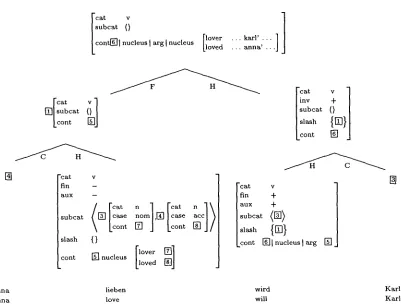
The compiler is not able to find an evaluation or- der such that the Earley generator has sufficient re- stricting information to generate all subparts of the construction efficiently in particular cases of comple- ment displacement. More specifically, this problem arises when a complement receives essential restrict- ing information from the head of the construction from which it has been extracted, while, at the same time, it provides essential restricting information for the complements that stayed behind. Such a case is represented schematically in figure 1 (see next page). The first processing complement ( e l ) of the head (H) has been displaced. This is problematic in case c l provides essential bindings for the successful eval- uation of the complement c2. c l can not be evalu- ated prior to the head and once H is evaluated it is no longer possible to evaluate c l prior to c2. An example of problematic complement displace- ment taken from our test-grammar is given in fig- ure 2 (see next page). The topicalized partial vP "Anna lichen" receives its restricting semantic infor- mation from the auxiliary verb and upon its eval- uation provides essential bindings not only for the direct object, but also for the subject that stayed behind in the Mittelfeld together with the auxiliary verb. These mutual dependencies between the sub- constituents of two different local trees lead either to the unrestricted generation of the partial vP, or to the unrestricted generation of the subject in the Mittelfeld. We handled this problem by partial exe- cution (Pereira and Shieber, 1987) of the filler-head rule. This allows the evaluation of the filler right after the evaluation of the auxiliary verb, but prior to the subject. A head-driven generator has to rely on a similar solution, as it will not be able to find a successful ordering for the local trees either, simply because it does not exist.
4.2 Generalization
A potential problem for our approach constitutes the requirement that the phrase structure rules in the grammar need to have a particular degree of
specificity for the generalization operation to be used successfully to mimic its evaluation. This is best illustrated on the basis of the following, more 'schematic', phrase structure rule:
[cat (}l~.]] [i at
subcat _....
v
fin ~- >1
(~
,ff]NN
u b c a t , ~ ] , [ ~ ' ' Lcont
[cont
Underspecification of the head of the rule allows it to
unify with both finite auxiliaries and finite ditransi- tive main verbs. In combination with the underspec- ification of the complements, this allows the rule not only to be used for argument composition construc- tions, as discussed above, but also for constructions in which a finite main verb becomes saturated. This means that the logical form of the nonverbal com- plements (if] and [~) becomes available either upon the evaluation of the complement tagged [] (in case of argument composition), or upon the evaluation of the finite verb (in case the head of the rule is a ditransitive main verb). As a result, the use of generalization does not suffice to mimic the evalua- tion of the respective right-hand side categories. Be- cause both verbal categories have defining lexical en- tries which do not instantiate the logical form of the nonverbal arguments, the dataflow analysis leads to the conclusion that the logical form of the nonver- bal complements never becomes instantiated. This causes the rejection of all possible evaluation orders for this rule, as the evaluation of an unrestricted non- verbal complement clearly exceeds the allowed max- imal degree of nondeterminacy of the grammar. We are therefore forced to split this schematic phrase structure rule into two more specific rules at least during the optimization process. It is important to note that this is a consequence of a general limita- tion of dataflow analysis (see also Mellish, 1981).
5
C o n c l u d i n g
R e m a r k s
An innovative approach to HPSG processing is de- scribed that uses an off-line compiler to automat- ically prime a declarative grammar for generation or parsing, and inputs the primed grammar to an advanced Earley processor. Our off-line compiler extends the techniques developed in the context of the DIA in that it compiles typed feature struc- ture grammars, rather than simple logic grammars. The approach allows efficient bidirectional process- ing with similar generation and parsing times. It is shown that combining off-line techniques with an advanced Earley-style generator provides an elegant solution to the general problem that empty or dis- placed heads pose for conventional head-driven gen- eration.
l
H ] C 2Figure 1: Complement displacement.
c at
v
subcat()
cont[~'[[ nucleus I arg[ nucleus lover . . . k a r l ' . . . ] ] loved anna' .
[]
F
cat
(
)[~ll
F~/subcat Lcont
"cat v fin
Fat n Fat n
subcat ['g'] lease ~ m [~] [case
cont cont
slash {}
lover cont [] nucleus [loved ~N-'I]
is:L,
~-
slash contfin + aux + subcat ([~])
sl,.,h {D}
eont I~llnueleuslarg []
[]
Anna lieben wird
Anna love will
"Karl will love Anna"
Figure 2: Example
of problematic complement displacement.
[image:6.596.249.406.77.172.2] [image:6.596.139.540.292.597.2]dataflow analysis, which is used extensively to pro- vide the information upon which off-line compilation is based. Our compiler uses the type hierarchy to de- termine paths with a value of a minimal type with- out appropriate features as bound. However, the equivalent of this kind of minimal types in untyped feature structure grammars are constants which can be used in a similar fashion for off-line optimization.
R e f e r e n c e s
Appelt, Douglas. 1987. Bidirectional Grammars and the Design of Natural Language Generation Systems. In Proceedings of TINLAP-3, Las Cruces, New Mexico, USA.
Dymetman, Marc; Pierre Isabelle and Franqois Perrault. 1990. A Symmetrical Approach to Pars- ing and Generation. In Proceedings of
COLING-90,
Helsinki, Finland.
Gerdemann, Dale. 1991. Parsing and Generation of Unification Grammars. Doctoral dissertation. University of Illinois. Published as Beckman Insti- tute Cognitive Science technical report, number cs-91-06. Urbana-Champaign, Illinois, usa.
Gerdemann, Dale and Erhard Hinrichs. in press. Some Open Problems in Head-driven Genera- tion. In Linguistics and Computation. CSLI Lec- ture Notes. Stanford, California, usA.
Gerdemann, Dale and Paul King. 1994. The Correct and Efficient Implementation of Appropriateness Specifications for Typed Feature Structures. In Proceedings of COLING-94(, Kyoto, Japan.
Hinrichs, Erhard and Tsuneko Nakazawa. 1989. Subcategorization and vP Structure in German. Paper presented to the '3rd Symposium on Ger- manic Linguistics' at Purdue University. Pub- lished as SFB 340 technical report. Tiibingen, Ger- many.
tIinrichs, Erhard; Detmar Meurers and Tsuneko Nakazawa. 1994. Partial ve and Split NP
Top-
icalization in German: An HPSG Analysis and its Implementation. SFB 340 technical report nr. 58. Tiibingen, Germany.
KSnig, Esther. 1994. Syntactic-Head-Driven Gener- ation. In Proceedings of COLING-9~. Kyoto, Japan
Martinovid, Miroslav and Tomek Strzalkowski. 1992. Comparing Two Grammar-based Genera- tion Algorithms: A Case Study. In Proceedings of ACL-92, Newark, Delaware, usa.
Mellish, Chris. 1981. The Automatic Generation of Mode Declarations for Prolog Programs. In Pro- ceedings of the Workshop on Logic Programming and Intelligent Systems, Los Angeles, California, USA.
Minnen, Guido; Dale Gerdemann and Erhard Hinrichs. 1995. Direct Automated Inversion of Logic Grammars. In New Generation Computing, volume 13, number 2.
Pereira, Fernando and Stuart Shieber. 1987. Pro- log and Natural Language Analysis. CSLI Lecture Notes, number 10. Stanford, California, usA.
Pollard, Carl and Ivan Sag. 1 9 9 4 . Head- driven Phrase Structure Grammar. University of Chicago Press, Chicago, Illinois, usa.
Shieber, Stuart. 1988. A Uniform Architecture for Parsing and Generation. In Proceedings of
COLING-88. Budapest, Hungary.
Shieber, Stuart; Gertjan van Noord; Fernando Pereira and Robert Moore. 1990. Semantic Head- Driven Generation. In Computational Linguistics, volume 16, number 1.
Strzalkowski, Tomek (editor). 1993a. Re- versible Grammar in Natural Language Process- ing. Kluwer Academic Publishers, Dordrecht, The Netherlands.
Strzalkowski, Tomek. 1993b. A General Com- putational Method for Grammar Inversion. In Strzalkowski 1993a.