Full Text Parsing using Cascades of Rules:
an Information Extraction Perspective
F a b i o C i r a v e g n a a n d A l b e r t o L a v e l l i
I T C - i r s t C e n t r o per la R i c e r c a Scientifica e T e c n o l o g i c a via S o m m a r i v e , 18
38050 Povo ( T N ) ITALY
{cirave[lavelli} Q i r s t . i t c . i t
A b s t r a c t
This paper proposes an approach to full parsing suitable for Information Extrac- tion from texts. Sequences of cascades of rules deterministically analyze the text, building unambiguous structures. Ini- tially basic chunks are analyzed; then ar- gumental relations are recognized; finally modifier attachment is performed and the global parse tree is built. The ap- proach was proven to work for three lan- guages and different domains. It was im- plemented in the IE module of FACILE, a EU project for multilingual text classi- fication and !E.
1 I n t r o d u c t i o n
Most successful approaches in IE (Appelt et al., 1993; Grishman, 1995; Aone et al., 1998) make a very poor use of syntactic information. They are generally based on shallow parsing for the anal- ysis of (non recursive) NPs and Verba~ Groups (VGs). After such step regular patterns are ap- plied in order to trigger primitive actions that fill template(s); meta-rules are applied to patterns to cope with different syntactic clausal forms (e.g., passive forms). If we consider the most com- plex MUC-7 task (i.e., the Scenario Template task (MUC7, 1998)), the current technology is not able to provide results near an operational level (ex- pected F(1)=75%; the best system scored about 50% (Aone et al., 1998)). One of the limita- tions of the current technology is the inability to extract (and to represent) syntactic relations among elements in the sentence, i.e. grammati- cal functions and thematic roles. Scenario Tem- plate recognition needs the correct treatment of syntactic relations at both sentence and text level (Aone et al., 1998). Full parsing systems are gen- erally able to correctly model syntactic relations,
but they tend to be slow (because of huge search spaces) and brittle (because of gaps in the gram- mar). The use of big grammars partially solves the problem of gaps but worsens the problem of huge search spaces and makes grammar modifications difficult (Grishman, 1995). Grammar modifica- tions are always to be taken into account. Many domain-specific texts present idiosyncratic phe- nomena that require non-standard rules. Often such phenomena are limited to some cases only (e.g., some types of coordinations are applied to people only and not to organizations). Inserting generic rules for such structures introduces (use- less) extra complexity into the search space and - when applied indiscriminately (e.g., on classes other than people) - can worsen the system re- sults. It is not clear how semantic restrictions can be introduced into (big) generic grammars.
In this paper we propose an approach to full parsing for IE based on cascades of rules. The approach is inspired by the use of finite-state cas- cades for parsing (e.g., (Abney, 1996) uses them in a project for inducing lexical dependencies from corpora). Our work is interesting in an IE per- spective because it proposes:
• a method for efficiently and effectively per- forming full parsing on texts;
• a way of organizing generic grammars that simplifies changes, insertion of new rules and especially integration of domain-oriented rules.
the financial domain. The proposed approach has been tested mainly for Italian, but proved to work also for English and, as of the time of this writing, partially for Russian. Applications and demon- strators have been built in four different domains. In this p a p e r we first introduce the adopted for- malism and then go into details on g r a m m a r orga- nization and on the different steps through which parsing is accomplished. Finally we present some experimental results.
2
R e p r e s e n t a t i o n
and Rules
Every lexical element a in the input sentence w is abstractly represented by means of elementary objects, called t o k e n s . A token T is associated with three structures:
• [T]dep is a dependency tree for a, i.e. a tree representing syntactic dependencies between a and other lexical elements (its dependees) in w.
• [T]leat is a feature structure representing syn- tactic and semantic information needed to combine a with other elements in the input. • [T]zy is a Quasi Logical Form (QLF) providing
a semantic interpretation for the combination of a with its dependees.
Rules operate on tokens, therefore they can access all the three structures above. Rules incremen- tally build and update the above structures. Lex- ical, syntactic and semantic constraints can then be used in rules at any level. The whole IE ap- proach can be based on the same formalism and rule types, as both lexical, syntactic and semantic information can be processed uniformly.
The general form of a r u l e is a triple (Ta~, FT, FA>, where
• 7c~d is a non-empty string of tokens, called the rule p a t t e r n ; cr is called the rule c o r e and is non-empty, 7, fi are called the rule c o n - t e x t and m a y be empty;
• FT is a set of boolean predicates, called rule t e s t , defined over tokens in the rule pattern; • FA is a set of elementary operations, called rule a c t i o n , defined over tokens in the sole rule core.
The postfix, unary operators " , " (Kleene star) and "?" (optionality operator) can be used in the rule patterns.
A basic d a t a structure, called t o k e n c h a r t , is processed and dynamically maintained. This is a directed graph whose vertices are tokens and whose arcs represent binary relations from some (finite) basic set. Initially, the token chart is a chain-like graph with tokens ordered as the corre- sponding lexical elements in w, i.e. arcs initially represent lexical adjacency between tokens. Dur- ing the processing, arcs might be rewritten so t h a t the token chart becomes a more general kind of graph.
For a rule to apply, a path cr m u s t be found in the token chart that, when viewed as a string of tokens, satisfies the two following conditions: (i) ~ is matched by 7a~; and (ii) all the boolean predicates in FT hold when evaluated on c~.
When a rule applies, the elementary operations in FA are executed on the tokens of ¢ matching the core of the rule. The effect of action execution is t h a t [T]dep, IT]lear and [Tit/are u p d a t e d for the appropriate matching tokens.
Rules are grouped into c a s c a d e s t h a t are fi- nite, ordered sequences of rules. Cascades rep- resent elementary logical units, in the sense t h a t all rules in a cascade deal with some specific con- struction (e.g., subcategorization of verbs). From a functional point of view, a cascade is composed of three segments:
• s l contains rules that deal with idiosyncratic cases for the construction at hand;
• s2 contains rules dealing with the regular cases;
• s3 contains default rules t h a t fire only when no other rule can be successfully applied.
3
Parsing
The parsing model is strongly influenced by IE needs. Its aim is to build the sufficient IE ap- proximation (SIEA) of the correct parse tree for each sentence, i.e. a complete parse tree where all the relations relevant for t e m p l a t e filling are represented, while other relations are left implicit. The parser assumes that there is one and only one possible correct parse tree for each sentence and therefore also only one SIEA.
Parsing is based on the application of a fixed sequence of cascades of rules. It is performed in three steps using different grammars:
* chunking (analysis of NPs, VGs and PPs); . subcategorization frame analysis (for verbs,
[ACME] np A C M E
[iniziare] vg start
[in raodo da]compt so to
[ha d e c i s o ] v g ,
has decided,
[1' emis s l o n e ] np the issue
[divers if icare] vg diversify
[informa] vg tells
[di obbligazioni] pp of bonds
[il proprio impegno]np its obligation
[una n o r a ] np, [ d i ] eompt a press release, to
[per 12 milioni di Euro]pp for 1~ million (o]) Euro
[nel mercato]pp. in the market.
Figure 1: The Italian sentence used as an example.
T h e first two steps are syntax driven and based on generic grammars. Most rules in such grammars are general syntactic rules, even if they strongly rely on the semantic information provided by a foreground lexicon (see also Section 3.2). Dur- ing modifier attachment, mainly semantic pat- terns are used. At the end of these three steps the SIEA is available.
We use deterministic dependency parsing 1 op- erating on a specific linear path within the to- ken chart (the parsing path); at the beginning the parsing path is equal to the initial token chart. When a rule is successfully applied, the parsing p a t h is modified so that only the head token is visible for the application of the following rules; this means that the other involved elements are no longer available to the parser.
3.1 C h u n k i n g
Chunking is accomplished in a standard way. In Figure I an example of chunk recognition is shown. 2
3.2 A-structure Analysis
A-structure analysis is concerned with the recognition of argumental dependencies between chunks. All kinds of modifier dependencies (e.g., P P attachment) are disregarded during this step.
More precisely: let w be the input sentence. A d e p e n d e n c y tree for w is a tree represent- ing all predicate-argument and predicate-modifier syntactic relations between the lexical elements in w. T h e A-structure for w is a tree forest ob- tained from the dependency tree by unattaching all nodes that represent modifiers. A-structures are associated with the token that represents the semantic head of w (Tsent in the following). A- structure analysis associates to Ts~nt:
• [Tsent]dep: the A-structure spanning the whole sentence;
t Even if we use dependency parsing, in this paper we will make reference to constituency based struc- tures (e.g., PPs) because most readers are more ac- quainted with them than with dependency structures. 2In this paper we use literal English translations of Italian examples.
* [Ts~.t]f~,t: its feature structure;
• [Tsent]tf: its QLF.
A-structure analysis is performed without recur- sion by the successive application of three se- quences of rule cascades: 3
. The first sequence of cascades performs anal- ysis o f basic (i.e., non-recursive) sentences. It does so using the subcategorization frames of available chunks. Three cascades of rules are involved: one for the subcategorization frames of NP and PPs, one for those of VGs, and one for combining complementizers with their clausal arguments.
• The second sequence of cascades performs analysis of dependencies between basic sen- tences. This sequence processes all sentential arguments and all incidentals by employing only two cascades of rules, without any need for recursion. This sequence is applied twice, i.e. it recognizes structures with a m a x i m u m of two nested sentences.
* The third sequence of cascades performs re- covery analysis. During this step all tree frag- ments not yet connected together are merged. Tokens not recognized as arguments at the end of A-structure analysis are marked as modifiers and left unattached in the resulting A-structure. They will be attached in the parse tree during modifier attachment (see Section 3.3).
[image:3.596.75.545.62.136.2]P A T T E R N T E S T ACTION Matched Input T1
T2*
T3
[T1]yeat.cat=NP
[T2]/eat.cat=ld j
unct[T3]yeat.cat=PP
[T3]]eat=[T1]]e~t.subcat.int-arg
Depend ant (IT1] aep, [T3] aep)
[T1]yeat.subcat.int-arg=[T3]yeat
[T1]t/.patient =[7"3]ty.head
"the issue"
" o f b o n d s "
Figure 2: T h e rule that recognizes [the i s s u e o f bonds]np.
generally includes subject, object and - possibly - one indirect complement. The information in the foreground lexicon allows to classify known tokens as arguments of other known tokens with high re- liability. Let's go back to our example. The first sequence of cascades recognizes:
* [ t h e i s s u e o f bonds]np: the rule in Figure 2 recognizes [ o f bonds]pp as internal argu- ment of [ t h e i s s u e ] n p ; the rule uses the in- formation associated with i s s u e in the fore- ground lexicon, i.e. that it is the nominal- ization of "to issue". The subcategorization frame of such verb specifies its arguments and their semantic restrictions. The syntactic rule adds the condition that - being a nomi- nalization - the internal argument is realized as a PP marked by of;
- [ACME has decided]ip: [ACME]np is the ex- ternal argument of [has d e c i d e d ] v g ;
• [tells a press release]ip: [a press
release]np is the external argument of
[tells]vg;
• [start the issue of b o n d s for 12
million Euro]ip: [issue]np is the internal
argument of [start]v9; [for 12 million
Euro]pp is a modifier (as it is not subcatego- rized by other tokens) and is unattached in the A-structure;
- [diversify its obligation in the market]ip: [its obligation]np is the
internal argument of [diversify]v9; [in the market]pp is a modifier;
• [to start t h e issue of b o n d s for 12 m i l l i o n Euro]ep:
[tO]compl
gets its argu- m e n t [start ...lip;• [so to d i v e r s i f y its o b l i g a t i o n in the market]cp: [so
tO]compl
gets its a r g u m e n t [ d i v e r s i f y . . . ]ip.The result after the application of the first se- quence is:
[ACME
has decided]ip
[tells a press release]ip[to start the issue of bonds for 12 million Euro] cp
[so to diversify its obligation in the
market] cp
The second sequence recognizes that [ACME has decided]@ still needs a sentential argument, i.e. a subordinate clause introduced by t o (such infor- mation comes from the foreground lexicon). Such argument is found after the incidental [ t e l l s a p r e s s r e l e a s e ] : it is the CY headed by [ t o s t a r t ] . The result of the second phase is:
[ACME has decided, t e l l s a p r e s s r e l e a s e , to start the issue of b o n d s f o r 12
million Euro]
sentence
[so to diversify its obligation in the market]
ep
Finally, the recovery sequence collapses the two constituents above into a single sentence struc- ture; the CP is considered a clausal modifier (as it was not subcategorized by anything) and is left unattached in the A-structure.
At the end of the A-structure recognition
Tsent
is the token associated with [has decided'].
[Tsent]dep
is integrated with the search space for each unattached modifier (see Section 3.3).The way A-structures are produced is interest- ing for a number of reasons.
[image:4.596.83.503.60.223.2]Kameyama, 1997).
The initial generic grammar is designed to cover the most frequent phenomena in a restrictive sense. Additional rules can be added to the gram- mar (when necessary) for coping with the un- covered phenomena, especially domain-specific id- iosyncratic forms. The limited size of the gram- mar makes modifications simple (the A-structure grammar for Italian contains 66 rules).
The deterministic approach combined with the use of sequences, cascades and segments makes grammar modifications simple, as changes in a cascade (e.g., rule addition/modification) influ- ence only the following part of the cascade or the following cascades. This makes the writing and debugging of grammars easier t h a n in recursive approaches (e.g., context-free grammars), where changes to a rule can influence the application of any rule in the grammar.
The grammar organization in cascades and seg- ments allows a clean definition of the grammar parts. Each cascade copes with a specific phe- nomenon (modularity of the grammar). All the rules for the specific phenomenon are grouped to- gether and are easy to check.
The segment/cascade structure is suitable for coping with the idiosyncratic phenomena of re- stricted corpora. As a matter of fact domain- oriented corpora can differ from the standard use of language (such as those found in generic cor- pora) in two ways:
• in the frequency of the constructions for a specific phenomenon;
• in presenting different (idiosyncratic) con- structions.
Coping with different frequency distributions is conceptually easy by using deterministic parsing and cascades of rules, as it is just necessary to change the rule order within the cascade coping with the specific phenomenon, so that more fre- quently applied rules are first in the cascade. Cop- ing with idiosyncratic constructions requires the addition of new rules. Adding new rules in highly modularized small grammars is not complex.
Finally from the point of view of grammar or- ganization, defining segments is more than just having ordered cascades. Generic rules ~in s2) are separated from domain specific ones (in sl); rules covering standard situations (in s2) are separated from recovery rules (in s3). In s2, rules are generic and deal with unmarked cases. In principle s2 and s3 are units portable across the applications without changes. Domain-dependent rules are grouped together in sl and are the resources the
application developer works on for adapting the grammar to the specific corpus needs (e.g., cop- ing with idiosyncratic cases). Such rules generally use contexts a n d / o r introduce domain-dependent (semantic) constraints in order to limit their ap- plication to well defined cases. S1 rules are ap- plied before the standard rules and then idiosyn- cratic constructions have precedence with respect to standard forms.
Segments also help in parsing robustly. $3 deals with unexpected situations, i.e. cases t h a t could prevent the parser from continuing. For example the presence of unknown words is coped with after chunking by a cascade trying to guess the word's lexical class. If every strategy fails, a recovery rule includes the unknown word in the immedi- ately preceding chunk so to let the parser con- tinue. Recovery rules are applied only when rules in sl and s2 do not fire.
3.3 M o d i f i e r a t t a c h m e n t
The aim of modifier attachment is to find the cor- rect position for attaching relevant modifiers in the parse tree and to add the proper semantic relations between each modifier and its modifiee in
[Tsent]ty. [Tsent]dep and
[Tsent]t$
are used to determine the correct attachments and are also modified during this step. Modifier attachment is performed in two steps: first all the possible attachments are computed for each modifier (its s e a r c h s p a c e , SP). Here mainly generic syntac- tic rules are used. Then the correct attachment in the search space is determined for each modifier, applying domain-specific rules. The rules always modify both[Tsent]dep
and[Tsent]ty.
Only modi- fiers relevant for the IE task are attached in the proper position. Other modifiers are attached in a default position in[T~ent] d~p.
Initially modifiers are attached in the lowest po- sition in
[Tsent]dep.
No semantic relation is hy- pothesized between each modifier and the rest of the sentence in[Ts~nt]t/.
Given:• T~: a modifier token derived from chunk n,
• Tn-l:
the token, derived from chunk n - 1,immediately preceding n in the sentence, in right branching languages (such as Italian) the lowest possible attachment for T,~ is in the position of modifier of Tn-x.
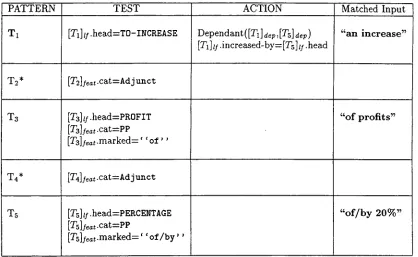
P A T T E R N T I
T2*
T3
T4*
T5
T E S T
[T1] t/.head=TO-INCREASE
[T2]/eat.cat
= A d j u n c t[T3]i/.head=PROFIT
[T3]/oor.cat=VV
[Ta]/~,~t.marked='
' o f "[T4]Ieat.Cat
: A d j u n c t[Tb] I/.head:PERCENTAGE
[Tb]/eat.cat=PP
[Ts]feat.marked: "
o f / b y ' 'ACTION Dependant ([T1]
dev,
[Tb] dev)[ T1] l]
.increased-by=[Ta]t/.headMatched Input " a n i n c r e a s e "
" o f p r o f i t s "
" o f / b y 2 0 % "
Figure 3: An example of modifier attachment rule.
with Tsent. Then rules are applied to filter out elements in SPs according to syntactic constraints (e.g., NPs or PPs can be modified by a relative clause, but VGs can not).
After SPs have been computed, modifiers are attached using a sequence of cascades of rules.
A first cascade, mainly composed by generic syntactic rules, attaches subordinates (e.g., rela- tive clauses). Many of these rules are somehow similar to A-structure recognition rules. They are truly syntactic rules recognizing part of the sub- categorization frame of subordinated verbs, using semantic information provided by the foreground lexicon. Note however that they are applied onto SPs not on the parsing path (as A-structure rules are).
Other cascades are used to attach different types of modifiers, such as PPs. Such rules mainly involve semantic constraints. For exam- ple, the rule shown in F i g u r e 3 can recognize
una crescita dei profitti del 20Y, (lit. an
increase of profits of/by 20%).4
4Generally rules involve two elements (i.e. the modifier and the modifiee), taking into account in- tervening elements (such as other adjuncts) that do not have further associated conditions. The example above, instead, is more complex as it introduces con- straints also on one of the intervening adjuncts (i.e., on T3). Such domain-oriented rule solves a recurring am- biguity in the domain of company financial results. As a matter of fact o f / b y 20% could modify both nouns from a syntactic and semantic point of view. The rule
Rules for modifier attachment are easy to write. The SP allows to reduce complex cases to simple ones. For exampl e the rule in Figure 3 also applies
to:
• an increase in 1997 of profits of/by
20Z
• an increase, news report, of profits of/by 20Z
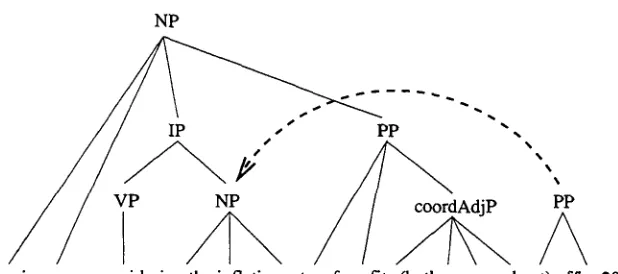
• an increase, considering the inflation rate, of profits (both gross and net) of/by 20~
Patterns are usually developed having in mind the simplest case, i.e. a sequence of contiguous chunks in the sentence (such as in [an i n c r e a s e ]
[of p r o f i t s ] [ o f / b y 20%]) that can be inter- leaved by other non relevant chunks.
Conceptually this step is very similar to that used by shallow parsing approaches such as in (Grishman, 1997). Note however that rules are not applied on a list of contiguous chunks, but on the search space (where the parse tree and re- lated syntactic relations are available). Parse-tree based modifier attachment is less error prone than attachment performed on fiat chunk structures (as used in shallow parsing). For example it is possi- ble to avoid cases of attachments violating syntac- tic constraints, as it would be the case in attaching
[image:6.596.85.503.78.335.2]NP
~
p
p
"..
,,,
an increase,
considering
the
inflation
rate,
of
profits
(both
gross
and
net)
of/by
20%
Figure 4: Violation of syntactic constraints
(in the third example above)
profit
to i n c r e a s e and 20% to i n f l a t i o n r a t e (see Figure 4).At the end of modifier a t t a c h m e n t the final parse tree is available in
[T~ent] aep,
together with[Tse,~t]feat
and[Tsent]g.
The syntactic informa- tion in[Tse,,t]aep
and[Tsent].feat
is useful in the steps following parsing because, for example, the availability of syntactic relations increases the ac- curacy in determining discourse relations. As a m a t t e r of fact at discourse level it is possible to adopt strategies to compute salience for corefer- ence resolution that take into account both the syntactic relations among constituents and the ar- gumental structure of the sentence. Shallower ap- proaches do not produce anything similar either to[Tse,~t]aep
or to[Tse,~t]yeat.
T h e y generally adopt heuristics such as linear ordering and recency of basic chunks: such heuristics have been shown not as effective as those based on full syntactic rela- tions, even if for some languages they represent an acceptable approximation (Kameyama, 1997).The obtained final parse tree is very close to the SIEA mentioned at the beginning of Section 3. In this tree all the A-structures are correctly built and all the modifiers are attached. Modi- fiers relevant for the IE application are attached in the correct position in the tree and a valid se- mantic relation is established with the modifiee in
[Tsent]g.
Irrelevant modifiers are attached in a default position in the tree (the lowest possi- ble attachment) and a null semantic relation is established with the m o d i f i e e . The only differ- ence between the produced tree and the SIEA is in the A-structure, where all the relations are captured (and not only those relevant for the do- main). Modeling also the argumental structures of irrelevant constituents can be useful in order to correctly assign salience at discourse level. For ex- ample when interesting relations involve elements that are dependees of irrelevant verbs.4
R e m a r k s and C o n c l u s i o n s
T h e approach to parsing proposed in this paper was implemented in the IE module of FACILE (Ciravegna et al., 1999), a EU project for multi- lingual text classification and IE. It was tested on four domains and in three languages. In particular for Italian one application (about bond issues) has been fully developed and two others have reached the level of demonstration (management succes- sion and company financial results). For English a demonstrator for the field of economic indica- tors was developed. A Russian demonstrator for bond issues was developed till the level of modi- fier attachment. The approach to rule writing and organization adopted for parsing '(i.e., the type of rules, cascades, segments, and available primitives and rule interpreter) was extended to the whole architecture of the IE module. Also lexical (lexi- cal normalization and preparsing), semantic (de- fault reasoning and template filling) and discourse levels are organized in the same way.
Provided that the approach to parsing proposed in this paper is strongly influenced by IE needs, it is difficult to evaluate it by means of the stan- dard tools used in the parsing community. Ap- proximate indications can be provided by the ef- fectiveness in recognizing A-structures and by the measures on the overall IE tasks.
Effectiveness in recognizing A-structures was experimentally verified for Italian on a corpus of 95 texts in the domain of bond issue: 33 texts were used for training, 62 for test. Results were: P = 9 7 , R=83 on the training corpus, P=95, R=71 on the test corpus. In our opinion the high preci- sion demonstrates the applicability of the method. T h e lower recall shows difficulties of building com- plete foreground lexica, a well known fact in IE.
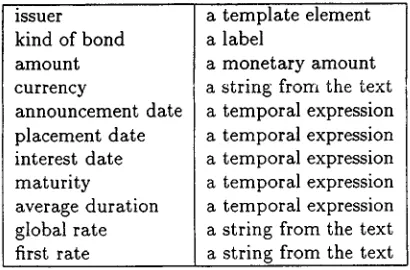
[image:7.596.141.450.69.206.2]texts used for development (33 ANSA agency news, 20 "II Sole 24 ore" newspaper articles, 42 Radiocor agency news; 10,472 words in all). Ta- ble 4 shows the kind of template used for this ap- plication. Effectiveness was automatically calcu- lated by comparing the system results against a user-defined tagged corpus via the MUC scorer (Douthat, 1998). The development cycle of the template application was organised as follows: re- sources (grammars, lexicon and knowledge base) were developed by carefully inspecting the first 33 texts of the corpus. Then the system was com- pared against the whole corpus (95 texts) with the following results: Recall=51, Precision=74, F(1)=60. Note that the corpus used for train- ing was composed only by ANSA news, while the test corpus included 20 "I1 Sole 24 ore" newspa- per articles and 42 Radiocor agency news (i.e., texts quite different from ANSA's in both termi- nology and length). Finally resources were tuned on the whole corpus mainly by focusing on the texts that did not reach sufficient results in terms of R&P. The system analyzed 1,125 word/minute on a Sparc Ultra 5, 128M RAM (whole IE pro- cess).
issuer kind of bond amount currency
announcement date placement date interest date maturity
average duration global rate first rate
a template element a label
a monetary amount a string from the text a temporal expression a temporal expression a temporal expression a temporal expression a temporal expression a string from the text a string from the text Table 1: The template to be filled for bond issues.
A c k n o w l e d g m e n t s
Giorgio Satta has contributed to the whole work on parsing for IE via cascades of rules. The au- thors would like to thank him for the constant help and the fruitful discussions in the last two years. He also provided useful comments to this pa- per. The FACILE project (LE 2440) was partially funded by the European Union in the framework of the Language Engineering Sector. The En- glish demonstrator was developed by Bill Black, Fabio Rinaldi and David Mowatt (Umist, Manch- ester) as part of the FACILE project. The Russian demonstrator was developed by Nikolai Grigoriev (Russian Academy of Sciences, Moscow).
R e f e r e n c e s
Steven Abney. 1996. Partial parsing via finite- state cascades. In Proceedings of the ESSLI '96 Robust Parsing Workshop.
Chinatsu Aone, Lauren Halverson, Tom Hamp- ton, and Mila Ramos-Santacruz. 1998. SRA: description of the IE 2 system used for MUC-7. In Proceedings of the Seventh Message Understanding Conference (MUC-7), http://www.muc.saic.com/.
Douglas E. Appelt, Jerry R. Hobbs, John Bear, David Israel, and Mabry Tyson. 1993. FAS- TUS: A finite-state processor for information extraction from real-world text. In Proceed- ings of the Thirteenth International Joint Con- ference on Artificial Intelligence, Chambery, France.
Fabio Ciravegna, Alberto Lavelli, Nadia Mann, Luca Gilardoni, Silvia Mazza, Massimo Ferraro, Johannes Matiasek, William J. Black, Fabio Ri- natdi, and David Mowatt. 1999. FACILE: Clas- sifying texts integrating pattern matching and information extraction. In Proceedings of the Sixteenth International Joint Conference on Ar- tificial Intelligence, Stockholm, Sweden. Aaron Douthat. 1998. The message un-
derstanding conference scoring software user's manual. In Proceedings of the Seventh Message Understanding Conference (MUC- 7}, http://www.muc.saic.com/.
Ralph Grishman. 1995. The NYU system for MUC-6 or where's syntax? In Sixth mes- sage understanding conference MUC-6. Morgan Kaufmann Publishers.
Ralph Grishman. 1997. Information extraction: Techniques and challenges. In M. T. Pazienza, editor, Information Extraction: a multidisci- plinary approach to an emerging technology. Springer Verlag.
Megumi Kameyama. 1997. Recognizing referen- tial links: An information extraction perspec- tive. In Mitkov and Boguraev, editors, Proceed- ings of ACL/EACL Workshop on Operational Factors in Practical, Robust Anaphora Resolu- tion for Unrestricted Texts, Madrid, Spain. Adam Kilgarriff. 1997. Foreground and back-
ground lexicons and word sense disambiguation for information extraction. In International Workshop on Lexically Driven Information Ex- traction, Frascati, Italy.
[image:8.596.73.278.384.519.2]
![Figure 2: The rule that recognizes [the issue of bonds]np.](https://thumb-us.123doks.com/thumbv2/123dok_us/1328786.663763/4.596.83.503.60.223/figure-rule-recognizes-issue-bonds-np.webp)