1614
Early Rumour Detection
Kaimin Zhou2,3 Chang Shu1,2 Binyang Li3⇤ Jey Han Lau2,4,5
1 School of Computer Science, University of Nottingham Ningbo China
2DeepBrain
3School of Information Science and Technology, University of International Relations
4 School of Computing and Information Systems, The University of Melbourne
5 IBM Research Australia
[email protected],[email protected],
[email protected],[email protected]
Abstract
Rumours can spread quickly through social media, and malicious ones can bring about sig-nificant economical and social impact. Moti-vated by this, our paper focuses on the task of rumour detection; particularly, we are
in-terested in understanding how early we can
detect them. Although there are numerous studies on rumour detection, few are con-cerned with the timing of the detection. A successfully-detected malicious rumour can still cause significant damage if it isn’t de-tected in a timely manner, and so timing is crucial. To address this, we present a novel methodology for early rumour detection. Our model treats social media posts (e.g. tweets) as a data stream and integrates reinforcement learning to learn the number minimum num-ber of posts required before we classify an event as a rumour. Experiments on Twitter and Weibo demonstrate that our model identifies rumours earlier than state-of-the-art systems while maintaining a comparable accuracy.
1 Introduction
The concept of rumour has a long history, and there are various definitions from different re-search communities (Allport and Postman,1947). In this paper, we follow a commonly accepted def-inition of rumour, that it is an unverified statement, circulating from person to person and pertaining to an object, event, or issue of public concern and it is circulating without known authority for its truth-fulness at the current time, but it may turn out to be true, or partly or entirely false; alternatively, it may also remain unresolved (Peterson and Gist,
1951;Zubiaga et al.,2018).
Rumours have the potential to spread quickly through social media, and bring about significant economical and social impact. Figure1illustrates an example of a rumour propagating on TWIT -TER. The source message started a claim about
0 hour
4 hours
8 hours
12 hours
16 hours
20 hours
24 hours
This is unbelievable, or should be.
User 2
Follower Count: 3144
No excuse.
User 1
Follower Count: 1222
It applies to Black people.
User 3 Follower Count: 6
These days anything, especially with Stand Your Ground and even a sneeze is punishable by death.
User 5
Follower Count: 6632
Anything is punishable by death if the youth is black.
User 8
Follower Count: 11197
apparently it is now.
User 4 Follower Count: 205
He was 18. Nothing to do with stealing candy. He was walking in the street. Horrible situation. But stop spreading false facts.
User 7 Follower Count: 122
17 year old unarmed kid shot ten times by police for stealing candy. I didn't know that was punishable by death.
User 0
Follower Count: 873021
there has not been any proof that he stole candy. I guess skittles has become a reason to kill black teens.
User 6
Follower Count: 1141
I was just going off what I read in the #ferguson tag early last night. Wasn't any real news out at that point.
User 0
[image:1.595.308.523.226.467.2]Follower Count: 873021
Figure 1: An illustration of a rumour propagating on TWITTER. The green box indicates the source
mes-sage, and the red box highlights a post that rebuts the rumour.
the cause of Michael Brown’s shooting, and it was published shortly after the shooting happened. It claimed that he was shot ten times by the police for stealing candy. The message was retweeted by multiple users on TWITTER, and within 24 hours there were about 900K users involved, either by reposting, commenting, or questioning the origi-nal source message. From Figure1, we see some users (e.g. User 7) question the veracity of the original message. Had the rumour been identified timely and rebutted, its propagation could have been contained.
features to capture rumour indicative signals for detecting a rumour, and a few recent works ex-plore deep learning approaches to enhance detec-tion accuracy (Long et al.,2017;Ruchansky et al.,
2017). In all these studies, however, the timeliness of the rumour detection is not evaluated.
There are a few exceptions. InMa et al.(2015) andKwon et al.(2017), the authors define a check-point (e.g. number of posts or time elapsed after the source message) in the timeline and use all the posts prior to this checkpoint to classify a rumour. The checkpoint is often a pre-determined value for all rumours, and so does not capture the variation of propagation patterns for different rumours.
The focus of our paper is on earlyrumour de-tection. That is, our aim is to identify rumours as early as possible, while keeping a reasonable detection accuracy. Our early rumour detection system (ERD) features two modules: a rumour detection module that classifies whether an event (which consists of a number of posts) constitutes a rumour, and a checkpoint module that determines when to trigger the rumour detection module.
ERD treats incoming posts as a data stream and monitors the posts in real time. When ERD re-ceives a new post, this post — along with all prior posts of the same event — will be used to decide if it constitutes an appropriate checkpoint to trig-ger the rumour detection module. ERD integrates reinforcement learning for the checkpoint module to guide the rumour detection module, using its classification accuracy as a reward. Through rein-forcement learning ERD is able to learn the min-imum number of posts required to identify a ru-mour. In other words, ERD can dynamically deter-mine the appropriate checkpoint for different ru-mours, and this feature is the core novelty of our methodology.
To evaluate our approach, we use standard mi-croblog data sets from WEIBOand TWITTER. We compare our method with benchmark rumour de-tection systems (Ma et al.,2016;Ruchansky et al.,
2017; Dungs et al., 2018) and found that ERD could on average identify rumours within 7.5 and 3.4 hours with an accuracy of 93.3% and 85.8% on WEIBOand TWITTERrespectively. Our detec-tion accuracy performance is better than a state-of-the-art system that that detects rumours within 12 hours.
To summarise, we present a novel methodol-ogy for rumour detection. Unlike most rumour
detection systems, our approach determines the checkpoint for each event dynamically, by learn-ing when it should classify it as a rumour. Our experimental results showed that ERD outper-forms state-of-the-art methods over two bench-mark data sets in detection accuracy and timeli-ness. Our proposed framework is flexible and the individual modules (i.e. the rumour detection and checkpoint module) can be extended to incorpo-rate more complex networks for further improve-ments. An open source implementation of our model is available at:https://github.com/ DeepBrainAI/ERD.
2 Related Work
Traditionally, research on rumour detection has mainly focused on developing handcrafted fea-tures for machine learning algorithms (Qazvinian et al.,2011).Takahashi and Igata(2012) propose a method for rumour detection on Twitter using cue words and tweets statistics. Yang et al.(2012) ap-ply two new types of features — client-based and location-based features — to rumour detection on Sina Weibo. Beyond this, user-based (Liang et al.,
2015) and topic-based (Yang et al.,2015) features have also been explored. Friggeri et al. (2014) demonstrate that there are structural differences in the propagation of rumours and non-rumours, and
Wu et al.(2015) andMa et al.(2017) experiment with using these propagation patterns extensively to improve detection.
More recently, deep learning models are ex-plored for the task. Compared to traditional ma-chine learning approaches, these deep learning models tend to rely less on sophisticated hand-crafted features. Ma et al.(2016) introduce a ru-mour detection model for microblogs based on re-current networks. The input to their model is sim-ple tf-idf features but it outperforms models lever-aging handcrafted features.Sampson et al.(2016) show that implicit linkages between conversation fragments improve detection accuracy.Long et al.
(2017) present a deep attention model that learns a hidden temporal representation for each sequential posts to represent the hypothesis.Ruchansky et al.
(2017) integrate textual, user response, and source information into their neural models and achieve better performance.
series structure to incorporate temporal informa-tion to the features to understand the whole life cycle of rumours. Zhao et al. (2015) propose a detection model using a set of regular expressions to find posts that question or rebut the rumour to detect it earlier. Dungs et al. (2018) present an approach that checks for a rumour after 5 or 10 retweets. These models are interested inearly ru-mour detection, although the checkpoint for trig-gering a detection is pre-determined, and succeed-ing posts after the checkpoint are usually ignored. On a similar note but a different task, Farajtabar et al.(2017) experiment with reinforcement learn-ing by combinlearn-ing it with a point process network activity model to detect fake news and found some success.
3 Model Architecture
LetE denote an event, and it consists of a series
of relevant postsxi, wherex0 denotes the source
message andxT the last relevant message.1 The objective of early rumor detection is to make a classification decision whetherE is a rumour as
early as possible while keeping an acceptable de-tection accuracy.2
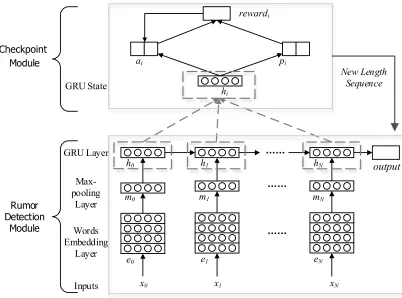
As shown in Figure 2, ERD has two modules: a rumour detection module (RDM) that classifies whether an event is a rumour, and a checkpoint module (CM) that decides when the rumour detec-tion module should be triggered. The checkpoint module plays an important role here, as it is re-sponsible for the timeliness of a detection.
3.1 Rumor Detection Module (RDM)
RDM contains three layers: a word embedding layer that maps input words into vectors, a max-pooling layer that extracts important features of a post, and a GRU (Cho et al.,2014) that processes the sequential posts of an event.
In the word embedding layer, we map words in post xi into vectors, yielding vectors eji for each word. To capture the most salient features of a post, we apply a max pooling operation (Collobert et al.,2011;Kim,2014;Lau et al.,2017), produc-ing a fixed size vectormi:
mi =maxpool([Wme0i;Wme1i;...;WmeKi ])
1Relevant posts are defined as retweets or responses to a
source message.
2The earliest possible time to classifyEis when we
re-ceive the first postx0.
where K is the number of words in the post.
HenceforthWin all equations are model
parame-ters.
To capture the temporal relationship between multiple posts, we use a GRU (Cho et al.,2014):
hi=GRU(mi, hi 1) (1)
We take the final state hN (N = number of posts received to date) and use it to perform ru-mour classification:
p=softmax(WphN+bp) (2) wherep2R2, i.e.p0(p1) gives the probability of
the positive (negative) class.3
3.2 Checkpoint Module (CM)
Rather than setting a static checkpoint when to classify an event as a rumour, CM learns the num-ber of posts needed to trigger RDM. To this end, we leverage deep reinforcement learning to iden-tify the optimal checkpoint. We reward CM based on RDM’s accuracy and also penalise CM slightly every time it decides to not trigger RDM (and con-tinue to monitor the event). This way CM learns the trade-off between detection accuracy and time-liness. The reward function is detailed in Sec-tion3.3.
We use the deep Q-learning model (Mnih et al.,
2013) for CM. The optimal action-value function
Q⇤(s, a)is defined as the maximum expected re-turn achievable under states, which can be
formu-lated as follows:
Q⇤(s, a) =Es0"[r+ max a0 Qi(s
0, a0)|s, a]
wherer is the reward value, the discount rate,
and the optimal action in all action sequence a0
is selected to maximise the expected value ofr+
Q⇤(s0, a0).
The optimal action-value function obeys the Bellman equation and is used for iterative value update:
Qi+1(s, a) =E[r+ max
a0 Qi(s
0, a0)|s, a]
The above iterative algorithm will converge and reach the optimal action value function, i.e.Qi !
Q⇤whenq ! 1(Sutton et al.,1998).
3Although sigmoid activation is more appropriate here as
x0 e0 m0 h0
hi
ai pi
e1 m1 h1
x1
eN mN hN
xN rewardi
…… …… ……
output
Checkpoint
Module
Rumor Detection
Module
GRU State
GRU Layer
Max-pooling
Layer
Words Embedding
Layer
Inputs
[image:4.595.104.506.64.362.2]New Length Sequence
Figure 2: Architecture of ERD.
CM takes as input the hidden states produced by the GRU in RDM to compute the action-value function using a two-layer feedforward network:
ai =Wa(ReLu(Whhi+bh)) +ba (3) where ai 2 R2 is the action value for terminate (a0i) or continue(a1i) at postxi. Note that a ran-dom action will be taken with the probability of✓
irrespective to the action valueai.
3.3 Joint Training
We train both RDM and CM jointly, and the train-ing process is similar to that of generative adver-sarial networks (Goodfellow et al., 2014). The checkpoint module serves as the generator for ac-tion sequences, while the detecac-tion module is the discriminator. A key contrast, however, is that the two modules are working cooperatively rather than adversarially.
CM is trained using RDM’s accuracy as reward. To compute the reward, we first pre-train RDM based on cross entropy:
X
j
[Ljlog(p0j) + (1 Lj)(log(p1j))] +↵l2
whereLjis a binary label indicating the true class for eventEj,pis computed based on Equation (2),
l2 is the L2 loss for RDM parameters, and↵ is a
hyper-parameter for scalingl2.
We then train CM while keeping RDM’s param-eters fixed. In each step of the training, new posts that have arrived and previous GRU states are first fed to the RDM to produce the new states (Equa-tion (1)), which will in turn be used by CM to cal-culate the action values (Equation (3)). This de-cides whether the system takes thecontinueor ter-minateaction. If terminateis chosen, the reward is given in accordance to RDM’s prediction; oth-erwise, a small penalty is incurred:
ri =
(
logM, terminatewith correct prediction P, terminatewith incorrect prediction
", continue
whereM is the number of correct predictions
ac-cumulated thus far,P is a large value to penalise an incorrect prediction, and " is a small penalty
value for delaying the detection.
Interval 0 Interval 1 Interval 2 Interval 3 Interval 4
Sample distribution
0:00 2:00 4:00 10:00 12:00
……
Interval 0 Interval 1 Interval 2
0:00 2:00 4:00 6:00 8:00 10:00 12:00
……
0:00 2:00 4:00 6:00 8:00 10:00 12:00
……
Interval 0 Interval 1 Interval 2
Interval 5 0:00 2:00 4:00 6:00 8:00 10:00 12:00
Fixed number of posts
Fixed time intervals
6:00 8:00 Dynamic intervals
Time
Figure 3: Three bucketing strategies to process stream-ing posts in batches.
follows:
yi =
(
ri, terminate
ri+ max a0
Q(hi+1, a0;✓), continue
where is the discount rate that decides how much experience is taken into consideration. And lastly, CM is optimised by minimising the cost:
(yi ai)2
We train CM and RDM in an alternating fash-ion, i.e. we train CM for several iterations while keeping RDM’s parameters fixed, and then we move to train RDM for several iterations while keeping CM’s parameters fixed. Training con-verges when CM’s reward value stabilises between consecutive epochs.
3.4 Bucketing Strategy
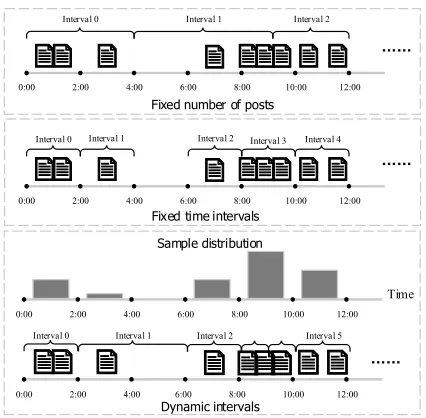
For processing efficiency purposes, instead of pro-cessing each incoming post individually, we ex-periment with several bucketing strategies that group posts together and process them in batches. As Figure3illustrates, we group posts based on: (1) a fixed number of posts (FN), e.g. every 3 posts (i.e. 3 posts are combined together forming 1 sin-gle post); (2) a fixed time interval (FT), e.g. every 2 hours; and (3) a dynamic interval (DI) that en-sures the number of posts collected in an interval is close to the mean number of posts collected in an hour in the full data set.
Statistics WEIBO TWITTER
User# 2,746,818 49,345
Posts# 3,805,656 103,212
Events# 4,664 5,802
Rumors# 2,313 1,972
Non-rumours 2,351 3,830
Avg. hours per event 2,460.7 33.4
Avg. # of posts per event 816 17
Max # of posts per event 59,318 346
[image:5.595.74.287.64.273.2]Min # of posts per event 10 1
Table 1: Statistics of WEIBOand TWITTER.
4 Experiment
4.1 Data Set
We experiment with two data sets: WEIBO and TWITTER, developed byMa et al.(2016) and Zu-biaga et al.(2016) respectively.4
Statistics of the data sets is presented in Ta-ble 1. Even though both data sets have a com-parable number of events, WEIBO is an order of magnitude larger than TWITTERas there are more posts per event. We reserve 10% of the events as the validation set for hyper-parameter tuning and early stopping, and split the rest in a ratio of 3:1 for training and test partitions.
4.2 Model Comparison
As a baseline, we use an SVM with tf-idf features. We also include several state-of-the-art rumour de-tection systems for comparisons: CSI ( Ruchan-sky et al.,2017) on WEIBO; CRF (Zubiaga et al., 2016) and HMM (Dungs et al., 2018) on TWIT -TER; and GRU-2 (Ma et al., 2016) on both data sets. For GRU-2 (Ma et al.,2016) we also report performance on several variants that use a differ-ent recurrdiffer-ent network: simple RNN with tanh ac-tivation (RNN); single-layer LSTM (LSTM); and single-layer GRU (GRU-1).
CSI is a neural model that integrates text and users representations to classify rumours. CRF and HMM are classical models that use crowd opinions (a.k.a. stance) of the event for classifi-cation. GRU-2 is based on a two-layer GRU that captures contextual information of posts with tf-idf features as inputs.
4There is a small difference in the definition of a
“ru-mour” in these two data sets. For WEIBO, all labelled
0 0.2 0.4 0.6 0.8 1
0 5 10 15 20 25 30 35 40 45 50
L
os
s
[image:6.595.76.287.64.188.2]Iterations (k)
Figure 4: Loss over time during joint training.
-0.15 -0.05 0.05 0.15 0.25 0.35
0 200 400 600 800 1000 1200 1400 1600 1800 2000
R
ew
ar
d
s
[image:6.595.306.526.66.127.2]Iterations (k)
Figure 5: Reward over time during joint training.
4.3 Preprocessing and Hyper-parameters
We preprocess each post by segmenting them into words, and remove all stop words.5 We pre-train word embeddings and kept them fixed dur-ing traindur-ing.6 ✓is set to 0.01 and to 0.95; both values are determined empirically based on vali-dation data. We use the Adam optimiser (Kingma and Ba,2014) with a learning rate of 0.001 during joint training, which we found to produce stable training.
4.4 Training Loss and Reward
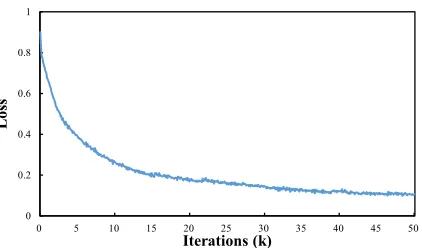
We present the training loss and reward values over time during joint training in Figure4and Fig-ure 5. We pre-train RDM for 2 epochs before joint training, and then we train RDM and CM in an alternating fashion for 1 epoch and 200K iterations respectively. We can see that loss de-clines steadily after 20K iterations and converges
5For TWITTER, words are tokenised using white spaces,
and stopword list is based on NLTK (Bird et al.,2009). For WEIBO, Jieba is used for tokenisation: https://pypi. org/project/jieba/; and stopword list is a customised list based on:http://blog.sina.com.cn/s/blog_ a19ab3770102wjav.html.
6For WEIBO, the embeddings are pre-trained using
word2vec (Mikolov et al., 2013) on a separate Weibo data set we collected. For TWITTER, the embeddings are pre-trained GloVe embeddings (Pennington et al., 2014). Un-known words are initialised as zero vectors.
Method Accuracy Precision Recall F1
FN 0.874 0.808 0.835 0.821
FT 0.861 0.771 0.850 0.808
DI 0.814 0.771 0.767 0.769
Table 2: Classification performance for 3 bucketing
strategies on TWITTER.
at around 50K iterations. The reward curve, on the other hand, fluctuates more as the reward was calculated based on the accuracy of RDM. When switching between training RDM and CM, the re-ward value tends to change abruptly, although over time we see a consistent improvement.
4.5 Results
4.5.1 Bucketing Strategy
Recall that we explore 3 different methods to group posts in order to process them in batches (Section3.4). Here we evaluate them on rumour classification accuracy over the validation set of TWITTER. Note that we do not use CM here (and hence no reinforcement learning is involved) — we simply use all posts of an event to perform ru-mour classification with RDM. In terms of metrics we use standard accuracy, precision, recall and F1 scores. Results are presented in Table2.
We see FN produces the best performance, and so FN is used for all following experiments as the default bucketing strategy.7As certain events have a long delay between posts, we also incorporate a maximum delay of one hour before processing the posts in a batch.
4.5.2 Detection Accuracy
In this section, we assess how accurately the mod-els classify rumours. All baselines and bench-mark systems uses all posts of an event to perform classification, with the exception of HMM which uses only the first 5 posts. For our models, we present: (1) the full model ERD, which uses a sub-set of posts for classification (checkpoint decided by CM); and (2) RDM, which uses the full set of posts. Results are detailed in Table3and4.
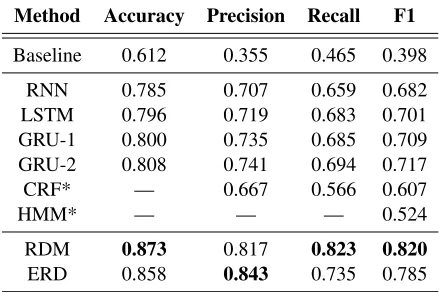
We can see that RDM outperforms all mod-els across most metrics, including state-of-the-art rumour detection systems CSI (marginally) and CRF (substantially). ERD, on the other hand, performs very competitively, outperforming most
[image:6.595.73.287.227.340.2]Method Accuracy Precision Recall F1
Baseline 0.724 0.673 0.746 0.707
RNN 0.873 0.816 0.964 0.884
LSTM 0.896 0.846 0.968 0.913
GRU-1 0.908 0.871 0.958 0.913
GRU-2 0.910 0.876 0.956 0.914
CSI* 0.953 — — 0.954
RDM 0.957 0.950 0.963 0.957
[image:7.595.310.523.65.200.2]ERD 0.933 0.929 0.936 0.932
Table 3: Detection accuracy on WEIBO. ‘*’ denotes
values taken from the original publications.
Method Accuracy Precision Recall F1
Baseline 0.612 0.355 0.465 0.398
RNN 0.785 0.707 0.659 0.682
LSTM 0.796 0.719 0.683 0.701
GRU-1 0.800 0.735 0.685 0.709
GRU-2 0.808 0.741 0.694 0.717
CRF* — 0.667 0.566 0.607
HMM* — — — 0.524
RDM 0.873 0.817 0.823 0.820
ERD 0.858 0.843 0.735 0.785
Table 4: Detection accuracy on TWITTER. ‘*’ denotes
values taken from the original publications.
benchmark systems and baselines, with the excep-tion of CSI on WEIBO. Note, however, that unlike most other systems, ERD leverages only a subset of posts for rumour classification. HMM is the only benchmark system on TWITTER that uses a subset (first 5), and its performance is markedly worse than that of ERD (which uses 4.03 posts on average).
4.5.3 Detection Timeliness
Next we evaluate the timeliness of the detection, and we focus on comparing our system with GRU-2 (Ma et al.,2016), as it performed competitively in Section 4.5.2. Note that GRU-2 uses a manu-ally set checkpoint (12 hours) that were found to be optimal, while ERD determines the checkpoint dynamically.
We first present the proportion of events that are classified by ERD over time (6-hour interval) in Figure 6.8 We see that for both WEIBO and
8We include all events (whether it is a true of false
posi-tive) that CM decides to checkpoint.
0% 20% 40% 60% 80% 100%
0-6 6-12 12-18 18-24 24-30 30-36 36-42 42-48
Pe
rc
en
t
Checkpoints (Hours)
[image:7.595.71.292.254.400.2]Weibo Twitter
Figure 6: Proportion of events classified by ERD over time. Dashed line indicates the optimal checkpoint (12 hours) for GRU-2.
0.00 0.20 0.40 0.60 0.80 1.00
0-6 6-12 12-18 18-24 24-30 30-36 36-42 42-48
Ac
cur
acy
Checkpoints (Hours)
Weibo Twitter
Figure 7: Detection accuracy of ERD over time.
Dashed lines indicates GRU-2’s accuracies.
TWITTER, the majority of the events (approxi-mately 80%) are classified within the first 6 hours. GRU-2’s optimal checkpoint is 12 hours (dashed line), and so ERD is detecting rumours much ear-lier than GRU-2.
We next present the classification accuracy of these events over time (again, in 6-hour interval) in Figure 7. ERD generally outperforms GRU-2 (dashed lines) over all checkpoints. To be fair, checkpoints that are longer than 12 hours are not exactly comparable, as ERD uses more posts than GRU-2 in these instances. But even if we con-sider only the first 2 intervals (0-6 and 6-12 hours), ERD still outperforms GRU-2 across both data sets, demonstrating that ERD detects rumours ear-lier and more accurately.
[image:7.595.309.521.270.400.2]diffi-0.80 0.85 0.90 0.95 1.00
0 4 8 12 16 20 24 28 32 36 40 44 48
Acc
u
racy
[image:8.595.76.287.65.221.2]Detection Deadline (Hours) RDM-Weibo RDM-Twitter ERD-Weibo ERD-Twitter
Figure 8: Detection accuracies of ERD and RDM over time.
Interval Salient Words Translation
18:41 – 18:44 '¯ ≥˘ “'⇤ ¿ hairy crabs, toxicity, hor-mone, harmful, amazed
18:48 – 18:51 'o¯⇤ ˘ ⌃˙⌦⇥ à hairy crabs, bursts, message,amazed, on the market
18:51 – 18:59 éflU :UŒ⇢ Ÿ7 delicious food, why, so,dizzy, one city club
18:59 – 19:09 b⇤⌫" Ë ⇤óww⌘ ú dare to eat, afford to eat, like,miserable, laughing
19:11 – 19:15 fl¡âh1 ^l Ñ⌫˝ food safety, really, disap-pointment, what, cannot
Rumour Detected
19:34 – 19:49 /⇣/ë'Ó¯Ù˘¬⇤ is it, hairy crabs, cannot eat,doubt, look around
Table 5: Case study of a rumour on WEIBO.
cult cases, and as such the classification decision is deferred until much later (and classification per-formance is ultimately still low due to its diffi-culty).
To understand the advantage of incorporating reinforcement learning (CM) for rumour detec-tion, we compute the detection accuracy over time for ERD and RDM in Figure 8. The dashed lines indicate the average accuracy performance of ERD, which detects rumours on average in 7.5 and 3.4 hours on WEIBO and TWITTER respectively. The solid lines show the accuracy performance of RDM, which increases over time as it has more evidence. For RDM to achieve the performance of ERD, we see that it requires approximately at least 20 hours of posts on both data sets. This highlights the importance of the checkpoint module, which allows ERD to detect rumours much earlier. In certain events, they are detected within 3 minutes.
4.5.4 Case Study
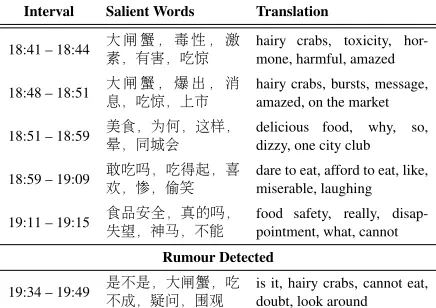
To provide a qualitative analysis for our ap-proach, we showcase an example of a rumour event from WEIBO in Table 5. We present a set of salient words (second column) and their trans-lations (third column) extracted from posts pub-lished during a particular period (first column) us-ing simple tf-idf features.
The rumour was started by a message claim-ing that hairy crabs contain harmful hormones and toxins on August 18th, 2012. After the message was posted, within 12 hours 2.3M users partici-pated in its propagation, either by re-posting, com-menting, or questioning the original source mes-sage. The rumour spread quickly and led to sig-nificant economic damage to the aquaculture in-dustry in China. Officially the rumour was rebut-ted after 24 hours, but in Table5we see that ERD detects the rumour in 34 minutes.
5 Conclusions
We present ERD, an early rumour detection sys-tem. Rather than setting a static checkpoint that determines when an event should be classified as rumour, ERD learns dynamically the minimum number of posts required to identify a rumour. To this end, we integrate reinforcement learning with recurrent neural networks to monitor social media posts in real time to decide when to classify ru-mours. We evaluate our model on two standard data sets, and demonstrate that ERD identifies ru-mours within 7.5 hours and 3.4 hours on WEIBO and TWITTER on average, compared to 12 hours of a competitive system. In terms of detection ac-curacy, ERD achieves a performance of 93.3% and 85.8%, which is comparable to state-of-the-art ru-mour detection systems.
Acknowledgements
This work is partially funded by the National Natural Science Foundation of China (61502115, U1636103, U1536207). We would also like to thank Wei Gao and Jing Li for their valuable sug-gestions.
References
Gordon W Allport and Leo Postman. 1947. The psy-chology of rumor.
Steven Bird, Ewan Klein, and Edward Loper. 2009.
[image:8.595.72.290.284.438.2]An-alyzing Text with the Natural Language Toolkit. O’Reilly Media, Sebastopol, USA.
Kyunghyun Cho, Bart Van Merri¨enboer, Dzmitry Bah-danau, and Yoshua Bengio. 2014. On the properties of neural machine translation: Encoder-decoder
ap-proaches. arXiv preprint arXiv:1409.1259.
Ronan Collobert, Jason Weston, L´eon Bottou, Michael Karlen, Koray Kavukcuoglu, and Pavel Kuksa. 2011. Natural language processing (almost) from scratch. 12:2493–2537.
Sebastian Dungs, Ahmet Aker, Norbert Fuhr, and Kalina Bontcheva. 2018. Can rumour stance alone
predict veracity? InProceedings of the 27th
Inter-national Conference on Computational Linguistics, pages 3360–3370.
Mehrdad Farajtabar, Jiachen Yang, Xiaojing Ye, Huan Xu, Rakshit Trivedi, Elias Khalil, Shuang Li, Le Song, and Hongyuan Zha. 2017. Fake news
mit-igation via point process based intervention. In
In-ternational Conference on Machine Learning, pages 1097–1106.
Adrien Friggeri, Lada A Adamic, Dean Eckles, and
Justin Cheng. 2014. Rumor cascades. InICWSM.
Ian Goodfellow, Jean Pouget-Abadie, Mehdi Mirza, Bing Xu, David Warde-Farley, Sherjil Ozair, Aaron Courville, and Yoshua Bengio. 2014. Generative
ad-versarial nets. In Advances in neural information
processing systems, pages 2672–2680.
Yoon Kim. 2014. Convolutional neural networks for
sentence classification. InProceedings of the 2014
Conference on Empirical Methods in Natural Lan-guage Processing (EMNLP). Association for Com-putational Linguistics.
Diederik P. Kingma and Jimmy Ba. 2014. Adam:
A method for stochastic optimization. CoRR,
abs/1412.6980.
Sejeong Kwon, Meeyoung Cha, and Kyomin Jung. 2017. Rumor detection over varying time windows.
PloS one, 12(1):e0168344.
Jey Han Lau, Timothy Baldwin, and Trevor Cohn. 2017. Topically driven neural language model. In
Proceedings of the 55th Annual Meeting of the As-sociation for Computational Linguistics (Volume 1: Long Papers), pages 355–365.
Gang Liang, Wenbo He, Chun Xu, Liangyin Chen, and Jinquan Zeng. 2015. Rumor identification in microblogging systems based on users’ behavior.
IEEE Transactions on Computational Social
Sys-tems, 2(3):99–108.
Yunfei Long, Qin Lu, Rong Xiang, Minglei Li, and Chu-Ren Huang. 2017. Fake news detection
through multi-perspective speaker profiles. In
Pro-ceedings of the Eighth International Joint Confer-ence on Natural Language Processing (Volume 2: Short Papers), volume 2, pages 252–256.
Jing Ma, Wei Gao, Prasenjit Mitra, Sejeong Kwon, Bernard J Jansen, Kam-Fai Wong, and Meeyoung Cha. 2016. Detecting rumors from microblogs with
recurrent neural networks. InIJCAI, pages 3818–
3824.
Jing Ma, Wei Gao, Zhongyu Wei, Yueming Lu, and Kam-Fai Wong. 2015. Detect rumors using time se-ries of social context information on microblogging
websites. In Proceedings of the 24th ACM
Inter-national on Conference on Information and Knowl-edge Management, pages 1751–1754. ACM.
Jing Ma, Wei Gao, and Kam-Fai Wong. 2017. De-tect rumors in microblog posts using propagation
structure via kernel learning. InProceedings of the
55th Annual Meeting of the Association for Compu-tational Linguistics (Volume 1: Long Papers), vol-ume 1, pages 708–717.
Tomas Mikolov, Ilya Sutskever, Kai Chen, Greg S Cor-rado, and Jeff Dean. 2013. Distributed representa-tions of words and phrases and their
compositional-ity. InAdvances in neural information processing
systems, pages 3111–3119.
Volodymyr Mnih, Koray Kavukcuoglu, David Sil-ver, Alex Graves, Ioannis Antonoglou, Daan Wier-stra, and Martin Riedmiller. 2013. Playing atari
with deep reinforcement learning. arXiv preprint
arXiv:1312.5602.
Jeffrey Pennington, Richard Socher, and Christo-pher D. Manning. 2014. Glove: Global vectors for
word representation. InEmpirical Methods in
Nat-ural Language Processing (EMNLP), pages 1532– 1543.
Warren A Peterson and Noel P Gist. 1951. Rumor
and public opinion.American Journal of Sociology,
57:159–167.
Vahed Qazvinian, Emily Rosengren, Dragomir R Radev, and Qiaozhu Mei. 2011. Rumor has it:
Iden-tifying misinformation in microblogs. In
Proceed-ings of the Conference on Empirical Methods in Nat-ural Language Processing, pages 1589–1599. Asso-ciation for Computational Linguistics.
Natali Ruchansky, Sungyong Seo, and Yan Liu. 2017. Csi: A hybrid deep model for fake news detection. In Proceedings of the 2017 ACM on Conference on Information and Knowledge Management, pages 797–806. ACM.
Justin Sampson, Fred Morstatter, Liang Wu, and Huan Liu. 2016. Leveraging the implicit structure within
social media for emergent rumor detection. In
Pro-ceedings of the 25th ACM International on Confer-ence on Information and Knowledge Management, pages 2377–2382. ACM.
Richard S Sutton, Andrew G Barto, Francis Bach, et al.
1998. Reinforcement learning: An introduction.
Tetsuro Takahashi and Nobuyuki Igata. 2012. Rumor
detection on twitter. InSoft Computing and
Intelli-gent Systems (SCIS) and 13th International Sympo-sium on Advanced Intelligent Systems (ISIS), 2012 Joint 6th International Conference on, pages 452– 457. IEEE.
Ke Wu, Song Yang, and Kenny Q Zhu. 2015. False ru-mors detection on sina weibo by propagation
struc-tures. InData Engineering (ICDE), 2015 IEEE 31st
International Conference on, pages 651–662. IEEE.
Fan Yang, Yang Liu, Xiaohui Yu, and Min Yang. 2012.
Automatic detection of rumor on sina weibo. In
Pro-ceedings of the ACM SIGKDD Workshop on Mining Data Semantics, page 13. ACM.
Zhifan Yang, Chao Wang, Fan Zhang, Ying Zhang, and Haiwei Zhang. 2015. Emerging rumor iden-tification for social media with hot topic detection. InWeb Information System and Application Confer-ence (WISA), 2015 12th, pages 53–58. IEEE.
Qiao Zhang, Shuiyuan Zhang, Jian Dong, Jinhua Xiong, and Xueqi Cheng. 2015. Automatic
detec-tion of rumor on social network. In Natural
Lan-guage Processing and Chinese Computing, pages 113–122. Springer.
Zhe Zhao, Paul Resnick, and Qiaozhu Mei. 2015. En-quiring minds: Early detection of rumors in social
media from enquiry posts. In Proceedings of the
24th International Conference on World Wide Web, pages 1395–1405. International World Wide Web Conferences Steering Committee.
Arkaitz Zubiaga, Ahmet Aker, Kalina Bontcheva, Maria Liakata, and Rob Procter. 2018. Detection and resolution of rumours in social media: A survey.
ACM Computing Surveys (CSUR), 51(2):32.
Arkaitz Zubiaga, Maria Liakata, and Rob Procter. 2016. Learning reporting dynamics during breaking
news for rumour detection in social media. arXiv