
R u l e - b a s e d A c q u i s i t i o n a n d M a i n t e n a n c e o f
L e x i c a l a n d S e m a n t i c K n o w l e d g e *
D o n n a M . G a t e s a n d P e t e r S h e l l I n t e r n e t : d m g @ c m u . e d u , p s h e l l @ c m u . e d u
C e n t e r for M a c h i n e T r a n s l a t i o n C a r n e g i e M e l l o n U n i v e r s i t y
5000 F o r b e s A v e n u e P i t t s b u r g h , PA 15213
U.S.A.
Abstract
The lexicons for Knowledge-Based Machine Translation systems require knowledge in- tensive morphological, syntactic and se- mantic information. This information is of- ten used in different ways and usually for- matted for a specific NLP system. This tends to make both the acquisition and maintenance of lexical databases cumber- some, inefficient and error-prone. In order to solve these problems, we have developed a program called COOL which automates the acquisition and maintenance processes and allows us to standardize and central- ize the databases. This system is currently being used in the ESTRATO machine trans- lation project at the Center for Machine Translation.
1 Introduction
In this paper, we describe a fully-implemented rule- based system for the semi-automatic acquisition and maintenance of lexical and semantic knowledge in a knowledge-based machine translation system. This rule-based system is called COOL: Creator Of ontologies and Lexicons. COOL can create and up- date various lexical and semantic knowledge sources for different NLP modules.
COOL is a working system that was developed for ESTRATO (EScuela de TRAductores de TOledo), a joint project of the Center for Machine Translation at CMU and Union Electrica Fenosa, an electric util- ity company in Madrid, Spain. E S T R A T O is a system *This project was funded by Union Electrica Fenosa, Madrid, Spain.
for translating Spanish to English in a restricted do- main with controlled input. E S T R A T O consists of sev- eral modules from the K A N T MT system [Mitamura et al., 1991] as well as morphological analysis and phrasal recognition modules and the TWS authoring environment[Nirenburg et ai., 1992].
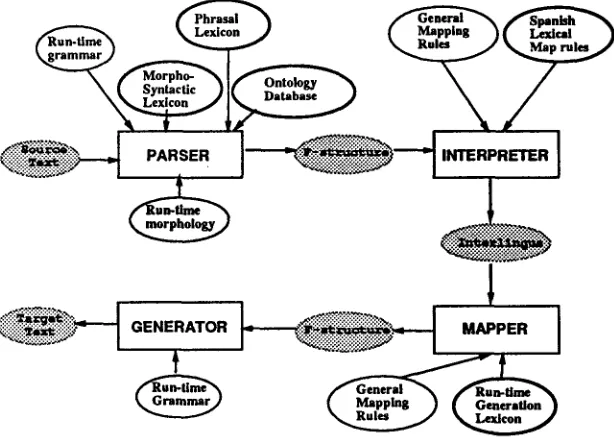
As shown in figure 1, every ESTRATO run-time module uses a different lexical or semantic knowledge source, which differs in content as well as format. The knowledge contained in these modules overlaps. We needed to coordinate and maintain these know- ledge sources in a robust and efficient way. Further- more, the lexical information needed by the trans- lator is initially acquired by people ("editors") who are neither linguists nor domain experts. This lex- ical information is kept in lexical feature files. 1 We needed a way to convert these lexical feature files into forms which could be used by the run-time modules of ESTRATO.
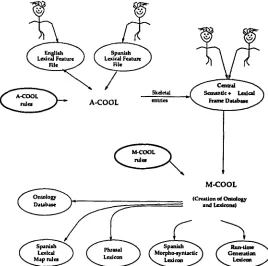
Our solution is to maintain a centralized lexical and semantic frame database, and to use COOL to help us acquire this database by converting the ini~ tial feature files created by the human editors. The lexical and semantic knowledge sources needed by the run-time translator are then automatically gener- ated and maintained by COOL. Two subsystems per- form these tasks: ACQUISITION-COOL (A-COOL) and M A I N T E N A N C E - C O O L (M-COOL). A-COOL produces the central lexical and template semantic databases from the initial lexical feature files, which the linguist and domain expert can then modify. M - C O O L goes beyond simple acquisition of lexical information. It automatically generates efficient run-time versions of the lexical and semantic knowledge from the central repository of lexical and semantic databases initially
~ J PARSER " ~ ... INTERPR~" iER
: !:::::::::.'.'+:.?~'- .:..:::!:
,~:~::i:i~:!:!:i~-"-I GENERATOR
Figure 1: Knowledge-based translator and run-time knowledge. Thick ovals represent knowledge generated by COOL.
created by A-COOL and maintained by experts. The relationship between A-COOL, M-COOL and the three different types of information is depicted in figure 2. COOL maintains consistency in the knowledge sources and makes it easy to add lexical databases for new modules. By keeping a single source for all lexical information for a given language, COOL allows us to robustly maintain knowledge and eliminate re- dundancy, by using the power of a frame-based rule language.
First we describe the acquisition and maintenance problems in more detail, and then describe the A- COOL and M-COOL tools which we developed to solve these problems. We also look at related efforts, and mention some ideas for future work.
2
T h e Knowledge Acquisition and
Maintenance P r o b l e m s
At the Center for Machine Translation, we use Lex- ical Functional Grammar (LFG) [Kaplan Bresnan, 1982] as a basis for our syntactic grammars as well as our linking rules [Levin, 1987] for mapping syn- tactic functions to and from semantic roles. The lat- ter we refer to as "mapping rules". These mapping rules are used in conjunction with a domain model to build or generate from the interlingua text rep- resentations (ILT). The use of ILT is characteristic of the CMT approach to Knowledge-Based Machine Translation [Goodman, 1991; Mitamura e~ al., 1991; Frederking et al., 1992].
Given the emphasis placed on the lexicon in LFG in both syntax and semantics and the extensive do- main knowledge required for our translation system, we place a great deal of importance on the lexicon and finding easy methods to acquire, maintain, view, store and reuse the lexical information. COOL is a tool we are developing and using on the ESTRATO
project for accomplishing these tasks.
The knowledge acquisition and maintenance tasks can be rather cumbersome. Acquiring 1000's of new semantic concepts and placing them into the top- level semantic hierarchy by hand is tedious and error- prone. This also applies to adding English and Span- ish words. Once the run-time knowledge sources for the various NLP modules have been acquired, main- taining consistency among the lexical and semantic files (phrasal-noun list, glossary, morpho-syntactic lexicons, word-to-concept mappings and the seman- tic concepts) is difficult. The NLP modules require different lexical and semantic knowledge with vary- ing formats. All modules share some information which must be kept consistent, such as the part of speech and the word-sense. The concept name must be the same for the run-time semantic know- ledge source, the Spanish run-time lexical knowledge source, and the English run-time lexical knowledge source. Both acquiring the knowledge and maintain- ing consistency in the knowledge are prone to human error.
One of the requirements of ESTRATO is that a non- linguist lexicographer be able to acquire and main- tain lexical information as much as possible. A-COOL allows the semi-automatic creation of NLP lexical knowledge from lexicographic information supplied by a non-linguist.
[image:2.596.154.461.45.264.2]Skeletal A-COOL en~es
M-COOL
Figure 2: Relationship between A-COOL, M-COOL and lexical and semantic information.
the lexicon relevant to lexical selection[Mel'~uk et al., 1984].
3
Automated Knowledge Acquisition
A-COOL automates the acquisition of lexical and se- mantic knowledge in ESTR.ATO. For each entry in a Spanish lexical feature file, A-COOL creates: a new semantic concept frame for the central seman- tic database, a Spanish lexical frame for the Spanish central lexical database and a skeletal entry for the English lexical feature file. Once the entry from the English lexical feature file has been filled out by the editor, A-COOL will also create a lexical frame for the English central lexical database. The word-to- concept mappings for the Spanish and English words are automatically created by A-COOL in order to en- sure consistency. A-COOL accomplishes all of this by means of easily modified if-then rules.
When A-COOL creates a new concept, it automat- ically makes a link to a more general semantic class. The top-level hierarchy we are currently using was created at Carnegie Mellon University [Carlson and Nirenburg, 1990]. The insertion of semantic concepts into a hierarchy is not dependent on the specific top- level. The rules specify the linking of the new con- cepts in the semantic hierarchy based on features (such as ACTION for verbs and ANIMACY for nouns) in the lexical feature files. These rules can be modified easily for adding concepts to a different top-level.
W h a t follows is a description of the A-COOL pro- cess using the entry for the Spanish verb "funcionar" ("to work"). The verb feature ACTION in the lexical acquisition phase is designed such that the user is
(" FUSCIONAR"
(cat v) ( t r a n s i n t r a n s ) ( a c t i o n physical) (eng "function")
(stem-change no) (comp-type O)
.°°)
("WORK"
(cat v) (action physical) (span "funcionar")
(comp-type 0) ( t r a n s i n t r a n s ) . . . )
Figure 3: Sample input verbs to A-COOL
prompted for a response to a question about the type of action the verb represents (if any at all). With this information, A-COOL can produce the prelimi- nary value of IS-A for a semantic frame when it cre- ates the semantic frame from the verb entry.
The "if" or "LHS" (left-hand-side) part of the A-COOL rules specifies properties of lexical features which must be true for the rule to apply. If the rule does apply, the "then" or "RHS" (right-hand-side) specifies which slots of the central database frame to create.
For example, figure 3 shows entries for the Spanish verb "funcionar" and its corresponding English verb "work" from the lexical feature files.
[image:3.596.136.404.49.315.2] [image:3.596.316.477.362.489.2](SPANISH-RULE rulel LHS (trans i n t r a n s )
( r e f l e x i v e tmknown) RHS
( c l a s s a g e n t )
(is-a +w-spanish-intrans-verb) (trans intrans))
Figure 4: A-COOL rule to convert Spanish words
(ENGLI SH-RD~E rule2 LHS (trans Imknown)
(cat v) l~S
( c l a s s agent-theme) (traits t r a n s ) )
Figure 5: A-COOL rule to convert English words
reflexive value is unknown (see figure 4). It also in- serts the word into the lexical hierarchy under +W- SPANISH-INTRANS-VEItB and copies the TITANS infor- mation to the new frame.
Similarly, r u l e 2 (see figure 5) helps to convert "work" by guessing at the value of the TITANS slot and setting the CLASS to AGENT-THEME.
Finally, r u l e 3 (see figure 6) helps to generate the template semantic frame corresponding to the mean- ing of "funcionar" and "work" by placing the frame under PHYSICAL-EVENT in the semantic IS-A hierar- chy.
A-COOL works by using the following algorithm: 1. Read in the (Spanish or English) lexical feature
file.
2. For each lexical item, generate a frame by ap- plying all relevant rules to that lexical item. 3. Write t h a t frame to the central frame file.
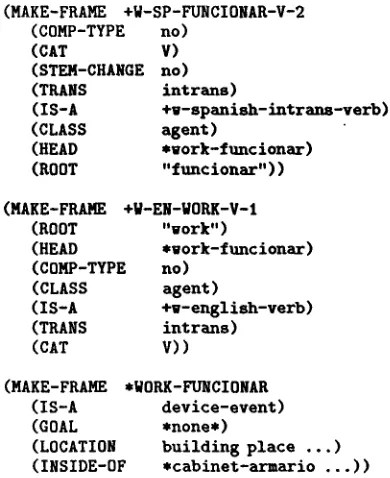
With "funcionar" and "work" as the input lexical items, the rules generate the central frames shown in figure 7.
4
A u t o m a t e d Knowledge
M a i n t e n a n c e
4.1 I n t r o d u c t i o n
M-COOL allows the linguist to keep just one source for Spanish lexical information and one source for English lexical information (the central lexical frame
(SEMANTIC-RULE r u l e 3 LHS ( a c t i o n p h y s i c a l ) RHS ( i s - a p h y s i c a l - e v e n t ) )
Figure 6: A - C O O L rule to place a semantic frame in the
IS-A hierarchy
(MAKE-FRAME +W-SP-FUNCIONAR-V-2 (COMP-TYPE no)
(CAT v)
(STEM-CHANGE no)
(TRANS intrans)
(IS-A +u-spanish-intrans-verb)
(CLASS agent)
(HEAD *work-funcionar) (ROOT "funcionar"))
(MAKE-FRA~ +W-EN-WORK-V-1 (ROOT "work")
(HEAD *work-funcionar)
(COMP-TYPE no)
(CLASS agent)
(IS-A +w-english-verb)
(TRANS intrans)
(CAT V))
(MAKE-FRAME *WORK-FUNCIONAR (IS-A device-event)
(GOAL *none*)
(LOCATION building place ...) (INSIDE-OF *cabinet-armario ...))
Figure 7: Lexical and Semantic frame entries generated by A-COOL and used as input to M-COOL.
databases). Thus, the lexical information is not spread out over several files and can be modified eas- ily. Each language's lexicon can also be organized hierarchically.
Using a set of if-then rules, M-COOL automatically produces the necessary run-time lexical and seman- tic knowledge sources for the various NLP modules. These rules specify which features are needed for the different modules. The rules also create some lexical knowledge t h a t can be extracted from the lexical and semantic hierarchies. This information need not be specified in the lexical entries.2
Since the various run-time lexical and semantic knowledge sources now come from common central databases, consistency is maintained and h u m a n er- ror is minimized. Both the semantic knowledge and the lexical knowledge are stored in a standard frame- based format. This allows the linguist and domain- expert to view or modify the knowledge with a frame- based editor.
The rest of this section describes the M-COOL pro- gram, the lexical and semantic frames used by M- COOL, and then gives an annoted example to illus- trate how M-COOL works.
4.2 P r o g r a m D e s c r i p t i o n
In order to make the knowledge maintenance cycle fazter, M-COOL can also work incrementally as well as in batch mode. If the linguist only modifies or
[image:4.596.309.504.81.320.2]adds a small number of lexical or semantic items, the incremental version of M-COOL will only update the run-time knowledge sources which are affected by the changes, instead of re-generating all of the run-time knowledge sources. This saves considerable time over the non-incremental method.
M-COOL works by first determining which run-time knowledge sources need to be updated. For each such knowledge source, it then applies all rules which are relevant to that knowledge source. Each rule is as- sociated with a specific knowledge source.
To extend M-COOL to generate the run-time know- ledge source for a new NLP module, two steps are taken:
1. Define the properties of the new knowledge source in the file-type table.
2. Write a new set of rules for generating the en- tries which comprise the new knowledge source. These rules specify the lexical features to be used for the entry as well as the format of the entry.
The file-type table simply tells M-COOL whether the given knowledge source is lexical or semantic, and whether it is for generation or analysis. It also supplies miscellaneous information such as the name of the file where the run-time entries are kept and whether it can be compiled using the LISP compile command. For example, our S p a n i s h - l e x i c a l - a n a l y s i s file-type is defined with this entry:
DATABASE Spanish-lexical-analys is "Spanish/Mappings/lex-map. lisp"
:lexical :analysis
The rule language used by M-COOL is called FRULEKIT [Shell and Carbonell, 1986]. FRULEKIT is an efficient CommonLisp pattern matcher with sev- eral extensions over oPs-5. The most relevant exten- sion is that it allows rules to flexibly match against and modify frames in a hierarchy. Having such a frame-based rule language makes it easy for us to write rules to update the ESTRATO runtime know- ledge sources.
4.3 L e x i c a l a n d S e m a n t i c k'Yame D e s c r i p t i o n
Let us briefly discuss the lexical and semantic database files which are the input to M-COOL. The lexical frames are the repository of all lexical know- ledge for the ESTRATO system. These frames contain structural, grammatical and some semantic encod- ing information for words or phrases. They can be easily extended to include other lexical information (e.g., definitions or synonyms) for display to a hu- m a n translator. For the purposes of ESTRATO, each lexical entry contains a part of speech (CAT), a lex- ical mapping rule (HEAD or SEM-MAP), a root form (ROOT) and a link (IS-A) to its location in the lex- ical hierarchy. Nouns (CAT N) contain agreement
(MAKE-FRAME+W-EN-GO-OFF-V-I (ROOT "go")
(HEAD *work-ftmcionar) (PATTERN (agent
(is-a *alarm-alarma))) (SEM-DOMAIN "mech/tech")
(COMP-TYPE no) (CLASS agent)
(IS-A +w-english-verb) (TRANS intrans)
(IRREGULARS (past "went") (pastpart "gone")) (PARTICLE off)
(CAT V))
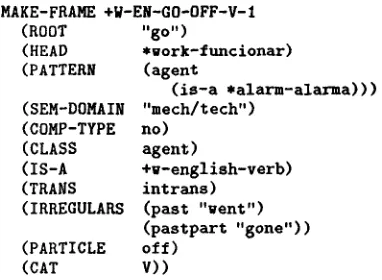
Figure 8: Alternative English lexical entry for *WORK-
F U N C I O N A R
(GENDER and NUMBER) count/mass (COUNT) and a trinary distinction of ANIMACY (human, animal, non-living). Morphological information for Span- ish is represented in the feature STEM-CHANGE and for both Spanish and English in the features ALLO- FLAG and IRREGULARS. Verbs and adjectives contain features for subcategorization (TRANS, COMP-TYPE) and features for syntactic-semantic argument link- ing (CLASS, MAPPINGS). CLASS here refers to the type of linking rules a verb or adjective [Levin and Rappaport, 1987] will use for its syntactic arguments (SUBJ, OBJ, OBJ2, XCOMP, and COMP [Kaplan Bres- nan, 1982l). Semantic knowledge about the world is stored in a domain model organized in an is-a hierarchy using frames that correspond to the var- ious events (PHYSICAL-EVENT *ASSEMBLE-MONTAR) and objects (PHYSICAL-OBJECT *TRANSFORMER- TRANSFORMADOR), relations (AGENT, THEME) 3 be- tween these objects and events and properties (COLOR, SHAPE) in the specific domain[Carlson and Nirenburg, 1990]. The name of each lexical frame represents a single word sense [Meyer et al., 1992]. Examples of lexical frames are shown in figure 7.
Each frame specifies a link to a parent in the lexi- cal hierarchy or the domain model hierarchy (IS-A). This allows lexical entries to be arranged into classes which require similar "mapping rules" [Mitamura, 1989].
Each semantic knowledge database frame in the domain model also specifies the roles which a given concept may have as well as specific restrictions on the fillers of those roles. An example of a semantic frame was shown in figure 7. The information in the databases is used in different forms and combinations depending on the NLP component's needs.
Figure 8 shows a frame which is an alterna- tive English lexical entry for the concept *WORK- FUNCIONAR.
[image:5.596.309.500.81.221.2](MRULE lex-analysis-Spanish-verb :LHS
(=!+w-sp-Spanish-verb
:head =head :root =root :class =class :sem-map =sem) (current-file:value Spanish-lexical-analysis) :RHS
(cool-output
'(:root (gen-frame-name =verb) : c a t V
: h e a d =head :class =class : s e m =sem)))
Figure 9: M-COOL rule ]or generating run-time lexical mapping data.
(:ROOT "+W-SP-FUNCIONAR-V-2" :CAT V
:HEAD *WORK-FUNCIONAR :CLASS AGENT)
Figure 10: Lexical-map entry generated by M-COOL.
The value of the PATTERN slot in this frame (AGENT (IS-A *ALARM-ALAR.MA)) is used so that when the AGENT role is filled with an "alarm", the English word selected for generation is "go off" rather than "work".
4.4 E x a m p l e
Now we will illustrate how M-COOL rules auto- matically generate various types of run-time know- ledge from the frames shown in figure 7. Figure 9 shows a rule for generating lexical mapping informa- tion. This rule applies to the lexical frame Tw-sP- FUNCIONAR-V-2 in order to generate the run-time lexical analysis mapping data depicted in figure 10.
Next we have a rule for generating the run-time Ontology database, which we call "framettes" (fig- ure 11). This rule applies to the semantic frame *WORK-FUNCIONAR (shown in figure 7) to generate the framette as shown in figure 12.
The two previous rules were fairly simple, but M- COOL can perform much more complex computa- tions. For example, in order to generate efficient run- time knowledge which allows the translator to map from interlingua into English feature-structures, M- COOL must find, for each semantic frame, every En- glish lexical frame which corresponds to it. It then combines this correspondence information into a sin- gle LISP function which will efficiently perform the mapping at run-time. One of the M-COOL rules re- sponsible for constructing this knowledge is shown in figure 13. In this example, it applies to the se- mantic frame *WORK-FUNCIONAR.. It finds two lex-
(MRULE e v e n t s - o n t o - r u l e :LHS
( = ! e v e n t (LABEL = e v e n t ) )
( c u r r e n t - f i l e :value e v e n t - f r a m e t t e s ) :RHS
( c o o l - o u t p u t
' ( , ( c o o l - f r a m e - n a m e =event) ( i s - a ( c l a s s - o f = e v e n t ) ) , ( g e n - f r a m e t t e - s l o t s = e v e n t ) ) ) )
Figure 11: M-COOL rule ]or generating r u n . t i m e event ]ramette data.
(*WORK-FUNCIONAR (IS-A DEVICE-EVENT)
(INSIDE-OF * C A B I N E T - A I ~ I O ...) (LOCATION BUILDING PLACE ...) (GOAL *NONE*))
Figure 12: Event.framette generated by M-COOL.
ical frames which correspond to each other: +W- SP-FUNCIONAR-V-2 AND q-W-EN-WORK-V-1 (see fig- ure 7). The LISP function generated by this rule is shown in figure 14.
5
R e l a t e d W o r k
Most of the effort in developing software tools for NLP has focused on user interfaces and acquisition of lexical databases from text corpora, but there are
very few rule-based systems for knowledge mainte- nance. [Pin-Ngern et al., 1989] go beyond corpus analysis by augmenting the lexicM databases with knowledge supplied by human editors. The Word Manager [Domenig, 1988] is a system for both acqui- sition and maintenance of morphological knowledge, but its main strength is its user-interface. LUKE [Knight, 1991] is an interactive system which uses several heuristics exploiting the relationship between linguistic and world knowledge to partially automate the acquisition process.
More effort has gone into the acquisition and main- tenance of knowledge for expert-systems. 4 The fo- cus of such efforts is to acquire smaller amounts of problem-solving knowledge, which is more complex than the semantic and lexicM knowledge used in ES- TRATO.
6
F u t u r e W o r k
We intend to extend COOL in three directions: by supporting the acquisition and maintenance of lexi- cal and semantic information for new languages, by adding rules for completely automating the acquis- tion of semantic classes and lexical argument alter- nations [Bresnan, 1982; Perlmutter, 1983], and by
[image:6.596.66.251.83.240.2] [image:6.596.309.497.83.175.2](MRULE gen-lex-code-English-verb :LHS
(need-lex-info (LABEL =need-info) :lex-entry =word
(CHECK (isa-p (pa-class-of =word) '+w-EN-English-verb))) (have-lex-info (LABEL =have-info)) :RHS
o , o
(push (list passive-complete-pattern pass-syn-entry
map-code-pass)
(have-lex-info-glex-entries =have-info))
(push (list complete-pattern syn-entry map-code) (have-lex-info-glex-entries
=have-info)))
Figure 13: M - C O O L rule for generating a run-time En-
glish generation mapping function.
(DEFUN ENG-LUTHOR-*WORK-FUNCIONAR (ILT) (COND
((IS-A-P-SLOT 'AGENT '*ALARM-ALARMA) (LIST '(SYN ((CAT V) (PARTICLE OFF)
... (TRANS INTRANS) (IRREGULARS
((PAST "went") (PASTPART "gone"))) (ROOT GO)))
*ENGLISH-AGENT-VERB-MAPPINGS*)) (T (LIST
' ( S Y N ( ( C A T V) . . . (TRANS INTRANS) (ROOT WORK)))
*ENGLISH-AGENT-VERB-MAPPINGS,))))
Figure 14: Part of an english lexical mapping function generated by M-COOL.
improving the functionality of the underlying system itself. Because it is easy to extend M-COOL to gen- erate run-time knowledge sources for new modules, we plan to add, for example: English-analysis lexical tables, Spanish-generation lexical tables, and lexical tables for an external machine-translation system.
We also have plans for integrating the various acquisition and maintenance tools we use in the ESTRATO system (which include A-COOL and M- COOL) into a single incremental lexical acquisition and maintenance program with a user-friendly in- terface for both experts and non-experts. T h e in- terface will p r o m p t the non-expert for information about a word without the user needing to know lin- guistics. For example, determining the countablilty of a noun can be done by prompting the user with examples of the word being used in a countable con- text and non-countable context. This will allow non-experts to add most of the lexical and seman- tic knowledge. Currently the process of adding or modifying database entries and running A-COOL and M-COOL requires the user to understand both the in- ternM representation of the lexical items and how to run the various programs. An interactive know- ledge editor which hides all of the details from the user will make the user's work much more productive and simple.
7 C o n c l u s i o n s
Our idea of developing a program to help automate the task of lexical and semantic knowledge acquisi- tion and maintenance has been very fruitful for us. We have realized the following benefits:
• A-COOL and M - C O O L make knowledge acquisi- tion and maintenance easier, faster and more robust. By automatically generating template lexical and semantic database entries from the lexical feature files, A-COOL accelerates the ac- quisition process and eliminates many sources of human error. Similarly, M - C O O L eliminates the need to manually update a large number of run- time knowledge sources each time a new lexical entry is added. By using a powerful and efficient frame-matching rule-based system to automat- ically generate the correct run-time knowledge sources, knowledge-maintenance is faster.
• M-COOL allows us to integrate generation and
analysis lexical knowledge. Because M-COOL can generate both analysis and generation lex- ical knowledge sources from the same central database, this makes it very easy to create Span- ish generation and English analysis knowledge sources. This solves the problem of having to maintain separate versions of knowledge for the analysis and generation of the same language. • It is easy to extend M-COOL to new modules.
variety of additional knowledge sources (for ex-
ample, a custom glossary and a phrasal-lexicon
file). M-COOL'S design makes this easy.
Given the complexity and size of our machine-
translation system, COOL has become an indispensi-
ble part of our knowledge acquisition environment.
A c k n o w l e d g e m e n t s
We would like to thank the members of the
ESTR.ATOproject for their help and support: Mildred Galarza,
Jose Garcia, Jose Goyeneche, Michael Mauldin and
Teresa Rubio. We would also like to thank Lori Levin
and Barbara Moore for their comments and sugges-
tions.
R e f e r e n c e s
[Mitamura et
al.,
1991] Teruko Mitamura, Eric It.
Nyberg, and Jaime G. Carbonell. An Efficient
Interlingua Translation System for Multi-lingual
Document Production. In
Proceedings of the Ma-
chine Translation Summit III,
Washington D.C.,
1991.
[Nirenburg et
al.,
1992] S. Nirenburg, P. Shell, A.
Cohen, P. Cousseau, D. Grannes, C. McNeilly.
Multi-purpose development and operation envi-
ronments for natural-language applications. In 3rd
Conference on Applied Natural Language Process-
ing,
Trento, Italy, 1992.
[Frederking
et at.,
1992] R. Frederking, A. Cohen,
D. Grannes, P. Cousseau, S. Nirenburg. The Pan-
gloss Mark I MAT System. In
Proceedings of the
European Association for Computational Linguis-
tics Conference, Utrecht, The Netherlands, 1993.
[Carlson and Nirenburg, 1990] Lynn Carlson and
Sergei Nirenburg, World Modeling for NLP. Cen-
ter for Machine Translation Technical Report 121,
Pittsburgh, PA, 1990.
[Bateman
et al.,
1990] John A. Bateman, Robert T.
Kasper, Johanna D. Moore and Richard Whitney,
A General Organization of Knowledge for Natural
Language Processing: the Penman Upper Model.
March 1990
[Meyer
et al.,
1992] Ingrtid
Meyer,
Boyan
Onyshkevych, and Lynn Carlson. Lexicographic
Principles and Design for Knowledge-Based Ma-
chine Translation. Center for Machine Translation
Technical Report 118, Pittsburgh, PA, 1990.
[Pin-Ngern et
al.,
1989]
Pin-Ngern, Strutz and Evens. Lexical Acquisition
for Lexical Databases. In
Proceedings of Comput-
ing in the 90's Conference,
Kalamazoo, MI, USA,
1989.
[Domenig, 1988] M. Domenig. Word Manager: a
System for the Definition, Access and Mainte-
nance of Lexical Databases. In
Proceedings of
COLING Budapest Conference on Computational
Linguistics,
Budapest, 1988.
[Knight, 1991] Kevin Knight.
Integrating knowledge
acquisition and language acquisition.
PhD Thesis,
Carnegie Mellon University School of Computer
Science, Pittsburgh, PA, 1991.
[Mitamura, 1989] Teruko Mitamura.
The Hierar-
chical Organization of Predicate Frames for In-
terpretive Mapping in Natural Language Process-
ing.
PhD Thesis, University of Pittsburgh, De-
partment of Linguistics, Pittsburgh, PA, 1989.
[Levin, 1987] Lori S. Levin.
Toward a Linking The-
ory of Relation Changing Rules in LFG.
CSLI
Report No. CSLI-87-115, Center for the Study of
Language and Information, Stanford, CA, 1987.
[Guerssel
et al.,
1985] Mohamed Guerssel, Kenneth
Hale, Mary Laughren, Beth Levin, and Josie
White Eagle, A Cross-Linguistic Study of Tran-
sitivity Alternations. Presented at the parasession
on Causatives and Agentivity at the 21st Regional
Meeting of the Chicago Linguistic Society, April
1985.
[Levin and Rappaport, 1987] Beth Levin and Malka
Rappaport, The Formation of Adjectival Passives.
em Linguistic Inquiry Vol.17, No. 4,623-661, MIT
Press, Cambridge, MA, 1986.
[Michalski, 1989] R. S. Miehalski, J. G. Carbonell
and T. M. Mitchell, editors.
Machine Learning,
An Artificial Intelligence Approach,
Vol. 4. Tioga
Press, Palo Alto, CA, 1989.
[Goodman, 1991] Kenneth Goodman and Sergei
Nirenburg, editors.
The KBMT Project: A Case
Study in Knowledge-Based Machine Translation,
Morgan Kaufmann Publishers, San Marco, CA,
1991.
[Jackendoff, 1983] Ray Jackendoff.
Semantics and
Cognition,
MIT Press, Cambridge, MA, 1983.
[Perlmutter, 1983] David Perlmutter, editor.
Stud-
ies in Relation Grammar I,
The University of
Chicago Press, Chicago, IL, 1983.
[Bresnan, 1982] Joan Bresnan, Polyadieity, Joan
Bresnan, editior.
The Mental Representation of
Grammatical Relations,
MIT Press, Cambirdge,
MA, 149-172 1982.
[Kaplan Bresnan, 1982] Ronald Kaplan and Joan
Bresnan, Lexical Functional Grammar: A Formal
System for Grammatical Representation, Joan
Bresnan, editior
The Mental Representation of
Grammatical Relations,
MIT Press, Cambirdge,
MA: 173-281, 1982.
[Talmy, 1985] Leonard Talmy, Lexicalization Pat-
terns: Semantic Structure in Lexical Forms, Timo-
thy Shopen, editior.
Language Typology and Syn-
tactic Description,
Vol. 3 Cambridge University
[Talmy, 1972] Leonard Talmy. Semantic Structures in English and Atsugewi. PhD Thesis, University of California, Berkely, CA, 1972.
[Light, 1992] Marc Light. A Computational Theory of Lexical Relatedness. University of Rochester, Computer Science Department, Technical Report 421, Rochester, New York, 1992.
[Mel'~uk et al., 1984] Igor MelYuk, Na- dia Arbatchewsky-Jumarie, Leo Elnitsky, Lidija Iordanskaja, and Addle Lessard . Diclionnaire
![Figure 11: M-COOL rule ]or generating run.time event ]ramette data.](https://thumb-us.123doks.com/thumbv2/123dok_us/1330660.664040/6.596.66.251.83.240/figure-cool-rule-generating-time-event-ramette-data.webp)
