Proceedings of the 2019 Conference on Empirical Methods in Natural Language Processing 974
Don’t Forget the Long Tail! A Comprehensive Analysis of Morphological
Generalization in Bilingual Lexicon Induction
Paula Czarnowska1 Sebastian Ruder2∗ Edouard Grave3 Ryan Cotterell1 Ann Copestake1
1University of Cambridge 2National University of Ireland 3Facebook AI Research
[email protected] [email protected] [email protected]
[email protected] [email protected]
Abstract
Human translators routinely have to translate rare inflections of words—due to the Zipfian distribution of words in a language. When translating from Spanish, a good translator would have no problem identifying the proper translation of a statistically rare inflection such ashablar´amos. Note the lexeme itself,hablar, is relatively common. In this work, we investi-gate whether state-of-the-art bilingual lexicon inducers are capable of learning this kind of generalization. We introduce 40 morpholog-ically completedictionaries in 10 languages1
and evaluate three of the state-of-the-art mod-els on the task of translation of less frequent morphological forms. We demonstrate that the performance of state-of-the-art models drops considerably when evaluated on infrequent morphological inflections and then show that adding a simple morphological constraint at training time improves the performance, proving that the bilingual lexicon inducers can benefit from better encoding of morphology.
1 Introduction
Human translators exhibit remarkable general-ization capabilities and are able to translate even rare inflections they may have never seen before. Indeed, this skill is necessary for translation since language follows a Zipfian distribution (Zipf, 1949): a large number of the tokens in a translated text will come from rare types, including rare inflections of common lexemes. For instance, a Spanish translator will most certainly know the verbhablar“to speak”, but they will only have seen the less frequent, first-person plural future form hablar´amosa few times. Nevertheless, they would have no problem translating the latter. In this paper we ask whether current methods for bilingual lexi-con induction (BLI) generalize morphologically as
1
The dictionaries are available at https://github. com/pczarnowska/morph_dictionaries.
?Sebastian is now affiliated with DeepMind.
–10k
10–50k 50–100k100–200k200–300k300–400k400–500k500–600k Remaining
OO Vs 1163
970
2506
-1512
-1470
-745
-494
-416
-338
-1126
-4917
-Dictionary Ours MUSE
In vocab
+OO Vs
0.0 0.1 0.2 0.3 0.4 0.5 0.6 0.7 0.8 0.9
Accuracy
9770 970
21087 970
[image:1.595.296.529.207.424.2]French–Spanish
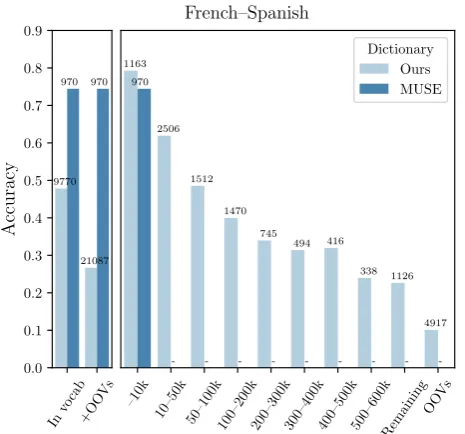
Figure 1: The relation between the BLI performance and the frequency of source words in the test dictio-nary. The graph presents results for the model ofRuder et al.(2018) evaluated on both the MUSE dictionary (Conneau et al.,2018) and our morphologically com-plete dictionary, which contains many rare morpholog-ical variants of words. The numbers above the bars cor-respond to the number of translated source words (a hyphen represents an empty dictionary).
humans do. Generalization to rare and novel words is arguably the main point of BLI as a task—most frequent translation pairs are already contained in digital dictionaries. Modern word embeddings en-code character-level knowledge (Bojanowski et al., 2017), which should—in principle—enable the models to learn this behaviour; but morphological generalization has never been directly tested.
dictionar-ies for 5 Slavic and 5 Romance languages, which contain the inflectional paradigm of every word they hold. Much like with a human translator, we expect a BLI model to competently translate full paradigms of lexical items. Throughout this work we place our focus on genetically-related language pairs. This not only allows us to cleanly map one morphological inflection onto another, but also pro-vides an upper bound for the performance on the generalization task; if the models are not able to generalize for closely related languages they would most certainly be unable to generalize when trans-lating between unrelated languages.
We use our dictionaries to train and evaluate three of the best performing BLI models (Artetxe et al., 2016, 2017;Ruder et al., 2018) on all 40 language pairs. To paint a complete picture of the models’ generalization ability we propose a new experimental paradigm in which we independently control for four different variables: the word form’s frequency, morphology, the lexeme frequency and the lexeme (a total of 480 experiments). Our com-prehensive analysis reveals that BLI models can generalize for frequent morphosyntactic categories, even of infrequent lexemes, but fail to generalize for the more rare categories. This yields a more nuanced picture of the known deficiency of word embeddings to underperform on infrequent words (Gong et al.,2018). Our findings also contradict the strong empirical claims made elsewhere in the literature (Artetxe et al.,2017;Conneau et al., 2018;Ruder et al.,2018;Grave et al.,2018b), as we observe that performance severely degrades when the evaluation includes rare morphological variants of a word and infrequent lexemes. We picture this general trend in Figure1, which also highlights the skew of existing dictionaries towards more frequent words.2 As our final contribution, we demonstrate that better encoding of morphology is indeed beneficial: enforcing a simple morpho-logical constraint yields consistent performance improvements for all Romance language pairs and many of the Slavic language pairs.
2 Morphological Dictionaries
2.1 Existing Dictionaries
Frequent word forms can often be found in human-curated dictionaries. Thus, the practical purpose of training a BLI model should be to create
transla-2For MUSE, we only evaluate on forms that are not present
in our training dictionary (970 out of 1500 source words).
Source Word
Target Word
Source Lemma
Target Lemma Tag
morza moˇre morze moˇre N;NOM;PL
morzu moˇri morze moˇre N;DAT;SG
morze moˇre morze moˇre N;NOM;SG
morzami moˇri morze moˇre N;INS;PL
m´orz moˇr morze moˇre N;GEN;PL
morzu moˇri morze moˇre N;ESS;SG
[image:2.595.308.527.66.168.2]morzom moˇr´ım morze moˇre N;DAT;PL
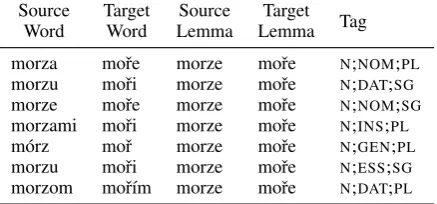
Table 1: An example extract from our morphologically complete Polish–Czech dictionary.
tions of new and less common forms, not present in the existing resources. In spite of this, most ground truth lexica used for BLI evaluation contain mainly frequent word forms. Many available resources are restricted to the top 200k most frequent words; this applies to the English–Italian dictionary ofDinu et al. (2015), the English–German and English– Finnish dictionaries ofArtetxe et al.(2017), and Artetxe et al.(2018a)’s English–Spanish resource. The dictionaries of Irvine and Callison-Burch (2017) contain only the top most frequent 10k words for each language. Zhang et al.(2017) ex-tracted their Spanish–English and Italian–English lexica from Open Multilingual WordNet (Bond and Paik,2012), a resource which only yields high fre-quency, lemma level mappings. Another example is the recent MUSE dataset (Conneau et al.,2018), which was generated using an “internal translation tool”, and in which the majority of word pairs con-sist of forms ranked in the top 10k of the vocabu-laries of their respective languages.
Another problem associated with existing re-sources is ‘semantic leakage’ between train and evaluation sets. As we demonstrate in§2.3, it is common for a single lexeme to appear in both train and test dictionary—in the form of different word inflections. This circumstance is undesirable in evaluation settings as it can lead to performance overstatements—a model can ‘memorize’ the cor-responding target lemma, which ultimately reduces the translation task to a much easier task of find-ing the most appropriate inflection. Finally, most of the available BLI resources include English in each language pair and, given how morphologically impoverished English is, those resources are unsuit-able for analysis of morphological generalization.
2.2 Our Dictionaries
Slavic Czech Russian Slovak Ukrainian Romance Spanish Catalan Portuguese Italian
Polish 53,353 128,638 14,517 12,361 French 686,139 381,825 486,575 705,800
Czech - 65,123 10,817 8,194 Spanish - 343,780 476,543 619,174
Russian - 128,638 10,554 Catalan - 261,016 351,609
Slovak - 3,434 Portuguese - 468,945
Table 2: The sizes of our morphologically complete dictionaries for Slavic and Romance language families. We present the sizes for 20 base dictionaries. We further split those to obtain 40 train, development and test dictionaries—one for each mapping direction to ensure the correct source language lemma separation.
dictionaries, which contain most of the inflectional paradigm of every word they contain. This enables a more thorough evaluation and makes the task much more challenging than traditional evaluation sets. In contrast to the existing resources our dictio-naries consist of many rare forms, some of which are out-of-vocabulary for large-scale word embed-dings such as FASTTEXT. Notably, this makes them the only resource of this kind that enables evaluatingopen-vocabularyBLI.
We focus on pairs of genetically-related lan-guages for which we can cleanly map one mor-phological inflection onto another.3 We selected 5 languages from the Slavic family: Polish, Czech, Russian, Slovak and Ukrainian, and 5 Romance lan-guages: French, Spanish, Italian, Portuguese and Catalan. Table1presents an example extract from our resource; every source–target pair is followed by their corresponding lemmata and a shared tag.
We generated our dictionaries automatically based on openly available resources: Open Multi-lingual WordNet (Bond and Paik, 2012) and Ex-tended Open Multilingual WordNet4 (Bond and Foster, 2013), both of which are collections of lexical databases which group words into sets of synonyms (synsets), and UniMorph5(Kirov et al., 2016)—a resource comprised of inflectional word paradigms for 107 languages, extracted from Wik-tionary6and annotated according to the UniMorph schema (Sylak-Glassman, 2016). For each lan-guage pair(L1, L2)we first generated lemma trans-lation pairs by mapping allL1lemmata to allL2 lemmata for each synset that appeared in bothL1
3
One may translatetalked, the past tense oftalk, into many different Spanish forms, but the Portuguesefalavamhas, ar-guably, only one best Spanish translation:hablaban.
4
We used the union of the extended and the original version of the multilingual WordNet since the latter included entries that were not present in the extended version.
5
https://unimorph.github.io/
6Wiktionary (https://en.wiktionary.org/
wiki/Wiktionary:Main_Page) is a large-scale, free content multilingual dictionary.
andL2WordNets.7 We then filtered out the pairs which contained lemmata not present in UniMorph and generated inflected entries from the remain-ing pairs: one entry for each tag that appears in the UniMorph paradigms of both lemmata.8 The sizes of dictionaries vary across different language pairs and so does the POS distribution. In partic-ular, while Slavic dictionaries are dominated by nouns and adjectives, verbs constitute the major-ity of pairs in Romance dictionaries. We report the sizes of the dictionaries in Table2. In order to prevent semantic leakage, discussed in§2.1, for each language pair we split the initial dictionary into train, development and test splits so that each sub-dictionary has its own, independent set of lem-mata. In our split, the train dictionary contains 60% of all lemmata, while the development and test dictionaries each have 20% of the lemmata.
2.3 Comparison with MUSE
In this section we briefly outline important differences between our resource and the MUSE dictionaries (Conneau et al.,2018) for Portuguese, Italian, Spanish, and French (12 dictionaries in total). We focus on MUSE as it is one of the few openly available resources that covers genetically-related language pairs.
Word Frequency The first and most prominent
difference lies in the skew towards frequent word forms in MUSE evaluation. While our test dictio-naries contain a representative sample of forms in
7
Note that with this many-to-many mapping we allow for many translations of a single word.
8
lower frequency bins, the majority of forms present in MUSE are ranked in the top 10k in their re-spective language vocabularies. This is clearly pre-sented in Figure1for the French–Spanish resource and also holds for the remaining 11 dictionaries.
Morphological Diversity Another difference
lies in the morphological diversity of both dictionar-ies. The average proportion of paradigm covered for lemmata present in MUSE test dictionaries is 53% for nouns, 37% for adjectives and only 3% for verbs. We generally observe that for most lemmata the dictionaries containonly oneinflection. In con-trast, for our test dictionaries we get 97% coverage for nouns, 98% for adjectives and 67% for verbs. Note that we do not get 100% coverage as we are limited by the compatibility of source language and target language UniMorph resources.
Train–test Paradigm Leakage Finally, we
care-fully analyze the magnitude of the train–test paradigm leakage. We found that, on average 20% (299 out of 1500) of source words in MUSE test dictionaries share their lemma with a word in the corresponding train dictionary. E.g. the French– Spanish test set includes the formperdent—a third-person plural present indicative ofperdre(to lose) which is present in the train set. Note that the splits we provide for our dictionaries do not suffer from any leakage as we ensure that each dictionary con-tains the full paradigm of every lemma.
3 Bilingual Lexicon Induction
The task of bilingual lexicon induction is well estab-lished in the community (Vuli´c and Moens,2013; Gouws et al., 2015) and is the current standard choice for evaluation of cross-lingual word embed-ding models. Given a list ofN source language word forms x1, . . . , xN, the goal is to determine
the most appropriate translationti, for each query form xi. In the context of cross-lingual embed-dings, this is commonly accomplished by finding a target language word that is most similar toxiin the shared semantic space, where words’ similarity is usually computed using a cosine between their embeddings. The resulting set of(xi, ti)pairs is then compared to the gold standard and evaluated using the precision atk(P@k) metric, wherekis typically set to 1, 5 or 10.9Throughout our
evalua-9Precision atk represents how many times the correct
translation of a source word is returned as one of itsknearest neighbours in the target language.
tion we use P@1, which is equivalent to accuracy. In our work, we focus on the supervised and semi-supervised settings in which the goal is to au-tomatically generate a dictionary given only mono-lingual word embeddings and some initial, seed translations. For our experiments we selected the models ofArtetxe et al.(2016),Artetxe et al.(2017) and Ruder et al. (2018)—three of the best per-forming BLI models, which induce a shared cross-lingual embedding space by learning an orthogo-nal transformation from one monolingual space to another (model descriptions are given in the sup-plementary material).10 In particular, the last two employ a self-learning method in which they alter-nate between a mapping step and a word alignment (dictionary induction) step in an iterative manner. As we observed the same general trends across all models, in the body of the paper we only report the results for the best performing model ofRuder et al.(2018). We present the complete set of results in the supplementary material.
Experimental Setup We trained and evaluated
all models using the WikipediaFASTTEXT embed-dings (Grave et al.,2018a). Following the existing work, for training we only used the most frequent 200k words in both source and target vocabularies. To allow for evaluation on less frequent words, in all our experiments the models search through the whole target embedding matrix at evaluation (not just the top 200k words, as is common in the liter-ature). This makes the task more challenging, but also gives a more accurate picture of performance. To enable evaluation on the unseen word forms we generated a FASTTEXTembedding for every out-of-vocabulary (OOV) inflection of every word in WordNet that also appears in UniMorph. We built those embeddings by summing the vectors of alln-grams that constitute an OOV form.11In the OOV evaluation we append the resulting vectors to the original embedding matrices.
4 Morphological Generalization
We propose a novelquadripartite analysisof the BLI models, in which we independently control for four different variables: (i) word form frequency, (ii) morphology, (iii) lexeme frequency and (iv)
10We also used our dictionaries to train and test the more
re-cent model ofArtetxe et al.(2018b) on a handful of languages and observed the same general trends.
11We did this within the
–10k
10–50k 50–100k100–200k200–300k300–400k400–500k500–600k Remaining
OO Vs 567
158
1023 288
673 172
710 182
346 95
228 76
141 41
8927
266 126
1029 149
Dictionary Polish–Czech Russian–Ukrainian
Invo cab
+OO Vs
0.0 0.1 0.2 0.3 0.4 0.5 0.6 0.7 0.8 0.9
Accuracy
4043 1165
5332 1396
Slavic Bilingual Lexicon Induction
–10k
10–50k 50–100k100–200k200–300k300–400k400–500k500–600k Remaining
OO Vs 1163
1114
2506 1765
1512 865
1470 805
745 435
494 249
416 185
338
-1126
-11024
5171
Dictionary French–Spanish Catalan–Portuguese
Invo cab
+OO Vs
0.0 0.1 0.2 0.3 0.4 0.5 0.6 0.7 0.8 0.9
Accuracy
9770 5418
21087 10759
[image:5.595.70.529.64.284.2]Romance Bilingual Lexicon Induction
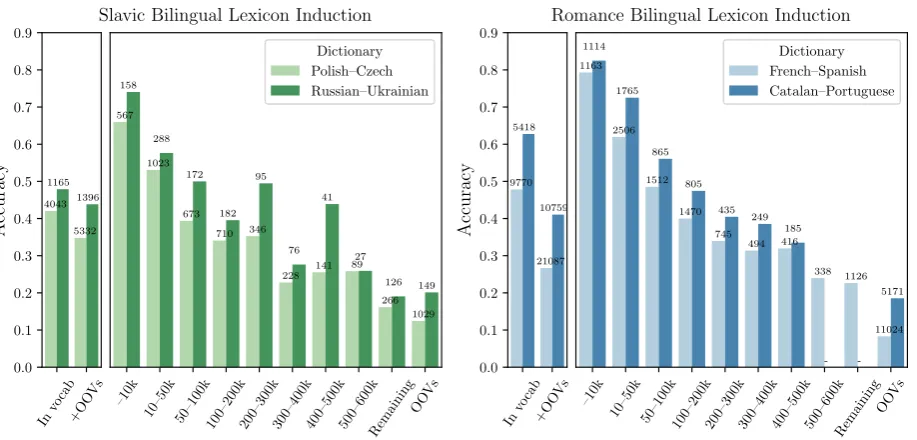
Figure 2: The relation between performance and the frequency of source words in the test dictionary for four example language pairs on the standard BLI task. The numbers above the bars correspond to the dictionary sizes.
lexeme. We provide detailed descriptions for each of those conditions in the following sections. For each condition, we analyzed all 40 language pairs for each of our selected models—a total of 480 experiments. In the body of the paper we only presenta small representative subsetof our results.
4.1 Controlling for Word Frequency
For highly inflectional languages, many of the in-frequent types are rare forms of otherwise common lexemes and, given the morphological regularity of less frequent forms, a model that generalizes well should be able to translate those capably. Thus, to gain insight into the models’ generalization ability we first examine the relation between their perfor-mance and the frequency of words in the test set.
We split each test dictionary into 9 frequency bins, based on the relative frequencies of words in the original training corpus for the word embed-dings (Wikipedia in the case ofFASTTEXT). More specifically, a pair appears in a frequency bin if its source word belongs to that bin, according to its rank in the respective vocabulary. We also consid-ered unseen words that appear in the test portion of our dictionaries, but do not occur in the training cor-pus for the embeddings. This is a fair experimental setting since most of those OOV words are asso-ciated with known lemmata. Note that it bears a resemblance to the classic Wug Test (Berko,1958) in which a child is introduced to a single instance of a fictitious object—‘a wug’—and is asked to
name two instances of the same object—‘wugs’. However, in contrast to the original setup, we are interested in making sure the unseen inflection of a known lexeme is properly translated.
Figure2presents the results on the BLI task for four example language pairs: two from the Slavic and two from the Romance language family. The left-hand side of the plots shows the performance for the full dictionaries (with and without OOVs), while the right-hand side demonstrates how the performance changes as the words in the evalua-tion set become less frequent. The general trend we observe across all language pairs is an acute drop in accuracy for infrequent word forms—e.g. for Catalan–Portuguese the performance falls from 83% for pairs containing only the top 10k most fre-quent words to 40% for pairs, which contain source words ranked between 200k and 300k.
4.2 Controlling for Morphology
dis-Tag Accuracy Distribution Across Frequency Bins
In vocab All 10k 50k 100k 200k 300k 400k 500k 600k Tail OOVs
French–Spanish
N;SG 56.7 55.1 45% 33% 10% 6% 1% 1% 0% 0% 1% 2%
N;PL 53.6 49.9 31% 29% 14% 9% 4% 3% 2% 1% 3% 4%
ADJ;MASC;SG 62.7 60.9 29% 40% 16% 7% 3% 1% 1% 0% 1% 2%
NFIN;V 50.6 49.0 35% 37% 13% 7% 2% 1% 1% 1% 2% 2%
2;IMP;PL;POS;V 1.5 2.0 3% 4% 16% 14% 12% 4% 5% 3% 12% 25%
3;FUT;PL;V 34.7 23.3 0% 4% 8% 14% 9% 8% 8% 5% 16% 27%
3;COND;SG;V 41.0 30.6 0% 5% 14% 14% 9% 9% 3% 6% 15% 23%
Polish–Czech
INS;N;PL 29.5 23.8 1% 17% 16% 21% 10% 7% 7% 2% 9% 10%
DAT;N;SG 26.1 18.7 13% 15% 10% 12% 7% 4% 3% 3% 8% 24%
ACC;ADJ;MASC;SG 47.8 47.8 10% 28% 27% 16% 11% 4% 1% 1% 1% 0%
ACC;ADJ;FEM;SG 47.0 46.4 4% 29% 27% 25% 6% 4% 3% 1% 0% 0%
NFIN;V 47.4 45.0 13% 42% 18% 15% 4% 4% 0% 0% 0% 5%
3;MASC;PL;PST;V 59.4 51.4 2% 23% 16% 21% 9% 12% 5% 5% 0% 7%
[image:6.595.74.526.63.273.2]2;IMP;PL;V 11.1 8.1 0% 0% 0% 14% 0% 7% 14% 7% 3% 55%
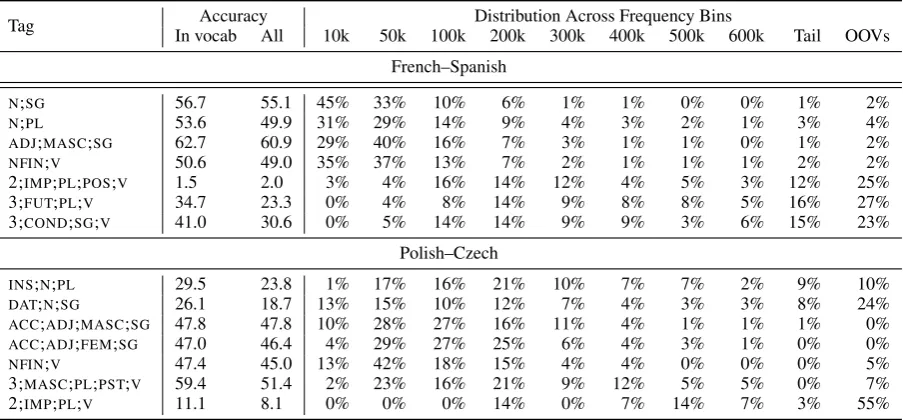
Table 3: BLI results for word pairs that have a specific morphosyntactic category (left) and a distribution of those forms across different frequency bins (right).
tribution of these categories across the frequency bins.
In Table3we present our findings for a represen-tative sample of morphosyntactic categories for one Slavic and one Romance language pair (we present the results for all models and all language pairs in the supplementary material).12 It illustrates the great variability across different paradigm slots— both in terms of their frequency and the difficulty of their translation.
As expected, the performance is best for the slots belonging to the highest frequency bins and forms residing in the rarer slots prove to be more challenging. For example, for French–Spanish the performance on 2;IMP;PL;POS;V, 3;FUT;PL;Vand 3;COND;SG;V13is notably lower than that for the remaining categories. For both language pairs, the accuracy for the second-person plural present im-perative (2;IMP;PL;V) is particularly low: 1.5% accuracy for French–Spanish and 11.1% for Polish– Czech in the in-vocabulary setting. Note that it is unsurprising for an imperative form, express-ing an order or command, to be infrequent in the Wikipedia corpora (the resource our monolingual embeddings were trained on). The complex distri-bution of the French 2;IMP;PL;POS;Vacross the
12We selected the morphosyntactic categories
indepen-dently for each language family based on how well the models translate words of such morphology–‘the good, the bad and the ugly’.
132nd person imperative plural form of a verb, 3rd person
future plural form of a verb and 2nd person conditional singu-lar form of a verb.
frequency bins is likely due to syncretism—the 2;IMP;PL;POS;Vparadigm slot shares a form with 2nd person present plural slot, 2;PL;PRS;V. Our hypothesis is that syncretism may have an effect on the quality of the monolingual embeddings. To our knowledge, the effect of syncretism on embeddings has not yet been systematically investigated.
4.3 Controlling for Lexeme Frequency
To get an even more complete picture, we inspect how the performance on translating inflections of common lemmatadiffers to translating forms com-ing from less frequent paradigmsby controlling for the frequency of the lexeme. We separated our dictionaries into two bins based on the rela-tive frequency of the source lexeme. We approxi-mated frequency of the lexemes by using ranks of their most common inflections: our first bin con-tained lexemes whose most common inflection is ranked in the top 20k forms in its respective vocab-ulary, while the second bin consisted of lexemes with most common inflection ranked lower than 60k.14 We present the results for the same mor-phosyntactic categories as in§4.2on the left side of the graphs in Figure3. As anticipated, in the case of less frequent lexemes the performance is generally worse than for frequent ones. However, perhaps more surprisingly, we discover that some morphosyntactic categories prove to be problem-atic even for the most frequent lexemes. Some
14Future work could operate on actual word counts rather
Most frequent Rare
DAT;N;SG INS;N;PL ACC;ADJ;MASC;SG
ACC;ADJ;FEM;SG 2;IMP;PL;V NFIN;V
3;MASC;PL;PST;V ALL
Most frequent Rare
0.0 0.2 0.4 0.6 0.8 1.0
Accuracy
243
(33)
237
(23)
36
(0)
36
(0)
21
(15)
22
(0)
21
(0)
2969
(359)
106
(81)
99
(59)
13
(0)
13
(3)
8
(7)9 (2)
8
(4)
1253
(626) Polish–Czech
0k–8k 15k–
N;PL N;SG 3;FUT;PL;V
3;COND;SG;V 2;IMP;PL;POS;V NFIN;V
ADJ;MASC;SG ALL
0k–8k 15k–
0.0 0.2 0.4 0.6 0.8 1.0
Accuracy
953
(10)
989
(1)
196
(64)
197
(46)
195
(93)
197
(1)
241
(0)
8901
(3804)
565
(218)
627
(66)
115
(114)
113
(110)
114
(112)
113
(16)
167
(16)
5478
[image:7.595.67.523.67.288.2](3757) French–Spanish
Figure 3: The performance on the standard BLI task (left side of the graphs) and the controlled for lexeme BLI (right side) for words pairs belonging to the most frequent paradigms and the infrequent paradigms. The numbers above the bars are dictionary sizes and the number of out-of-vocabulary forms in each dictionary (bracketed).
examples include the previously mentioned imper-ative verb form or, for Slavic languages, singular dative nouns (DAT;N;SG).
4.4 Controlling for Lexeme
We are, in principle, interested in the ability of the models to generalizemorphologically. In the pre-ceding sections we focused on the standard BLI evaluation, which given our objective is somewhat unfair to the models—they are additionally pun-ished for not capturing lexical semantics. To gain more direct insight into the models’ generalization abilities we develop a novel experiment in which the lexeme is controlled for. At test time, the BLI model is given a set of candidate translations, all of which belong to the same paradigm, and is asked to select the most suitable form. Note that the model only requires morphological knowledge to success-fully complete the task—no lexical semantics is required. When mapping between closely related languages this task is particularly straightforward, and especially so in the case ofFASTTEXTwhere a singlen-gram, e.g. the suffix-ingin English as in the nounrunning, can be highly indicative of the inflectional morphology of the word.
We present results on 8 representative language pairs in Table4(column Lexeme). We report the accuracy on the in-vocabulary pairs as well as all the pairs in the dictionary, including OOVs. As ex-pected, compared to standard BLI this task is much
easier for the models—the performance is generally high. For Slavic languages numbers remain high even in the open-vocabulary setup, which suggests that the models can generalize morphologically. On the other hand, for Romance languages we observe a visible drop in performance. We hypothesize that this difference is due to the large quantities of verbs in Romance dictionaries; in both Slavic and Ro-mance languages verbs have substantial paradigms, often of more than 60 forms, which makes identi-fying the correct form more difficult. In contrast, most words in our Slavic dictionaries are nouns and adjectives with much smaller paradigms.
Following our analysis in§4.3, we also exam-ine how the performance on this new task differs for less and more frequent paradigms, as well as across different morphosyntactic categories. Here, we exhibit an unexpected result, which we present in the two right-hand side graphs of Figure3: the state-of-the-art BLI modelsdogeneralize morpho-logically for frequent slots, butdo notgeneralize for infrequent slots. For instance, for the Polish– Czech pair, the models achieve 100% accuracy on identifying the correct inflection when this in-flection isACC;ADJ;MASC;SG,ACC;ADJ;FEM;SG, 3;MASC;PL;PST;V orNFIN;V15 for frequent and, for the first two categories, also theinfrequent
lex-15Masculine accusative singular form of an adjective,
Normal Lexeme Dictionary Sizes
In vocab +OOVs In vocab +OOVs
In vocab +OOVs
Constraint 7 3 7 3 7 3 7 3
[image:8.595.100.504.64.223.2]Ukrainian–Russian 68.4 61.1 63.7 56.1 89.9 89.1 88.6 87.6 786 933 Russian–Slovak 25.7 21.1 20.9 17.0 79.3 76.8 76.0 74.2 1610 2150 Polish–Czech 42.0 44.4 34.8 36.7 80.6 81.1 75.3 75.9 4043 5332 Russian–Polish 39.8 41.2 34.8 36.1 80.8 82.6 77.7 80.2 9183 11697 Catalan–Portuguese 62.8 64.2 41.1 42.4 83.1 84.3 57.7 59.0 5418 10759 French–Spanish 47.8 50.2 26.7 28.9 78.0 81.4 47.9 52.2 9770 21087 Portuguese–Spanish 60.2 61.1 36.8 37.6 84.7 85.4 57.1 58.2 9275 22638 Italian–Spanish 42.7 43.8 21.1 22.1 76.4 77.6 47.6 49.6 11685 30686 Polish–Spanish 36.1 32.1 28.0 25.0 78.1 77.7 68.6 68.4 8964 12759 Spanish–Polish 28.1 30.9 21.0 23.2 81.2 82.0 64.2 65.8 4270 6095
Table 4: The results on the standard BLI task and BLI controlled for lexeme for the originalRuder et al.(2018)’s model (7) and the same model trained with a morphological constraint (3) (discussed in§4.6).
emes; all of which are common morphosyntactic categories (see Table3). The results from Figure3 also demonstrate that the worst performing forms for the French–Spanish language pair are indeed the infrequent verbal inflections.
4.5 Experiments on an Unrelated Language
Pair
So far, in our evaluation we have focused on pairs of genetically-related languages, which provided an upper bound for morphological generalization in BLI. But our experimental paradigm is not lim-ited to related language pairs. We demonstrate this by experimenting on two example pairs of one Slavic and one Romance language: Polish–Spanish and Spanish–Polish. To construct the dictionar-ies we followed the procedure discussed in§2, but matched the tags based only on the features exhib-ited in both languages (e.g. PolishDAT;N;SGcan be mapped toN;SGin Spanish, as Spanish nouns are not declined for case). Note that mapping between morphosyntactic categories of two unrelated lan-guages is a challenging task (Haspelmath,2010), but we did our best to address the issues specific to translation between Polish and Spanish. E.g. we ensured that Spanish imperfective/perfective verb forms can only be translated to Polish forms of imperfective/perfective verbs.
The results of our experiments are presented in the last two rows of Table4 and, for Polish– Spanish, also in Figure 4. As expected, the BLI results on unrelated languages are generally, but not uniformly, worse than those on related language pairs. The accuracy for Spanish–Polish is particu-larly low, at 28% (for in vocabulary pairs). We see large variation in performance across
morphosyn-Most frequent Rare
DAT;N;SG INS;N;PL 2;IMP;PL;V
3;MASC;PL;PST;V NFIN;V ACC;ADJ;FEM;SG
ACC;ADJ;MASC;SG ALL
Most frequent Rare
0.0 0.2 0.4 0.6 0.8 1.0
Accuracy
385
(45)
366
(31)
29
(24)
37
(0)
29
(0)
84
(1)
84
(0)
5569
(1028)
369
(243)
322
(183)
15
(14)
17
(12)
14
(1)
53
(10)
54
(7)
4481
(2144) Polish–Spanish
Figure 4: The results of the experiments on a pair of unrelated languages—Polish and Spanish—on the stan-dard BLI task (left side) and the controlled for lexeme BLI (right side) for word pairs belonging to the most frequent and the infrequent paradigms.
tactic categories and more and less frequent lex-emes, similar to that observed for related language pairs. In particular, we observe that 2;IMP;PL;V— the category difficult for Polish–Czech BLI is also among the most challenging for Polish–Spanish. However, one of the highest performing categories for Polish–Czech, 3;MASC;PL;PST;V, yields much worse accuracy for Polish–Spanish.
4.6 Adding a Morphological Constraint
[image:8.595.303.528.277.499.2]simple, hard morphological constraintat training timecan lead to performance improvements at test time—both on the standard BLI task and the con-trolled for lexeme BLI. We adapt the self-learning models of Artetxe et al.(2017) and Ruder et al. (2018) so that at each iteration they can align two words only if they share the same morphosyntactic category. Note that this limits the training data only to word forms present in UniMorph, as those are the only ones for which we have a gold tag.16 The results, a subset of which we present in Table4, show that the constraint, despite its simplicity and being trained on less data, leads to performance im-provements foreveryRomance language pair and many of the Slavic language pairs. We take this as evidence that properly modelling morphology will have a role to play in BLI.
5 Discussion and Conclusion
We conducted a large-scale evaluation of the gen-eralization ability of the state-of-the-art bilingual lexicon inducers. To enable our analysis we cre-ated 40 morphologically complete dictionaries for 5 Slavic and 5 Romance languages and proposed a novel experimental paradigm in which we indepen-dently control for four different variables.
Our study is the first to examine morphologi-cal generalization in BLI and it reveals a nuanced picture of the interplay between performance, the word’s frequency and morphology. We observe that the performance degrades when models are evaluated on less common words—even for the in-frequent forms of common lexemes. Our results from the controlled for lexeme experiments suggest that models are able to generalize well for more frequent morphosyntactic categories and for part-of-speech with smaller paradigms. However, their ability to generalize decreases as the slots get less frequent and/or the paradigms get larger. Finally, we proposed a simple method to inject morpho-logical knowledge and demonstrated that making models more morphologically aware can lead to general performance improvements.
References
Mikel Artetxe, Gorka Labaka, and Eneko Agirre. 2016. Learning principled bilingual mappings of word
em-16We also experimented with more relaxed versions of the
constraint, where we only used a subset of the features, but we found that for most languages the constraint worked better with more features.
beddings while preserving monolingual invariance. In Proceedings of the 2016 Conference on Empiri-cal Methods in Natural Language Processing, pages 2289–2294.
Mikel Artetxe, Gorka Labaka, and Eneko Agirre. 2017.
Learning bilingual word embeddings with (almost) no bilingual data. InProceedings of the 55th Annual Meeting of the Association for Computational Lin-guistics (Volume 1: Long Papers), pages 451–462. Association for Computational Linguistics.
Mikel Artetxe, Gorka Labaka, and Eneko Agirre. 2018a. Generalizing and improving bilingual word embedding mappings with a multi-step framework of linear transformations. In Thirty-Second AAAI Conference on Artificial Intelligence.
Mikel Artetxe, Gorka Labaka, and Eneko Agirre. 2018b. A robust self-learning method for fully un-supervised cross-lingual mappings of word embed-dings. InProceedings of the 56th Annual Meeting of the Association for Computational Linguistics (Vol-ume 1: Long Papers), pages 789–798. Association for Computational Linguistics.
Jean Berko. 1958. The child’s learning of English mor-phology.Word, 14(2-3):150–177.
Piotr Bojanowski, Edouard Grave, Armand Joulin, and Tomas Mikolov. 2017. Enriching word vectors with subword information. Transactions of the Associa-tion for ComputaAssocia-tional Linguistics, 5:135–146.
Francis Bond and Ryan Foster. 2013. Linking and ex-tending an open multilingual wordnet. In Proceed-ings of the 51st Annual Meeting of the Association for Computational Linguistics (Volume 1: Long Pa-pers), volume 1, pages 1352–1362.
Francis Bond and Kyonghee Paik. 2012. A survey of wordnets and their licenses. InProceedings of the 6th Global WordNet Conference (GWC 2012), page 6471.
Alexis Conneau, Guillaume Lample, Marc’Aurelio Ranzato, Ludovic Denoyer, and Herv´e J´egou. 2018. Word Translation Without Parallel Data. In Proceed-ings of ICLR 2018.
Georgiana Dinu, Angeliki Lazaridou, and Marco Ba-roni. 2015. Improving zero-shot learning by mitigat-ing the hubness problem. InProceedings of the 3rd International Conference on Learning Representa-tions (ICLR 2015), workshop track, Workshop Track.
Chengyue Gong, Di He, Xu Tan, Tao Qin, Liwei Wang, and Tie-Yan Liu. 2018. FRAGE: Frequency-Agnostic Word Representation. In Proceedings of NIPS 2018.
Edouard Grave, Piotr Bojanowski, Prakhar Gupta, Ar-mand Joulin, and Tomas Mikolov. 2018a. Learn-ing word vectors for 157 languages. In Proceed-ings of the International Conference on Language Resources and Evaluation (LREC 2018).
Edouard Grave, Armand Joulin, and Quentin Berthet. 2018b. Unsupervised alignment of embeddings with wasserstein procrustes. CoRR, abs/1805.11222.
Martin Haspelmath. 2010. Comparative concepts and descriptive categories in crosslinguistic studies.
Language, 86(3):663–687.
Ann Irvine and Chris Callison-Burch. 2017. A com-prehensive analysis of bilingual lexicon induction.
Computational Linguistics, 43(2):273–310.
Roy Jonker and Anton Volgenant. 1987. A shortest augmenting path algorithm for dense and sparse lin-ear assignment problems. Computing, 38(4):325– 340.
Christo Kirov, John Sylak-Glassman, Roger Que, and David Yarowsky. 2016. Very-large scale pars-ing and normalization of wiktionary morphological paradigms. In Proceedings of the Tenth Interna-tional Conference on Language Resources and Eval-uation (LREC 2016), Paris, France. European Lan-guage Resources Association (ELRA).
Sebastian Ruder, Ryan Cotterell, Yova Kementched-jhieva, and Anders Søgaard. 2018. A discrimina-tive latent-variable model for bilingual lexicon in-duction. InProceedings of the 2018 Conference on Empirical Methods in Natural Language Processing, pages 458–468. Association for Computational Lin-guistics.
John Sylak-Glassman. 2016. The composition and use of the universal morphological feature schema (uni-morph schema). Technical report, Technical report, Department of Computer Science, Johns Hopkins University.
Ivan Vuli´c and Marie-Francine Moens. 2013. Cross-Lingual Semantic Similarity of Words as the Similar-ity of Their Semantic Word Responses. In Proceed-ings of the 2013 Conference of the North American Chapter of the Association for Computational Lin-guistics: Human Language Technologies (NAACL-HLT 2013).
Meng Zhang, Yang Liu, Huanbo Luan, and Maosong Sun. 2017. Adversarial training for unsupervised bilingual lexicon induction. In Proceedings of the 55th Annual Meeting of the Association for Compu-tational Linguistics (Volume 1: Long Papers), vol-ume 1, pages 1959–1970.