Proceedings of the 2019 Conference on Empirical Methods in Natural Language Processing
887
Multi-Granularity Self-Attention for Neural Machine Translation
Jie Hao∗
Florida State University [email protected]
Xing Wang
Tencent AI Lab
Shuming Shi
Tencent AI Lab
Jinfeng Zhang
Florida State University [email protected]
Zhaopeng Tu
Tencent AI Lab [email protected]
Abstract
Current state-of-the-art neural machine trans-lation (NMT) uses a deep multi-head self-attention network with no explicit phrase in-formation. However, prior work on statis-tical machine translation has shown that ex-tending the basic translation unit from words to phrases has produced substantial improve-ments, suggesting the possibility of improv-ing NMT performance from explicit model-ing of phrases. In this work, we present multi-granularity self-attention (MG-SA): a neural network that combines multi-head self-attention and phrase modeling. Specifically, we train several attention heads to attend to phrases in either n-gram or syntactic for-malism. Moreover, we exploit interactions among phrases to enhance the strength of structure modeling – a commonly-cited weak-ness of self-attention. Experimental results on WMT14 English-to-German and NIST Chinese-to-English translation tasks show the proposed approach consistently improves per-formance. Targeted linguistic analysis reveals that MG-SAindeed captures useful phrase in-formation at various levels of granularities.
1 Introduction
Recently, TRANSFORMER(Vaswani et al.,2017), implemented as deep multi-head self-attention networks (SANs), has become the state-of-the-art neural machine translation (NMT) model in recent years. The popularity of SANs lies in its high
par-allelization in computation, and flexibility in mod-eling dependencies regardless of distance by ex-plicitly attending to all the signals.
More recently, an in-depth study (Raganato and Tiedemann, 2018) reveals that SANs generally focus on disperse words and ignore continuous phrase patterns, which have proven essential in both statistical machine translation (SMT,Koehn
∗
Work done when interning at Tencent AI Lab.
et al., 2003; Chiang, 2005;Liu et al., 2006) and NMT (Eriguchi et al., 2016; Wang et al., 2017;
Yang et al.,2018;Zhao et al.,2018).
To alleviate this problem, in this work we pro-pose multi-granularity self-attention (MG-SA), which offers SANs the ability to model phrases
and meanwhile maintain their simplicity and flex-ibility. The starting point for our approach is an observation: the power of multiple heads in SANs is not fully exploited. For example,Li et al.(2018) show that different attention heads generally at-tend to the same positions, and Voita et al.(2019) reveal that only specialized attention heads do the heavy lifting while the rest can be pruned. Accord-ingly, we spare several attention heads for model-ing phrase patterns for SANs.
Specifically, we use two representative types of phrases that are widely-used in SMT models: n-gram phrases (Koehn et al., 2003) to use sur-face of adjacent words, andsyntactic phrases(Liu et al., 2006) induced from syntactic trees to rep-resent well-formed structural information. We first partition the input sentence into phrase frag-ments at different levels of granularity. For ex-ample, we can split a sentence into 2-grams or 3-grams. Then, we assign an attention head to at-tend over phrase fragments at each granularity. In this way, MG-SANs provide a lightweight strat-egy to explicitly model phrase structures. Fur-thermore, we also model the interactions among phrases to enhance structure modeling, which is one commonly-cited weakness of SANs (Tran et al.,2018;Hao et al.,2019b).
speeds marginally decrease. Analysis on multi-granularity label prediction tasks reveals that MG -SA indeed captures and stores the information of different granularity phrases as expected.
2 Background
Multi-Head Self-attention Instead of perform-ing a sperform-ingle attention, Multi-Head Self-attention Networks (MH-SA), which are the defaults set-ting in TRANSFORMER (Vaswani et al., 2017), project the queries, keys and values into multiple subspaces and performs attention on the projected queries, keys and values in each subspace. In the standard MH-SA, it jointly attends to information from different representation subspaces at differ-ent positions. Specifically, MH-SA transform
in-put layerH = h1, ..., hn ∈ Rn×dinto h-th
sub-space with different linear projections:
Qh,Kh,Vh =HWQh,HWKh,HWhV, (1)
where {Qh,Kh,Vh} ∈ Rn×dh are respectively
the query, key, and value representations of theh -th head, {WhQ,WhK,WhV ∈ Rd×dh} denote
pa-rameter matrices associated with theh-th head,d
anddh represent the dimensionality of the model
and h-th head subspace. Moreover, N attention functions are applied to generate the output states
{O1, ...,ON}in parallel, among them:
Oh =ATT(Qh,Kh)Vh. (2)
Finally, the output states are concatenated to pro-duce the final state. Here ATT denotes attention
models, which can be implemented as either ad-ditive attention or dot-product attention. In this work, we use dot-product attention which is ef-ficient and effective compared with its additive counterpart (Vaswani et al.,2017):
ATT(Qh,Kh) =sof tmax(Q hKhT
√ dh
), (3)
where√dhis the scaling factor.
Motivation We demonstrate our motivation from two aspects. On the one hand, the conven-tional MH-SA model the individual word depen-dencies, in such scenario the query directly at-tends all words in memory without considering the latent structure of the input sentence. We ar-gue that self-attention can be further improved by taking phrase pattern into account. On the other
hand, recent study (Vaswani et al.,2017) implic-itly hint that attention heads are underutilized as increasing number of heads from 4 to 8 or even 16 can hardly improve the translation performance. Several attention heads can be further exploited under specific guidance to improve the perfor-mance (Strubell et al.,2018). We expect the induc-tive bias for multi-granularity phrase can further improve the performance of SANs and meanwhile maintain its simplicity and flexibility.
3 Multi-Granularity Self-Attention
We first introduce the framework of the proposed MG-SA. Then we describe the approaches of gen-erating multi-granularity representation on a cer-tain granularity representation. Finally, we intro-duce the training objective of our model with aux-iliary supervision.
3.1 Framework
The proposed MG-SA aims at improving the
ca-pability of MH-SA by modeling both word and phrase. We introduce various phrase granularity over the conventional word-level memory to gen-erate phrase level memory.
Specifically, we first transform the input layer Hto a phrase level memory by functionFhin
cer-tain attention head:
Hg = Fh(H), (4)
whereHgis the generated phrase level memory,h
denotes theh-th head which is used to generate a certain granularity of phrase memory, andFh is a
representation function with its own trainable pa-rameters. The details for Fh will be described in
Section 3.2.
Then we perform attention on phrase level memoryHg:
Qh,Kh,Vh = HWQh,HgWhK,HgWhV(5)
Oh = ATT(Qh,Kh)Vh, (6)
whereQh ∈
Rn×dh,Kh ∈ Rp×dh,Vh ∈ Rp×dh,
thepmeans the length of the key and value vectors which is decided by the granularity of phrase.
Based on the single head self-attention, the final output of MG-SAcan be expressed as follows:
MG-SA(H) = [O1, ...,ON], (7)
(a) Syntactic phrase partition
[image:3.595.94.505.61.317.2](b)Multi-Granularity Self-Attentionon syntactic phrase partition
Figure 1: Illustration of the proposed MG-SAmodel for syntactic phrase partition. In this example, we partition the sentence with top two layers in the constituent parse tree and obtain the syntactic phrase partitions (“Bush”, “held a talk with Sharon”), (“Bush”, “held”, “a talk”, “with Sharon”). Under the syntactic partition, multi-head attention in MG-SAattends the phrase memory (headsj andk) as well as the conventional word memory (head
i). The approach of phrase memory representation is described in Section 3.2. Best viewed in colour.
3.2 Multi-Granularity Representation
As seen in Figure1, multi-granularity phrases are simultaneously modeled by different heads. To obtain the multi-granularity phrase representation, we first introduce phrase partition and composi-tion strategies. Then, we describe phrase tag su-pervision and phrase interaction to further enhance the structure modeling on phrase representation.
Phrase Partition Partially inspired by Shen et al. (2018), we split the entire sequence into N-grams without overlaps. Such N-gram phrases are expressed as structurally adjacent and contin-uous items in the sequence. Formally, let x = (x1, ..., xT) be a sequence, the phrases sequence
ofxcan be denoted as isPx= (p1, ..., pM), M = T /n, where pm = (xn×(m−1), ..., xn×m),1 ≤ m ≤ M, and ndenotes the length of the phrase which is a hyper-parameter. Padding is applied to the last phrase if necessary.
In addition, syntactic information has proven helpful in both SMT and NMT. We further intro-duce a syntactic phrase partition to represent well-formed structural information. Syntactic phrases organize words into nested constituents by using
constituent parse tree. To obtain phrases in the view syntax, we break down the nodes at top K layers in the parse tree to capture top K levels of granularity for phrases, as illustrated in Figure 1
(a). Formally, one phrase in a certain layer of the parse tree can be defined as pm = (x1, ..., xl), l
is the length of the phrase which is decided by the parse tree. The phrase sequence of the given input xisPx= (p1, ..., pM),Mis the number of phrase
in the sequence.
Composition Strategies Given phrase sequence
Px = (p1, ..., pM) of input sequence, to
cap-ture local struccap-ture and context dependency inside each phrase and further generate phrase represen-tationQM, we adopt phrase composition function
to each phrase in the phrase sequence:
gm=COM(pm), (8)
where COM is the composition function with shared parameters to all phrases, gm ∈ R1×dh
Net-works (SANs). For CNNs we only apply the Max-pooling layer. For RNNs, we use the last hid-den state of Long Short-term Memory Networks (LSTM) as phrase representation. For SANs, we use max pooling vector of the phrase to serve as the query for extracting inside phrase features to generate phrase representation. Then the phrase level memory of the input sequence can be de-noted asGx= (g1, ..., gM).
Phrase Tag Supervision Recent study shows auxiliary supervision on heads of SANs can
further improve semantic role labeling perfor-mance (Strubell et al., 2018). In this work, we leverage tag information as the auxiliary supervi-sion on syntactic phrase representation. We argue that the proposed framework provide a natural way to incorporate syntactic tag signal of phrase rep-resentation. In detail, given phrase level memory Gx = (g1, ..., gM) after phrase composition, we
predict the phrase tag of each phrase representa-tion. We extract the node of each phrase in the constituent parsing tree to generate the phrase tag sequence Tx = (t1, ..., tM). ti denotes the tag
for each phrase. For example, “NP” is the tag of the phrase “a talk” in second layer of parse tree, as shown in Figure1(a). We use the phrase represen-tation to compute the probability of phrase tags:
pθi =sof tmax(Wtgi+bt), i= 1, ..., M, (9)
whereWt andbtare parameters of tag generator.
Formally, the phrase tag loss can be written as:
Ltag =− M
X
i=1
tilogpθi(ti). (10)
The loss is equivalent to maximizing the condi-tional probability of tag sequenceTxgiven phrase
representationGx.
Phrase Interaction We introduce phrase inter-action approach to better model dependencies be-tween phrase representation. Since recurrence has proven important for capturing structure in-formation (Tran et al., 2018; Hao et al., 2019b), we propose to introduce recurrence to interact phrases and further model latent structure among phrases. Specifically, we apply the recurrence function REC(·) on the output of phrase compo-sition Gx = (g1, ..., gM) in order to model the
latent structure of the phrase sequence.
Hg =REC(Gx), (11)
whereHgis the final phrase level memory for the
input layerH. One general choice for REC(·)is Long Short-term Memory Networks (LSTM). Re-cently,Shen et al.(2018) introduce a new syntax-oriented inductive bias, namely ordered neurons, which enables LSTM models to perform tree-like composition without breaking its sequential form, and propose an advanced LSTMvariant –Ordered NeuronsLSTM (ON-LSTM). Hao et al. (2019a) demonstrate the effectiveness of ON-LSTM on
modeling structure in NMT. Accordingly, we fur-ther use ON-LSTM for REC(·), and expect ON -LSTMcan capture the latent structure under such
syntax-oriented inductive bias between phrases. Finally, the representation functionFh in
Equa-tion4of the framework can be summarized by the following components: 1). Phrase partition. 2). Phrase composition. 3). Phrase interaction.
3.3 Training
The training loss for a single training instance x = (x1, ..., xT),y = (y1, ..., yL)is defined as a
weighted sum of the negative conditional log like-lihood and the phrase tag loss. The total loss func-tion can be written as:
L=− L
X
i=1
yilogPω(yi) +λLtag, (12)
whereλis the coefficient to balance two loss func-tions andLtag follows Equation10. The hyperpa-rameterλis empirically set to 0.001 in this work.
4 Experiments
In this section, we conduct experiments and make analysis to answer the following three questions:
Q1. Does the integration of the proposed MG-SA
into the state-of-the-art TRANSFORMER im-prove the translation quality in terms of the BLEU score?
Q2. Does the proposed MG-SApromote the gen-eration of the target phrases?
Q3. Does MG-SA capture more phrase informa-tion at the various granularity levels?
In Section 4.1, we demonstrate that inte-grating the proposed MG-SA into the TRANS
-FORMER consistently improves the translation
NIST Chinese⇒English (Q1). Further analysis re-veals that our approach has stronger ability of cap-turing the phrase information and promoting the generation of the target phrases (Q2).
In Section 4.2, we conduct experiments on the multi-granularity label prediction tasks (Shi et al.,
2016), and investigate the representations of NMT encoders trained on both translation data and the training data of the label prediction tasks. Experi-mental results show that the proposed MG-SA in-deed captures useful phrase information at various levels of granularities in both scenarios (Q3).
4.1 Machine Translation
Implementation Detail We conduct the ex-periments on the WMT14 English-to-German (En⇒De) and NIST Chinese-to-English (Zh⇒En) translation tasks.
For En⇒De, the training dataset consists of 4.56M sentence pairs. We use the newstest2013 and newstest2014 as development set and test set respectively. For Zh⇒En, the training dataset consists of about 1.25M sentence pairs. We used NIST MT02 dataset as development set, and MT 03-06 datasets as test sets. Byte pair en-coding (BPE) toolkit1 (Sennrich et al., 2016) is used with 32K merge operations. We used case-sensitive NIST BLEU score (Papineni et al.,2002) as the evaluation metric, and bootstrap resam-pling (Koehn et al., 2003) for statistical signifi-cance test. We use the Stanford parser (Klein and Manning,2003) to parse the sentences and obtain the relevant tags.
We test both Base andBigmodels, which dif-fer at hidden size (512 vs. 1024), filter size (2048 vs. 4096) and the number of attention heads (8 vs. 16). All models are trained on eight NVIDIA Tesla P40 GPUs where each is allocated with a batch size of 4096 tokens. We imple-ment the proposed approaches on top of TRANS -FORMER (Vaswani et al., 2017) – a state-of-the-art SANs-based model on machine translation, and followed the setting in previous work (Vaswani et al.,2017) to train the models.
We incorporate the proposed model into the en-coder. In each of our model variant, we main-tain a quarter of heads for vanilla word level self-attention. For N-gram phrase models, we arrange the rest 3 quarters of heads for 2-gram, 3-gram and 4-gram respectively. For syntactic based models,
1https://github.com/rsennrich/subword-nmt
Phrase Modeling # Para. Speed BLEU
n/a 88.0M 1.28 27.31
MAX-POOLING 88.0M 1.27 27.56
SANs 90.4M 1.26 27.69
[image:5.595.307.527.63.132.2]LSTM 96.1M 1.14 27.58
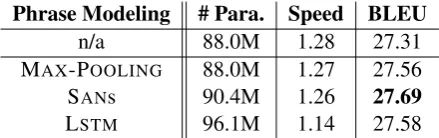
Table 1: Evaluation of various phrase composi-tion strategies under N-gram phrase particomposi-tion. “# Para” denotes the trainable parameter size of each model (M=million), “Speed” denotes the training speed (steps/second).
Encoder Layers # Para. Speed BLEU
[image:5.595.309.523.217.275.2][1−6] 90.4M 1.26 27.69 [1−3] 89.2M 1.27 27.74 [1] 88.4M 1.28 27.83
Table 2: Evaluation of different layers in the encoder, which are implemented as self-attention with SANs phrase composition under N-gram partition. “1” de-notes the bottom layer.
we use the top 3 levels of granularity for phrases generated from constituent parse tree, each gran-ularity of phrase modeled in a quarter of heads. There are many possible ways to implement the general idea of MG-SA. The aim of this paper is not to explore this whole space but simply to show that some fairly straightforward implementations work well.
Table 1, 2 and 3 show the results on WMT14 English⇒German translation task with
TRANSFORMER-BASE. These results show the
evaluation on the impact of different components.
Phrase Composition We investigate the effect of different phrase composition strategies with N-gram phrase partition. As seen in Table1, all pro-posed phrase composition methods consistently outperform TRANSFORMER-BASE baseline, val-idating the importance of introducing multi-granularity phrase in TRANSFORMER. Compared
with other two models, SANs achieve best perfor-mance with its strong representational powers in-side the phrase, while only marginally increase the parameters and decrease the speed. We use SANs phrase composition strategy as the default setting in subsequent experiments.
Encoder Layers Recent works (Shi et al.,2016;
# Model Architecture # Para. Speed BLEU ∆
1 TRANSFORMER-BASE 88.0M 1.28 27.31
-2 + N-gram Phrase 88.4M 1.28 27.83 +0.52 3 + Syntactic Phrase 88.4M 1.24 28.01 +0.70 4 + Syntactic Phrase +Ltag 88.4M 1.23 28.07 +0.76
[image:6.595.136.462.64.171.2]5 + LSTMInteraction 89.5M 1.20 28.14 +0.83 6 + ON-LSTMInteraction 89.9M 1.19 28.28 +0.97
Table 3: Evaluation of phrase partition, tag supervision and interaction strategies.
for modeling phrase structure in each layer. In this experiment, we investigate the question of which layers should be applied with MG-SA. We apply
MG-SA on different combination of layers. As shown in Table2, reducing the applied layers from high-level to low-level consistently increase trans-lation quality in terms of BLEU score as well as the training speed. The results reveal that the bot-tom layer in encoder, which is directly taking word embedding as input, benefits more from modeling phrase structure. This phenomena verifies it is un-necessary to apply the phrase structure modeling to all layers. Accordingly, we only apply MG-SA
in the bottom layer in the following experiments.
Phrase Partition and Tag Supervision As seen in Table3, syntactic phrase partition (Row 3) im-proves the model performance over the N-gram phrase partition (Row 2), showing that the syn-tactic phrase benefits to translation quality. In addition, incorporating tag loss (Row 4) in train-ing stage can further boost the translation perfor-mance. This indicates the auxiliary syntax objec-tive is necessary, which is consistent with the re-sults in other NLP task (Strubell et al.,2018). We use syntactic phrase partition with tag supervision as the default setting for subsequent experiments unless otherwise stated.
Phrase Interaction As observed in Table 3, phrase interaction (Row 5-6) consistently im-proves performance of translation, proving the effectiveness and necessity of enhancing phrase level dependencies on phrase representation. ON
-LSTM based interaction (Row 6) outperforms its LSTMcounterpart (Row 5). We attribute the im-provement of ON-LSTMto the stronger ability to
perform syntax-oriented dependencies on phrase representation. We apply ON-LSTMas the default setting for phrase interaction.
G
ap of BL
E
U
S
core
0.0 0.2 0.4 0.6 0.8 1.0
N-Gram
1 2 3 4 5 6 7 8
Syntactic Phrase+Interaction Syntactic Phrase
N-gram Phrase
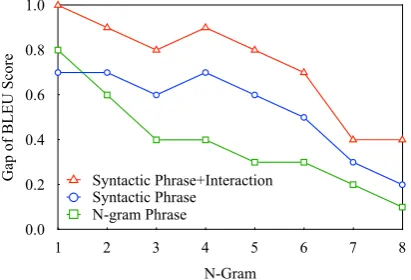
Figure 2: Performance improvement according to N-gram. Y-axis denotes the gap of BLEU score between our models and the baseline.
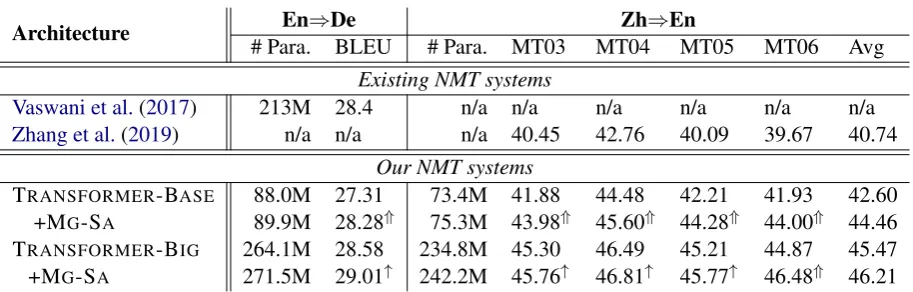
Main Results Table 4 lists the results on WMT14 En⇒De and NIST Zh⇒En translation tasks. Our baseline models, outperform the re-ported results on the same data (Vaswani et al.,
2017;Zhang et al.,2019), which we believe make the evaluation convincing. As seen, in terms of BLEU score, the proposed MG-SA consistently improves translation performance across language pairs, which demonstrates the effectiveness and universality of the proposed approach.
Phrasal Pattern Evaluation As aforemen-tioned, the proposed MG-SA aims to simulta-neously model different granularities of phrases with different heads in SANs. To investigate whether the proposed MG-SA improves the gen-eration of phrases in the output, we calculate the improvement of the proposed models over mul-tiple N-grams, as shown in Figure 2. The re-sults are reported on En⇒De validation set with
TRANSFORMER-BASE.
[image:6.595.314.520.218.358.2]pro-Architecture En⇒De Zh⇒En
# Para. BLEU # Para. MT03 MT04 MT05 MT06 Avg
Existing NMT systems
Vaswani et al.(2017) 213M 28.4 n/a n/a n/a n/a n/a n/a
Zhang et al.(2019) n/a n/a n/a 40.45 42.76 40.09 39.67 40.74
Our NMT systems
TRANSFORMER-BASE 88.0M 27.31 73.4M 41.88 44.48 42.21 41.93 42.60
+MG-SA 89.9M 28.28⇑ 75.3M 43.98⇑ 45.60⇑ 44.28⇑ 44.00⇑ 44.46
TRANSFORMER-BIG 264.1M 28.58 234.8M 45.30 46.49 45.21 44.87 45.47
[image:7.595.72.529.60.206.2]+MG-SA 271.5M 29.01↑ 242.2M 45.76↑ 46.81↑ 45.77↑ 46.48⇑ 46.21
Table 4: Comparing with the existing NMT systems on WMT14 En⇒De and NIST Zh⇒En test sets. “↑ / ⇑”: significant over the conventional self-attention counterpart (p <0.05/0.01), tested by bootstrap resampling. “MG -SA” denotes “Syntactic Phrase +Ltag+ ON-LSTMInteraction” in Table3.
moting the generation of the target phrases. Con-cerning the variations of proposed models, two syntactic phrase models outperforms the N-gram phrase model on larger phrases (i.e. 4-8 grams). We attribute this to the fact that more syntactic in-formation is beneficial for the translation perfor-mance. This is also consistent with the strengths of phrase-based and syntax-based SMT models.
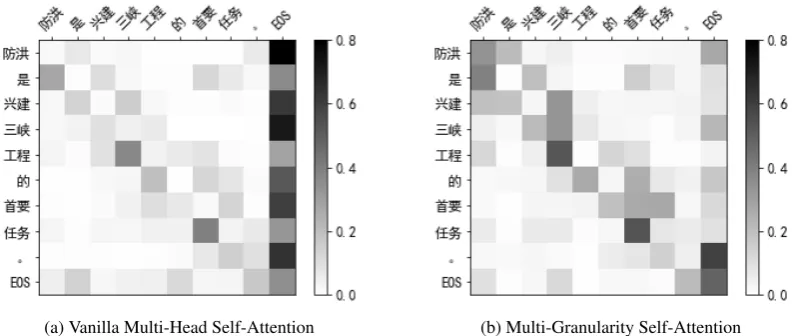
Visualization of Attention In order to evaluate whether the proposed model is able to capture phrase patterns or not, we visualize the attention layers in the encoder2. As shown in Fig. 3, the vanilla model prefers to pay attention to the pre-vious and next word and the end of the sentence, which is consistent with previous findings in Ra-ganato and Tiedemann(2018). The proposed MG -SA successfully focuses on the phrases: 1) “三峡 工程”, the 4th and the 5th rows in Fig. 3(b), its English translation is ‘the Three Gorges Project’; 2) “首要任务”, the 7th and 8th rows in Fig.3(b), its English translation is ‘top priority’. By visu-alizing the attention distributions, we believe the proposed MG-SA can capture phrase patterns to improve the translation performance.
4.2 Multi-Granularity Phrases Evaluation
In this section, we conduct multi-granularity label prediction tasks to the proposed models in terms of whether the proposed model is effective as ex-pected to capture different levels of granularity phrase information of sentences. We analyze the impact of multi-granularity self-attention based on
2Since the attention weights of M
G-SAcannot be visual-ized at word level, we visualize the attention weights in the subsequent layer after MH-SAand MG-SA.
two sets of experiments. The first set of experi-ments are probing the pre-trained NMT encoders, which aims to evaluate the linguistics knowledge embedded in the NMT encoder output in the ma-chine translation section. Furthermore, to test the ability of the MG-SAitself, we conduct the second set of experiments, which are on the same tasks using encoder models trained from scratch.
Tasks Shi et al. (2016) propose 5 tasks to pre-dict various granularity syntactic labels of from sentence to word in order to investigate whether an encoder can learn syntax information. These labels are: “Voice”: active or passive, “Tense”: past or non-past of main-clause verb, “TSS”: top-level syntactic sequence of constituent tree, and two word-level syntactic label tasks, “SPC”: the smallest phrase constituent that above each word, “POS”: Part-of-Speech tags for each words. The tasks for predicting larger labels require mod-els to capture and record larger granularity of phrase information of sentences (Shi et al.,2016). We conduct these tasks to study whether the proposed MG-SA benefits the multi-granularity phrase modeling to produce more useful and in-formative representation.
Data and Models We extracted the sentences from the Toronto Book Corpus (Zhu et al.,
2015).We sample and pre-process 120k sentences for each task followingConneau et al.(2018). By instruction ofShi et al.(2016), we label these sen-tences for each task. The train/valid/test dataset ratios are set to 10/1/1.
For trained NMT encoders, we use the pre-trained encoders of model variations in Table 3
(a) Vanilla Multi-Head Self-Attention (b) Multi-Granularity Self-Attention
Figure 3: Visualization of attention examples of the same input sentence: (a) and (b) are produced by the vanilla multi-head self-attention and the proposed MG-SAmodels, respectively. Each row is the attention distribution
over all the source tokens. The attention layer has 16 attention heads, and the attention weights in each row are the average of all the heads.
# Model Label Granularity: Large→Small
Voice Tense TSS SPC POS Avg Pre-Trained NMT Encoder
1 BASE 73.38 73.73 72.72 92.81 93.73 81.27 2 N-Gram Phrase 73.06 72.83 72.11 96.42 96.34 82.15 3 Syntactic Phrase 73.37 73.62 75.60 96.72 96.68 83.19 4 Syntactic Phrase + Interaction 73.20 74.78 75.24 96.78 96.56 83.31
Train From Scratch
[image:8.595.109.491.314.480.2]5 BASE 83.46 85.39 83.44 96.35 96.12 88.95 6 N-Gram Phrase 83.55 85.62 85.21 96.23 96.17 89.36 7 Syntactic Phrase 84.70 87.52 97.42 96.95 96.24 92.57 8 Syntactic Phrase + Interaction 86.45 87.65 99.07 96.99 96.40 93.31
Table 5: Accuracies on multi-granularity label prediction tasks. “Pre-Trained NMT Encoder” denotes using the pre-trained NMT encoders of model variations in Table3. “Train From Scratch” denotes using three encoder layers with proposed MG-SAvariants, which are trained from scratch. For syntactic phrase based models, we only apply syntactic boundary of phrases and do not use any tag supervision for fair comparison.
carry out probing tasks.
For models trained from scratch, each of our model consists of 3 encoding layers followed by a MLP classifier. For each encoding layer, we employ a multi-head self-attention block and a feed-forward block as in TRANSFORMER, which have shown significant performance on several NLP tasks (Devlin et al., 2019). The difference between the compared models merely lies in the self-attention mechanism: “BASE” denotes stan-dard MH-SA, “N-Gram Phrase” and “Syntactic
Phrase” are the proposed MG-SA under N-gram phrase and syntactic phrase partition, and “Syn-tactic Phrase + Interaction” denotes MG-SA with
phrase interaction by using ON-LSTM. We use same assignments of heads for multi-granularity phrases as machine translation task for all model variants.
prob-ing, the proposed models outperform the base-line model especially on relative small granularity of phrases information, such as ‘SPC’ and ‘POS’ tasks. 4). If trained from scratch, the proposed models achieve more improvements on predict-ing larger granularities of labels, such as ‘TSS’, ‘Tense’ and ‘Voice’ tasks, which require models to record larger phrase of sentences (Shi et al.,2016). The results show that the applicability of the pro-posed MG-SA is not limited to machine
transla-tion, but also on monolingual tasks.
5 Related Works
Phrase Modeling for NMT Several works have proven that the introduction of phrase modeling in NMT can obtain promising improvement on trans-lation quality. Tree-based encoders, which ex-plicitly take the constituent tree (Eriguchi et al.,
2016) or dependency tree (Bastings et al., 2017) into consideration, are proposed to produce tree-based phrase representations. The difference of our work from these studies is that they adopt the RNN-based encoder to form the tree-based encoder while we explicitly introduce the phrase structure into the the state-of-the-art multi-layer multi-head SANs-based encoder, which we believe is more challenging.
Another thread of work is to implicitly pro-mote the generation of phrase-aware representa-tion, such as the integration of external phrase boundary (Wang et al., 2017; Nguyen and Joty,
2018;Li et al.,2019b), prior attention bias (Yang et al.,2018,2019;Guo et al.,2019). Our work dif-fers at that we explicitly model phrase patterns at different granularities, which is then attended by different attention heads.
Multi Granularity Representation Multi-granularity representation, which is proposed to make full use of subunit composition at different levels of granularity, has been explored in various NLP tasks, such as paraphrase identification (Yin and Sch¨utze, 2015), Chinese word embedding learning (Yin et al., 2016), universal sentence encoding (Wu et al., 2018) and machine transla-tion (Nguyen and Joty, 2018; Li et al., 2019b). The major difference between our work and
Nguyen and Joty (2018); Li et al. (2019b) lies in that we successfully introduce syntactic infor-mation into our multi-granularity representation. Furthermore, it is not well measured how much phrase information are stored in multi-granularity
representation. We conduct the multi-granularity label prediction tasks and empirically verify that the phrase information is embedded in the multi-granularity representation.
Multi-Head Attention Multi-head attention mechanism has shown its effectiveness in machine translation (Vaswani et al., 2017) and generative dialog (Tao et al.,2018) systems. Recent studies shows that the modeling ability of multi-head attention has not been completely developed. Several specific guidance cues of different heads without breaking the vanilla multi-head attention mechanism can further boost the performance, e.g., disagreement regularization (Li et al.,2018;
Tao et al., 2018), information aggregation (Li et al., 2019a), and functional specialization (Fan et al., 2019) on attention heads, the combination of multi-head attention with multi-task learn-ing (Strubell et al.,2018). Our work demonstrates that multi-head attention also benefits from the integration of the phrase information.
6 Conclusion
In this paper, we propose multi-granularity self-attention model, a novel self-attention mechanism to simultaneously attend different granularity phrase. We study effective phrase representation for N-gram phrase and syntactic phrase, and find that a syntactic phrase based mechanism obtains the best result due to effectively incorporating rich syntac-tic information. To evaluate the effectiveness of the proposed model, we conduct experiments on widely-used WMT14 En⇒De and NIST Zh⇒En datasets. Experimental results on two language pairs show that the proposed model achieve sig-nificant improvements over the baseline TRANS
-FORMER. Targeted multi-granularity phrases eval-uation shows that our model indeed capture useful phrase information.
As our approach is not limited to specific tasks, it is interesting to validate the proposed model in other tasks, such as reading comprehension, lan-guage inference, and sentence classification.
Acknowledgments
References
Joost Bastings, Ivan Titov, Wilker Aziz, Diego Marcheggiani, and Khalil Simaan. 2017. Graph convolutional encoders for syntax-aware neural ma-chine translation. InEMNLP.
David Chiang. 2005. A hierarchical phrase-based model for statistical machine translation. InACL.
Alexis Conneau, German Kruszewski, Guillaume Lample, Lo¨ıc Barrault, and Marco Baroni. 2018. What you can cram into a single $&!#∗ vector: Probing sentence embeddings for linguistic proper-ties. InACL.
Jacob Devlin, Ming-Wei Chang, Kenton Lee, and Kristina Toutanova. 2019. Bert: Pre-training of deep bidirectional transformers for language understand-ing. InNAACL.
Akiko Eriguchi, Kazuma Hashimoto, and Yoshimasa Tsuruoka. 2016. Tree-to-sequence attentional neu-ral machine translation. InACL.
Angela Fan, Mike Lewis, and Yann Dauphin. 2019. Strategies for structuring story generation. InACL.
Maosheng Guo, Yu Zhang, and Ting Liu. 2019. Gaus-sian transformer: a lightweight approach for natural language inference. InAAAI.
Jie Hao, Xing Wang, Shuming Shi, Jinfeng Zhang, and Zhaopeng Tu. 2019a. Towards better modeling hi-erarchical structure for self-attention with ordered neurons. InEMNLP.
Jie Hao, Xing Wang, Baosong Yang, Longyue Wang, Jinfeng Zhang, and Zhaopeng Tu. 2019b. Modeling recurrence for transformer. InNAACL.
Dan Klein and Christopher D Manning. 2003. Accu-rate unlexicalized parsing. InACL.
Philipp Koehn, Franz Josef Och, and Daniel Marcu. 2003. Statistical phrase-based translation. In NAACL.
Jian Li, Zhaopeng Tu, Baosong Yang, Michael R. Lyu, and Tong Zhang. 2018. Multi-Head Attention with Disagreement Regularization. InEMNLP.
Jian Li, Baosong Yang, Zi-Yi Dou, Xing Wang, Michael R Lyu, and Zhaopeng Tu. 2019a. Infor-mation aggregation for multi-head attention with routing-by-agreement. InNAACL.
Yang Li, Lukasz Kaiser, Samy Bengio, and Si Si. 2019b. Area attention. InICML.
Yang Liu, Qun Liu, and Shouxun Lin. 2006. Tree-to-string alignment template for statistical machine translation. InACL.
Phi Xuan Nguyen and Shafiq Joty. 2018. Phrase-based attentions. arXiv preprint arXiv:1810.03444.
Kishore Papineni, Salim Roukos, Todd Ward, and Wei-Jing Zhu. 2002. Bleu: a method for automatic eval-uation of machine translation. InACL.
Matthew E Peters, Mark Neumann, Mohit Iyyer, Matt Gardner, Christopher Clark, Kenton Lee, and Luke Zettlemoyer. 2018. Deep contextualized word rep-resentations. InNAACL.
Alessandro Raganato and J¨org Tiedemann. 2018. An analysis of encoder representations in transformer-based machine translation. In EMNLP Workshop BlackboxNLP: Analyzing and Interpreting Neural Networks for NLP.
Rico Sennrich, Barry Haddow, and Alexandra Birch. 2016. Neural machine translation of rare words with subword units. InACL.
Tao Shen, Tianyi Zhou, Guodong Long, Jing Jiang, and Chengqi Zhang. 2018. Bi-directional block self-attention for fast and memory-efficient sequence modeling. InICLR.
Xing Shi, Inkit Padhi, and Kevin Knight. 2016. Does string-based neural mt learn source syntax. In EMNLP.
Emma Strubell, Patrick Verga, Daniel Andor, David Weiss, and Andrew McCallum. 2018. Linguistically-Informed Self-Attention for Seman-tic Role Labeling. InEMNLP.
Chongyang Tao, Shen Gao, Mingyue Shang, Wei Wu, Dongyan Zhao, and Rui Yan. 2018. Get the point of my utterance! learning towards effective responses with multi-head attention mechanism. InIJCAI.
Ke Tran, Arianna Bisazza, and Christof Monz. 2018. The importance of being recurrent for modeling hi-erarchical structure. InEMNLP.
Ashish Vaswani, Noam Shazeer, Niki Parmar, Jakob Uszkoreit, Llion Jones, Aidan N Gomez, Łukasz Kaiser, and Illia Polosukhin. 2017. Attention is All You Need. InNIPS.
Elena Voita, David Talbot, Fedor Moiseev, Rico Sen-nrich, and Ivan Titov. 2019. Analyzing multi-head self-attention: Specialized heads do the heavy lift-ing, the rest can be pruned. InACL.
Xing Wang, Zhaopeng Tu, Deyi Xiong, and Min Zhang. 2017. Translating phrases in neural machine translation. InEMNLP.
Wei Wu, Houfeng Wang, Tianyu Liu, and Shuming Ma. 2018. Phrase-level self-attention networks for uni-versal sentence encoding. InEMNLP.
Baosong Yang, Longyue Wang, Derek Wong, Lidia S Chao, and Zhaopeng Tu. 2019. Convolutional self-attention networks. InNAACL.
Rongchao Yin, Quan Wang, Peng Li, Rui Li, and Bin Wang. 2016. Multi-granularity chinese word em-bedding. InEMNLP.
Wenpeng Yin and Hinrich Sch¨utze. 2015. Convolu-tional neural network for paraphrase identification. InNAACL.
Meishan Zhang, Zhenghua Li, Guohong Fu, and Min Zhang. 2019. Syntax-enhanced neural machine translation with syntax-aware word representations. InNAACL.
Yang Zhao, Yining Wang, Jiajun Zhang, and Chengqing Zong. 2018. Phrase table as recommen-dation memory for neural machine translation. In IJCAI.